



Abstract
The epidemiology of human T-lymphotropic virus (HTLV) among sexual minority cisgender women (SMCW) remains poorly understood globally. We conducted a cross-sectional study of 251 SMCW in Belém, Brazilian Amazon, between March 2023 and April 2025. Participants underwent serological screening (ELISA) with molecular confirmation (qPCR). The prevalence of HTLV infection was 0.4% (1/251), with HTLV-2 identified in a 46-year-old asymptomatic bisexual woman with previous male partners and a current female partner. Serological testing showed strong ELISA reactivity (OD ratio 3.8), and qPCR confirmed HTLV-2 with a Ct value of 28.4 for the pol gene, while HTLV-1 remained negative. This represents the first documented HTLV-2 case in SMCW in the Amazon region, demonstrating viral circulation in an understudied population. Despite the low prevalence, comparable to the general population, these findings highlight the need for inclusive epidemiological surveillance and culturally sensitive prevention strategies for LGBTQIA+ communities in endemic regions.
Keywords
Human T-lymphotropic virus (HTLV) represents a significant yet neglected public health concern, with an estimated 5–10 million people infected worldwide. Brazil harbors approximately 800,000 infected individuals, with the highest prevalence in the North and Northeast regions. 1 The Brazilian Amazon exhibits unique epidemiology, with HTLV-2 predominating in Indigenous and riverine communities. 2 Despite increasing awareness of sexually transmitted infections (STIs) among LGBTQIA+ populations, sexual minority cisgender women (SMCW), including women who have sex with women, remain underrepresented in surveillance systems. The hidden and stigmatized nature of this population, combined with the absence of sampling frames, necessitates the use of convenience sampling approaches widely accepted for reaching vulnerable groups in sexual health research. 3
This study aimed to provide the first epidemiological data on HTLV infection among SMCW in the Brazilian Amazon, an endemic region where no previous investigations have targeted this population. This cross-sectional study was conducted between March 2023 and April 2025 in Belém, Pará. Ethical approval was obtained (CAAE: 78856124.4.0000.0018), and all participants provided written informed consent. We recruited 251 SMCW aged ≥18 years through community-based strategies, including social media outreach, LGBTQIA+ organizations, and educational institutions. Given the lack of a comprehensive registry of SMCW and the potential risks of discrimination, we employed non-probabilistic convenience sampling, a methodology recommended by international guidelines for hidden populations where probability sampling is unfeasible. 4 Structured questionnaires collected sociodemographic and behavioral data.
Blood samples (5 mL) were collected in EDTA tubes, and plasma was screened for anti-HTLV-1/2 antibodies using ELISA (Murex HTLV I+II, DiaSorin, Italy). Reactive samples underwent confirmatory qPCR targeting non-homologous pol gene regions (186 bp) of HTLV-1 and HTLV-2, with human albumin as an endogenous control, using the TaqMan® system on a 7,500 Real-Time PCR System (Applied Biosystems). 5 The single positive sample was subjected to duplicate testing to confirm results.
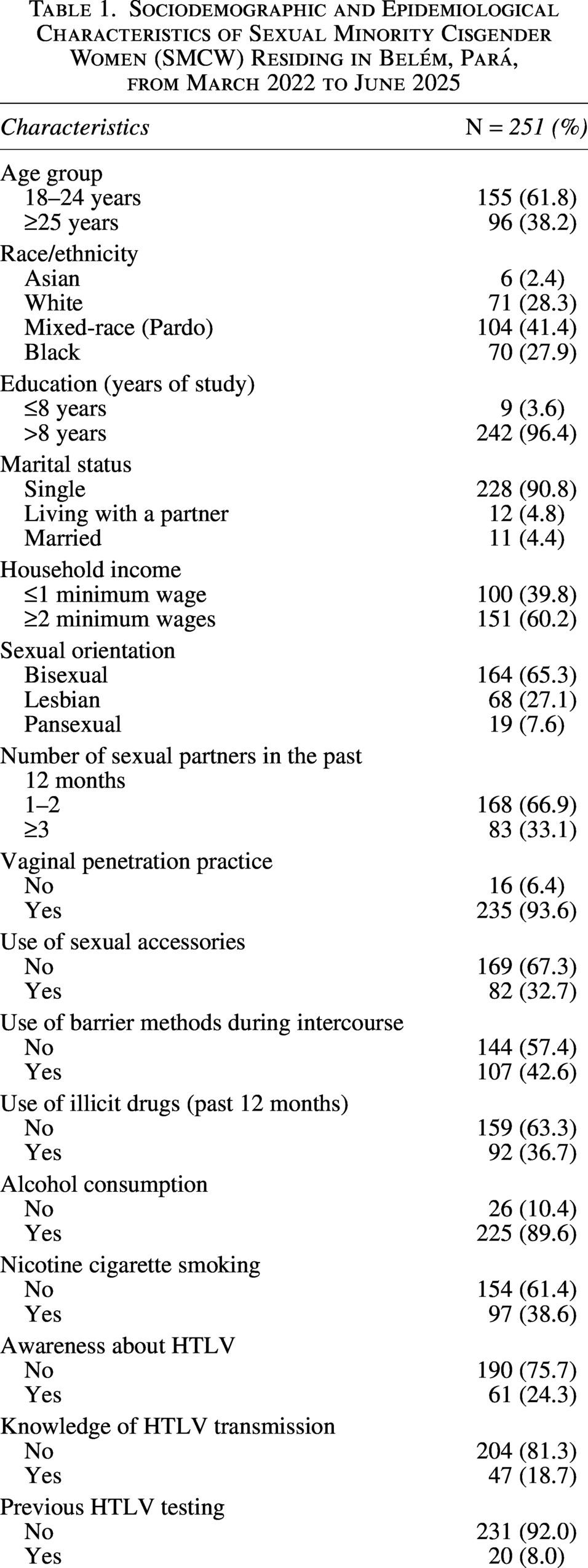
Participants had a mean age of 24.4 years (range: 18–68), with 61.8% aged 18–24 years. Most were single (90.8%), self-identified as bisexual (65.3%), and reported >8 years of education (96.4%). Notably, 57.4% did not use barrier methods during sex, and 75.7% lacked knowledge about HTLV (Table 1). The prevalence of HTLV infection was 0.4% (1/251), with HTLV-2 identified. The positive participant showed strong ELISA reactivity (optical density ratio: 3.8; cutoff: 1.0). Confirmatory qPCR demonstrated specific amplification of HTLV-2 pol gene (Ct value: 28.4) with adequate albumin control (Ct: 23.1), while HTLV-1 pol gene remained negative (no amplification detected after 50 cycles). Duplicate testing confirmed these results.
Sociodemographic and Epidemiological Characteristics of Sexual Minority Cisgender Women (SMCW) Residing in Belém, Pará, from March 2022 to June 2025
The infected individual was a 46-year-old married bisexual woman who self-identified as mixed-race, had 8 years of education, reported household income ≤1 minimum wage, and had three children from previous relationships with men. She reported exclusive sexual relationships with women for the past 2 years, engaging in vaginal penetration and oral-genital contact without barrier protection. She was asymptomatic, had never been tested for HTLV, and was unaware of the infection or its transmission routes. Despite counseling about the importance of family screening, the participant declined permission for testing her children or current partner, precluding intrafamilial transmission analysis.
This represents the first documented HTLV-2 case in SMCW in the Brazilian Amazon. The observed prevalence (0.4%) was lower than reported among transgender women in Central Brazil (1.0% HTLV-1), 6 yet comparable to the general population in metropolitan Belém (0.19%–0.5%) 7 , 8 and higher than blood donors (0.005%). 9 While the prevalence was substantially lower than hyperendemic Indigenous communities (8.1%), 2 this finding confirms HTLV-2 circulation among SMCW and challenges assumptions that this population faces negligible STI risk. The participant’s sexual history, including relationships with both men and women, highlights the fluidity of sexuality and underscores the importance of comprehensive sexual health services tailored to SMCW needs. 10
This study has limitations inherent to its design. The single positive case limits statistical inference and prevents identification of specific risk factors. Convenience sampling may introduce selection bias, potentially affecting generalizability. The participant’s refusal of family testing precluded assessment of household transmission dynamics. Nevertheless, this pioneering investigation fills a critical knowledge gap and provides baseline data essential for designing future studies with larger samples and probability-based approaches when feasible.
In conclusion, we report the first detection of HTLV-2 in SMCW in the Brazilian Amazon, demonstrating viral circulation in a historically neglected population. The low prevalence, similar to the general population, suggests comparable vulnerability rather than reduced risk. These findings emphasize the urgent need to integrate SMCW into epidemiological surveillance systems, implement culturally sensitive educational programs, and develop inclusive public health policies addressing HTLV and other STIs in LGBTQIA+ communities in endemic regions. Future investigations should employ longitudinal designs, larger sample sizes, and family-based approaches to comprehensively characterize HTLV epidemiology and transmission dynamics in this underserved population.
Authors’ Contributions
T.M.S.C.: Conceptualization (lead), investigation and methodology (lead), writing—original draft (lead), writing—review and editing (equal). L.F.M.: Data curation (equal). D.O.A.: Data curation (equal). J.J.N.S.: Data curation (equal), investigation and methodology (equal). G.P.B.: Data curation (equal), investigation and methodology (supporting). J.J.S.G.: Data curation (equal). R.V.L.: Formal analysis (supporting), writing—review and editing (supporting). F.B.F.: Investigation and methodology (equal). P.R.B.A.: Investigation and methodology (equal). G.R.O.N.: Formal analysis (supporting), formal analysis (support). A.B.O.F.: Writing—original draft (supporting), writing—review and editing (supporting). L.F.A.M.: Conceptualization (equal), formal analysis (lead), writing—original draft (supporting), writing—review and editing (lead), project administration (lead).
Footnotes
Acknowledgment
The authors acknowledge all subjects enrolled in this study and Executive Secretariat of Public Health of the State of Pará.
Author Disclosure Statement
No competing financial interests exist.
Funding Information
This study received financial support from the National Council for Scientific and Technological Development (CNPq/MCTI/FNDCT #407219/2021–8, CNPq #445041/2023–4) and FAPESPA (#001/2023). L.F.A.M. is a CNPq Grantee (#314209/2021–2). The author T.M.S.C. received fellowships of Coordenação de Aperfeiçoamento de Pessoal de Nível Superior-Brasil (CAPES), Finance Code 001, to develop the study.