



Abstract
Purpose:
To explore whether the physical activity (PA) component of the Coordinated Approach to Child Health Early Childhood (CATCH EC) program helps increasing preschoolers’ PA during active times at preschool.
Design:
Nonrandomized controlled experimental study.
Setting:
Head Start centers in Houston, Texas, 2009 to 2010 school year.
Participants:
A total of 439 preschoolers aged 3 to 5 years (3 intervention centers, n = 220; 3 comparison centers, n = 219).
Intervention:
The CATCH EC preschool-based teacher-led nutrition and PA program.
Measures:
Preschoolers’ PA was measured at baseline and postintervention using the System for Observing Fitness Instruction Time–Preschool version, a direct observation method measuring PA at the classroom level. Parent surveys provided demographic data.
Analysis:
Pre-to-post changes in preschoolers’ PA were examined using the Mann-Whitney U test.
Results:
Results show a significant decrease in the percentage time preschoolers spent in level 2 PA (low activity) at intervention (P = .005) and comparison (P = .041) centers. Indoor vigorous activity increased significantly on an average by +6.04% pre-to-post intervention among preschoolers in the intervention group (P = .049); no significant change was found in the comparison group.
Conclusion:
The CATCH EC favorably increased indoor vigorous PA level among low-income children attending Head Start.
Keywords
Purpose
Lack of physical activity (PA) and increased sedentary behaviors are known risk factors for childhood obesity, 1 which continues to persist at epidemic proportions in the United States even among preschoolers 2 to 5 years of age, with 22.8% of preschoolers classified as overweight or obese. 2 The importance of PA for preschoolers lies not only on being healthy and preventing obesity but also on building motor skills and establishing a lifetime of healthy behaviors. 3
Federal statistics indicate 61% of the US children 3 to 6 years of age attend center-based childcare (ie, preschools). 4 However, studies conclude that preschoolers do not spend the recommended amount of time 5 engaging in PA while at preschool, especially moderate-to-vigorous physical activity (MVPA), 6 and evidence-based programs to increase PA during preschool hours are lacking. 7
The purpose of this pilot study was to evaluate the feasibility and effectiveness of the Coordinated Approach to Child Health Early Childhood (CATCH EC) 8 on increasing PA during preschool active times among 3- to 5-year-old children enrolled in Head Start centers in Texas.
Methods
Study Design and Sample
This was a nonrandomized controlled experimental study. The CATCH EC was implemented and evaluated during the 2009 to 2010 school year in a convenience sample of 3 Harris County Department of Education (HCDE) Head Start centers (n = 220), while 3 other HCDE Head Start centers (n = 219) were matched based on size and ethnic distribution and assigned to a wait-list comparison group. Response rates for the intervention and comparison centers were 78.6% and 78.8%, respectively. This study was approved by the Committee for the Protection of Human Subjects at the University of Texas Health Science Center at Houston as well as the institutional review board of HCDE.
The CATCH EC preschool-based program, grounded in the Social Cognitive Theory and Social Ecological Model, 8 –10 and modeled after the CATCH program with proven effectiveness in reducing childhood obesity, 11 aims to create opportunities for healthy eating and PA for children while at preschool. It includes: (1) It’s Fun to be Healthy! a 9-lesson, teacher-led, nutrition-based classroom curricula aims to promote preschoolers’ healthy eating habits; (2) structured, teacher-led, indoor and outdoor physical activities promoting gross motor skills and MVPA during preschool hours; and (3) bilingual parent education tip sheets designed to modify the home nutrition and PA environment. 8
All enrolled preschoolers in the intervention centers received the CATCH EC program, while the comparison centers continued with usual care. At the start of the school year, teachers at participating intervention centers were trained by CATCH master trainers in a 6-hour training to implement CATCH EC. Teachers’ understanding and confidence level to teach others were evaluated at the end of the CATCH EC training.
Measures
Sociodemographic characteristics of participating preschoolers were collected at baseline using parent-reported surveys, which reported child age, gender, ethnicity, and language spoken at home.
Preschoolers’ PA was measured by trained project staff at baseline and postintervention using System for Observing Fitness Instruction Time–Preschool (SOFIT-P) 12 version at intervention and comparison centers. The SOFIT-P is a validated direct observation instrument that measures percent time preschoolers spend in PA during active times at preschool. 12 Active times are defined when the preschoolers participate in free play (indoors or outdoors with no teacher instruction), circle time (instructor-led activity time), music and movement time, or learning centers (time spent at specific stations, including art, blocks, reading, etc). Nap and meal times are not considered as active times. Types of PA (eg, music, group game, etc), levels of PA (described by the body position of the preschooler; 1 = lying, 2 = sitting, 3 = standing, 4 = walking, and 5 = being more active than walking [fast/very active]), and contexts of PA (indoor/outdoor) were recorded during observation. All classrooms (n = 17 intervention and n = 17 comparison) were observed for 1 school day and the first active session was recorded at baseline and 1 to 2 sessions at postintervention (observed sessions increased at posttest to capture enough number of observations within each context groups to ensure comparability with baseline data). To reduce potential observer bias, the active sessions observed were randomly selected by project staff; only center directors were informed of observations prior to the visits and not the classroom teachers. Preintervention measurements were conducted in September/October prior to CATCH EC implementation, and subsequently, postintervention measures were conducted in late March to early May. The fidelity, reach, and dosage of the CATCH EC implementation process were evaluated by direct observations by trained program staff visiting the 3 intervention centers (n = 46 visits) throughout the year.
Analysis
Demographic variables including child gender, age, ethnicity, and language used at home are described and presented with counts and percentages. The mean percent time spent in each PA level for each observed PA session was calculated using SOFIT-P data for each classroom. Percent time spent at levels 1 to 3 PA was collapsed into light PA. Moderate PA was calculated by percent time spent at level 4, and vigorous PA (VPA) was calculated by percent time spent at level 5. Moderate-to-vigorous physical activity was calculated by collapsing percent time spent at levels 4 and 5. To ensure comparability, preintervention and postintervention SOFIT-P data were paired according to activity contexts (indoors/outdoors), where the observed Physical Education (PE) class took place. 12 The interobserver agreement is 93% (97% at pretest and 85% at posttest)
The Shapiro-Wilk test showed that the SOFIT-P PA level data (percent time spent in different levels of PA) were not normally distributed. Also, the number of SOFIT-P observations collected at the classroom level is relatively small with up to 1 PA observation per context per class. Therefore, a Mann-Whitney U test was used to examine pre-to-post intervention changes in the intervention and comparison groups for the percent time spent in different levels of PA. Physical activity data were stratified by the context of PA for compatibility, but the analysis did not account for the clustered data due to small sample size. Significance level was set at P < .05.
Results
More than half (53.1%) of the participating preschoolers were Hispanic and 37.2% were African American. There were significantly more Hispanic children in the intervention group (63.4%) than the comparison group (45.9%; P < .01). Also, more parents in the comparison group were speaking English at home (68.7%) than the intervention group (53.3%; P = .005).
A total of n = 35 classroom-level PA direct observations using SOFIT-P were conducted at preintervention (n = 17 at intervention centers and n = 18 at comparison centers) and n = 57 observations at postintervention (n = 27 at intervention centers and n = 30 at comparison centers; Table 1). Overall, preschoolers spend approximately 30% of their time in MVPA at baseline (32% for intervention and 37% for comparison). A statistically significant decrease in the percent time preschoolers spent in level 2 PA (stationary with movement of limbs or trunk, such as sitting) for both the intervention (P = .005) and comparison (P = .041) groups was observed postintervention, with a greater decrease among those implementing CATCH EC. After further stratifying by indoor versus outdoor PA, there was a significant increase in the mean percent time spent in indoor VPA among preschoolers receiving CATCH EC (+6.04%; P = .049) as compared to those in the comparison group (+3.275%). We also observed improvements in outdoor MVPA among the children in the intervention group, albeit not statistically significant. Process evaluation by direct observations showed good fidelity (74%) and reach (78%) of CATCH EC implementation.
Changes in Percentage Time Spent on Physical Activity Between Preintervention and Postintervention Using SOFIT-P Stratified by Intervention and Comparison Groups.a
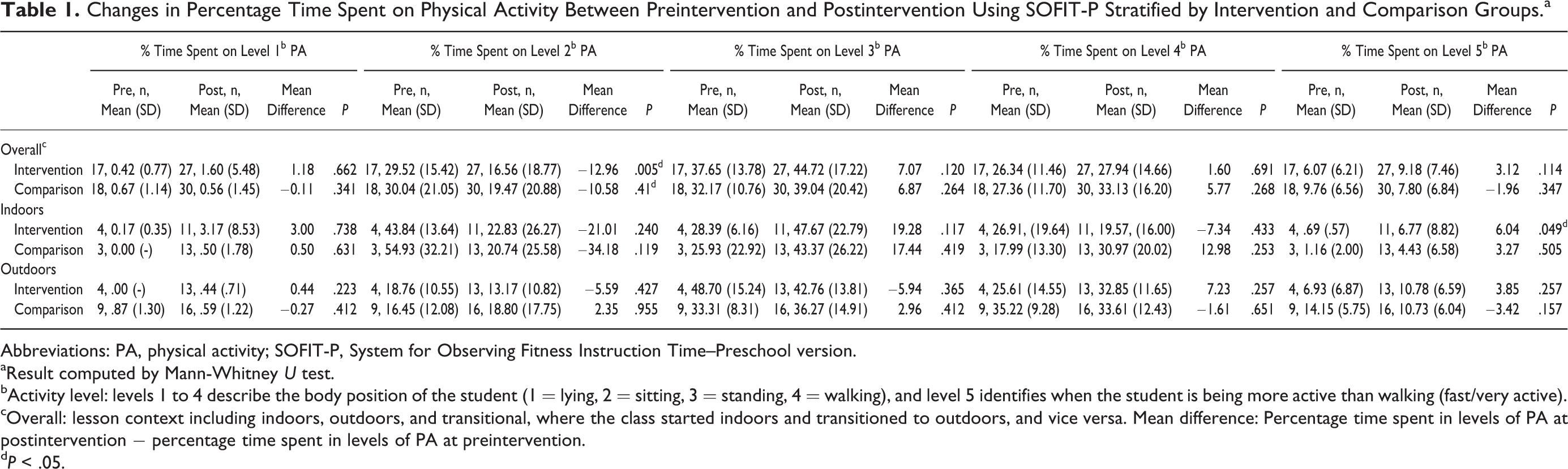
Abbreviations: PA, physical activity; SOFIT-P, System for Observing Fitness Instruction Time–Preschool version.
aResult computed by Mann-Whitney U test.
bActivity level: levels 1 to 4 describe the body position of the student (1 = lying, 2 = sitting, 3 = standing, 4 = walking), and level 5 identifies when the student is being more active than walking (fast/very active).
cOverall: lesson context including indoors, outdoors, and transitional, where the class started indoors and transitioned to outdoors, and vice versa. Mean difference: Percentage time spent in levels of PA at postintervention − percentage time spent in levels of PA at preintervention.
d P < .05.
Discussion
The purpose of this pilot study was to evaluate the feasibility and effectiveness of the CATCH EC on increasing PA during active times at preschool. Overall, the results of our study showed favorable changes in percent time preschoolers spend in VPA indoors and a concurrent decrease in light/sedentary activity especially among those in the intervention group receiving CATCH EC. Overall, preschoolers across both groups demonstrated a decrease in light PA, which could be because the CATCH EC program was implemented as part of Head Start on Healthy Living (HSHL), an initiative implemented by HCDE to promote health literacy and healthy lifestyles among HCDE Head Start children, families, and staff. Although none of the HSHL activities other than CATCH EC specifically targeted PA education in preschoolers, they may have influenced healthier lifestyle practices across all HCDE Head Start centers, thus attenuating the intervention effects. The small changes in PA observed among our intervention Head Start centers could potentially indicate that, while these changes are in the direction desired, the dosage of CATCH EC implementation may need to be strengthened. Moreover, the wide range of standard deviation on percent time spent on different PA levels is likely a result of the wide variety of PA types and contents observed in the study since the active sessions were randomly selected. Future studies are encouraged to increase sample size to account for clustering effects, strengthen the dosage of the program, and focus on specific types or contents of PA for observation to increase measurement precision. Many interventions targeting preschool children’s PA are designed to be applied outside the regular preschool schedule and only a few focus on aligning with ongoing preschool activities. 13 Individual and environmental strategies to create more opportunities for PA at the preschool level are needed. 14 Our study adds to the evidence base of promising programs with components integrated within existing preschool curriculum and structure to increase MVPA among children during active times at preschool.
Strengths of this study include strong fidelity, ease of implementation of CATCH EC, and using a direct observation to measure PA in a low-income population. Limitations include a nonrandomized convenience study sample and small sample size for direct observation measurement. The clustering within preschools and types of PA were not evaluated also due to small sample size.
This pilot study suggests that the CATCH EC strategies to provide opportunities to increase MVPA among preschoolers during active times at preschool are feasible and promising. Further evaluations with additional individual objective measures such as accelerometry, a larger sample size, and a stringent randomized controlled trial design are warranted.
SO WHAT? Implications for Health Promotion Practitioners and Researchers
What is already known on this topic?
Physical activity is found to be protective against obesity but at low levels among children while they are at preschool. In 2012, 61% of US preschool-aged children are in center-based childcare arrangements.
What does this article add?
This article reports the results of a theory-based intervention program targeting minority preschoolers’ physical activity change during active times at preschool. Our result showed a favorable increase in percentage time minority preschool-aged children spend on indoor VPA and feasibility of implementing the program in preschool setting.
What are the implications for health promotion practice or research?
Programs that are theory based and developed to be feasible are more likely to see desirable changes.
Footnotes
Acknowledgments
The authors would like to acknowledge HCDE Head Start director Ms Venetia Peacock, HCDE Head Start Health Services Manager, Ms Gulshan Rahman, and all HCDE Head Start center managers and staff for their support. The authors would also like to acknowledge the data collectors and data entry staff who made this manuscript possible.
Authors’ Note
The content is solely the responsibility of the authors and does not necessarily represent the official views of the Michael and Susan Dell Center for Healthy Living or the University of Texas Health Science Center, School of Public Health. The study was conducted at Harris County Department of Education.
Declaration of Conflicting Interests
The author(s) declared no potential conflicts of interest with respect to the research, authorship, and/or publication of this article.
Funding
The author(s) disclosed receipt of the following financial support for the research, authorship, and/or publication of this article: This work was supported by funding from the Michael and Susan Dell Center for Healthy Living, the University of Texas Health Science Center, School of Public Health.