




Abstract
Purpose:
We examined differences in the association between alcohol use and sedentary behavior by gender among adults.
Design:
Cross-sectional study that employs a complex, multistage stratified probability cluster sample design.
Setting:
National Health and Nutrition Examination Survey (NHANES) 2007 to 2014.
Participants:
NHANES participants aged ≥20 years and identifying as Hispanic, white, or black (N = 18 441).
Measures:
Demographic characteristics, sedentary behavior, and alcohol consumption. Sedentary behavior was measured based on the number of minutes of sedentary activity per week. Alcohol consumption in the last year was measured based on responses to items assessing whether the participant consumes alcoholic beverages and the number of alcoholic beverages consumed on average.
Analysis:
Multinomial logistic regression analysis was used to estimate associations of alcohol use with categories of sedentary behavior by gender.
Results:
Compared to women who reported not consuming alcohol, women who were heavy drinkers were significantly more likely to engage in high sedentary activity (odds ratio [OR]: 1.47; 95% confidence interval [CI]: 1.16-1.87), relative to low levels of sedentary activity. Similarly, women who were binge drinkers were more likely to engage in moderate levels of sedentary activity (OR: 1.39; 95% CI: 1.05-1.85). There were no significant associations between alcohol use and sedentary activity among men.
Conclusion:
Findings suggest that alcohol consumption should be considered in health promotion efforts targeting sedentary behavior among women.
Purpose
Obesity is associated with adverse health outcomes such as type 2 diabetes, cancer, and cardiovascular disease. 1 Although numerous efforts have sought to reduce rates of obesity, disparities in obesity persist. For example, the prevalence of obesity is higher among women than men (40.4% and 35%, respectively), and since 2005, a statistically significant increase in obesity has been observed among women, but not in men. 2 Further research is warranted to identify factors that contribute to these disparities in obesity.
A vast amount of research has indicated that sedentary behavior is associated with several adverse health outcomes, including obesity. 3 Sedentary behavior is defined as time spent sitting, 4 and previous research suggests that uninterrupted sedentary time or sitting time lasting longer than 2 hours in duration may have deleterious health implications even for people who meet current guidelines for physical activity. 5,6 Thus, it is important to identify factors that may contribute to activity-related outcomes beyond physical activity, such as sedentary behavior. For example, research has shown that health behaviors such as smoking and alcohol consumption are associated with physical activity. 7 –10 However, less is known about whether health behaviors such as alcohol consumption may be a contributing factor to sedentary behavior. 11
A previous study by Esser et al using data from the 2009 to 2011 National Survey on Drug Use and Health showed that 70.5% of US adults reported consuming alcohol in the past year. 12 Specifically, 29.3% reported excessive drinking and 27.4% reported binge drinking in the past month. 12 Previous research has shown that physical activity is related to alcohol consumption. 7,9,10 However, little is known about the association between alcohol consumption and sedentary behavior, which is a distinct construct of energy expenditure from physical activity. Furthermore, to our knowledge, this association by sex has not been previously examined. Evidence suggests that sex differences are present in both sedentary behavior and alcohol consumption, with women having a higher prevalence of sedentary behavior, 13 while men have been shown to have higher rates of alcohol consumption. 14
Using nationally representative data from the 2007 to 2014 National Health and Nutrition Examination Survey (NHANES), we examined the association between alcohol consumption and sedentary behavior by gender. We hypothesized that alcohol consumption would be associated with sedentary behavior and differ by gender. Obtaining a better understanding of the factors that contribute to sedentary behavior among US adults is critical for the improvement of obesity prevention and health promotion efforts.
Methods
Design
We used data from 2007 to 2014 NHANES. NHANES is a cross-sectional study examining health and nutrition of children and adults in the United States. 15 NHANES employs a complex, multistage stratified probability cluster sample design to obtain a nationally representative sample of the noninstitutionalized US civilian population.
Sample
The inclusion criteria of the individuals included in our sample consisted of being 20 years of age and older and identifying as Hispanic, white, or black. Our final analytic sample was based on data from 18 441 men and women with complete data on the variables of interest.
Measures
Sedentary behavior
Participants were asked how many minutes of sedentary activity they engaged in per week (ie, time spent sitting, but not including sleep). Based on approximate tertiles of the observed distribution of sedentary activity, time spent in weekly sedentary activity was classified into 3 groups: low (≤1680 minutes), medium (>1680 to ≤3360 minutes), and high (>3360 minutes).
Alcohol consumption
Participants were asked questions related to their alcohol consumption in the last year: (1) “In any 1 year, have you had at least 12 drinks of any type of alcoholic beverage?” and (2) “In the past 12 months, on those days that you drank alcoholic beverages, on the average, how many drinks did you have?”. Using data from these items, we created sex-specific categories of alcohol use consistent with established alcohol use categories. 16 –18 Specifically, for women, we created the following categories: none: nondrinker; moderate: ≤1 drink per day; heavy: >1 to <4 drinks per day; and binge: ≥4 drinks per day and for men: none: nondrinker; moderate: ≤2 drinks per day; heavy: >2 to <5 drinks per day; and binge: ≥5 drinks per day.
Covariates
Self-reported covariates in multivariable models included age, education, and race/ethnicity. Age was modeled continuously, and educational attainment was categorized as having obtained less than a high school diploma or graduate equivalent diploma, some college, and college graduate. Race/ethnicity was categorized as Hispanic, black, and white.
Analysis
Unadjusted means or frequencies and standard errors were computed for all covariates by gender. To assess significant differences between men and women for the covariates, we used a Rao-Scott χ2 test to obtain P values. Multinomial logistic regression models were used to estimate the odds ratios (ORs) of the sedentary activity outcomes by level of alcohol consumption. Specifically, we estimated the likelihood of engaging in high or medium levels of sedentary activity (relative to low) by level of alcohol use for men and women separately. All models were adjusted for age, education, and race/ethnicity. All analyses were adjusted for sampling weights to account for the complex sampling design of NHANES. SAS version 9.4 (SAS Institute Inc., Cary, North Carolina) was used to carry out the descriptive and regression analyses using survey procedures.
Results
Descriptive Characteristics
Table 1 displays the distribution of demographic characteristics, sedentary activity, and alcohol use among men and women in the study. Men had a higher proportion of individuals who reported engaging in low sedentary activity relative to women, while women were more likely to report engaging in medium levels of sedentary activity. Men were likely to report being moderate and binge drinkers, while women had a higher proportion of individuals who reported heavy alcohol use.
Participant Characteristics Overall and by gender Among US Adults: National Health and Nutrition Examination Survey, 2007 to 2014.
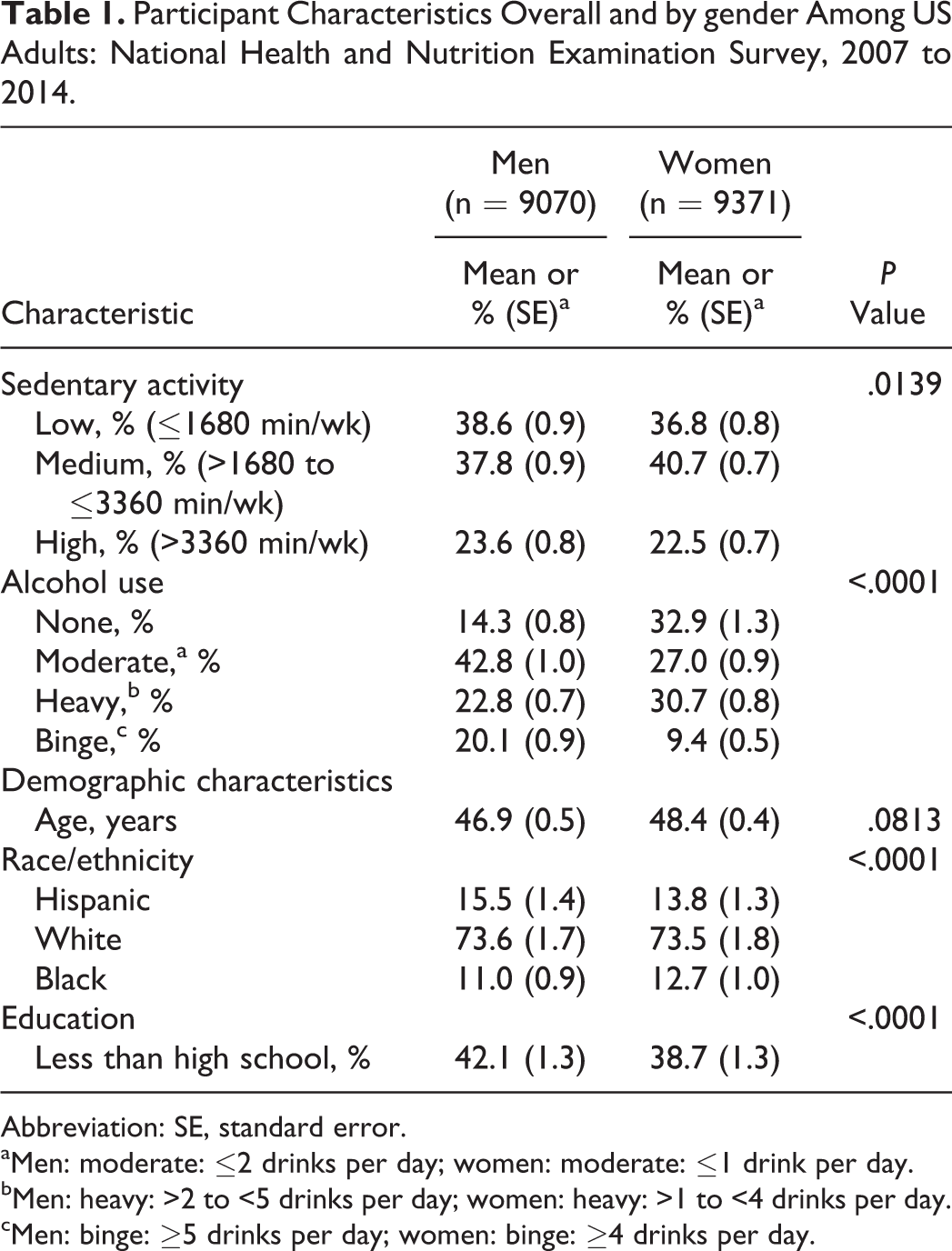
Abbreviation: SE, standard error.
aMen: moderate: ≤2 drinks per day; women: moderate: ≤1 drink per day.
bMen: heavy: >2 to <5 drinks per day; women: heavy: >1 to <4 drinks per day.
cMen: binge: ≥5 drinks per day; women: binge: ≥4 drinks per day.
Association of Alcohol Consumption With Sedentary Behavior
Tables 2 and 3 present the results from the multinomial logistic regression analysis. Compared to women who reported not consuming alcohol, those who reported heavy levels of alcohol use were significantly more likely to engage in high sedentary activity (OR: 1.47; 95% confidence interval [CI]: 1.16-1.87), relative to low levels of sedentary activity. Similarly, women who reported being binge drinkers were more likely to engage in moderate levels of sedentary activity (OR: 1.39; 95% CI: 1.05-1.85), relative to low levels. There were no significant associations between alcohol use and sedentary activity among men.
Association of Alcohol Consumption With Sedentary Activity Among US Men: National Health and Nutrition Examination Survey, 2007 to 2014.a
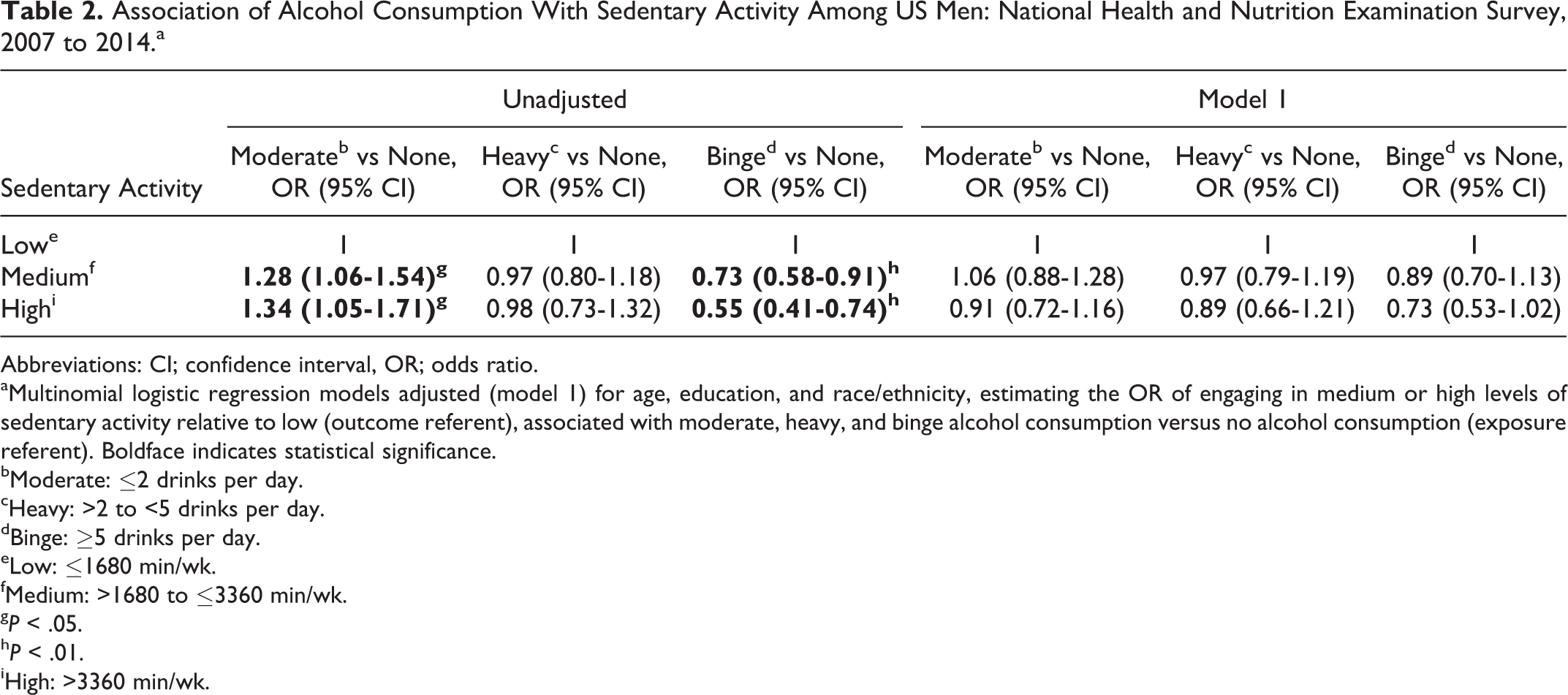
Abbreviations: CI; confidence interval, OR; odds ratio.
aMultinomial logistic regression models adjusted (model 1) for age, education, and race/ethnicity, estimating the OR of engaging in medium or high levels of sedentary activity relative to low (outcome referent), associated with moderate, heavy, and binge alcohol consumption versus no alcohol consumption (exposure referent). Boldface indicates statistical significance.
bModerate: ≤2 drinks per day.
cHeavy: >2 to <5 drinks per day.
dBinge: ≥5 drinks per day.
eLow: ≤1680 min/wk.
fMedium: >1680 to ≤3360 min/wk.
g P < .05.
h P < .01.
iHigh: >3360 min/wk.
Association of Alcohol Consumption With Sedentary Activity Among US Women: National Health and Nutrition Examination Survey, 2007 to 2014.a
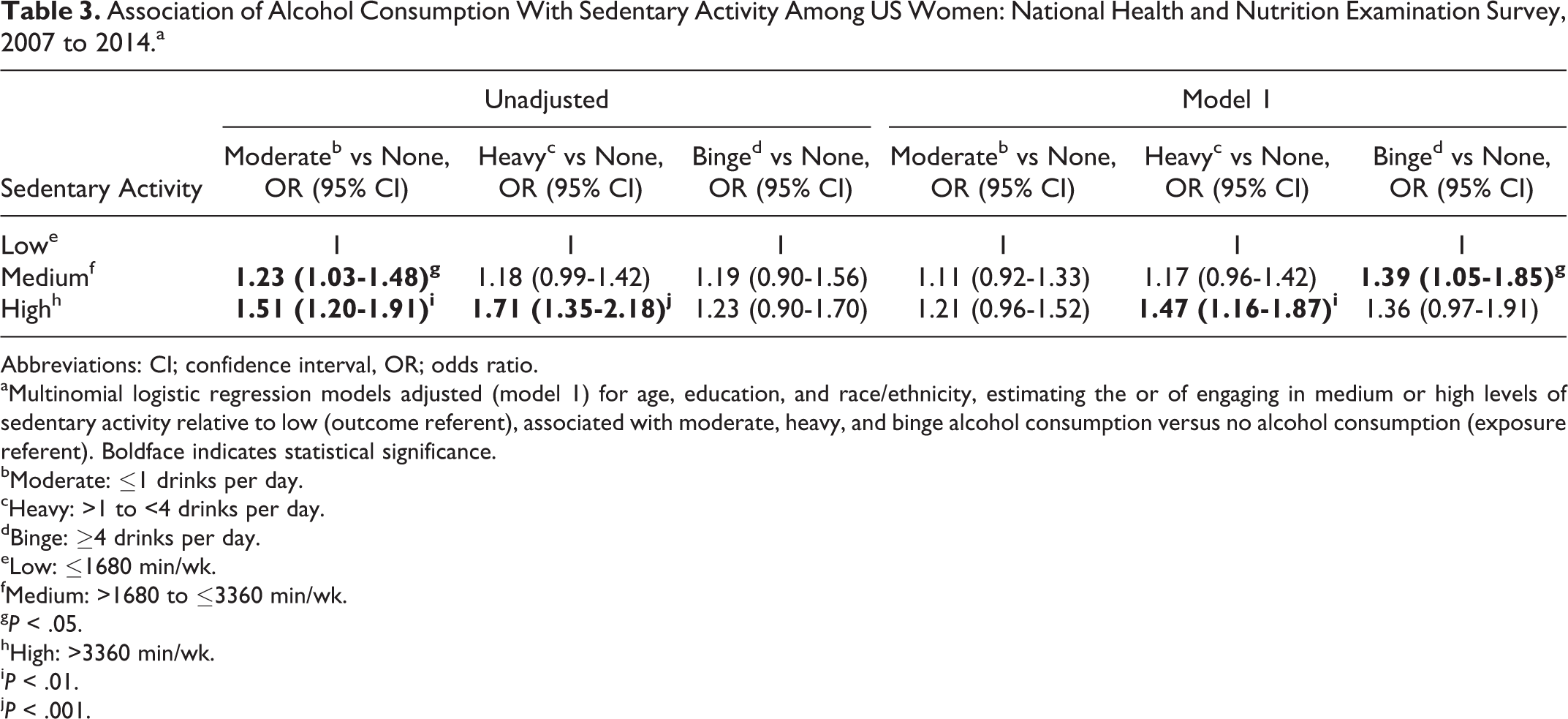
Abbreviations: CI; confidence interval, OR; odds ratio.
aMultinomial logistic regression models adjusted (model 1) for age, education, and race/ethnicity, estimating the or of engaging in medium or high levels of sedentary activity relative to low (outcome referent), associated with moderate, heavy, and binge alcohol consumption versus no alcohol consumption (exposure referent). Boldface indicates statistical significance.
bModerate: ≤1 drinks per day.
cHeavy: >1 to <4 drinks per day.
dBinge: ≥4 drinks per day.
eLow: ≤1680 min/wk.
fMedium: >1680 to ≤3360 min/wk.
g P < .05.
hHigh: >3360 min/wk.
i P < .01.
j P < .001.
Discussion
This study examined the association of alcohol consumption with sedentary behavior by gender among NHANES participants. Findings indicate that the association between alcohol consumption and sedentary behavior varies by gender, with greater alcohol consumption being associated with greater sedentary activity among women, but not men. Specifically, compared to women who do not drink alcohol, those who consumed heavy levels of alcohol were significantly more likely to engage in high levels of sedentary activity. Similarly, women who were binge drinkers were more likely to engage in medium levels of sedentary activity.
Our findings indicate that alcohol consumption is associated with sedentary behavior. Although sedentary behavior and physical activity are different constructs of activity, previous findings on the association between physical activity and alcohol consumption may provide some insight into our findings. For example, physical activity has been found to be positively associated with drinking for men, but not for women. 19,20 Because gender has been found to be a moderator in the relationship between physical activity and alcohol consumption, it may also moderate the relationship between sedentary behavior and alcohol consumption. Other potential moderators, such as psychological distress, have been found to be separately linked to greater alcohol consumption and time spent sitting at work and should be examined for potential moderation of the association observed in our study. 21,22 Future research should also consider examining other personality factors, such as shyness and social anxiety, which have been associated with lower levels of alcohol consumption, 9 as potential contributors to the association between alcohol consumption and sedentary behavior.
Another possible explanation for the association found in this study is the clustering of unhealthy lifestyle behaviors. These behaviors, including smoking, poor nutrition, excess alcohol consumption, and physical inactivity, have a tendency to co-occur or cluster together. 23 –25 When combined, these clusters produce an effect that is more harmful than when considered alone. 26 Therefore, it is possible that unhealthy levels of alcohol consumption cluster with sedentary behavior. Further, previous research has found that women are especially prone to the clustering of unhealthy behaviors; 27 this may explain why we observed a significant association among women, but not men. Further research is warranted to determine how alcohol consumption and sedentary behavior cluster together and examine the gender disparity further. The gender differences we observed in the association between alcohol consumption and sedentary behavior may also be attributed to the types of beverages (eg, beer, wine, or hard liquor) generally preferred by men and women, as well as the setting and context in which they are consumed (eg, socially or privately, at home, or at a bar).
This study is not without limitations. Given the cross-sectional nature of NHANES, causality cannot be inferred and we were not able to assess changes in the association or potential confounders (eg, age) over time and within the same individual to better determine the mechanism through which alcohol consumption and sedentary behavior are related. The cross-sectional design also limited our ability to determine the directionality between alcohol use and sedentary behavior, meaning the alcohol use could have occurred after the sedentary behavior. For example, a woman could have become overweight, then sedentary, and lastly started consuming alcohol, leading to increased weight and sedentary behavior. Additionally, both alcohol and sedentary behavior were based on self-reported measures, which can impact results by misrepresenting actual activity performed and alcohol consumed. Underreporting of alcohol consumption levels has been found to be common in self-reported measures. 28
Our study contributes to the existing literature on factors contributing to sedentary behavior in adults by investigating the association between alcohol consumption and sedentary behavior. Our findings suggest that alcohol consumption may be a contributing factor to gender disparities in sedentary behavior, which may consequently contribute to gender disparities observed in obesity. These findings may help inform approaches to reducing sedentary behavior and obesity risk utilized by health practitioners by proving insight into the role of alcohol consumption in sedentary behavior outcomes in women, among whom alcohol use may not be a critical factor considered given that alcohol consumption is lower among women compared to men. Therefore, in developing interventions, it will be important to consider the role of alcohol consumption in sedentary activity among women and to identify how these unhealthy behaviors may cluster together to contribute to obesity risk.
So What? Implications for Health Promotion Practitioners and Researchers
What is already known on this topic?
Sedentary activity has been linked to adverse health outcomes such as obesity and cardiovascular disease. Research on the association between alcohol consumption and sedentary behavior is limited.
What this study adds?
Our findings indicate that the association between alcohol consumption and sedentary behavior varies by gender, with greater alcohol consumption being associated with greater sedentary activity among women, but not men, suggesting that alcohol consumption may contribute to gender disparities in sedentary behavior and may consequently contribute to gender disparities observed in obesity.
What are the implications for health promotion practice or research?
Understanding the role of alcohol consumption in the rise in sedentary behavior will be essential for intervention development focused on reducing obesity risk, especially among women.
Footnotes
Declaration of Conflicting Interests
The author(s) declared no potential conflicts of interest with respect to the research, authorship, and/or publication of this article.
Funding
The author(s) received no financial support for the research, authorship, and/or publication of this article.
