



Abstract
Self-determination theory and substantial research findings suggest that more desirable outcomes may occur when participants are able to choose their prevention or treatment interventions, as having a choice may lead to greater motivation and feelings of self-efficacy. The present study examined the influence of having a choice of family-based prevention programs for youth alcohol, tobacco, and other drug use on mothers’ communication outcomes. Families (N = 496) were those with an 11- to 12-year-old enrolled in Kaiser Permanente medical centers at one of four locations. Results from multivariate repeated measures analyses supported the importance of having a choice for improved communication outcomes. As compared with families who were randomly assigned to a program, those allowed to choose showed improved tobacco-specific and peer pressure communication, with marginally improved alcohol communication. No differences were found between the groups for general communication. Results suggest that allowing mothers to participate in decisions about health-related interventions for their teens may lead to better outcomes.
Traditionally, randomization is used to evaluate prevention and treatment programs in order to increase internal validity and accuracy of conclusions about effectiveness (Leykin et al., 2007). However, randomization may affect who participates in random control trials and thus may not reflect the larger population, which includes those who would not participate in a study because they want control over their treatment as well as those who would participate regardless of whether they have control over their treatment. Substantial theory and research suggest that better outcomes may occur when individuals are able to choose their own treatment, as having a choice is thought to act to motivate individuals (Patall, Cooper, & Robinson, 2008). Early research showed that people were more likely to engage in, and find more pleasant, activities they had chosen (Lewin, 1952; Zimbardo, Weisenberg, & Firestone, 1965), which may lead to improved performance and outcomes. Consistent with self-determination theory (Deci & Ryan, 1985, 2000), having a choice is considered to lead to increased motivation and better outcomes, as intrinsic motivation is based on needs for autonomy, competence, and relatedness, which the ability to choose could provide (Patall et al., 2008). People who are given a choice of their own treatment or intervention may experience greater levels of autonomy, personal control, and self-efficacy and therefore better outcomes (Clark & Dodge, 1999; Taylor, 1989). This idea has been supported across a variety of contexts, such as health, education, and work environments (Patall et al., 2008).
There is now an increased focus on the importance of patients’ participation in treatment choices and involvement in changing health behaviors (Emmons & Rollnick, 2001). For example, motivational counseling, which involves the client in designing strategies for change, has shown to be more effective than instructional strategies (Thorpe, 2003). Similarly, studies across a variety of health behaviors, such as substance use and smoking cessation, demonstrate that patients’ choosing their intervention for health outcomes is strongly related to improved outcomes (Clark et al., 2008; Cox & Klinger, 2002; Curry et al., 2003). For example, a study of patients receiving treatment for pain management who were randomized to outpatient treatment (instead of inpatient) required significantly greater amounts of pain medication usage than patients who chose outpatient treatment (de C Williams, Nicholas, Richardson, Pither, & Fernandes, 1999). Similar results were found for patients randomized to inpatient treatment. Although most research on the effect of choice on outcomes is based on medical treatments, this issue may also be important in educational, behavioral, and prevention interventions. For example, Iyengar and Lepper (1999) found that when Caucasian students were allowed to choose the tasks they participated in, their performance improved, as compared with students without a choice.
Because of its potential for preventing youth alcohol, tobacco, and other drug (ATOD) use, improved parent–youth communication is a key target for prevention. General and ATOD-related communication typically decrease throughout adolescence, although demographic differences have been found (Fulkerson et al., 2010; Keijsers, Frijns, Branje, & Meeus, 2009; Van Der Vorst, Burk, & Engels, 2010; Yang et al., 2007). However, parent–youth communication has been shown to be protective (Brody, Flor, Hollett-Wright, & McCoy, 1998; Harakeh, Scholte, de Vries, & Engels, 2005; Martyn et al., 2009). Specifically, more frequent communication about alcohol use has been associated with less liberal norms about alcohol use and lower levels of alcohol use and binge drinking (Brody et al., 1998; Martyn et al., 2009). Greater frequency and quality of communication about smoking have also been related to less adolescent smoking, for both smoking and nonsmoking parents (Harakeh et al., 2005; Jackson & Henriksen, 1997). ATOD communication can include several aspects, such as negative consequences, encouragement not to use, and peer pressure resistance (Ennett, Bauman, Foshee, Pemberton, & Hicks, 2001), although these aspects have not been examined separately.
Parent–youth communication in general (e.g., talking about plans for the day) has also been linked to decreased youth ATOD use. For example, teen boys who felt they could not talk with their parents about problems were more likely to become involved in substance use (Ackard, Neumark-Sztainer, Story, & Perry, 2006). General communication has also been associated with less alcohol, cigarette, and other drug use (Beebe et al., 2008; Pokhrel, Unger, Wagner, Ritt-Olson, & Sussman, 2008).
The present study examines the influence of having a choice of adolescent family–based prevention programs, as compared with being assigned to one of the programs, on targeted program outcomes related to mothers’ communications, as these are key outcomes targeted by the program. There are three targeted areas of communication in the two family-based programs in this study: alcohol, tobacco, and peer pressure related. In addition, the study measured general communication patterns. As most studies on the effect of choice on educational or behavioral interventions examine youth outcomes, this study will make an important step by examining parent-targeted outcomes. Based on self-determination theory (Deci & Ryan, 1985, 2000), we hypothesize that mothers who are given a choice of programs will show improved communication outcomes, compared with mothers randomized to a program, as having a choice should be related to increased motivation and outcomes because of increased autonomy.
Method
Sample and Procedures
The sample was drawn from families enrolled in Kaiser Permanente (KP) medical centers at one of four locations in the San Francisco area (Oakland, Vallejo, Walnut Creek, or San Francisco) and who had an 11- to 12-year-old child. An initial list of these families (N = 5,219) was provided by KP and then families were contacted in random order and randomized into one of two conditions: (a) Assigned or (b) Choice. In the Assigned condition, families were randomly assigned to one of two programs. In the Choice condition, families could choose between the programs. The two prevention programs were Family Matters (FM; Bauman, Foshee, Ennett, Hicks, & Pemberton, 2001b) and Strengthening Families Program: For Parents and Youth 10-14 (SFP; Spoth, Redmond, & Lepper, 1999). As depicted in Figure 1, starting with a list of 5,219 families, we randomly contacted families by mail about the opportunity to participate in the study. Phone calls were made randomly to a smaller sample (N = 3,230) in order to confirm eligibility. Eligibility criteria included the following: (a) one family member insured by KP at the time of the sample draw; (b) there was a child between the ages of 11 and 12 years; (c) the target child and enrolling parent (i.e., mother/female guardian) spoke English, as programs were offered in English; and (d) the target child had not received alcohol or other drug (ATOD) treatment. Participation in ATOD treatment was used as an exclusion criterion because the specific programs implemented are universal prevention programs, not focused on families already experiencing behavioral problems. Of the 2,441 families confirmed to be eligible, 964 (39.5%) agreed to participate in the study. About two thirds (N = 614; 63.7%) of the families who agreed to participate enrolled in the study by completing baseline enrollment interviews. Informed consent (mothers) and assent (youth) procedures were implemented prior to the interviews.

Sampling flowchart
Only the youth and their mother/female caregiver enrolled in the study and completed study surveys because of financial considerations. However, fathers and other family members were encouraged to participate in the programs as well. Mothers and youths each completed separate and private interviews at baseline and 1 and 2 years later. Of the 614 enrolled families, 496 were in intervention groups (226 Assigned and 270 Choice) and 116 were in the control group. Two additional families in the Choice condition did not choose a program and were not included in analyses. Because only mothers, and not fathers, completed interviews, they were also the persons allowed to choose the program for their family. Because mothers were encouraged to make their choice after the baseline interview, they did not consult with other family members before choosing. More details of choice procedures can be found elsewhere (B. A. Miller, Aalborg, Byrnes, Bauman, & Spoth, 2012).
In the Choice group, 57.4% chose FM, whereas 42.6% chose SFP. In the Assigned group, 47.3% were in FM, whereas 52.7% were in SFP. Analyses for the current paper include intervention families (N = 496) to determine the effects of having a choice of program on program outcomes. The institutional review boards at the Pacific Institute for Research and Evaluation and KP approved the study procedures.
Mothers in the sample of 496 families were 43.94 years of age on average (SD = 7.31) and were mostly married (77%), and about half (56.3%) had graduated from college. Their children who participated in the study were 11 or 12 years of age at recruitment (M = 11.5, SD = 0.51), and about half (48.8%) were female. Mothers were allowed to endorse multiple ethnicities, resulting in the following distribution: 58.9% White, 17.0% Asian, 14.7% African American, 14.0% Hispanic/Latino, 3.0% Native American, 1.4% Pacific Islander, and 14.0% unknown. Families in the sample also reflected a wide range of incomes: 10.7% had family incomes of $40,000 or less, 28.7% between $40,001 and $80,000, 28.5% between $80,001 and $125,000, 11.9% between $125,001 and $150,000, 10.1% between $150,001 and $200,000, 6.7% between $200,001 and $300,000, and 3.4% had incomes higher than $300,000.
Programs
Both programs are universal prevention programs, not targeted at specific risk groups. The development of both programs was guided by theory, and both have undergone rigorous tests in randomized experimental designs showing their effectiveness for preventing adolescent ATOD use (Bauman et al., 2002; Bauman, Foshee, Ennett, Hicks, & Pemberton, 2001; Bauman, Foshee, Ennett, Pemberton, et al., 2001; Spoth, Redmond, & Shin, 2001; Spoth, Reyes, Redmond, & Shin, 1999). Both programs target specific parenting behaviours related to preventing ATOD, and communication is a key behaviour targeted. The structure, demand on families, and program delivery cost differ substantially and thus provide a meaningful choice to families.
FM is a parent-led program in which four booklets are mailed to parents in succession. Parents lead activities with family members at home, and health educators call parents to encourage completion and answer questions. FM is based on health promotion practice principles that focus on changing risk and protective factors by changing ecological issues (Glanz, Lewis, & Rimer, 1997; Institute of Medicine, 1989). Communication is a key component of the FM booklets. Booklet 1 discusses with parents the negative consequences of and vulnerabilities to ATOD use. Booklet 2 focuses on skillful communication, support, supervision, and conflict resolution. Booklet 3 emphasizes alcohol- and tobacco-specific communication, and Booklet 4 guides parents in discussing peer pressure and other outside influences.
SFP is rooted in the biopsychosocial model emphasizing family risk and protective factors that have been linked to adolescent ATOD use and other problem behaviors (Kumpfer, Molgaard, & Spoth, 1996; Molgaard, Kumpfer, & Fleming, 1997). In contrast to FM, SFP has an interactive group format, led by health educators during seven weekly sessions at KP medical centers. During the first hour of each session, parents and youth meet in separate groups. During the second hour, families meet together and practice skills learned in the first hour.
Communication is also a main focus of SFP. Parent sessions focus on topics such as parental management skills, family problem-solving skills, and effective communication skills both in general and regarding expectations for adolescent substance use. Adolescent sessions also focus on communication skills, as well as on prosocial goal setting and family cooperation. In the joint family sessions, parents and adolescents identify family values and practice skills learned.
Fidelity procedures are described in more detail elsewhere (Byrnes, Miller, Aalborg, Plasencia, & Keagy, 2010), but we summarize them here. All SFP sessions were videotaped, and all FM calls were automatically audiorecorded. To determine fidelity, we used rating systems adapted from the program originators’ manual and original fidelity forms (Bauman, 1996; Spoth, Redmond, et al., 1999). To allow for objective assessments of program implementation, separate staff members were trained as fidelity raters. Interrater reliability was good, indicated by average consensus scores of 92% for SFP (κ = .67) and 90% for FM (κ = .76). About one third of tapes were double rated to ensure rating consistency and to evaluate interrater reliability.
Measures
Mother–Youth Communication
Four sources of mother–youth communication were examined: (a) alcohol-specific communication, (b) tobacco-specific communication, (c) peer pressure discussions, and (d) general communications.
Alcohol communication
Using four items adapted from Ennett, Bauman, Pemberton, et al. (2001), mothers reported the frequency with which they did the following over the past 12 months (1 = never, 2 = once, 3 = twice, 4 = three to five times, 5 = more than five times): (a) encouraged youth not to have friends who use alcohol, (b) talked to their child about what he or she can or cannot do when it comes to alcohol, (c) talked to their youth about how they would discipline him or her if he or she used alcohol, and (d) told their youth he or she cannot use alcohol. Mean scores were created for each time point (Cronbach’s α = .85, .83, and .83 for Times 1, 2, and 3, respectively).
Tobacco communication
Mothers’ responses to five items adapted from Ennett, Bauman, Pemberton, et al. (2001) were also used to assess tobacco communication over the past 12 months. Four of the items were the same as the “alcohol communication” questions described above, except they were regarding tobacco (also same response options). The fifth item asked how often mothers talked to their youth about how to resist peer pressure to use tobacco. Items were averaged to create summary scores for each time point (α = .87, .90, and .90 for each time point).
Peer pressure discussions
Mothers responded to seven items adapted from Institute for Social and Behavioral Research (2000) indicating whether they have ever taught their youth specific ways to handle peer pressure about drinking alcohol, such as teaching their youth to suggest something else to do (1 = yes, 0 = no). The number of “yes” responses was tallied at each time point, and the count was used as an index of peer pressure discussions (α = .79, .73, .79 for each time point).
General communication
Using eight items adapted from Institute for Social and Behavioral Research (2000), mothers reported how often they typically talk to their youth about issues such as problems, family values, and future goals (1 = never, 5 = always). Items were averaged across each time point to create summary scales (α = .74, .76, and .76 for Times 1, 2, and 3, respectively).
Group
Random assignment to study group was coded as 1 = Assigned, 2 = Choice.
Demographic Variables
As shown in Table 1, the Choice and Assigned groups were similar on demographic variables, including youth age, gender, and ethnicity; family income; and mother’s education. The only significant difference was mothers’ ethnicity (χ2 = 8.06, p = .005). The Choice group had 53.2% White mothers, whereas the Assigned group had 65.9%. We controlled for the demographic variables in the models, specifically youths’ reports of gender (0 = female, 1 = male), age, and ethnicity, and mothers’ reports of their ethnicity, education, and family income.
Demographic Variables by Condition

p < .01.
Data Analyses
We first conducted descriptive statistics for communication outcomes. Then we conducted multivariate repeated measures analyses to determine the effects of being able to choose versus being assigned to a program on communication outcomes over time, controlling for demographic variables and baseline levels of communication. Analyses were conducted using the GLM procedure in SPSS PASW Statistics Version 18. Time by group interactions were examined for significant effects.
Results
Program Implementation
For both programs, health educators delivered the programs with high levels of fidelity, at the level of quality established by program developers. For SFP, on average, health educators followed 78% of steps as described in the SFP manual. For FM, on average, 82% of the program was adhered to. For SFP, 93% of sessions had Quality scores meeting or exceeding expectations. For FM, 91% of calls met or exceeded Quality score criteria. In addition, as reported elsewhere (Byrnes et al., 2010), family satisfaction for both programs and FM health educator ratings of mothers’ enthusiasm were very high.
Descriptive Analyses
Descriptive statistics were conducted for the mother–youth communication outcomes overall and by intervention group, as shown in Table 2. Overall, conversations about alcohol use were reported relatively infrequently. At Time 1, mothers talked to their youth about alcohol less than two times in the past year. Alcohol communication increased significantly over time, indicating that mothers talked to their youth about these issues twice in the past year. Tobacco conversations did not significantly change over time. However, there were increases in discussion regarding peer pressure, especially after Time 1. Peer pressure discussions were quite low at Time 1, with mothers teaching their youth only two of the seven ways to handle peer pressure. However, at Time 2, these scores almost doubled, and they stayed relatively steady at Time 3. General communication was very high over the three time points, although it declined slightly over time. At Time 1, mothers reported an average of 4.27, which reflects that they had conversations about general issues more than “most of the time,” and by Time 3, the average had fallen to 4.03, reflecting “most of the time.” As seen in the table, patterns were similar for the two intervention groups, Assigned and Choice, although improvements were more pronounced for the Choice group. Patterns were also similar for the control group, although their communication scores tended to be slightly higher at baseline and so tended to also be higher at later time points.
Descriptive Statistics for Communication Variables

p < .05. **p < .01. ***p < .001.
Repeated Measures Analyses
Multivariate repeated measures analyses were conducted to determine the effects of group membership (i.e., Choice or Assigned) on mothers’ communication outcomes over time, controlling for background demographic variables and baseline communication. Figures 2 through 4 present the estimated marginal means by group for alcohol-specific communication, tobacco-specific communication, and peer pressure discussions over time, respectively. Time by group interactions show that mothers in the choice group engaged in marginally greater alcohol-specific communication over time, at the trend level (F = 2.45, degrees of freedom [df] = 1.98, p = .087). As shown in Figure 2, both groups increased their alcohol communication at both time points, with Choice mothers having a slightly steeper increase.
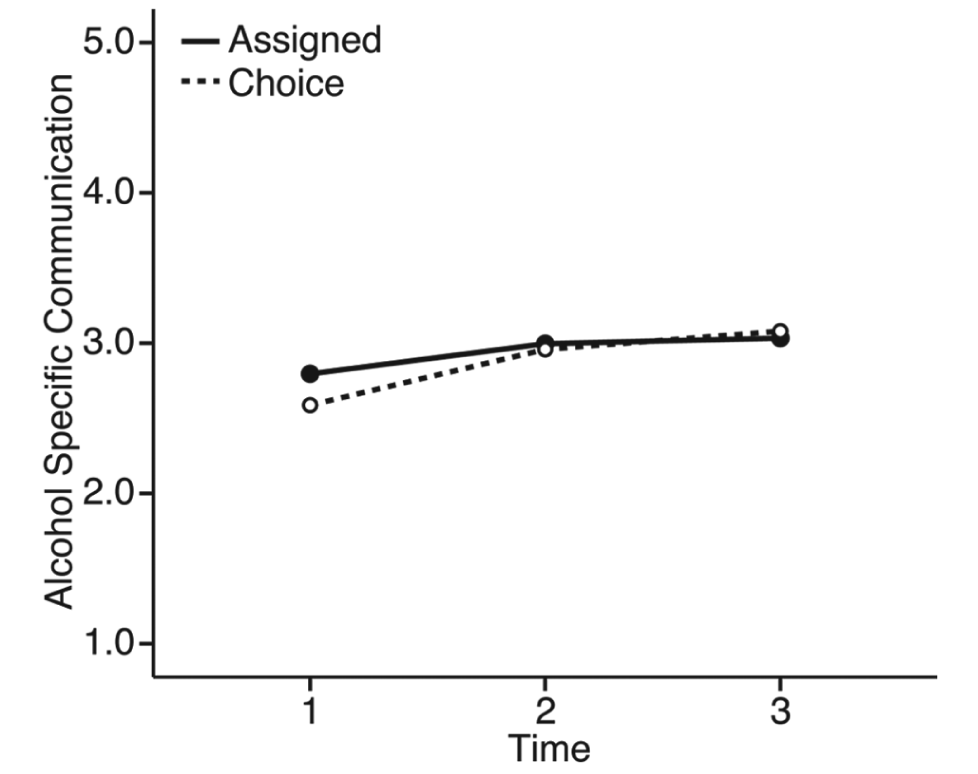
Estimated marginal means for alcohol-specific communication by group

Estimated marginal means for tobacco-specific communication by group

Estimated marginal means for peer pressure discussions by group.
Mothers in the Choice group also had significantly higher levels of tobacco communication over time than mothers in the Assigned group (F = 3.28, df = 2.00, p < .05). Figure 3 shows the pattern of change for both groups, as tobacco communication declined over time for the Assigned group, whereas it increased and then decreased for the Choice group, although it still remained better than the Assigned group. Results show that having a choice of programs was related to greater tobacco communication over time.
Similarly, Choice group mothers also had higher scores for peer pressure discussions over time than mothers in the Assigned group (F= 3.67, df = 2.00, p < .05). As presented in Figure 4, both groups showed large increases in peer pressure discussions between Times 1 and 2, with the Choice group remaining relatively steady at Time 3, whereas the Assigned group showed a slight decline. Findings indicate that mothers who were able to choose their program had improved peer pressure discussions over time. The group by time interaction was not significant for general communication (F = 1.89, df = 2.00, p = .15), indicating that Choice and Assigned group mothers had similar levels of general communication over time. For the substance-specific and peer pressure communication, we also conducted analyses controlling for overall general communication, and findings were similar.
Discussion
Overall, findings provide some evidence of the importance of having a choice of prevention options for improved communication outcomes: specifically, those communication skills related to tobacco and peer pressure resistance, with marginal improvement for alcohol communication. Across all three specific communication behaviors, we found either significant or trend findings suggesting that having a choice improved outcomes. However, no differences were found between the two groups for general communication. This may be because the programs implemented in this study emphasized risk-specific communications, rather than general communication. Therefore, effects may have been stronger for the more highly targeted communication behaviors.
Results are consistent with self-determination theory (Deci & Ryan, 1985, 2000), in that having a choice is thought to be related to improved outcomes because of the increased motivation that comes from the autonomy and feelings of self-control of being involved in one’s own treatment. Being able to choose one’s own treatment is related to greater feelings of self-efficacy, autonomy, personal control, and enjoyment of the activity, which may be related to improved outcomes (Clark & Dodge, 1999; Cordova & Lepper, 1996; Iyengar & Lepper, 1999; Taylor, 1989). Findings are also consistent with previous studies showing that having a choice of health-related interventions is associated with better outcomes (Clark et al., 2008; de C. Williams et al., 1999). Although findings show that choice may be important for improved outcomes, it is important to note that if parents choose a program not shown to be effective, outcomes may not be improved. However, in the current study, both program choices had been demonstrated to be effective for preventing adolescent ATOD use (e.g., Bauman et al., 2002; Spoth et al., 2001).
Interestingly, descriptive analyses also showed a demographic difference in families willing to participate. In the Choice condition, minority mothers were more likely to participate. This is consistent with prior studies showing that some minority groups have a distrust of the medical/scientific community (Yancey, Ortega, & Kumanyika, 2006) and so may only participate when they know they will have control over their own treatment. Accordingly, ethnicity was controlled for in all analyses.
Possibly, mothers who were given a choice may have better outcomes because they received their preferred intervention rather than because they were allowed to make a choice. As participant characteristics and needs influence preference (B. A. Miller et al., 2012), participants typically have a preference for a specific treatment (Swift & Callahan, 2009) even if they are in an assigned condition and thus do not get to choose. Therefore, if participants are assigned to the intervention they prefer, outcomes may be as good as if they had been given the freedom to choose their intervention. For example, in a study of depressed primary care patients, patients who received their preferred treatment had better outcomes than those that did not, regardless of whether they chose or were randomized to their preferred treatment (Mergl et al., 2011). Findings are not consistent, however. One study found no difference between patients that received their preferred versus nonpreferred treatment through a randomized process (Leykin et al., 2007). Future studies examining the influence of having a choice should also assess program preference to examine the relative influence of the ability to choose as compared with the influence of receiving one’s preferred intervention in family-based prevention programs.
The limitations of the current study should be noted. This is a study of families who wanted to participate in a family-based prevention study, and therefore the findings cannot be generalized to all families. Thus, our overall recruitment rate is reflective of real-world conditions appropriate to clinical settings and represents families who are willing to participate in a prevention program, differences based on choice. From a clinical perspective, these findings have meaning because most agencies and health care facilities are interested in the impact of the program among the families they can engage.
Although our sample reflected a wide range of incomes, the sample was relatively advantaged overall, and this may influence generalizability. We thus controlled for income in our analyses. In addition, because the sample included only mothers and their 11- to 12-year-olds, generalization to fathers and other age-groups of youth is limited.
Another limitation is that only mothers were allowed to choose the prevention program for their family. Since mother–youth communication depends on the involvement of both youth and mothers, if youth had been allowed to choose, communication outcomes may have been different. Future studies might also examine the influence of the person making the decision (mothers vs. fathers vs. youth). The low recruitment rate is another limitation. However, engaging participants in prevention programs, particularly family-based programs, is challenging (Heinrichs, Bertram, Kuschel, & Hahlweg, 2005; Prinz et al., 2001; Spoth & Redmond, 2000). As a result, recruitment rates tend to be very low (Heinrichs et al., 2005). Our recruitment rate of 25% is comparable to other family-based prevention programs, for example, as reported by Heinrichs et al. (2005; 31%).
It should also be noted that for alcohol communication, even with randomization, the Choice group started out with worse communication at baseline and showed improvement over time to become similar to that of the Assigned group. It is possible that some of this could be attributed to regression to the mean. However, for other outcomes (tobacco and peer pressure communication), the Choice group starts out with lower communication and ends with better communication than the Assigned group at Time 3, arguing against regression to the mean as an explanation for our findings.
Conclusions
This study makes several contributions to the literature. First, it adds to the growing body of literature suggesting that involving the individual(s) who are the focus of the intervention control over decisions regarding the intervention modality can have a positive impact on outcomes. This is in keeping with alcohol treatment literature that has emphasized the importance of involving the client in their treatment for beneficial outcomes (W. R. Miller & Rollnick, 1991).
Second, this study examines the impact of choice in a real-world setting. The study examines families who desired participating in a family-based prevention study and so is reflective of real-world conditions. However, it is important for communities and health care organizations to examine whether the size of differences is important enough to warrant the expense of offering two programs, especially if resources are limited. However, small differences may have meaning because of perceived differences, rather than the actual size of the differences. In addition, although differences may be small, over the course of the general population, this could mean large numbers of people affected.
Third, this study suggests new directions for future research. Future studies should examine the mechanisms of choice on outcomes in family-based prevention programs for adolescent ATOD use. Studies could examine engagement (i.e., motivation, adherence, satisfaction with intervention) as a mediator of the relationship between choice and program outcomes. This would have important implications for cost-effectiveness as well, since individuals who are more engaged in the intervention may attend more scheduled sessions.
Footnotes
Authors’ Note
The contents of this article are solely the responsibility of the authors and do not necessarily represent the official views of the National Institute on Alcohol Abuse and Alcoholism or the National Institutes of Health.
Declaration of Conflicting Interests
The authors declared no potential conflicts of interest with respect to the research, authorship, and/or publication of this article.
Funding
The authors disclosed receipt of the following financial support for the research, authorship, and/or publication of this article:
This work was supported by National Institute on Alcohol Abuse and Alcoholism (Grant No. R01-AA015323-01, 2005-2010, “Adolescent Family-Based Alcohol Prevention,” to Brenda A. Miller).