




Abstract
Purpose:
Google Trends (GT) offers insights into public interests and behaviors and holds potential for guiding public health campaigns. We evaluated trends in US searches for sunscreen, sunburn, skin cancer, and melanoma and their relationships with melanoma outcomes.
Design:
Google Trends was queried for US search volumes from 2004 to 2017. Time-matched search term data were correlated with melanoma outcomes data from Surveillance Epidemiology and End Results Program and United States Cancer Statistics databases (2004-2014 and 2010-2014, respectively).
Setting:
Users of the Google search engine in the United States.
Participants:
Google search engine users in the United States. This represents approximately 65% of the population.
Measures:
Search volumes, melanoma outcomes.
Analysis:
Pearson correlations between search term volumes, time, and national melanoma outcomes. Spearman correlations between state-level search data and melanoma outcomes.
Results:
The terms “sunscreen,” “sunburn,” “skin cancer,” and “melanoma” were all highly correlated (P < .001), with sunscreen and sunburn having the greatest correlation (r = 0.95). Sunscreen/sunburn searches have increased over time, but skin cancer/melanoma searches have decreased (P < .05). Nationally, sunscreen, sunburn, and skin cancer were significantly correlated with melanoma incidence. At the state level, only sunscreen and melanoma searches were significantly correlated with melanoma incidence.
Conclusions:
We conclude that online skin cancer prevention campaigns should focus on the search terms “sunburn” and “sunscreen,” given the decreasing online searches for skin cancer and melanoma. This is reinforced by the finding that sunscreen searches are higher in areas with higher melanoma incidence.
Keywords
Purpose
Quantifying the effects of outreach efforts on public interest in skin cancer or risk factor modification is difficult. Google Trends (GT) is a web site containing freely available data on user search queries for specific keywords over specified time intervals and geographic locations. Google Trends can provide baseline trends in public interests as well as track changes in interests over time. In dermatology, GT has been used to evaluate trends in tanning bed interest over time as more public education efforts have discouraged their use. 1
Little is known regarding public interest in searches for sunscreen and sunburn; one study explored seasonal trends in sunscreen searches. 2 We sought to evaluate baseline trends in public interest for the terms sunscreen, sunburn, skin cancer, and melanoma and evaluate correlations between search terms and melanoma outcomes. Correlations with melanoma outcomes were performed to identify areas of potential mismatch (ie, areas where interest is low despite high melanoma incidence). Presumably, areas with higher melanoma incidence should have more melanoma searches due to increased public education and awareness; areas with a mismatch may benefit more from educational campaigns. 1 Understanding trends in public interest can aid in monitoring outreach effectiveness and message optimization with popular keyword selection.
Methods
Design
This study used publicly available data and did not require institutional review board approval. Data were collected for averaged state-based searches for sunscreen, sunburn, skin cancer, and melanoma as well as monthly national data. Trend analysis using correlations was performed for between-search term relationships and search term popularity over time was assessed with correlations between search term and month. Month signified the number of months since January 01, 2004, ranging from 1 to 170. Positive correlations with month represented increased search term popularity over time. Correlations between GT search data and state-based and national melanoma outcomes data were also performed to evaluate whether differences in outcomes may affect public interests.
Sample
Search volume data for the terms sunscreen, sunburn, skin cancer, and melanoma were downloaded in February 2018 from trends.google.com for US searches between January 2004 and February 2018, as GT data starts in January 2004. Age-adjusted melanoma incidence and mortality data came from the publicly accessible United States Cancer Statistics (USCS) database by the Centers for Disease Control and Prevention (state-based) and Surveillance Epidemiology and End Results Program (SEER, national) databases. 3,4 State melanoma data from USCS represented the overall age-adjusted melanoma incidences and mortality rates for each state; Nevada was excluded from analyses due to missing incidence data.
Measures
Google Trends reports search volume data in “search volume indices”, which represent a standardized form of the number of searches for a keyword of interest in a specific geographical area within a specified time frame. Keyword searches are standardized to the total number of searches being performed during each time point to adjust for overall trends in search engine usage. This number is then converted to a 100-point scale, with 100 representing the highest volume search term and other search terms adjusted proportionately. 5 Thus, for our 4 search terms, the term with the highest search volume would become “100.” As such, all 4 search terms were queried together for between-term correlational analysis, but to analyze search trends over time and comparisons with melanoma outcomes data, each term was queried individually.
Google Trends outputs US search data in 2 ways: (1) state based, representing an averaged overall search volume for each state for the entire time range selected, which allows between-state comparisons of aggregate search term volume; and (2) national, representing month-to-month measurements of each search term for the entire country, but lacking state-level granularity. State-based search data were truncated (2010-2014) to match available state-based melanoma outcome data from the USCS database. National search term comparisons were made with annual national melanoma outcomes (incidence and mortality) matching the availability of outcomes data from SEER (2004-2014).
Analysis
Relationships between search terms and comparisons of searches with national melanoma outcomes were evaluated using Pearson correlations. State-level search data and melanoma outcomes were compared using Spearman correlations to better account for outliers in search data. Statistical significance was defined as P < .05. All statistics were conducted using STATA version 14.2 (College Station, Texas).
Results
All search terms demonstrated seasonal variation, with more searches for all terms during spring/summer months and fewer during winter months (Figure 1). Nationally, the most popular search term from 2004 to 2017 was skin cancer, followed by melanoma, sunscreen, then sunburn. However, in more recent years, sunscreen and sunburn have become more popular than skin cancer, especially during peak times (Figure 1). The most popular overall search term by state and each search term’s variations in popularity are shown in Figures 2 and 3, respectively.
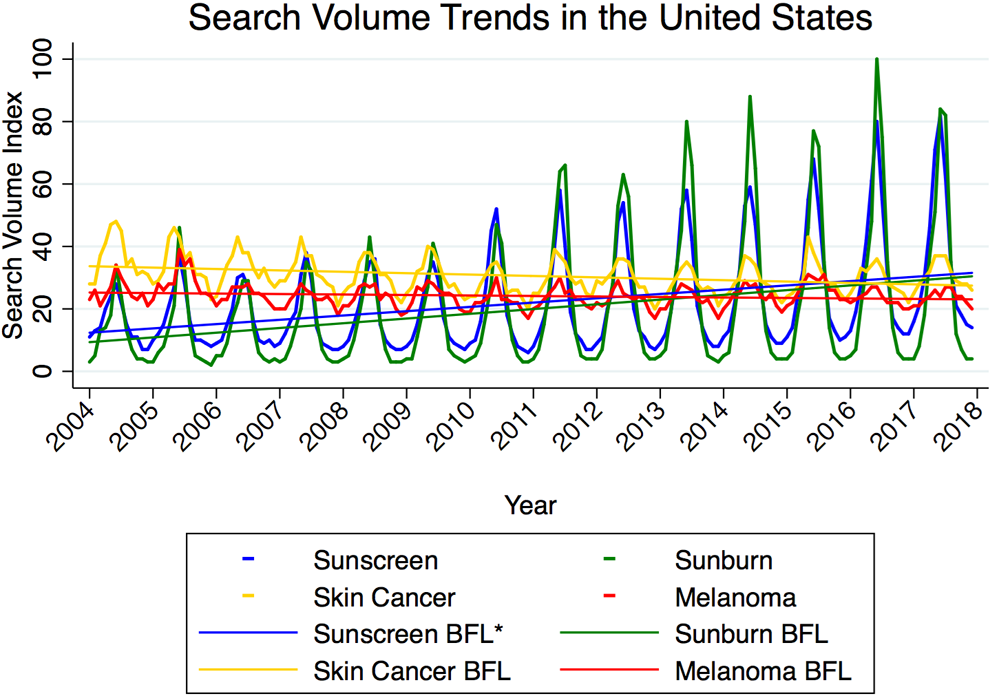
Overall search volume indexes (SVIs) for sunscreen (blue), sunburn (green), skin cancer (yellow), and melanoma (red) in the United States from January 2004 to February 2018. Best fit lines (BFL) visually depict general trends in search term popularity over time.

Screenshot from the Google Trends software showing distribution of top search volumes by state. For each state, the color represents the most popular search term: blue (sunscreen), green (sunburn), yellow (skin cancer), and red (melanoma).

Top left: Thermal map showing the relative search volumes for sunscreen by state. States with darker colors had higher search volumes. Top right: Thermal map showing the relative search volumes for sunburn. Bottom left: Thermal map showing the relative search volumes for skin cancer. Bottom right: Thermal map showing the relative search volumes for melanoma.
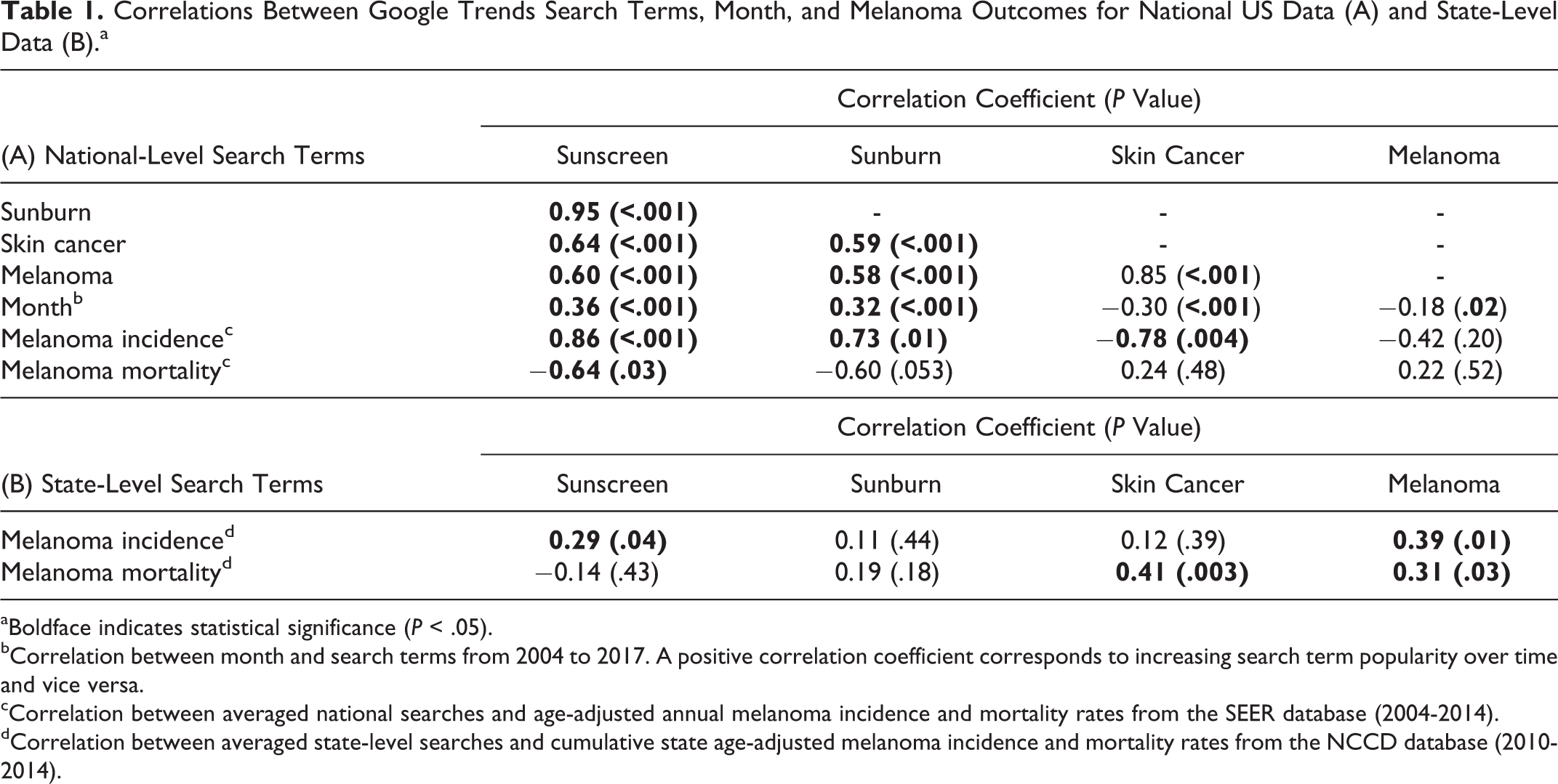
Significant positive correlations were seen between all search terms (P < .05; Table 1A). The strongest correlation existed between sunscreen and sunburn (r = 0.95) and the weakest between sunburn and skin cancer/melanoma (r = 0.59 and r = 0.58, respectively). From 2004 to 2018, search frequencies increased over time (positive and significant r) for sunscreen and sunburn (r = 0.36 and r = 0.32, respectively, P < .001), but decreased (negative and significant r) for melanoma and skin cancer (r = −0.30, and r = −0.18, respectively, P < .05; Figure 1 and Table 1A).
Correlations Between Google Trends Search Terms, Month, and Melanoma Outcomes for National US Data (A) and State-Level Data (B).a
aBoldface indicates statistical significance (P < .05).
bCorrelation between month and search terms from 2004 to 2017. A positive correlation coefficient corresponds to increasing search term popularity over time and vice versa.
cCorrelation between averaged national searches and age-adjusted annual melanoma incidence and mortality rates from the SEER database (2004-2014).
dCorrelation between averaged state-level searches and cumulative state age-adjusted melanoma incidence and mortality rates from the NCCD database (2010-2014).
National (Table 1A) and state-by-state (Table 1B) comparisons with melanoma outcomes were assessed. Nationally, sunscreen and sunburn were significantly and positively associated with melanoma incidence. Skin cancer searches were significantly and negatively associated with melanoma incidence. Only sunscreen searches were significantly correlated (negative) with mortality (P = .03). Using state-level data, the terms sunscreen and melanoma were significantly and positively associated with melanoma incidence, whereas skin cancer and melanoma were positively correlated with mortality (Table 1B).
Discussion
Summary
Seasonal variation in sunscreen, skin cancer, and melanoma searches has been reported. 1,6 Our data support this and demonstrate a similar pattern for sunburn. More recently, sunburn has become the most popular of these 4 search terms (Figure 1), reinforcing the need to target the term sunburn in melanoma outreach campaigns. Also, despite being more popular overall, sunscreen and sunburn searches were less popular than melanoma and skin cancer searches during winter months, indicating that outreach campaigns should target the terms skin cancer and melanoma during winter months. Thus, melanoma prevention campaigns would improve by optimizing year-round search-term targeting based on seasonal popularity instead of targeting melanoma only.
Previous literature has suggested that skin cancer and melanoma prevention campaigns have led to increased online interest in sunscreen. 2 We question these findings, as sunscreen searches were most closely correlated with sunburn searches than with skin cancer or melanoma. Also, sunscreen/sunburn searches are increasing in popularity, but skin cancer/melanoma searches are decreasing. Regardless of the reasons behind these trends, exploiting these high-interest key words improves message penetration. Additionally, evaluating keyword searches before and after a campaign helps quantify the campaign’s impact.
The positive correlation between national sunscreen/sunburn searches and cumulative melanoma incidence reflects an increasing popularity in these 2 terms that mirrors the increasing national melanoma incidence. Interestingly, skin cancer/melanoma searches did not follow this trend; skin cancer was significantly and negatively associated with national melanoma incidence. The decreasing interest in skin cancer/melanoma is concerning and highlights the need for search term optimization.
At the state level, sunscreen and melanoma searches were significantly and positively associated with melanoma incidence, meaning that these keywords were searched more frequently in states with higher melanoma incidence (Table 1B). Sunburn and skin cancer searches were not correlated with melanoma incidence, suggesting the need for more pointed education on these topics and more tailored educational messages based on GT search volume analysis by location. State-based GT data (Figure 3) can further aid in identifying areas with unique search interests.
Only skin cancer/melanoma searches were associated with state-based melanoma mortality data (Table 1B), suggesting that high mortality areas generate increased interest specifically in skin cancer and melanoma, which can also aid in tailoring educational campaigns. For example, messaging in areas with high melanoma mortality can emphasize the importance of regular skin screenings to improve early melanoma detection. Dermatologic societies can use these data to identify areas that need more dermatologists and improved access. 7
Limitations
Google Trends research has several limitations. Internet access is not universal with US Internet penetration >85%. 8 Another limitation involves the uncertainty in interpreting GT data in that searches for behaviors may not actually reflect behaviors and geographic search volumes cannot adjust for transient changes like tourism. Additionally, provision of nonadjusted data would aid in research flexibility.
Significance
These data support seasonally guided targeting of search terms for skin cancer and melanoma prevention. Sunscreen and sunburn searches were closely correlated and increasing in popularity, so educational efforts should focus on these terms. Finally, interests in skin cancer-related topics are affected by variations in melanoma outcomes geographically, highlighting the utility of GT to tailor outreach efforts toward the specific interests of local populations.
So What?
What is already known on this topic?
Google trends gained notoriety tracking areas of increasing influenza infection rates during the H1N1 outbreak. Dermatologic Google trends studies have evaluated seasonal trends and patterns surrounding tanning bed use as well as searches for sunscreen.
What this article adds to the body of knowledge?
This research provides insights for online skin cancer prevention campaign key word targeting. The terms “sunscreen” and “sunburn” are highly correlated and the popularity of these terms is increasing, suggesting these terms be targeted for online campaigns.
Implications for health promotion practice or research?
Google Trends aids in evaluating public interest and trends in interests regarding skin cancer prevention topics. By utilizing these results, and this tool, health promotion practitioners, clinicians, and researchers can better target educational campaigns, thus optimizing message penetration.
Footnotes
Authors’ Note
This article has been presented at the 2018 American Academy of Dermatology meeting in San Diego, California, and is not currently under consideration for publication elsewhere.
Declaration of Conflicting Interests
The author(s) declared the following potential conflicts of interest with respect to the research, authorship, and/or publication of this article: Dr Secrest is on the Advisory Board of VisualDx.
Funding
The author(s) received no financial support for the research, authorship, and/or publication of this article.
