




Abstract
Objective:
To synthesize evidence from qualitative studies relating to adolescent girls’ perceptions of physical activity participation. The protocol for this review is registered with PROSPERO (ID no. CRD42017054944).
Data Source:
PubMed, Sports Discus, Academic Search Complete, and Education Resources Information Centre.
Inclusion and Exclusion Criteria:
Studies reporting qualitative data that explored the views/opinions/perceptions of adolescent girls (>12 and <18 years old) published between 2001 and 2016 were included. Studies not in English, those focusing on school physical education or specific sports, and those including special populations were excluded.
Extraction:
Study characteristics and results were extracted to a form developed by the authors and managed using NVivo 10 (QSR International’s NVivo 10 software). Data were extracted by 1 reviewer, and a sample (25%) was checked by a second reviewer.
Synthesis:
Data were synthesized using a thematic network and managed using NVivo 10. The validity of the included studies was assessed using the “Critical Appraisal Skills Programme (2018)” checklist. The ENTREQ and PRISMA statement was followed when reporting this qualitative synthesis.
Results:
Of the 1818 studies identified in the search strategy, 24 met the inclusion criteria and were included in the analysis. Global themes were identified using a thematic network. These themes were “Gender Bias in Sport,” “Motivation and Perceived Competence,” “Competing Priorities during Adolescence,” and “Meeting Societal Expectations.”
Conclusions:
The results of this review provide insights into adolescent girls’ views on physical activity. Future research is needed to investigate the potential impact of alternative activity programs on adolescent girls with appropriate follow-up. Researchers and individuals working with young girls must consider the role of perceived motor competence in participation and how this can impact their perceptions.
Introduction
Participation in regular physical activity (PA) is associated with numerous physical benefits, including reduced blood pressure, lower cholesterol, and reduced risk of coronary heart disease. 1 –3 Physical activity can also positively impact psychological well-being, reducing stress and anxiety. 1,2 Despite the strong evidence for PA engagement, physical inactivity has been identified as the fourth leading risk factor for global mortality. 4
Numerous benefits are associated with PA in school-aged children and adolescents. 5 However, adolescents do not accumulate sufficient PA, failing to reach the recommended 60 minutes of moderate to vigorous physical activity a day. 6 Girls are frequently reported as being inactive, 6,7 with 95% of adolescent girls across 100 countries considered insufficiently active. 6 The influences on PA participation during adolescence are multifactorial, 8 and girls cite many barriers to their participation, 9 including feeling incompetent and disliking structured sport. 10,11 Adolescent girls have demonstrated lower life satisfaction than their male counterparts, 12 and this evaluation of quality of life is an important indicator of well-being. 12 Similar to PA levels, life satisfaction decreases with age for this population. 12 The benefits gained from regular PA engagement are paramount during adolescence for growth and development, 2 with health behaviors adopted during adolescence tracking into adulthood. 13 As adolescent behaviors are predictive of adult behaviors, promoting a healthy lifestyle at this stage is crucial to shape PA behaviors for life. 14
Several interventions have targeted the PA behaviors of adolescents yet have only demonstrated modest effects. 14 In the United States in particular, there have been some interventions targeting girls in both middle school (Trial of Activity in Adolescent Girls) 15 and high school (Lifestyle Education for Activity Project). 16 Interventions such as these that were based on extensive formative research did demonstrate increased PA in adolescent girls; however, the effects were modest. Interventions have been documented as being unsuccessful to date due to an inability to meet the interests of the participants, resulting in a contrast between the activities provided and the participants interests. 17 Without the involvement of youth voice, interventions fail to accurately represent the needs of adolescents 18 ; therefore, gaining an understanding of participant perceptions is integral for improving intervention design. 19 Several qualitative studies have been conducted, providing insights into adolescent girls’ perceptions of PA, identifying various barriers and facilitators to PA 20 –23 ; however, no previous review has synthesized qualitative studies to allow for the development of overarching perceptions that go beyond individual study findings. 24
Objective
To synthesize evidence from qualitative studies relating to adolescent girls’ perceptions of PA participation.
Methods
The present article is reported in accordance with the Preferred Reporting Items for Systematic Reviews and Meta-Analyses (PRISMA) and the Enhancing Transparency in Reporting the synthesis of Qualitative research (ENTREQ) statements (supplementary files 1 and 2). 25,26 The protocol for this review has been registered with PROSPERO (https://www.crd.york.ac.uk/prospero/display_record.php?RecordID=54944).
Data Sources
A preplanned electronic search was carried out on 4 electronic databases: PubMed, Sports Discus, Education Resources Information Centre, and Academic Search Complete. A record of the search strategy, which was developed in consultation with a librarian, is available in Supplementary file 3. Forward and backward citation searches of results from the online searches were also conducted.
Inclusion and Exclusion Criteria
Studies published between 2001 and 2016 reporting qualitative data exploring the views and perceptions of adolescent girls >12 years and <18 years old with regard to PA were included. Studies including both males and females were included if the data on females were presented separately to males.
Studies with a sport or physical education (PE) focus were excluded, as the aim of this review was to synthesis girls’ perceptions of PA, not a specific sport or subject. Studies focusing on special populations were also excluded (eg, individuals with cerebral palsy). Studies not in English were excluded as translation resources were not available. Finally, studies where the qualitative data were part of an existing intervention or program were excluded because the results pertained to adolescent’s views of the intervention, rather than PA in general.
Screening and Data Extraction
Results from the searches were imported into EndNote reference management software and duplicates were removed. Remaining studies were imported into Covidence (2016), 27 a web-based software to streamline systematic review production, and initially screened by title and abstract by 2 reviewers. Conflicts were resolved through discussion. Full text of studies was reviewed by 2 reviewers, and conflicts were resolved through discussion.
Study characteristics including setting, participants, data collection, and analysis were extracted to a form developed by the authors. Text under the results sections were extracted and imported into NVivo 10, a qualitative data management software. Data were extracted by 1 reviewer, and a sample (25%) was checked by a second reviewer.
Synthesis Methodology and Appraisal
A thematic synthesis following the guidelines of Thomas and Harden 28 was conducted. Thematic networks were used to draw on core features that were common to several studies. 29 Using a thematic network, basic, organizing, and global themes were created. Initial coding took place inductively on a subset of papers, coding line-by-line. A sample of studies (10%) were coded by a second reviewer to ensure all themes were considered. Once all initial coding was completed, basic themes were created and were combined to form organizing themes and subsequently grouped into global themes. 29
The quality and validity of included studies was assessed using the “Critical Appraisal Skills Programme (2018)” (CASP) toolkit, 30 allowing the researchers to assess the appropriateness of the methodology, participants, study design, and data analysis. The toolkit comprises of 10 questions, and 2 authors appraised each study independently. The results of these appraisals were compared, and conflicts were resolved through discussion.
Results
In all, 1818 studies were identified through database searches, 24 met the inclusion criteria and were included in the analysis (see Figure 1); 29% (n = 7) were conducted in Canada, 21% (n = 5) in Australia, 16% (n = 4) in the United Kingdom, 16% (n = 4) in the United States, and the remaining studies were set in Asia, South America, South Africa, and Ireland. The school setting was used by most of studies (n = 20) and 5 studies included data from males and females. Content and thematic analysis was the most common analysis tool used within the included studies. Activity levels of participants varied across studies, with 41% (n = 10) involving a mixture of active and inactive participants, 20,31 –39 12% (n = 3) involved active participants, 22,40,41 and 4% (n = 1) contained mostly inactive participants. 42 In 10 (41%) studies, participants’ activity levels were not explicitly stated. 21,23,43 –50 The characteristics of included studies can be seen Table 1.
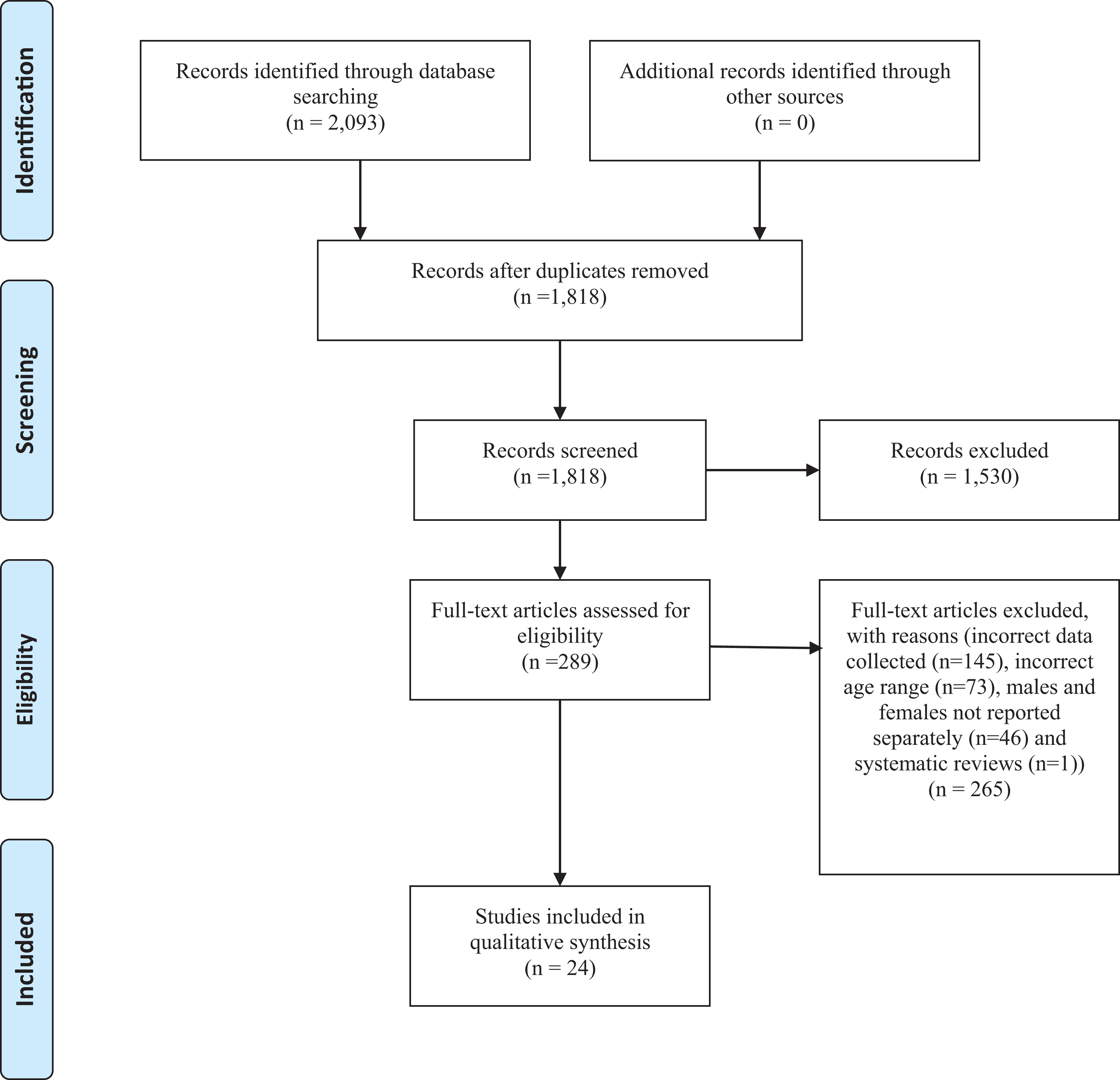
PRISMA 2009 flow diagram.
Characteristics of Included Studies.

In general, the included studies met the CASP criteria in terms of clarity of aims, appropriate design, and rigorous data analysis. The majority (n = 19) provided insufficient detail regarding a consideration of the researcher/participant relationship and details of ethical approval and informed consent.
Initial coding resulted in the development of 73 basic codes. Basic codes were then grouped into organizing themes (n = 18). Analysis of organizing themes resulted in the development of 4 global themes: “Gender bias in sport,” Motivation and perceived competence,” “Competing priorities during adolescence,” and “Meeting societal expectations.” These themes and their subthemes are discussed below. Quotations from participants in included studies are presented in “italics.”
“Gender Bias in Sport”
The first major theme encompassed pressures from society to uphold a feminine image and internal barriers felt regarding participation in PA. Across studies, authors reported struggles faced by girls attempting to be active in a society which they perceived to portray PA as something masculine.
Body image/body-centered issues
Internal barriers, including body image and menstruation, were discussed in 15 studies. 21,23,31 –34,36 –42,47,48 Across these studies, girls with low perceived competence and high weight status discussed how this acted as a barrier for their participation. Many overweight girls lacked motor skills and held a negative attitude toward PA, finding the prospect of being active daunting, especially in the presence of males. A fear of embarrassment hindered participation, with several girls across studies noting it is not possible to look good 23 and be active at the same time as: what stops a lot of girls from doing sports is that they’re worried about how they look, their make-up, and everything. 21
Biological changes experienced during puberty also deterred participation. In several studies, girls discussed feeling gross 38 and experiencing discomfort while menstruating, leading to increased self-consciousness and reduced PA. Some girls reported using menstruation as an excuse to opt of PE: Sometimes I lie and say I have my [menstrual] period and that I don’t feel well, so the teacher lets me skip [the] class. 47
Societal pressure
Societal pressure, including bullying and stereotypes of femininity, were discussed in 18 of the studies. 20,21,23,31 –37,39 –43,45,47,50 Girls experienced teasing from peers due to low competence levels, and pressures to perform deterred their desire to participate: If you are in a team with all the good people, you have to make sure that you do everything right, there’s always pressure. 33
Another common assumption across the studies was that PA was not suitable for girls. A fear of being viewed negatively for engaging in activities that were not considered gender-appropriate deterred their participation. Girls were aware of the gendered nature of PA, discussing how they would be viewed as “masculine” if they did not conform to societal norms. Girls were reluctant to participate in what they considered to be “boys sports”: if some girls wanna play football or soccer (mm) and then some like other girls that don’t want to play it, [they] just look at them weirdly and say you’re a boy, you’re playing a boy’s game. 36 Being physically active contradicted the image of femininity portrayed to girls by society.
Peer and teacher feedback
The influence of both teacher and peer feedback was discussed in 21 of the included studies. 20,21,23,31 –34,36,38,40 –50 The opinions of boys had a particularly strong influence on girls PA perceptions: Some of the girls…when they’re trying to be, trying to join in and trying to be good sports (mm) and people [boys] are teasing them about it, so it can affect them so they just don’t. 36 The influence of the PE teacher also impacted girls’ perceptions of PA, with several girls noting that male PE teachers were unsupportive, too competitive, and more interested in the boys in the class: Male [teachers] just make you think that you just don’t want to do it. 33 There was an assumption that some PE teachers assumed that girls did not want to participate and did not encourage their participation. In fact, several girls across the studies found that PE teachers often discouraged their participation in PA, claiming the boys would be “too rough” on them, emphasizing the gendered roles evident in PA and team sports.
However, active girls received positive feedback from both peers and teachers. Their high skill levels and perceived competence led to encouragement from teachers: One of the teachers said I was really good at netball at school and that’s when I tried to get into netball. 33 Due to their higher skill levels, being able to participate with peers was fun, unlike the inactive girls who found trying to participate with skilled peers stressful. These active adolescents also discussed the benefits of PA to make new friends. Making new friends and being able to actively participate made PA fun, which helped sustain their motivation for engagement: Having friends there makes it a lot easier; it makes it more comfortable to do sports, and because you get to spend more time with friends, you look forward to the activities. 39
“Motivation and Perceived Competence”
The second theme describes the contrast in motivation felt by active and inactive girls. Across studies, girls with low perceived competence discussed how their lack of motivation stemmed from low levels of perceived skill, a dislike of team sports, and negative feedback from peers and teachers.
Low perceived skill
Ability levels and competition were discussed in several studies. 20,21,32 –34,36 –38,40,41,43,45,48,50 Within these studies, inactive girls discussed how their low motivation derived from their perceived low competence. Comparison of skill levels among peers led to disengagement. Girls often described enjoying PA yet withdrew because their peers were perceived to be more skilled. A reluctance to learn new skills or join new teams during adolescence was also seen, with girls explaining there was no point trying as you got older: I eventually stopped trying to do well in gym because I didn’t care—I wasn’t going to be good at it anyway. 38
Levels of competition increased during adolescence and pressure to perform well in a team setting led to high levels of disengagement. Girls within the studies discussed the burden of being placed on a “good team,” with poor performances leading to ridicule from peers. Girls also noted that as competition levels increased, those with lower levels of motor competence would not be chosen for a team. The embarrassment of not being picked resulted in girls no longer feeling a desire to try, with one participant saying don’t bother trying (to get into a sport team) you know you won’t get in if you have limited skills. 43
However, girls who perceived themselves to have high competence and skill were constantly cited as enjoying PA. Unlike their inactive peers, these girls thrived in competitive settings and enjoyed working to increase their skill levels. Being involved in competition provided an exhilarating rush: I like the flush you get out of being competitive, being competitive in sport, I love that. 40 These girls enjoyed being able to socialize and compete with their friends. These active girls were constantly motivated by the prospect of improving themselves and reaching goals. In contrast to their inactive peers, these girls liked to participate with males, stating it was more fun as boys provided higher levels of competition: boys, they really bring the excitement! 48
PA opportunities
Activities offered during PE, team sports, and a desire for single-sex classes were discussed in 22 of the included studies. 20,21,23,31 –37,39 –48,50 Within studies reporting data from less active girls, competitive sports and school PE were discouraging to their engagement: And we had the bleep test like nearly every month. It was AWFUL—err I hated it. The dropout rate went up because we just couldn’t be bothered to do it—we hated it—that awful taste in your mouth. 42 Negative PE experiences revolved around competitive team-based sports. The lack of variety and emphasis on skill did not appeal to these girls. A desire for single-sex classes and a wider variety of content was expressed, emphasizing fun and involvement rather than skill and competition: There should be more boys’ classes and girls’ classes because it makes you feel more comfortable and you would make more effort and all the girls would encourage each other. 33
“Competing Priorities During Adolescence”
The third theme highlights competing priorities, including increased school work, part-time jobs, and responsibilities at home. The PA was not perceived to be important enough to be prioritized in the lives of many adolescent girls with competing priorities discussed in 14 of the included studies. 20,21,31,34,37,40,42 –47,49,50
School work and home responsibilities
The increased importance of education and performance in examinations takes precedence over being physically active during adolescence. Many girls discussed not having time to do any PA due to increased workloads in school and the pressure from parents to perform well: Pretty much when I’m not at school I’m doing school work at home. 50
As well as increased school work, several adolescents within the studies described increased responsibilities at home, which restricted their ability to participate in PA. Doing housework, looking after younger siblings, and part-time employment were given a higher priority than PA. Taking on these responsibilities, combined with their school workload, left girls feeling they didn’t have time to be physically active: There are things that hold me back, like work. Work is a big issue because you can’t tell them, Oh well, that’s when I go to the gym, at night. They don’t care. You’re scheduled and you’re going to have to work. 21
Parental expectations
The expectations of parents and grandparents also influenced the girls’ perceptions of the importance of PA. Several girls discussed how their parents devalued PA, encouraging their daughters to study different subjects in school and to focus on achieving high grades: But she doesn’t want me to; she said get that out of your mind, what’s PE going to do for you in your life?. 44 From the included studies, several girls discuss how their parents would actively discourage their PA participation in favor of studying or working part time. This discouragement impacts the girls’ perceptions of PA, leading them to devalue and deprioritize it with the aim of pleasing their parents.
Changes in leisure activities
Another competing priority was the change in leisure experiences during adolescence. Adolescents have increased opportunities for leisure activities as they get older. The participants in several studies said they preferred to “hang out” with friends at shopping centers, go to the cinema, or spend time with boyfriends rather than be physically active: I like hanging out with mates just chilling, actually partying. 43 Some participants discussed how being physically active was not “cool” and opted to participate in alternative leisure activities.
“Meeting Societal Expectations”
The final theme discusses the influence of external factors, such as environments and the influence of peers and adults. For the self-proclaimed active girls, these influences are positive and encourage their involvement. Conversely, for those inactive girls, the influences in their lives are largely negative, leading to a disengagement from PA.
Peer influence
The influence of peers on adolescent girls’ perceptions of PA was discussed in 17 of the included studies. 20,21,23,31 –34,37,38,40 –42,44 –46,48,50 This influence was either positive or negative. For some girls, if their friends were involved in PA, then it became a motivating factor for them to be active too as well as increasing enjoyment levels and providing positive activity experiences: My best friend dances with me and it’s way more motivating cause then you know you won’t be alone when you need to go somewhere, and you tell yourself it’s going to be real fun. 20 However, in some cases within the included studies, girls discussed how they failed to participate in PA due to peer influence. This occurred for 2 reasons: first, girls didn’t want to participate in PA because their friends didn’t. If they participated, it meant they missed opportunities to spend time with friends, and as discussed in theme 3, these alternative activities took precedence during adolescence. The second reason was a fear of ridicule from friends: Some of the guys they like gang up on the girls and they just like make fun of them, like the way they look, and…they don’t want you playing with them and stuff. 35 Girls spoke of a reluctance to participate in activities because it led to their friends teasing them and excluding them from conversations.
Adult influence
Like peer influences, the influence of parents and adults on adolescent’s perceptions of PA had both positive and negative impacts. These influences were discussed in 17 of the included studies. 20,21,31 –34,36,37,40,42 –47,49,50 Girls with parents and teachers who supported and encouraged them to participate in PA had positive perceptions, in comparison to girls who lacked these supportive role models. These adolescents discussed how their parents never engaged in PA, or encouraged them to be active, leading to the development of negative opinions of PA. Lack of support from adults resulted in adolescents failing to see the value of PA and led them to mimic the inactive lifestyles they had observed at home: I was just tired of asking them (parents) for drives so I just quit. 20
Community influences
The community and environment in which an adolescent lived also impacted their perceptions of PA, with adolescents in rural and urban settings having varying opinions. These issues were discussed in 12 of the included studies. 32 –34,40,42,43,45 –47,49,50 Those in rural settings found they were limited in their choice of activities, making it difficult to participate in PA: In a little town it is kind of hard because there are not many teams. 33 If you failed to participate in a team sport, the likelihood you participated in PA was very low. In urban settings, however, there was a greater variety in activities, although financial constraints often hindered involvement, with girls discussing how gym membership was too expensive. Urban settings were also considered to have higher levels of competition: In the city its tougher competition to here. There’s more people and that makes it harder as well 40 ; therefore, if girls didn’t perceive themselves as competent in team sports, they were likely to cease participation.
Discussion
The present review is the first synthesis of qualitative studies focusing on adolescent girls’ perceptions of PA. The methods employed were transparent, rigorous, and reported according to published guidelines. The presented themes illustrate the opinions of both active and inactive girls in relation to their PA participation. This qualitative synthesis provides valuable insights into opinions of adolescent girls, which should be considered when creating opportunities to increase their PA levels. The results also provide practical application for researchers, policymakers, and individuals working to increase PA levels of adolescent girls in school or community settings.
Across studies, participants discussed the gendered nature of sport and PA. Historically, PA has been categorized into masculine and feminine domains, 51 with the majority of team-based sports being associated with traditional masculine qualities such as strength and competitiveness. 52,53 Within the media, PA has also been traditionally portrayed as masculine, emphasizing aggression and strength. 54 The gender roles in PA portrayed in society are adopted from a young age, and during adolescence there is a desire to align with peers and define oneself as either masculine or feminine. 55 Several girls within the included studies perceived PA and sport to be unfeminine, and their desires to appear feminine and fit in with peers deterred PA participation. Therefore, to change perceptions and increase participation rates, girls must feel empowered and motivated to be active and be given the tools to rethink their stereotyped perceptions of PA. 56 The PA opportunities provided must be on their terms 57 and their ideas must be included in an effort to create a positive environment and increase PA levels. 56
Along with the gendered nature of PA, levels of perceived competence, fear of embarrassment, and the type of activities provided influenced adolescent girls’ perceptions of PA across studies. Many of the self-proclaimed inactive girls reported low perceived competence, experienced humiliation in front of peers, and felt activities available did not encourage their participation. Perceived competence is central to self-esteem, 58 with motor skill proficiency developed as a child being a key indicator of positive competence, and in turn PA particiaption. 58,59 Given that much of school-based activities focus on team-based competitive sports, 60 girls lacking motor competence are often marginalized within PA. The traditional team-based setting where individual failure is negatively viewed results in girls opting out of PA, avoiding activities they feel they will not succeed in. 61,62 Less competent girls within this review found PE placed too much emphasis on performance and activities outside school were heavily focused on competition and ability. The PE is an ideal venue to increase actual and perceived motor competence (PMC) of children and adolescents, 59 with several studies reporting the positive impact PE can have on perceived competence. 63 –65 Although several studies focus on developing fundamental movement skills (FMS) in primary-aged students, emphasis must also be placed on those adolescents who have failed to adequately develop FMS, as there is a relationship between PMC, actual motor competence, and subsequent development of PA. 58 Perceived competence is particularly important for adolescents, as De Meester et al found adolescents with low actual motor competence but high PMC were more active than their peers with lower perceived competence, illustrating the importance of increasing PMC of this population. 66 Improving PMC and providing opportunities that encourage lifelong PA, emphasizing enjoyment over competition, should be prioritized for adolescent girls.
Another prominent theme regarding PA perceptions was the concept of having “no time” to be active. Competing priorities such as homework, part-time jobs, and spending time with peers were some of the reasons cited by girls in this review. The PA was not seen as valuable and therefore was not prioritized over other responsibilities. Schools provide an optimal site for the promotion and encouragement of PA, as young people spend most of their waking hours in school. 67 However, due to increased pressure for schools to produce high-quality standardized test scores, time spent in academic subjects are often increased, while time spent in PE is decreased or eliminated. 68,69 This illustrates to girls that PA should not be prioritized over academic subjects, and within this review it is evident that adolescent girls fail to see the value of PA. However, participation in regular PA has been shown to have a positive impact on learning and memory, 70 helping to improve cognitive performance and academic achievement. 68 , 71 Introducing more PA time in schools does not have a detrimental impact on academic performance, 72 but rather it can improve concentration and attention levels. 70 There is potential to increase the PA participation rates of girls if schools focused on the educational potential of PE rather than competition. 70 Highlighting the full range of benefits of PA to adolescent girls could be a key strategy in shifting their perceptions and getting them to prioritize their PA habits.
Finally, the influence of peers and friendship groups plays an important role in determining adolescent’s perceptions of PA, and this was evident in the included studies in both positive and negative ways. Peer support for PA with adolescent girls declines with age, while the importance of peer support for PA participation increases. 73 , 74 This trend was evident within this review, and participants with active peers were more likely to be active, while those with inactive peers were more likely to disengage from activity. The role of friendship groups must be considered when providing girls PA opportunities, as some girls will choose to participate in PA based on who else is participating, rather than the activity being offered. 74 Choosing activities based on friendship groups can lead to the development of a positive learning environment and increased levels of fun and engagement. 74
It is important to note that while the aim of this review was to investigate adolescent girls’ perceptions of PA without focusing specifically on school PE or sport, it became clear in this review that most adolescent girls cannot distinguish between the 3. This would suggest that PE and team sports are the main sources of activity for adolescent girls or that they do not identify other activities such as walking to school and others as PA. This further emphasizes the importance of providing opportunities for girls to engage in lifelong PA and introducing them to other forms of PA in both school and community settings that do not revolve around competitive team-based sports.
Implications for Future Research and Practice
The results of this qualitative synthesis provide insights into adolescent girls’ perceptions of PA, which can inform attempts to increase the PA levels of this cohort. However, the low number of included studies (n = 24) indicates the need for additional research to be done to truly understand how the activity levels of this cohort can be increased. Based on the findings from this review, it is recommended that future interventions focus on developing PMC in adolescents, as low perceived competence was often cited as a barrier to participation. As well as increasing PMC, future research is needed to investigate the potential impact of PA programs in schools incorporating peer leaders as peer support was found to be extremely important in this review.
Strengths and Limitations
The qualitative nature of this synthesis is a strength of the review, allowing for the development of themes and ideas which go beyond the findings of individual papers. The reporting of this review followed the PRISMA and ENTREQ guidelines, as well as adopting a rigorous search strategy and analysis of the findings. Limitations included the homogeneous nature of the settings for included studies, with over half being conducted in Canada and the United States. Additional research is needed in other countries to investigate the perceptions of adolescent girls from different cultures and countries. Similarly, there was inconsistency in the reporting of activity levels of participants within studies, with not all studies identifying the views of perceived “active” or “inactive” girls. Another potential limitation is that 19 of the 24 included studies provided insufficient detail regarding informed consent, ethical approval, and consideration of researcher/participant relationship. This may reflect issues with reporting, rather than the actual conduct of the studies; however, it is important that future studies are explicit in their reporting with regard to consent, ethical approval, and the participant–researcher relationship.
Conclusion
This qualitative synthesis of studies examining adolescent girls’ perceptions of PA demonstrates that PA behavior in this group is a complex topic, and many factors impact their perceptions. We have highlighted possible directions for future research and practice; however, more work is needed to investigate the potential impact of alternative PA programs on adolescent girls. Researchers and individuals working with young girls must also consider the important role of PMC in PA and how this can positively or negatively impact PA participation.
So What?
The present qualitative synthesis provides a thorough review of adolescent girls’ perceptions of PA, makes recommendations for future research, and reveals potential limitations in the existing evidence base.
It is important to note that within the included studies, adolescent girls conflated PA, sport, and PE. This would suggest that adolescent girls do not identify other forms of PA outside these domains (eg, walking to school). Our findings suggest PA programs for girls in both school and community settings should focus on alternative activities aside from the competitive team-based sports often offered. Opportunities to engage in single-sex activities may also be important for girls. Future programs should also focus on developing PA habits for lifelong engagement. Educating girls on the range of benefits of PA is also important as the findings from this review illustrate the PA is not prioritized during adolescence.
More high-quality studies are needed to increase the overall body of evidence on this topic. Future studies should report detailed information on informed consent, participant/researcher relationship, and ethical approval. Qualitative studies should also be diligent in distinguishing between the perceptions of girls who currently engage in PA and those who do not, allowing for the identification of strategies that work to engage girls in PA.
Supplemental Material
Supplementary_File_1 - Adolescent Girls’ Perceptions of Physical Activity: A Systematic Review of Qualitative Studies
Supplementary_File_1 for Adolescent Girls’ Perceptions of Physical Activity: A Systematic Review of Qualitative Studies by Méabh Corr, Jennifer McSharry and Elaine M. Murtagh in American Journal of Health Promotion
Supplemental Material
Supplementary_File_2 - Adolescent Girls’ Perceptions of Physical Activity: A Systematic Review of Qualitative Studies
Supplementary_File_2 for Adolescent Girls’ Perceptions of Physical Activity: A Systematic Review of Qualitative Studies by Méabh Corr, Jennifer McSharry and Elaine M. Murtagh in American Journal of Health Promotion
Supplemental Material
Supplementary_File_3 - Adolescent Girls’ Perceptions of Physical Activity: A Systematic Review of Qualitative Studies
Supplementary_File_3 for Adolescent Girls’ Perceptions of Physical Activity: A Systematic Review of Qualitative Studies by Méabh Corr, Jennifer McSharry and Elaine M. Murtagh in American Journal of Health Promotion
Footnotes
Declaration of Conflicting Interests
The author(s) declared no potential conflicts of interest with respect to the research, authorship, and/or publication of this article.
Funding
The author(s) disclosed receipt of the following financial support for the research, authorship and/or publication of this article:Méabh Corr is supported by a PhD Studentship from Mary Immaculate College.

Supplemental Material
Supplemental material for this article is available online.
References
Supplementary Material
Please find the following supplemental material available below.
For Open Access articles published under a Creative Commons License, all supplemental material carries the same license as the article it is associated with.
For non-Open Access articles published, all supplemental material carries a non-exclusive license, and permission requests for re-use of supplemental material or any part of supplemental material shall be sent directly to the copyright owner as specified in the copyright notice associated with the article.
