In brief
 Available accessIn briefFirst published June, 2019pp. 640-645

Select search scope: search across all journals or within the current journal


 Available accessIn briefFirst published June, 2019pp. 640-645Available accessEditorialFirst published June, 2019pp. 646-651
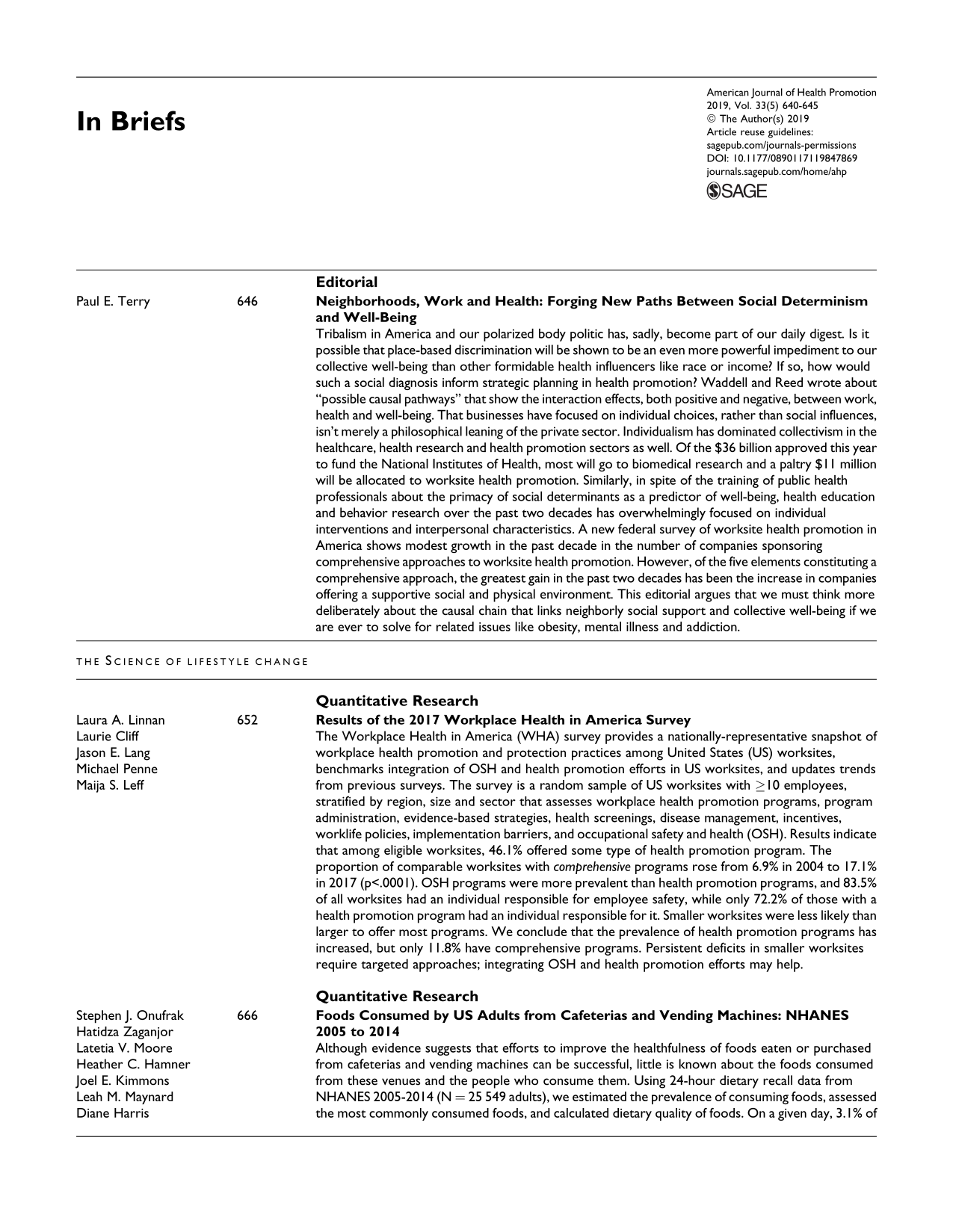
Tribalism in America and our polarized body politic has, sadly, become part of our daily digest. Is it possible that place-based discrimination will be shown to be an even more powerful impediment to our collective well-being than other formidable health influencers like race or income? If so, how would such a social diagnosis inform strategic planning in health promotion? Waddell and Reed wrote about “possible causal pathways” that show the interaction effects, both positive and negative, between work, health, and well-being. That businesses have focused on individual choices, rather than social influences, is not merely a philosophical leaning of the private sector. Individualism has dominated collectivism in the health care, health research, and health promotion sectors as well. Of the $36 billion approved this year to fund the National Institutes of Health, most will go to biomedical research and a paltry $11 million will be allocated to worksite health promotion. Similarly, in spite of the training of public health professionals about the primacy of social determinants as a predictor of well-being, health education and behavior research over the past 2 decades has overwhelmingly focused on individual interventions and interpersonal characteristics. A new federal survey of worksite health promotion in America shows modest growth in the past decade in the number of companies sponsoring comprehensive approaches to worksite health promotion. However, of the 5 elements constituting a comprehensive approach, the greatest gain in the past two decades has been the increase in companies offering a supportive social and physical environment. This editorial argues that we must think more deliberately about the causal chain that links neighborly social support and collective well-being if we are ever to solve for related issues like obesity, mental illness, and addiction.
Available accessResearch articleFirst published June, 2019pp. 652-665To provide a nationally representative snapshot of workplace health promotion (WHP) and protection practices among United States worksites.
Cross-sectional, self-report Workplace Health in America (WHA) Survey between November 2016 and September 2017.
National.
Random sample of US worksites with ≥10 employees, stratified by region, size, and North American Industrial Classification System sector.
Workplace health promotion programs, program administration, evidence-based strategies, health screenings, disease management, incentives, work–life policies, implementation barriers, and occupational safety and health (OSH).
Descriptive statistics,
Among eligible worksites, 10.1% (n = 3109) responded, 2843 retained in final sample, and 46.1% offered some type of WHP program. The proportion of comparable worksites with
The prevalence of WHP programs has increased but remains low across most health programs; few worksites have comprehensive programs. Smaller worksites have persistent deficits and require targeted approaches; integrated OSH and WHP efforts may help. Ongoing monitoring using the WHA Survey benchmarks OSH and WHP in US worksites, updates estimates from previous surveys, and identifies gaps in research and practice.
Available accessResearch articleFirst published June, 2019pp. 666-674As part of wellness efforts, employers may seek to improve the nutritional quality of foods offered and consumed in cafeterias and vending machines. However, little is known about who consumes food from these venues and the types and dietary quality of the foods consumed.
Cross-sectional.
Nonschool cafeterias and vending machines.
US adults ≥20 years old.
Prevalence of consuming foods, most common foods eaten, leading calorie sources, 2010
Using 24-hour dietary recall data from NHANES 2005-2014 (N = 25,549 adults), we estimated the prevalence of consuming foods, assessed the most commonly consumed foods, and calculated dietary quality of foods.
On a given day, 3.1% of adults consumed foods from cafeterias and 3.9% from vending machines. Consumers averaged 692 kcal from cafeterias and 264 kcal from vending machines. Cafeteria consumers had higher income and education, while vending consumers were more likely to be male and younger adults. Common cafeteria foods included vegetables and fruits, but cafeteria foods were generally high in sodium and low in whole grains. Sugar-sweetened beverages and candies accounted for approximately half of all vending calories.
Foods chosen from cafeterias and vending machines do not align well with the Dietary Guidelines for Americans. Improving the dietary quality of foods consumed from these venues could impact millions of adults.
Available accessResearch articleFirst published June, 2019pp. 675-682 , John Scerpella, Stephanie A. Kliethermes , [...]
To examine and compare the role of self-assessed sport and physical activity involvement on the health-related quality of life among undergraduate student-athletes and general undergraduate college students.
Cross-sectional survey. Data set was examined for differences in physical and mental health by self-assessed sport and physical activity level.
Large Midwestern University in the fall of 2016.
A combined data set representing undergraduate Division I student athletes (n = 842) and general undergraduate students (n = 1322).
Veterans RAND 12 Item Health Survey (VR-12), as measure of health-related quality of life, comprised of physical component score (PCS) and mental component score (MCS). Self-assessed sport and physical activity level categorized as Division I athlete, club athlete, intramural player, student who works out regularly, or student who is physically inactive.
Standard univariable statistics described the study population. Two-sample
Significant differences in MCS were noted between levels of sport and physical activity; however, such differences were not detected in PCS. After controlling for sex, a positive relationship between increased sport and physical activity level and greater MCS was found.
This study represents the first prospective assessment of health-related quality of life among undergraduate athletes and general college students. Higher levels of sport and physical activity were associated with more positive mental health in these populations.
Available accessResearch articleFirst published June, 2019pp. 683-697, Barbara J. Walkosz, Mary Klein Buller , [...]Implementation of employer sun safety actions was assessed in a 2-year follow-up to an occupational sun protection policy intervention.
Two-year follow-up assessment in a randomized pretest–posttest controlled design.
Local government organizations with workers in public safety, public works, and parks and recreation.
Sixty-three local government organizations (participation = 64%) and 330 frontline supervisors and 1454 workers.
Sun Safe Workplaces (SSW) intervention promoting occupational sun safety policy and education.
Observations of SSW messages and sun safety items and surveys on organizations’ communication and actions on sun safety.
Comparison between SSW and control groups was conducted using regression models and adjusted for clustering where appropriate, with α criterion set at
At intervention worksites, more
Sun Safe Workplaces appeared to produce actions by organizations to support employee sun safety. Large organizations may have processes, communication channels, and slack resources to achieve more implementation.
Available accessResearch articleFirst published June, 2019pp. 698-707, Hilary K. Seligman, Irene H. Yen , [...]To examine whether food insecurity longitudinally affects smoking status.
Population-based prospective study
Data from the 2003 and 2015 Panel Study of Income Dynamics (PSID).
Four thousand five hundred sixty-three adults who were smokers and nonsmokers, participating in the 2003 (current study baseline) and 2015 (current study follow-up) waves of PSID.
Based on self-reported smoking status at baseline and follow-up, respondents were categorized as continued smoking, stopped smoking, started smoking, and continued nonsmoking. Similarly, respondents were categorized as stayed food secure, stayed food insecure, became food insecure, and became food secure based on responses to the Food Security Survey at baseline and follow-up.
Two logistic regression analyses to examine (1) among smokers at baseline the odds of stopping versus continuing smoking by follow-up and (2) among nonsmokers at baseline the odds of starting versus continuing nonsmoking by follow-up. In both models, change in food insecurity status was the primary independent variable, controlling for demographics including poverty.
Among smokers at baseline, becoming food insecure (vs staying food secure) was independently associated with lower likelihood of stopping smoking by follow-up (odds ratio [OR] = 0.66). Among nonsmokers at baseline, becoming food insecure (vs staying food secure) was independently associated with higher likelihood of starting smoking by follow-up (OR = 3.77).
Food insecurity is a risk factor for smoking, which has significant implications for developing interventions to reduce smoking prevalence, especially among low-income groups.
Available accessResearch articleFirst published June, 2019pp. 708-717, Tiffany L. Young, Dana Carthron , [...]African Americans (AAs) in rural south and southeast regions of the United States have among the highest prevalence of cardiovascular disease (CVD) in the country. The purpose of this qualitative, exploratory study is to understand family influences on CVD-related knowledge and health-related behaviors among rural AA adults.
Qualitative descriptive study design using a community-based participatory research approach.
Two rural North Carolina counties.
Eligible participants were AA adults (at least 21 years of age), who self-reported either CVD diagnosis or selected CVD risk factor(s) for themselves or for an adult family member (N = 37).
Directed content analysis of semistructured interviews by community and academic partners.
Family health history and familial norms and preferences influenced participants’ CVD-related knowledge, beliefs, and health-related behaviors. Participants reported their families were helpful for increasing motivation for and overcoming barriers to healthy behaviors, including hard-to-access community resources and physical challenges. Conversely, and to a lesser extent, participants also reported that family members hindered or had little influence (positive or negative) on their engagement in healthy behaviors.
Family played an important role in helping individuals overcome personal and community-related challenges. Efforts to reduce CVD burden among rural AAs should seek to understand the family-related facilitators, barriers, and processes associated with CVD knowledge and risk-reduction behaviors.
Available accessResearch articleFirst published June, 2019pp. 718-726, Heather Klusaritz, Rahshida Atkins , [...]To describe perceptions of physical activity, opinions, on intergenerational approaches to physical activity and a vision for increasing physical activity in an underresourced urban community.
Focus groups embedded in a large Community-Based Participatory Research Project.
West and Southwest Philadelphia.
15 parents, 16 youth, and 14 athletic coaches; youth were 13 to 18 years old and attended West Philadelphia schools; parents’ children attended West Philadelphia schools; and coaches worked in West Philadelphia schools.
Six focus groups (2 youth, 2 parent, and 2 coach) were conducted guided by the Socio-Ecological Model; transcriptions were analyzed using a rigorous process of directed content analysis.
Factors on all levels of the Socio-Ecological Model influence the perception of and engagement in physical activity for youth and their families. Future strategies to increase engagement in physical activity need to be collaborative and multifaceted.
When physical activity is reframed as a broad goal that is normative and gender-neutral, a potential exists to engage youth and their families over their lifetimes; with attention to cross-sector collaboration and resource sharing, engaging and sustainable intergenerational physical activity interventions can be developed to promote health in underresourced urban communities.
Available accessResearch articleFirst published June, 2019pp. 727-735To understand parental ethnotheories (ie, belief systems) and practices about preschoolers’ healthy eating guided by the developmental niche framework.
Qualitative hermeneutic phenomenology.
Home.
Participants were 20 parents of preschool-age children ages 3 to 5 years, recruited from a quantitative investigation. A majority of the participants were white, female, married, well educated, and working full time.
Participants who completed the quantitative survey were asked to provide their contact information if they were willing to be interviewed. From the pool of participants who expressed their willingness to participate in the interviews, 20 participants were selected using a random number generator. In-person semistructured interviews were conducted until data saturation (n = 20). Thematic analysis was performed.
Three themes and 6 subthemes emerged:
Findings advance the literature on parental practices about healthy eating. Parental ethnotheories (eg, beliefs, motivations, knowledge, and skills) matter. Developmental niche of preschoolers (ie, physical and social settings, childrearing practices, and parental ethnotheories) constitutes an interactive system in which ethnotheories serve as guides to parental practices. Fostering nutrition education and parent–child engagement, communication, and encouragement in food-related activities are recommended to promote children’s healthy eating in daily routines.
Available accessResearch articleFirst published June, 2019pp. 736-744To better understand the barriers to implementing Supplemental Nutrition Assistance Program Education (SNAP-Ed) direct education programming in rural communities, as well as strategies to overcome these barriers. This includes (1) barriers to implementing direct education in rural communities, and (2) facilitators to overcoming direct-education barriers in rural communities.
This was a qualitative study that included in-depth interviews.
Fifteen states across all 7 SNAP-Ed regions.
Participants were eligible if they (1) were SNAP-Ed staff who were involved with implementing programs; (2) implemented at least 50% of their programming in rural communities, and (3) worked in their role for at least 12 months. Twenty-seven (n = 27) staff participated in interviews.
Online surveys ascertained if participants were interested in participating in a 60-minute interview about implementing SNAP-Ed in rural communities. Interviews were semistructured and focused on the barriers and facilitators to implementing SNAP-Ed direct-education nutrition programming in rural areas.
Qualitative interviews were analyzed using content analysis in Atlas.ti.
Barriers to implementing direct education in rural communities included lack of healthy food and physical activity infrastructure to reinforce messages taught in class, funding restrictions, transportation for SNAP-Ed staff and the perception that this was also a problem for participants, and SNAP-Ed staff being seen as “outsiders” (not from the community). Facilitators included partnering with other organizations to increase recruitment and retention of SNAP-Ed participants, buy-in from local leaders, and SNAP-Ed staff being from the community.
Partnerships between SNAP-Ed programs and non-SNAP-Ed organizations were essential in helping to recruit and retain participants. The SNAP-Ed staff should get buy-in from local leaders before starting direct-education programming. The SNAP-Ed programs should explore innovative delivery modalities including online and text messaging due to transportation issues in widespread rural geographies. Lastly, more work should be done to complement SNAP-Ed direct education with policy, systems, and environmental change initiatives.
Available accessBrief reportFirst published June, 2019pp. 745-748, Maribeth Rouseff, Henry E. Guzman , [...]Diabetes imposes a significant economic burden on employers, particularly when including productivity costs. Given the great interest on multicomponent lifestyle interventions in these individuals, we assessed the short-term and long-term efficacy of a structured lifestyle modification program, My Unlimited Potential, among employees with diabetes of Baptist Health South Florida (BHSF), a large non-for profit health-care system.
This is a pre- and post-effectiveness of a workplace health promotion program.
Worksite intervention at BHSF.
The study analyzed the data of 93 employees with diabetes involved in a worksite wellness program after completion of a year long program.
The intervention was an intense lifestyle modification program that was targeted to the individual needs of the participants.
Cardimetabolic risk factors such as body mass index (BMI), weight, systolic blood pressure, diastolic blood pressure, glycated hemoglobin, total cholesterol, triglycerides, high-sensitivity C-reactive protein, low-density lipoprotein, high-density lipoprotein, and maximal oxygen consumption.
Paired 2-sample
A mean decrease of 0.6 percentage points was observed in HbA1c values from baseline to 12 months. Weight, BMI, blood pressure, and lipid profile improved significantly after 12 months.
This study suggests worksites with existing health promotion programs, and health-care staff can effectively deliver a diabetes prevention program that appears to have a long-term impact on employee health.
Available accessBrief reportFirst published June, 2019pp. 749-755To describe teacher’s integration of activity into general education classroom time (ie, movement integration—MI).
Cross-sectional, observational.
Eight elementary schools in a rural, low-income school district.
Elementary classroom teachers (N = 48).
Classroom teachers were observed using the System for Observing Student Movement in Academic Routines and Transitions (SOSMART) on random, unannounced days during the 2015-16 academic year.
Descriptive statistics were calculated for the frequency and types of MI being used.
Of the 9398 SOSMART scans completed, students engaged in movement in 41.3% of the scans. Student movement was observed to be teacher directed in 14.4% and nonteacher directed in 26.9% of scans. Nonteacher-directed movement consisted mostly of transitions (
This is one of the first studies to provide objective information about MI. These descriptive data lay the groundwork for future correlational and experimental research that can lead to the development of effective intervention design to increase MI use in schools.
Available accessBrief reportFirst published June, 2019pp. 756-759The Flint, Michigan, water crisis (2014 to present) increased awareness of the dangers of lead-contaminated water. Consumption of lead-contaminated water is associated with adverse pregnancy outcomes. The purpose of this research was to identify intervention strategies to decrease consumption of lead-contaminated water among women of reproductive age.
Qualitative data were collected via an online survey consisting of open-ended questions among 63 women and 3 focus groups among 27 women.
The University of Michigan–Flint.
Qualitative data were analyzed utilizing a grounded theory approach.
Participants recommended professional educational reading materials regarding lead be placed in public places. Women highlighted the need for interventions where women, partners, and relatives test water in homes, install water filters, cook lead-mitigating meals, and receive education on the pregnancy risks of consuming contaminated water.
The study offers women perspectives on strategies to decrease consumption of lead-contaminated water. Future investigations may examine the influence of such strategies on knowledge and behaviors that promote safe water drinking.
Available accessBrief reportFirst published June, 2019pp. 760-763To examine the trends in total and segmented sedentary and physical activity behaviors during a Sports, Play, and Recreation for Kids (SPARK) program in incarcerated adolescent boys.
Longitudinal trend analysis.
Two juvenile justice facilities.
Eighty-six adolescent boys (mean age = 17.1 ± 1.0 years).
Sports, Play, and Recreation for Kids implemented over 36 weeks.
Sedentary times and physical activity were examined at baseline and at 3 follow-up time points at 12, 24, and 36 weeks after SPARK implementation. Physical activity was assessed using the percentage of accelerometer wear time within each segment for sedentary (%SED) and moderate-to-vigorous physical activity (%MVPA).
Trends in %SED and %MVPA were assessed using 2 × 4 doubly multivariate analysis of variance tests.
For the total week, there was a significantly lower %SED (mean difference = −10.6%,
There were significantly lower sedentary times and higher levels of physical activity during the middle portions of the SPARK intervention in incarcerated adolescent boys, highlighting the potential of this intervention to affect sedentary and physical activity behaviors in the population.
 Open accessBrief reportFirst published June, 2019pp. 764-767
The purposes of this study were to examine associations between objectively measured walkable urban design attributes with Japanese older adults’ body mass index (BMI) and to test whether objectively assessed physical activity and sedentary behavior mediated such associations.
Cross-sectional.
Matsudo City, Chiba Prefecture, Japan.
Participants were 297 older residents (aged 65-84 years) randomly selected from the registry of residential addresses.
Walkable urban design attributes, including population density, availability of physical activity facilities, intersection density, and access to public transportation stations, were calculated using geographic information systems. Physical activity, sedentary behavior, and BMI were measured objectively.
The relationships of walkable urban design attributes, Walk Score®, and BMI were examined by multiple linear regression with adjustment for covariates in all models. Mediation effects of the physical activity and sedentary behavior variables in these relationships were tested using a product-of-coefficients test.
Higher population density and Walk Score® were associated with lower BMI. Light and moderate-to-vigorous physical activities partially mediated the relationships between these walkable urban design attributes and BMI.
Developing active-friendly environmental policies to (re)design neighborhoods may not only promote active transport behaviors but also help in improving residents’ health status in non-Western contexts.
Available accessBrief reportFirst published June, 2019pp. 768-773The study’s purpose was to improve the psychometric properties of the Youth Asset Survey (YAS).
Longitudinal cohort study with youth and parents recruited via door-to-door canvassing to participate in a 5-wave, 4-year study that assessed prospective associations among youth assets and youth health-related behaviors. Additional test items were added in the last 2 waves of a study to improve the YAS.
Households in randomly selected census tracts located in the Oklahoma City metropolitan area.
Youth and their parents (N = 1111 parent/child dyads). Youth demographic characteristics at wave 4 were mean age = 17.3 (standard deviation = 1.62) years; 53% female, 41% white, 28% Hispanic, 24% African American, and 6% other.
Sixty-eight items assessing 17 youth asset constructs and 8 single items assessing youth risk behaviors.
Confirmatory factor analysis and generalized linear models were conducted to assess construct reliability and predictive validity, respectively.
Cronbach α for the revised asset constructs ranged from .72 to .82, predictive validity was strong, and all revised asset constructs were assessed via 4 items.
Researchers and practitioners have an improved 68-item YAS-Revised, freely available for their use, which measures 17 youth assets with good reliability, validity, and functionality.
Available accessBrief reportFirst published June, 2019pp. 774-777 , [...]To describe changes in health-related quality of life (HRQOL) related to variation in demographic characteristics, program goals, and program participation, among health coaching program participants.
A retrospective observational study of a health coaching program.
A total of 2169 adults enrolled in an individually purchased or employer-sponsored health plan from a large health and well-being company, who participated in a health coaching program between January 2016 and April 2017.
The health coaching program used evidence-based behavior change strategies to encourage skill development, self-monitoring, and goal setting/achievement. Health coaching program modalities included online and telephonic coaching sessions.
Demographic characteristics (gender, age, race, income), goal categories (weight management, fitness, nutrition, stress management, other), program modality (online, telephonic, both), engagement level (low, medium, high), and Healthy Days, a validated HRQOL measure developed by the Centers for Disease Control and Prevention.
There were significant (
Our findings indicate significant reductions in UHD, following 6 months of health coaching, and support the use of HRQOL measures, which are known to be highly correlated with traditional measures of health, to evaluate health coaching programs.
Available accessReview articleFirst published June, 2019pp. 778-791To evaluate the effectiveness of wearable device interventions (eg, Fitbit) to improve physical activity (PA) outcomes (eg, steps/day, moderate to vigorous physical activity [MVPA]) in populations diagnosed with cardiometabolic chronic disease.
Based on Preferred Reporting Items for Systematic Reviews and Meta-Analyses, an electronic search of 5 databases (Medline, PsychINFO, Scopus, Web of Science, and PubMed) was conducted.
Randomized controlled trials (RCTs) published between January 2000 and May 2018 that used a wearable device for the full intervention in adults (18+) diagnosed with a cardiometabolic chronic disease were included. Excluded trials included studies that used devices at pre–post only, devices that administered medication, and interventions with no prospective control group comparison.
Thirty-five studies examining 4528 participants met the inclusion criteria. Study quality and RCT risk of bias were assessed using the Cochrane Collaboration Tool.
Meta-analyses to compute PA (eg, steps/day) and selected physical dispersion and summary effects were conducted using the raw unstandardized pooled mean difference (MD). Sensitivity analyses were examined.
Statistically significant increases in PA steps/day (MD = 2592 steps/day; 95% confidence interval [CI]: 1689-3496) and MVPA min/wk (MD = 36.31 min/wk; 95% CI: 18.33-54.29) were found for the intervention condition.
Wearable devices positively impact physical health in clinical populations with cardiometabolic diseases. Future research using the most current technologies (eg, Fitbit) will serve to amplify these findings.
Available accessReview articleFirst published June, 2019pp. 792-805, Li YinThis study aims to identify groups of the social and built environment factors that have been studied substantially along with factors that need further attention, to guide the research, designing, and planning of the social and built environment for reducing obesity prevalence.
A systematic search of literature was undertaken from PubMed, Google Scholar, and Web of Knowledge.
Keyword combination of “built environment,” “social environment,” and “obesity” were used to expand the search scope. Exclusion criteria included (1) any article with less than 50 citations from 2005 to 2010, and those with less than 25 citations from 2011 to 2015. In this way we included the most prominent peer-reviewed studies published in recent years while excluding less influential publications; (2) any article published in a language other than English; (3) literature review articles; (4) any article studying health outcomes not obesity related. We included research on eating behaviors since the studies contributed profoundly to food environment research.
A meta-analysis of 153 empirical studies, selected from 2005 to 2015 based on a series of criteria, was conducted using factor analysis. The exploratory factor analysis was undertaken to group the prevalence and use of the social and built environment factors associated with obesity.
The findings suggested that the research community has gained a substantial understanding of the
The findings are important to guide future research directions, giving more attention to the factors in need of more in-depth research.
Available accessReview articleFirst published June, 2019pp. 806-819, Jennifer McSharry, Elaine M. MurtaghTo synthesize evidence from qualitative studies relating to adolescent girls’ perceptions of physical activity participation. The protocol for this review is registered with PROSPERO (ID no. CRD42017054944).
PubMed, Sports Discus, Academic Search Complete, and Education Resources Information Centre.
Studies reporting qualitative data that explored the views/opinions/perceptions of adolescent girls (>12 and <18 years old) published between 2001 and 2016 were included. Studies not in English, those focusing on school physical education or specific sports, and those including special populations were excluded.
Study characteristics and results were extracted to a form developed by the authors and managed using NVivo 10 (QSR International’s NVivo 10 software). Data were extracted by 1 reviewer, and a sample (25%) was checked by a second reviewer.
Data were synthesized using a thematic network and managed using NVivo 10. The validity of the included studies was assessed using the “Critical Appraisal Skills Programme (2018)” checklist. The ENTREQ and PRISMA statement was followed when reporting this qualitative synthesis.
Of the 1818 studies identified in the search strategy, 24 met the inclusion criteria and were included in the analysis. Global themes were identified using a thematic network. These themes were “Gender Bias in Sport,” “Motivation and Perceived Competence,” “Competing Priorities during Adolescence,” and “Meeting Societal Expectations.”
The results of this review provide insights into adolescent girls’ views on physical activity. Future research is needed to investigate the potential impact of alternative activity programs on adolescent girls with appropriate follow-up. Researchers and individuals working with young girls must consider the role of perceived motor competence in participation and how this can impact their perceptions.
Available accessEditorialFirst published June, 2019pp. 820-834 Available accessEditorialFirst published June, 2019pp. 820-821
 Available accessEditorialFirst published June, 2019pp. 821-824
 Available accessEditorialFirst published June, 2019pp. 825-829
 Available accessEditorialFirst published June, 2019pp. 830-832
 Available accessEditorialFirst published June, 2019pp. 832-834