



Abstract

In recent years, the terms “culinary medicine” and “food as medicine” have begun to filtrate health-care discourse and gain national media attention. Look no further than very recent New York Times and Time Magazine articles on this emerging medical trend.
1,2
For those unfamiliar with the term, culinary medicine is an evidence-based field of medicine that combines the art of cooking with the science of medicine. A growing number of medical schools across the country are increasing the education provided to their students on clinical nutrition and many are doing so in a hands-on way in a teaching kitchen. When we consider the state of the American diet and the health-care environment, it’s obvious that increased attention on lifestyle and nutrition is sorely needed. Chronic disease is the leading cause of death and disability and accounts for 80% of our tremendous health-care spend.
3
Nearly 80% of chronic disease can be avoided by healthier lifestyle behaviors,
4
with unhealthy dietary patterns being a key driver of the development of inflammation and disease
5
-7
Rising health-care costs are considered a crisis with much focus placed on how to control health-care costs while improving the value and quality of the care provided.
8
Focusing more of health care on lifestyle and nutrition is a critical piece of reducing the burden of chronic disease and health-care costs. Teaching and empowering individuals to eat healthier is far less costly than the medications and invasive procedures needed to manage chronic disease. However, as great as that sounds, it’s not an easy or a quick solution. Health care is not structured today in a way in which clinicians are trained with the education and skills to deliver nutritional counseling, nor is there reimbursement to support such counseling or programming. For culinary medicine to truly improve health and reduce health-care costs, it must be integrated beyond medical student training and more fully into our health-care model. This is a journey that we have begun at Spectrum Health. I’ll share insights from our experience of developing and growing a culinary medicine program over the past 3 years and our engagement of over 400 people through 36 hands-on classes for residents, health-care professionals, patient and community populations, and innumerable presentations and other informal educational sessions. It is my hope that health-care and health promotion professionals can use our learnings to implement programs in their organizations and communities. The true reach and impact of culinary medicine will be achieved when it is part of health care that is delivered across the country.
What Is Culinary Medicine?
Culinary medicine pairs the art of cooking with the science of medicine. The objective is to educate about the powerful influence that food has on health and disease and through hands-on cooking classes teach skills for preparing meals with nutritional health benefits toward preventing, managing, and reversing chronic disease. Culinary medicine is not gourmet cooking. It’s about teaching the why and how behind low-cost, convenient, health promoting, and delicious home-cooked meals, and eating patterns. It’s as much about learning about which foods reduce inflammation and fight disease as it is about how to slice an onion and cook with healthy spices and herbs. Importantly, culinary medicine offers individuals an opportunity to practice culinary skills and taste new recipes alongside education, all of which is taught in a way that translates to their home kitchen. Culinary medicine should be targeted for the audience, with medical training and professional education including clinical case studies and peer-reviewed journal articles and community classes focusing on education and skills that can be translated in the home kitchen. Culinary medicine, if executed appropriately, is accessible for all populations regardless of culinary skill, socioeconomic background, or educational level. Although culinary medicine doesn’t adhere to one dietary pattern, it is aligned most closely with the Mediterranean diet and whole food and plant-based eating patterns—both of which are supported by a rigorous evidence base for their health-promoting and disease-fighting properties. 9-12
Where to Begin: Necessary Ingredients for a Culinary Medicine Program
How exactly does one accomplish combining the art of cooking with the science of medicine? Culinary medicine requires a multidisciplinary approach that brings physicians and health-care providers into the kitchen alongside chefs and registered dietitians (RDs) with a shared appreciation and respect for each other’s disciplines. Necessary ingredients for a successful culinary medicine program include: Culinary medicine faculty including a physician or clinician lead trained in culinary medicine, a chef, and an RD Operational support for planning and logistics (sometimes is led by the RD) Curriculum and recipes (original or licensed) A teaching kitchen or other suitable space Partners (internal and community partners)
A first step to building a local culinary medicine team is identifying an interdisciplinary team to spearhead the effort, ideally including a physician, an RD, and a chef. In addition to appropriate training and education, a passion for food, nutrition, education, and collaboration are critical assets for such a team. Often, there many individuals who are eager and well suited for the opportunity to lead culinary medicine. The next step is identifying recipes and content to use as a foundation for the curriculum. Although developing original content and recipes is one path, fortunately there are programs throughout the country that you can partner with to leverage their curriculum. A teaching kitchen with stations for hands-on learning in a group setting is the ideal location for culinary medicine education. Some health-care organizations have built teaching or even demo kitchens, though most partner with local culinary schools (often part of community colleges) for kitchen access and culinary partnership. Other community organizations that may provide teaching kitchen access include YMCA’s, community centers, high schools, colleges, or hospitality trainee programs. Later, I will discuss creative and scalable solutions to deliver culinary medicine outside teaching kitchens for when access is a barrier or not feasible. A key success factor for culinary medicine is forming strong internal and community partners. Partners can help you champion and promote the program, provide access to target audiences, provide access to kitchen space and culinary professionals, and may help fund programming efforts. At Spectrum Health, we have received both internal and external grant funding to support our initial endeavors with community and patient populations, including underserved families with children at risk for obesity and heart failure patients.
Socialize the Topic and Invite People to Experience Culinary Medicine
Launching a culinary medicine program, regardless of your starting point, requires support and engagement from various stakeholders. You may need support from deans and program directors of your medical school and/or residency programs. C-level suite support likely will be needed for financial support, marketing support, and championing the new program. Support from physician and other clinical leadership, such as nursing, will be critical to supporting the merit of the science and impact of the program. There may be community leaders to engage such as organizations you wish to partner with and those that reach community populations, particularly those who provide nutrition education and food access in the community. At our health system, we began with support from medical leadership and brought the idea to our residency program directors. We conducted a series of 3 pilot classes for our initial stakeholders, including individuals from executive and medical leadership, clinical practice, residency education, nutritional services and dietetics, and community partners. We found that there was no better substitute to the hands-on experience of culinary medicine. Our system, physician, and community leaders alike found tremendous value in the education, skills, and experience they received in the teaching kitchen. The experience spoke for its self and turned the dialogue around culinary medicine from “we like the idea but how will we execute it” to “this is critical, we will figure out how.”
Educate Health-Care Trainees
A foundation to building a culinary medicine program is integrating curriculum within your medical school and/or residency programs so that you are developing a future medical workforce that is knowledgeable of nutritional education and comfortable providing nutritional counseling. Currently, very little of medical school training is focused on nutritional education. In fact, less than half of surveyed medical schools report providing even the recommended 25 hours of nutrition education. Research conducted at Tulane University demonstrated that medical students trained in culinary medicine report increased positive dietary attitudes, appreciation of the need for and impact of nutritional counseling on patients behaviors, and consumption of dark green vegetables. 13 Tulane University’s Health Meets Food culinary medicine program has a national reputation and more than 45 partners across the country including medical schools, residency programs, and some nursing schools that are deploying their curriculum to their students. In addition to providing key knowledge for the future of health care, medical students and residents fluent in culinary medicine can also provide a workforce to teach community classes as part of their community service and clinical experience. The concepts of culinary medicine are relevant not only for the professional trajectory of trainees but also for their own health and well-being. Burnout and poor health behaviors unfortunately are common among health-care professionals as they are stretched thin to provide care involving long hours and irregular shifts. Culinary medicine can be as helpful to the self-care of medical students, residents, and health-care professionals as it is to the care they provide to patients. 13,14
Engage Health-Care Teams
As important as it is to educate health-care trainees first, it is critical to engage and educate health-care teams prior to engaging patients in culinary medicine programming. Sometimes culinary medicine programming may be led by a patient’s physician or health-care team, and other times they may be referred to or select into a culinary medicine class or event. Before offerings for patients begin, it’s important that educational opportunities for health-care teams are implemented so that clinicians are armed with the knowledge of clinical nutrition and skills for counseling patients. There are a few ways of engaging clinicians in culinary medicine education. The most pure way is to invite them into the teaching kitchen for a continuing education event in which they read relevant literature and experience education and skill development in the teaching kitchen. Similar to programs for trainees, continuing education may be a one-time experience but is more powerful if it is delivered as a series of events over a period of time. Other ways to socialize the topic and educate clinicians are through presentations at grand rounds, department meetings, and local conferences and through lunch and learns offered onsite at clinic space. Be creative in how you get the message and education delivered so that you reach as many people as possible. Often times, a presentation or lunch and learn provides a segue to engage someone at a continuing education event in the teaching kitchen later.
Reach Patients and the Community
Once health-care trainees and professionals are exposed to culinary medicine, there is tremendous opportunity to reach and impact patients and community members. Although the research based on hands-on culinary medicine programming for specific populations is building, rigorous and replicated research has demonstrated the profound impact that following a Mediterranean diet can have on health outcomes. 5,7,9,15 -17 A landmark prospective study with 22 000 participants demonstrated that a 2-point improvement in adherence to a Mediterranean diet pattern of eating conferred with a 25% reduction in all-cause mortality including death from heart disease and cancer. 15 Following a Mediterranean diet also has been found to reduce the occurrence of a second cardiac event by up to 70% among populations who had already suffered a heart attack. 16 Following a Mediterranean diet also has been found to prevent the occurrence of cardiovascular disease 17 and diabetes. 18 Going further with healthful dietary patterns, following a whole-food plant-based diet has been demonstrated to even reverse chronic disease 19 and nutrient-rich whole-food dietary patterns have been associated with improved cognitive functioning and reduction and even reversal of dementia. 20,21 Culinary medicine offers tremendous opportunity to educate patients and community members around health promoting dietary patterns while also offering hands-on, skill-based instruction to translate the education in sustained behavior change. Tulane’s Health Meets Food Center has published the positive impact of hands-on culinary medicine programming on diabetic patients with demonstrated improvements in cholesterol and blood pressure and trending improvements in HA1c and nutritional competencies. 22 We at Spectrum Health currently have 2 active grant-based projects exploring the impact of hands-on culinary medicine programming combined with RD health coaching for heart failure patients, funded by our internal Heart and Vascular Institute, and for underserved families with one or more children at risk for obesity, funded by the Michigan Health Endowment Fund. Beyond patient populations, we are partnering internally and externally to hold classes for our community members, including local high school children, athletes, church congregations, and our own workforce. The further the reach, the greater the impact this evidence-based programming will offer.
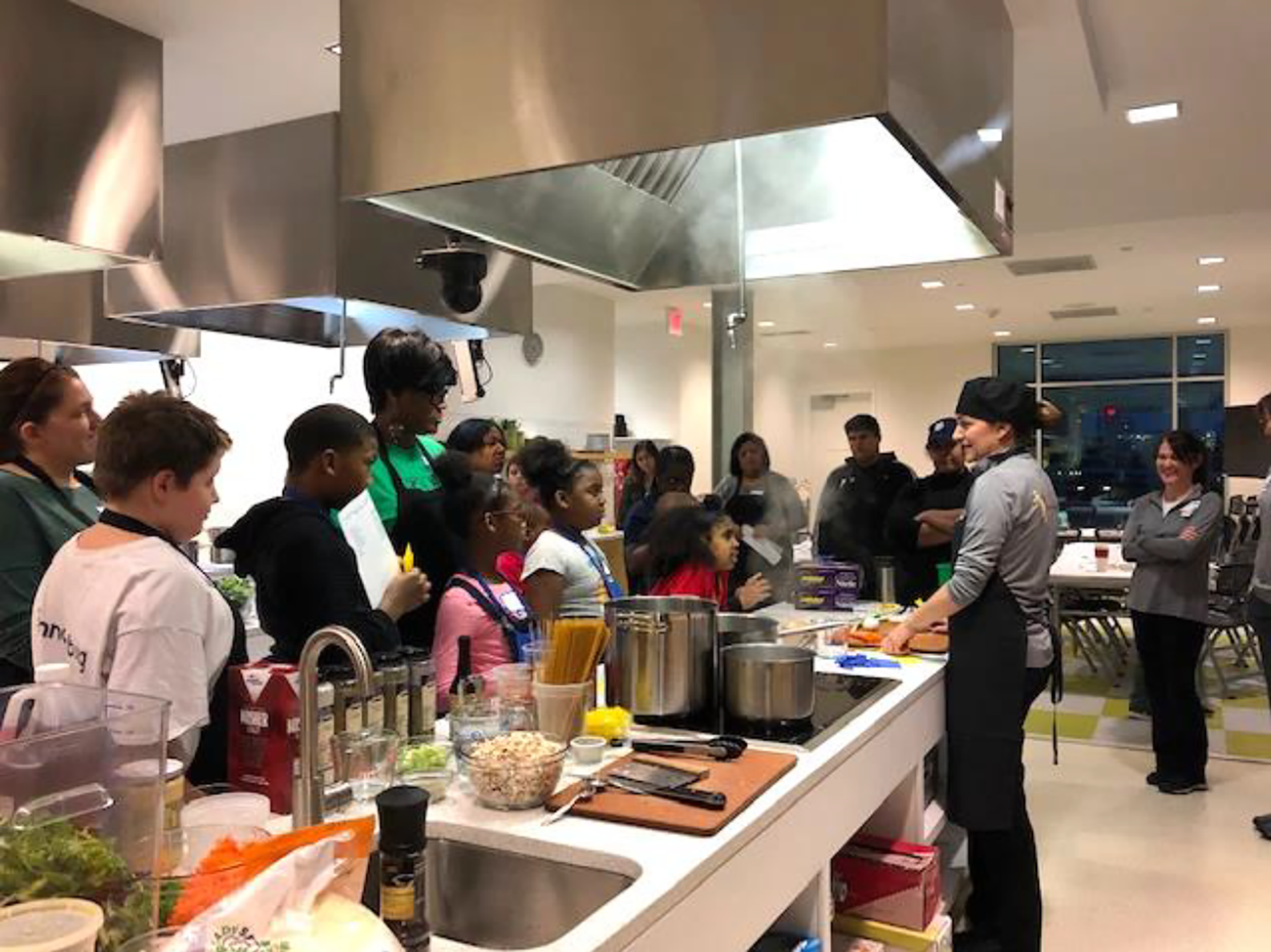
Family kitchen Rx attendees.

Spectrum Health residents cooking during their 2-week elective in culinary medicine.
Go Beyond Education: Create Behavior Change
Although culinary medicine education of any magnitude can be powerful, as we work with patient populations that have elevated body mass index or are managing chronic disease, we are combining education in the kitchen with virtual health coaching by an RD to bolster the support patients have when translating what they learn in the teaching kitchen into their home kitchen. Our programming includes evidence-based behavior change strategies and processes including intake and goal setting with an RD health coach (trained in motivational interviewing and behavior change), a series of 4 hands-on class in the teaching kitchen with a support person over 12 weeks, and ongoing virtual support with your RD health coach throughout the 12 weeks. 23,24 The virtual support includes electronic bidirectional communication within the patient portal, prescription of mobile apps and culinary medicine recipes, and 1-2 virtual telehealth virtual visits. Patients for whom access to healthy ingredients is a barrier are connected with community resources for support, transportation to and from classes is offered, and patients receive leftovers and ingredients to bring home at the end of each kitchen session.
Study the Impact and Let the Program Speak for Itself
In implementing culinary medicine for our medical residents, health-care professionals, and community members, we are utilizing reliable and validated instruments that evaluate attitudes and behaviors around healthy eating and assess a food frequency questionnaire. The professional surveys also assess competencies, comfort, and perceived efficacy around providing patient dietary education. 10,11,25 -27 While we await analysis on quantitative data collected, we have examined acceptability data. Across all populations we’ve engaged, programming acceptability has been stellar. We ask attendees to rate the program on 10 items on a 5-point ranging from 1 = strongly disagree to 5 = strongly agree. Table 1 depicts the average ratings on each item.
Acceptability Results of Culinary Medicine Programming at Spectrum Health.

Qualitative comments have been positive with residents stating that, “The pairing of learning modules and hands-on culinary sessions…allowed me to further find ways to apply nutritional concepts directly to the kitchen and dinner plate,” and “I feel I gained knowledge and motivation to improve my own diet, my family’s diet, and my patient’s diet.” In our family programming, one parent stated that, “‘I’m so excited my son is liking the lentils! I am definitely going to use them now in all kinds of meals, it’s going to save me money and make us healthier!”
Scale and Sustain: Look Beyond the Kitchen Setting
Although the teaching kitchen is a perfect environment for culinary medicine education, it’s not always the most feasible or scalable way to deliver programming, particularly for patient and community populations. Other creative modalities of delivering education and hands-on teaching can be considered including: Using a demo cart to illustrate culinary skills in a community or clinic setting Using pop-up kitchen equipment (mobile stations) to bring hands-on classes to community or clinic settings Doing education at community events such as Farmer’s Markets and offering samples of recipes Using a van or other mobile venue to bring a teaching kitchen like setting into a community or employer setting
Costs associated with educating patient and community populations need to be considered as we look to scale culinary medicine as part of health-care delivery. Shared medical appointments or group visits is one means of integrating nutritional education and skill development combined with medical care being explored as a billable encounter. Increased opportunity for insurance reimbursement for nutritional and lifestyle counseling and coaching is critical to integrating lifestyle as part of routine medical care.
Create Organizational Change
A positive consequence of our program implementation and the increased dialogue at our organization around food as medicine has been a refresh of the food offered at some of our hospital eateries and the internal catering menu. We partner extremely closely with our nutritional services and culinary teams. We gained their early support to offer culinary medicine recipes for a few of our initial stakeholder events. The recipes and food were so well received that internal catering requests for the culinary medicine recipes began and continued to grow. Culinary medicine recipes have been requested and become standard for certain leadership meetings, department meetings, board meetings, and most notably, for orientation for new employees. We have uploaded all of our recipes online, and they are available for employees and the public to download (spectrumhealth.org/culinarymedicine). Most recently, the main eatery for employees and visitors at Spectrum Health’s main hospital has been overhauled with the mission statement of the eatery grounded in culinary medicine, “offering whole foods sourced locally and prepared fresh in our kitchens—to nourish body, mind, and community.” There is tremendous value in the power of culinary medicine to influence the food choices presented in the workplace and to increase employees knowledge, skills, and comfort with making and selecting health promoting food choices in their everyday lives.
Conclusion
Culinary medicine offers a concrete and specific way health-care and health promotion professionals can work to improve the health of the populations we serve. Given the important role of nutrition and dietary patterns in the prevention, management, and reversal of chronic disease, culinary medicine, if adopted broadly and successfully, has potential to improve health and lower health-care costs nationally. To be successful with community outreach and impact, we must begin with enhanced nutrition education for health-care and health promotion professionals. Continuing education in culinary medicine can offer teams not only enhanced skills and comfort in addressing nutrition with patients and clients but also can improve their own health and well-being if they embrace culinary medicine principles personally. Culinary medicine is a key pillar of the emerging medical specialty of lifestyle medicine. 28 Spectrum Health alongside several other health systems are pioneering the establishment of lifestyle medicine as a formal medical specialty and consulting service. To successfully bend the burgeoning health-care costs and chronic disease prevalence, the future of medicine must position lifestyle medicine as a core tenet and treatment modality. Leveraging culinary medicine as a means to improving dietary patterns is a powerful first step to embracing lifestyle as medicine.