



Abstract
Purpose:
To examine how the effect of adverse weather on participation in leisure-time physical activities (LTPA) varies with income.
Design:
Cross-sectional study.
Subjects:
14,394 individuals from 56 Canadian cities, surveyed in 1992, 1998, and 2005.
Measures:
The adverseness level of daily weather is measured by the number of hours with precipitation or strong winds (wind speeds in excess of 38 km/hour) between 6 am and 11 pm.
Analysis:
Probit and multinomial logit models are used to examine the variation in weather-LTPA correlations across income levels.
Results:
At the mean income level, when the weather quality deteriorated from all-day nice weather to all-day adverse weather, the probability of participating in LTPA decreased by 24.54% (from 0.2424 to 0.1829, P < 0.01). As income increased by $10,000, the same deterioration in weather quality led to a 17.06% decrease in LTPA (from 0.2508 to 0.2080, P < 0.01). The smaller decrease is mainly because the $10,000 increase in income is associated with a 14.49% increase in indoor LTPA, which partly offsets the decrease in outdoor LTPA.
Conclusion:
Interventions and policies that increase indoor physical activity options, such as providing easier access to indoor facilities and offering subsidies for purchasing or renting home exercise equipment, are promising for effectively promoting LTPA, especially for individuals in lower-income groups or from regions that frequently experience adverse weather.
Purpose
A rich body of research has shown that adverse weather conditions strongly deter participation in leisure-time physical activities (LTPA). However, little is known about how this negative effect varies across different segments of the population. 1 -4 Although the weather cannot be changed, knowledge of how daily weather affects the decision to exercise and how this effect differs across subgroups of the general population can be valuable for designing effective interventions to mitigate the adverse effect of weather, especially for targeted subgroups. Given that the most popular forms of outdoor and indoor physical activities are walking and gym-related activities, respectively, it is reasonable to postulate that indoor LTPA is generally costlier than outdoor LTPA, which implies that when weather conditions alter the viability of LTPA options, the monetary price associated with participation in LTPA changes accordingly. 5 -7 Therefore, responses in LTPA behavior to adverse weather might be especially sensitive to people’s income levels. That is, the LTPA of people in lower-income groups might be more vulnerable to adverse weather. People in lower-income groups have been found repeatedly to be less likely to engage in LTPA which is blamed for being a contributor to their poorer health outcomes. A better understanding of how the effects of adverse weather on LTPA varies with income can thus help to reduce the disparity in physical health behavior and improve health outcomes across income levels. 5 -10
Linking daily weather conditions to individuals’ daily activity information, this study attempts to (1) examine whether the effect of weather on LTPA participation varies with income, that is, whether the negative effect of adverse weather on LTPA participation is smaller when income increases; (2) investigate how higher income alleviates the negative effects of adverse weather on LTPA, that is, whether higher income leads to an increase in costlier indoor LTPA to partly offset the negative effect of adverse weather on outdoor LTPA.
Methods
Data
Time-use data were collected from 3 waves (1992, 1998, and 2005) of Canada’s General Social Survey (GSS). The GSS time-use data not only identify the detailed activities of survey respondents continuously over a randomly assigned 24-hour period but also contains information on their demographic characteristics. According to the detailed activity information from the GSS, 19 activities are identified as leisure-time physical activities and are classified into 3 categories: outdoor, indoor, or ambiguous (the activities could take place either indoors or outdoors). In the GSS, household income is recorded in ranges of less than $10,000-$19,999, $20,000-$29,999, $30,000-$ 39,999, $40,000-$49,999, $50,000-$ 59,999, $60,000-$79,999, and greater than $80,000. Following Ruhm (2005), 11 the income level is coded as the midpoint of the range reported or 150% of the upper threshold. To correct for problems arising from comparing the monetary incomes of households with different numbers of household members, the level of income is also adjusted by dividing the amount of income by the square root of family size as an equivalence scale, as is standard practice in the income distribution literature.
The weather data were taken from Environment Canada’s National Climate Data and Information (NCDIA). Weather information is collected for 56 Canadian cities for 5 weather elements—temperature, relative humidity, wind, cloud cover, and precipitation—at the top of each hour. Weather conditions showing the presence of precipitation or strong winds (wind speeds in excess of 38 km/hour) 1 were defined as “adverse weather” in the sense that it would prohibit outdoor activities or lower the enjoyment of those activities. Since the weather information is collected at the top of each hour, the adverseness level of the weather is defined as the number of hours having “adverse weather” between 6 am and 11 pm.
Sample
Restricting the analysis to individuals who were 15 years or older and had no long-term mental or physical health conditions, the final sample included 14,394 individuals with the information about their physical activities and the weather adverseness level they faced on the randomly selected day. All individuals in our sample were categorized into 4 groups: no participation in LTPA, participation in outdoor LTPA, participation in indoor LTPA, and participation in ambiguous LTPA.
Analysis
The probit model (1) was used to examine whether the effect of adverse weather on participating in LTPA varied with income:

The multinomial logit model (2) was estimated where the linear index

where
Results
The results of estimates from (1) and (2) are reported in Table 1 and Table 2, respectively. Table 1 shows that increases in the adverseness level of weather conditions significantly reduced the probability of LTPA (β2 = −0.0262, s.e. = 0.0067, P-value < 0.01). However, the significant and positive coefficient of the interaction term implies that the negative correlation between adverse weather and LTPA was smaller when income increased (β3 = 0.0004, s.e. = 0.0001, P-value < 0.01), which means that the negative effect of adverse weather on LTPA is indeed alleviated by higher income. The main result of the multinomial logit analysis, shown in Table 2, was that both outdoor and indoor LTPA are negatively affected by adverse weather. However, the weather-income interaction term was only significant and positive for indoor LTPA (β3 = 0.0010, s.e. = 0.0003, P-value < 0.01), meaning that higher income helps to maintain indoor LTPA to alleviate the negative effects of adverse weather on participating in LTPA.
Probit Regression: Effect of Adverse Weather on LTPA Versus Income.

The number in the parentheses represents the standard error. ***P-value < 0.01.
The estimates of other dependent variables are available upon request.
Multinomial Logit Regression: Effect of Adverse Weather on LTPA Versus Income, by Different Types of LTPA.

The number in the parentheses represents the standard error. ***P-value < 0.01, **P-value < 0.05.
The estimates of other dependent variables are available upon request.
To make our results more concrete, we use the results from Table 1 and Table 2 to graph the predicted probability of participating in LTPA against weather conditions. Figure 1 shows that at the sample mean, at which all the control variables other than the weather conditions are fixed at their sample mean values, the probit coefficients from Table 1 imply that when weather quality deteriorates from all-day nice weather to all-day adverse weather, the probability of participating in LTPA decreases by 24.54% (from 0.2424 to 0.1829). As income increases by $10,000, the same deterioration in weather quality leads to a 17.06% decrease in LTPA (from 0.2508 to 0.2080). Moreover, Figure 2 shows that the smaller decrease associated with higher income is mainly due to the 14.49% increase in the probability of indoor LTPA (from 0.0538 to 0.0616), which partly offsets the decrease in outdoor LTPA.
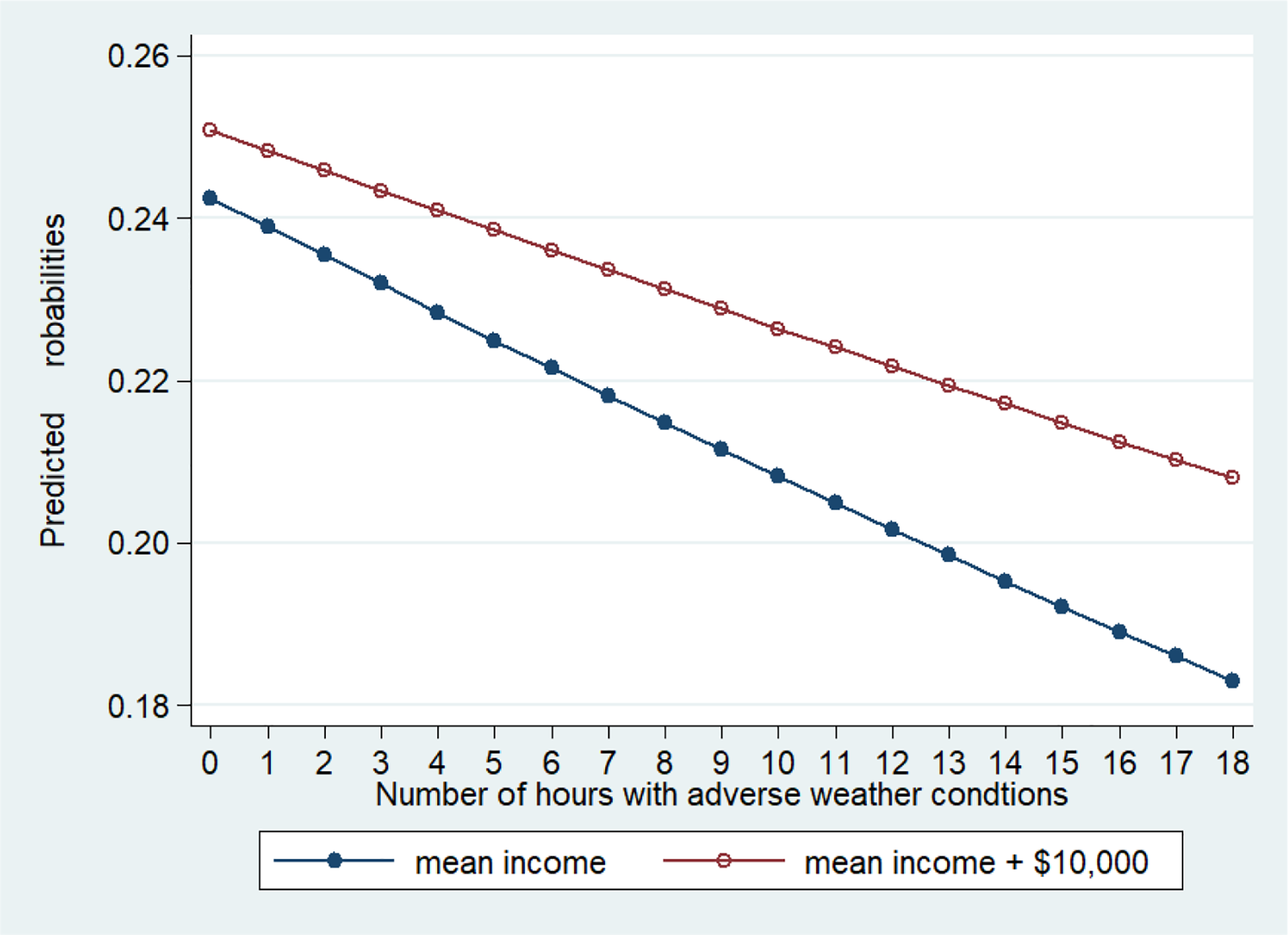
Predicted probability of participating in LTPA vs. weather conditions.
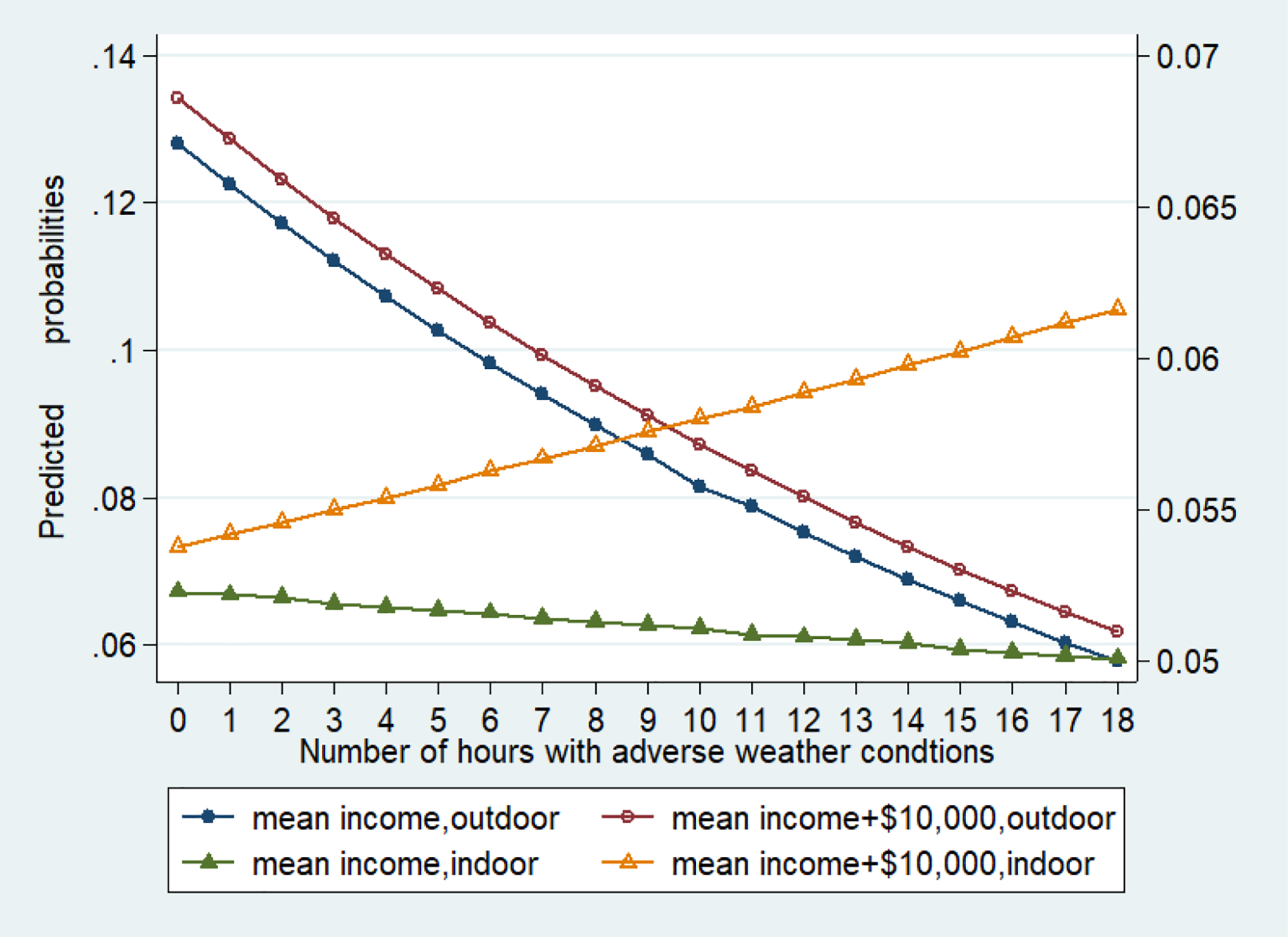
Predicted probability of participating in LTPA vs. weather conditions (by indoor LTPA and outdoor LTPA, respectively).
Discussion
Summary
To the best of our knowledge, this is the first study to investigate how the effect of adverse weather on LTPA varies with income. The results of this study show that when weather quality deteriorates from all-day nice weather to all-day adverse weather, the probability of participating in LTPA decreases by 24.54% on average, while a $10,000 increase in income can reduce the decline in probability to 17.06%, which implies that the negative effect can be mitigated by 30%. Moreover, the smaller decrease in LTPA associated with higher income is mainly due to the 14.49% increase in the probability of indoor LTPA. Our findings support the previous studies in which adverse weather has been identified as a barrier to being physically active, and more importantly our findings suggest that this barrier is more difficult for people with lower income as an additional obstacle. 1 -4
Limitations
First, linking the weather and physical activity behavior at the daily level shows only short-term effect; how the long-term relationship between LTPA and weather varies with income remains unanswered. In the long term, rescheduling exercise plans can help avoid the negative effect of weather on LTPA. However, interruptions in LTPA caused by short-term adverse weather make it challenging to maintain habitual participation in LTPA, which has been proven to be important for realizing the health benefits of LTPA. Therefore, future research is needed to examine the long-term effects of weather conditions on LTPA.
Second, the interaction effect of weather and income captures how the effect of adverse weather on LTPA varies with income. To make the interpretation of the parameter of the interaction term coherent, we converted household income, which is recorded in ranges in the GSS, into levels. Although this operation is unlikely to change the results qualitatively since the ranking of income ranges still holds, the magnitudes of the estimates may lose some accuracy.
Significance
Research has consistently shown that people in lower-income groups are less likely to engage in leisure-time physical activities. Our results imply that natural adverse weather (and perhaps other unfavorable environmental factors as well) may be an important contributor to the socioeconomic gradients in physical activity behavior. Policies aimed at promoting LTPA among lower-income groups should take this into account. Previous studies have shown that interventions and policies that directly increase indoor physical activity options, such as providing easier access to indoor facilities, are likely to be effective for promoting LTPA. 12 This study suggests that access to indoor LTPA options may be especially important for those in lower-income groups who frequently face adverse weather conditions. Moreover, the current literature has not reached a consensus on how much money matters in terms of participating in LTPA, and some studies even contend that the marginal effect of money on participating in LTPA may be small. 13 We do not assert that having money can lead people to participate LTPA. However, the results of this study do imply that the better financial position provided by higher income is closely related to higher participation in LTPA. Therefore, promotion efforts that help to relax budget constraints, such as offering subsidies for purchasing or renting home exercise equipment, are promising for promoting LTPA not only among lower-income groups but also for the general population.
So What?
What Is Already Known on This Topic?
Adverse weather deters participation in LTPA.
What Does This Article Add?
The leisure-time physical activity of people at lower income levels is affected more profoundly by adverse weather conditions than those at higher income levels. Higher income mitigates the negative effects of adverse weather on LTPA by providing indoor LTPA options.
What Are the Implications for Health Promotion Practice or Research?
Interventions and policies that directly increase indoor physical activity options, such as providing easier access to indoor facilities or offering subsidies for purchasing or renting home exercise equipment, are likely to promote LTPA, especially among those in lower-income groups who frequently face adverse weather conditions.
Footnotes
Declaration of Conflicting Interests
The authors declared no potential conflicts of interest with respect to the research, authorship, and/or publication of this article.
Funding
The author(s) disclosed receipt of the following financial support for the research, authorship, and/or publication of this article: This paper received funding from National Natural Science Foundation of China #71804152.
