



Abstract
Purpose
To identify whether physical fitness (PF) components play a moderating role in the relationship between TV time and adiposity levels.
Design
Cross-sectional study.
Setting
Few studies have examined if different PF levels modify the association between TV time and adiposity in adolescents. Studies often focus on the isolated relationships between obesity and TV time, or obesity and PF levels.
Subjects
1071 adolescents (617 girls), aged 12 to 17 years.
Measures
Cardiorespiratory fitness (CRF), abdominal muscular endurance, and lower limb strength were evaluated using the protocols of the Projeto Esporte Brasil fitness testing battery. TV time was obtained using a self-reported questionnaire. Body mass index (BMI) and waist circumference (WC) were also assessed. Moderation analyses were conducted through multiple linear regression models with the following associations tested in different models: PF components, TV time, and interaction (PF component x TV time) with adiposity parameters (BMI and WC);
Results
A significant interaction term was found for CRF and TV time in the association with both WC (β: −.005; 95% CI: −.009; −.001; P = .012) and BMI (β: −.002; 95% CI: −.004; −.001; P = .009).
Conclusion
CRF moderates the relationship between TV time and adiposity measures in this cross-sectional analysis. These data support strategies looking at increasing physical activity levels to improve CRF and avoid the development of excess abdominal obesity and excess weight.
Purpose
The increasing prevalence of obesity in youth and adolescents is a common issue worldwide. The consequences of excess weight include long-term adverse effects on cardiometabolic health, leading to a higher risk of cardiovascular morbidity and mortality. 1 Sedentary behaviours, including television (TV) and electronic screen time involve prolonged periods of low energy expenditure, 2 and have been increasingly highlighted risk factor for obesity in youth. In fact, an accumulating literature has demonstrated the influence of the time spent in front of the TV with development of obesity.3-5 However, the potential issue of confounding by other physical activities has not always been fully taken into consideration. Within Mitchell and Byun’s 6 review of sedentary behaviour and obesity outcomes in children and adolescents, within all 6 cross-sectional studies where a moderation analysis was conducted; screen-based sedentary behaviour was associated with increased BMI only when moderate-to-vigorous physical activity (MVPA) was low. Furthermore, some quantitative meta‐analyses have indicated that there is limited evidence that the total volume, or patterns of sedentary behaviour, is associated with adiposity in children and adolescents when accounting for MVPA in cross-sectional investigations. 7 Further, these conclusions were also consistent based on evidence from 13 longitudinal studies with adiposity outcomes. For the most part, the evidence in previous reviews comes from studies examining TV viewing as the sedentary behaviour exposure.
The narrative review of epidemiological studies conducted in children and adolescents by Ortega et al. 8 indicated that increasing physical fitness (PF) in overweight children and adolescents may have many positive effects on health, including lowering body fat levels. The levels of PF were also associated with obesity outcomes in other subsequent studies amongst youth.9,10 Longitudinal evidence demonstrates that children with higher PF tend to present more favourable levels of adiposity.11,12 Within the European HELENA study of adolescents, 13 sedentary screen behaviour (time habitually spent in front of the TV, the computer and/or playing video games) showed a significant positive association with adiposity (skinfold) measures. Furthermore, cardiorespiratory fitness (CRF) increased in participants undertaking higher vigorous physical activity and less sedentary behaviour, and there was also a protective effect of against cardiometabolic risk. Additionally, PF components associate with adverse cardiometabolic health amongst adolescents. 14 In the cross-sectional AVENA study of Spanish adolescents, both moderate-to high levels of CRF, in addition to sedentary activities, but not physical activity status were associated with lower abdominal adiposity. 15 However, the majority of adolescents do not achieve the current daily guidelines for MVPA, 16 which leads to little or almost no energy expenditure and weight gain. 17
There are a lack of studies assessing the moderating role of PF components in the relationship between TV time and adiposity (this is, testing to examine if different PF levels modify the association between TV time and adiposity). The studies conducted often focus on the isolated relationships between obesity and TV time,18,19 or obesity and low physical fitness levels in adolescents.20,21 Rauner et al. 22 provided limited evidence from a systematic review of cross-sectional and longitudinal studies on physical activity, fitness and overweight in adolescents, specifically focused to ‘identify mediator and moderator effects’ in the inter-relationships among these three lifestyle-related variables. Notably, within a 3‐year longitudinal serial measurement study of 345 Portuguese adolescent high school students, changes in BMI were associated with changes in CRF over 3 years. As expected, changes in physical activity were the best predictor for changes in CRF in each year and over the 3 years of evaluation in this cohort. Santos et al. 23 showed that time in MVPA and accumulating screen time in shorter sedentary bouts was inversely related to adiposity measures (assessed with dual-energy X-ray absorptiometry) in 333 participants (172 girls) age 9 to 11 years. Moreover, CRF, determined by maximal cycle testing, was inversely related to total and abdominal adiposity. A large portion (40.9-65.7%) of the associations of MVPA and sedentary bouts with both was mediated by CRF. Time spent in MVPA, but not sedentary time, has been independently associated with PF, including cardiorespiratory and musculoskeletal components. 24 Therefore, this study aims to identify whether PF components play a moderating role in the relationship between TV time and adiposity levels within a large representative sample of adolescents participating in the Schoolchildren’s Health Study, Rio Grande do Sul, Brazil.
Methods
Study Design and Sample
Cross-sectional study conducted with a sample of 1071 adolescents (617 girls), aged 12 to 17 years, enrolled as students in public (municipal and state) and private schools, living in the urban and rural areas of the municipality of Santa Cruz do Sul, Rio Grande do Sul, Southern Brazil. All adolescents from 25 randomly selected schools (from a total of 50) were invited to participate. Parents and/or guardians providing authorization the student´s participation by signing the Free and Informed Consent Form were included in the present study. The students also signed the Terms of Assent. G*Power 3.1 program (Heinrich-Heine-Universität -Düsseldorf, Germany) was used to calculate the required sample size, based on a multiple linear regression. A sample of 1048 subjects was established after adjustments for a test power (1 − β) of .98, effect size (f2) = .02, a significance level of α=.05 and 3 predictors.
Measures
CRF was obtained by completion of a 6-minute running and walking test in metres. The test was performed on athletics track and the adolescents were instructed to run as long as possible during 6 minutes with subsequent quantification of the total distance covered by the participant. Abdominal muscular endurance (AME) was assessed using the 1-minute sit-up test, and lower limbs strength (LLS) was assessed using the standing long jump. All tests were standardized and followed the protocols of the Projeto Esporte Brasil 25 fitness testing battery. TV time was obtained in hours, using a self-reported questionnaire, and converted into minutes. BMI was calculated using the following formula: BMI = weight (kg)/height(m). 2 The waist circumference (WC) was evaluated using a inelastic plastic tape measure, using as reference the narrowest part between the ribs and the iliac crest. 26
Analysis
All analyses were performed using the Statistical Package for the Social Sciences (SPSS) v. 23.0 software (IBM, Armonk, NY, USA). The characterization of the sample was described with means and standard deviations for continuous variables, or absolute and relative frequency for categorical variables. The difference between sexes for continuous variables was calculated using the bootstrapping resampling procedure for the independent Student t-test. The procedure used a resampling of 1000 bootstrap samples and the Bias Corrected Accelerated (BCa) method.
Before moderation analyses, the CRF 6-minute running and walking test was converted to peak oxygen uptake (VO2peak); the standard expression of CRF. VO2peak was estimated with the following equation: 6-minute test→VO 2peak = 41.946 + .022 * (Test distance) – .875 * (BMI) + 2.107 * (Sex) 27 ; where test is the value of metres performed by the adolescent; and sex equals to 1 and 0 for boys and girls, respectively. Additionally, sex- and age-specific standardized z-scores for PF components were calculated using the following equation: z-score = (XIndividual participant value – XSex- and age-specific standardized mean)/Standard deviation. The VO2peak standardized z-score was calculated using the international reference for cardiometabolic risk factors established by Stavnsbo et al. 28 For the calculation of standardized z-scores of the other PF components we used our sample specific values. Before standardization, AME and LLS were logarithmically transformed (natural log) because of skewness of their distributions. All analyses were conducted separately for boys and girls in order to assess sex- and age-specific estimations that would be used in the standardized mean of the z-score equation.
The PROCESS macro for SPSS was used for moderation analyses through multiple linear regression models, as described by Hayes. 29 The following associations were tested in different models: (1) AME (z-score), TV time, and interaction (AME x TV time) with adiposity parameters (BMI and WC); (2) CRF (VO2peak; z-score), TV time, and interaction (VO2peak x TV time) with adiposity parameters (BMI and WC); (3) LLS (z-score), TV time, and interaction (LLS x TV time) with adiposity parameters (BMI and WC). Preliminary regression analyses evaluated which confounders should be used to adjust the models. No model was adjusted because the confounder variable tested was not associated with both the independent and dependent variables. Additionally, the Johnson-Newman technique was applied if a significant interaction term were found. This technique indicates the relationship between the independent and dependent variables in the low, medium and high levels (16th, 50th and 84th percentiles, respectively) of the moderator variable. The P value<.05 was considered significant for all analyses.
Results
Descriptive Data of the Participants.
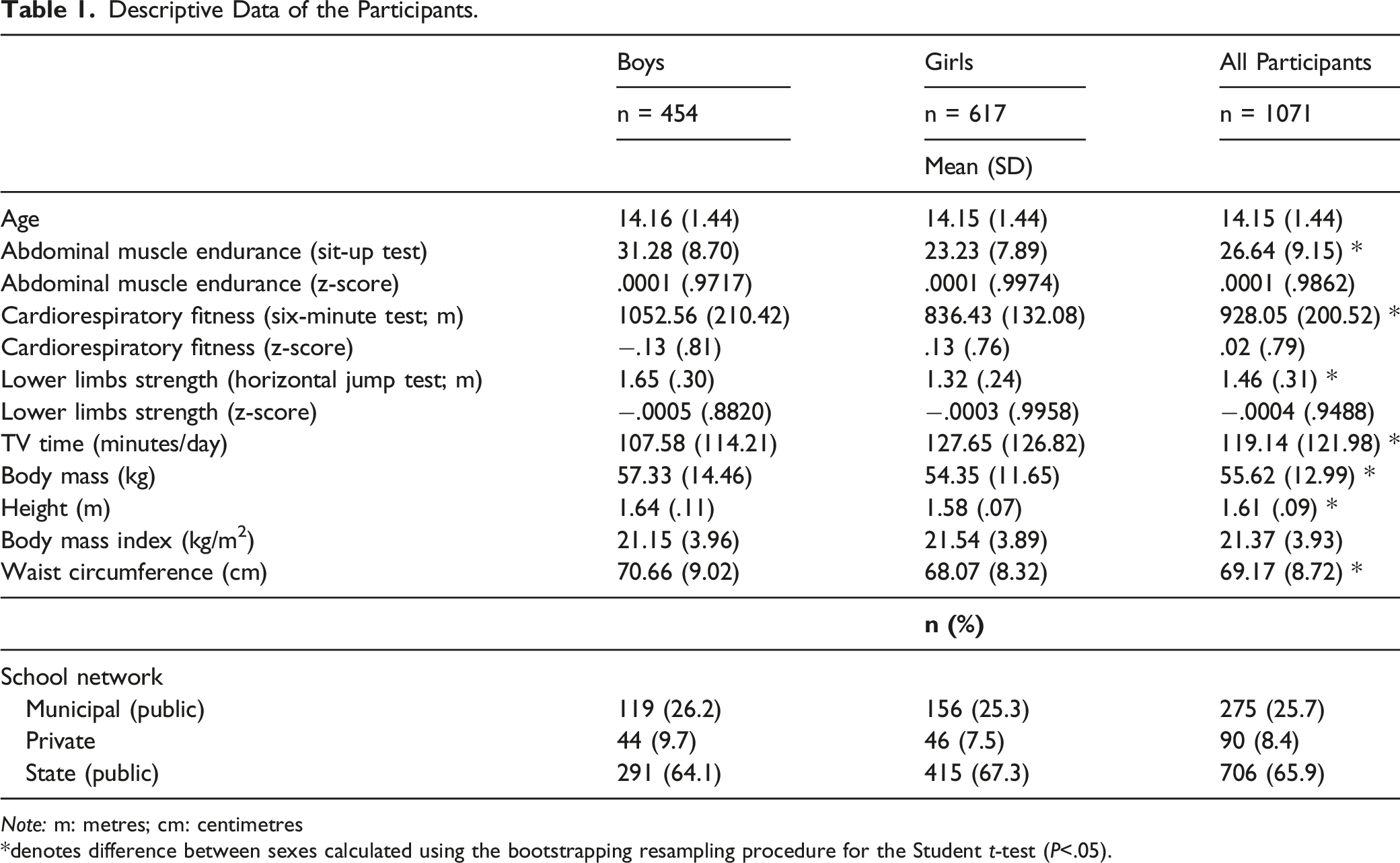
Note: m: metres; cm: centimetres
*denotes difference between sexes calculated using the bootstrapping resampling procedure for the Student t-test (P<.05).
Moderation role of physical fitness components in the association between TV time and adiposity parameters.

Note: 95% CI: 95% confidence interval; AME: abdominal muscle endurance; VO2peak: peak oxygen uptake; LLS: lower limbs strength.

Moderation of VO2peak in the relationship between TV time and BMI. Note: SD: standard deviation.
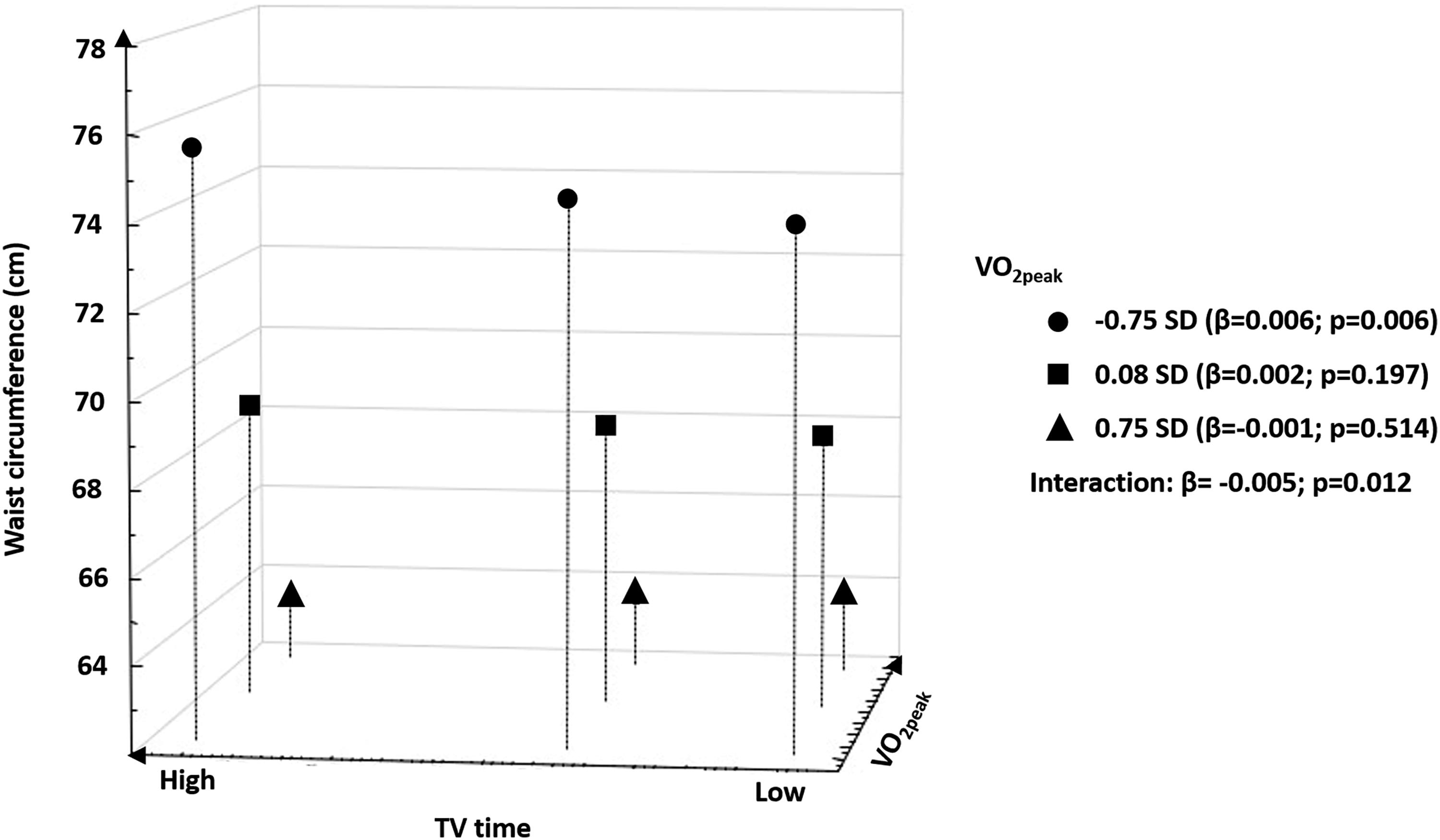
Moderation of VO2peak in the relationship between TV time and WC. Note: SD: standard deviation.
Discussion
Findings from this study demonstrate that estimated CRF from a run/walk test significantly moderated the relationship between TV time and adiposity measures in Brazilian adolescents. The evidence from the present study indicates that higher CRF levels can attenuate the positive relationship between time spent in front of the TV and excess bodyweight and abdominal obesity amongst adolescents. Within the cross-sectional findings of the AVENA study in adolescent Spanish boys and girls, and following adjustment for confounding variables, CRF was found to be inversely associated with WC and BMI, independent of sedentary activities or physical activity. Whereas, sedentary activities were also independently and directly related to WC in both sexes, and to BMI in adolescent boys. 15 Our findings are also consistent those from a 3‐year longitudinal study of 345 Portuguese adolescent high school students. In this study, changes in BMI were associated with changes in CRF over 3 years. As expected, changes in physical activity were the best predictor for changes in CRF in each year and over the 3 years of evaluation in this cohort. 30
In contrast to our findings, a higher level of screen time, including TV and mobile devices, was associated with weight status, independent of meeting the physical activity guideline (or not) in adolescents within a cross-sectional study of 422 adolescents recruited to the NHANES National Youth Fitness Survey (NNYFS), a nationally representative study, United States. 31 Time spent in TV viewing also predict changes in BMI and hip circumference in boys, but not in girls, over a one-year period, in 465 Dutch adolescents. 32 In the above study, prospective associations between TV screen time and adiposity were adjusted for CRF (shuttle run test).
Previous data have already shown that the chances of being obese are higher amongst adolescents spending higher amounts of time in front of the TV. This appears to be related to one or more of the following related behaviours: physical inactivity, high energy intake, sedentary behaviour, exposure to food advertising and reduced sleep time. 18 Although not always associated with being overweight or obese, TV time has a considerable influence on sedentary behaviours in general 33 and unhealthy outcomes. Systematic reviews have demonstrated that sedentary behaviours (as the high time expenditure in front of the TV and other screen media devices) are associated with increased adiposity, hypertension, higher cardiometabolic risk for chronic diseases and lower PF itself.3,5 These statements are particularly worrying for children and adolescents who do not meet screen time guidelines, especially in Brazil, which has an estimation of more than half of adolescents who exceed screen time recommendations. 34 Furthermore, evidence suggests that sedentary behaviours will track from childhood/adolescence into adulthood, 35 which means interventions looking at reducing these screen-related behaviours should start at an early age.
The higher time dedicated to sedentary behaviours is related to the low weekly frequency of physical activity engagement and lower levels of aerobic capacity and muscular strength/endurance. 36 It is also known that less favourable physical activity biomarkers, such as PF components, are associated with excess weight in adolescents,37,38 and additionally with high levels of different types of screen-based sedentary behaviours. 3 Kim et al. 39 verified the joint associations of subjectively measured physical activity and screen-based sedentary behaviours on excess weight. Their findings demonstrated that the odds of being obese were significantly higher for low physical activity and high sedentary behaviour groups when compared to high physical activity and low sedentary behaviour groups. Therefore, it is plausible that the combination of the lowest levels of CRF and higher TV time interact to significantly increase the development of excess weight. Other short-term results showed a strong negative associations between CRF levels and children’s BMI (and weight gain) in Chinese children aged 8–13 years. 40 Furthermore, the prospective Oslo Youth Study showed that early adolescent fitness showed some inverse associations with obesity measures into early adulthood, although these effects diminished markedly into middle age. 41
Intervention strategies have been shown to be effective on increasing physical activities and decreasing sedentary behaviours amongst adolescents. 42 An intervention protocol demonstrated that increasing physical activities decreases the chances of being overweight or obese. 43 Furthermore, a systematic review and meta-analysis indicates that screen-based reduction interventions might be effective on preventing excess weight. 44 Our findings support the importance of increasing MVPA and exercise training, such that PF levels are improved (specially CRF 45 ), and also reducing the amounts of time in front of the TV.3,5,18
Our study has some worthwhile strengths in examining the moderating role of CRF in the relationship between TV time and excess weight. Firstly, we highlight the importance of monitoring the time spent in front of the TV and the levels of CRF given their associations with higher adiposity. However, our study also has some limitations that should be appreciated. Firstly, the cross-sectional design of the study, which makes impossible to examine a causal impact between the variables. Future studies should verify the longitudinal joint associations of these variables on the excess weight development or maintenance through adolescence. Secondly, we relied on the use of self-reported measures of TV time instead of more objective measures of sedentary behaviour, such as accelerometry. Self-report measures are subject to recall bias and socially desirable answers. TV viewing has been considered as the most important sedentary behaviour affecting body fatness,
46
possibly due to its coincidence with other obesity-related behaviours, such as the consumption of soft drinks and high energy snacking. However, a major limitation of research examining sedentary behaviour is the use of self- and proxy-report questionnaires without empirical support for reliability, or validity.
3
A systematic review of this topic indicated that self‐report measures provide reliable estimates of screen time, yet their validity remains largely untested.
47
A notable limitation of this study is that we did not include in our sedentary behaviour variable the time spent in other screen-based devices (computer/mobile phones) frequently used by adolescents. Studies have reported differential associations between different forms of screen time and fatness measures in adolescents, notably computer time predicting increases in body fatness. Therefore, caution should be exerted when comparing our results using only TV time to studies that include both screen time, TV time and other screen-based devices. We also did not evaluate other lifestyle aspects such as direct and objectively measured physical activity levels, which could have modified our results. However, CRF has been shown to be related to time spent in physical activity in adolescents from different ethnic groups.
48
Moderate-to-vigorous physical activity behaviours are typically required to improve CRF components. Lastly, we used a field test and estimation of VO2peak as a measure of CRF, instead of a maximum exercise protocol with direct-determination of VO2peak. Further, the VO2peak equations used BMI as a VO2peak predictor variable, which is a possible confounder of the associations within the models. There are several studies utilizing different types of study design and statistical analysis which conceptually show that there is an inter-relationship between screen or TV time, adiposity, and physical fitness. To the best of our knowledge, this is one of the few studies evaluating the moderating role of CRF in the relationship between TV time and adiposity parameters amongst adolescents. The present approach provides a new theoretical contribution via a new way of evaluating cross-sectional data incorporating PF, sedentary TV time, and adiposity measures. CRF appears to be a moderator in the cross-sectional relationship between TV time and adiposity. These data support strategies looking at increasing levels of MVPA, especially at younger ages, to improve CRF and attenuate the development of excess abdominal obesity and weight. These findings suggest that adolescents with high levels of sedentary behaviour should be encouraged to meet physical activity guidelines, especially moderate-to-vigorous activities and that this could sufficiently increase energy expenditure to help correct a positive energy balance.So What?
What is already known on this topic?
What Does This Article Add?
What are the implications for health promotion practice or research?
In Brief
The present study aimed to identify whether physical fitness (PF) components play a moderating role in the relationship between TV time and adiposity levels within a sample of 1071 adolescents (617 girls), aged 12 to 17 years. The results demonstrated a significant interaction term for cardiorespiratory fitness x TV time in the association with both waist circumference (β: −.005; 95% CI: −.009; −.001; P=.012) and body mass index (β: −.002; 95% CI: −.004; −.001; P=.009). Therefore, cardiorespiratory fitness is a moderator in the relationship between TV time and adiposity. These data support strategies looking at increasing physical activity levels to improve CRF and avoid the development of excess abdominal obesity and excess weight.
Footnotes
Authors’ Contributions
NC, JFCS, LBS, and APS developed the idea and design of the work. JFCS, LBS, APS, EMR and CPR collected data. JFCS analysed and interpreted data. All authors have contributed to critical revisions, writing and editing the manuscript. All authors read and approved the final version of the manuscript.
Ethical Approval
This research is part of the Schoolchildren’s Health Study, developed at the University of Santa Cruz do Sul (UNISC) between 2016 and 2017 and approved by the UNISC Ethics Committee in Research with Human Beings under opinion number 1,498,305.
Declaration of Conflicting Interests
The author(s) declared no potential conflicts of interest with respect to the research, authorship, and/or publication of this article.
Funding
The author(s) disclosed receipt of the following financial support for the research, authorship, and/or publication of this article: This work was supported by a grant from the National Council of Technological and Scientific Development (CNPq), and Coordination of Improvement of Higher Level Personnel (CAPES).
