




Abstract

Keywords
Introduction
How and where we do our work is changing in the United States across industry, government, and non-profit sectors. This evolving landscape includes downsized office space, the reduction of corporate fitness centers, decreased daily commutes, increased hybrid or remote work environments, and experiments with the length of the work week. While some of these changes may prove transient, others will likely be permanent changes affecting the context of work. Some occupations require in-person work settings, especially in the health care, education, travel and food processing sectors. Many of these employees are experiencing burnout after prolonged overtime work and stressful pandemic-related work conditions. Accordingly, employers are turning their focus to employee health and well-being; productivity, retention, promotion; diversity, equity, and inclusion; re-thinking their corporate wellness programs; and prioritizing financial stability, work-life balance, mental health, and other health-promoting culture, systems and policy changes. 1
Domains for Physical Activity Across the 24-hour Movement Cycle. 5

This article outlines why physical activity is important; what has happened to adults’ physical activity levels during the COVID-19 pandemic; how employers and employees are responding to changing work environments; potential solutions for promoting physical activity with particular focus on vulnerable employee populations; which industries, job types, and population sub-groups may be most affected; and the impact on health care costs and utilization. Given that appropriate levels of physical activity and fitness across work and in leisure time can sustain workforce health and well-being, employers should be leading the way in supporting this movement.
Background
The changing dynamics in our various work settings are affecting how people move throughout the day, and concurrently in their leisure time, which has a direct impact on their physical activity and cardiorespiratory fitness levels. During the pandemic, there was a significant overall decrease in physical activity, with disparities across certain geographies, ages, occupations, job types, and racial and ethnic groups. 6 Some of this reduction in physical activity levels may be attributed to stay-at-home orders, resulting in a switch to remote work, long hours by front-line responders, and closure of exercise facilities, parks and schools. 6 The downward trend in physical activity as well as the variety of other stressors during the pandemic had profound negative effects on mental health.7,8 Other chronic disease risk factors increased during the pandemic as well, including diabetes, hypertension, and obesity.9-11 All of these trends have significant negative implications for burnout, resiliency, retention, and work satisfaction as well as healthcare costs and utilization. Already stretched health systems are burdened by preventable disease. Entire communities are failing to benefit from the wider social, environmental and economic benefits associated with more people living active lives. 12
Benefits of physical activity promotion accrue not only to workers and their families but also to employers and other institutions. A review of the literature 13 noted increased productivity, more meaningful co-worker interactions, reduced injury rates, lower presenteeism, and lower excess medical care costs for employees. In addition, benefits for the employer include healthier work culture, increased company performance in the marketplace, enhanced corporate image, and improved retention of talent. 14
Meanwhile, employers continue to face soaring health care costs and health care utilization. 15 The economic burden of physical inactivity is estimated at $27 billion/year due to treatment costs for resulting non-communicable diseases and worsening mental health. 16 In one study of more than 50,000 older adults, total average healthcare expenses (including medical and pharmacy) were 16% lower for fitness program participants compared to non-participating members. Another study suggests meeting aerobic physical activity guidelines is associated with reduced healthcare utilization for inpatient, primary care, and emergency department visits. 17
Variation in Physical Activity by Race, Ethnicity and Geography
Currently, no more than 28% of the US adult population meets both the aerobic and muscle strengthening physical activity recommendations. 18 Adults in rural counties (16.1%) are less likely to meet combined physical activity guidelines compared to those in major urban centers (27.8%), while adults in the West region (28.5%) are more active than adults in the Northeast (24.4%), Midwest (23.4%), and South (22.0%). 18 Most recent data indicate notable differences in physical inactivity levels by race and ethnicity. Overall, Hispanic adults (32.1%) had the highest prevalence of aerobic physical inactivity outside of work, followed by non-Hispanic Black (30.0%), non-Hispanic American Indian/Alaskan Native (29.1%), non-Hispanic White (23.0%), and non-Hispanic Asian (20.1%) adults. 19 When the physical inactivity map is compared to other maps that display prevalence of chronic diseases, obesity, tobacco use, dietary habits, short sleep duration, or COVID-19 death rates, similar patterns emerge—the highest prevalence of unhealthy lifestyle behaviors coincides with the highest mortality rates for COVID-19. 20 Furthermore, these prevalence rates patterns are similar to other maps summarizing the proportion of people living without health insurance, living in poverty, or who are Black or non-Hispanic. 21 Therefore, depending upon the geographic location of the work setting, strategies deployed to promote physical activity in the workforce should consider the prevalence of physical activity in the larger surrounding community where the worksite or workforce is located. When deployed, this geographic strategy should ideally consider cultural sensitivities likely to differ among communities and surrounding neighborhoods of companies located in different parts of the country.
The Impact of COVID-19 on Work Settings and Physical Activity Levels
During the pandemic, physical activity levels declined due to community-level mitigation strategies, such as stay-at-home orders and business closures, which restricted access to places where adults were most able to be active. 22 For many businesses with primarily non-essential workers, organizational survival depended on successfully navigating an almost total shift to remote work. In other businesses, essential workers migrated to a hybrid schedule in which on-site exposures were minimized while still getting essential on-site work accomplished. Between 2019 and 2021, the number of employees working remotely tripled from 5.7% to 17.9%. 23 The financial, communications/information, and technical/professional service industries reported the highest proportion of remote workers. 24
With increases in remote work came increases in sedentary behavior. A study 25 from Stanford University surveyed 1316 working adults 25 and 74 years old to assess the impact of remote work on physical activity levels. On average, the results showed that working from home was associated with an additional two hours of sitting time compared to employees working entirely in person (9.2 vs 7.3 hours of sitting time, respectively). This study also reported that employees working exclusively from home were more likely to report an increase in sedentary behavior and a decrease in exercise time from their pre-COVID level compared to adults working entirely in-person.
This reduction in physical activity is a result of a variety of factors, including reductions in active transportation, changing work-life balance, decreased employer support for physical activity, and home and community-built environments that are less conducive to physical activity. The HERO Health and Well-being Best Practices Scorecard™ is a free online organization-level health and well-being scorecard designed to help companies learn about best practices for promoting workplace health and well-being and to discover opportunities to improve and measure progress over time. Data from the HERO Scorecard Version 5 (n = 246 organizations) show that organizations with a higher proportion of remote employees (more than 75% remote workforce (n = 37)) are less likely to have written policies supporting physical activity in their workforce when compared to organizations with smaller proportions of their employees working remotely (<25% remote workforce (n = 150) and 25-74% remote workforce (n = 59)). Additionally, organizations with a higher proportion of employees working from home reported their physical work environment to be less likely to support physical activity by providing amenities such as onsite fitness centers, walking trails, and standing desks. 20
A person’s employment industry determines how and when they work. Additional analyses of HERO Scorecard Version 5 data showed the technical/professional services industry had the largest proportion of employees working remotely, followed by the financial services industry. Conversely, food services, transportation, manufacturing, and healthcare all reported low percentages of employees working remotely. When organizational support for physical activity was analyzed by industry type, the retail (11.1%), healthcare (24.1%), and manufacturing (21.4%) industries were much less likely to have written policies supporting physical activity in their workforce compared to technical/professional services (50.0%), financial services (50.0%), education (50.0%), and government industries (50.0%). Further, the technical/professional services (70.6%), financial (92.3%), and education (82.1%) sectors were the most likely to report physical work environments that support physical activity options, while the retail (55.6%), communications (60.0%), and manufacturing (57.1%) sectors reported the lowest percentages. 20
Most employers have begun bringing at least some employees back on-site, but many remain committed to continuing hybrid work schedules. This continuation of hybrid work may partially stem from the need to retain employees in a competitive market, since surveys indicate that a vast majority of workers do not want to return to the office full-time. 26 However, many employers have also reported short-term productivity gains they attributed to these more flexible work arrangements.27,28
Despite the potential of flexible hybrid or remote work arrangements to elevate work performance during the time-limited period of the pandemic, it is unclear whether such productivity gains can be sustained as the economy and job market return to normalcy. A recent Gallup survey of a nationally representative sample of more than 8000 employees reported threats to long-term productivity including the lack of access to resources and equipment, feeling of disconnection with culture, and difficulties with collaboration and developing co-worker relationships. 29
How Employers and Employees Are Evolving Worksite Health and Physical Activity Promotion
Due to the pandemic and generational transitions reshaping the workplace, a more permanent era of hybrid work for desk-based employees may be emerging, but there is still limited hybrid functionality for most frontline workers, like manufacturing and healthcare. 30 Reportedly, 58% of organizations that employ frontline workers have invested in improving their employee experience in the past year, including benefit programs. About a third of those that have not yet done so intend to in the next 12 months. 31 With a renewed focus for many employers on inclusivity, making sure the entire workforce has access to promoted health initiatives, like physical activity, is foundational for fostering successful adoption and buy-in.
Hybrid environments and remote work are shifting how employees in more sedentary positions work during the day and how employers can offer opportunities for employees to be physically active. Access to on-site facilities may be less of a priority than before the pandemic and can be replaced with incentives to take time for physical activity when working remotely. Examples include companies providing flexible work schedules to allow for physical activity during the day; subsidizing park or fitness center memberships or sessions with a health and fitness professional. Other occupations where employees have been on the front lines during COVID-19 and are moving throughout their work day such as health care, retail, and the food industry, have different needs. These employees may get more of their physical activity at work (ie, occupational physical activity) vs in leisure time, so workplace health promotion programs should prioritize the safety of their physical activity and adjust for other health and well-being priorities like work-life balance.
Employers have also shifted over the past five years from addressing primarily physical health-related initiatives to a greater emphasis on mental health, financial wellbeing, and diversity, equity, inclusion.32,33 There is a positive correlation between exercise and lower levels of stress, improved sleep, and higher overall quality of life, which carries over into the workplace.34,35 Despite this, employers are not emphasizing physical activity enough to address engagement and burnout, instead relying on flexible work schedules and mental health resources to make progress. 29 Other obstacles for employees getting adequate levels of physical activity is job roles and lack of time. Studies have shown modest results when incorporating physical activity into the workday, but barriers remain around culture, logistics, and technology adoption. 36
Employers have also pivoted on physical activity program offerings. When on-site fitness classes became restricted due to the pandemic, 47% of employers began investing more in on-demand sessions. While this trend is more commonly observed amongst large employers, small and mid-size organizations could benefit from this lower cost option that removes the need for space and equipment. 29 On-demand options allow employees to access a variety of physical activity opportunities at the time and place of their choosing. This can be especially appealing to hybrid and fully remote workers, as well as employees who may not feel comfortable participating in physical activity programs alongside their coworkers. On-demand options may also provide increased diversity in the types of physical activity programming offered, which is important to ensure that people with different abilities can participate and enjoy movement options. 37 Employers should consider working with vendors who not only have diverse instructors and physical activity options, but also provide an environment that truly welcomes and celebrates differences including size-inclusivity and ability level. 38
Potential Solutions for Integrating Physical Activity Promotion in the Evolving Work Landscape
Incorporating the Employee Voice
Organizations that can create a climate of caring by collecting employee feedback and acting upon it create environments that foster better social connections between coworkers, which can lead to an increase in positive role modeling of healthy behaviors. 47 A workplace culture that values both physical activity and meaningful employee participation in design and implementation of physical activity programming can optimize solutions that address both increasingly sedentary work environments and promoting leisure-time physical activity. Robust literature suggests that offering employees a choice in how they engage in workplace wellness is pivotal.48,49 Ways to honor the employee voice include using checklists, surveys, focus groups, team meetings, and other forms of input to learn what employees want in physical activity programming and then implementing their preferences.26,27 Allowing employees to opt out of certain activities can contribute to employees feeling they have a choice in how they spend their work days and leisure time. 26 Another approach to integrate the employee voice is to frame workplace physical activity programs as responses to employee concerns, such as fatigue and stress. 26 Linking stretch breaks and walks to improved productivity and decreased muscular aches can be a way to address employees’ stated concerns while encouraging physical activity as a solution. These approaches require employers and employees to collaborate in implementing conditions favorable to employees’ perceived ability to choose physical activity as part of their workday and leisure time and assuring sustainable implementation of workplace health opportunities.26,50 Sustained communication between organizational leaders and employees can embed the importance of physical activity and health into the organization’s core values.
Community Partnerships
Community partnerships are an important way to successfully implement physical activity strategies. Leveraging community partnerships is mutually beneficial for the community and workplace. The community partner often provides structure, planning, facilities, and expertise. Forming community partnerships is an investment in the local culture and social, physical, and economic environments. These partnerships can be small, individual partnerships like local yoga instructors leading wellness sessions with employees or large scale, comprehensive partnerships that link multiple resources together like uniting local employers, schools, businesses, and parks to create a suite of physical activity opportunities for employees and community residents.51,52
Use of Digital Tools/Technology
Given the geographical and generational diversity of many employee populations, technology has become a leading solution for providing corporate wellness programming, including physical activity initiatives, and fostering sufficient engagement. The accessibility of wearables and device connectivity can reduce barriers to participation for wellness initiatives. While 84% of US adults have a smart phone with connectivity access, incorporating other methods, such as wearable giveaways and easy-to-use computer applications, are vital to elicit an inclusive program for broad participation. 53 Digitalization has allowed human resources and benefits teams to accelerate implementation of their programs while reducing the administrative burden and stress of deploying such programs. Having the right digital tools can also promote proper measurement, which is typically a barrier for manual, spreadsheet-oriented programs, making technology an integral part of meeting goals and objectives of wellness initiatives.
Digital tools and technologies can be useful aids to support engaging in physical activity or encouraging people to stand up from their desks. Mobile and computer apps, wearable activity monitors, and personalized dashboards have been in use for decades. 54 A 2019 meta-analysis was conducted on the use of digital tools to reduce sedentary behavior in office workers. 42 Forty-five technologies were described specific to workplace sedentary behavior reduction. Some of these technologies provide physical activity health information and encouraging messages, while others allow users to set and track goals. Many can sync with other systems, such as health providers and health insurers, or with other users for peer support and accountability. Many apps and dashboards can be configured to allow public viewing of key metrics on social media or through dashboard metrics, such as minutes walked and number of days walked in order to support friendly competition and offer incentives. Similarly, digital tools can be used to gamify physical activity with potential to earn badges, points, and prizes.42,55 Apps in particular can be a low-cost means to reach employees.42,43
Whereas use of apps and other digital tools can be a cost-effective and user-friendly approach to fostering engagement in workplace physical activity, there are several considerations in assuring effective use. Data security must be assured in all digital tools. Ethically, data sharing with others, particularly employers, should be a choice; ideally, shared data should be aggregated. Selection of digital tools should be purposeful, ensuring inclusion of all employees within the organization and allowing control of the technology to rest with the individual employee. Additionally, incentivizing or gamifying workplace wellness initiatives can be an effective approach, but it is important to ensure that incentives are not coercive.
Physical Activity Assessment, Prescription and Referral in Workforce Health Promotion
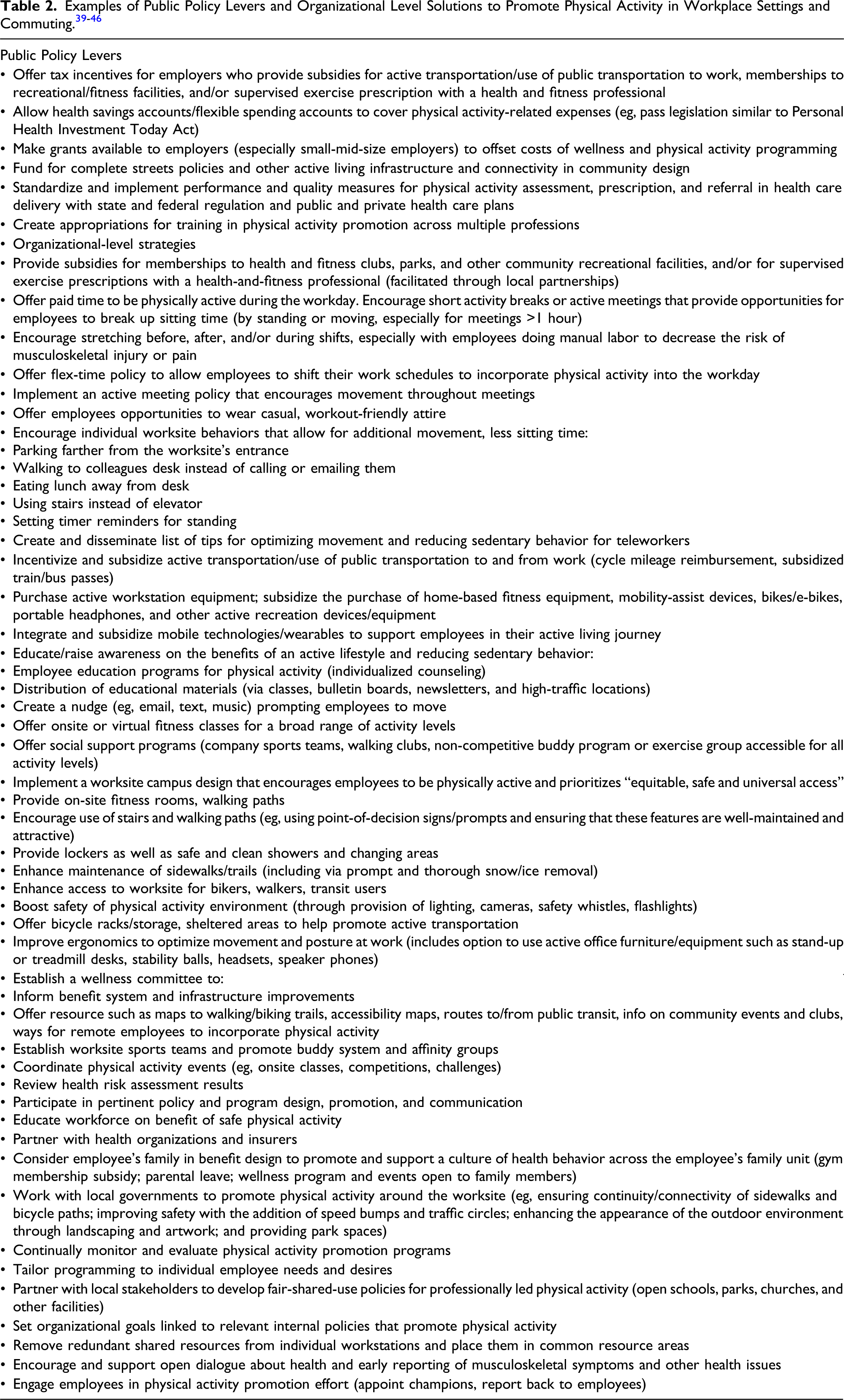
With increasing health care costs for employers and increasing health care utilization, the integration of physical activity assessment, prescription and referral into workforce health promotion is critically important. Employers should consider integration of program options in coordination with prescriptions for physical activity or health from their employees’ health care clinicians. Worksite health assessment for aerobic and muscle strengthening physical activity should be consistent with those measures and related advice used in health care systems and integrated into federal and state regulations.56,57 This assures optimal and standardized assessment, as well as benchmarking and population-level monitoring. Employers can amplify and support the physical activity prescription and referral coming from an employee’s clinical visit with the strategies highlighted in Table 2. Workplaces can be supportive environments for physical activity and the originator of the physical activity prescription within health promotion/chronic disease management programming.
Conclusion
The COVID-19 pandemic amplified changes that were already beginning to reshape work in the U.S.
These changes include greater use of technology, new business models, new hiring and promotion strategies, an increased focus on mental health and financial well-being, and a renewed commitment to diversity, equity, and inclusion. Physical activity represents a well-supported strategy to counter detrimental changes to worker health that have resulted from recent shifts in the context of work. To best respond to this changing environment, employers should prioritize physical activity – addressing sedentary work environments, leisure time, as well as commuting -- in their suite of strategies to optimize employee health and well-being. Employers can be strong role models and lead a movement that promotes recommended levels of physical activity across the lifespan. That is good for workers, their families, organizations, and the community.