




Abstract
Purpose
To evaluate the impact of a statewide flavored tobacco restriction among Massachusetts residents who use menthol or flavored tobacco and to assess differences in impact between Black and White users, as the tobacco industry has targeted menthol to Black users.
Design
An online survey was distributed through a panel provider and household mailings.
Setting
Eleven Massachusetts communities with higher-than-state-average Black, Indigenous or People of Color populations
Subjects
Black (n = 63) and White (n = 231) non-Hispanic residents who used menthol or other flavored tobacco products in the past year.
Measures
Impact of the law on use, access, and quitting behaviors.
Analysis
Outcomes were assessed between Blacks and Whites using Pearson chi-square tests.
Results
Over half (53% of White, 57% of Black) of respondents believed the law made it more difficult to access menthol products; two-thirds (67% of White,64% of Black) accessed menthol products in another state. Black users were significantly more likely to report purchasing menthol products off the street (P ≤ .05). One-third (28% of White, 32% of Black) believed the law made it easier to quit, and one-third (27% of White, 34% of Black) completely quit in the past year.
Conclusions
Flavored tobacco restrictions may positively and equitably impact cessation. Cross-border access and off-the-street purchasing suggest the need for greater cessation support and underscore the importance of a national policy.
Keywords
Purpose
Historically, the tobacco industry has intentionally targeted menthol tobacco products to Black Americans through advertisement placement, price promotions, and music marketing.1–4 Studies have shown disproportionate point-of-sale tobacco marketing in Black neighborhoods 5 and that inequity grows when looking at marketing of menthol tobacco; multiple studies have demonstrated more menthol advertisements, greater menthol availability, and lower menthol prices in communities of color.6-8
The targeting of menthol tobacco products to Black Americans has contributed to disproportionately high menthol use among Black smokers. Nationally, non-Hispanic Black (referred to throughout this article as Black) adults smoke menthol cigarettes at significantly higher rates than their non-Hispanic White (referred to as White) counterparts (76.8% of Black smokers usually use menthol compared to 24.6% of White smokers). 9 Studies show that menthol cigarettes may be biologically more addictive and increase dependency more than non-flavored cigarettes in the general population.9-12 This may lead to greater smoking intensity and more difficulty quitting. In Massachusetts (MA), people of color are 25% less likely to successfully quit than Whites, this inequity has persisted over decades (MA BRFSS).
Some localities and states have implemented restrictions on flavored and menthol tobacco sales, which have reduced the availability, marketing, and sales of restricted products and decreased use rates in youth and adults.13-15 In Ontario, Canada researchers found that two years after a menthol tobacco restriction took effect, menthol smokers reported more quit attempts (adjusted relative risk [ARR] = 1.45) and a higher likelihood of quitting (ARR = 2.08) than non-menthol smokers. 16
On June 1, 2020, MA enacted a comprehensive, statewide flavored tobacco restriction entitled “An Act Modernizing Tobacco Control” that, in part, restricts the sale of all tobacco and vape products with flavors including menthol. Sales of these products are now allowed only in the few state-licensed smoking bars (currently 25 in MA) for on-site consumption. The law also prohibits retailers from advertising the sale of flavored tobacco and vape products.
In addition to including menthol among other restricted tobacco flavorings, several measures were taken to help ensure the law does not exacerbate inequities in enforcement. First, the law does not include a Purchase, Use or Possession (PUP) component (meaning it is not illegal to obtain or use flavored tobacco products), thereby requiring the tobacco industry be responsible for the distribution of its products, not shifting responsibility to individuals grappling with nicotine addiction. 17 Second, the MA legislature assigned enforcement authority and gave funding to municipal boards of health, and thus, minimizing the potential for increased police presence due to the law. Third, the MA Tobacco Cessation and Prevention program (MTCP) worked with its state Quitline to develop a program specifically for users of menthol products to aid in cessation. Finally, the MA Police Chiefs Association distributed guidance to all municipal police departments outlining the enforcement parameters for the law and stressing that the law does not make it illegal for anyone to use or possess flavored tobacco products.
To date, few studies have examined the impact menthol sales restrictions have on racial and health equity, especially among the Black community that have been disproportionately targeted by the tobacco industry. 13 Those that have, found the rationale for menthol tobacco sales restrictions were not well-understood or universally supported by Black smokers and Black young adults were more likely than other young adults to continue using flavored cigars after implementation of a flavored and menthol sales restriction.18,19 This paper intends to begin to fill this gap in the literature by sampling areas of the state with higher-than-average Black, Indigenous, People of Color (BIPOC) populations to ensure BIPOC perspectives are adequately represented.
This study aims to understand awareness and attitudes towards the law among menthol and other flavored tobacco users in MA and examine the impact of the law on tobacco access and quitting behaviors, both intended by the law and possible unintended consequences, such as access to flavored tobacco products from other states or “off the street” sources. Furthermore, given the industry targeting of menthol tobacco towards Black communities and subsequent high rates of menthol use among this population, this study aims to examine any differences in outcomes between Black and White tobacco users who use menthol and other flavored tobacco products. We hypothesize that the law will make it harder for tobacco users to access menthol and flavored tobacco products and will have a positive impact on their quitting behavior.
Methods
Design
MTCP partnered with Market Street Research to create and disseminate an online survey. From July to September 2021, a 10-minute online survey was disseminated through an online panel provider as well as by direct mailings (with a link to the online survey) to individual households in the targeted communities.
Sample
The survey was disseminated to MA residents in 11 communities with higher-than-state average BIPOC populations: Boston, Brockton, Chelsea, Everett, Fall River, Lawrence, Milton, New Bedford, Quincy, Randolph, and Springfield. Additional inclusion criteria included: being 21 or older and having ever used at least one type of tobacco product (cigarettes, cigars/cigarillos, smokeless tobacco, or vape) within the past year.
The final survey consisted of up to 80 questions (both multiple-choice and open-response). It was available in English, Spanish, Portuguese, and Haitian Creole.
Measures
Demographics
Demographics and Tobacco Use.
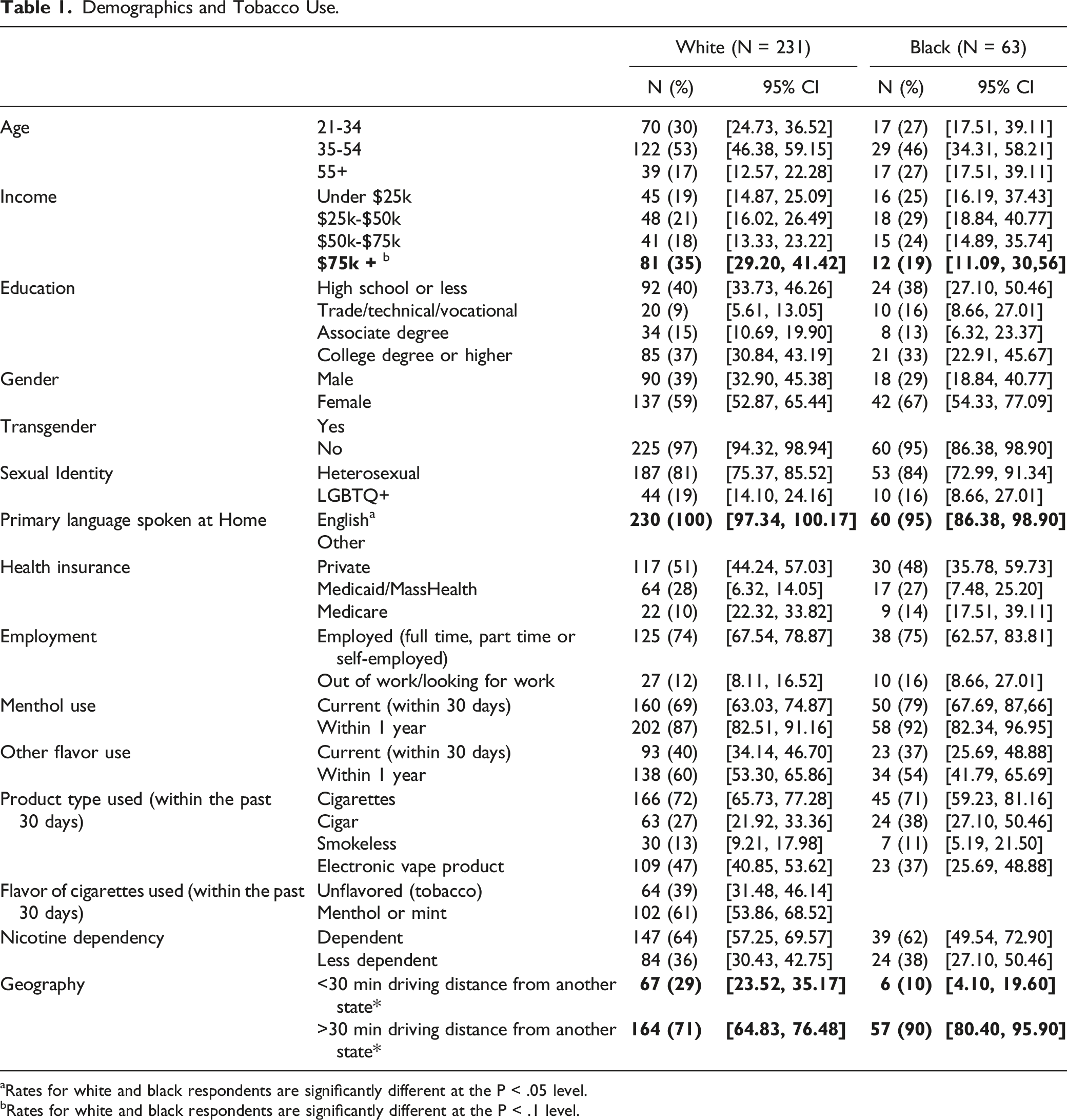
aRates for white and black respondents are significantly different at the P < .05 level.
bRates for white and black respondents are significantly different at the P < .1 level.
Tobacco Use
For each tobacco product respondents indicated they have ever used in the past year, they were asked how long they have regularly used that product in their entire life, as well as what flavor(s) they used most often in the past 30 days. See Table 1 for response options.
State Law Opinion
Respondents were asked if they were aware of the new law prior to the survey, and whether they support it and why.
State Law Impact
Law Perceptions and Impact of the Law on Access.
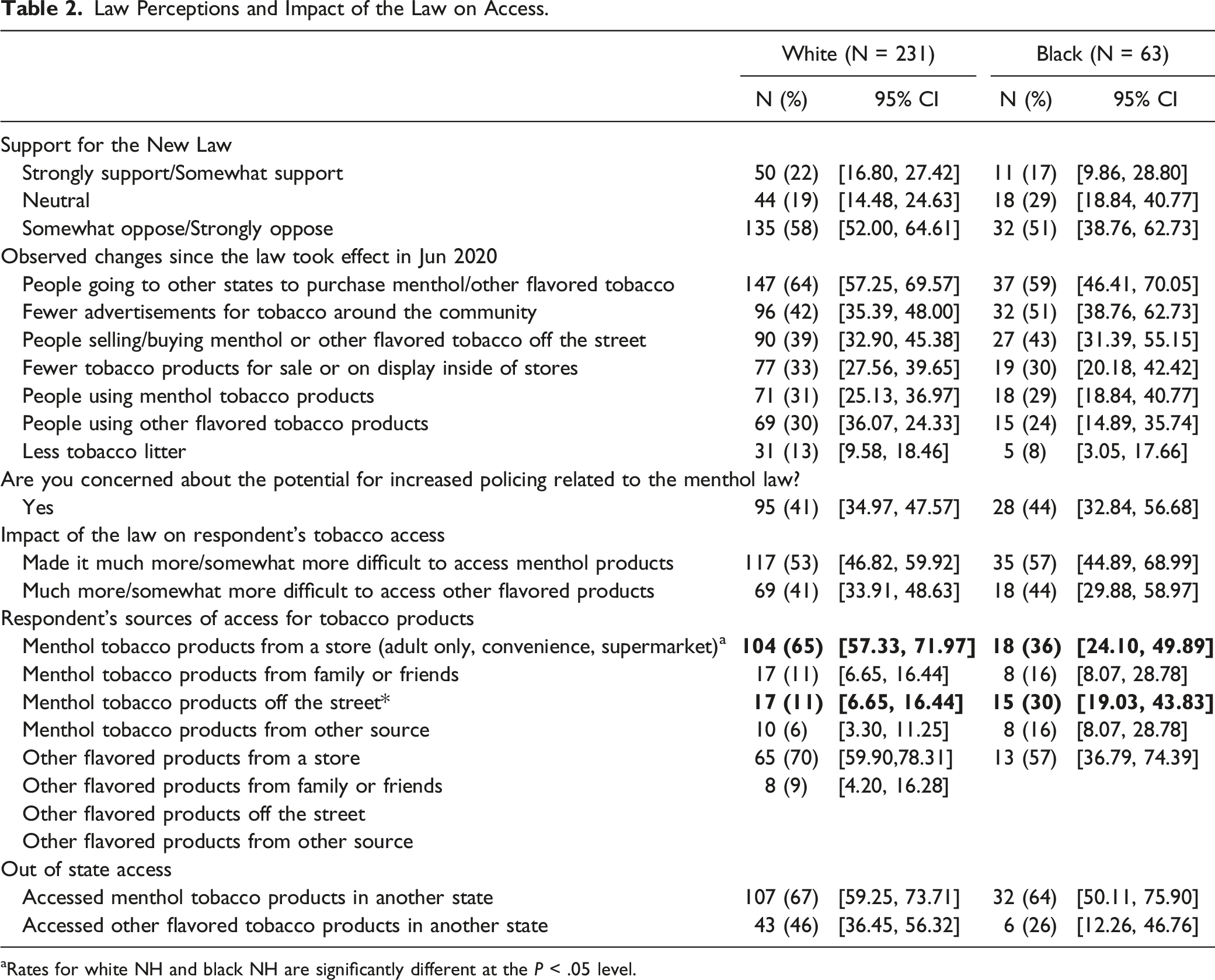
aRates for white NH and black NH are significantly different at the P < .05 level.
Nicotine Dependency
Questions about nicotine dependency were adapted from the National Adult Tobacco Survey. 20 Respondents were asked if they ever wake up at night to have a tobacco product, whether they’ve had a strong craving to use tobacco products of any kind within the past 30 days, if they ever felt like they really needed to use a tobacco product within the past 30 days, if there was a time when they wanted to use a tobacco product so much they found it difficult to think of anything else, and if they felt restless and irritable after not using tobacco for a while. A latent class segmentation analysis was used to group respondents into two categories: more dependent and less dependent.
Change in Use Since COVID-19
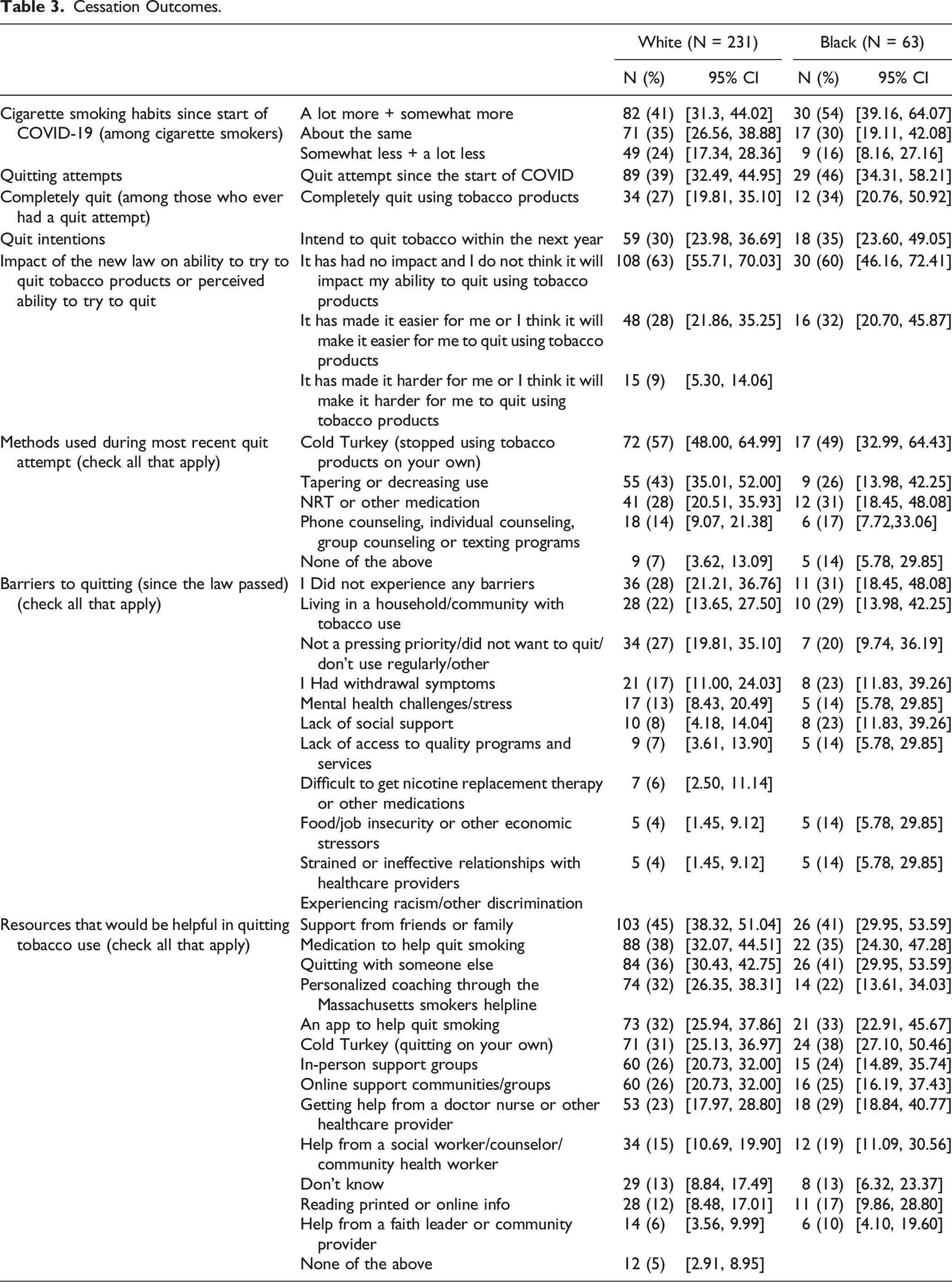
Cessation Outcomes.
Cessation
Respondents were asked about their quitting behaviors: if they have quit tobacco products since the start of COVID, if they intend to quit within the next year, reasons for wanting to quit or not wanting to quit.
Respondents were then asked about any barriers to quitting, what helped them quit (facilitators), and if the new law had impacted their ability to try to quit tobacco products and why. See Table 3 for detailed response options.
Geography
Respondents were categorized as being close (< 30 min driving distance) to another state’s border or further from another state’s border (≥ 30 min driving distance) depending on the community they reside in. Fall River, Springfield and Lawrence were categorized as close to another state’s border.
Analysis
Descriptive statistics were calculated for all questions, and Pearson chi-square tests were used to assess differences between White and Black respondents who have used a flavored tobacco product in the past year (respondents who identified as a different race/ethnicity or who haven’t used flavored tobacco products in the past year were excluded from this analysis).
MA Department of Public Health Institutional Review Board (IRB) determined this study does not meet the definition of human subject research and does not require review by the IRB.
Results
Study Population
A total of 590 MA residents responded to the survey. The analysis sample consisted of 294 respondents (231 White and 63 Black) who used either menthol or flavored tobacco products in the past year. Demographic characteristics and tobacco use behaviors can be found in Table 1. Most characteristics were similar between White and Black respondents; significant differences only existed for primary language spoken at home, proximity to the state border, and median household income.
Tobacco Use
Among the study population, cigarettes were the most frequently reported tobacco product used. White respondents had higher rates of use of other flavored tobacco products, 60% [53.3, 65.9] compared to 54% [41.8, 65.7] (Table 1). Black respondents reported significantly higher rates of menthol cigarette use (96% [84.35, 99.59] of Black and 61% [53.9, 68.5] of White cigarettes smokers use menthol).
Nicotine dependency status was similar between the two groups; 64% [57.3, 69.6] of White respondents and 62% [49.5, 72.9] of Black respondents were considered “more dependent” on nicotine.
Awareness and Support for the Law
Table 2 contains responses to survey questions concerning respondents’ awareness and support for the law. Most respondents (88% White and 81% Black) reported they were aware of the law prior to taking the survey. Around half of respondents were either in support of the law or neutral.
Those in support of the law cited reasons such as the law protects consumers’ health and prevents youth from smoking. Supplemental Table 1 (Table S1) contains select responses to the open-ended survey questions. One respondent in support of the law wrote “I believe that this law was made to protect the consumer. I would like to quit and not use any of these products. Flavor products are thought to be fun. Making them unavailable to be purchased I believe will help to keep them out of the hands of children.” Those who were opposed cited reasons such as the law is an infringement on personal choice, sales of other substances (e.g., marijuana and alcohol) are legal, and people can travel to other states to buy restricted products. One respondent opposed to the law wrote “It hasn’t stopped menthol cigarette smokers from smoking menthol cigarettes it really just makes people buy them out of state so MA loses the tax revenue”.
General Perceived Impact of the Law
Table 2 also contains responses to survey questions concerning respondents’ perceptions of the impact of the law on general changes in the environment and behaviors of people around them. The most frequently cited perceived impact of the law among both groups (64% [57.3, 69.6] of White and 59% [46.4, 70.1] of Black respondents) was people going to other states to buy menthol/flavored tobacco. Other frequently cited impacts were seeing fewer tobacco advertisements around the community, and people selling menthol/flavored tobacco on the street. There were no significant differences in perceived impact of the law between White and Black respondents.
Tobacco Access
Finally, Table 2 contains responses to survey questions concerning impact of the law on the respondents’ own tobacco access. Overall, many (86.7%) respondents reported the law made it somewhat or much more difficult to access all types and flavors of tobacco products.
One of the primary perceived impacts of the law was that people would travel to other states to purchase restricted products. Many (67% [59.3, 73.7] of White and 64% [50.1, 75.9]) of Black respondents) did in fact report travel out of state to purchase menthol products; these rates were lower for other flavored tobacco products. There were no significant differences between White and Black respondents in rates of out-of-state access.
The most frequently reported source of access for menthol, and other flavored tobacco products among both Black and White respondents was from a store (adult only, convenience, or supermarket). The survey did not specify if the store was located in state or out of state. However, some differences exist by race. Black respondents were significantly more likely than White respondents to report buying menthol products off the street. White respondents were significantly more likely to report buying menthol products from a store (Table 2).
Racial differences in sources of access may be partially modified by geography. Respondents of either race that live in communities further from another state’s border (≥ 30 min driving) were significantly less likely to report buying menthol products from a store and more likely to report buying off the street than those living closer to another state’s border (data not shown in tables). Significantly more White respondents lived in a community closer to another state’s border (Table 1). However, even after stratifying by geographic distance, differences by race remained. Among those who lived further from a state border, Black respondents remained significantly more likely to report the law made it more difficult to access menthol products and were more likely to purchase these products off the street compared to White respondents.
Despite significant differences in sources of access by race, both Black and White respondents were equally concerned about increased policing due to the law; there was no significant difference by race (41% [35.0, 47.6] of White and 44% [32.8, 56.7]) of Black respondents reported concerns). As one Black respondent wrote “I’m also concerned that police presence in historically…disadvantaged areas will be policed more than upper-middle-income areas” (Table S1).
Cessation
Table 3 contains responses to questions regarding cessation behaviors. Since the start of the COVID-19 pandemic, which roughly coincides with law implementation, 16.1% of Black respondents reported using cigarettes a lot or somewhat less frequently, compared to 24.3% of White respondents (Table 3).Around one third of respondents stated that they intend to quit using tobacco products during the next year and one third believed the state law would make it easier to quit using tobacco (28% [21.9, 35.3] of White and 32% [20.7, 45.9] of Black respondents) (Table 3). Reasons for perceived ease in quitting include difficulty accessing tobacco products (“more of a pain to get them so less likely to go get them”) and desire to “obey the law”. However, most (63% [55.7, 70.0] of White and 60% [46.2, 72.4] of Black respondents) believed the law would have no impact on their quitting behaviors, stating that they can still access restricted products or will use unflavored products, or that if they decide to quit it will be a personal choice, not due to the law (“I am quitting for me and my health not the law”). Less than 10% of both groups believed that the law would make it harder to quit. Reasons for this included wanting products more (“you want what you can’t have”) and buying restricted products in bulk (“Because now I have to travel and I tend to bulk buy”) (Table S1).
Racial differences in quit attempts, successful quitting, and cessation methods were not statistically significant. However, Black respondents reported more types of barriers to quitting than White respondents; many of these barriers were related to environmental factors and social determinants of health, including experiencing racism, food/job insecurity, and strained or ineffective relationships with healthcare providers (Table S1). Facilitators to quitting looked more similar between groups. The most frequently reported facilitator among both groups was support from friends and family.
Discussion
Awareness and Support for Law
This study assesses the impact of the MA statewide flavored tobacco restriction on perceptions and behaviors of White and Black tobacco users. Overall, there was high awareness of the law among both groups. We found that almost half of respondents either supported the law or were neutral. While slightly lower than national research from The Truth Initiative showing that most adults (56.4%) support a federal ban on menthol cigarettes, 21 support for the law was still high among our study population of recent flavored tobacco users.
General Perceived Impact of the Law
The most frequently cited perceived impact of the law was people traveling to other states to purchase restricted products. We found that about 2 out of 3 respondents reported traveling out of state to purchase menthol and there were high rates of out-of-state travel for other products.
Tobacco Access
Since MA is small in landmass and many bordering states are a short drive away, there is a history of residents traveling to other states, primarily New Hampshire (NH), where base prices and excise taxes are typically lower, and there is no state sales tax, to purchase tobacco. For example, the average price per pack of cigarettes in MA is $11.11 and the average price in NH is $7.73. 22 However, cross-border sales do not necessarily indicate higher tobacco use rates in MA; this survey did not quantify the frequency of out-of-state access, amount of tobacco purchased out-of-state, or individual tobacco use intensity. Furthermore, there is evidence to suggest initial cross-border sales increases following a policy change are not sustained; historical NH cigarette stamp data indicate an initial increase in cigarettes stamped immediately after MA increased its cigarette sales tax in 2013, but this increase was not sustained (NH Department of Revenue).
Another major finding that highlights an unintended consequence of the law was the difference between White and Black respondents in sources of access for menthol products, even among respondents in equal proximity to another state. White respondents were more likely to purchase menthol products from a store, and Black respondents were more likely to purchase products off the street. Some differences in access can be attributed to decades of systemic racism resulting in lower incomes and transportation barriers that may make it more difficult for Black respondents to access menthol and flavored products from another state.23,24 Furthermore, while Black tobacco users may be more likely to purchase off the street, there is no evidence to suggest that they are also more likely to illegally sell these products.
Cessation
Close to one third of respondents believed the law would make it easier to quit, and close to one third of those who made a quit attempt reported having completely quit tobacco products since the start of the COVID-19 pandemic (which occurred shortly before state law implementation). However, less than a quarter of respondents reported smoking cigarettes less since the start of the pandemic; in fact, nearly half of respondents reported smoking somewhat or a lot more. This may be attributed in large part to increased stress from the economic and social impact of the pandemic, such as job loss, concerns about paying bills, and poor mental health, as documented in data collected from a large statewide covid impact survey conducted by the MA Department of Public Health in Fall 2020. 25 The percentage that reported smoking less was particularly low among Black smokers, who experienced disproportionate effects of the pandemic and who smoke menthol cigarettes at higher rates. The effects of the pandemic, in combination with the addictive qualities of menthol and cessation barriers felt among Black respondents, underscore the need for greater and tailored cessation support for this population.
Previous studies have shown that reduced availability of tobacco products and point-of-sale marketing can reduce relapse and spontaneous purchases, lending support to the eventual reduction of tobacco use as an outcome from this law.26,27 Though differences were not statistically significant, Black smokers reported higher rates of both quit attempts and successful quitting, yet also reported experiencing more types of barriers to quitting compared to Whites. There was a clear desire among Black smokers to quit tobacco, however, systemic barriers, such as structural racism and its impact on access to healthcare and other services may be impeding success. 28 Therefore, it is important for tobacco product restrictions to be paired with initiatives to help support tobacco users to quit.
MA takes a multi-pronged approach to support cessation among menthol and other flavored tobacco users who may be impacted by the law. The state law itself included a component that requires private insurers and MassHealth, the state’s Medicaid program, to provide coverage for tobacco use cessation counseling and at least one generic FDA-approved tobacco cessation product at no out-of-pocket costs. MTCP is also engaged in quality improvement efforts to improve the MA Quitline through increasing provider awareness and providing patients with better information about what to expect when being referred. When the law took effect, the Quitline implemented a special program for menthol smokers that provides monetary incentives and targeted cessation support.
Limitations
There are some limitations to note. This study included a small sample overall (n = 294), and an even smaller sample size for Black participants (n = 63), so it is possible the analysis was underpowered to detect all differences between racial groups. This study was cross-sectional, so it is not possible to know whether self-reported quitting behaviors and other outcomes were sustained over time without continued surveying. However, existing research suggests menthol bans have led to increases in quit attempts and successful quitting even two years post-policy implementation. 13 Additionally, these findings may not be generalizable to the rest of MA as cities selected for inclusion are potentially different from other communities. Finally, the law went into effect shortly after the COVID-19 pandemic began, so tobacco use and cessation outcomes may have been impacted by the pandemic in addition to the law, and it was not possible to disentangle the extent that each factor individually impacted outcomes. Studies have shown evidence of increased smoking prevalence and increased quit attempts during COVID-19. 29
Future Directions
In terms of understanding unintended consequences of the law, the survey did not ask questions regarding access to cars and/or other transportation. Therefore, the finding that Black respondents were more likely to purchase flavored products off the street may have been due in part to participants’ inabilities to travel out of state to purchase products. Additionally, several of the municipalities in this study had existing flavor restrictions (excluding menthol). Thus, menthol users (who are a greater percent Black) experienced a more abrupt change compared users of other flavors (who are a greater percent White). Finally, many questions asked were about perceptions related to the law, such as concern for increased policing, and additional data sources were not available for validation. Research exists that proactive policing policies disproportionately impact Black communities, and police stops alone can result in psychological distress (among other long-term consequences).30,31 The law does not grant enforcement authority to police, nor does it include possession or use penalties, and education outreach was made to local police departments about the parameters of the law to mitigate the potential for increased policing. Nevertheless, our study findings suggest that off the street tobacco sales are disproportionately impacting Black residents, and therefore, the possibility of increased policing remains. MA will continue to monitor this possible issue through resident surveys and continue to engage communities of color in dialogue and education around the law and provide greater cessation support.
“So What?”
What is already known on this topic?
• The tobacco industry has targeted menthol tobacco products to communities of color across the United States
• Existing studies demonstrate that menthol and flavored tobacco restrictions have reduced the availability and sales of these products
What this paper adds?
• This study suggests that comprehensive flavored tobacco restrictions may have a positive impact on quitting outcomes among Black non-Hispanic flavored tobacco users in Massachusetts, especially when coupled with programmatic efforts to support tobacco cessation.
• However, results also suggest some residents continue to access menthol and other flavored tobacco products in other states or off the street. These findings underscore the importance of continuing to monitor access and use over time, as well as the importance of the widespread passage of these policies throughout the country.
What are the implications for health promotion practice or research?
• Cross-border access and off-the-street purchasing suggest the need for greater cessation support targeted to menthol and flavored tobacco users and underscore the importance of a national flavored tobacco policy inclusive of menthol
Supplemental Material
Supplemental Material - Evaluation of a Statewide Flavored Tobacco Restriction on Use, Access, and Cessation Among Black and White Tobacco Users in Massachusetts
Supplemental Material for Evaluation of a Statewide Flavored Tobacco Restriction on Use, Access, and Cessation Among Black and White Tobacco Users in Massachusetts by Hannah McGinnes, MPH, Melody Kingsley, MPH, Glory Song, MPH, Jana Rosewarne, PhD, Stephanie Gonthier, MBA, Jacqueline Doane, and Patricia Henley, Med in American Journal of Health Promotion
Footnotes
Authors’ Contributions
PH, JD, GS, MK, and HM conceived and designed the study. SG and JR acquired the data. JR was responsible for analyzing the data. HM, MK and GS interpreted the data. HM drafted the manuscript with input from MK and GS. All authors reviewed, revised, and approved the article.
Declaration of Conflicting Interests
The author(s) declared no potential conflicts of interest with respect to the research, authorship, and/or publication of this article.
Funding
The author(s) received no financial support for the research, authorship, and/or publication of this article.
Ethical Approval
Massachusetts Department of Public Health (MDPH) Institutional Review Board (IRB) determined this study does not meet the definition of human subject research and does not require review by the IRB.

Supplemental Material
Supplemental material for this article is available online.
References
Supplementary Material
Please find the following supplemental material available below.
For Open Access articles published under a Creative Commons License, all supplemental material carries the same license as the article it is associated with.
For non-Open Access articles published, all supplemental material carries a non-exclusive license, and permission requests for re-use of supplemental material or any part of supplemental material shall be sent directly to the copyright owner as specified in the copyright notice associated with the article.
