



Abstract
Purpose
Owing to the reproductive health needs of the budding adolescent and young population, the present study aims to determine the factors associated with and decomposing the gap in contraceptive use among adolescents and young women in India.
Design
Cross sectional design.
SettingThe present study is based in India using the appended datasets (IV and V rounds) of the Indian Demographic Health Survey (DHS), also known as National Family Health Survey (NFHS) conducted in 2015-16 and 2019-21.
Sample
The adequate sample size was 475,294 adolescents and young women in NFHS-4 and 229,705 in NFHS-5, totaling 704,999 adolescents (appended for NFHS-4 and 5) for the present study.
Measures
Sociodemographic, sexual and reproductive history and contraceptive measures.
Analysis
Descriptive statistics, chi-square tests, and a binary logistic regression model were executed. Additionally, a decomposition technique called Fairlie decomposition was employed to identify the primary causes of the difference in the prevalence of contraceptive use between the two survey periods.
Results
Almost 96% of young women aged 15-24 knew about contraception, but only 12% used it. Regression analysis revealed that contraceptive use was associated with higher age (AOR 1.09), higher education (AOR 1.28), married adolescents (AOR 4.08), richest wealth quantile (AOR 2.95), joint decision making (AOR 4.40), knowledge of ovulatory cycle (AOR 1.47), interaction with a health worker about any methods of family planning (AOR 3.29) and three and above children ever born (AOR 18.54). Decomposition analysis showed that factors like decision-making of contraception, age, interaction with family planning worker, the intention of last pregnancy, place of residence and age at first sex contributed to increasing the probability of contraceptive use from NFHS-4 to 5.
Conclusion
A target-based approach dedicated to understanding the mindset of adolescents and keeping up with their unique needs is the need of the hour.
Purpose
Developing countries have been a central hub of the youth population, wherein almost every fifth person is aged between 15 and 24. India is also considered the land of young people, with the world’s largest youth population. Approximately 66% of the total population of India (more than 808 million) is below the age of 35. 1 As per the National Youth Policy of India, nearly 40% of India’s population is aged between 13 to 35 years. 2 Youth in the age group of 15-29 years comprise 27.5% of the population. Currently, about 34% of India’s Gross National Income (GNI) is contributed by the youth aged 15-29 years. 2 A country comprising a young population means more economical and workforce avenues, but there are also some risks which become part and parcel of this young population. The adolescents and young population are required to have not just good mental and physical health but also good reproductive health. For ensuring safe and healthy reproductive health, a thorough knowledge of contraceptives, access to comprehensive reproductive health services and safe sexual involvement among the youth population is essential.
In this regard, preventing unintended pregnancy is essential to improving adolescents’ sexual and reproductive health and their social and economic wellbeing. About half of the pregnancies among adolescent women aged 15-19 living in developing regions are unintended, and more than half of these end in abortion, often under unsafe conditions. 3 Unintended pregnancies are highly significant, with negative social, mental and physical outcomes for women and children both. An estimated one-fourth and two-fifths of maternal deaths could be averted if unplanned pregnancies were prevented.4,5 Adolescents and youth are at greater risk of unplanned or unintended pregnancy, gender-based violence, and sexually transmitted diseases, as well as education and other basic life choices. The sexually active youth population, including newly married couples, are in constant need of contraceptives for disease protection and to reduce unintended pregnancy. 6 Amongst other sociocultural blockades, the use and non-use of contraception and traditional methods pose a high risk of unintended pregnancy among young women. Girls, especially adolescent girls in particular, can face an increased risk of early pregnancy/motherhood, sexual coercion, exploitation and violence. These situations can have a serious mental and physical impact on them as well as their families and communities. 7
There are several factors beyond individual control that are responsible for better adolescent and youth reproductive health, mainly involving the role of interventions to influence community-level normative change towards healthy reproductive behavior among the young population. 8 Knowing the potential of the country’s large youth population and realizing the importance of adolescent health and wellbeing, the government of India made various reforms in the adolescent health sector in the early 2000s. 9 This started with the Ministry of Health and Family Welfare (MoHFW) strengthening its programmes and systems for adolescents in 2005 with the Adolescent Reproductive and Sexual Health Strategy until 2013, later converted into the Rashtriya Kishor Swasthya Karyakram (RKSK) from 2014 onwards. The RKSK is a health programme launched for adolescents aged 10-19 which majorly revolves around improving their nutritional status, reproductive health and substance abuse. The programme includes facilities like adolescent-friendly health clinics, counselling, adolescent health days, peer education and weekly iron-folic acid supplementation. 10
Owing to persistently low use of contraception and high rates of early childbearing combined with unintended pregnancies among the young population, there is a need to address the drivers of contraceptive use and increase accessibility and knowledge among adolescents and the young population in India.11,12 Despite efforts from the government to strengthen the adolescents' sexual and reproductive health policies, the participation and motivation of youth to use contraception remain less than expected. Little is known about factors contributing to contraceptive use among Indian adolescents and the young population. There are a few studies conducted which have explored this topic, but none of them has special concerns about the young and vulnerable young population in India. Moreover, no study has ever dealt with examining the inequality in contraceptive use among adolescents and young people in India. Therefore, the present study effectively aims to address the reproductive health needs of the young population in India by assessing and decomposing the factors with contraceptive use among young women in India.
Methods
Design
The present study is cross-sectional in nature as it utilized the appended datasets (IV and V rounds) of the National Family Health Survey (NFHS) conducted in 2015-16 and 2019-21, respectively. NFHS is a large-scale cross-sectional survey which provides information on population, health, and nutrition for India, each state/union territory (UT), and 707 districts as on March 31 2017. Funded by the MoHFW, Government of India, the NFHS sample is a stratified two-stage sample. The 2011 census served as the sampling frame for the selection of Primary Sampling Units (PSUs). PSUs were villages in rural areas and Census Enumeration Blocks (CEBs) in urban areas. The final sample PSUs and CEBs were selected with Probability Proportional to Size (PPS) systematic sampling. The Woman’s Questionnaire collected information from all eligible women aged 15-49, who were asked questions on a large variety of topics comprising background characteristics, reproduction history, family planning, knowledge and use of contraception, maternal and child health, fertility preferences and women empowerment. 13
Sample
In total, 699,686 women in NFHS-4 and 724,115 women in NFHS-5 were successfully interviewed. The effective sample size was 475,294 women in NFHS-4 and 229,705 women in NFHS-5, making a total of 704,999 women (appended for NFHS-4 and 5) for the present study. Adolescents and young women in the age group 15-24 were selected for the final sample of the study.
Measures
The sociodemographic measures in the study included age (categorized as 15-19 and 20-24), education (categorized as none, primary, secondary and higher), marital status (categorized as never married, married and widowed/divorced/separated), place of residence (categorized as urban and rural), caste (categorized as Scheduled caste (SC), Scheduled Tribe (ST), Other Backward Castes (OBC) and Others/don’t know) and wealth (categorized as poorest, poorer, middle, richer and richest). In NFHS, the wealth index was generated through household scores based on the ownership of consumer and household goods and amenities such as toilet facilities, sources of drinking water, and flooring material. These scores were used to classify all households into wealth quantiles. The lowest quantile has the poorest 20%, while the uppermost quantile has the wealthiest 20%. 14
Measures of sexual and reproductive history included age of sexual debut (categorized as never had sex, 8-14 years, 15-19 years, 20-24 years and at first union), lifetime number of sexual partners (categorized as 1, 2, 3 and 4 and above), children ever born (categorized as 1, 2 3 and 4 and above), the intention of last pregnancy (categorized as planned and unplanned), heard of Sexually Transmitted Infections (STIs) (categorized as No and Yes), undergone cervical screening (No and Yes), interaction with a health worker about family planning (categorized as No and Yes). Contraceptive measures included knowledge and awareness of contraceptive methods, current contraceptive use, source of current contraception and use decision maker for contraception.
Use of modern contraception among females was the dependent variable which (0 = No method, 1 = Traditional method and 2 = Modern method) was evaluated by the question: “Are you [and your partner] currently doing something or using any method to delay or avoid getting pregnant?” Participants who reported ‘yes' were then asked to list all current methods. Current contraceptive method use was recorded as per the responses and was categorized as none, traditional method (defined as rhythm or withdrawal methods) and modern methods (defined as female and male sterilization, Intrauterine device (IUD), injectable, implant, pill, male or female condom, lactational amenorrhea method, diaphragm, foam/jelly, or emergency contraception).
Analysis
All the analyses were performed using Stata (Version 15), and the statistical tests were anticipated at a significance level of P-value <.05. Descriptive statistics and chi-square tests were used. A binary logistic regression model was executed to investigate the predictors of modern contraceptive use among women. All the variables were used as binary or categorical predictors, with one category selected as the reference group based on a large sample size and/or meaningful comparison. In order to identify the primary causes of the difference in the prevalence of contraceptive use between the two survey periods (NFHS-4 and 5), a decomposition technique called Fairlie decomposition was employed. It is an extension of the Blinder-Oaxaca decomposition technique, which is the most famously used method for the identification and quantification of contributions of measurable variables in outcomes. However, this technique has one genuine drawback it cannot be applied if the outcome is binary in nature and the coefficients are from a logit or probit model. 15 It is in this regard that an extension of the Blinder-Oaxaca decomposition technique, Fairlie decomposition, comes into the picture. A Fairlie decomposition uses estimates from a logit or probit model and provides reliable estimates. 16 This method of decomposition permits us to compute the absolute contribution of factors explaining the group differences (over two groups) in the probability of using contraceptives among adolescents and young women. 17
Results
Sociodemographic and Reproductive Health Profile of the Respondents
Sociodemographic and Sexual and Reproductive Health Characteristics of Female Adolescents Aged 15-24, India, NFHS-4 and 5.
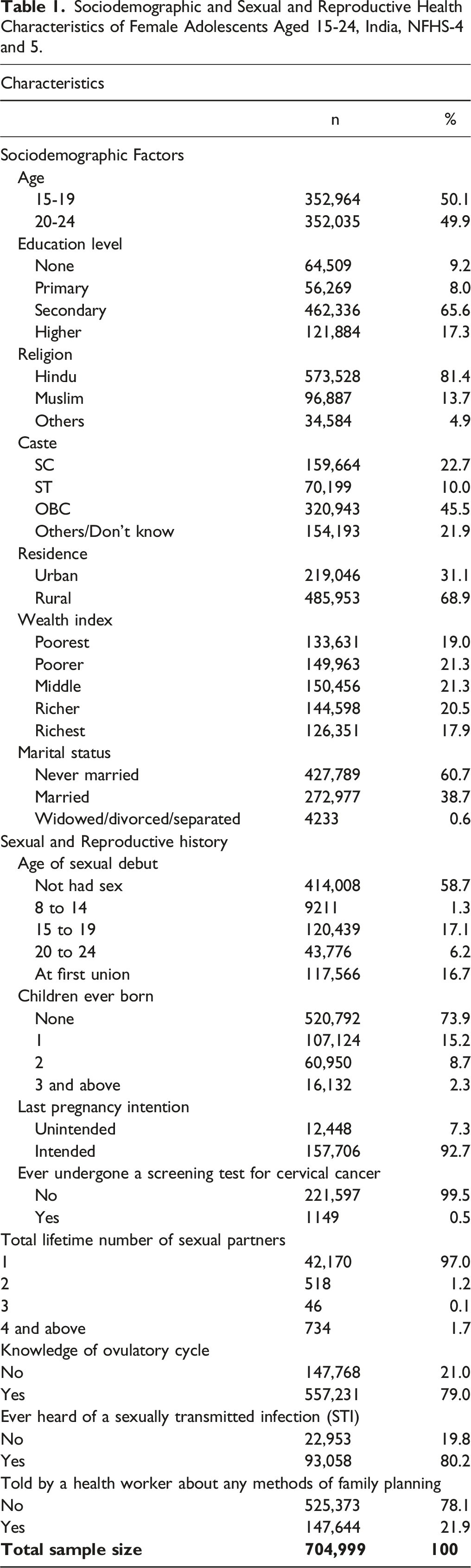
Almost 17% of respondents made their sexual debut at their first union (marital union), while almost 59% of the respondents reported that they never had sex. 17.1% of respondents made their sexual debut by the age of 15 to 19. 73.9% of the respondents had no children ever born, while almost 16% of them had one child, followed by 8.7% per cent having two children. 7.3% of the total respondents reported their current pregnancy as unintended, whereas 92.7% of them reported their current pregnancy as intended. Only 0.5% of the total young respondents had ever undergone a cervical cancer screening. The majority of the respondents had one-lifetime sexual partner, 1.2% of them had two sexual partners, and 1.7% had four and above sexual partners in life. The majority of them had knowledge about the ovulatory cycle (79%), and 80.2% of them had heard about sexually transmitted infections (STIs). Lastly, the majority of the respondents (78.1%) were never told by a health worker about any methods of family planning.
Figure 1 presents the knowledge and prevalence of contraceptive use among female respondents aged 15-24 in India. It shows that the majority of respondents (96.15%) knew about any method of contraception, but only 12% of them were using contraception at the time of the survey. Knowledge and use of contraception among adolescent and young women aged 15-24 in India, NFHS 2015-2021.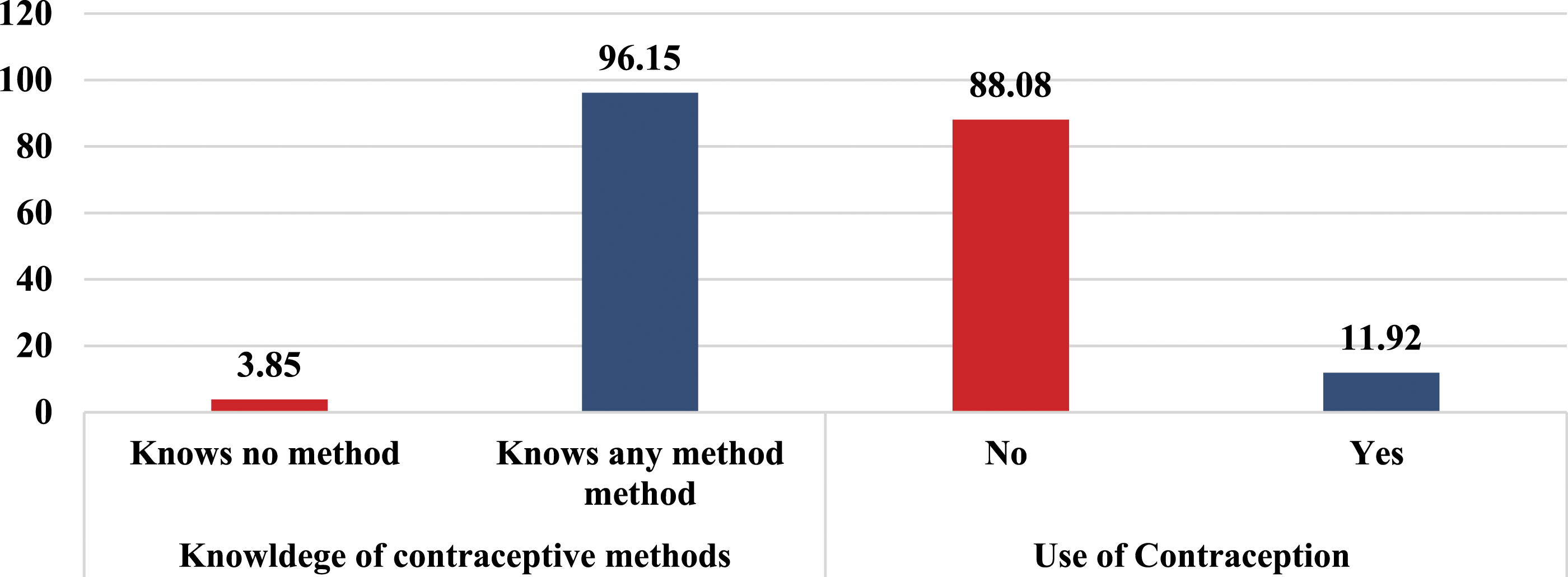
Contraceptive Knowledge and Use
Awareness of and Attitude Towards Contraceptive Methods Among Female Adolescents Aged 15-24, India, NFHS-4 and 5.

Almost half of the total respondents obtained their last method of contraception from a government clinic or pharmacy (47.2%). On the other hand, the least preferred source of contraceptives was NGOs (.3%). After the government clinic or pharmacy, the majority of the females acquired their chosen method through a local shop or friends (17.9%), followed by the pharmacy (16.3%) and private clinic (15.9%). Lastly, the majority of the respondents reported that they mutually take decisions to use contraception with their partners (82.9%), followed by husband/partner (8.58%) and respondents themselves (8.27%).
Predictors of Contraceptive Use Among the Young Female Population
Predictors of Contraceptive Use Among Female Adolescents in India, NFHS-4 and 5.

The respondents used more contraception at younger ages of their sexual debut. Women who had their sexual debut between 8 to 19 years were significantly 5.50 and 4.27 times more likely to use contraception than those who never had sex. For those who had their sexual debut at age 20 and above, the likelihood of contraceptive use was 3.60 times, while it was 6.05 times among those who had sex at their first union than those who never had sex. Similarly, women having two and three-lifetime sexual partners were 22 and 23% significantly more likely to use contraception than those having one sexual partner in a lifetime. A significantly higher likelihood of contraceptive use was observed when the last pregnancy was planned [OR 1.78, CI (1.66-1.92), P < .000]. Women with three and above children ever born were 18.54 times significantly more likely to use contraception than those with no child. A significantly higher likelihood of contraceptive use was reported among women when they were informed by a health worker about family planning methods than those who were not told [OR 3.29, CI (2.56-4.24), P < .000]. Women who heard about STIs and knew about the ovulatory cycle were 32% and 47% significantly more likely to use contraception as compared to those who did not know about it. Lastly, women were 4.40 times significantly more likely to use contraception when the decision-making was joint in nature compared to the decision making by respondent alone.
Fairlie Decomposition Analysis Depicting Contribution of Selected Characteristics in the Difference of Contraceptive Use Among Female Adolescents in India, NFHS-4 and 5.

Figure 2 depicts the contribution of predictors in the gap in contraceptive use among females in India from NFHS-4 to NFHS-5. The major contributor to widening the gap in contraception use among female adolescents is explained by the decision-making of contraception (65.86), followed by religion (45.90), age (14.05), wealth (10.51), marital status (5.51) and caste (5.15). On the other hand, factors like heard of STIs (−40.20), place of residence (−23.38), the intention of last pregnancy (−8.88), age at first sex (−6.91) were responsible for narrowing the gap in contraceptive use among adolescents and young women from NFHS-4 to 5. Results of firlie decomposition showing percentage distribution of each covariate to the gap in contraceptive use among adolscents and young women from NFHS-4 to 5.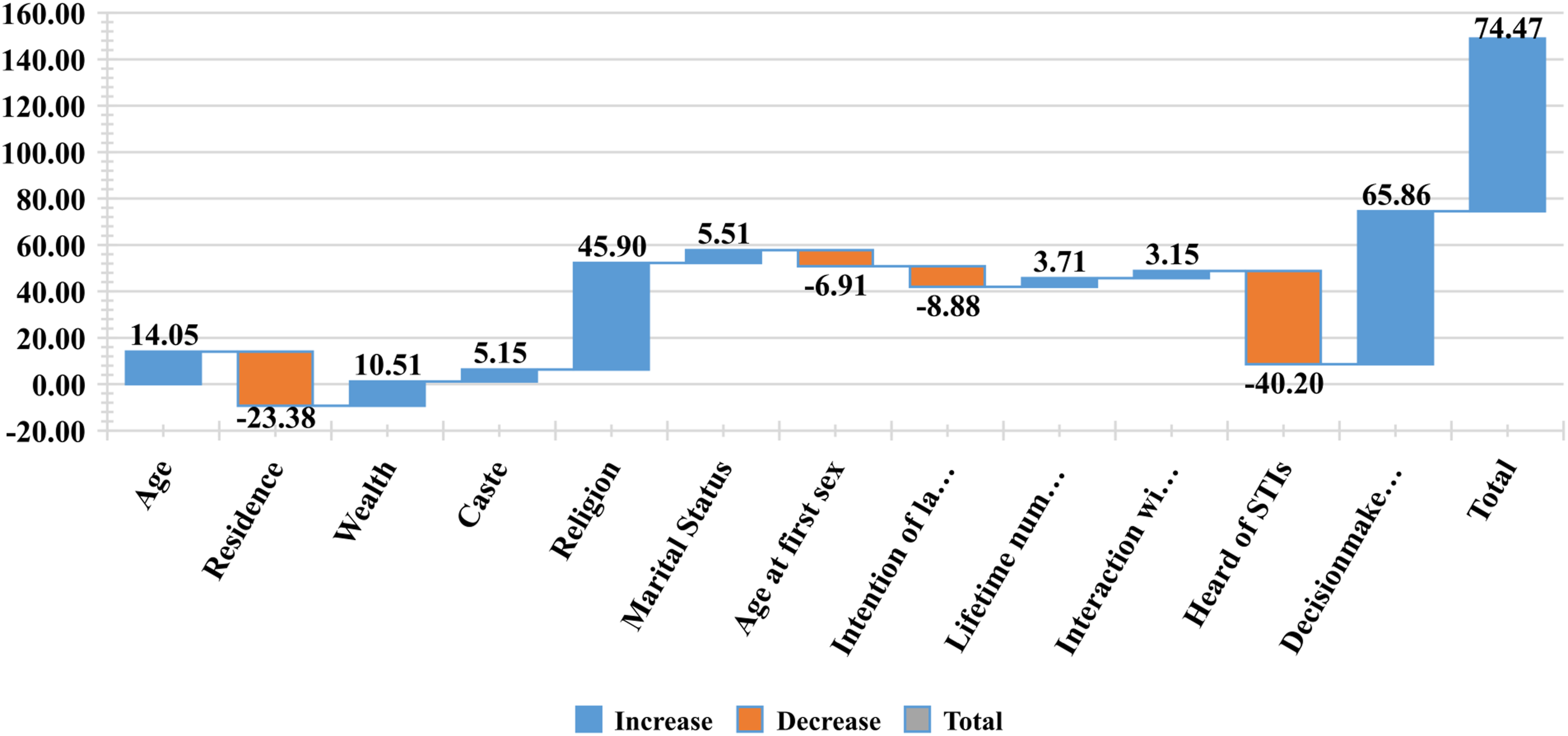
Discussion
The present study first demonstrated the level of awareness and use of contraception among female adolescents and young women of age 15-24 in India. It also revealed the specific sexual and reproductive nature of the youth and decomposed the difference in the use of contraception between the two survey periods (NFHS 4 to 5). The results clearly showed that almost 96% of young women had knowledge about contraception. However, this knowledge of contraception did not articulate into use, as only 12% of the young women in age 15-24 used contraception, majorly among younger ages (15-19). This finding corroborates the findings found in a former study. 18 A plausible explanation for this finding is that young women aged 20-24 have a better understanding of the repercussions of getting involved in unsafe sexual acts compared to those aged 15-19. 19
Additionally, the present study revealed that women who were sexually active at younger ages and had multiple sexual partners were using more contraception. The possible reason for these findings can be linked to the association between contraceptive use and marital status. Earlier studies have elucidated that unmarried adolescents and young women are more likely to use contraception in order to prevent unintended pregnancies.20,21 This is appropriate, specifically among those whose age at first sex is below 20 years, as it is most likely to take place outside the wedlock. 22
Despite the high level of awareness, young women seem to be disinclined towards using contraception, except condoms. In the present study, the most popular birth control method among young women was a male condom (4.9%), followed by female sterilization (4%). It can be linked to the fact that there are several misconceptions about how contraceptive use hampers the health of individuals and that use of contraception promotes promiscuity among women. 23 Not just awareness about contraceptives, women who were aware of STIs and their ovulatory cycle were more likely to use contraception, the present study reveals. The study through its findings states that awareness and knowledge play an essential role in empowering adolescents and young women about the matters of family planning.
Low socioeconomic background acts as an obstacle to contraceptive use, especially when adolescents and young women are at stake. Earlier studies conducted in this regard also reveal the same picture. The use of contraception among female adolescents is low and socioeconomic factors contributed substantially to it. 24 The results of this study revealed that adolescents residing in rural areas showed a low preponderance of using contraception. Uneducated women, women from the poorest strata of society and belonging to disadvantageous social groups like the OBCs, used less contraception as a result of their socioeconomic profile. These findings go in tune with previous studies which have acknowledged the importance of socioeconomic factors as facilitators and barriers to the uptake of modern contraceptive use among adolescents.25-27 Another important socioeconomic factor affecting contraceptive use was religion. Respondents from Muslim and Other religions showed a low preponderance of using contraception. Religious and cultural factors do affect the use and acceptance of contraception by individuals/couples from different religious backgrounds. 28 This finding also aligns with past studies, which revealed that Muslim women are hesitant to use contraception as their religion disapproves of contraception. 29
It is apparent from the present study that contraceptive use and planned pregnancy were positively associated. Women used more contraception when their last pregnancy was planned. Earlier studies have shown that almost every woman is at risk of unintended pregnancy throughout their reproductive span, and women at risk of non-use of contraception demonstrate a similar pattern to that of women at risk of unintended pregnancy. 30 Moreover, women having a say in decision-making showed a positive association with contraceptive use as well. Contraceptives were mostly used when it was a joint decision. Women contributing to decision-making reflects that women may have perceived behavioural control to utilize contraceptives as compared to those who are socioeconomically disadvantaged, 31 and hence they don’t have any contribution in the contraceptive decision-making as well.
The results of the study reflected that almost half of the female adolescents sought contraception from a government clinic or pharmacy. This signifies that the young population is also inclined towards facilities and services provided by the government with respect to family planning and contraception. After the paradigm shift in 2012, India witnessed a new integrated Reproductive, Maternal, Newborn, Child and Adolescent Health (RMNCH + A) approach, which was dedicated to achieving the goals of Family Planning by 2020. This involved more responsive approaches towards family planning demands of the population, assuring quality, identifying and catering to indigent states through Mission Parivar Vikas. The next government strategy that came up in the contour was India’s Vision Family planning 2030. It envisaged catering to the varied needs of the couples by strengthening the ASHA workforce at the community level in the country. 32 The government also envisaged a regular and sustained supply of quality contraceptive methods at affordable rates at the government health centers. 33 A positive association between interaction with health workers and contraceptive methods was observed. Those who had interacted with a health worker and were being told about the methods of family planning had higher odds of using modern contraceptives. 27 Health workers play an important role in disseminating knowledge amongst adolescents, training them to communicate their reproductive choices with partners and parents. The PRACHAR initiative, for instance, implemented in Bihar aimed to delay the age at first birth by delaying the age at marriage and increasing voluntary contraceptive use among young nulliparous married women. Through this initiative, rural health service providers were trained on reproductive health issues and contraception. 34 Lastly, the study highlighted a significant gap in contraceptive use among the young population of females from NFHS-4 to NFHS-5. The study found a significant increment in the probability of contraceptive use among female adolescents in India from 2015-16 to 2019-2021. The results of decomposition analysis reveal that factors like decision-making of contraception, age, interaction with family planning worker, the intention of last pregnancy, place of residence and age at first sex were responsible for contributing to the gap in contraceptive use from NFHS-4 to 5.
Strengths and Limitations of the Study
The biggest strength of the study lies in the fact that it uses data from two rounds of a nationally representative sample survey in India (NFHS-4 and 5). Moreover, the present study is one of its kind, depicting the levels, correlates of contraceptive use among adolescent young females in India and decomposing the contribution of each covariate as well. However, one limitation of this study is that it uses data from a cross sectional survey and therefore no causal linkages could be established.
Previous literature has focused on the level, trends and correlates of contraceptive use among the women of reproductive age group (15-49). However, adolescents and young women aged 15-24 represent a different contraceptive use pattern and have unique reproductive and family planning needs. In this context, the present study adds something new to the literature on adolescent reproductive health in India. High awareness and low uptake of contraception depicts a non-inclined attitude of the young females towards contraception in India. The findings indicate towards improving the intervention of health care providers like ASHA/ANM and front line workers to entertain the targeted needs of adolescent and young women. There is a need for more comprehensive family planning services for adolescents to improve their awareness and knowledge about family planning, especially younger adolescents. More focused approach of involving adolescents into family planning programmes should be encouraged through social media campaigns, workshops in community settings.So what?
What is already known on this topic?
What does this article add?
What are the implications for health promotion practice or research?
Footnotes
Authors’ Contribution/Roles
HS proposed and conceptualized the paper. HS analyzed and interpreted the data. HS was the major contributor in writing the manuscript while SKS supervised and reviewed the entire work. All authors read and approved the final manuscript.
Declaration of Conflicting Interests
The author(s) declared no potential conflicts of interest with respect to the research, authorship, and/or publication of this article.
Funding
The author(s) received no financial support for the research, authorship, and/or publication of this article.
Ethical Approval
The study is based on a secondary dataset; hence, no ethical approval from any institutional board was required. Procedures and questionnaires for standard DHS surveys have been reviewed and approved by ICF Institutional Review Board (IRB). Additionally, country-specific DHS survey protocols are reviewed by the ICF IRB and typically by an IRB in the host country. Before each interview or biomarker test is conducted, an informed consent statement is read to the respondent, who may accept or decline to participate. A parent or guardian must provide consent prior to participation by a child or adolescent. DHS ensures that the privacy of the respondents and the confidentiality of the data is maintained. More information can be read about it at  .
.
Data Availability Statement
The data given this article are the datasets used for the present research paper are available in the data repository of the official website of Demographic Health Surveys, following the links: (1) https://dhsprogram.com/methodology/survey/survey-display-541.cfm, (2) (2019).