



Abstract
Self-control has predominantly been characterized as a domain-general individual difference, assuming that highly self-controlled individuals are generally, that is, irrespective of domain, better at resisting their desires. However, qualitative differences in the domains in which these desires emerge and how individuals interact with these domains have rarely been examined. We re-analyzed three experience sampling datasets (N participants = 431, N observations = 15,962) and found that person × domain interactions predicted significant additional variance in momentary self-control above and beyond person differences, ranging from additional 6.2% of variance in desire strength to 17.0% of variance in conflict strength. Moreover, person × domain interactions in resistance strength predicted significantly more variance in resistance success than person or domain differences. Nevertheless, the number of individual resistance profiles was too diverse to be meaningfully reduced to a core set of latent resistance profiles. Thus, our results demonstrate the importance of considering person × domain interactions in future investigations of self-control and show that there is great diversity in how and how successfully different people interact with their self-control conflicts in different domains.
Having self-control is a trait that is not only highly desired (American Psychological Association, 2012) but also highly adaptive: Individuals with higher levels of self-control report better grades at school (Kuhnle et al., 2012), less substance abuse (Moffitt et al., 2011), as well as more happiness and life satisfaction (Cheung et al., 2014; Wenzel et al., 2021). Even having very high levels of self-control is not maladaptive for individuals’ affective well-being and does not lead to a joyless life marked by deprivation (Hofmann et al., 2014; Wiese et al., 2018). Thus, there is a general consensus that acting against one’s own desires is an important and adaptive human ability (Baumeister et al., 2008).
However, research on the relation between self-control and well-being has mainly focused on self-control as a domain-general trait, thereby often assuming that individuals high compared to low in self-control are better at resisting all sorts of desires, irrespective of whether they are experienced in the domains of eating, working, sleeping, or others. This is evident in trait self-control questionnaires, which often assess trait self-control as domain-general (e.g., Tangney et al., 2004). However, this can also be observed in research on momentary self-control, which sometimes assesses different domains of desires but seldomly includes them in statistical analyses (e.g., Baumeister et al., 2018; Duckworth, White et al., 2016; Hofmann, Baumeister et al., 2012; Wenzel et al., 2020; Wilkowski et al., 2018). The domain-generality of self-control is furthermore a key assumption of the now-disputed (e.g., Lurquin & Miyake, 2017) strength model of self-control which assumes that exerting self-control in one domain, for example, to restrain one’s eating, can diminish a common resource for self-control that, in turn, cannot be used in a different domain anymore, for example, for solving difficult puzzles (e.g., Baumeister, 2002). Thus, self-control research views highly self-controlled individuals as individuals who are good at keeping their eating behavior in check while also being good at limiting their alcohol or media consumption. The role of the domains in which desires are experienced and how these domains interact with the individual has received surprisingly little attention in research on trait self-control or resistance, while it has been acknowledged more strongly in research fields related to self-control such as goal pursuit (e.g., Orehek & Vazeou-Nieuwenhuis, 2013) and motivation (e.g., Hornstra et al., 2016). In the current study, we wanted to close this research gap and investigate person × domain interactions in self-control in daily life by re-analyzing a large dataset from three pooled studies deploying the experience sampling method (ESM) to study momentary self-control.
Before continuing, we first define self-control as the act and the ability to overcome a desire in favor of a competing goal (Milyavskaya et al., 2019). One way of overcoming is willpower or resistance (Inzlicht & Friese, 2021) and research has examined resistance by both looking at resistance strength, that is, how strongly individuals attempt to resist a desire, and resistance success, that is, how successfully individuals resist a desire by not enacting it (e.g., Friese & Hofmann, 2016; Hofmann, Baumeister et al., 2012). In the following, we use the terms resistance strength and success, when it is important to distinguish them, and the term resistance when referring to the general concept.
Decomposing variance into contributions of person, domain, and person × domain interactions
In the first step of the present research, we wanted to quantify how important person × domain interactions are in comparison to (domain-general) person differences. To that end, we adopted the person × situation interaction model of personality (Moskowitz & Fournier, 2015; Zuroff et al., 2021)
1
, which allows to examine how variance in self-control can be attributed to differences between individuals (person), domains (domain), and person × domain interactions. To illustrate these sources of variance, Figure 1 shows the resistance strength profiles of two fictitious individuals across 12 desire domains, which depicts how resistance strength varies for the two individuals over the desire domains. Participants’ profiles can vary with regard to their overall level of resistance strength, as reflected by the dotted or dashed horizontal line in Figure 1, which reflect person differences in resistance strength. Research on trait self-control looked at these domain-general person differences and demonstrated that individuals reported more resistance success if they also reported to have high levels of trait self-control (e.g., Hennecke et al., 2019; Tangney et al., 2004) or momentary resistance strength (e.g., Hofmann, Baumeister et al., 2012; Wenzel et al., 2020). Resistance strength profiles for two fictitious individuals (Person A and B). Note. The colored solid lines represent the mean resistance strength of each individual in each domain (person × domain). The solid black line represents mean resistance strength in each domain across individuals (domain). The dotted and dashed lines represent the person mean of the respective individual (person).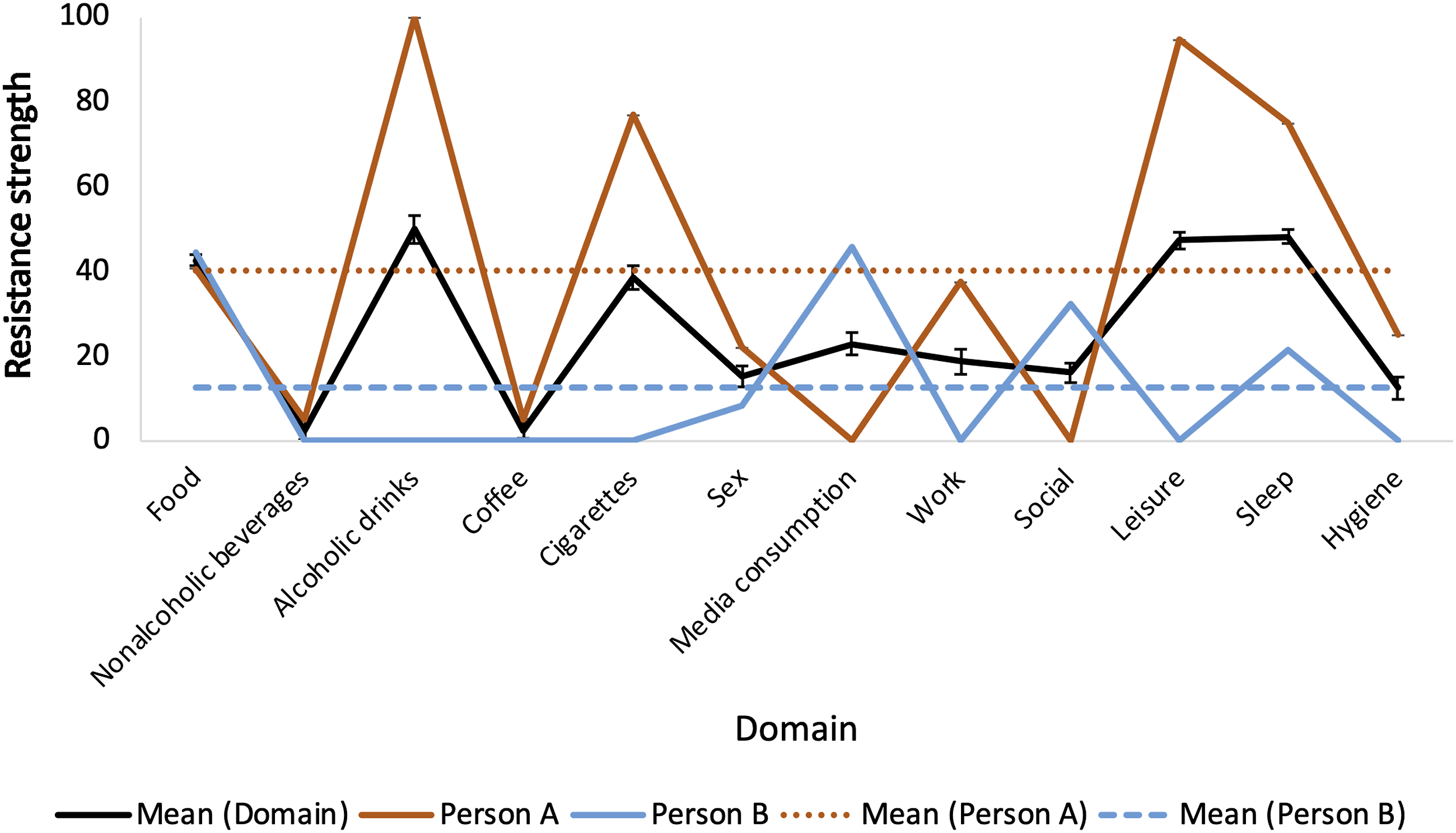
Averaging the profiles of all individuals provides a measure of normative differences in resistance strength across the domains, as reflected by the black solid line in Figure 1. This shows that in some domains, desires are more or better resisted than in other domains (i.e., domain differences). Finally, the shape of the profile could differ from individual to individual, indicating that some individuals control desires in some domains more strongly or better than in other domains or than other individuals.
In the first research question of the present research, we wanted to quantify how much of the total variance in resistance strength and success can be attributed to differences between persons, domains, and person × domain interactions. So far, knowledge is limited: One study compared random intercept variances (i.e., between-person differences) and residual variances (i.e., within-person variance) and found, across three datasets, that between-person differences explained, on average, 15% of the total variance in impulsivity, whereas 85%, on average, could be explained by within-person differences (Tsukayama et al., 2012). 2 Although innovative at its time, this approach cannot model domain and person × domain differences separately, as these are lumped into the residual, which also consists of measurement error. Recently, Zuroff et al. (2021) proposed variance component analyses (Searle et al., 2009) to decompose variance into contributions of differences between persons, domains, and person × domain interactions. They found that person × domain interactions accounted for considerable variance in self-compassion and self-criticism. Based on this approach, we hypothesized that differences in domain and person × domain interactions account for significant variance in resistance strength and success above and beyond person differences (RQ 1).
However, this approach is descriptive and can only show how much variance in resistance strength and success can be attributed to which source. An interesting substantial question remains unanswered, namely, whether variance in resistance strength due to differences in domains or person × domain interactions can add significant information in predicting resistance success. In other words: Is the association between how strongly individuals try to resist a desire (their resistance strength) and how successful they resist it moderated by the desire domain in which desires are resisted? To examine such questions, Zuroff et al. (2021) proposed to use multilevel models. In our case, momentary resistance success would be predicted by differences between (1) persons (obtained by computing mean resistance strength for each individual across all domains), (2) domains (obtained by computing mean resistance strength for each domain across all individuals), and (3) person × domain interactions (obtained by computing the momentary resistance strength score and subtracting the person and domain score). In this way, it is possible to examine how much variance each component can explain in resistance strength and success. The question regarding the person source would be whether individuals who resist more strongly than others also report greater resistance success. The question regarding the domain source is whether domains, in which desires are more strongly resisted, are also the ones, in which they are more successfully resisted. Finally, the person × domain interactions reflect whether individuals who resist more strongly than they usually resist and more strongly than other individuals usually resist in the respective domain also report greater resistance success.
Preliminary evidence for the importance of differences between domains comes from a study that has shown that a questionnaire, which included both domain-general and domain-specific aspects of impulsivity, showed a better model fit for the domain-specific model with six factors than the domain-general model with one factor (Tsukayama et al., 2012), demonstrating the importance of considering domain differences in self-control. Another study found that people chose different self-regulatory strategies, depending on the domain in which they experience a desire (Milyavskaya et al., 2020).
Taken together, resistance strength in different domains should play an important role in predicting resistance success. Therefore, we hypothesized that the domains in which individuals more intensely try to resist desires are also the domains in which desires are most successfully resisted. Moreover, we also predicted a positive association between resistance success and person × domain interactions in resistance strength, such that individuals, who resisted more strongly than how they and other individuals typically resist in the respective domain, reported more resistance success (RQ 2).
Domain differences in self-control
After establishing the independent contributions of self-control differences between persons, domains and person × domain interactions, it is important to examine specific patterns in differences between domains and person × domain interactions. Research has shown that desire domains differ with regard to how much individuals want them or how much they conflict with long-term goals (Hofmann, Vohs et al., 2012). Moreover, a meta-analysis on the associations between trait self-control and a wide range of behaviors revealed that these associations differed substantially between domains, with associations ranging from r = .17 (eating behavior) to r = .36 (school/work performance; de Ridder et al., 2012). This suggests that the extent to which trait self-control predicts self-controlled behavior depends on the domain in which self-control is used. In the third research question, we wanted to connect to this line of research and explore from which domains desires are resisted more intensely and more successfully on average in daily life (RQ 3).
Person × domain interactions in self-control
Additionally, and perhaps most centrally, we assumed that individuals show considerable variation in how they control themselves in various domains, such that they resist some desires more strongly or more effectively than others, resulting in domain deviations from a person’s typical (i.e., average) resistance. Furthermore, which domains are particularly well-resisted, and which are not, may differ from one person to the next, which demonstrate the ideographic nature of person × domain interactions. For example, Person A in Figure 1 resists their urge to consume alcohol more strongly than individuals do on average. These self-control efforts, generally termed behavioral profiles or signatures (Mischel et al., 2002), reflect the domain-specific aspect of individuals’ self-control. So far, such profiles have not been systematically investigated in self-control research, although their importance has been recognized in emotion regulation research (e.g., Aldao et al., 2015; Bonanno & Burton, 2013) and recently, in the domain of self-control, where Hennecke and Bürgler (2020) have argued that the effectiveness of self-control depends on situational characteristics, for example, on whether a task is physically effortful, mentally draining, or boring.
One problem of behavioral profiles is their ideographic nature, that is, each individual often shows a unique profile, leading to a large variety of profiles. Variance decomposition can be used to test the importance of differences between individual behavioral profiles, but it does not provide more specific information in terms of which profiles are more strongly associated with resistance success. Moreover, theoretical accounts are missing that explain why desires in one domain should be more difficult to resist than in another domain or why an individual should be better at resisting a desire in one domain over another. To reduce the number of individual behavioral profiles and to inform theory building, we therefore took a data-driven approach in the present research and computed latent profile analysis to identify underlying subgroups, thereby reducing the number of individual profiles. Latent profile analysis (LPA) is a dimension reduction method (Spurk et al., 2020) with the goal of identifying profiles of participants who show similar combinations of domains in which they resist their impulses. Thus, it is aimed at identifying subgroups of individual profiles within a sample and these subgroups can then be used to predict resistance success. By applying LPA to the data, we explored which configural profiles (i.e., combinations of domains) were particularly associated with more resistance success (RQ 4).
The present research
In the present research, we wanted to go beyond differences between individuals or domains in self-control that have been previously examined but explore the contribution of person × domain interactions, which are relatively understudied, although they are assumed to be very important in understanding self-control (e.g., Hennecke & Bürgler, 2020). One reason for the relatively little attention to person × domain interactions might be that this approach is inherently idiographic and therefore requires collecting data in multiple domains. In our perspective, the experience sampling method (ESM), in which participants are typically asked about their cognitions and behaviors multiple times per day, should be well-suited to study person-domain interactions in daily life since it taps into different kinds of situations in which desires and resistance in different domains can be captured (Wenzel & Kubiak, 2018; Wrzus & Mehl, 2015). Thus, we re-analyzed a pooled dataset from three ESM studies with a total of N = 419 participants and N = 15,805 observations to examine the role of person × domain interactions for resistance success and trait self-control in daily life. Given that we re-analyzed the data that we already collected, none of the analyses presented here were preregistered and are, thus, exploratory.
Method
Participants
Dataset 1
Dataset 1 is from the SMASH Study (Rowland et al., 2016), which recruited 137 undergraduate students were recruited through flyers, mailing lists, social networks, bulletins, and direct approaches, of which eleven participants dropped out throughout the study. All participants who completed less than 33% completed signals were excluded from the analyses, resulting in a final sample of 125 participants (77.6% female; M = 22.9 years, SD = 5.1). Participants received partial course credit in exchange for their participation. Please refer to the study protocol for more information on the inclusion criteria, design, and compensation (Rowland et al., 2016).
Dataset 2
Dataset 2 is from the Everyday Temptation Study (Hofmann, Baumeister et al., 2012), which consists of a sample of 208 participants (137 participants who self-identified as female and 71 as male) ranging from 18 to 55 years (M = 25.2 years, SD = 6.3). However, three participants were excluded due to technical problems but none due to low adherence, leaving a final sample of 205 participants. These participants received up to 35€ in exchange for their participants and could participate in a raffle for one of two iPod touch devices if they completed more than 80% of the ESM signals.
Dataset 3
Dataset 3 (Friese & Hofmann, 2016) contains data from 101 participants (65 and 26 participants who self-identified as female and male, respectively 3 ) that were aged between 19 and 62 years (M = 36.1, SD = 12.7) and who reported at least five desires. Recruitment of participants, who were being older than 18 years, resided in the United States or Canada, and were being fluent in English, took place via university mailing lists and various publicly available websites. As compensation for their participants, participants received up to US$30, with the total being contingent on their adherence to the study protocol.
Procedure
Dataset 1
The SMASH study is a combined laboratory and ambulatory assessment study, with seven weekly laboratory sessions and a 6-week experience sampling. In the first lab session, participants signed an informed consent form and completed several trait questionnaires that were not of interest for this study except for the trait self-control scale (for a complete overview of the measures, please see the study protocol, Rowland et al., 2016). Starting the next day and for 40 subsequent days, participants received six randomly distributed signals per day between 10 am and 8 pm from the Android application movisensXS (movisens GmbH, Karlsruhe, Germany). Each signal was 45 to 200 minutes apart, with an average interval of 103.4 minutes (SD = 34.3) and presented the participants with questionnaires regarding their recent regulatory efforts. Each week, participants returned to the lab where they filled out questionnaires and could talk about their experiences with the study, for example, about the mindfulness intervention or the experience sampling, with the ambulatory assessment team to keep adherence high over the course of relatively long ambulatory assessment period. In addition, participants in the mindfulness intervention condition performed a weekly computer-based guided-breathing meditation, for which possible influence we controlled for in the statistical analyses of this study. After 40 days of ambulatory assessment, the study concluded with a post-measurement laboratory session. Overall, adherence to the study protocol was good with 76.2% completed observations on average.
Dataset 2
In the intake session, participants provided informed consent and were instructed into the goal of the study and the use of the Blackberry pocket personal data assistants that presented the ESM questionnaires over the course of the study. In the ESM part, participants responded to seven signals per day for a total of seven consecutive days, with the signals being randomly distributed on the condition of being at least 30 minutes apart (M interval = 115.8 min, SD = 83.5). On average, participants responded to 92.2% of the signals.
Dataset 3
Upon receiving information regarding the study, participants were checked for eligibility, provided informed consent, and completed a baseline questionnaire regarding their sociodemographic information and personality. Starting the next day, participants received seven ESM signals over seven consecutive days. These signals were randomly distributed within a 14-hr time frame, with the contingency that two signals were at least 30 minutes apart (Median = 109.0 min). Adherence to the study protocol was acceptable, with a completion rate of 65.0%.
Measures
Momentary measures
Descriptive statistics of the measures.

Note. n = absolute frequency; % = relative frequency. The measures are reported as Percent of Maximum Possible scores, which range between 0 and 100.
Importantly, resistance strength and success were only assessed if participants indicated having experienced at least some conflict. Thus, analyses that focus on resistance strength and success are based on conflicted desires only.
Self-control domain was assessed by presenting a list of domains to the participants, which was adapted from Hofmann, Baumeister et al. (2012). Whenever they had indicated to experience a recent or current desire, participants could select one of the twelve domains illustrated in Table 1. Participants could also report other domains (n Dataset1 = 480, n Dataset2 = 147, n Dataset3 = 142), which however were not included in the analyses given that this assessment was too unspecific for the research questions of the present research. Moreover, there were some domains that were not assessed in all three datasets and were, thus, not included in the analyses: “Spending” (Dataset 1 and 2), “other substances” (Dataset 1 and 3), and “sports” (Dataset 2 and 3).
Analytic approach
All analyses were performed in Stata 17 (Stata Corporation, College Station, TX) and the analysis scripts, dataset, and full results can be found on the OSF project page (https://osf.io/uaxbw/). In case of models with multiple predictors, we computed the variance inflation factor to check for multicollinearity. However, all of the predictors in the reported analyses in the results section were below 3, which is lower than the recommended cut-off of 5 (Sheather, 2009). Effect sizes were deemed significant at an α-level of p < .05. However, when comparing the results between the twelve individual domains, we used a Šidák-corrected pŠidák < .0043 to adjust for type I error inflation due to the multiple comparisons (Šidák, 1967). Given that the study in which Dataset 1 was collected included a mindfulness training (Rowland et al., 2016), we controlled for the possible influence of the training by including it as a predictor in Dataset 1. However, it is important to note that none of the variables of interest to the present research, namely, desire, conflict, and resistance, and enactment strength as well as resistance success, were significantly impacted by the training over the course of the study (please see the full results on the OSF project page at https://osf.io/uaxbw/).
Power estimation for detecting very small to very large effects in a random-effects meta-analysis with the three datasets.
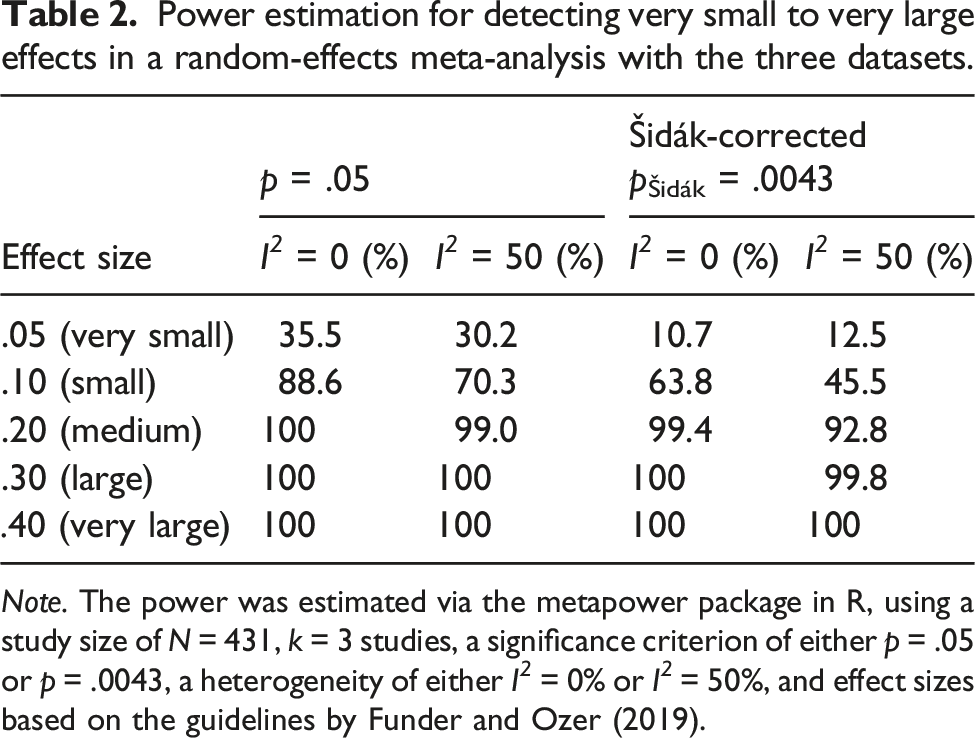
Note. The power was estimated via the metapower package in R, using a study size of N = 431, k = 3 studies, a significance criterion of either p = .05 or p = .0043, a heterogeneity of either I 2 = 0% or I 2 = 50%, and effect sizes based on the guidelines by Funder and Ozer (2019).
RQ 1: Variance decomposition
The self-control measures can, among other aspects, be explained by variables pertaining to the person (e.g., trait self-control) the domain (e.g., types of desires), as well as interactions between the person and the domain. In the following research question, we wanted to investigate to what extent the two variables “person” and “domain” as well as their interaction, were able to explain variance in desire, conflict, and resistance strength as well as in resistance success. To decompose the variance into these sources, we conducted variance components analyses (Searle et al., 2009), using the mixed command in Stata 17 and the maximum likelihood option. To that end, we computed multilevel models, where the domain was nested within and crossed with participants, and observations were nested within domains (Marchenko, 2006). Thus, the random intercept variance of participants reflects differences between persons, the random intercept variance of domain (crossed with participants) reflects differences between domains, and the random intercept variance of domain nested within participants reflects the person × domain interactions. We did this for each dataset and then meta-analyzed the results via a random-effects meta-analysis, using Stata’s default restricted maximum likelihood option.
RQ 2: Association of resistance differences between persons, domains, and person × domain interactions with resistance success
RQ 1 is descriptive in nature, in that it shows to which source variance in self-control can be attributed. For resistance strength, however, it would be important to know how these sources predict variance in resistance success. The question regarding the person source would be whether individuals who resist more strongly than others also report greater resistance success. The question regarding the domain source is whether domains, in which desires are more strongly resisted, are also the ones, in which they are more successfully resisted. Finally, the person × domain interactions reflect whether individuals who resist more strongly than they usually resist and what other usually resist in the respective domain report greater resistance success. RQ 2 aims to test and compare these associations.
To test which source differences are more strongly associated with resistance success, we followed the approach outlined by Zuroff et al. (2021). First, we computed the between-person scores by computing mean resistance strength for each participant (person). Second, we obtained the scores capturing differences between domains (domain): To control for the mindfulness training in Dataset 1, we did not use the mean of resistance strength within the respective domain but computed a two-level model, in which resistance strength was regressed on domain, controlling for the mindfulness training in Dataset 1. We then used the marginal means as the normative mean resistance strength score of the respective domain. Third, we obtained the within-person person × domain interactions by subtracting the person (person-mean of resistance strength) and the domain score (domain-mean of resistance strength) from each individual’s level-1 raw value of resistance strength. This term reflects the deviation from both the mean of the respective person and the respective domain. A positive value, thus, indicates that an individual resisted more strongly in this situation than they and other individuals are typically resisting in this domain. The variables capturing differences between persons and domains and resistance success were z-standardized, whereas the within-person variable capturing person × domain interactions was within-person standardized.
To answer RQ 2, we computed the same multilevel model as for RQ 1 but additionally included the fixed slopes of the variables capturing person, domain, and person × domain differences. In addition, the within-person variable capturing person × domain interactions was allowed to vary randomly within participants and within domains.
RQ 3: Domain differences in self-control
Next, we wanted to take a closer look at domain differences in self-control by identifying domains in which desires were particularly strongly and successfully resisted. To that end, we used a two-level model, where we predicted resistance strength or success by the effect-coded domain factor. Thus, greater coefficients indicated more resistance strength in or resistance success of the respective domain. Due to the relatively large number of effects, we computed a mega-analysis (Boedhoe et al., 2019) instead of meta-analysis by including dataset as a third level.
RQ 4: Person × domain interactions in self-control
Finally, to examine individual differences in individual resistance profiles across domains, we used latent profile analyses. Latent profile analysis is a dimension reduction method with the goal of identifying profiles of participants who show similar combinations of domains, in which they resist their desires (e.g., Grommisch et al., 2019). Thus, the latent profile analysis is well suited to identify self-control efforts in domains that go well together by first identifying the profiles in the given data and then examine whether these profiles differ with regard to their resistance success. We computed the latent profile analysis on the twelve person-aggregated resistance values in the twelve domains in Stata 17, using the gsem command. To select the optimal number of profiles, we used the Akaike (AIC) and Bayesian information criteria (BIC), which did not differ with regard to the selected number of profiles.
Results
Preliminary analyses
First, we aimed to replicate the findings by Tsukayama et al. (2012) who reported that 15% of the total variance in impulsivity could be explained, on average, by between-person differences, whereas 85% could be attributed to within-person differences. To adopt this approach, we computed a two-level model where we predicted desire strength, conflict strength, resistance strength, or resistance success. The results of the meta-analysis indicated that 16.6%, 95% CI [11.4%, 21.8%], of the total variance in resistance strength could be explained by between-person differences (Figure 2). Regarding resistance strength, we found that, on average, 12.7%, 95% CI [10.0%, 15.3%], of the total variance could be explained by between-person differences. Taken together, these estimates were very close to the estimate reported by Tsukayama et al. (2012). Intraclass correlation estimates for desire strength, conflict strength, resistance strength, and resistance success. Note. The bars represent the intraclass correlation, with larger values indicating larger between-person differences. Error bars indicate the standard error of the intraclass correlation.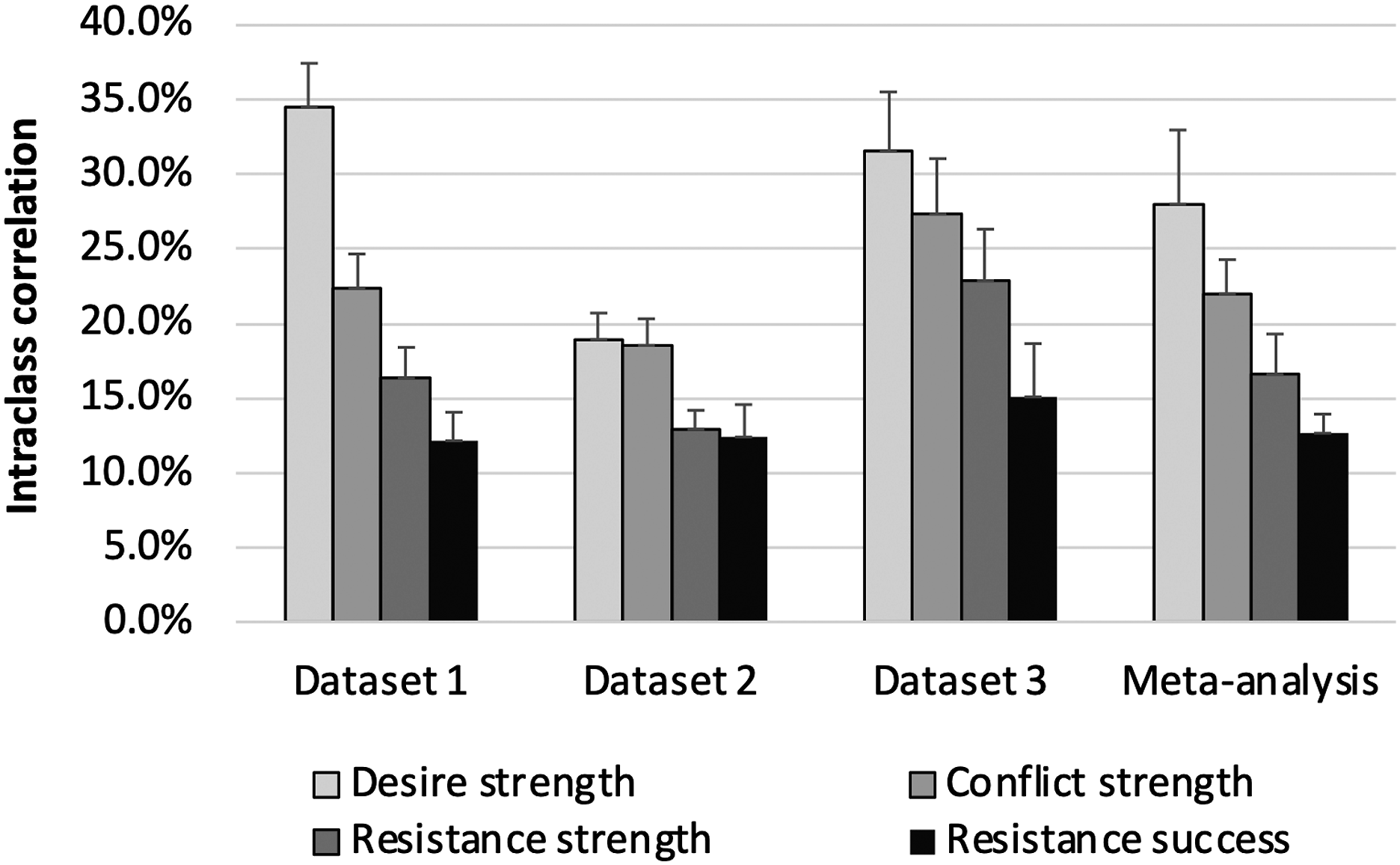
Moreover, Figure 2 also demonstrates that the ICC was larger for earlier steps in the conceptual model of self-control (Hofmann, Baumeister et al., 2012) as compared to later steps, with the largest between-person differences in desire strength and the smallest between person-differences in resistance success.
Research question 1: Variance decomposition
Next, to further decompose the residual variance, we computed variance component analyses. Together, differences between persons, domains, and person × domain interactions explained Explained variance estimates for person, domain, and person × domain for desire strength, conflict strength, resistance strength, and resistance success. Note. Error bars indicate the standard error of the explained variance estimate.
In turn, Figure 3 shows that
We also examined differences in resistance strength (Figure 3). Regarding conflict strength, we found that person differences explained
RQ 2: Association of resistance strength differences between persons, domains, and person × domain interactions with resistance success
Next, we investigated how differences between persons, domains, and person × domain interactions in resistance strength were associated with resistance success. A meta-analysis of the multilevel models revealed that differences in resistance strength between persons were positively and significantly associated with resistance success,
Importantly, the effect size for person × domain interactions was very large and significantly larger than the effect sizes for differences between persons,
RQ 3: Differences between domains in self-control
Next, we examined resistance differences between domains to identify desires that were particularly strongly or successfully resisted. Mean resistance strength and success of the respective domain are depicted in Figure 4. Regarding resistance strength, there were significant differences between the domains, χ(11) = 357.9, p < .001. As illustrated in Figure 4, desires in the domains “food”, “nonalcoholic beverages”, “alcoholic drinks”, “coffee”, “media consumption”, “work”, “social contacts”, and “personal hygiene” were, on average, significantly less strongly resisted, whereas desires in the domains of “smoking”, “sex”, “leisure”, and “sleep“ were significantly more strongly resisted than other desires, on average. Mean resistance strength and resistance success for each domain. Note. The minus (−) or plus (+) sign indicate that the value in a domain is significantly (p
Šidák
< .0043) lower or higher than the average value across domains. The black horizontal line reflects the grand mean across all domains. Error bars indicate the 95% confidence interval.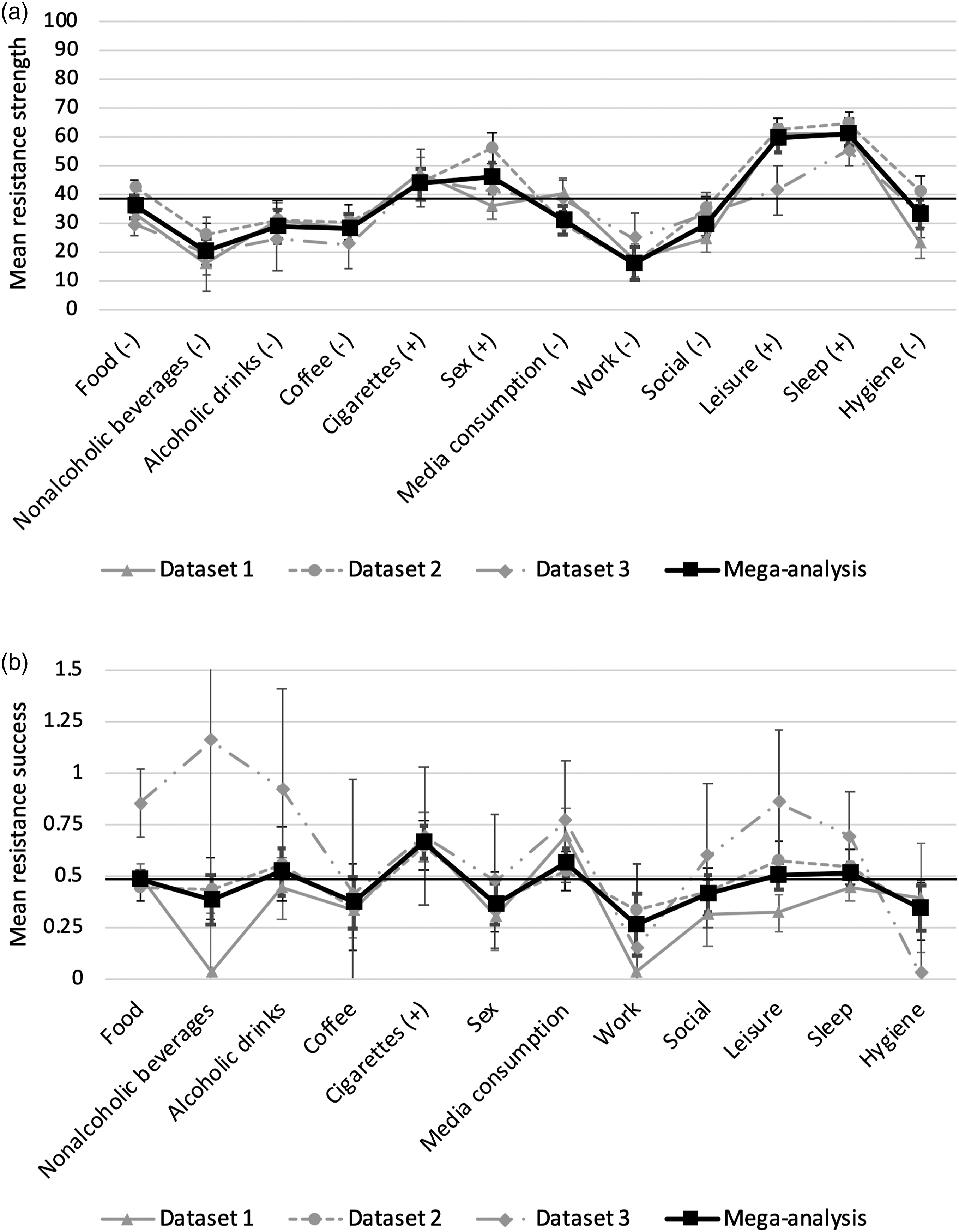
Regarding resistance success, there were also significant differences between the domains, χ(11) = 53.2, p < .001. Figure 4 shows that only smoking cigarettes was resisted more successfully on average, p < .001. The lowest resistance success was in the domain of “work”, in which participants, for example, were significantly less successful in resisting conflicted desires than in other domains such as “leisure” or “sleep”, p < .001. Thus, not all desires were resisted equally on average in our sample, with desires for “smoking cigarettes” being the most strongly and most successfully resisted desire.
RQ 4: Person × domain interactions in self-control
Visualizing person × domain interactions is difficult given that it is an inherently ideographic approach. To illustrate the variety in resistance profiles, we plotted the profiles of three participants from the sample in Figure 5, one with high levels (the individual with the identifier ID 1002), one with medium levels (ID 1001), and one with low levels of mean resistance (ID 1024), which were selected to demonstrate different resistance profiles. All three individuals did not only show considerable differences regarding their mean resistance strength but also demonstrated person × domain variability. Whereas ID 1001 resisted their desires of engaging in sex, sleeping, and drinking coffee most strongly, ID 1002 resisted desires geared towards alcohol and leisure in particular, ID 1024 resisted the desires of food and personal hygiene most strongly. Mean resistance strength in each domain for each participant. Note. ID = identifier.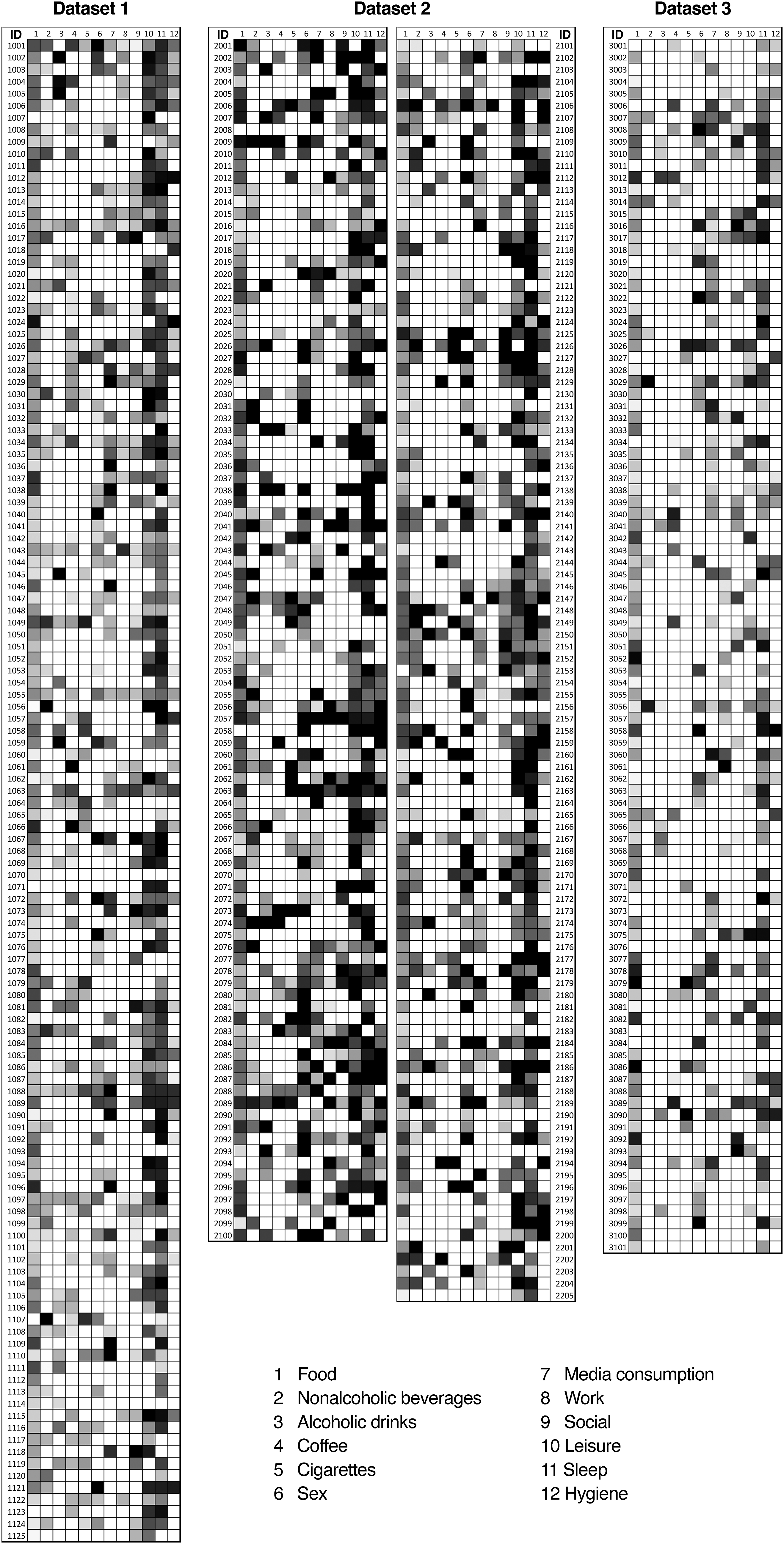
Fit indices (AIC, BIC) from the models with 1 to 15 latent profiles.
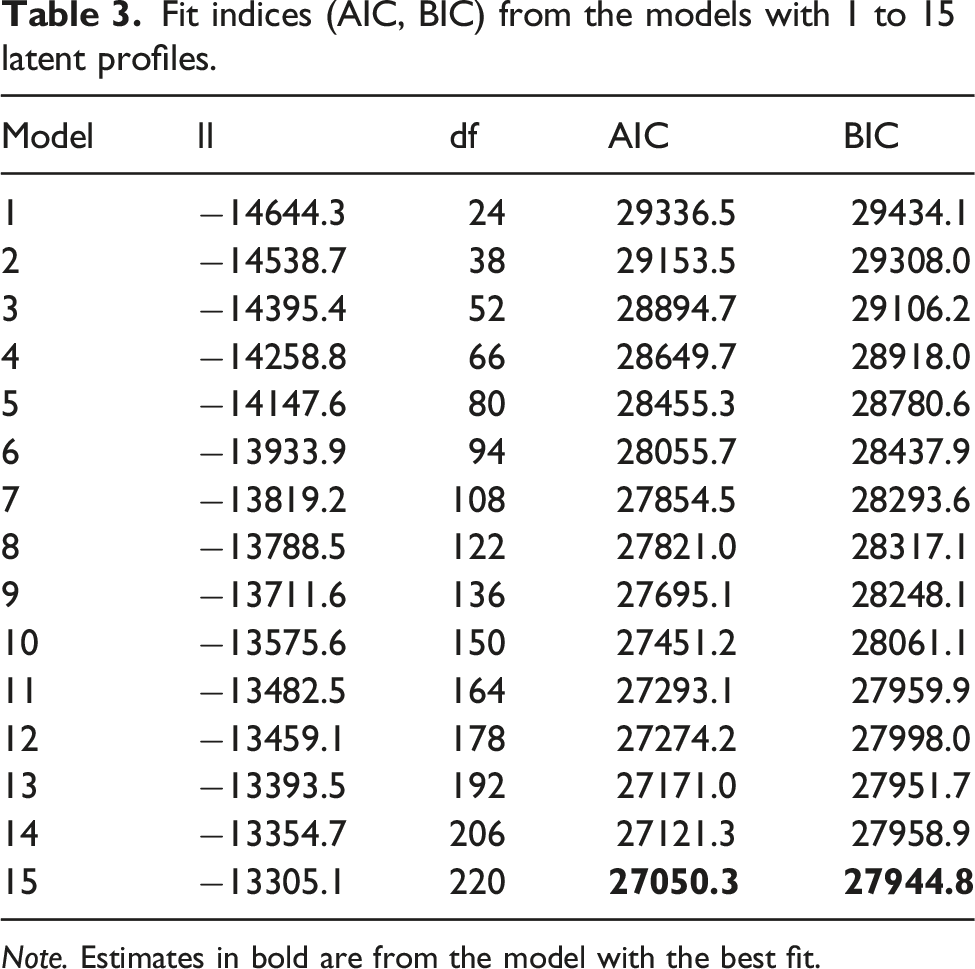
Note. Estimates in bold are from the model with the best fit.
Discussion
For a long time, self-control had been mainly conceptualized as a domain-general construct that is invariant across different kinds of self-control domains (e.g., Tangney et al., 2004). Based on the person × situation interaction model of personality (Moskowitz & Fournier, 2015; Zuroff et al., 2021), we tested this assumption by examining how much of the variance in self-control can be attributed to differences between individuals (person), differences between domains, and person × domain interactions. We found that person × domain interactions explained significantly more variance in conflict strength and resistance success than person or domain differences, while person differences explained the most variance in desire strength. Importantly, person × domain interactions always explained significant variance above and beyond person and domain differences, ranging from
RQ 1 and 2: Self-control has both domain-general and domain-specific aspects
We replicated previous findings showing that the largest amount of variance in self-control can be attributed to within-person differences, with about 15% being explained by between-person differences (Tsukayama et al., 2012). This estimate connects well to reported ICCs from prior research indicating that only between 10% (Milyavskaya & Inzlicht, 2017) and about 25% (Buyukcan-Tetik et al., 2018) of variance could be attributed to between-person differences. We also expanded on past research by also taking a closer look at within-person differences: By using variance component analysis, we found that differences in desire domains and in person × domain interactions explained a considerable amount of variance in self-control related variables beyond and above between-person differences (RQ1). Furthermore, by using multilevel models with nested and crossed factors, we additionally examined whether variance in the different sources of resistance strength explained differences in resistance success (RQ 2). As for RQ 1, we found evidence for domain-general aspects in resistance strength, such that participants who resisted more strongly than others reported greater resistance success. However, we also found that both domain differences and person × domain interaction were significantly associated with greater resistance success, which means that participants who resisted more strongly than usually and more strongly than how other individuals usually did in the respective domain also reported greater success in resisting their desires. Importantly, the effect size for person × domain interactions was very large and significantly larger than the effect sizes for differences between person, indicating that domain-specific aspects of resistance strength were most important in understanding self-reported resistance success in daily life. Thus, we renew the recent calls for future research (Hennecke & Bürgler, 2020) to not only focus on person differences underlying self-control but instead acknowledge and embrace the role of context and situations more strongly when examining the personal and societal costs and benefits of self-control.
Interestingly, person differences were most important for early steps in Hofmann’s conceptual model of self-control (Hofmann, Baumeister et al., 2012): Whereas 25.1% of the variance in desire strength could be explained by person differences, it reduced to 6.5% of the variance in resistance success. Importantly, this was consistent across all three datasets. Consequently, our results show that there were large individual differences in the strength people typically experience desires in daily life, that is, there are individuals who experience stronger desires on average than others, independent of the domain in which these desires arise. However, whether people resist these desires and whether these resistance efforts are successful was much less dependent on the person itself but depended more strongly on how individuals interact with the domains.
Even though we were able to explain more variance in self-control than past research (Tsukayama et al., 2012), all sources of variance together only explained 34.1% of the total variance in desire strength, 44.9% in conflict strength, 31.6% in resistance strength, and 22.1% in resistance success, leaving most of the total variance unexplained. One possible reason for this relatively large number for resistance strength and success could be that we only assessed general resistance strength, that is, inhibitory control, as a self-control strategy, neglecting other possible strategies that may also be more important in varying domains and for different individuals (e.g., Duckworth, Gendler et al., 2016; Milyavskaya et al., 2020). 4 For example, Milyavskaya et al. (2020) have shown that individuals engage in different self-control strategies to resist different kinds of desires, such as eating or leisure. Thus, future research may also assess further strategies to examine not only person × domain interactions but also person × domain × strategy interactions that offer a more detailed picture of self-control in daily life. Even though this is an interesting and important future research topic, the collection of large ecological momentary datasets that offer enough power to detect three-way interactions will be a potential challenge as well as the complexity of possible relationships.
RQ 3: Domain differences
Another aim of this research was to examine differences in self-control between several domains (RQ3). We found that, on average, not all desires were resisted equally on average. Desires for leisure and sleep were most strongly resisted in our sample compared to the mean resistance strength across desires. Given that our sample mainly consisted of undergraduate students of psychology in their twenties, their goal to achieve a good academic output might have conflicted with their desire to sleep or to have some leisure time. These findings are in line with another study that showed in a sample of German university students that desires towards sleep and leisure were being particularly highly desired and conflicted (Hofmann, Vohs et al., 2012). However, in other samples, other desires from other domains might have occurred more frequently. For example, in a sample that aims to diet and to lose weight, food and drinks might have been the domains in which desires had to be most strongly resisted. Thus, we advise caution in generalizing our findings to other populations given that these results most likely dependent on the specific makeup of the samples (i.e., cultural, gender or age differences); their interpretation should, thus, be limited to young and mostly female university students. However, this also means that research should not neglect the importance of normative domain differences when examining individual factors of self-control, although these differences were only important for resistance strength but not success.
RQ 4: Person × domain interactions
A past study, in which children’s behavior in response to different social situations was observed for on average of 167 hours per child, found profiles that could describe typical situation-response signatures for children’s verbal aggressions (Mischel et al., 2002). However, in the present research, we did not find interpretable self-control domain profiles in our student samples (RQ4). The 15-profile solution provided the best fit but resulted in number of profiles too large to be meaningfully interpreted. Moreover, this model could not sufficiently predict profile membership and produced latent profiles that could describe only about two thirds of the participants. We therefore think that our results demonstrate that the individual resistance profiles (i.e., signatures) are too diverse to be reduced to a sufficiently small number. Thus, while our results testing RQ 1 and especially RQ 2 show how important person × domain interactions are for resistance success, their ideographic nature represents a challenge that future research need to address in order to fully understand the complex relationships between characteristic of the person and the situation.
These relationships are even more complex if we move beyond self-control conflicts in which people try to resist a desire and also include conflicts in which people try to initiate an aversive task or persist in such a task (Hennecke et al., 2019; Hoyle & Davisson, 2016). With such different types of self-control conflicts considered, the number of possible situational and individual factors to moderate the efficacy of any given self-regulatory strategy becomes even larger (Hennecke et al., 2019; Hoyle & Davisson, 2016). Persistence conflicts, for example, may come along with different demands, given that activities could be difficult to continue because they are boring, highly mentally demanding, emotionally demanding, or physically effortful (Hennecke et al., 2019). In addition, people’s characteristics and strategies may be more or less suited to match these demands. For example, people with higher working memory capacity compared to people with lower working memory capacity (Hofmann et al., 2008; Schmeichel et al., 2008) could be more successful in deploying cognitive self-regulatory strategies (such as reappraisal, focusing on the positive or negative consequences, or monitoring one’s goal progress; Hennecke & Bürgler, 2020). A person with lower working memory capacity and a propensity to use cognitive strategies to deal with self-control conflicts might then simply do not have the appropriate tools to persist in a cognitively demanding activity, even if they tried very intensely. In those cases, it might even indicate metacognitive knowledge about one’s own self-regulatory strengths and weaknesses (Bürgler et al., 2021) if a person does not even try to resist their urge to discontinue the activity because they would likely not be successful if they tried. In conclusion, a more fine-grained view on different goals, conflicts, and their demands would further help to understand person × domain interactions in self-control.
Finally, our results might explain why research on trainings that aimed to improve self-control has provided only limited evidence (Friese et al., 2017). These trainings often build on the idea that practicing self-control in one domain leads to improvements in other domains. Although this is certainly an intriguing proposition, this approach is limited given that it does not account for the importance of person × domain interactions in self-control. Thus, we think that future self-control interventions should acknowledge the role of the domains and how they interact with person characteristics.
Limitations
Taken together, our findings provide evidence for the importance of person × domain interactions in self-control in daily life. However, we also want to discuss some limitations of our work. First, ecological momentary data assessments, especially for 40 days like in Dataset 1, are most likely a burden for the participants. Given that burden, it is possible that individuals did not report all their desires that they had experienced in daily life. Additionally, individuals had to answer more items when they indicated to experience a desire at a given measurement timepoint than when they did not, which may have reduced the number of reported self-control episodes. And indeed, whereas participants reported on approximately every second observation a desire in the first days of the study in Dataset 1, which is in line with Dataset 2 and prior research (Hofmann, Baumeister et al., 2012), they reported a desire for every three to four observations in the last days in Dataset 1. However, desire strength did not change over the course of the study, so participants might have avoided reporting some desires but did not respond differently. Future research could avoid this possible issue by presenting the same number of items.
Second, measurements were on average approximately 100 minutes apart from each other. By asking about current or recent desires within the last 30 minutes, we potentially missed several desires. Furthermore, at the time an individual reported a desire, it could have already happened several minutes ago and, thus, we could not always assess how intensely individuals controlled themselves when the desire first occurred. Moreover, desire, conflict, and resistance strength, as well as resistance success were all assessed at the same time, which made these measures susceptible to common method biases (Podsakoff et al., 2003). However, it is important to note that such a bias would affect both domain-general and -specific aspects of self-control and, therefore, should not affect the comparison of these aspects.
Third, we did not examine how long individuals had to control themselves to successfully resist their desires. However, the temporal course of self-control could be an important indicator to further understand person × domain interactions. Therefore, future research may try to capture desires and resistance as they occur and track them over time by combining event-contingent and sampling-contingent measurements to gain a better understanding regarding the temporal course of self-control in daily life.
Fourth, we neglected any other self-control strategies than inhibition or resistance and, thus, strategies that are, for example, anticipatory, that is, used before a conflict even occurs. Given that individuals high in self-control were found to experience less self-control conflicts (Hofmann, Baumeister et al., 2012), these anticipatory or situational strategies that avoid conflicts in the first place (Duckworth, Gendler et al., 2016) may be of particular importance to understand successful self-control (Bürgler et al., 2021).
Fifth, the samples differed in a number of ways. Dataset 1 (but not the other datasets) included a mindfulness training. To control for its possible effects on our outcomes, we included the training as a predictor in the analyses. The datasets also used different response scales for the measures. For example, for resistance and enactment strength, Dataset 1 used a 5-point scale, Dataset 2 binary items, and Dataset 3 a 7-point scale. The samples also differed regarding the age of the participants: Whereas Dataset 1 and 2 recruited mostly young university students in their twenties, the mean age in Dataset 3 was around 36 years of age. However, given the robustness of our results across the datasets, we view these heterogeneities as a strength of the present research since it demonstrates that the results were not affected by the differences between the study procedures.
Conclusion
Taken together, our findings challenge the notion that self-control should be conceptualized as a mainly domain-general skill. It is at least to a similar extent a domain-specific skill that depends on person × domain interactions. Future research on self-control should complement research efforts aimed at outcomes of being generally good or not good at self-control with research that examines the situation in which self-control takes place. Thus, individuals who tailor their self-control to the demands of the respective domain and know when to resist their desires and when to indulge them might be particularly successful at self-control in daily life.
Footnotes
Data accessibility statement
Open Data Statement. The anonymized datasets are publicly available at  . Open Material Statement. We affirm that we reported all manipulations and exclusions in the present research. However, we did not report all measures, because we re-analyzed datasets that were collected for different research purposes. Reproducible Script Statement. We provide openly accessible data analysis scripts that allow to reproduce all reported results at https://osf.io/uaxbw/.
Declaration of conflicting interests
The author(s) declared no potential conflicts of interest with respect to the research, authorship, and/or publication of this article.
Funding
The author(s) disclosed receipt of the following financial support for the research, authorship, and/or publication of this article: Deutsche Forschungsgemeinschaft; HO 4175/3-1, HO 4175/4-1.
Ethic Statement
The study protocols were approved by the local ethics committee of the respective local university: at the Johannes Gutenberg University Mainz (Dataset 1) and at the University of Chicago (Dataset 3). The study protocol of Dataset 2 was not submitted to an ethics committee because the department did not have a local internal review board at the time the study was conducted. However, the study was conducted in accordance with the Helsinki Declaration and with the ethical guidelines by the German Research Foundation.