




Abstract
Studying how attitudes develop in the transition from late adolescence to emerging adulthood offers unique insights into future generations’ perceptions of society and of others. However, findings on ethnic prejudice during this life period are mixed. The current research aims to examine the development of affective and cognitive ethnic prejudice, adopting a person-centered approach. Furthermore, it examines the associations between educational identity processes and prejudice. A sample of 297 Italian adolescents (Mage = 17.48, SDage = 0.79, 37.8% males) participated in a five-wave longitudinal study. At the mean level, cognitive prejudice decreased slightly over time, while affective prejudice remained stable. Additionally, rank-order stability coefficients were high (r ≥ .526). Moreover, for each dimension of prejudice (i.e., cognitive and affective) taken separately, three groups of participants were identified based on their high, moderate, or low scores, respectively. Finally, higher levels of educational identity in-depth exploration at baseline significantly increased the chances of adolescents falling into the low rather than the moderate group for both cognitive and affective prejudice. Conversely, it significantly reduced the chances of being in the high compared to the moderate group for affective prejudice. This study highlights the importance of considering multiple components of prejudice and their reciprocal associations with identity processes to identify at-risk segments of the adolescent and emerging adult populations.
Immigration flows to Europe have steadily increased over the last decade (EUROSTAT, 2020), contributing to a progressive diversification of the population of several countries. Increased ethnic diversity may have a complex impact on the inclusion of minority groups. On the one hand, it might enhance intergroup contact opportunities (Allport, 1954), leading to reduced prejudice toward minorities (for a review, see Pettigrew & Tropp, 2008). On the other hand, diversity could elicit threatening perceptions of immigrants and subsequent enhancement of ethnic prejudice (e.g., Vervoort et al., 2011; Wilson-Daily et al., 2018).
In light of the current political and social challenges posed by society’s diversification, it is of utmost importance to advance knowledge on the development and correlates of ethnic prejudice, which implies negative attitudes, feelings, and behaviors against others for their different ethnic background (Brown, 2011). Social psychologists have long investigated this phenomenon, exploring possible factors and interventions that could effectively reduce negative attitudes in intergroup contexts (e.g., Allport, 1954; Fiske, 1998). Responding to a call for the adoption of transdisciplinary approaches to better understand the unique features of ethnic prejudice among younger generations (Rutland et al., 2007), the current study aims to explore the development of multiple components of prejudice in the transition from late adolescence to emerging adulthood. Beside the inherently social nature of this phenomenon, studying prejudice among youth requires adopting a developmental perspective that takes into account the unique features of this life stage (e.g., Albarello et al., 2020). In this vein, the present study adopts a cross-fertilization approach combining social and developmental perspectives.
Adolescence is considered a critical life period characterized by steady and progressive development in several psychosocial domains (Meeus, 2019). As adolescents proceed along this stage, they acquire more sophisticated cognitive abilities (see Kuhn, 2009), advance their moral reasoning (see Killen & Smetana, 2014; Nucci & Turiel, 2009), and face the pivotal task of defining and re-defining their personal and social identities (Albarello, Crocetti, & Rubini, 2018; Crocetti, 2017). A crucial turning point is the transition from late adolescence to emerging adulthood (Arnett, 2000). During this period, social and political attitudes established during adolescence tend to progressively consolidate (e.g., Eckstein et al., 2012; Niemi & Klingler, 2012; Rekker et al., 2015) and can offer an insight into future political orientations and views of society and culture (Hooghe & Wilkenfeld, 2008; Rekker, 2016).
Despite the significant changes expected during adolescence, meta-analytic studies (Crocetti et al., 2021; Raabe & Beelmann, 2011) have shown that ethnic prejudice remains relatively stable over this period. However, less is known about how it develops and is organized during the transition from late adolescence to emerging adulthood. The few longitudinal studies (e.g., Rekker et al., 2015; Wölfer et al., 2016) exploring prejudice during this transitional phase have mostly adopted a variable-centered perspective, focusing on general developmental trends in the population. Understanding the development of prejudice can highly benefit from adopting a person-centered approach, which recognizes that individuals vary considerably in how they develop and function (Bergman et al., 2003; von Eye & Bogat, 2006). By moving beyond the study of mean-level changes, this approach helps understand whether within a given population it is possible to differentiate groups that show a specific profile, accounting for the unique heterogeneity in social and psychological features (Bergman & El-Khouri, 2003; Bergman et al., 2003). Additionally, besides studying the unique developmental patterns of different groups of individuals, it addresses possible predictors of membership to one group rather than another, which can be useful to set future interventions targeting individuals at higher risk of developing prejudice (Crocetti et al., 2021).
The development of ethnic prejudice
Ethnic prejudice can be defined as a form of antipathy against members of a specific group (usually referred to as outgroup or minority) because of their cultural and ethnic background (Allport, 1954; Brown, 2011) or, even worse, “thinking ill of others without sufficient warrant” (Dixon, 2017, p. 1). It is a multifaceted phenomenon that encompasses both cognitive (i.e., stereotypes and negative beliefs) and affective (i.e., negative emotions and dislike) dimensions, which in turn can inform behavioral tendencies (i.e., discrimination, avoidance, aggression) in intergroup contexts (Brown, 2011).
Numerous studies have addressed this issue and provided researchers with evidence on prejudice development during the lifespan. Social developmental theories of intergroup prejudice (Aboud, 1988; Bigler & Liben, 2007; Nesdale, 2004) posit that children from a very young age are able to perceive and distinguish relevant social categories such as gender and ethnicity and preferentially engage in activities with those similar to them. This first applies to group membership based on gender and then extends to ethnic-based categorization (for a review, see Nesdale, 2004).
A meta-analysis by Raabe and Beelmann (2011) explored prejudice development from childhood to adolescence and found that ethnic prejudice follows an inverted U-shaped trajectory, progressively increasing from early (i.e., 2–4 years) to middle (i.e., 5–7 years) childhood, and then slightly decreasing in the transition from childhood to preadolescence (i.e., around 10 years). However, the authors could not find any significant change in the years following preadolescence, primarily because of the lack of longitudinal studies investigating this age period (Raabe & Beelmann, 2011). Building upon these findings and subsequent research targeting adolescents, a more recent meta-analysis (Crocetti et al., 2021) concluded that ethnic prejudice does not change during this life period, probably due to opposing trends in adolescents’ cognitive development and life experiences. For instance, in line with the social-cognitive developmental theory of prejudice (Aboud, 1988), increased cognitive abilities coupled with advancements in moral reasoning could lead to decreased ethnic prejudice because adolescents move beyond a dichotomous view of “Us vs. Them,” embrace more complex views of their own and others’ identities (Albarello, Crisp, & Rubini, 2018), and endorse values of diversity, tolerance, and equality to a larger extent than before (Rutland & Killen, 2015). At the same time, however, adolescents have been found to report progressively lower social trust (Flanagan & Stout, 2010) and may perceive minority groups as potential threats to their own future (see Albarello et al., 2019), which in turn may cause an increase in prejudice over time.
In addition to mean-level changes in prejudice, studies have also focused on rank-order stability, which indicates whether the relative standing of individuals within a group, based on their levels of a specific trait, is maintained over time (Bornstein et al., 2017). Many psychological and personality characteristics have been found to show high rank-order stability throughout adolescence (Meeus, 2019). A meta-analysis (Crocetti et al., 2021) highlighted that the same applies to ethnic prejudice: Rank-order stability is high during adolescence, increases linearly over time, and is inversely related to the time lag across measurement points (i.e., the shorter the time interval, the higher the stability).
Findings presented so far have focused on adolescence. But what happens in the transition from this life stage to the following years? Emerging adulthood refers to the period of life between 18 and 25 years, a specific developmental phase in current societies, with unique features and goals regarding romantic, job, civic, and social life domains (Arnett, 2000). As such, it would seem essential to investigate how ethnic prejudice develops and is organized during these years. Available findings are somewhat mixed in this regard. For instance, affective ethnic prejudice in a sample of 18-year-old White Americans was found to be relatively stable across 5 years (Bratt et al., 2016; study 2). On the contrary, while some studies reported a decrease in ethnocentrism (i.e., the belief that the ingroup is superior to the outgroup; Rekker et al., 2015) and in negative evaluation of ethnic minority groups (Wölfer et al., 2016) over time, others highlighted a decrease of affective prejudice followed by a slight increase from the age of 20–21 (Weber, 2019). In the light of these mixed findings, the development of ethnic prejudice from late adolescence to emerging adulthood appears to need further clarification.
Additionally, studies investigating changes in ethnic prejudice during this life transition have focused primarily on group-level changes, assuming that adolescents are all alike in their attitudes toward ethnic minority groups. Adopting a person-centered approach (Bergman et al., 2003) makes it possible to explore whether adolescents’ heterogeneity (if any) could be traced back to several sub-groups based on different developmental trajectories and to identify possible antecedents of membership to these sub-groups (Crocetti et al., 2021). Moreover, since prejudice is a multifaceted construct (Brown, 2011), it is crucial to examine whether distinct developmental trajectories can be identified for its components, such as the cognitive and affective dimensions, which can inform behavioral patterns in intergroup contexts (Cuddy et al., 2007).
Antecedents of prejudice: The importance of identity processes
The literature on antecedents of ethnic prejudice in youth has considered several factors that can be grouped into individual and socio-contextual variables (Crocetti et al., 2021). Among the individual variables, gender differences in prejudice have been examined. For instance, male adults have generally reported higher levels of prejudice (for a review, see Dozo, 2015). This might be associated, for instance, to the tendency of males to support the status quo to a greater extent and display higher social dominance orientation than females (Foels & Reid, 2010; Pratto et al., 2006). Additionally, gender-specific socialization practices often encourage girls to care for and nurture others (for a review, see Carlo, 2014), and display other-oriented feelings (e.g., empathy; Carlo et al., 2015; Van der Graaff et al., 2014), which in turn might be associated with lower ethnic prejudice (e.g., Bobba & Crocetti, 2022; Taylor et al., 2020). Nevertheless, findings among adolescents and emerging adults are quite mixed. Some studies have reported no effect (e.g., Weber, 2019) or weaker effects of gender on ethnocentrism from adolescence to the following years (e.g., Hooghe et al., 2013), while others have found males to display higher ethnocentrism and prejudice compared to females (e.g., Rekker et al., 2015). A clearer picture is provided by other individual variables examined in the literature. Specifically, ideologies such as social dominance orientation (Sidanius & Pratto, 2001) have been found to heighten prejudice (e.g., Albarello et al., 2020), while social-cognitive (i.e., multiple categorization; e.g., Albarello et al., 2018; Albarello et al., 2018; Albarello & Rubini, 2012; Crisp et al., 2001) and socio-emotional (i.e., empathy and perspective-taking; e.g., Miklikowska, 2017) factors were found to be negatively associated with prejudice.
Much attention has also been given to socio-contextual factors, which might play a role in molding adolescents’ attitudes and feelings towards others. In this regard, the family context has been explored as a possible source of influence (Crocetti et al., 2021), starting from the parents’ level of education. For instance, several studies have shown that level of education is negatively related to prejudice, and that highly educated parents have less ethnically prejudiced children (e.g., Meeusen et al., 2013; Miklikowska, 2017). These findings have been explained in relation to multiple factors. Low educated people might display less cognitive sophistication, which hinders the ability to overcome the simplistic dichotomous view of “Us vs. Them” in favor of a more inclusive perception of diversity (Meeusen et al., 2013). Additionally, the realistic intergroup threat theory suggests that lower educated individuals might perceive migrants as direct competitors in the labor market and therefore hold negative attitudes against them (Quillian, 1995; Riek et al., 2006), which might then influence adolescents’ prejudice levels (e.g., Miklikowska, 2016, 2017). However, the overall effects of parental education on adolescents’ ethnic prejudice were found to be somewhat weak (e.g., Rekker, 2016; Weber, 2019). Somewhat stronger effects were found for parents’ attitudes: Acting as modeling agents, parents appear to influence adolescents in their attitudes and prejudice levels (e.g., Miklikowska, 2016, 2017). Peers’ prejudice levels, intergroup friendships and contacts have been investigated, confirming strong associations with adolescents’ attitudes (e.g., Miklikowska, 2017; Trifiletti et al., 2019; Van Zalk et al., 2013). Finally, school inclusion norms and ethnic diversity in the class have been found to reduce prejudice and support positive intergroup experiences among students (e.g., Schwarzenthal et al., 2018; Thijs & Verkuyten, 2014).
Moreover, the ways in which adolescents approach ethnic and cultural diversity might also be influenced by how they define themselves and their own identities in relevant domains. Individuals usually embrace multiple dimensions of personal and social identity simultaneously (Albarello et al., 2018; Albarello et al., 2021; Crocetti et al., 2013). Personal commitments in relevant domains are intertwined with individuals’ membership to significant social groups (e.g., group of classmates or work group; Albarello et al., 2018; Crocetti, Avanzi et al., 2014). Therefore, it could be argued that identity processes can provide a parsimonious way to explain adolescents’ attitudes toward others by linking the individual and the socio-contextual dimensions.
A salient identity domain for late adolescents is that of education. Educational identity comprises goals, values, and choices that people define, endorse, and follow in their educational context (Negru-Subtirica & Pop, 2018). School is an important social context where adolescents spend a considerable amount of time and develop their own identity in conjunction with continuous interactions with diverse others (Benner et al., 2015). School experience is common to almost all adolescents and it involves many factors of human experience: it is a context in which individuals can prove their personal value by putting into play their intellectual and motivational abilities and energies (Eccles, 2004). At the same time school is a context in which people experience many interpersonal and intergroup contacts which are fundamental to start appreciating cultural and group diversity as buffering factors of prejudice (Thijs & Verkuyten, 2014).
The three-factor identity model (Crocetti et al., 2008) represents a parsimonious and reliable theoretical model and methodological tool to capture how individuals deal with their identities in relevant domains such as that of educational identity (for a discussion, see Crocetti, 2017). Within this framework (Crocetti et al., 2008), educational identity commitment refers to the stable and enduring choices made about the educational domain and how those choices foster adolescents’ sense of self-confidence and personal evaluation. In-depth exploration, on the other hand, refers to the active process of reflecting on current commitments, looking for additional information, and talking about them with others. Reconsideration of commitments refers to the comparison between present educational commitments and possible alternatives, with the ultimate decision of abandoning the former in favor of more satisfying opportunities (Crocetti et al., 2017). These three identity processes capture the dynamics through which identity-relevant information is elaborated and used to form, maintain, and revise identity in relevant domains over time (Crocetti et al., 2018). From specific combinations of the identity processes, it is possible to classify adolescents into distinct identity statuses, referring to different ways in which adolescents engage in identity-related issues, exploring them and making meaningful choices (Crocetti & Meeus, 2015). Therefore, identity statuses differ among adolescents depending on the specific configuration of the identity processes characterizing them (e.g., high commitment, high in-depth exploration, and low reconsideration of commitment corresponds to the status of identity achievement). Thus, while considering identity statuses makes it possible to examine differences among groups of adolescents showing different profiles, focusing on identity processes allows a closer look into the dynamic cycles through which individuals form and consolidate their identity over time (Meeus, 2011, 2019).
Identity processes in the educational domain have been previously linked to key individual and social outcomes. At the individual level, educational identity processes have been associated to the identity styles used by adolescents to elaborate identity-relevant information (Berzonsky, 2011). For instance, in-depth exploration of educational commitments was found to promote an information-oriented style, whereby individuals seek relevant information and engage in thoughtful reflection (Negru-Subtirica et al., 2017). Moreover, regarding relevant social outcomes, commitment and exploration of educational identity have shown significant concurrent associations with adolescents’ identification with the proximal groups of classmates and friends (Albarello et al., 2018). In turn, identification with classmates was found to be associated with stronger identification with the superordinate human group which might buffer intergroup discrimination (Albarello et al., 2021). Thus, these findings suggest that such processes might not only affect the development of educational identity per se, but also expand to the experiences and relations within and outside the educational context, ultimately influencing how youth behave as members of their social groups and interact with others in the broader community.
Although no previous study has examined the associations between educational identity processes and prejudice, the process of in-depth exploration is likely to play an important role. That is, adolescents who engage in in-depth exploration of their relevant identities might be less susceptible to the use of the cognitive simplification processes (e.g., ingroup favoritism, biases) that lead to prejudicial thinking (Fiske et al., 2002). Indeed, youth with high in-depth exploration might adopt more sophisticated reasoning and cognitive processes (e.g., multiple categorization, counter-stereotypical thinking) which are known to reduce negative intergroup attitudes (e.g., Albarello et al., 2020; Gocłowska et al., 2013). Empirical evidence supports these assumptions. For instance, in-depth exploration has been previously linked to social responsibility and civic engagement (Crocetti et al., 2012), as well as to openness to experience (Crocetti et al., 2010; Hatano et al., 2016), which has been associated to lower racism and generalized prejudice (for a meta-analysis, see Sibley & Duckitt, 2008). Moreover, in-depth exploration is a core feature (Crocetti et al., 2013; Zimmermann et al., 2012) of the information-oriented identity style and, as previously mentioned, high levels of exploration of educational identity commitments have shown to be associated with the adolescents’ adoption of this style (Negru-Subtirica et al., 2017). In turn, this style was found to be positively associated with pro-diversity and pro-equality values (Erentaitė et al., 2019) and civic engagement (Crocetti, Erentaitė et al., 2014), and negatively associated with forms of closure to experiences or others, such as the need for cognitive closure (Crocetti et al., 2009). Additionally, late adolescents who adopt an information-oriented style endorsed less traditional or conservative opinions, showing lower need for closure, right-wing authoritarianism, and cultural conservatism (Soenens et al., 2005).
Thus, reflecting on personal identity choices seems to go hand in hand with a broader intellectual curiosity and thorough information processing, which may be extended to the social and interpersonal domains. Building upon evidence that identity processes in the educational domain interact with social identity processes and their outcomes (e.g., Albarello et al., 2018; Albarello et al., 2021) and extending available evidence on the associations between information-oriented style and conservatism (Soenens et al., 2005), the current study aims to test for the first time whether educational identity processes—and specifically educational in-depth exploration—might predict membership to one of the different ethnic prejudice groups identified within the population.
The current study
In line with the research reviewed above, the present longitudinal study aims to fill the existing gaps in the literature on ethnic prejudice, its developmental trajectories, and possible antecedents in the transition from late adolescence to emerging adulthood. This life phase is unique as it presents individuals with experiences, expectations, and goals inherently different from both those of adolescence and those of adulthood (Arnett, 2007).
Our goals, hypotheses, and analysis plan were pre-registered and can be retrieved from: https://osf.io/swx8y. Specifically, the purpose of this research is threefold. First, it aims to study the development of cognitive and affective prejudice in terms of mean-level changes and rank-order stability. In line with the literature (for a meta-analysis, see Crocetti et al., 2021), we hypothesize that cognitive and affective prejudice would remain relatively stable over time and that rank-order stability would be high for both components of prejudice (Meeus, 2019).
Second, this study adopts a person-centered approach (Bergman et al., 2003) to identify different developmental trajectories of cognitive and affective ethnic prejudice. Specifically, we expect to detect significant variability in ethnic prejudice and to trace it back to the existence of different sub-groups of participants. Being conceived as social attitudes and individual orientations (Brown, 2011), prejudicial affects and cognitions could be endorsed either at low, moderate, or high levels. Therefore, we hypothesize that participants could be differentiated into three sub-groups (i.e., low, moderate, and high) based on their mean level (i.e., intercept) of ethnic prejudice. We expected this to be the main discriminant between groups, while we did not have specific hypotheses concerning differences in the rate of change. Meta-analytic evidence shows that during adolescence mean-levels of prejudice do not change (Crocetti et al., 2021) and thus the same trend could be replicated across different groups. Nevertheless, from a theoretical standpoint, it is not possible to exclude that different sub-groups of adolescents would display different rates of change. Therefore, regarding this aspect we took a mainly exploratory approach.
Finally, and most interestingly, given the interconnection between personal and social identity processes in this specific life period (Albarello et al., 2018) and the crucial identity domain of education for late adolescents (Arnett, 2000; Negru-Subtirica et al., 2017), the third aim of the current investigation is to explore whether educational identity processes (i.e., commitment, in-depth exploration, and reconsideration of commitment; Crocetti et al., 2008) could predict participants’ membership to such groups. Building upon previous research on the correlates of identity processes and styles (Crocetti et al., 2014; Hatano et al., 2016; Soenens et al., 2005), we expect adolescents’ in-depth exploration to be linked to low prejudicial attitudes toward migrants. Further, we control for personal (i.e., participants’ gender) and family (i.e., parents’ educational level) demographics as covariates, in light of the fact that these variables have been previously examined as significant factors shaping prejudice development (Rekker et al., 2015; Weber, 2019), although the extant findings are relatively mixed.
Method
Participants
The present data were collected as part of a larger longitudinal project. Participants included in the current study were 297 adolescents (Mage = 17.48, SDage = 0.79 at T1, 37.8% males) attending the 11th and 12th grades in a large high school complex located in the North-East of Italy (specifically, in the Emilia-Romagna region). This upper secondary education institution comprised two main tracks, offering both academic-oriented (i.e., lyceum) and technical programs. In the current study, six classes from the lyceum and eight classes from the technical programs were included. Since the focus was on prejudice against ethnic minority adolescents, only Italian adolescents were included in this study (i.e., youth of immigrant descent were excluded). Most students reported their parents were married (75.2%), while 18.8% reported their parents were separated or divorced. Among participants, 78.9% had one or more siblings. Regarding parents’ educational level, 47.6% of the adolescents’ fathers had a low (i.e., up to middle school diploma), 42.9% had a medium (i.e., high school diploma), and only a few (9.5%) had a high educational level (i.e., university degree or higher). Participants’ mothers mostly (53.2%) had a medium educational level, followed by those with a low (34.7%) and high (12.1%) educational level.
Following suggestions from simulation studies (Hamilton et al., 2003), the sample size of about 300 participants was deemed appropriate for conducting growth analyses within a Structural Equation Modeling (SEM) framework. Additionally, a retrospective power analysis was conducted using Monte Carlo features available in Mplus (Muthén & Muthén, 2002). Information about the procedure followed and results of the simulation studies are reported in Supplemental Materials 1, which can be retrieved from: https://osf.io/pfjy5/. The sample size of the current study falls above the minimum number of observations required (i.e., 100 without missing data and 150 with missing data) to reject the null hypothesis that the mean of the slope growth factor is equal to zero.
A total of 280 participants completed three, and 236 completed four waves, while approximately half (N = 135) of the total sample completed all five assessments. Little’s Missing Completely at Random (MCAR) test yielded a normed χ2 (χ2/df) of 1.208, indicating that data were likely missing completely at random (Bollen, 1989). Therefore, the total sample of 297 participants was included in the analyses, and missing data were handled with the Full Information Maximum Likelihood (FIML) procedure available in Mplus (Kelloway, 2015).
Procedure
The present study was approved by the Ethics Committee of the Alma Mater Studiorum University of Bologna (Italy). Prior to conducting the study, the schools’ principals and teachers agreed on participating in the research project. The study was presented to 11th and 12th grade students who were asked to read and sign the informed consent form. Additionally, informed consent was collected from parents of minors. Participation in the study was voluntary, and students were informed they could withdraw their consent at any time. Data collection consisted of five waves. The first three were 3 months apart (November 2016, February 2017, and May 2017), while the last two were 1 year apart (May 2018 and May 2019). Thus, the first three waves examined in-depth the span of one academic year (Albarello et al., 2020; Pop et al., 2016), while the additional two waves monitored the transition from late adolescence to emerging adulthood.
Participants completed paper-and-pencil questionnaires during school hours at each wave until their graduation (i.e., up until wave 4 and wave 3 for 11th- and 12th-graders, respectively). For the following waves, they were provided with a link by e-mail to access online questionnaires on Qualtrics. Thus, the data attrition pattern reported above could be largely attributed to the difficulties in retaining participants after they graduated from high school. Adolescents were required to create a personal code to ensure confidentiality and pair their responses over time. Questionnaires at each wave comprised measures of identity, attitudes, and well-being as part of a larger longitudinal project (see Albarello et al., 2020, 2021). The present investigation focuses specifically on cognitive and affective prejudice and educational identity measures among Italian students. An extract of the study materials can be retrieved from: https://osf.io/pfjy5/.
Measures
Demographics
At Time 1, participants reported on demographic information, including their age, gender, family composition, and parents’ educational level. Regarding parental education, participants were required to report the highest level of education reached by their father and mother separately. For the current study, these data were aggregated in a composite score ranging from 0 (indicative of both parents’ low educational level, i.e., up to middle school diploma) to 4 (indicative of both parents’ high educational level, i.e., university degree or higher).
Cognitive prejudice
The cognitive dimension of prejudice was evaluated using the Modern and Classical Racial Prejudice scale (Akrami et al., 2000; Italian validation by; Gattino et al., 2011). This scale assesses prejudicial cognitions (i.e., stereotypes and negative beliefs) about migrants expressed in two forms, that is, the Classical prejudice subscale expressing open rejection of immigrants, and the Modern prejudice subscale stressing resentment for special treatment of immigrants, denial of continue discrimination, and antagonism against minority groups’ demands. This scale was chosen since it was explicitly developed to capture the attitudes towards ethnic minorities in Europe by adapting it to the changed normative climate that makes old-fashioned forms of prejudice socially unacceptable (Akrami et al., 2000; Gattino et al., 2011). It consists of 12 items scored on a 5-point Likert scale from 1 (completely false) to 5 (completely true). Sample items are the following: “Migrants do not take care of their personal hygiene” (classical racial prejudice; 7 items) and “Migrants are getting too demanding in the push for equal rights” (modern racial prejudice; 5 items). Items were coded such that the higher the score, the higher the prejudice. Cronbach’s Alphas of Classical prejudice subscale were .82, .85, .85, .83, .85 at T1, T2, T3, T4, and T5, respectively. Cronbach’s Alpha of Modern prejudice subscale were .67, .70, .74, .67, .76 at T1, T2, T3, T4, and T5, respectively.
Affective prejudice
The affective component of prejudice (i.e., the negative emotions or dislike elicited by social groups) was assessed with the Feelings Thermometer (Haddock et al., 1993; for the Italian version, see Albarello & Rubini, 2011), asking participants to express their feelings toward the group of migrants on a scale from 0°C (cold feelings) to 100°C (warm feelings). To simplify the presentation of results, the scale was reversed, with higher scores indicating higher prejudice.
Educational identity processes
Commitment, in-depth exploration, and reconsideration of commitment in the educational domain were measured with the Utrecht-Management of Identity Commitments Scale (U-MICS, Crocetti et al., 2008; Italian validation by Crocetti et al., 2010). The instrument consists of 13 items scored on a 5-point Likert-type rating scale, ranging from 1 (completely false) to 5 (completely true). Sample items include “My education gives me certainty in life” (commitment; 5 items), “I think a lot about my education” (in-depth exploration; 5 items), and “I often think it would be better to try to find a different education” (reconsideration of commitment; 3 items). Cronbach’s Alphas were .87, .72, and .80 for commitment, in-depth exploration, and reconsideration of commitment subscales at T1.
Strategy of analyses
Descriptive analyses were computed using IBM SPSS Version 23.0 for Windows. The main analyses were conducted in Mplus 8.4 (Muthén & Muthén, 1998-2017), using Maximum Likelihood Robust (MLR) estimator (Satorra & Bentler, 2010). As a preliminary step, we tested whether participants’ self-reported measures of Classical and Modern prejudice (separately and combined) showed longitudinal measurement invariance. First, configural models (M1s) for Classical prejudice, Modern prejudice, and the two scales combined were estimated. Next, these models were compared with the respective metric models (M2s) with factor loadings constrained to be equal across time. Finally, if metric invariance was reached, these models were tested against the scalar models (M3s) which imply also fixing intercepts to be equal across time points. Multiple indices were used to evaluate model fit (Byrne, 2012). The Comparative Fit Index (CFI) and the Tucker–Lewis Index (TLI), with values higher than .90 and .95 being indicative of an acceptable and excellent fit, respectively. The Root Mean Square Error of Approximation (RMSEA) and the Standardized Root Mean Residual (SRMR) with values below .08 and .05 being indicative of an acceptable and very good fit, respectively. Additionally, the RMSEA’s 90% confidence interval’s upper bound lower than .10 indicates an acceptable fit of the model (Chen et al., 2008). Differences between models were identified if at least two of the following criteria were met: a ΔχSB2 significant at p < .05 (Satorra & Bentler, 2001), ΔCFI ≥ −.010, and ΔRMSEA ≥ .015 (Chen, 2007).
Next, to study the development of affective and cognitive dimensions of prejudice at the mean-level and their rank-order stability, multiple analytical strategies were used. First, Latent Growth Curve Models (LGCM) were applied. Specifically, a univariate LGCM was estimated for affective prejudice, while a multivariate LGCM was used to assess changes in Classical and Modern prejudice combined. This strategy allows to estimate the mean levels (i.e., intercepts) and rates of change (i.e., slopes) of each dimension and the variability of these parameters. The fit of the linear models was tested relying on the same indices as presented above (Byrne, 2012).
Moreover, to assess the rank-order stability of manifest affective, Classical, and Modern prejudice scores, Pearson’s test-retest correlations (i.e., correlation between Classical prejudice at T1 and T2, at T2 and T3, and so forth) were computed in IBM SPSS. Additionally, the significance of differences in rank-order stability across adjacent time points was tested using the Fisher r-to-z transformation to convert correlation coefficients into z-scores and compare them for statistical significance (p < .05). Furthermore, in line with the latent mean-level change models used, we also assessed latent rank-order stability of Classical and Modern prejudice scores in Mplus. To assess whether latent rank-order coefficients significantly differed across adjacent time points, the Wald test procedure was used, with a significant Wald test indicative of significant differences between adjacent rank-order coefficients.
Moving to the second main goal of the present study, Latent Class Growth Analysis (LCGA) was performed. This analytical strategy assumes no within class variance of intercepts and slopes and therefore allows to identify homogeneous sub-groups within the population (Jung & Wickrama, 2008). Models with an increasing number of classes were tested for cognitive (multivariate LCGA, with Classical and Modern prejudice scores) and affective (univariate LCGA) dimensions of prejudice. A combination of fit indices, theoretical meaningfulness, and parsimony criteria was used to determine the best solution. Regarding fit indices, adding one group should result in improvement in model fit, as highlighted by a decrease in the Sample Size Adjusted Bayesian Information Criterium (SSA-BIC; Sclove, 1987), a significant value of the adjusted Lo–Mendell–Rubin Likelihood Ratio test (Lo et al., 2001), and an Entropy value equal to or higher than .75 (Reinecke, 2006). As regards theoretical meaningfulness, we expected adolescents to show low, moderate, and high prejudice levels. Additionally, besides considering comparison fit indices and theoretical expectations, the more parsimonious class solution should be retained. Finally, each subgroup identified by the LCGA procedure should comprise at least 5% of the total sample for meaningful interpretation of findings. Considering all these criteria, the best fitting class solution was identified for cognitive and affective prejudice.
The two LCGAs performed would result into categorical variables identifying participants’ membership to one of the groups of cognitive and one of the groups of affective ethnic prejudice respectively. Therefore, to tackle the last goal of the current study, two multinomial logistic regressions were conducted. The first assessed whether educational identity processes (i.e., commitment, in-depth exploration, and reconsideration of commitment) measured at T1 would predict membership to one of the different groups of participants based on their cognitive prejudice levels, also accounting for participants’ gender and their parents’ educational level. The second multinomial logistic regression tested whether educational identity processes at T1 would predict membership to one of the different classes of participants based on their affective prejudice levels, controlling for their gender and their parents’ educational level. Multinomial logistic regression implies the contrast with a reference class, which in the case of this study was identified in the moderate prejudice group for both cognitive and affective prejudice. Since the two multinomial logistic regression models included five independent variables each, a Bonferroni correction was used to account for multiple testing. This implies that the alpha level of 0.05 should be divided by the number of tests being performed on the same dependent variable, which in this case was five (as three independent variables and two covariates were included in each model). Therefore, results were deemed to be significant at p < .01.
Results
Preliminary analyses
Descriptive statistics are reported in Supplemental Materials 2. All levels (i.e., configural, metric, and scalar) of longitudinal measurement invariance of Classical and Modern prejudice subscales separately and combined in one model were established. Results are reported in Supplemental Materials 3. Supplemental Materials can be retrieved from: https://osf.io/pfjy5/. Additionally, codes and outputs of all the analyses of the current study are available at the following link: https://osf.io/4s6ue/.
Development of prejudice
The first goal of the present study was to assess the development of cognitive and affective prejudice in the transition from late adolescence to emerging adulthood, examining mean-level changes and rank-order stability.
Mean-level changes
Unstandardized growth estimates.
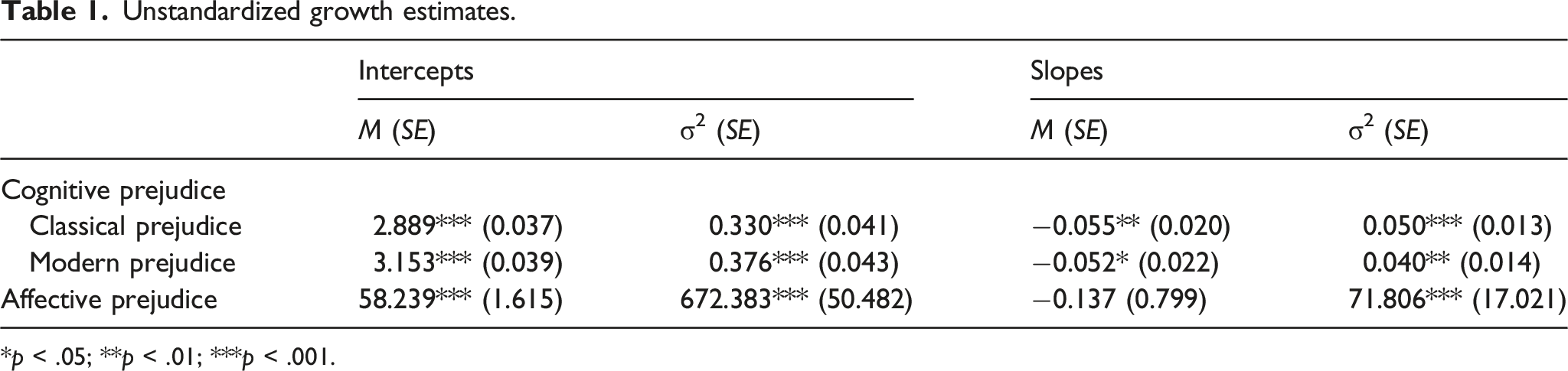
*p < .05; **p < .01; ***p < .001.
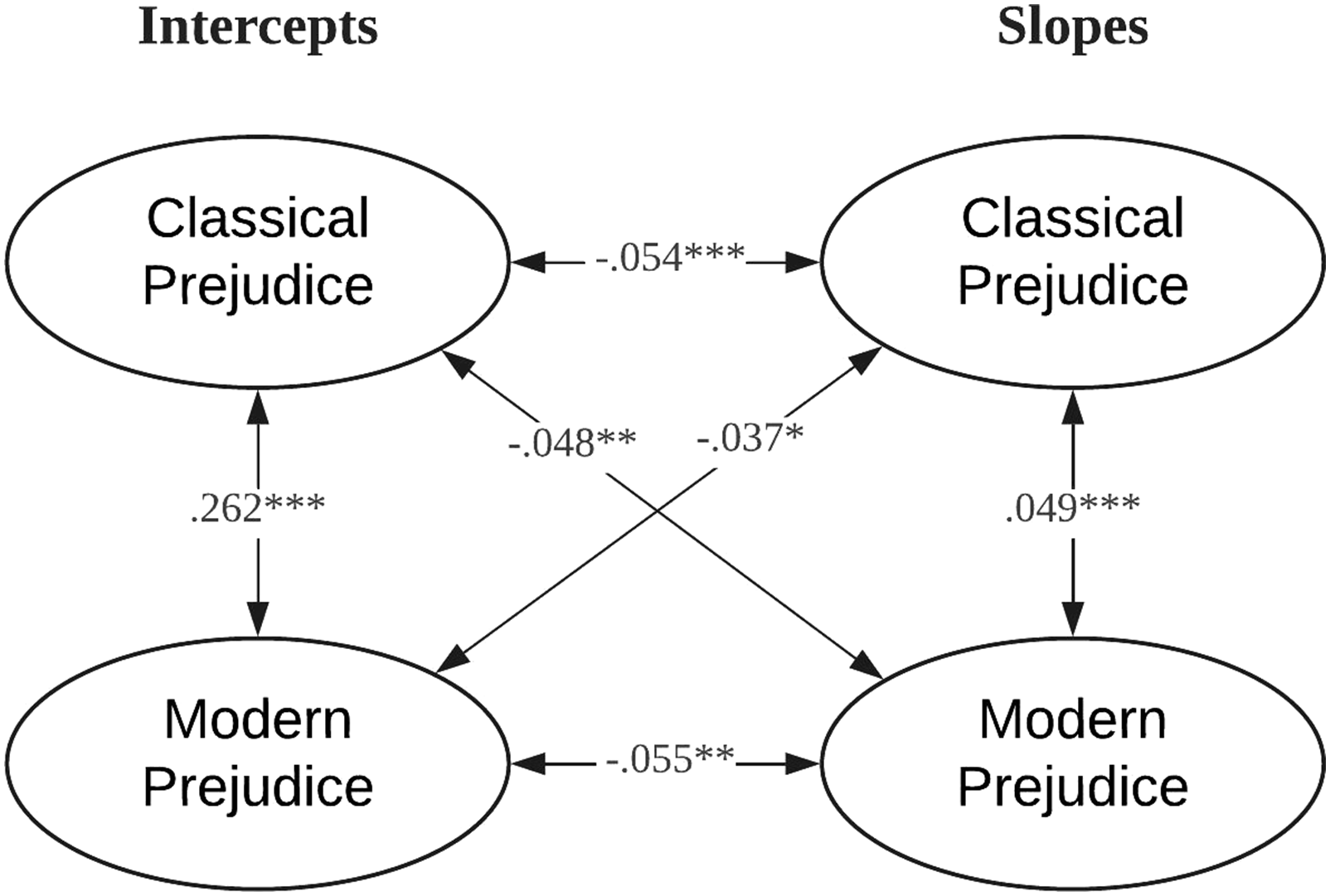
Correlations between intercepts and slopes of Classical and Modern prejudice. *p < .05; **p < .01; ***p < .001.
Rank-order stability
Rank-order stability with manifest and latent variables.
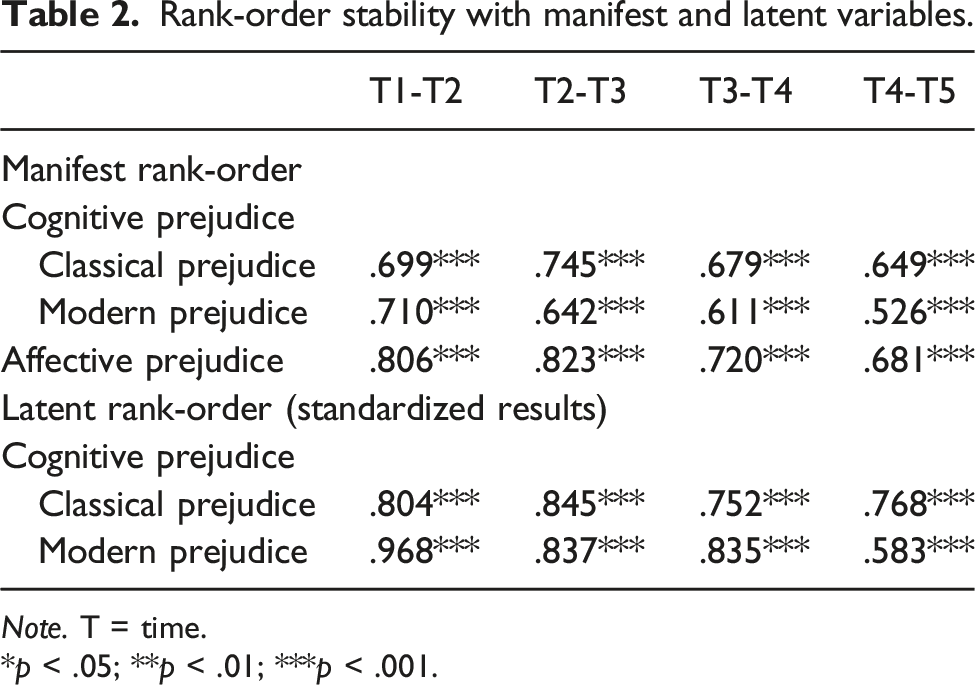
Note. T = time.
*p < .05; **p < .01; ***p < .001.
Latent class growth analyses
Class solutions resulting from latent class growth analysis.
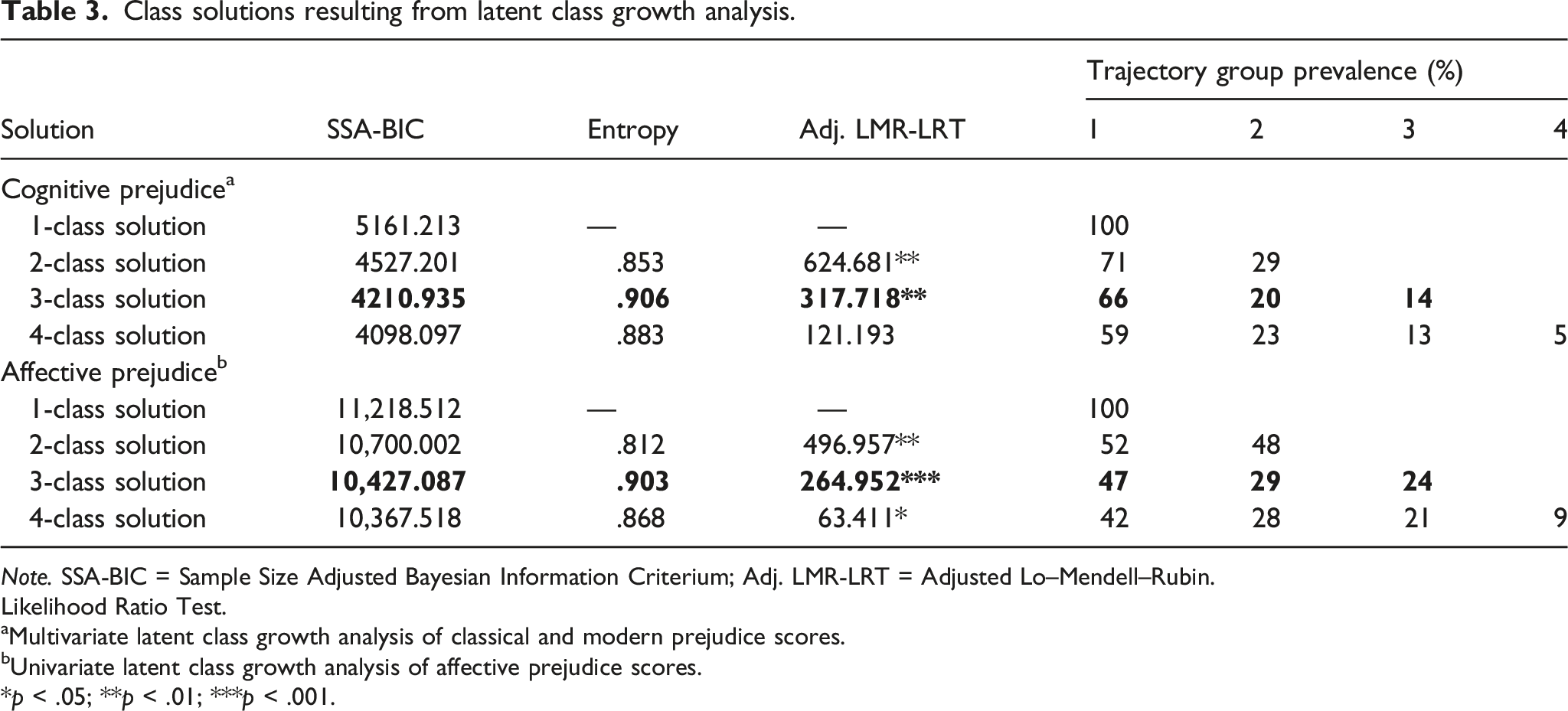
Note. SSA-BIC = Sample Size Adjusted Bayesian Information Criterium; Adj. LMR-LRT = Adjusted Lo–Mendell–Rubin.
Likelihood Ratio Test.
aMultivariate latent class growth analysis of classical and modern prejudice scores.
bUnivariate latent class growth analysis of affective prejudice scores.
*p < .05; **p < .01; ***p < .001.
Unstandardized parameter estimates of LCGA models.
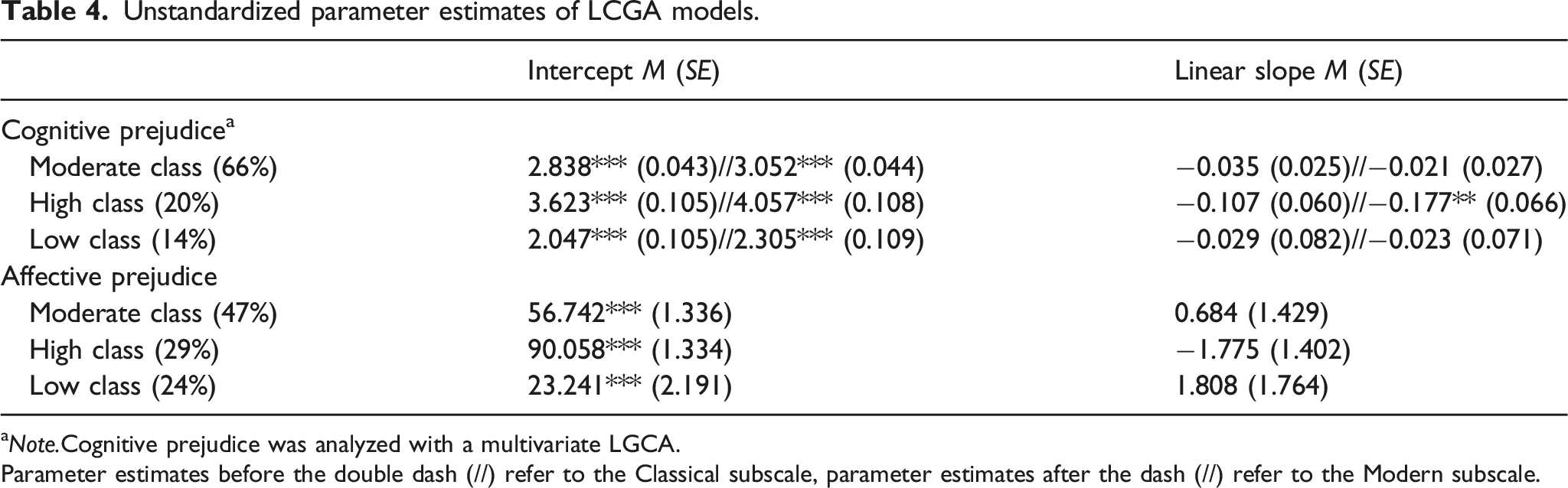
aNote.Cognitive prejudice was analyzed with a multivariate LGCA.
Parameter estimates before the double dash (//) refer to the Classical subscale, parameter estimates after the dash (//) refer to the Modern subscale.

Developmental trajectories of prejudice classes extracted with LCGA. Note. Different classes of participants were extracted by means of a Latent Class Growth Analysis, based on respondents’ levels (high, moderate, and low) of cognitive (on the left) and affective (on the right) prejudice. Cognitive prejudice scores ranged from 1 (low cognitive prejudice) to 5 (high cognitive prejudice). Affective prejudice scores ranged from 0 (low affective prejudice) to 100 (high affective prejudice).
Regarding affective prejudice, the three-group solution was retained in the end, even though the four-group solution was associated with a decrease in SSA-BIC and a significant Adjusted LMR-LRT. However, the four-class solution had a poorer Entropy value and violated the parsimony principle, as adding one more group did not highlight any profile substantially different from those already detected (Table 3). Therefore, the three-class solution provided the best fit. The first group, comprising 47% of participants, was characterized by moderate levels of affective prejudice, which remained stable over time. The second group included 29% of participants who showed high affective prejudice, which slightly decreased over time, although not significantly. A third group, comprising the remaining 24% of the sample, displayed low levels of affective prejudice, which slightly increased over time, although not significantly. The three groups were labeled moderate affective prejudice, high affective prejudice, and low affective prejudice, respectively (see Figure 2). Additionally, Wald test comparisons indicated that intercepts were all significantly different across the three groups, while slopes were not.
Multinomial logistic regression
Results of multinomial logistic regression for cognitive and affective prejudice classes (unstandardized parameters).
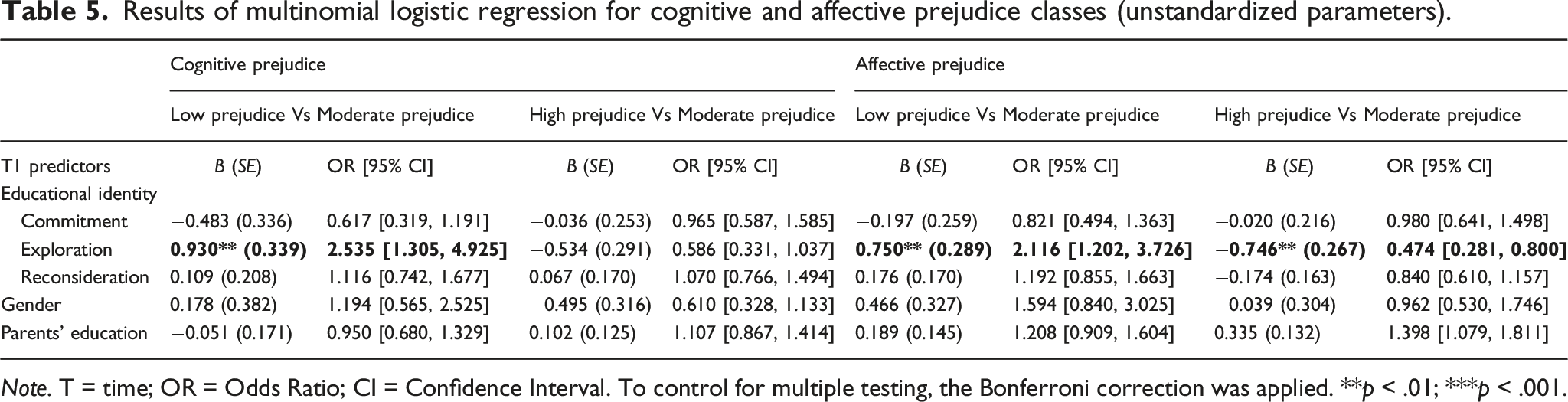
Note. T = time; OR = Odds Ratio; CI = Confidence Interval. To control for multiple testing, the Bonferroni correction was applied. **p < .01; ***p < .001.
For affective prejudice, results (Table 5) confirmed that educational identity in-depth exploration measured at T1 significantly predicted the likelihood of falling into one group of affective prejudice rather than another, while educational identity commitment and educational identity reconsideration of commitment did not. Specifically, educational identity in-depth exploration at T1 doubled the chances of participants falling into the low rather than the moderate group of prejudice and halved the likelihood of participants being in the high rather than the moderate affective prejudice group. In both models, the covariates (i.e., participants’ gender and their parents’ educational level) did not significantly account for prejudice group membership.
Discussion
Characterized by the progressive consolidation of youth’s social and political attitudes, the transition from late adolescence to emerging adulthood appears to offer an insight into the future generation’s views of society and others (Hooghe & Wilkenfeld, 2008; Rekker, 2016). However, previous studies on the development of ethnic prejudice during this life stage (e.g., Bratt et al., 2016; Rekker et al., 2015; Wölfer et al., 2016) reported mixed findings and mainly focused on mean-level changes. The present research aimed to address these gaps in the literature. First, it investigated the development (in terms of mean-level changes and rank-order stability) of cognitive and affective components of ethnic prejudice in the transition from late adolescence to emerging adulthood. Second, it adopted a person-centered approach (Bergman & El-Khouri, 2003) to extend these findings and identify different groups within the population, based on participants’ levels (i.e., high, moderate, low) of cognitive and affective prejudice dimensions. Third, given the intertwined nature of personal and social identity domains, it examined educational identity processes (i.e., commitment, in-depth exploration, and reconsideration of commitment; Crocetti et al., 2008) as possible predictors of membership to one of the identified prejudice groups. Overall, this study provides novel insights on how ethnic prejudice changes during this life stage and which factors might contribute to different levels of its cognitive and affective dimensions, as further discussed below.
Ethnic prejudice: Multifaceted nature and developmental trends
As regards the first aim, contrary to our expectations, the present study found that at the mean-level ethnic prejudice showed different developmental patterns depending on the component considered. The cognitive component of ethnic prejudice displayed a slight and significant decrease over time, in line with previous research on interethnic attitudes (e.g., Rekker et al., 2015; Wölfer et al., 2016). On the other hand, affective ethnic prejudice remained relatively stable over time, confirming prior findings in the literature (Bratt et al., 2016; study 2). These findings might be explained in light of a differential effect of cognitive development on the two dimensions of prejudice. That is, the cognitive facet of prejudice might be more susceptible to changes due to increased cognitive skills that help late adolescents and emerging adults recognize the multiple complex belongingness of others (Albarello et al., 2020, 2021; Kuhn, 2009), thus leading to a decrease in prejudicial beliefs. On the contrary, the affective facet of prejudice, being an immediate reaction to others (which might involve automatic neurophysiological processes; Amodio, 2014), might be less sensitive to cognitive development and thus more resistant to change. Additionally, these results appear to be in line with emotion intensity theory (Brehm, 1999) and recent empirical findings (Pantaleo & Contu, 2021), highlighting dissociations in cognitive and affective components of prejudice in response to counter-attitudinal information. Overall, the results of the current and previous studies confirm the multifaceted nature of prejudice (Brown, 2011) and suggest the importance of considering its different components in order to reach a more complex and effective understanding of this phenomenon.
Moving to rank-order stability, as expected based on previous findings (for a meta-analysis, see Crocetti et al., 2021), the coefficients were high across all time points for both cognitive and affective dimensions of ethnic prejudice. This evidence is consistent with research on the rank-order stability of personality (e.g., Borghuis et al., 2017; Klimstra et al., 2009; Roberts & DelVecchio, 2000), self and identity (e.g., Crocetti et al., 2016; Klimstra et al., 2010), social judgments (e.g., Crocetti et al., 2019), and political views (e.g., Rekker et al., 2015). Although modern prejudice displayed a different pattern, with a low rank-order coefficient at T4-T5 compared to the cutoff point of .60 (Mroczek, 2007), this value was not significantly different from the coefficient at T3-T4. The only decrease in rank-order coefficients was observed in affective prejudice from T2-T3 to T3-T4 coefficients. This result might be a consequence of the time lag of assessments points, since rank-order stability was previously found to be inversely associated with the time lag between waves—that is, the larger the lag, the lower the stability observed (Crocetti et al., 2021). While the first three waves (T1, T2, and T3) were conducted 3 months apart, the following two (T4 and T5) were 1 year apart. Therefore, the decrease in affective prejudice rank-order coefficients could be attributed to the change from a shorter to a longer time lag.
Overall, our findings extend prior results in the literature (Crocetti et al., 2021) by informing on the specific developmental trends (in terms of both mean-level changes and rank-order stability during the transition from late adolescence to emerging adulthood. When developmental trajectories at the mean-level are coupled with high rank-order stability, conclusions about normative development can be drawn (Meeus, 2019). This information is crucial to expand the knowledge of how ethnic prejudice changes in the transition from late adolescence to emerging adulthood and identify a space for appropriate interventions to support positive intergroup relations and attitudes. For instance, interventions at this life stage might be more effective when tackling the cognitive dimension of prejudice, benefiting from the development of more sophisticated cognitive abilities (Albarello et al., 2020). These could help emerging adults to recognize and understand counter-stereotypical information, ultimately supporting a more complex view of their own and other people’s identities.
Capturing variability in ethnic prejudice levels: The benefits of a person-centered approach
Examining the longitudinal development of cognitive and affective ethnic prejudice at the mean-level highlighted significant variability in intercepts and rates of change, setting the stage for the second goal of the study, which was to investigate whether such variability could be traced back to different groups based on prejudice levels (i.e., high, moderate, low). Consistently with expectations, participants were assigned to one of three different groups of cognitive ethnic prejudice (i.e., high cognitive prejudice, moderate cognitive prejudice, and low cognitive prejudice) and to one out of three groups of affective ethnic prejudice (i.e., high affective prejudice, moderate affective prejudice, and low affective prejudice). Interestingly, participants in the high cognitive prejudice group displayed slightly different developmental trajectories for the dimensions of Classical and Modern prejudice: while Classical prejudice did not change, Modern prejudice slightly but significantly decreased over time. This difference could be a consequence of the different forms of prejudice tackled, with the former assessing blatant (and less socially acceptable) instances and the latter evaluating more subtle manifestations of this attitude (Akrami et al., 2000; Gattino et al., 2011). Thus, the assessment of Classical prejudice may have been sensitive to the respondents’ desire to display more socially acceptable positions. Nonetheless, more data is needed to evaluate this tentative interpretation.
For both dimensions of prejudice, the most represented group was the one with moderate levels of prejudice (66% and 47% of participants in the moderate group for cognitive and affective prejudice, respectively), followed by the one with high (20% and 29% of participants in the high group for cognitive and affective prejudice, respectively) and with low levels (14% and 24% of participants in the low group for cognitive and affective prejudice, respectively), indicating that only a small proportion of late adolescents display low ethnic prejudice. These patterns are in line with recent research showing that young people are generally more tolerant towards social groups that have traditionally been marginalized or discriminated (such as sexual minorities), but they are less accepting of immigrants than older generations (Janmaat & Keating, 2019).
From a practical standpoint, adopting a person-centered approach (Bergman et al., 2003) allows the identification of adolescents at risk of developing negative relationships with people of different ethnic backgrounds and offers pivotal information to plan developmentally appropriate interventions (Beelmann & Lutterbach, 2021). For instance, the fact that approximately a quarter of our participants displayed high levels of cognitive and affective prejudice substantiates the need for interventions aimed at reducing negative intergroup attitudes and relations. This is crucial in light of the heinous consequences that negative intergroup experiences (e.g., prejudice, discrimination, negative contact) might exert on both minority and majority youth (Bagci & Rutland, 2019).
Fighting prejudice: The protective role of educational identity
The third aim of the present research was to investigate the role of educational identity processes in predicting membership to one of the cognitive and affective prejudice groups over and above a reference group (i.e., the moderate prejudice group for both dimensions). Gaining more knowledge on this aspect is of utmost importance in planning tailored interventions to promote positive intergroup relations. Specifically, educational identity processes were chosen as a parsimonious construct at the intersection between individual and socio-contextual factors, and in light of the importance attributed to school during this life stage (Negru-Subtirica & Pop, 2018), especially for the development of adolescents’ identity (see Verhoeven et al., 2019), positive intergroup experiences and attitudes (Schachner et al., 2016; Schwarzenthal et al., 2020). We found that adolescents who at the beginning of the study engaged in in-depth exploration of their commitment in the educational domain to a higher extent were more likely to fall into the low rather than the moderate prejudice group for both cognitive and affective components and were less likely to fall in the high rather than the moderate prejudice group, although this was true only for the affective dimension of ethnic prejudice. Commitment and reconsideration of commitment were not significant predictors of group membership, thus showing that such processes might be relatively unrelated to the views individuals develop about others in their social context.
These findings confirm our hypothesis about the key role played by thoughtful exploration and are in line with previous research on identity processes (Crocetti et al., 2010, 2012; Hatano et al., 2016) and styles (Crocetti et al., 2014; Erentaitė et al., 2019; Soenens et al., 2005), which highlighted the associations between in-depth exploration and multiple personal (e.g., openness to experience; Crocetti et al., 2010; Hatano et al., 2016) and social (e.g., civic engagement; Crocetti et al., 2012) aspects that inform individuals’ views of others within society (Brandt et al., 2015; Pancer et al., 2007). Besides extending the literature on associations between personal identity processes and social identity processes (Albarello et al., 2018), our findings also highlight for the first time the link between in-depth exploration and ethnic prejudice among late adolescents. Active and thoughtful reflection—that is, the cornerstone of identity exploration—not only informs personally relevant decisions but also extends to the interpersonal domain by guiding adolescents’ ways of feeling and thinking about others and preventing the development of cognitive and affective prejudice against ethnic minorities. Following the line of research on counter-stereotypes, which have been found to activate flexible thinking (Gocłowska et al., 2013) and reduce dehumanization (i.e., an aggravated form of prejudice denying full humanness to others; Albarello & Rubini, 2008) and the use of heuristics (Prati et al., 2015), in-depth exploration might be an expression of a general mindset characterized by greater cognitive flexibility and less reliance on stereotypical thinking. Such mindset might support adolescents in embracing the peculiarity and diversity of interpersonal encounters in a multicultural world. Although flexibility and willingness to engage in thorough information processing define the in-depth exploration process, it could also be argued that these cognitive features are even amplified when it comes to the exploration of educational identity commitment. For instance, the exploration of relevant commitment in this domain might rely on social comparisons between personal and others’ (e.g., classmates) educational choices. These might in turn heighten perceived similarities based on the shared educational commitments made (i.e., all classmates made similar educational choices), increase identification with the group of classmates (Albarello et al., 2018), and ultimately help adolescents recognize commonalities beyond diversity and avoid prejudicial thinking. In this vein, it might be argued that educational in-depth exploration has unique and specific associations with ethnic prejudice. However, these considerations should be further addressed in future studies examining differences and commonalities in exploration processes of multiple relevant domains.
In our models, the participants’ gender and parental education were used as covariates. Prior studies have suggested the importance of these factors although they have reported mixed findings on their associations with prejudice (e.g., Rekker, 2016; Weber, 2019). In the current study participants’ gender and their parents’ educational level did not play a role in predicting prejudice group membership. These findings are in line with previous research (Hooghe et al., 2013; Weber, 2019; for a meta-analysis, see Crocetti et al., 2021) attributing a marginal role to these factors in influencing ethnic prejudice development.
Limitations and suggestions for future research
The current research contributed to the literature on ethnic prejudice by extending knowledge about its development in the transition from late adolescence to emerging adulthood, identifying different groups of youth based on their levels of cognitive and affective prejudice, and pointing to the predicting role of educational identity in-depth exploration. These findings, however, should be read in the light of some limitations. First, it should be noted that the sample size was adequate as indicated by the power analysis, but some participants dropped out after graduating from high school and did not participate in the final (those attending 11th grade at T1) or the last two waves (those attending 12th grade at T1) of the study. Second, our results come from a sample of Italian late adolescents living in a specific region of Italy (i.e., Emilia-Romagna), which was chosen since it is the one with the highest percentage of immigrants among the student population (Ministero della Pubblica Istruzione, 2019). The generalizability of the present findings should be considered carefully, as Italy is quite different in terms of migrant share in the population, history of migration, and policies about inclusion and citizenship compared to other European countries and the American context (MIPEX, 2020). Third, the current study tackled the cognitive and affective dimensions of prejudice but did not explore its behavioral counterpart. Prejudice is a multifaceted construct (Brown, 2011), and future studies should investigate all its components because each of them may show different developmental trajectories. Finally, this study investigated the role of educational identity processes in predicting membership to different groups of prejudice. However, additional individual (e.g., values, socio-emotional competences, personal experiences) and socio-contextual factors (e.g., family, peers, intergroup contacts) might play a role in shaping developmental trajectories of ethnic prejudice. For instance, evaluating adolescents’ social identification with their (national) ingroup might provide a more comprehensive picture of how personal identity processes and those of social identity might jointly contribute to the development of prejudice among youth (e.g., Meeus et al., 2010). Therefore, future research should include additional predictors and strive to disentangle the relative importance of each of them at different life stages.
Conclusions
This study addressed the development of ethnic prejudice in the transition from late adolescence to emerging adulthood by considering both its cognitive and affective components. It was found that cognitive ethnic prejudice displayed a significant decrease over time, while affective prejudice remained relatively stable. Additionally, rank-order stability was high, indicating that individuals tend to maintain their position in terms of attitudes relative to their peers. Moreover, by applying a person-centered approach (Bergman & El-Khouri, 2003), we found that variability in terms of prejudice levels could be traced back to different groups within our sample, distinguishing between those with high, moderate, and low levels of prejudice, for both its cognitive and affective components. Finally, we highlighted that educational identity in-depth exploration significantly predicted membership to one of these groups.
Overall, the findings from the current study are particularly relevant not only because they extend knowledge of how ethnic prejudice develops over time but also because they highlight important predictors of such development, increasing the understanding of the intertwined nature of personal and social identity processes. Such knowledge is crucial to inform future interventions aimed at supporting harmonious relations within our societies. This research confirmed that the study of prejudice development could be particularly effective when adopting a person-centered approach, which tackles the variability within the general population and allows for a deeper understanding of psychological phenomena. Additionally, supporting adolescents in the in-depth exploration of their identity commitments might be a useful strategy to reduce their ethnic prejudice and improve the quality of their interactions with members of other social groups.
Supplemental Material
Supplemental Material—Addressing ethnic prejudice in youth: Developmental trajectories and associations with educational identity
Supplemental Material for Addressing ethnic prejudice in youth: Developmental trajectories and associations with educational identity by Beatrice Bobba, Flavia Albarello, Monica Rubini, and Elisabetta Crocetti in European Journal of Personality
Footnotes
Declaration of conflicting interests
The author(s) declared no potential conflicts of interest with respect to the research, authorship, and/or publication of this article.
Funding
The authors disclosed receipt of the following financial support for the research, authorship, and/or publication of this article: This research was undertaken with the support of the Alma Idea Junior research grant by the Alma Mater Studiorum University of Bologna to Elisabetta Crocetti and by the European Association of Social Psychology (EASP) Seedcorn Grants to Flavia Albarello and Elisabetta Crocetti.
Data availability statement
Study materials, and analyses codes and outputs are publicly available and can be retrieved from:  . The datasets generated and/or analyzed for the current study are not publicly available due to ethical restrictions (i.e., participants did not agree for their data to be shared publicly) but are available from the last author on reasonable request.
Supplemental Material
Supplemental material for this article is available online.
References
Supplementary Material
Please find the following supplemental material available below.
For Open Access articles published under a Creative Commons License, all supplemental material carries the same license as the article it is associated with.
For non-Open Access articles published, all supplemental material carries a non-exclusive license, and permission requests for re-use of supplemental material or any part of supplemental material shall be sent directly to the copyright owner as specified in the copyright notice associated with the article.
