



Abstract
Extensive knowledge about creative achievements and their association with personality traits, motivation, and cognitive ability has been derived from univariate studies in adult samples. In contrast, research on children’s talent development often focuses narrowly on academic performance, overlooking creative achievements as developmental milestones. To better understand the nomological net of childhood creativity, this study took a comprehensive, multimodal approach to explore predictors of creative activities and (scientific and artistic) creative achievements in N = 431 gifted secondary school students. Using self- and parent-reports, performance tests, and a machine learning approach, over 40 theoretically derived predictors from personality, motivation, and cognitive domains were analyzed. Our results broadly aligned with the pattern of associations from adult samples and revealed domain-specific differences. Important predictors identified by machine learning included openness, creative self-efficacy, artistic and investigative vocational interests, and divergent thinking. Structural equation modeling showed that intellectual curiosity and investigative interests were the strongest predictors of scientific creative achievement, whereas aesthetic sensitivity was the strongest predictor of artistic creative achievement. Creative activities partly mediated the associations. Our findings underscore the multidimensional nature of creativity in gifted adolescents during an important stage of talent development and highlight key factors by distinguishing robust predictors from simple correlates.
Plain Language Summary
Why was this study done? When we talk about talented kids, we often focus on good grades. But creativity in areas like art, music, or writing is also an important talent. While we know a lot about what makes adults creative, less is known about what helps young people achieve creative success. This study aimed to fill that gap. We studied 431 talented secondary school students. We asked them and their parents questions regarding students’ creative activities, creative achievements, personality, and motivation. We also had the students complete tests measuring their creative and cognitive thinking skills. We analyzed over 40 factors using modern methods to see how these pieces fit together to predict real-life creative success. We found that the factors related to young people’s creativity are quite similar to those in adults, and that they depend on the specific type of creativity. Overall, the most important factors included being open to new experiences and aesthetic things, believing in one’s own creative abilities, being interested in creative and scientific work, and being able to think “outside the box”. Interestingly, different factors predicted different types of creativity. For example, a strong sense of intellectual curiosity was one of the best predictors for scientific creativity, such as inventing or exploring new concepts. On the other hand, an appreciation for beauty and art was the strongest predictor for artistic creativity. We also noticed that regularly engaging in creative hobbies helps bridge the gap between these personal traits and major creative achievements. What do these findings mean? This study shows that creativity in teenagers is a complex mix of personality, interests, and skills. By identifying the most important factors, we can better understand how to support young creative talent. These findings can help parents and teachers recognize and nurture the specific strengths that lead to creative success.
Introduction
Creativity is key to innovation and, thus, an important 21st-century skill (OECD, 2019). It is essential to address complex global challenges such as rapid digitalization, climate change, economic instability, and social inequalities. Understanding how creative activities and achievements emerge and become established, from an early age, is crucial to the question of how society can support individuals in their talent development to ensure more creative achievements later in life.
However, historically, much of the research on children’s talent development and achievements has been driven by a focus on traditionally defined cognitive ability (e.g., IQ) and/or academic achievements (e.g., Lubinski, 2016; Steinmayr et al., 2014), failing to focus on creativity and creative achievements as developmental milestones earlier in life. Renzulli (1986, 2016; see also Renzulli & Reis, 2021) therefore distinguished between “schoolhouse giftedness,” which refers to high performance in traditional academic settings, and “creative giftedness,” which involves the ability to produce original and valuable work in diverse domains and which is the focus of the present work. In contrast, research on adult creativity and creative achievements is extensive, but typically focuses on only single predictors related to creativity examined in isolated studies (see also van der Zanden et al., 2020), without taking a comprehensive and interdisciplinary approach (Benedek, 2024; Roberts et al., 2024).
Given the fact that (a) early creative achievements in talent development have received little research attention and (b) creativity is influenced by various, mostly interrelated factors, this study employed an integrative, multidimensional, and multimodal approach to better understand the nomological network of childhood creativity and compare it with findings from adult samples. By combining a confirmatory and an exploratory approach and integrating a wide range of theoretically derived variables from different research areas, the study examined their importance for predicting creative activities and (scientific and artistic) creative achievements (CAs).
In particular, we examined data from the Talent Study, a study of talented secondary school students nominated by teachers for a gifted STEM enrichment program (Jaggy et al., 2025). We assessed students’ CAs, personality (both self- and informant perspectives), motivation, and cognitive abilities. We bring to bear two theoretical frameworks, the Neo-Socioanalytic Model of Personality Development (Roberts & Yoon, 2022) and the Talent-Development-in-Achievement-Domains (TAD) Framework (Preckel et al., 2020), to help inform our research questions and data analyses. We first review the factors from prior research that have been shown to predict CAs and consider the developmental factors within adolescence that may affect these patterns.
Creative Activities and Achievements
Creativity is a multifaceted and elusive construct that can be generally defined as the ability to generate new, unexpected ideas or products that are useful and valuable (Runco & Jaeger, 2012). Whereas several approaches exist to better understand and capture the complexity of creativity (e.g., J.C. Kaufman & Beghetto, 2009; Rhodes, 1961), an often-made distinction is that between a person’s creative potential and their real-life creativity or creative behavior (Benedek, 2024; Kim, 2008), with the latter seen as an outcome of creative potential (Runco & Acar, 2012). This view aligns with actual talent developmental perspectives, emphasizing the developmental process from having potential to realizing actual (creative) achievement (Preckel et al., 2020; Renzulli & Reis, 2021).
Real-life creativity spans from everyday creative activities, which can be categorized as little- or mini-c activities (Four-C Model of Creativity; J. C. Kaufman & Beghetto, 2009)
Real-life creative activities and achievements are domain-specific (Baer, 2015) and can range from artistic works to scientific discoveries. According to the Amusement Park Theoretical model (J. C. Kaufman & Baer, 2004), while general traits support overall creative endeavors, actual creative achievements require domain-specific skills, traits, and motivational profiles. Theoretically, this suggests that while creative achievements require a high degree of domain-specific specialization, everyday creative activities in adolescence often represent a broader, more exploratory engagement in which domain boundaries are not yet as pronounced. Therefore, to accurately capture creativity, it is essential to differentiate between distinct subject domains, such as scientific and artistic creative achievements (S. B. Kaufmann et al., 2016).
Moreover, everyday creative activities, like creative potential, are considered a prerequisite for creative achievement (Jauk et al., 2014; Zhu et al., 2016). A first important step toward a better understanding of why some children translate early creative potential into tangible achievements is a closer examination of the nomological net of childhood creativity, with a particular focus on the role of key individual differences.
Interindividual Differences in Creativity
One of the challenges in investigating childhood creativity is organizing the range of concepts brought to bear on defining and studying creativity. The Neo-Socioanalytic Model of Personality Development (Roberts et al., 2024) provides a useful framework for organizing the variety of factors that contribute to creativity and creative achievements later in life. Rather than arguing for the primacy of any one domain of personality, the Neo-Socioanalytic model delineates the existence of at least four domains of personality that should be kept distinct in understanding how personality might impact an outcome such as creativity. Those four domains are personality traits (e.g., Big Five; McCrae & Costa, 2008), motivation (e.g., intrinsic motivation, interests, self-efficacy; Eccles & Wigfield, 2020), abilities (e.g., cognitive abilities, social-emotional skills; Soto et al., 2022), and narrative identity (e.g., storied content of a person’s self-concept; Glaveanu et al., 2020). Whereas relevant to creative achievement later in life (McAdams, 2011), narrative identity is most likely less relevant for 11- to 13-year-olds, the sample we are studying here. Therefore, we focus our review and subsequent research on the three domains of traits, motives, and abilities, where the vast majority of findings have been obtained from adult samples.
Creativity and Personality
In terms of the Big Five taxonomy of personality traits (McCrae & Costa, 2008), the domains of openness, extraversion, and agreeableness show the clearest and most consistent pattern of associations with creativity in adult samples. Creative adults tend to be more open (e.g., Feist, 1993; Jauk et al., 2014), more assertive and/or dominant (e.g., Feist, 1998; S. B. Kaufman et al., 2016), and more disagreeable (e.g., Feist, 1993). The roles of conscientiousness and neuroticism are less clear, possibly due to opposing effects at the facet level (Batey & Furnham, 2006). In the case of conscientiousness, for example, industriousness is positively associated with creative achievement, and conventionality is negatively associated (e.g., Roberts & Yoon, 2022). The analysis of the facet-level thus holds considerable potential for a deeper understanding of the factors that predict different forms of creative achievement. For instance, research has shown that the intellectual facet of openness is more strongly correlated with scientific creativity, whereas the openness to experience facet is more strongly related to creative achievement in the arts (S. B. Kaufman, 2013; S. B. Kaufman et al., 2016). The detailed understanding of how underlying facets of the Big Five are differentially related to (domain-specific) creativity has yet to be systematically investigated, something we address in this research.
Creativity and Motivation
The second major personality domain known to influence creativity is motivation (Roberts et al., 2024). Motivation and especially passionate interests in specific topics are also critical for participating in and achieving in creative activities (Eccles & Wigfield, 2020). Consistent with the idea that creative achievers are intrinsically motivated for their work is the fact that investigative and artistic vocational interests are the strongest positive predictors of success in scientific careers, while enterprising interests are the strongest negative predictor (McCabe et al., 2020). Creative achievers also show early signs of being interested in artistic and analytical activities (Zabelina et al., 2022), and investigative and artistic interests are associated with scientific and artistic creative activities, respectively (Perrine & Brodersen, 2005).
Motivation is a much more heterogeneous domain than personality traits. Beyond dimensions like interests, concepts such as self-concept and self-efficacy also play a role in creative achievement. Derived from the Expectancy-Value Theory (EVT; Eccles & Wigfield, 2020), one of the key elements of motivation to act on any issue, including creativity, is having the expectation that one will succeed at that activity, which typically manifests as the construct of self-efficacy. In contrast to academic self-concept, which represents a more stable, domain-specific perception of one’s ability that often involves social comparisons, self-efficacy is more future-oriented and task-specific (Bong & Clark, 1999). In the context of creative activities and achievements, which often involve novel, ill-defined, and highly specific tasks, self-efficacy is considered a more proximal and critical predictor of actual behavior. Meta-analytic estimates show robust and large relations between creative self-efficacy and different forms of creativity, including participating in creative activities, being a creative person, and creative achievement (Haase et al., 2018).
Creativity and Cognitive Ability
The third main domain of personality that is important for creativity is cognitive ability. Based on the literature focusing on the cognitive underpinnings of creativity (Nusbaum & Silvia, 2011; Weiss et al., 2021; Wilson et al., 1954), we distinguish between general cognitive abilities, involving logical reasoning, analysis, and the ability to narrow down options to determine the most effective answer (i.e., global intelligence; Gottfredson, 1997) and divergent thinking ability, which involves generating multiple creative solutions and is also often referred to as creative potential (Runco & Acar, 2012). Although some intelligence models subsume divergent thinking as the cognitive facet of creativity under general cognitive abilities (i.e., intelligence), the relationship between divergent thinking and intelligence is not definitively clarified, and meta-analyses report only a weak positive relation (d ∼ .20; Gerwig et al., 2021; Kim, 2008).
General Cognitive Ability
General cognitive abilities can also be differentiated into more specific components (Carroll, 2003), such as crystallized, fluid, and visual-spatial. Of particular interest, especially to creativity, are the visual-spatial abilities as they may lend themselves to higher creativity in fields that utilize these skills, such as visual arts (Kell & Lubinski, 2013). Regarding creative achievements, meta-analytic evidence shows a small, positive relation with intelligence (r ∼ .18; Karwowski et al., 2021; Kim, 2008). However, it is debated whether the association between intelligence and creativity is linear or curvilinear: The threshold hypothesis (cf. Jauk et al., 2013) states that the association between intelligence and creativity reaches an asymptote once one gets to a relatively high level of intelligence, but the empirical evidence is mixed (cf. Weiss et al., 2020).
Regarding the domain-specificity, research suggests that intelligence may play a more prominent role in scientific than in artistic creative achievements. While some earlier meta-analyses reported no substantial differences across creative fields (Kim, 2008), more recent evidence suggests a domain-dependent relationship. Specifically, higher general intelligence has been shown to correlate with scientific but not artistic creative achievements (S. B. Kaufman et al., 2016), a pattern supported by recent meta-analytic findings showing larger effect sizes for the scientific domain (Karwowski et al., 2021).
Divergent Thinking
Divergent thinking includes qualities such as fluency in creating numerous alternative uses for mundane activities or coming up with highly original alternative uses for objects or activities, for example, Runco & Acar (2012). In many cases, researchers have considered these qualities to be indicators of creative potential in that it is assumed that for someone to be creative, they have to be able to come up with many ideas and preferably many original ideas (Benedek, 2024; Jauk et al., 2014). A meta-analysis by Said-Metwaly et al. (2022) shows a weak positive relation between divergent thinking and overall creative achievement (d = .18), confirming previous meta-analytic results (r = .22; Kim, 2008).
The domain-specific role of divergent thinking also presents a mixed picture: Whereas early evidence linked it more strongly to the arts (Kim, 2008), recent research indicates that divergent thinking correlates equally well with both artistic and scientific achievements (S. B. Kaufman et al., 2016; Said-Metwaly et al., 2022).
Integrating Personality Traits, Motivation, and Cognitive Ability
As outlined above, the present study aims to integrate personality traits, motivation, and cognitive ability in predicting CAs in early adolescence. It is quite common in the study of creativity to investigate a narrow set of predictors rather than a complement of predictors from multiple domains, though there are a few exceptions, with most of them focusing on integrating personality traits and cognitive ability research. For example, using a sample of adults, Jauk et al. (2014) investigated the associations of openness, divergent thinking, and general cognitive ability with creative activities and overall creative achievement. They found that openness and divergent thinking were independently associated with participating in creative activities, while cognitive ability was the exclusive correlate of overall creative achievement. Moreover, creative activities statistically moderated the relationship between openness, divergent thinking, and overall creative achievement.
Similarly, Weiss et al. (2020) investigated several personality dimensions, including personality traits and intelligence, but focused on predicting divergent thinking instead of real-life creative outcomes themselves. Cognitive ability was the strongest predictor of divergent thinking, which is consistent with the idea that these indices have a common cognitive basis (Nusbaum & Silvia, 2011). In contrast, openness did not predict divergent thinking, but honesty/humility did, negatively, and extraversion positively. Also, Kandler et al. (2016) found in a twin study that openness and extraversion predicted creative activities, while intelligence predicted creative performance. Motivation has less often been combined with other predictors and, when done, has tended to be considered either a mediator or moderator of the effect of personality on creativity (e.g., Agnoli et al., 2018; Kaspi-Baruch, 2019).
Taken together, few studies have adopted a truly comprehensive approach that integrates a multidimensional set of personality traits alongside measures of motivation and cognitive ability to predict (domain-specific) CAs. Another significant limitation of empirical studies is the neglect of a developmental perspective on creative achievements (Benedek, 2024).
Developmental Perspective on Creative Achievements in Adolescents
Focusing on gifted children on the cusp of adolescence, the question arises how this exact developmental stage might affect the pattern of psychological predictors of CAs that were previously identified in adult samples. The TAD framework provides a structured developmental model that organizes factors that contribute to transformational achievement (e.g., creative achievement) and focuses on how these factors develop through time, experience, and education, starting from childhood and incorporating four developmental stages (Preckel et al., 2020). In our study, we use the TAD framework to better understand how past research on adult creativity might be modified to understand the role of creativity in talent development in adolescence.
In the TAD framework, talent development can be described through four developmental stages from aptitude to transformational achievement (see Figure 1). At first, the child shows some aptitude for a domain like math, language, the arts, or music. Usually, as a result of a combination of interest and opportunity, the child then develops a rudimentary competence in the skill. This burgeoning competence sparks an emerging identification with the domain and self-concept structures surrounding the activity; the child goes from playing the piano to becoming a “piano player”. Through dedication, time, and practice, the initial competence then becomes expertise, which typically entails high levels of dedication and self-discipline. Finally, for a small subset, this expertise becomes transformational achievement in the form of notable honors, awards, and acknowledgments. The Talent Development in Achievement Domains (TAD) Framework (Preckel et al., 2020, p. 697, reprinted by permission from SAGE Publications, Copyright © 2020)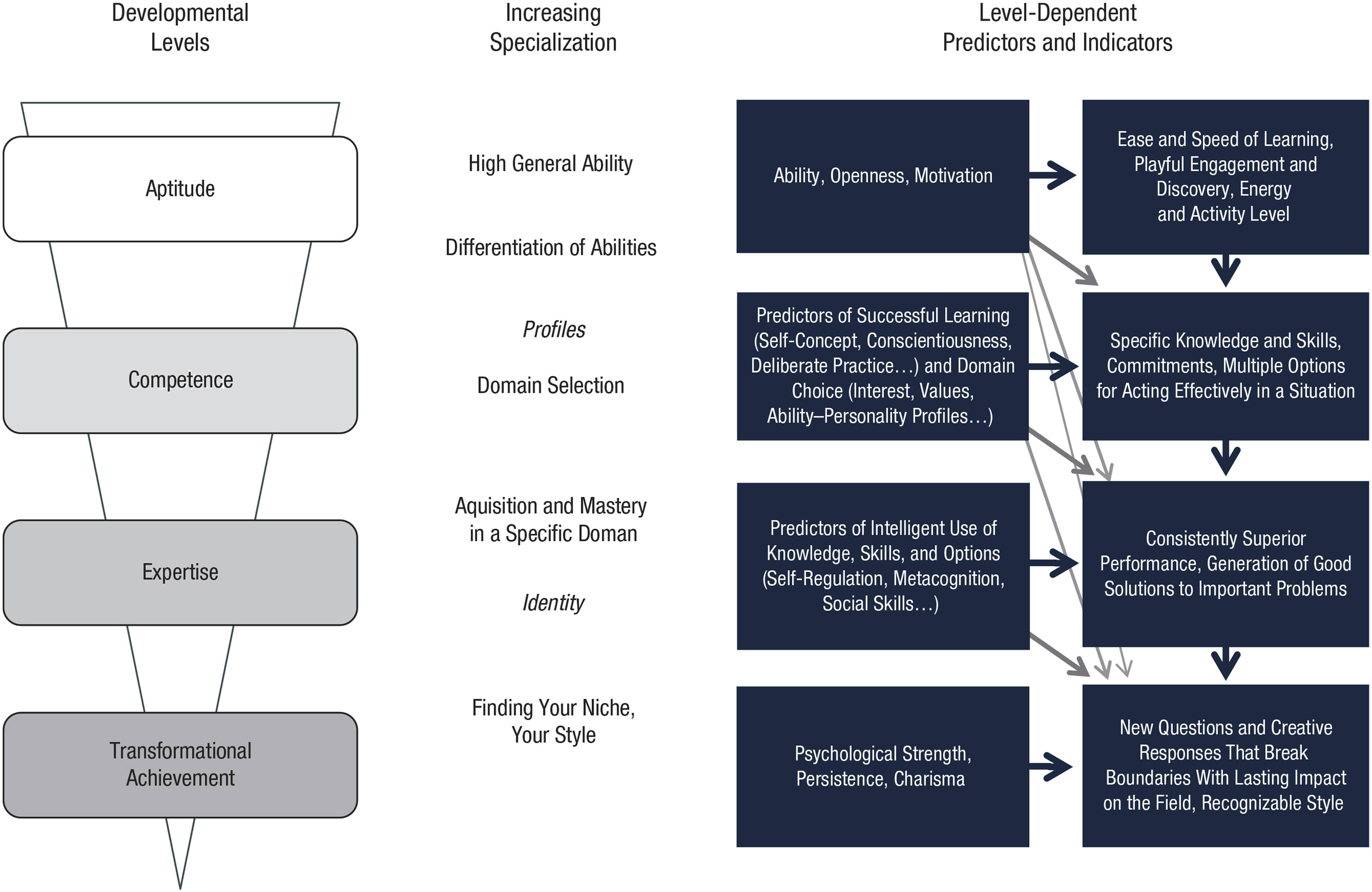
Two core postulates of the TAD model are particularly relevant for the present study: increasing specialization and developmental level-dependent predictors. The framework assumes that as individuals progress, their psychological profile becomes more specialized, with general cognitive abilities being supplemented by domain-specific skills and personality-ability profiles. Crucially, the model posits that the importance of specific predictors shifts across levels. For instance, while general openness might be critical at the aptitude level, psychosocial skills (e.g., self-efficacy) and specific motivational factors become increasingly decisive for reaching competence, expertise, and transformational achievement. By focusing on adolescents at the cusp of specialization, our study aims to identify which personality and motivational “engines” are most critical during the transition from creative potential and activity (competence level) to early milestones of creative achievement (expertise level).
In terms of consistencies, the TAD framework, like the larger body of creativity research, highlights the importance of abilities, openness to experience, and motivation in the form of interests. These qualities appear to be critical from the start of developing creative interests, behaviors, and ultimately achievement (Preckel et al., 2020). Where the TAD deviates from adult-centered research is the emphasis on discipline and conscientiousness. It would seem that to develop talent at this stage of life, children need higher than normal levels of conscientiousness, which does not emerge so clearly in adult samples (Feist, 1998). The second deviation concerns agreeableness. Where there appears to be a consistent signal for disagreeableness and creativity in adult samples, there does not appear to be a clear pattern in children (Preckel et al., 2020). It has been hypothesized that disagreeableness is not a cause of creativity so much as a necessity for surviving the roles that provide opportunities for creative achievement in adulthood (Roberts et al., 2024). Innovative artists, writers, and scientists often face disproportionate levels of criticism, which may winnow the field of highly agreeable creative types because they find the experiences intolerable.
So far, research on creativity that has been done with adolescents appears to be widely consistent with the adult literature (van der Zanden et al., 2020); for example, openness is only modestly related to measures of divergent thinking and creative performance in 5th graders (Theurer et al., 2020). Further, openness, creative self-efficacy, and intrinsic motivation were positively correlated with creative activities in 10th graders, whereas conscientiousness was not (Hong et al., 2014). Like the adult personality literature, it is unclear what would come about if three domains of personality were investigated simultaneously, and to what extent findings would converge across modalities when studying children instead of adults. Moreover, like almost all areas of personality psychology and related fields, the research is dominated by self-report methods.
Moving Beyond Single-Predictor and Single-Method Approaches
Taken together, few studies have adopted a truly comprehensive approach that integrates a multidimensional set of personality traits alongside measures of motivation and cognitive ability to predict CAs or consider developmental perspectives on CAs. Moreover, previous research has often neglected a multimodal perspective. However, incorporating different perspectives, such as self- and other-reports, especially in adolescence, can provide more valid insights (Campbell & Fiske, 1959; Dodorico McDonald, 2008; Mõttus et al., 2019). One reason for the somewhat narrow perspective in previous research might lie in the limitations of common statistical models in psychology. These models are often restricted to a small number of predictors and can be vulnerable to complex interdependencies (i.e., multicollinearity). Effectively analyzing studies with numerous potential predictors and their complex relationships necessitates robust variable selection techniques. Newer approaches drawing from machine learning (Yarkoni & Westfall, 2017), particularly those employing regularization combined with stability assessment via resampling (e.g., stability selection; Meinshausen & Bühlmann, 2010), offer such robustness. These methods are therefore well-suited for the comprehensive, multimodal analysis intended in the present study, addressing several limitations of prior work.
The Present Study
The study was designed to investigate a wide range of theoretically derived variables from different research areas and examine their importance for predicting creative activities and scientific and artistic creative achievements in adolescence. To this end, we used standardized tests and gathered both self- and informant reports of personality to test whether the different modalities provide overlapping or unique information in the prediction of creativity. Given the lack of systematic investigations of creativity in childhood that have brought a portfolio of predictors to bear on individual difference factors associated with creative engagement and achievement, we do not set out hypotheses for our research. We do, however, have several research questions derived from the literature, which are as follows:
Do the basic patterns of correlations between (single facets of) personality domains and CAs in a sample of gifted children look similar to the overall adult patterns in terms of positive associations with openness, extraversion, (dis)agreeableness, motivation, and cognitive ability?
Does the modality of personality assessment (i.e., self- vs. parent report) affect the associations between personality traits and CAs?
What are the strongest predictors of CAs, that is, key factors in terms of predictive power, among personality traits, motivation, and cognitive ability?
What is the relative predictive power of the identified key factors for predicting CAs at this age?
Do everyday creative activities statistically mediate the relation between the identified key factors and creative achievements in the science and artistic domains, respectively?
To take into account the multicollinearity and large number of predictors, we implement a combination of confirmatory and exploratory state-of-the-art statistical analyses using a machine learning approach to identify the most important predictors across personality domains (i.e., algorithmic decision making) before analyzing structural equation models using the identified predictors. Moreover, students’ age, gender, and socioeconomic status (SES) are included as potential covariates (Dai et al., 2012).
Method
The data originated from an ongoing large-scale study on talent development in secondary school and were collected from talented academic track students in Germany. The present study focuses on cross-sectional data from the first two study cohorts (Grades 6 and 7). For more detailed information on the recruitment process and study design of the overall large-scale study (i.e., the Talent Study), we refer the reader to Jaggy et al. (2025).
Transparency and Openness
We adhere to the Journal Article Reporting Standards (JARS, Kazak, 2018). All data and analysis codes are available at https://osf.io/9z4yv/overview. The overall large-scale study’s design was preregistered (see Jaggy et al., 2025); however, the current study was not. The Ethics and Data Protection Commission of the Faculty of Economics and Social Sciences at the University of Tübingen approved the study (A2.5.4-239.3_hb). Gemini (Google, 2025) was used for editing grammar and style, but not for research purposes.
Participants and Procedure
Participants were recruited from a two-step selection procedure (nomination and testing) for an enrichment program for gifted secondary school students (i.e., the Hector Seminar), located in a smaller area of the German federal state of Baden-Württemberg. In Step 1, using a checklist, STEM teachers from 80 cooperating schools were asked to nominate the best 10% of fifth-grade students based on perceived STEM competencies, intellect, creativity, and social skills. In Step 2 of the selection process, these students were tested for cognitive potential (in STEM), using a giftedness test battery. All of the first-step nominated students from two cohorts (2022 and 2023) were invited to participate in the current study, of which 661 students confirmed their participation. N = 457 6th and 7th graders participated in the cross-sectional online assessment in September 2023, which is the main database of the current study. Due to missingness in the CA scales, n = 26 participants were excluded from the analysis. The final sample included a total of N = 431 participants (42.4% female, Mage = 11.94 years, SD = 0.63). Of these, n = 389 parents participated in the study.
The assessment consisted of a cognitive ability test, an online questionnaire, and an online creativity test. The data for the first cohort (7th graders) was collected at three measurement points, whereas all data from the second cohort (6th graders) was collected at one measurement point (Figure 2). Study Design. Note. The school grade indicated corresponds to the grade at the time of the main assessment in September 2023.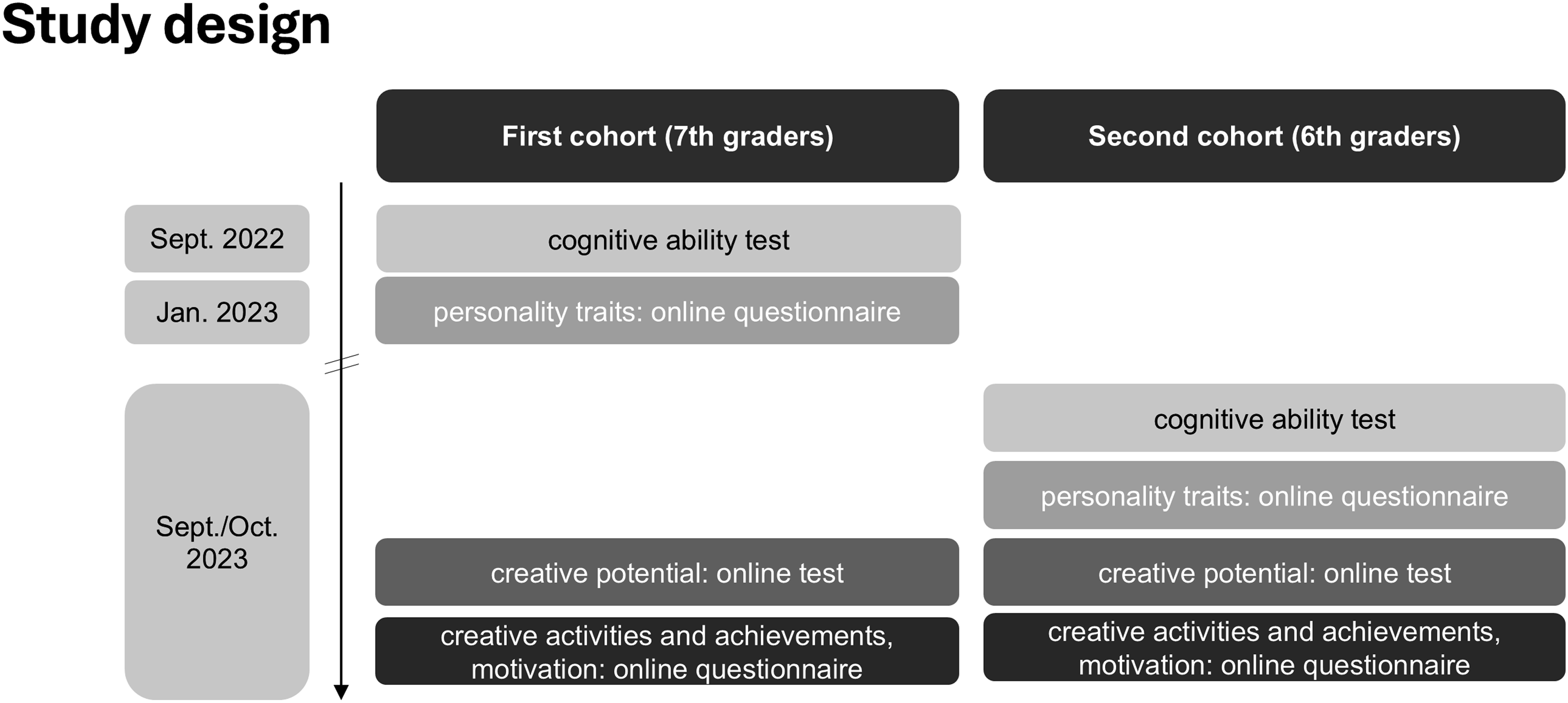
Students’ cognitive abilities and personality traits were assessed using standardized tests and an online questionnaire in the 6th grade for both cohorts (September/October 2022 and January 2023 for the first cohort and September/October 2023 for the second cohort). Students’ motivation, creative activities, and achievements were assessed using an online questionnaire, and creative potential was assessed using a speeded online test for both cohorts at the same measurement point in September/October 2023.
Measures
Creative Achievements
Students’ creative achievements were assessed via the German translation of the Creative Achievement Questionnaire (CAQ, Carson et al., 2005; Form et al., 2017). Creative achievements were evaluated in seven of the ten CAQ domains (i.e., visual arts, music, dance, creative writing, inventions, scientific inquiry, and theater and film). For each domain, participants were asked to indicate if they have specific achievements using 6–8 indicators (e.g., “recordings of my composition were sold publicly” for the music domain). In contrast to standard Likert-type scales, the CAQ is a weighted checklist designed to measure hierarchical levels of creative accomplishment across different domains. Each checked milestone is associated with a specific, ascending weight (from 0 points for “no training” up to 7 points for “national recognition”). For example, in the music domain, items range from “I play one or more musical instruments proficiently” (1 point) and “I have played with a recognized orchestra or band” (2 points) to “I have composed an original piece of music” (3 points), … up to “My compositions have been critiqued in a national publication” (7 points) (for a detailed overview of all items including their specific weights, see Carson et al., 2005). Although the CAQ was originally developed for adults and the highest levels of the CAQ are naturally rare for 11- to 13-year-olds, this hierarchical structure makes it a sensitive tool for identifying the early onset of domain-specific expertise in adolescents by including early milestones at the lower end of the scale.
Following Carson’s description, these items were summed up for a domain score that should be used for further analysis. For the highest scored achievements, students were also asked to indicate how many times the achievement occurred. Because not all students provided the answer to that question (58–100% missing), we decided not to include these values in our analyses, which is also in line with the recommendations of the questionnaire developers (see Harris et al., 2019). As creative achievement variables are known to be zero-inflated, we transformed the sum scores by using a logarithmic transformation, that is, log (x + 1), which has been shown to work well for the CAQ (see Weiss et al., 2025).
Following Carson et al. (2005), we used a two-factors solution for our analyses in which creative achievement in the arts is represented as the mean score out of the (log-transformed) sum scores of visual arts, music, dance, creative writing, and theater and film (McDonald’s ω = .63), and creative achievement in the sciences is represented as mean of the (log-transformed) sum scores of inventions and scientific inquiry (Spearman-Brown
Creative Activities
To measure students’ everyday creative activities, we used the recently developed Inventory of Creative Activities for Young Adolescents (Weiss et al., 2025). The ICAYA assesses creative activities across six domains: Visual arts, music, literature, science/engineering, performing arts, and arts/crafts. Students were asked how frequently they performed certain activities in the past 12 months on a 5-point Likert-type scale (1 = never; 2 = 1–2 times; 3 = 3–5 times; 4 = 6–10 times; 5 = more than 10 times). Each domain scale consisted of five items, that is, activities. An example activity for the music domain is “Generate a music playlist.” Averaging across the five items yielded a domain-specific score; a general score can be computed by calculating the mean across the six domains. Due to low reliability, one item of the literature domain and one item from the performing arts were excluded from our study (see Weiss et al., 2025). The internal consistency of the ICAYA was good with McDonald’s ω = .82.
Unlike the multidimensional structure observed for creative achievement, we treated creative activities as a unidimensional construct. This decision was based on the original conceptualization of the ICAYA (Weiss et al., 2025) that suggests a general factor of creative activities. An EFA empirically confirmed a unidimensional structure, with all domains loading substantially on a single factor (see Supplemental Material I, Table S2).
Personality Traits
Descriptive Statistics of Study Variables: Means, Standard Deviations, Reliabilities, and Number of Items
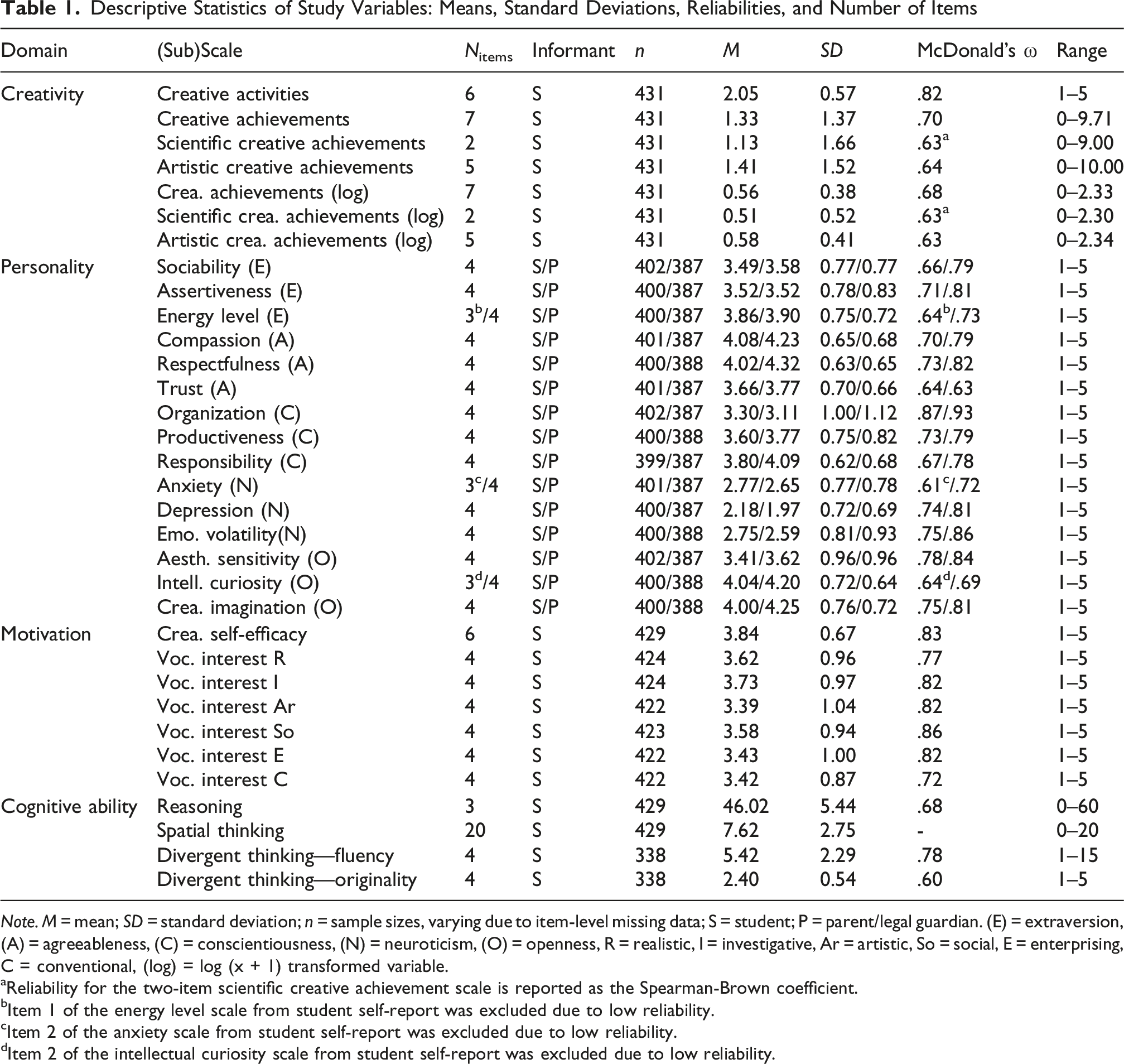
Note. M = mean; SD = standard deviation; n = sample sizes, varying due to item-level missing data; S = student; P = parent/legal guardian. (E) = extraversion, (A) = agreeableness, (C) = conscientiousness, (N) = neuroticism, (O) = openness, R = realistic, I = investigative, Ar = artistic, So = social, E = enterprising, C = conventional, (log) = log (x + 1) transformed variable.
aReliability for the two-item scientific creative achievement scale is reported as the Spearman-Brown coefficient.
bItem 1 of the energy level scale from student self-report was excluded due to low reliability.
cItem 2 of the anxiety scale from student self-report was excluded due to low reliability.
dItem 2 of the intellectual curiosity scale from student self-report was excluded due to low reliability.
Motivation
Creative Self-efficacy
Students’ creative self-efficacy was assessed using the respective six items of the Short Scale of Creative Self (SSCS; Karwowski et al., 2018). As a response format, a 5-point Likert scale ranging from 1 (completely disagree) to 5 (completely agree) was used for all items (e.g., “I trust my creative abilities”; ω = .83).
Vocational Interests
Students’ vocational interests were operationalized according to the RIASEC model using the Revised General Interest Structure-Test (AIST-R; Allgemeiner Interessen Strukturtest; Bergmann & Eder, 2005). The RIASEC dimensions (realistic, investigative, artistic, social, enterprising, and conventional; Holland, 1999) were assessed with four items each, asking students how much they like different activities on a 5-point Likert scale ranging from 1 (not at all) to 5 (very), for example, “doing things that require creativity and imagination” for artistic interest. For each dimension, the mean across all four items was calculated. Reliabilities ranged from ω = .72–.86.
Cognitive Ability
Intelligence
Students’ fluid intelligence was assessed with the latest German adaptation of Thorndike’s Cognitive Abilities Test (Kognitiver Fähigkeitstest III; KFT–III; Heller et al., in press; Heller & Perleth, 2000), which comprises nine subtests for assessing verbal, quantitative, and nonverbal reasoning abilities, with three scales each. However, the third scale of the nonverbal reasoning abilities (N3) was not assessed, as it was too similar to the unfolding test for assessing visual-spatial abilities. A composite score of the three subtests was used to capture students’ intelligence (ω = .69).
Visual-Spatial Abilities
Students’ visual-spatial abilities were assessed using the unfolding test from the Munich High Ability Test Battery (Heller & Perleth, 2007) with 20 items, which is based initially on the WILDE-Intelligenzstrukturdiagnostikum (Jäger & Althoff, 1983).
Divergent Thinking
Divergent thinking was assessed using the verbal Alternate Uses Task (AUT; Guilford, 1967; Wilson et al., 1954). Participants were instructed to name as many original, alternate uses as possible for four items (i.e., a wooden lath, a spoon, socks, and a lightbulb) within 3 minutes, each with a restriction to a maximum of 15 answers. The answers were double-coded by two randomly selected raters for each response out of a pool of five trained and independent human raters. Ratings were based on a scoring manual according to two dimensions: fluency and originality, which were chosen given their congruency with the instruction (be-fluent-be-original, Reiter-Palmon et al., 2019). Of the total sample, N = 338 completed the AUT.
Fluency refers to the number of reasonable single responses on each prompt. For each item, each response was coded 0/1, and the total amount of valid answers was summed. Originality reflected the uniqueness, remoteness, and cleverness of a single response rated on a 5-point Likert scale from 1 (not creative) to 5 (very creative) (Silvia, 2008; Silvia et al., 2009). For each item, the mean of all responses was calculated.
Incomplete and inappropriate answers were coded as zero. We aggregated the scores provided by two independent raters, resulting in a single mean score per item. Inter-Rater-Reliability (ICC1,k) between raters was acceptable, ranging from .65–.88.
Covariates
Information on age, gender, and socioeconomic status (SES) was collected from students and parents. Parents’ occupational status was used to compute the Highest International Socio-Economic Index of Occupational Status (HISEI; Ganzeboom et al., 1992) as the measure of SES. Moreover, the study cohort was added as a covariate to control for potential differences between cohorts due to age or assessment differences.
Statistical Analyses
Data were analyzed using R (version 4.5.3; R Core Team, 2026). We first examined bivariate correlations between CAs and personality traits, motivation, and cognitive abilities
We then investigated the relative predictive power of personality traits, motivation, and cognitive abilities
As the sample size was predetermined, we conducted a post-hoc sensitivity analysis to assess statistical power. Our study was sufficiently powered (1-β = .80, α = .05) to detect small effect sizes of f2 ≥ 0.038 in a multiple regression model with up to 10 predictors, confirming the adequacy of our sample for the main analyses. Specifics of the feature selection and SEM procedures follow.
Step 1: Feature Selection
In the context of high-dimensional data, regularized regression techniques are frequently recommended to identify key predictors by reducing the influence of insignificant variables (Jacobucci et al., 2019). Given the high correlation among our potential predictors, standard methodological guidance often favors Elastic Net (Zou & Hastie, 2005), as traditional LASSO regression can become unstable, arbitrarily selecting one variable from a correlated group while ignoring others. To address this instability while maintaining the parsimony of a strict LASSO penalty, we opted to use stability selection (Meinshausen & Bühlmann, 2010). This approach successfully overcomes the instability caused by correlated data while allowing us to retain the strict parsimony of LASSO (Emmert-Streib & Dehmer, 2019), ensuring the model remains parsimonious. Stability selection achieves this by repeatedly fitting the model on random subsamples of the data; it tracks the selection probability of each variable and only retains those that appear consistently across these iterations. This ensures that our final predictors represent only the strongest and most reliable signals.
Stability selection was implemented using the stabsel function from the stabs package in R (Hofner et al., 2015). We set the mixing parameter to α = 1 (resulting in LASSO regression) with 100 complementary pair subsamples. Within each subsample, the regularization parameter λ was selected using the “anticonservative” approach (minimizing cross-validation error), allowing for a broader initial selection of features. To ensure strict error control on the final model, we set the selection probability cut-off to π = .80, and the per-family error rate (PFER) to an upper bound of 2. The detailed rationale for these specific parameter choices, as well as results with different mixing parameter values α are detailed in Supplemental Material II.
As the dataset contained approximately 6.7% missing values, with up to 22% missingness observed in the divergent thinking test variables fluency and originality, we addressed missing values during the feature selection using multiple imputation (m = 100, to minimize random fluctuations) with predictive mean matching (PMM) for all continuous variables and logistic regression for all binary variables as implemented in the mice package (van Buuren & Groothuis-Oudshoorn, 2011). The maximum number of iterations for the imputation algorithm was set to 25. The imputation model included all variables. Stability selection was applied independently to each of the 100 imputed datasets. Only variables identified in a majority, that is, greater than 50%, of these imputed datasets were carried forward for inclusion in the structural equation modeling (SEM) analysis.
Step 2: Structural Equation Model
The study variables identified as most important based on our feature selection step were then first modeled individually as latent variables using Confirmatory Factor Analysis (CFA) before being combined within a Structural Equation Model (SEM), one for scientific creative achievements and one for artistic creative achievements, using the lavaan (Rosseel, 2012) package.
As we expected that everyday creative activities would also be a strong predictor of actual creative achievement (Jauk et al., 2014), we post-hoc tested mediation paths for all significant predictors of creative activities. To account for missing values in this analysis step, we used the full information maximum likelihood approach (FIML; see Enders, 2025) and robust standard errors to account for non-normality (MLR). The fixed marker coding method was used to identify all latent variables (Little, 2013). For the scientific factor, which consists of two indicators, we fixed both factor loadings to unity (1.0) to ensure model identification, a standard procedure for two-indicator latent variables (Little, 2013).
Model fit was evaluated using the following criteria: Comparative Fit Index (CFI) ≥ .95, Root Mean Square Error of Approximation (RMSEA) ≤ .06, and Standardized Root Mean Square Residual (SRMR) ≤ .08 for good model fit (Hu & Bentler, 1999), and CFI ≥ .90, RMSEA ≤ .08, and SRMR ≤ .10 for acceptable model fit (Bentler, 1990; Browne & Cudeck, 1992). Additionally, we computed dynamic fit indices models using the dynamic package (Wolf & McNeish, 2023) for models with more than one latent factor, given recent advances in the use of those (Groskurth et al., 2024; Wolf & McNeish, 2023). For these, we evaluated the empirical model fits (CFI and RMSEA) against the suggested dynamic cut-offs for mediocre, fair, and close model fit. Close fit is meant to indicate excellent fit of a model, while fair should be used as a lower threshold for accepting a model (Wolf & McNeish, 2023).
For all latent variables, the single CFA models showed a good model fit with fit indices higher than .96 for CFI, lower than .09 for RMSEA, and lower than .04 for SRMR. An overview of the model fit statistics for each latent variable’s CFA can be found in the Supplemental material (Table S3).
Results
Descriptives and Bivariate Correlations
Table 1 displays the descriptive statistics of the observed variables. Figure 3 shows the distributions of both raw and log-transformed CAs. In line with the expectations based on the definition of creative achievements, the achievement scales displayed positive skewness (ranging from 2.43 to 2.76) and high kurtosis (7.08 to 10.16), but the log transformation successfully reduced skewness and kurtosis to acceptable levels for both scientific (skewness = 1.09; kurtosis = 0.97) and artistic achievements (skewness = 1.33; kurtosis = 2.52). In contrast, the activities scale showed lower skewness and was closer to being normally distributed (skewness = 0.92; kurtosis = 0.97). Histograms of the Distribution of CAs. Note. For creative activities, the mean across the six domains is depicted. For creative achievement, the mean of the sum scores across the seven domains, the mean of the log-transformed (log) sum scores across the seven domains, as well as for the mean of the log-transformed sum scores of the two scientific and five artistic domains is presented.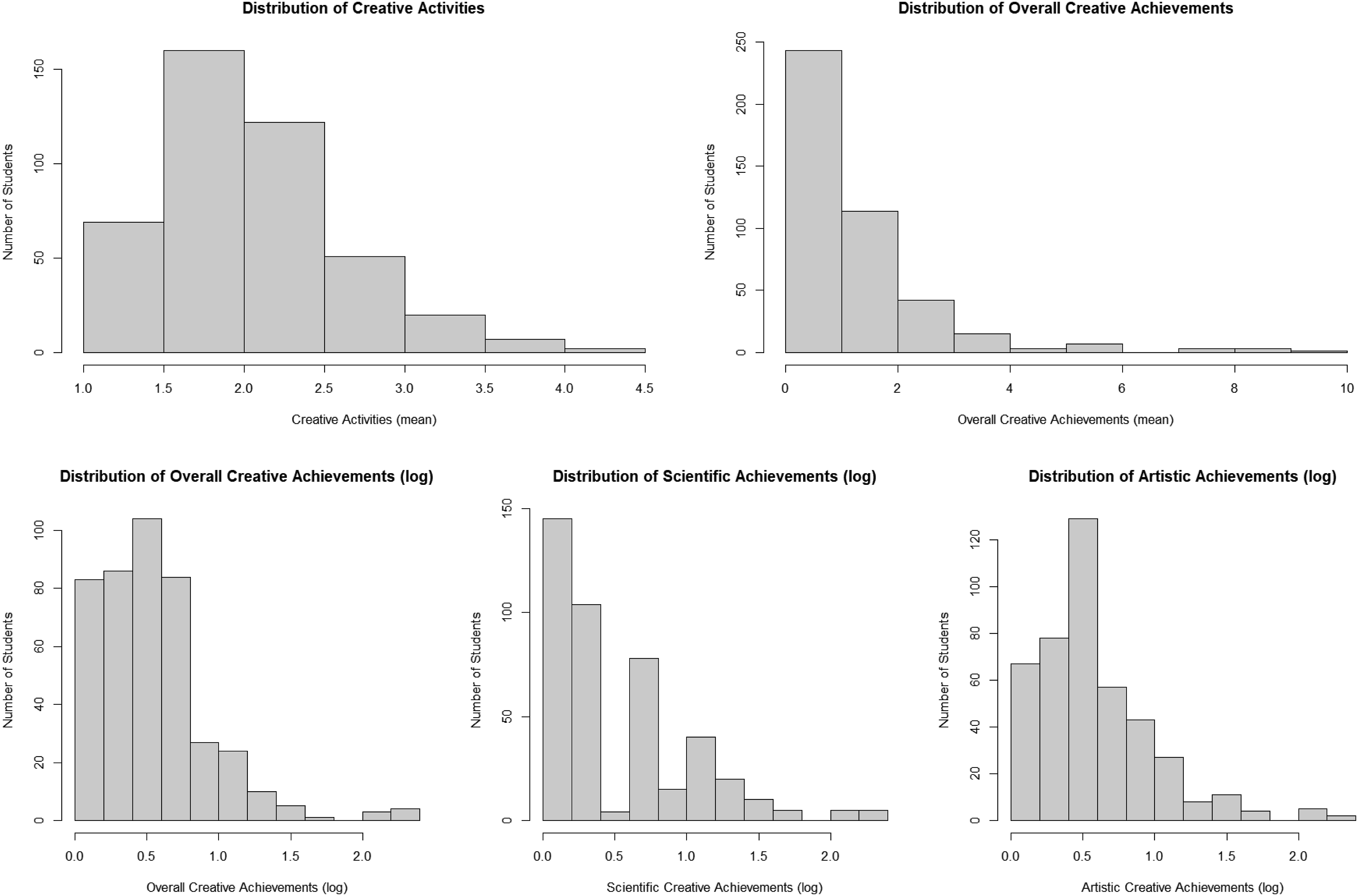
Intercorrelations of Creative Activities and Creative Achievements with Study Variables
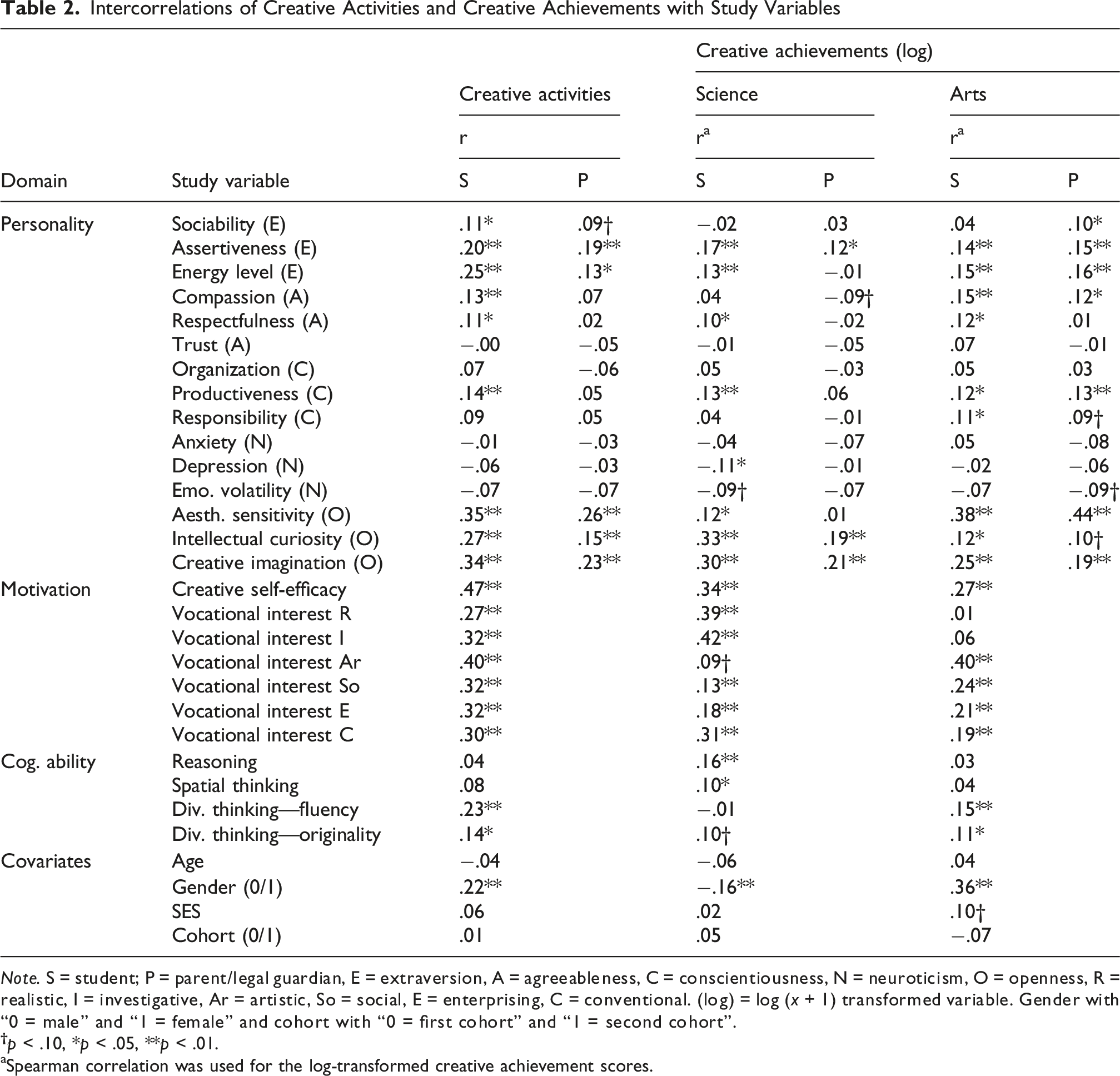
Note. S = student; P = parent/legal guardian, E = extraversion, A = agreeableness, C = conscientiousness, N = neuroticism, O = openness, R = realistic, I = investigative, Ar = artistic, So = social, E = enterprising, C = conventional. (log) = log (x + 1) transformed variable. Gender with “0 = male” and “1 = female” and cohort with “0 = first cohort” and “1 = second cohort”.
aSpearman correlation was used for the log-transformed creative achievement scores.
Creative activities and scientific and artistic creative achievements all showed small to moderate significant positive associations with the personality facets assertiveness (E), energy level (E), respectfulness (A), productiveness (C), all facets of openness (O), creative self-efficacy, and social, enterprising, and conventional vocational interests. Moreover, creative activities and artistic creative achievement showed weak positive associations with compassion (A), artistic vocational interest, and both dimensions of divergent thinking ability, whereas creative activities and scientific creative achievements were positively associated with realistic and investigative vocational interest. Scientific creative achievement showed a weak negative association with self-reported depression (N) and a weak positive association with reasoning and spatial thinking, whereas artistic creative achievement showed a weak positive association with responsibility (C).
Overall, the strongest but still moderate associations for both creative activities and creative achievements were found with openness facets, creative self-efficacy, and (domain-specific) vocational interests. Moreover, creative activities were positively associated with scientific creative achievements, rSpearman (430) = .42, p < .001, and artistic creative achievements, rSpearman (430) = .40, p < .001. Gender was the only covariate significantly associated with CAs, with girls reporting more creative activities and higher artistic creative achievements, but lower scientific creative achievements. The overall pattern of significant associations of both creative activities and scientific or artistic creative achievements with study variables was largely similar.
Overall, the pattern of associations between CAs and study variables was similar to that reported in adult literature, with small to moderate positive associations between CAs and the personality facets of openness and assertiveness, motivation, and cognitive ability, with expected variation between the scientific and artistic domains Comparison of Associations Between Self- and Parent-Reported Personality Traits With CAs. Note. E = extraversion, Ag = agreeableness, C = conscientiousness, N = neuroticism, O = openness. Facet abbreviations are as follows: exs = sociability (E), exa = assertiveness (E), exe = energy level (E); agc = compassion (A), agr = respectfulness (A), agt = trust (A); cno = organization (C), cnp = productiveness (C), cnr = responsibility (C); nea = anxiety (N), ned = depression (N), nee = emotional volatility (N); ome = aesthetic sensitivity (O), omi = intellectual curiosity (O), omc = creative imagination (O).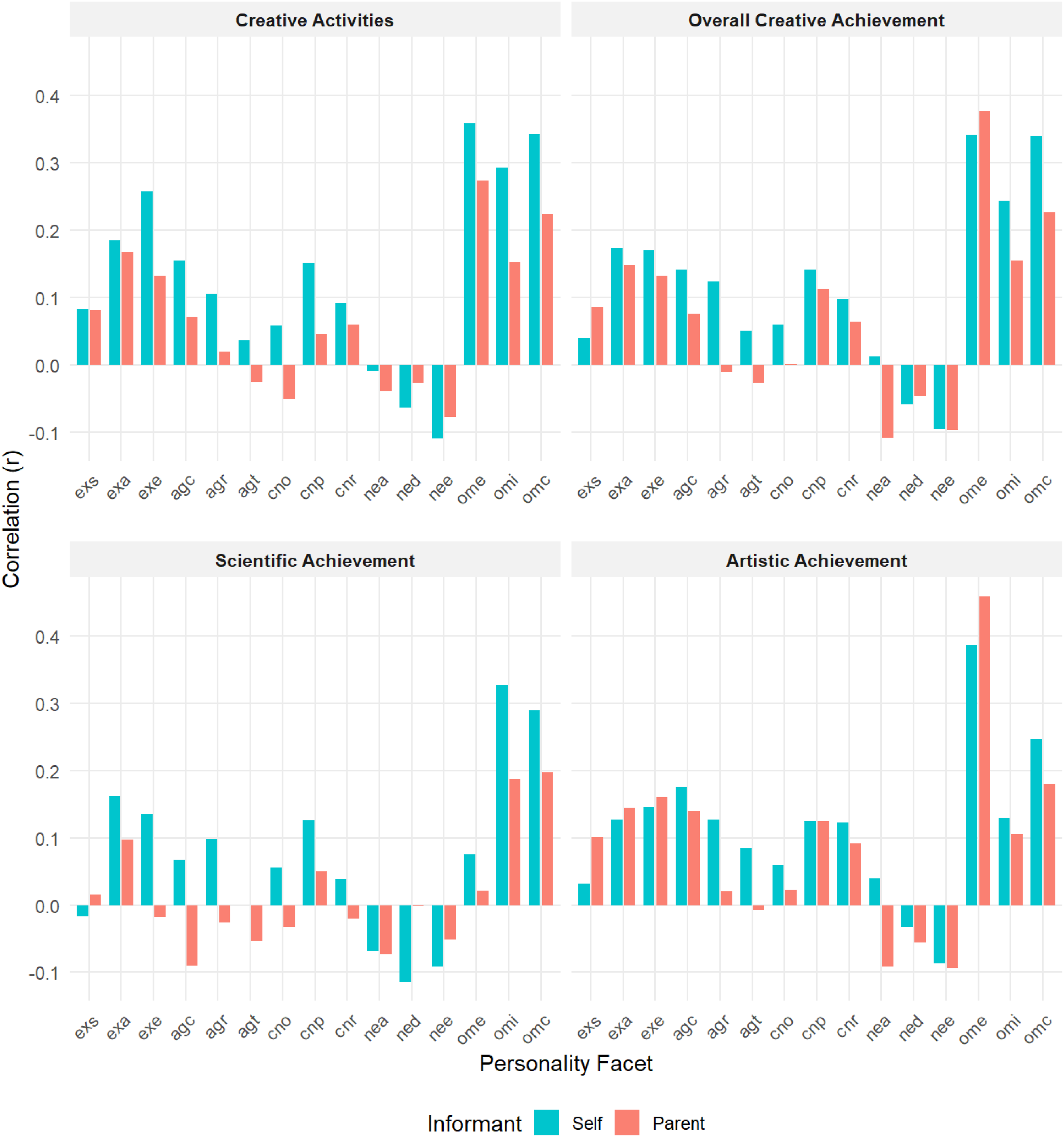
Moreover, bivariate correlation showed high multicollinearity among the predictor variables, especially within personality domains (see Supplemental Tables S4–S7), but also between personality domains, for example, self-reported creative imagination (O) was strongly associated with creative self-efficacy, r (399) = .63, p < .001.
Feature Selection
Variable Selection Results
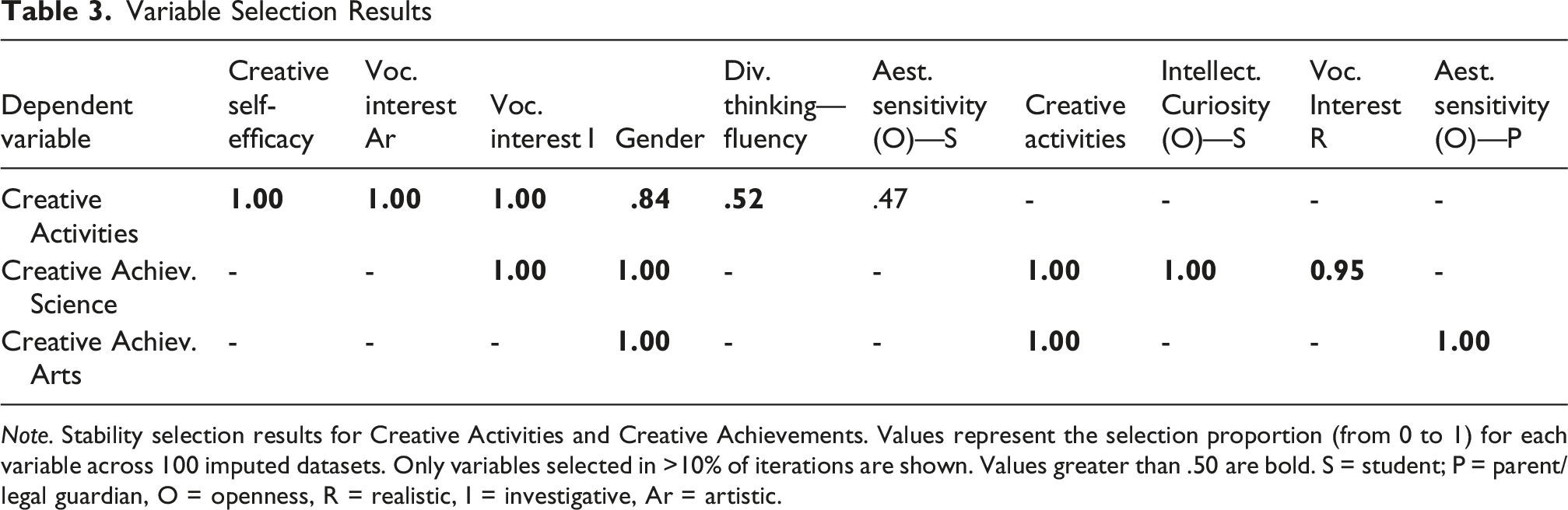
Note. Stability selection results for Creative Activities and Creative Achievements. Values represent the selection proportion (from 0 to 1) for each variable across 100 imputed datasets. Only variables selected in >10% of iterations are shown. Values greater than .50 are bold. S = student; P = parent/legal guardian, O = openness, R = realistic, I = investigative, Ar = artistic.
For creative activities, the following variables were selected: creative self-efficacy, artistic and investigative vocational interest, divergent thinking fluency, and gender. For creative achievements, predictors differed by domain. For scientific creative achievements, the selected variables were investigative and realistic vocational interest, creative activities, the intellectual curiosity facet from the openness trait, and gender. For artistic creative achievements, creative activities, aesthetic sensitivity from parents’ reports, and gender were selected. Consequently, the following variables were considered significantly important for predicting either creative activities or creative achievements in our SEM: student-reported intellectual curiosity facet of openness, parent-reported aesthetic sensitivity, creative self-efficacy, artistic, investigative, and realistic vocational interest, the fluency dimension of divergent thinking, creative activities, and gender.
SEM
To investigate the relative predictive power of the identified key factors from across all three personality domains for predicting CAs, we modeled two SEMs, one for scientific creative achievements and one for artistic creative achievements, each including the most important predictors identified by the feature selection.
Figure 5 shows the final SEM for creative activities and scientific creative achievements. SEM for Predicting Creative Activities and Scientific Creative Achievements Using the Study Variables Identified as Most Important by Feature Selection. Note. I = intellectual curiosity, S = student-reported. Grayed-out lines were non-significant (i.e., ps > .10). Gender with “0 = male” and “1 = female.” Numbers in parentheses are standard errors. Residuals between the domain-specific items of CAs were allowed to correlate freely in order to account for unique (domain-specific) variance. Residuals of all latent independent variables were also allowed to correlate freely. These correlations are not displayed in the figure but ranged from −.34 to .68 and were all significant (all ps < .05), except for realistic vocational interest with the fluency dimension of divergent thinking (r = .04, p = .580), as well as gender with investigative vocational interest (r = −.04, p = .527), student-reported intellectual curiosity (r = −.02, p = .754), and creative self-efficacy (r = .04, p = .442).
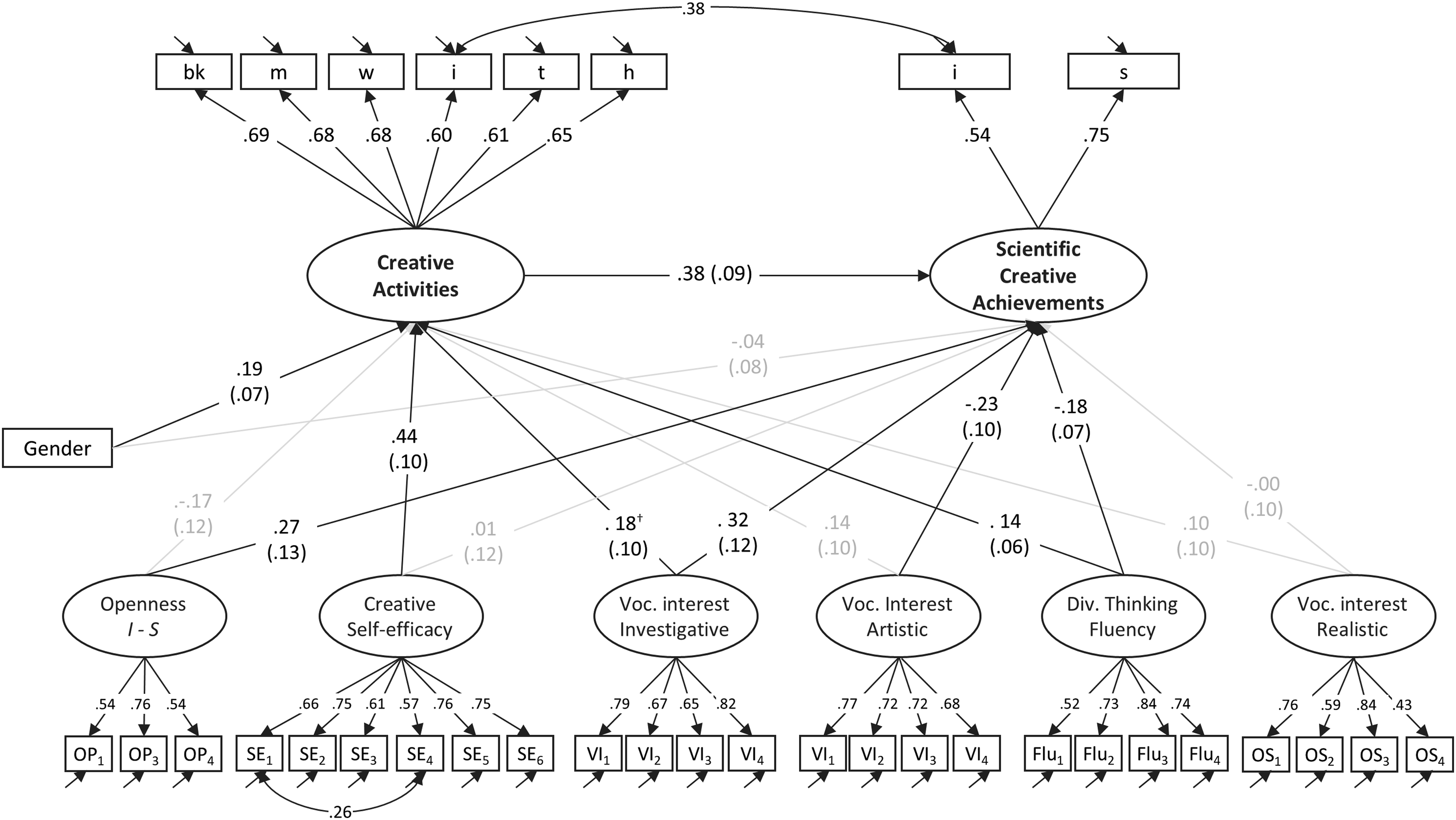
The model did not reach acceptable fit when it comes to the traditional fit indices’ boundaries, however, the dynamic fit indices indicated an acceptable, fair fit of the model (n = 431; scaled χ2 (491) = 1276.54, p < .001, CFI = .851, RMSEA = .064 with 90%-CI [.060; .069], SRMR = .076). Furthermore, only the CFI did not reach its cut-off in a traditional sense, and the disagreement between single model fit indices is a well-known issue (Lai & Green, 2016). Given the highly complex model and the high intercorrelations between variables, the model fit was interpreted as acceptable following the dynamic fit cut-offs.
Results showed creative self-efficacy was the strongest predictor of creative activities, followed by gender, investigative vocational interests, and the fluency dimension of divergent thinking. Creative activities were the strongest predictor for scientific creative achievement, followed by investigative vocational interests, self-reported intellectual curiosity, artistic vocational interest (negatively), and the fluency dimension of divergent thinking
Indirect Effects on Scientific Creative Achievement (Post-Hoc Analyses)
Mediation analysis was employed to examine potential indirect and total effects of creative self-efficacy, gender, investigative vocational interests, and fluency on scientific creative achievement. The results indicated (marginally) significant but small indirect effects of creative self-efficacy (β = .17, p < .05), gender (β = .07, p < .05), investigative vocational interest (β = .07, p = .087), and fluency (β = .05, p = .063) on scientific creative achievement through creative activities, underlining the role of creative activities as being a potential indirect pathway associated with the relationship between single personality domains and scientific creative achievements. Moreover, investigative vocational interest was the only variable that showed a significant positive total effect on scientific creative achievement (β = .39, p < .05), whereas the fluency dimension of divergent thinking showed a marginally significant negative total effect on scientific creative achievement (β = −.13, p = .088)
Figure 6 shows the final SEM for creative activities and artistic creative achievements. SEM for Predicting Creative Activities and Artistic Creative Achievements Using the Study Variables Identified as Most Important by Feature Selection. Note. AS = aesthetic sensitivity, P = parent/legal guardian. Grayed-out lines were non-significant (i.e., ps > .10). Gender with “0 = male” and “1 = female.” Numbers in parentheses are standard errors. Residuals between the domain-specific items of CAs were allowed to correlate freely in order to account for unique (domain-specific) variance. Residuals of all latent independent variables were also allowed to correlate freely. These correlations are not displayed in the figure but ranged from .15 to .56 and were all significant (all ps < .05), except for parent-reported aesthetic sensitivity with the fluency dimension of divergent thinking (r = .13, p = .059) and investigative vocational interest (r = .09, p = .208), as well as gender with investigative vocational interest (r = −.04, p = .469) and creative self-efficacy (r = .04, p = .466).
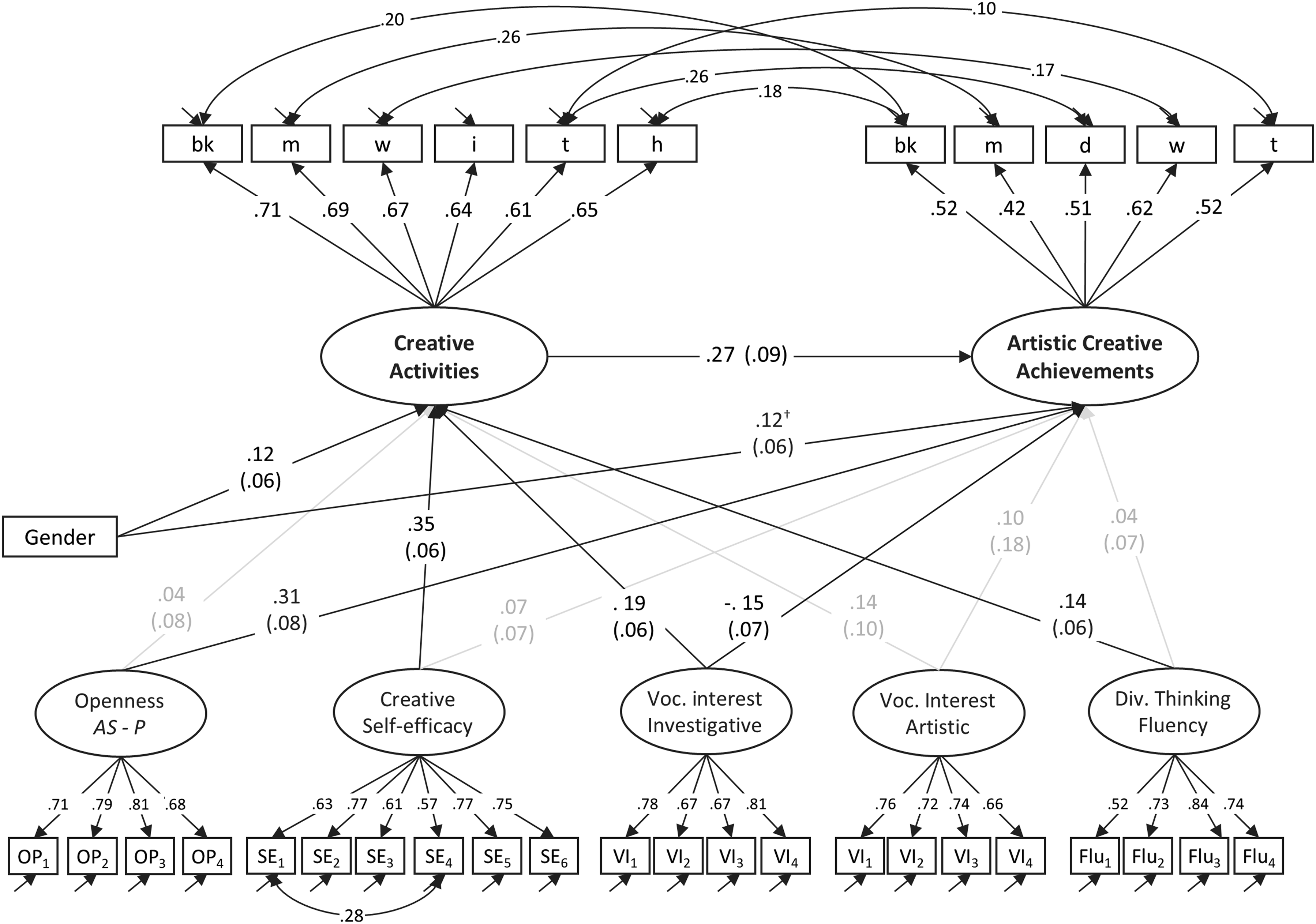
Again, the model did not reach acceptable fit when it comes to the traditional fit indices’ boundaries, however, the dynamic fit indices indicated an acceptable, fair fit of the model (n = 431; scaled χ2 (493) = 1261.73, p < .001, CFI = .854, RMSEA = .063 with 90%-CI [.058; .067], SRMR = .068). Furthermore, only the CFI did not reach its cut-off in a traditional sense, and the disagreement between single model fit indices is a well-known issue (Lai & Green, 2016). Given the highly complex model and the high intercorrelations between variables, the model fit was interpreted as acceptable following the dynamic fit cut-offs.
Results showed creative self-efficacy was the strongest predictor of creative activities, followed by investigative vocational interest, and the fluency dimension of divergent thinking. Aesthetic sensitivity reported by parents was the strongest predictor for creative achievement, followed by creative activities, investigative vocational interest (negatively), and gender
Indirect Effects on Artistic Creative Achievement (Post-Hoc Analyses)
Mediation analysis was employed to examine potential indirect and total effects of creative self-efficacy, gender, investigative vocational interests, and fluency on artistic creative achievement. The results indicated (marginally) significant but small indirect effects of creative self-efficacy (β = .10, p < .05), investigative vocational interest (β = .05, p < .05), and fluency (β = .04, p = .062) on artistic creative achievement through creative activities, again, underlining the role of creative activities as being a potential indirect pathway associated with the relationship between single personality domains and artistic creative achievements. This time, creative self-efficacy (β = .17, p < .05) and gender (β = .15, p < .05) both showed a significant total effect on artistic creative achievement
In addition to our analyses, a replication of the Jauk et al. (2014) SEM model with overall creative achievements can be found in Supplemental Figure S1. In line with Jauk et al., 2014 and our more comprehensive models, we could replicate the strong positive effect of creative activities on creative achievements (β = .32, p < .001), the positive effect of the personality trait openness (β = .49, p < .001), and the fluency dimension of divergent thinking (β = .17, p < .05) on creative activities. However, in contrast to the results reported by Jauk et al. (2014) for adult samples, general cognitive ability and the originality facet of divergent thinking did not show any predictive power on CAs in our sample.
Robustness Checks
To evaluate the robustness of the first step in our machine learning-based variable selection, we implemented a Random Forest regression model with a permutation-based feature selection procedure (Altmann et al., 2010; Breiman, 2001; Strobl et al., 2008). This more conservative approach, chosen for its ability to capture non-linear relationships and interactions without distributional assumptions, confirmed three of the variables selected by the stability selection approach, suggesting that creative activities, creative self-efficacy, and artistic vocational interest were the most important predictors (see Supplemental Material II, Table S11).
Discussion
The purpose of the present study was to gain a deeper understanding of the nomological network of childhood creativity and to compare it with the existing adult literature. To this end, we investigated the (relative) importance of a wide range of theoretically derived variables from different research areas for predicting creative activities and (scientific and artistic) creative achievements in gifted adolescents. Using a combination of exploratory and confirmatory approaches, our study adopted a multifaceted approach, moving beyond single-predictor studies and predominantly adult-focused research.
Overall, the study’s findings showed that basic patterns of positive associations between CAs and single facets of personality traits, motivation, and cognitive abilities found in adult samples were mostly similar in our gifted adolescent sample, with exceptions for (dis)agreeableness. Our comprehensive modeling approach, however, allowed us to identify a focused set of significant key predictors for (domain-specific) CAs from this wide array of factors: the intellectual curiosity and aesthetic sensitivity facet of openness (self- and parent-reported), creative self-efficacy, artistic and investigative vocational interests, the fluency dimension of divergent thinking, and gender, with girls reporting higher levels of creative activities and artistic achievements, but lower scores in the scientific domain.
Moreover, our multidimensional approach confirmed that the predictive patterns followed expected domain-specific directions (S. B. Kaufman, 2013): whereas intellectual curiosity and investigative interests were strong predictors of scientific creative achievements, aesthetic sensitivity and investigative vocational interests (negatively) were the strongest predictors for artistic creative achievements. Furthermore, everyday creative activities statistically (partly) mediated the relationship between creative achievements and creative self-efficacy, investigative vocational interest, the fluency dimension of divergent thinking, and gender.
Associations Between CAs and Personality Domains
In line with the adult literature on personality traits, our findings revealed small to moderate positive associations between CAs and all facets of openness, as well as the assertiveness and energy level facets of extraversion. This underscores the consistent role of open-mindedness highlighted in numerous studies (e.g., Feist, 1993; Jauk et al., 2014; Theurer et al., 2020) alongside theoretical talent development frameworks (cf. Preckel et al., 2020), confirming the foundational role of openness for creative behavior across the lifespan, beginning in adolescence. Furthermore, our results also highlight the supportive role of extraversion in creative engagement, consistent with prior research (Feist, 1998; S. B. Kaufman et al., 2016). Additionally, the productiveness facet of conscientiousness was weakly but positively associated with CAs, a result that partially aligns with the mixed findings observed in adult samples regarding positive associations between conscientiousness and creativity, particularly with positive associations with the industriousness facet (Feist, 1998). This finding also resonates with the TAD framework’s emphasis on being conscientious as crucial for talent development at this stage (Preckel et al., 2020).
Deviations from adult patterns were observed in the positive association between CAs and the agreeableness facets of respectfulness (only self-reported) and compassion. This contrasts with findings from adult populations, where creative individuals are often characterized by disagreeableness (Feist, 1993), but again aligns with the TAD framework, in which agreeableness seems to be more important in early stages of talent development and decreases with age (Preckel et al., 2020). Children often have more freedom to explore creative hobbies without facing the high-stakes consequences typically associated with creative expression in adulthood. The need to defend one’s creative ideas regardless of societal conventions becomes more prominent later in life, as individuals face greater external resistance navigating their professional fields (Roberts et al., 2024). Also, creativity in childhood is idealized by educational structures, so it does not have the potential negative consequences of adult creativity, which often necessitates pointing out that existing ideas are inadequate.
Domain-specific differences were primarily evident in associations with the facets of the personality trait openness: whereas aesthetic sensitivity was strongly positively associated with artistic creative achievements, scientific achievements were more closely linked to intellectual curiosity, a pattern consistent with prior research (e.g., S. B. Kaufman et al., 2016). Furthermore, parent-reported personality traits showed similar patterns of associations with CAs compared to self-reported personality traits, supporting the robustness of the observed relationships. This consistency across different information sources is particularly valuable from a multi-trait multi-method (MTMM) perspective (cf. Campbell & Fiske, 1959).
Within the motivational domain, almost all investigated variables were positively correlated with CAs, with important domain-specific patterns. Specifically, investigative and realistic vocational interests were positively associated with scientific achievements but not with artistic creative achievements, whereas artistic vocational interests showed the opposite pattern of association with artistic creative achievements.
At the same time, vocational interests not directly related to science or the arts also showed moderate positive associations with CAs without strong differentiation. This finding partly aligns with previous research which has shown overall positive associations between vocational interests across creative achievement domains (Zabelina et al., 2022). The results suggest that it might not only be a (domain-)specific interest per se (cf. Hidi & Renninger, 2006), but also being “interested” that is driving creativity in young adolescents at this stage of development.
The cognitive ability domain also showed domain-specific results: In line with previous findings, intelligence showed small positive associations with scientific creative achievements (Karwowski et al., 2021; S. B. Kaufman et al., 2016), whereas the fluency dimension of divergent thinking was positively related to creative activities and artistic creative achievements (Kim, 2008). The originality dimension of divergent thinking was weakly positively associated with all CAs, which is also in line with previous, more recent findings (S. B. Kaufman et al., 2016; Said-Metwaly et al., 2022). Thus, future research should differentiate between different dimensions of divergent thinking to get a more nuanced picture of the associations.
Overall, the associations between CAs and cognitive ability remained lower than typically reported in adult samples (e.g., Kim, 2008; Runco & Acar, 2012). It seems reasonable to assume that while the selective nature of the sample did not eliminate the correlation, it might have reduced it. In the context of the TAD framework, this might indicate that at this early developmental stage, the transition from potential to achievement is more strongly related to personality traits and motivation than to cognitive potential.
Additionally, the results indicated a domain-specific gender gap: Girls reported more frequent creative activities and higher artistic achievements than boys, but lower scientific creative achievements. This finding partly aligns with previous research indicating that girls outperform boys in creative potential (e.g., Goecke et al., 2024), and adds a crucial nuance to various findings showing that men tend to outperform women in creative achievements (cf. Baer & Kaufman, 2008). Our results suggest that the well-documented gender gap in creative achievement in favor of men among adults may not be fully present in early adolescence, highlighting a critical developmental window for interventions aimed at fostering female creative talent, particularly in STEM-related fields, before these early differences solidify into the broader gaps seen in later life.
The Relative Predictive Power of Key Factors on CAs
Our comprehensive, multivariate approach enables a crucial distinction between simple bivariate correlations and robust predictors, addressing a significant limitation in prior research. Among all of the theoretically derived variables investigated in this study, the feature selection process identified a focused set of robust predictors for CAs, spanning across all investigated personality domains of personality traits, motivation, and cognitive ability. The openness facet of aesthetic sensitivity for artistic creative achievement (parent-reported) and intellectual curiosity for scientific creative achievements (self-reported), creative self-efficacy, realistic, investigative, and artistic vocational interests, divergent thinking fluency, and gender emerged as key factors. Interestingly, these were also the variables with the strongest associations within each personality domain. This selection underscores the multifaceted nature of childhood creativity, emphasizing the interplay of different personality domains in fostering creative engagement and highlighting the multidimensional developmental perspective that talent development and CAs are influenced by a constellation of factors rather than a single personality domain (Preckel et al., 2020; Renzulli, 2016; Roberts et al., 2024).
The subsequent structural equation modeling further confirmed the multidimensionality by the unique variance in creativity that was explained across personality domains, emphasizing the importance of all personality domains in realizing creative potential in achievement contexts. Moreover, our results revealed clear domain-specific predictive patterns, supporting the domain-specificity of creative development (Baer, 2015; Preckel et al., 2020). At the same time, many of the initial correlates faded in importance when forced to compete for predictive power. This pattern strongly suggests that these variables may function as distal or indirect correlates rather than core drivers of creative engagement. For example, the positive association with agreeableness, which is consistent with developmental theories like the TAD framework (Preckel et al., 2020), became non-significant once the influence of more proximal motivational factors was controlled for. Rather, these variables may function as moderators in the creative process. Our analytical strategy, therefore, provides a crucial advantage by filtering the signal from the noise, yielding a more focused model of the key predictors of adolescent creativity.
Consistent with prior research (Jauk et al., 2014), creative activities were among the strongest predictors of scientific and artistic creative achievement, underscoring the potential developmental pathway from engagement in everyday creative behaviors to tangible creative outcomes (Jauk et al., 2014; Zhu et al., 2016). For scientific achievements, self-reported intellectual curiosity and investigative vocational interest were the strongest predictors. In contrast, artistic creative achievements were predicted by parent-reported aesthetic sensitivity and, interestingly, negatively by investigative vocational interests. The fact that artistic vocational interest was not a strong positive predictor of artistic achievement in the SEM, despite its strong bivariate correlation, might be fully accounted for by its shared variance with aesthetic sensitivity (r = .56, p < .001) and creative activities (r = .40, p < .001). This suggests that prior research, by focusing on a limited set of predictors, has overlooked the shared variance of these domains, especially in childhood.
Moreover, artistic interest negatively predicted scientific achievements, and investigative interest negatively predicted artistic achievements. This suppression effect strongly aligns with the TAD framework’s postulate of increasing specialization (Preckel et al., 2020). It suggests that while a general, broad interest profile drives everyday creative activities, reaching actual creative milestones (achievements) requires a differentiation of interests and focused resource allocation. Future research should not only include both domains more systematically, but also investigate where and when these domains differentiate.
Creative self-efficacy emerged as a particularly strong predictor of creative activities, which statistically mediated the effect of creative self-efficacy on creative achievements. This finding aligns with Expectancy-Value Theory (Eccles & Wigfield, 2020) and previous meta-analytic findings in adults (Haase et al., 2018), demonstrating that the belief in one’s own creative capabilities (Karwowski & Kaufman, 2017) is a fundamental predictor of engaging in creative behaviors, already in early adolescence.
Notably, creative self-efficacy and openness were also highly correlated (r = .23–.63). This high correlation is a challenge for prior visions of the uniqueness of social cognitive and trait visions of personality (Bandura, 2012) and supports the argument that the differences between social cognitive and trait psychology are more ideological than empirical (Jackson et al., 2012; Roberts, 2009). Our finding that both retain unique predictive power even when controlling for the other suggests that greater attention should be paid to when and how each of these predictors contributes to the development of creative activity and creative achievement.
Moreover, gender, investigative vocational interest, and the fluency dimension of divergent thinking were additional predictors of creative activities, which also weakly, statistically mediated the effects of these predictors on creative achievement. These findings further support the potential mediating role of everyday creative engagement in translating underlying personality factors into tangible creative achievements (Jauk et al., 2014).
Overall, the models accounted for a substantial portion of variance in both creative activities and creative achievements (∼40%), indicating a meaningful level of predictive power for a complex, multi-determined construct like creativity. However, it is striking that while personality and motivation were robust predictors, traditional measures of cognitive ability, specifically intelligence and the originality facet of divergent thinking, did not emerge as significant predictors in the final models, deviating from adult models (e.g., Jauk et al., 2014). This finding must be interpreted in light of our specific sample: students nominated for a gifted STEM program. The lack of predictive power for general cognitive ability likely reflects a restriction of range and supports a variant of the threshold hypothesis (Weiss et al., 2020), once a high baseline of cognitive ability is established, non-cognitive factors (traits and motivation) might become the decisive variance components for creative achievement (Preckel et al., 2020).
Strengths and Limitations
This study is the first multivariate and multimodal study investigating adolescent creative activities and achievements. A major strength was the innovative, comprehensive approach, which is an important first step toward a better understanding of the nomological net of creativity and talent development. The detailed examination of personality facets and the integration of multi-informant data, which enables more precise interpretations, further enhances the robustness of the findings. Furthermore, by explicitly differentiating between scientific and artistic domains, this study accounts for the domain-specific nature of creative development, thereby allowing the identification of the unique psychological architectures of different forms of creative achievement.
However, several potential limitations should be kept in mind when interpreting our findings. First, the cross-sectional nature of our data limits our ability to draw causal inferences about the directionality of the observed relationships. Consistent with the TESSERA model (Wrzus & Roberts, 2017), for example, it is also plausible that the observed associations are recursive; for instance, high creative achievement could subsequently reinforce a student’s creative self-efficacy and openness. Longitudinal and experimental studies are urgently needed to disentangle the developmental trajectories of creativity and to examine the dynamic, causal interplay between personality, motivation, cognitive abilities, and creative outcomes over time.
Second, while our robust feature selection method approach was designed to address multicollinearity, the inherent intercorrelations among predictors should be considered when interpreting SEM results, as shared variance may limit the observed unique contributions of individual variables. Related to this, the item formulation and potential conceptual overlap between constructs like openness and creative self-efficacy highlight the ongoing need for interdisciplinary dialogue and refined construct measurement in creativity research.
Third, an examination of the raw CAQ scores revealed a strong floor effect, with many students reporting no creative achievements, questioning the developmental adequacy of the CAQ for adolescents. However, this distribution is consistent with the “inverted-J” nature of creative achievement (Carson et al., 2005) and reflects the participants’ current stage of development. According to the TAD framework (Preckel et al., 2020), these students are at the very onset of domain-specific specialization. Our use of log transformation was therefore essential to capture the critical transition from creative potential to the first tangible milestones of achievement. Moreover, it is notable that despite the skewed nature of the outcomes, many of the relations were quite large and consistent with findings in adult samples.
Finally, our focus on a sample of academically talented adolescents, who were specifically nominated by STEM teachers, may limit the generalizability of our findings to broader populations. Future research should explore the generalizability of these findings across diverse samples.
Implications and Future Research
Our findings underscore the importance of adopting an inclusive and developmental perspective on CAs, highlighting substantial individual and domain-specific differences in CAs that are already evident in adolescence. Our results support a multidimensional and domain-specific understanding of creativity, with predictors emerging from various personality domains.
Overall, the findings show that creative self-efficacy, openness, and vocational interests (depending on the domain) warrant particular attention. Their robust associations with creative outcomes underscore the critical role of personality traits and motivational factors in creativity, aligning with theoretical frameworks (Preckel et al., 2020; Roberts et al., 2024). Despite its evident importance, motivation remains comparatively under-researched in creativity research in relation to personality traits and intelligence. Future research should prioritize a more comprehensive investigation of creative self-efficacy and its interplay with other factors relevant to creativity.
Moreover, our findings indicate the need for a more fine-grained examination of domain facets, particularly within personality (Roberts et al., 2024). The distinct patterns of associations observed across different facets within personality domains and creative achievement domains underscore the value of moving beyond broad trait levels to understand the nuanced interplay between specific personality characteristics and creative expression. For example, although all facets of openness were correlated with CAs, the specific facets of intellectual curiosity and aesthetic sensitivity emerged as key predictors in our analyses. Moreover, the fact that parent-reported aesthetic sensitivity was one of the most robust and unique predictors of artistic creative achievements suggests that parents, as long-term observers, are also uniquely positioned to identify important correlates of creative achievements.
For educators, our findings suggest that a multidimensional approach to nurturing creativity is essential, one that involves fostering creative self-efficacy, interest, and openness, for example. Whereas fostering openness is a valuable long-term goal, specific, evidence-based interventions for children in this domain are missing (Roberts et al., 2017). In contrast, research has demonstrated that creative self-efficacy is malleable and can be effectively promoted through targeted pedagogical strategies (Mathisen & Bronnick, 2009). Providing open-ended tasks, inquiry-based learning, and high-quality feedback are proven methods that enable students to perceive themselves as creatively self-efficacious (Beghetto, 2019; Karwowski & Kaufman, 2017). More broadly, to foster CAs, educational interventions should aim to cultivate openness, motivation, and divergent thinking skills.
However, although our study incorporated various personality domains, a meaningful amount of variance remains unexplained, indicating the influence of factors beyond those investigated in the study. For instance, future research should further expand the nomological network of creativity by incorporating environmental factors, social-contextual influences, and more domain-specific measures of creativity and abilities (Dai et al., 2012; Roberts et al., 2024; van der Zanden et al., 2020). Moreover, future research should utilize advanced machine learning techniques, such as Prediction Rule Ensembles (Friedman & Popescu, 2008) to systematically investigate potential non-linear interactions between predictors. However, these require larger cohorts to maintain statistical power and prevent overfitting.
Ultimately, this study calls for a stronger integration of two often separate lines of research: the study of creativity and the study of talent development. Our findings demonstrate that a developmental perspective on creativity is crucial. Future research must therefore move beyond a narrow focus on “schoolhouse giftedness” (Renzulli & Reis, 2021), and more explicitly integrate creativity as a central and multifaceted construct within talent development.
Conclusion
This study offers valuable and nuanced insights into the nomological network of childhood creativity during a critical developmental stage. By integrating personality traits, motivation, and cognitive ability within a solid theoretical framework (Preckel et al., 2020; Roberts et al., 2024), our findings underscore the multifaceted and domain-specific nature of early creative development. The key role of openness, creative self-efficacy, vocational interests, and divergent thinking, alongside the potential mediating function of creative activities, highlight potential pathways for fostering creative talent in educational settings.
By disentangling core predictors from simple correlates, emphasizing the interplay of these diverse factors, and investigating different domains, this research contributes to a more comprehensive understanding of the developmental antecedents of creative achievements, paving the way for targeted interventions and enriched learning environments that nurture the creative potential of young and talented individuals. Longitudinal research designs are urgently needed to further elucidate the developmental trajectories of creativity and to disentangle the complex interplay of individual differences and environmental influences across diverse creative domains.
Supplemental Material
Supplemental Material - Predicting Scientific and Artistic Creative Achievements in Adolescence: A Comprehensive Approach Integrating Personality, Motivation, and Cognitive Ability
Supplemental Material for Predicting Scientific and Artistic Creative Achievements in Adolescence: A Comprehensive Approach Integrating Personality, Motivation, and Cognitive Ability by Ann-Kathrin Jaggy, Manuel D. S. Hopp, Ulrich Trautwein, & Brent W. Roberts in European Journal of Personality
Footnotes
Acknowledgments
We thank Amelie Schönle for her support in data collection, Franziska Rahm for her support with scoring, and Jane Zagorski and Cavan Bonner for language editing. We also thank Benjamin Goecke for the fruitful exchange regarding the findings of our study.

Ethical Considerations
The Ethics and Data Protection Commission of the Faculty of Economics and Social Sciences at the University of Tübingen approved the study (A2.5.4-239.3_hb).
Consent to Participate
Written informed consent was obtained from the students and their legal guardians prior to the study.
Author Contributions
Ann-Kathrin Jaggy: Conceptualization (lead), data curation, formal analysis, funding acquisition, investigation, methodology, project administration, visualization, and writing—original draft
Manuel Hopp: Formal analysis and writing—original draft, review, and editing
Ulrich Trautwein: Funding acquisition, supervision, and writing—review and editing
Brent Roberts: Conceptualization and writing—original draft, review, and editing
Funding
The authors disclosed receipt of the following financial support for the research, authorship, and/or publication of this article: This research was supported by the Hector Foundation (WIB2301) and by the Postdoctoral Academy of Research on Education (PACE), funded by the Baden-Württemberg Ministry of Science, Research, and the Arts, at the Hector Research Institute of Education Sciences and Psychology, Tübingen.
Declaration of Conflicting Interests
The authors declared no potential conflicts of interest with respect to the research, authorship, and/or publication of this article.
Supplemental Material
Supplemental material for this article is available online.
References
Supplementary Material
Please find the following supplemental material available below.
For Open Access articles published under a Creative Commons License, all supplemental material carries the same license as the article it is associated with.
For non-Open Access articles published, all supplemental material carries a non-exclusive license, and permission requests for re-use of supplemental material or any part of supplemental material shall be sent directly to the copyright owner as specified in the copyright notice associated with the article.
