




Abstract
In the past two decades, many industrial districts have become more specialized in particular stages of production. Two related processes contribute to this specialization: globalization and fragmentation of production. Hence, this article asks the following question: Can an industry centered on one part of the production cycle become sustainable? This article examines an innovation-based cluster: the life sciences industry in Israel. This industry is based on innovative companies, with strong ties to university research. A majority of companies in Israel are small and focus on R&D. Following a series of in-depth interviews, site visits, and a survey, this article strengthens the perception that innovation can be the basis of an industry, but it may not be sufficient for sustainability. To achieve further development and regional growth, companies require additional factors in the form of other companies at different stages of production, which are supported by policy, funding, and expertise.
Introduction
In the past two decades, many industrial districts have become more specialized in particular stages of production. Two related processes contribute to this specialization: globalization and fragmentation of production. With globalization, firms can tap into resources and international markets, allowing them to increase productivity and reduce costs. With fragmentation of production, certain stages of production are conducted in particular locations. Examples of the globalization and fragmentation of production can be seen in research and development (R&D) clusters, such as the information and communication technology (ICT) industry in Israel, life sciences in Cambridge, Massachusetts, and Cambridge, United Kingdom, or biotechnology, such as biotechnology manufacturing clusters in Denmark and Ireland. Hence, this article asks the following question: Can an industry centered on one part of the production cycle become sustainable?
This question is vital at both the theoretical and policy levels. At the theoretical level, current economic changes require us to reconceptualize industrial clusters, to understand their composition, and to determine whether we should continue to rely on their ability to generate economic growth. At the policy level, industrial clusters have changed their role and their ability to contribute to local economies, and changes in policy must follow to ensure that we maximize the return from public investment.
An analysis of a specialized cluster will allow us to better understand the advantages and disadvantages of focusing on a specific stage of production or product. This article examines an innovation-based cluster: the life sciences industry in Israel. 1 This industry is based on innovative companies, with strong ties to university research. A majority of companies in Israel are small and focus on R&D. Following a series of in-depth interviews, site visits, and a survey, this article strengthens the perception that innovation can be the basis of an industry, but it may not be sufficient for sustainability. To achieve further development and regional growth, companies require additional factors in the form of other companies at different stages of production, which are supported by policy, funding, and expertise. In the case of the Israeli life sciences industry, focusing on R&D jeopardizes the development of an entire industry and its very existence.
What “Makes” a Cluster?
“Increasingly clusters—regional concentrations of related firms and organizations—are perceived to be the locus of economic growth” (Braunerhjelm & Feldman, 2006, p. 1). The importance of these agglomerated firms is their creation of an entrepreneurial environment in which knowledge and new ideas are shared, leading to economic development at a regional and national level (S. M. Breznitz & Anderson, 2006; Casper & Karmanos, 2003; Cooke, 2002; Doeringer & Terkia, 1995; Held, 1996; Keeble & Wilkinson, 1999; Lawson & Lorenz, 1999; Lowe & Gertler, 2005; Porter, 2000; Spencer, Vinodrai, Gertler, & Wolfe, 2010).
Importantly, the basic idea underlying industrial clusters is the ability to reduce costs and to create access to factors of production (physical resources, knowledge, logistics, labor force, markets, etc.). Firms locate in a cluster to benefit from joint availability of resources (Marshall, 1890). In the words of Keeble and Wilkinson (1999),
The concentration of firms in close geographical proximity allows all to enjoy the benefits of large-scale industrial production and of technical and organizational innovations, which are beyond the scope of any individual firm. (p. 297)
Moreover, studies show that the success of some clusters over others depends on the availability of specific factors. Michael Porter divides these factors into four categories:
(A) Factor conditions—the nation’s position in factors of production, such as skilled labor or infrastructure, necessary to compete in a given industry. (B) Demand conditions—the nature of home demand for the industry’s product or service. (C) Related and supporting industries—the presence or absence in the nation of supplier and related industries that are internationally competitive. (D) Firm strategy, structure, and rivalry—the conditions in the nation governing how companies are created, organized, and managed, and the nature of the domestic rivalry. (Porter, 1990, p. 71)
In other words, cluster development requires specific factors, starting with basic resources in the form of either materials or knowledge and the availability of service providers, such as accountants, lawyers, venture capital (VC) firms, and related industries. Many firms open branches in areas where they can maximize services and expand their markets to more companies. Thus, new firms locating in a cluster enjoy access to services that would not otherwise be available in geographic proximity to their company. Hence, this study investigates the availability of these factors as the basis for industrial development.
Among the factors known to be vital for cluster success is proximity to universities and research institutes (Aldridge & Audretsch, 2010; S. M. Breznitz, O’Shea, & Allen, 2008; Feldman, 1994; Feldman & Desrochers, 2003; Jaffe, Trajtenberg, & Henderson, 1993; Kenney, 1986; Miner, Eesley, Devaughn, & Rura-Polley, 2001). Theories analyzing the role of universities have focused on their “third role”—collaborating with industry and commercializing technology.
Current theories view the university as a potentially positive factor contributing to entrepreneurship in general and spin-off formation in particular (Di Gregorio & Shane, 2003; Goldstein & Renault, 2004; Kenney, 1986; Shane, 2004; Zucker, Darby, & Peng, 1998). The literature suggests that certain factors relating to the setting in which universities operate, as well as intrauniversity factors, are crucial for the success of a university’s technology transfer (Boucher, Conway, & Meer, 2003; Cooke, 2002; Etzkowitz, 1995; Kenney & Goe, 2004; O’Shea, Allen, Chevalier, & Roche, 2005; Siegel, Waldman, & Link, 2003). The ability of a university to transfer its technology to industry is influenced by two external factors: legislation and the relationships between nonfirm institutions and organizations. Factors in the legislative and economic arenas at both the national and regional levels are important external factors that affect a university’s commercialization ability (Lawton Smith, 2006; O’Shea et al., 2005; Rahm, Kirkland, & Bozeman, 2000). Different national laws, such as the Bayh-Dole Act in the United States, have influenced regions in general (Pike, 2002) and university–industry relationships in particular (Mowery & Sampat, 2001). The relationships between nonfirm institutions and organization can be viewed in terms of national and regional innovation systems and triple-helix theories. These theories contend that the environment in which universities operate and relationships between nonfirm institutions and organizations, such as government, trade associations, universities, and research institutes in the region, influence the ability to innovate and commercialize technology (Etzkowitz, 1995; Nelson, 1993). According to existing studies, three important intrauniversity factors influence a university’s technology transfer ability: the university’s entrepreneurial culture, technology transfer policies, and the university’s technology transfer organization (Bercovitz, Feldman, Feller, & Burton, 2001; S. M. Breznitz, 2011; Clark, 1998; Etzkowitz, 1998; Link & Scott, 2005; Markman, Gianiodis, Phan, & Balkin, 2005; O’Shea et al., 2005; Shane, 2004; Siegel & Phan, 2005). This study analyzes a life sciences cluster in which the majority of firms originate from local universities.
The availability of employees is an important basis of any industry and a basic factor condition both as a labor force and as a source of knowledge. Companies share resources in the form of equipment and a labor force, in particular, employees with different experience in the production chain. Young firms seek to recruit employees from companies that are further along the value chain in order to benefit from their knowledge and experience. Mature companies seek to recruit employees from younger firms as well as university graduates to benefit from any new innovation on the market (Amin, Thrift, & ESF Programme on Regional and Urban Restructuring in Europe, 1994; S.M. Breznitz et al., 2008; Castells & Hall, 1994; Cooke, 2002; R. Florida, 1995; Keeble & Wilkinson, 2000; Koepp, 2002; MacKinnon, Cumbers, & Chapman, 2002; Piore & Sabel, 1984; Porter, 1990; Saxenian, 1994). Moreover, many employees choose their work environment and stay in a region when there is a concentration of firms that can offer them job security (S. M. Breznitz & Anderson, 2006). Hence, in this research the impact of accessibility to qualified and experienced employees on cluster development is examined.
Existing studies show that the amount of Venture Capital (VC) investment and the participation of VC executives in young technology-based firms’ boards have a positive impact on a firm’s success. The interest and dedication of a VC firm can be viewed and valued in terms of the amount of money invested in the firm. Moreover, many of these firms exhibit a “hands-on” approach to managing firms in which they invest. Thus, Young technology-based firms enjoy the know-how and past experience that exists in developed firms (Avnimelech & Teubal, 2006; R. L. Florida & Kenney, 1988; Kenney, 2000; Kortum & Lerner, 2000).
Firm strategy in the form of both collaboration and competitiveness has been found to have a direct impact on cluster development and growth (Lazonick, 1993; Porter, 2000). In particular, we find collaborative efforts in which many firms contribute different segments of the final product. In their book, The Second Industrial Divide, Piore and Sable (1984) describe the optimal region in which small to medium-size enterprises (SMEs) cooperate in R&D, employment, product design, manufacturing, and marketing. Such collaboration contributes to the region’s innovation base (Porter, 1990; Saxenian, 1994). Importantly, studies of successful clusters have shown that knowledge transfer between firms is one of the most important factors affecting cluster growth and development. In many clusters, knowledge transfer can be viewed in terms of social networking of individuals and firms. Formal meetings arranged through industrial associations, memberships in multiple scientific advisory boards, as well as informal meetings at local coffee shops and restaurants contribute to knowledge exchanges and thus, cluster development (S. M. Breznitz & Anderson, 2006; R. Florida, 1995; Keeble & Wilkinson, 2000; Owen-Smith & Powell, 2004).
Clusters are created differently and operate in many ways. First, clusters differ from one another in terms of their composition and their level of industrial competitiveness (Braunerhjelm & Feldman, 2006; Wolfe & Gertler, 2004). There are two main kinds of cluster composition. In the first are many SMEs that collaborate in production networks (D. Breznitz, 2007). In these clusters, products may be the final manufactured goods or components. Moreover, these clusters are based on supplier–customer relationships, each producing one part of the final product (D. Breznitz, 2007; Piore & Sabel, 1984). In the second, firms of different sizes, each working at its own stage of production, enjoy the benefit of locating in proximity to other firms in the same industry to benefit from resources in the form of the labor force, equipment, and knowledge transfer (Harrison, 1992; Markusen, 1985; Porter, 1990).
Second, we increasingly find specialized clusters, such as the “Fabless design houses,” which focus on a particular stage or stages of production (D. Breznitz, 2007; Gereffi, 1994; Sturgeon, 2002; Trajtenberg, 2001, 2002). These clusters dedicate themselves to one part of the production process—that is, R&D, manufacturing, or design. Hence, specific stages of production, including R&D, are found in specific regions around the world. We find fragmented clusters in different industries including biotechnology. Some examples can be seen in the manufacturing biotechnology clusters in Ireland and Denmark and the R&D biotechnology clusters in Cambridge, Massachusetts, and Cambridge, United Kingdom. Similarly, we find an ICT R&D cluster in Israel and a software outsourcing cluster in India, which works on parts of projects for other software companies around the world.
Third, there are many ways in which clusters are formed. While some studies discuss a creation of a new industry, other studies point to clusters created based on heritage (Casper, 2007; Klepper, 1996, 2009) or knowledge source (Casper & Matraves, 2003; Link, Siegel, & Bozeman, 2007). Existing studies point to the increasing problem of clusters that are not sustainable. These clusters do not enjoy the benefits of external economies and hence disintegrate over time. This was the case with the tire industry in Akron, Ohio, as well as more recent studies on clusters related by multinational corporations (MNCs) in China and elsewhere (Klepper, 2009; Markusen, 1996; Phelps, 2008; Safford, 2004). Importantly, these cases are examples of firm agglomeration, not industrial clusters per se. Many of the cluster-related factors, such as firm collaboration, knowledge transfer, and external economies are missing. Hence, these regions with a large concentration of firms are not “true” clusters and will not survive. It could be that the Israeli life sciences industry is another such example.
In summary, though research shows that a cluster’s success and development are based on numerous factors, studies still highlight the importance of diversity and the depth of activities within the same cluster as a measure of industrial growth. In particular, scholars highlight variety in firm size, stage of production, and the importance of knowledge transfer and collaboration, much of which occurs through collaborative projects, scientific advisory boards, and professional VC financing.
Research Framework
This study seeks to determine whether specialized clusters are sustainable. In particular, this paper focuses on an important question: Can a cluster centered on one part of the production cycle grow and develop? The paper does this by examining one case study, that of the life sciences industry in Israel.
The life sciences industry is a particularly appropriate subject for a study focused on a specialized cluster. 2 It focuses on basic research, not a developed product. Moreover, because of the high costs and the length of time between R&D and actual production, a majority of young firms focus on R&D, whereas MNCs and other large corporations implement various steps in the production chain, including development, manufacturing, marketing, and sales. Thus, it is typical to find networking and technology transfer between individuals and between firms in biotechnology clusters, making the industry especially suitable for study as a specialized cluster. Furthermore, the length of time it takes to make progress in the production cycle of biotechnology tends to make this industry specialized and therefore, a perfect fit for this study.
Israel provides a good setting for this study for two reasons: First, we attempt to understand the ability of a specialized cluster to grow and develop. According to the Israeli Life Science Industry (ILSI) Association, 66% of the 773 life sciences companies in Israel are not revenue generating and define their stage of production as R&D. Therefore, this is a very young cluster. Second, in this article, we try to determine whether a successful cluster in one industry is a good indicator of success in another. Israel is one of the leading countries in ICT, in terms of both number of firms and number of employees. Its strength can be seen in the fact that it has the third highest number of firms traded on Nasdaq, following the United States and Canada. The Israeli government created policies and invested funding in the development of the industry, and the country’s subsequent success in this industry was based mostly on its industry’s strength in R&D (Avnimelech & Teubal, 2004, 2006; D. Breznitz, 2005, 2007). Hence, if there is any location where the life sciences industry can thrive by focusing on R&D, it would be Israel.
This article uses both quantitative and qualitative research methods. Quantitative methods provide the foundation of the research, with information on the industry’s growth rate, emergence of new companies, and their level of specialization. A large-scale online survey of the industry was conducted using the ILSI Association database. 3 This database included 645 of the 773 companies listed on the ILSI website. We included the specific sectors engaged in by those companies—biotechnology, pharmaceuticals, medical devices, and ag-bio—and excluded the sectors “service” and “other,” yielding a database of 641 firms. After verifying whether firms are still in business via their websites and repeated e-mails, we were left with 391 companies. The survey was initially sent in May 2010, with the last round of e-mails sent in August 2010. In the end, we received 114 responses for a response rate of 29%.
The dynamic of the industry was investigated using qualitative methods through field research including site visits and interviews. Eighteen open-ended interviews were conducted with company executives, researchers, government representatives, venture capitalists, and technology transfer offices. A majority of the interviews were conducted in the cities of Ness-Ziona and Rehovot, where an agglomeration of firms in the industry has formed around the Hebrew University’s Department of Agriculture and the Weitzmann Institute.
The Life Sciences Industry in Israel
The last ILSI survey, conducted in 2006, provides the following statistics: 396 companies produced medical devices, 156 were in biotechnology, 96 in pharmaceuticals, and 14 in ag-biotech. About 25% of these companies were established before 1995; Teva, the oldest Israeli pharmaceutical company, was established in 1901. Israel’s life sciences industry is ranked eighth in the world by number of companies (Ernst & Young, 2005). The industry is very young, however, with 50% of firms established in the past 10 years.
Israel is a world leader in life sciences research. Its universities are ranked among the top universities in the world, particularly in science (the Hebrew University and Technion) and in biological sciences (the Hebrew University and Tel Aviv University; The Times Higher Education, 2004). The academic strength of Israeli universities in the life sciences is indicated by the country’s number of life sciences companies, patents, and publications (Getz, Mansour, Peled, & Tehawkho, 2005; Trajtenberg, 2001). As a result, many of the life sciences firms were founded by academics and are located in proximity to universities. Like other life sciences firms, especially biotechnology spin-offs, these firms are small to medium in size and are R&D intensive (Kaufmann, Schwartz, Frenkel, & Shefer, 2003; Teubal, 1999; Trajtenberg, 2001, 2002).
Funding life sciences companies, especially at the seed stage, is difficult all over the world. According to the Ernst & Young report for 2005, the VC industry changed strategy from funding companies at the first round in 2000 to funding mainly mature companies in 2004. Overall, VC firms invested $287 million in Israel’s life sciences industry in 2004 (ILSI-Israeli Life Science Industry, 2010). Although this amount seems considerable, VC investment in Israeli life sciences firms is different from that in Europe and the United States. The average VC investment in 2004 per life sciences company was $14.75 million in Europe and $23.35 million in the United States, whereas the amount per Israeli life sciences firm was only $3.3 million (Colin Sanders Innovation Centre, 2006; PriceWaterhouseCoopers Kesselman & Kesselman, 2009). 4 Furthermore, in Israel, 79% of VC investment was in the medical device sector, whereas in Europe and the United States, 85% and 67%, respectively, was in biopharmaceutical firms.
Much of the funding for early-stage life sciences companies comes from the Office of the Chief Scientist (OCS) in the Ministry of Trade and Industry. The OCS was created in 1968 with a “mandate to subsidize commercial R&D projects undertaken by private firms” (Trajtenberg, 2002, p. 82). The chief scientist’s budget for 2005 was NIS1.2 billion (approximately US$275 million), down from NIS1.3 billion in 2004. This continues the downward budgetary trend of recent years: NIS1.6 billion in 2003, down from NIS1.8 billion in 2002 (Toren, 1990; Trajtenberg, 2002). 5
Funding through the OCS is available only for R&D. Thus, contract research organizations (CROs), organizations that offer clients a wide range of pharmaceutical research services that are vital to the biotechnology industry (animal testing, proteins, etc.), are not eligible for funding. Services offered by CROs can help their clients in moving a new drug from conception to marketing approval by the Federal Drug Administration by providing a staff for these services, which are often of limited duration. Thus, the lack of funding has created a shortage of CROs for the industry and forced many companies to seek these services outside the country (Ministry of Industry, 2010).
The OCS funds technological incubators in Israel. At present there is only one life sciences incubator in Jerusalem, Bioline (Ministry of Industry, 2010), a project-based incubator that does not develop companies (BiolineRX, 2010). Although government support for a life sciences company at an incubator is double the amount for any other kind of company, incubators are not inclined to support a biotechnology company. The time, knowledge, and equipment required for such development are more complex and not necessarily available within the existing funding base. Many of the incubators that do work with biotechnology companies do not have the resources to mentor and support them. Thus, these companies mostly have to work alone in making connections and searching for funding. Israel has an educated labor force for life sciences firms. Comparing the number of graduates in Israel and other countries with doctoral degrees, we find many potential employees for the life sciences industry, mostly graduates from academic institutions.
In sum, Israel has a strong knowledge base in biological science, high investment in education and R&D, and policies aimed at supporting innovation and research, all of which should promote the development of a life sciences industry.
Research Findings
From the survey and interviews conducted, we find that Israel was successful in amassing its academic expertise and government resources to create a life sciences cluster. However, lack of knowledge at later stages of production, limited funding options, and a fragmented social network all contribute to the inability of this cluster to further develop and contribute to the local economy.
We find that existing factors—the availability of basic resources, firm strategy, related and supporting industries, and the local market—provide a basis for cluster development. A survey of the life sciences industry in Israel indicates that there are about 391 firms working in medical devices, biotechnology, pharmaceuticals, and ag-biotech (ILSI–Israeli Life Sciences Industry, 2010). 6 Of that total, 60% focus on medical devices and 66% are based on R&D and are not revenue generating (ILSI–Israeli Life Sciences Industry, 2010). 7 In terms of the number of companies and patents, Israel is thus one of the leading countries in life sciences (Ernst & Young, 2007; Trajtenberg, 2001). The government, through the OCS, invests directly in R&D and has some specific programs to fund the life sciences industry.
However, when we compare this life sciences cluster with other life sciences clusters around the world, we find that the composition of the clusters is different. For example, the majority of firms in the Massachusetts biotechnology cluster focus on research products and instrumentation, North Carolina cluster firms focus on medical devices, and those in San Diego focus on biotechnology. Moreover, 55% of firms in the cluster in San Diego, which is relatively recent, are already generating revenue. Massachusetts leads the world, with 5.5% of global drug development pipelines (BioCom, 2010; Massachusetts Biotechnology Council, 2010b; North Carolina Biotechnology Center, 2010). By comparison, the life sciences industry in Israel appears to be stuck at the R&D stage. This implies that the Israeli cluster in the life sciences, unlike ICT, is a “knowledge-based cluster” and similar to what Klepper defines as a heritage cluster or a supplier-based cluster in that it depends on one source, in this case, higher education and research, but may not be sustainable (Casper, 2007; Klepper, 1996, 2009; Link et al., 2007; Phelps, 2008).
One reason for a lack of cluster development is a lack of knowledge base and experience at all stages of production. This issue is evident in the shortage of skilled employees. Israel’s life sciences industry is based on cohesive young, small, local, R&D firms. Surveyed firms indicated that the average firm employs 12.24 employees with a median of 6, and 66% of firms are at the R&D stage. Only a few companies in Israel, such as Teva, BTG, and XTL, have succeeded in getting a product from research to production. Moreover, a review of members in the ILSI Association reveals that no MNCs are involved in the life sciences industry in Israel (ILSI–Israeli Life Sciences Industry, 2010).
Firms can find employees for the research stage. Survey results indicate that 96.8% of firms have no recruitment issues (ILSI–Israel Life Science Industry, 2007) and can find skilled employees among the new graduates from the local research institutions (Getz et al., 2005). At the same time, 36% of existing employees possess previous biotechnology experience, which is not surprising or different from other life sciences industry locations. In addition, 18% of employees have previous experience in medical devices and ICT (Figure 1).
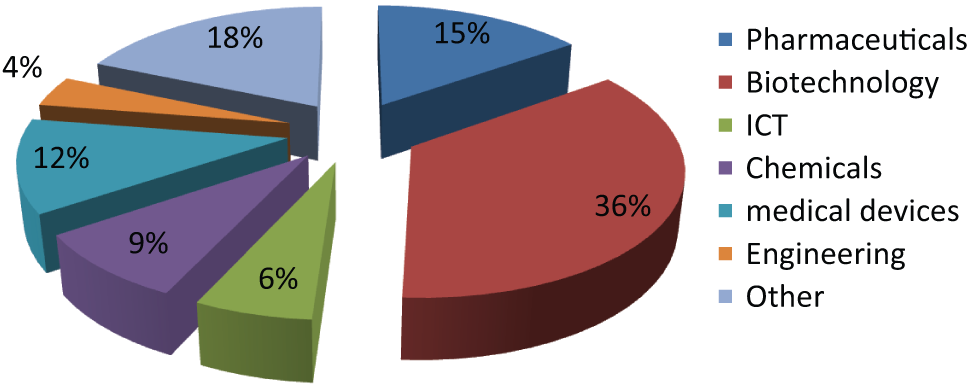
Responding firms by employee experience.
In our follow-up interviews, firms that indicated that they had recruitment problems specified the lack of qualified managers or employees with expertise and knowledge required by biotechnology companies, especially in management, development, and manufacturing. Many of the employees come directly from academia and thus lack work experience in an industrial laboratory.
These results indicate major hurdles for the industry. First, the small number of producing firms in the industry means that there are not enough companies that can transfer their knowledge and know-how on later stages of production. Second, these shortages lead to a shortage of employees who are skilled at later stages of the production chain. Both of these issues have a direct impact on the ability of an industry to further develop (S. M. Breznitz & Anderson, 2006; Casper & Karmanos, 2003; Porter, 1990). Hence, the lack of variation in the size of firms, the composition of employees, and the stage of production of firms impairs the growth and development of the Israeli life sciences cluster.
Companies deal with knowledge and labor problems in several ways: Some invest time and personnel in training new workers, while others collaborate with foreign companies or conduct their development stages in other countries, leaving only the research stage in Israel.
Human resources in science—excellent. In business very few have the knowledge. In our company we have two people that moved to this industry from ICT. (Interview with Biotechnology Executive A) There is a lack of experience in development and manufacturing. Today, our company has two employees who are working for [a bigger company] in order for them to gain the knowledge we need. (Interview with Biotechnology Executive B) It is hard to find people that have seen a product through all stages of production. Most people have only the clinical base. The academic background is important, but it is just the base. We are missing people that know how to develop. We need people with industry experience. (Interview with Biotechnology Executive C)
When we examine financial options for the industry in Israel, we find that the Israeli life sciences firms benefited from investment of more than $250 million in 2004 (ILSI–Israeli Life Sciences Industry, 2010). This level of investment ranks Israel among other leading life sciences clusters around the world: Germany $328 million, France $261 million, and the United Kingdom $396 million (Colin Sanders Innovation Centre, 2006). VC investment per Israeli firm, however, is very low. Our survey results show that the average investment in an Israeli life sciences company is $4.1 million, with an average of $3 million.
This level of investment, especially in life sciences, where equipment is very expensive and the length of time between an invention and realization averages 15 years, has a direct impact on the ability of the firms to develop. In addition, survey results show that only 36% of firms in Israel received funding from a local VC firm and only 24% from an international one. This low percentage of local investment correlates with a study by Trajtenberg (2001), who discovered that Israeli innovations do not contribute enough to make an impact on the Israeli economy. He found that “local economic gains from innovations are correlated with the percentage of patent owned by local corporations” (Trajtenberg, 2001, p. 386). Only 35% of patents are owned by Israeli corporations.
The Israeli life science industry reports that only 28% of funding in the industry comes from VC. Studies of the VC industry view the amount invested in a firm as an indicator of the venture capital firm’s commitment to the invested firm’s success. Since VC firms are known to be an important contributor to a firm’s ability to network, the low level of investment by professional VC firms in the Israeli life sciences industry has implications for its ability to succeed.
Social networks have been proven to be an important indicator as well as a mechanism of firm success (Cooke, 2003; Freeman, 1995; Gordon & McCann, 2000; Lowe & Gertler, 2005; Murray, 2002; Owen-Smith & Powell, 2004; Owen-Smith, Riccaboni, Pammolli, & Powell, 2002; Safford, 2004). Existing studies show that today knowledge transfer is achieved mainly through social networks (S. M. Breznitz & Anderson, 2006; Casper, 2007; Gordon & McCann, 2000; Murray, 2002; Owen-Smith et al., 2002; Owen-Smith & Powell, 2004; Safford, 2004). However, our study indicates that knowledge transfer in the Israeli life sciences industry is based more on direct and informal relations with either the faculty or alumni of the different local universities. Formal relations among companies and between companies and academic institutes are minimal. For the most part, relationships with the academic institutes are with a researcher or faculty with whom the founder or one of the company’s researchers has past connections.
Because they are graduates of a few distinguished life sciences programs, employees share a common background and together create a social and technological network, sharing information and equipment as needed. Numerous companies’ founders are graduates of one of the departments or of the former incubators and maintain close relations with their former departments and peers. Some companies that spun off from the academic institutes require assistance with equipment, consult with faculty, and use the universities’ libraries. Some of these relationships are official, but most rely on the generosity and curiosity of the faculty.
People are moving between companies. You stay friends (from academia) and you transfer knowledge and help each other. There is knowledge transfer with the academic departments, but it’s informal, between people, not necessarily between managements. (Interview with Biotechnology Executive A)
Thus, faculty interest in the company, both financially and academically, leads to provision of services for young start-ups. Most of these connections, however, are unofficial and sporadic.
Survey results indicate that 65% of firms have a scientific advisory board, which studies point out is important for social networks (D. Breznitz & Taylor, 2009). However, 83% indicate the use of foreign advisers. Though it cannot be conclusively confirmed by the study findings, they infer that Israeli firms base their social network on an international rather than national or regional network, which may have a direct impact on their ability to benefit from local resources and the past success from the Israeli ICT industry.
Part of the success of the ICT industry in Israel is based on favorable government policies and assistance in the development of a strong local VC industry (Avnimelech & Teubal, 2004, 2006; D. Breznitz, 2005, 2007). Though this success provides Israel with access to experienced employees, funding, and markets, it is industry specific and cannot be automatically extended to the life sciences industry. Still, when we examine the life sciences industry we find that 53% specialize in medical devices, an industry that bases some of its knowledge on ICT (ILSI–Israeli Life Sciences Industry, 2010). Moreover, 60% of VC investments in the industry in 2009 were in medical device firms, compared with 85% biopharmaceuticals in the United States and Europe. Hence, ICT knowledge and expertise did influence the composition of the life sciences industry and its strength in the medical devices sector.
In summary, existing theories view firm diversity and collaboration in a cluster as the basis of innovation, regional economic growth, and sustainability. Importantly, the literature reveals that further development of each cluster requires a variety of players at different stages of production. Our study finds that the Israeli life sciences industry is growing but consists of SMEs, a majority of which are in the research stage of the production cycle. The cluster has almost no companies at the development, manufacturing, marketing, and sales stages, resulting in a shortage of experienced managers and qualified employees for later stages of production. Moreover, the cluster lacks the networking and communication that are typical of industrial districts.
Measuring Up
Life sciences clusters can be found around the world. Successful clusters are characterized by many kinds of companies, which have different sizes, product specializations, and stages of production. Hence, the clusters encompass a variety of skills and knowledge that are transferred within the cluster through social networks. Germany, France, the United Kingdom, Ireland, and Denmark have all been developing regional life sciences clusters (Casper & Matraves, 2003; Ernst & Young, 2007; Lemarié, Mangematin, & Torre, 2001). Unlike the Israeli cluster approach of focusing on R&D, these concentrations of firms focus on bringing life sciences MNCs to their region. Ireland and Denmark promoted the availability of greenfields, access to the European Union, and policy incentives to attract MNCs that were interested in opening new manufacturing facilities. For these countries, manufacturing creates a broad base of good-paying jobs and at the same time brings the know-how to their region (Eastern Region Biotechnology Initiative, 2008; Ernst & Young, 2007; Colin Sanders Innovation Centre, 2006). In France, the United Kingdom, and Germany, many MNCs opened R&D facilities to tap into the local knowledge base and expertise, especially the availability of human resources with experience in pharmaceuticals.
In other R&D clusters, such as the one in Massachusetts, though R&D is the basis of the industry, many firms at the national and international levels are represented. Massachusetts thus shows strength in R&D and has many firms at later stages of production as well (Figure 2).
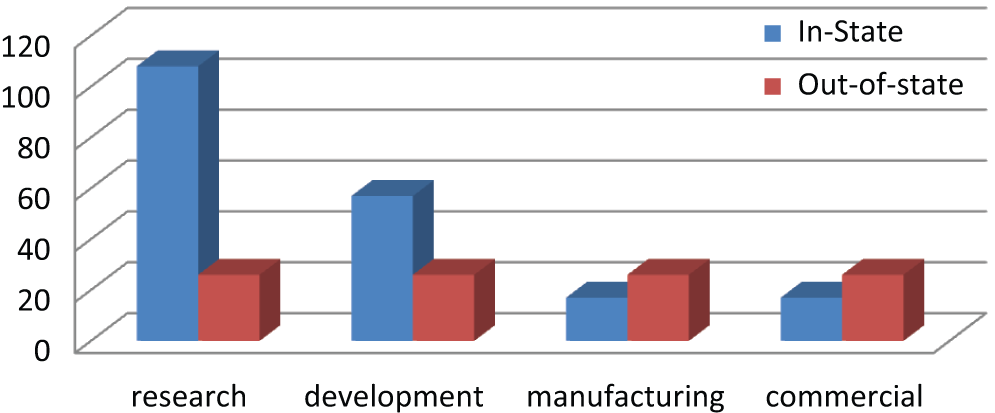
Massachusetts biotechnology capabilities (based on a survey of 134 biotechnology forms out of a total of more than 480).
The presence of multinational firms, even ones that opened only R&D facilities in Boston, allows for spillovers of knowledge and expertise in later stages of development to local SMEs. In terms of the number of drugs developed in the United States (11%) and in the world (5.5%), Massachusetts is one of the leading clusters (Massachusetts Biotechnology Council, 2010b). Moreover, the state ranks second in total VC investment in the United States, with more than 26% of the world’s VC investment in biotechnology (Massachusetts Biotechnology Council, 2010a).
Conclusions
Three important lessons can be learned from this study. First, although industrial clusters can be formed in many different locations, not all can grow, develop, and sustain. Cluster success depends on many factors, especially in the case of high-tech clusters. Many players and mechanisms have to be in place for clusters to achieve sustained success. Second, clusters can be specialized; that is, focus on one part of the production chain, yet still require different kinds of firms. Particularly in the case of R&D clusters, the existence of mature firms that provide knowledge and expertise, experienced employees, and the possibility of acquiring or offshoring later stages of production at a small technology-based company are critical. Third, the ability to develop an industrial cluster in one industry is not a guarantee of success in another industry. Each industry has its own peculiarities and requirements.
The life sciences industry has a global market. Building on Israel’s academic strengths can allow Israel to position itself as a leader in the industry. However, its lack of experienced employees and mature companies creates extreme developmental issues for this industry. Unlike in the Israeli ICT industry, life sciences companies require a level of funding that is currently not available. Moreover, whereas Israel has mature ICT companies, it has very few pharmaceutical companies and no mature biotechnology firms. Thus, it lacks a qualified labor force that can lead this industry in the later stages of the production chain. Hence, our study concludes that the Israeli R&D life sciences cluster is untenable and, therefore, suggests that a cluster with such a narrow base is unsustainable.
Footnotes
Acknowledgements
The author would like to thank David Audretsch, Dan Breznitz, John Bryson, Janelle Knox-Hayes, Al Link, Lydia Lazanes, Naama Samet-Rubinstein, Phil Shapira, Antti Tahvanainen, Jan Youtie, John Zysman, the participants of the Academic Entrepreneurship Workshop in Donostia–San Sebastián, and two anonymous reviewers for helpful comments and suggestions. Special thanks are extended to the interviewees in the project; their insight provides the foundation of this article.
Declaration of Conflicting Interests
The author(s) declared no potential conflicts of interest with respect to the research, authorship, and/or publication of this article.
Funding
The author(s) disclosed receipt of the following financial support for the research, authorship, and/or publication of this article:
Partial support for this article was provided by the European Union Center of Excellence at the Georgia Institute of Technology, The Samuel Neaman Institute in the Technion, Orkestra-Basque Institute of Competitiveness, and the Israeli Office of the Chief Scientist in the Ministry of Trade and Industry.