




Abstract
Using the Public Use Microdata Sample from 2006 to 2010 American Community Survey and a hierarchical regression, this study examines how metropolitan-area-level labor market conditions are associated with the propensity of business ownership for the Hispanic labor force in the United States, and how the relationship differs between the foreign born and the native born, and between men and women. Findings from this study suggest that, in addition to personal and household characteristics, metropolitan labor market characteristics such as demographic composition, economic structure, and general labor market strength are important for Hispanic business ownership, contingent on gender and foreign-born status of the individual labor force.
With the huge influx of immigrants from Latin America, Asia, and Africa during the past several decades, many cities in the United States have become fertile ground for individuals of various ethnic origins to start their business ventures. According to the most recent statistics from the Survey of Business Owners in the United States, between 2002 and 2007 the growth of minority-owned businesses outpaced the growth of nonminority businesses in gross receipts and number of employees. In particular, Hispanic-owned businesses grew by 43.7%, to 2.3 million, more than double the 18.0% growth rate for all businesses during the same period (Minority Business Development Agency, 2009). Although ethnic economies have become increasingly important in the United States, the preponderance of literature suggests that business ownership could provide ethnic minorities with a springboard for their economic, social, and even political progress (Bates, 2006; McDaniel & Drever, 2009; Portes & Jensen, 1989; Zhou, 1992; Zhou & Cho, 2010). Furthermore, promotion of ethnic businesses has been incorporated in some local governments’ development strategies. For instance, the mayor of Baltimore has launched an array of initiatives to attract immigrants to that city with the hope of bringing skills, entrepreneurship, jobs, consumers, and taxes needed to revitalize blighted neighborhoods. Other cities, including Boston, Detroit, and Dayton, have also designed programs to draw migrants and foster their economic potential (Ewing, 2012; Liu, Miller, & Wang, 2013; Stafford, 2012).
At the same time, business ownership rates differ significantly by race/ethnicity, gender, foreign-born status, and across places. Previous studies have identified a number of factors associated with the formation and development of ethnic enterprises, such as individual characteristics, cultural preferences, social capital, structural factors (e.g., discrimination), and transnational ties (Bates, 2011; Fairlie & Robb, 2008; Light, 1972, 1984; Min & Bozorgmehr, 2000; Zhou, 2004). Although these studies have provided valuable insights, very few of them have explicitly examined Hispanic entrepreneurship and, in particular, how Hispanic entrepreneurship differs across macro labor markets.
Given this background, the purpose of the current study is to examine how the propensity for self-employment or business ownership among the Hispanic labor force is associated with metropolitan labor market conditions in the United States (“Hispanic” and “Latino” are used interchangeably in this research). Specifically, this study addresses the following questions:
How is the probability of self-employment or business ownership for the Hispanic labor force associated with metropolitan labor market characteristics?
How do the relationships differ by gender and foreign-born status?
This study will make several contributions to the existing body of literature. Most existing studies of entrepreneurship at the regional-labor-market level do not consider the social and cultural identities of business owners. At the same time, existing studies on ethnic economies or ethnic businesses have predominantly focused on the neighborhood level and predominantly on small-scale and low-skilled sectors (Chaganti & Greene, 2002; Menzies, Filion, Brenner, & Elgie, 2007). Wang (2009, 2010) has found that racial/ethnic composition and industrial structure at the metropolitan-area level significantly affect the probability of business ownership across ethnic and gender groups; however, systematic comparisons of self-employment or entrepreneurship between the foreign born and the native born from the same ethnic groups are extremely scarce. Even less is known about how gender makes a difference in this process.
Geographically organized labor markets offer variant opportunity structures within which individual action is undertaken. Even given the same labor market context, different human beings can have profoundly different experiences, generating considerable variation in their socioeconomic outcomes. Therefore, a multilevel approach to consider both individual-level and regional-labor-market characteristics is increasingly appropriate to conceptualize and empirically test the hierarchical nature of an ethnic labor market process that is reflected in the uneven labor markets, housing markets, and other broad sociopolitical contexts (see, e.g., Baum & Mitchell, 2011; McCall, 2001). Using a multilevel research design, this study simultaneously examines the interaction of gender and foreign-born status at the individual level and their places (measured at the metropolitan-labor-market level) in the process of ethnic entrepreneurship. It is among the very few attempts to articulate and gauge the possible impacts from metropolitan-area-level labor market conditions on ethnic entrepreneurship while considering personal- and household-level characteristics.
Furthermore, the Latino labor force in the United States is the focus of this study. The Latino population has seen dramatic changes over the past several decades. While transforming the demographic component of the U.S. labor force, Latinos have also had an impact on economic, social, and political environments in the regional and local labor markets. A large number of Latinos, particularly Mexicans, have been perceived as low-skilled, low-educated laborers, and thus ethnic entrepreneurship among the Latino population has been relatively overlooked, with the exceptions of Cubans in Miami during the 1970s and 1980s (Portes & Jensen, 1989; Wilson & Portes, 1980). Recently, some literature has documented the trends and characteristics of Hispanic business ownership (Aguilera, 2009; Liu 2012; Robles & Cordero-Guzman, 2007; Wang & Li, 2007). However, our understanding of Latino business ownership remains very limited.
The rest of this study is organized to first examine previous studies on ethnic entrepreneurship. Built on these studies, a framework articulating the relationship between ethnic entrepreneurship and macro labor market environments is then constructed. Data and the multilevel research design are then discussed, followed by the presentation of the results on the associations of business ownership with metropolitan area characteristics. Finally, conclusions are drawn on how foreign-born status accounts for differences in Hispanic entrepreneurship, as well as a consideration of gender differences.
Ethnic Entrepreneurship and Metropolitan Labor Markets
Ethnic Entrepreneurship Examined With Multiple Dimensions
Different perspectives have been offered to explain the motivations for ethnic minorities to become business owners or self-employed. The neoclassical economic model emphasizes the role of human capital (Masurel, Nijkamp, & Vindigni, 2004). In previous studies, age, gender, language proficiencies, and education attainment are all closely related to ethnic minority-owned business start-up and success. For example, some studies show that the rate of business ownership is lower for Mexican Americans because of lower human and financial capital for business start-ups. However, if everything else is the same, Mexicans are more likely to be self-employed than non-Hispanic Whites (Lofstrom & Wang, 2007; Robles & Cordero-Guzman, 2007). Because this perspective does not explain the feature of “ethnicity,” some studies focus on cultural practices and heritages as explanations as to why ethnic minorities are more ready than nonimmigrants to own businesses (Fawcett & Gardner, 1994; Light & Rosenstein, 1995. Furthermore, the social capital approach argues that belonging to a particular ethnic group and using its associated network could act as an informal business incubator and provide varying physical and intellectual ethnic resources, such as labor, capital, suppliers, and markets (Adler & Kwon, 2002; Eckstein & Nguyen, 2011; Greve & Salaff, 2005; Portes, 1997). In contrast, the structuralism approach proposes that discrimination and marginalization could force some ethnic minority groups and immigrants to become self-employed because of their low social status (Masurel et al., 2004).
Based on different perspectives, Waldinger, Aldrich, and Ward (1990) argue that ethnic entrepreneurship is an interactive process in which three factors play a key role: (a) opportunity structure dictated by economic dynamics and regulatory systems, (b) group characteristics, and (c) ethnic strategies that bind all aforementioned factors together to survive in economic life. In this process, ethnic entrepreneurs have to adjust to the opportunity structure by strategically utilizing their ethnic resources. Similarly, the “mixed embeddedness approach” emphasizes the interplay between opportunity structures on one side and immigrant entrepreneurs and their resources on the other, with formal and informal regulatory regimes of the host society as one of the major foci (Kloosterman & Rath, 2001). Overall, these studies from a wide array of disciplines suggest that ethnic entrepreneurship is a process with multiple dimensions. In common, they all emphasize, even if not explicitly, the importance of “environments” and “contexts” and the interaction between entrepreneurs and their environment or contexts.
Macro Labor Market Environments and Ethnic Entrepreneurship
The macro labor market refers to the metropolitan-area level in this study. A large number of studies in regional sciences have documented that the general economic situation is important for any business to help it start and grow. For example, negative economic developments or higher unemployment rates may push individuals into self-employment (Tervo, 2006). High-tech entrepreneurship is significantly related to a higher proportion of the “creative class” in the regional labor force and higher diversity (Hart, Acs, & Tracy, 2009; Qian & Stough, 2011). The economic structure of a regional labor market is particularly important. Economic restructuring during the past decade could have produced special opportunities for business ownership in a specific set of economic sectors. For example, previous studies found that a high proportion of service sector jobs within a regional industrial structure are positively related to firm formation because of lower average start-up costs (Bosma, van Stel, & Suddle, 2007; Reynolds, Miller, & Maki, 1995).
These studies provide important building blocks to theorize about entrepreneurship and regional labor market characteristics; however, they do not examine the racial, ethnic, or foreign-born status of entrepreneurs. As discussed earlier, in addition to human capital at the personal level, cultural characteristics, ethnically or racially bounded social capital, or labor market discriminatory experiences could have all played into this process. Belonging to an ethnic or national group could endow individuals with unique resources and opportunities for current and potential entrepreneurs on which to capitalize. At the same time, gendered and racialized divisions in the labor market could also dictate limited choices; that is, blocked opportunities in the labor market for an ethnic minority or immigrant labor force (Menzies et al., 2007; Raijman & Tienda, 2000; Teixeira, Lo, & Truelove, 2007). Experiences on both sides can work as outside pressure, as well as personal motivation, for ethnic entrepreneurs to mobilize their resources in starting and operating their enterprises through creative business strategies (Waldinger et al., 1990). Therefore, it is important to consider race, ethnicity, and foreign-born status.
In particular, the ethnic and racial composition of a macro labor market is significantly associated with ethnic business ownership. On one hand, with a huge influx of immigrants to the United States, both the supply and demand for ethnic goods have significantly increased. In turn, this increase has created more opportunities for ethnic businesses (Lo, 2009; Teixeira et al., 2007). Furthermore, the increase in the relative size of the minority population in a regional market is likely to enhance minority workers’ negotiating power and favorable environments for their entrepreneurial exploration. On the other hand, the dramatic growth of an ethnic minority may generate hostility among the majority group if the majority group perceives potential competition for jobs, housing, and social goods (O’Neil & Tienda, 2010). In addition, a higher proportion of one specific ethnic group in a region may generate competition among themselves. Such competition may then trigger a process that results in depressed business profits and worsened working conditions for all other workers in the same business sector (Hodge & Hodge, 1965).We therefore expect that it is necessary to consider the overall ethnic diversity (see Qian, 2013, for a discussion on diversity as social driver of innovation and entrepreneurship) and the relative size of coethnic population.
Divergent Paths for Women and the Foreign Born in Entrepreneurship
Studies have addressed the differences between male and female entrepreneurs in educational and occupational backgrounds, their motivations and driving forces, goals and strategies, management styles, and personal value systems (Hanson, 2009; Levent, Nijkamp, & Sahin, 2009). However, knowledge about ethnic minority women entrepreneurs and their owned enterprises is relatively limited (Hackler & Mayer, 2008), and it is even more scarce with particular regard to Latino women business owners and their business ventures. In the existing studies on ethnic minority women’s labor market experiences, ethnic minority and immigrant women are often represented as low-wage labor and unpaid domestic workers. More disadvantaged when compared with men and women from the majority group, they could face greater hardships in the labor market (Raijman & Semyonov, 1997). At the same time, anecdotal experiences of women entrepreneurs indicate that ethnic- and gender-bounded networks could provide unique opportunities for ethnic minority women, as compared with men (Dallafar, 1994; Turner, 2007).
Foreign-born status could also interact with gender and ethnicity in shaping the business ownership patterns across metropolitan areas. For example, Hansen and Cardenas’s study (1988) on immigrant and native ethnic enterprises in Mexican American neighborhoods finds that the immigrant ethnic group has a greater degree of ethnic orientation than does the native ethnic group. Immigrant ethnic employers are more likely to hire Mexican immigrant workers than are native ethnic employers, whose behavior with this regard is not significantly different from that of nonethnic employers. For the Latino labor force in particular, although the older generations of Mexican immigrants’ businesses are highly concentrated in landscaping, construction, and food services (Raijman & Tienda, 2000), the second or third generations descended from them are mainly finding stable employment commensurate with their education credentials. As Luthra and Waldinger (2010) point out, Mexican immigrant offspring are more likely to be employed in the public sector, as well as much less likely to be self-employed. Therefore, it is expected that foreign-born status results in significant differences for Latino business ownership.
Considering gender, foreign-born status, and ethnicity together, I argue that with their own social and cultural identities (e.g., race, ethnicity, and gender), human capital endowment, personal values and aspirations, and family backgrounds, ethnic entrepreneurs are also embedded in multiple-scaled places that provide a mix of social, economic, political, cultural, and regulatory factors and forces. The entrepreneurship is a process of interaction between the entrepreneurs and their places. Through the interaction, the entrepreneurs and places shape and are shaped by each other, which further influences an individual entrepreneur’s perception of opportunities and entrepreneurial activities. Therefore, in this study, individual characteristics such as age, gender, level of education, marital status, foreign-born status, and whether the individual in the labor force has a spouse who is also self-employed or owns a business are first considered. At the same time, the metropolitan-labor-market characteristics are examined based on the discussion above, with a focus on the interaction effect between these metropolitan-labor-market characteristics and gender and foreign-born status. The next section provides detailed information on these regional characteristics.
Data and Methodology
Data in use are extracted from the Integrated Public Use Microdata Sample of the 2006 to 2010 American Community Survey, as restricted to the civilian employed labor force (Ruggles et al., 2010). The data set provides detailed demographic, housing, social, and economic information at the individual level, such as age, gender, level of education, occupation, and household characteristics. The variable of interest is self-employment or business ownership for each individual Latino labor force. The American Community Survey data provide information on each individual’s self-employment status. If self-employed, the respondent further details whether his or her business is “incorporated” or “unincorporated.” While agreeing that the conceptualization of entrepreneurship does not necessarily correspond to the same concept of self-employment, in this study “self-employment” is interchangeably used with “business ownership” and “entrepreneurship” to refer to those people who own and run their own businesses, regardless of whether or not the business is incorporated. 1
In conventional studies, metro-level variables are merged with individual-level variables to assess the effect of metropolitan conditions on individual employment outcomes. This is not appropriate for the measurement of metro-level effects, the significance of which is overestimated because of correlation error within labor markets (for discussion in detail, see Raudenbush & Bryk, 2002). Thus, this study uses a hierarchical modeling with data on both individuals (Level 1) and labor markets at the metropolitan statistical area (MSA) level (Level 2). This two-level approach includes random errors that control for correlation error among individuals in the same metropolitan area; therefore, it allows for the simultaneous estimation of a full metropolitan-area-level model with controlled personal-level variables to predict business ownership.
The dependent variable, owning a business (or being self-employed) or not, is a binary variable taking on a value of either zero or one, which is known as the Bernoulli distribution. A hierarchical generalized linear model is conducted in the following form (Raudenbush & Bryk, 2002):
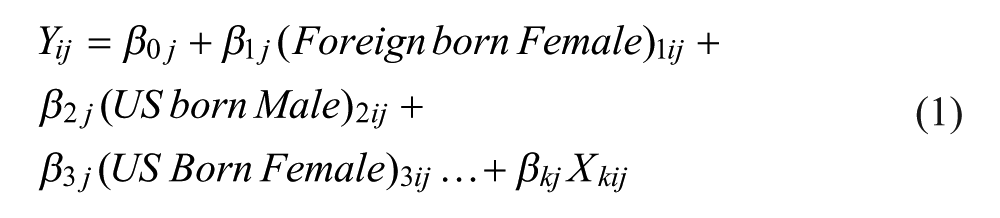
where
Variables in the Model.

Meanwhile, variation across metropolitan contexts in the probability of business ownership is estimated as a function of metropolitan area characteristics at Level 2 in the model, which takes the following form:




where
Also based on the earlier literature review, the MSA-level characteristics (
In addition, to examine the relationship between ethnic entrepreneurship and regional economic structure, this study considers the industrial structure at the metropolitan-area level. Of the total civilian employed labor force, the proportion of each of the manufacturing, construction, trade, services, and producer services sectors is included. Furthermore, to capture the ethnic composition of the regional labor market, a diversity index is constructed, and proportions of Asian, Blacks, and coethnic Latino populations are included. Following earlier literature (Alesina, Spolaore, & Wacziarg, 2000; Rupasingha, Goetz, & Freshwater, 2002), this study uses the ethnic fractionalization index to measure ethnic diversity at the metropolitan-area level. This index measures the probability that two randomly drawn people from a metropolitan area belong to different ethnic groups. The calculation is given by Index =1−
Results and Discussion
Overview: Hispanic Business Ownership in the United States
Figure 1 presents the rate of business ownership for Hispanics compared with other ethnic groups. For non-Hispanic Whites and Blacks, foreign-born males have a higher rate of business ownership than do U.S.-born coethnic males. Likewise, foreign-born females have a higher rate of business ownership than U.S.-born coethnic females. That is, for Whites and Blacks, foreign-born males have the highest rate of business ownership among their coethnics, followed by U.S.-born males. U.S.-born females have the lowest rate of business ownership. The pattern is different for Hispanics and Asians. For these two groups, the foreign-born civilian-employed labor force, regardless of gender, has a higher rate than the U.S.-born coethnics. Foreign-born females, thus, have a higher rate of business ownership than do native-born males. For the Hispanics, the rate of business ownership for foreign-born females is even higher than the rate for foreign-born males. This pattern indicates that foreign-born status has reshaped gender differences in business ownership across ethnic groups, especially for Hispanic groups.

Rate of self-employment of Hispanics compared with other groups.
The data sample shows that 71% of the self-employed Latino civilian labor force is foreign born in the United States. 2 Compared with the U.S.-born Hispanics, the foreign-born labor force has a lower percentage of college degree holders, lower English proficiency, larger family size, and a lower level of household income. Regardless of foreign-born status, male business owners work longer hours than women do and are more likely to be married than female business owners. Female business owners, however, are more likely to have a spouse who also owns a business. Regression at the individual level similarly suggests that having a self-employed spouse is strongly associated with a higher probability of business ownership for all the groups; however, the effects are stronger for women than for men. Although the data do not reveal whether or not the couple owns the same business, the patterns may suggest that women are less likely to own a business independently.
In addition, the individual-level regressions indicate that older age is significantly associated with a higher probability of business ownership for all the groups. In fact, foreign-born women have the highest average age. Seemingly consistent within the foreign-born groups, if one does not consider age, a longer stay in the United States is positively associated with a higher probability of business ownership for both foreign-born women and men. After controlling for personal age, however, length of stay in the United States becomes statistically insignificant for foreign-born men and even negative for foreign-born women. Further investigation finds that compared with those foreign born who stayed in the United States fewer than 10 years, those with a stay of 10 to 20 years in the United States are more likely to own a business; but those who have stayed 20 years or longer in the United States are less likely to own a business.
The rate of business ownership for the Hispanic labor force differs significantly across the 283 metropolitan areas in this study. Table 2 presents the ranges and means (with standard deviations) of rates of business ownership for each group across all metropolitan areas. The rate of business ownership for men ranges from 0.0% to 23.7% for the entire Hispanic group, 0.0% to 55.6% for foreign-born men, 0.0% to 31.7% for U.S.-born men, 0.0% to 29.5% for foreign-born females, and 0.0% to 27.4% for U.S.-born females. Although the rate in Williamsport, Pennsylvania is 55.0% for foreign-born Latino males, it is 0.0% for all other groups. Likewise, both U.S.-born men and women have their highest rates of business ownership (31.7% and 27.4%, respectively) in Johnstown, Pennsylvania, but the rate is 0.0% for foreign-born men and 15.3% for foreign women. In Springfield, Missouri, foreign women see their highest rate (29.1%) of business ownership, but both U.S.-born men and women have a rate of 7.7% and the rate is 0.0% for foreign-born males. Consistent with the dramatic spatial differences among the four groups across the metropolitan areas, results from the multilevel modeling suggest that the relationship between business ownership and gender and foreign-born status is highly contingent on metropolitan-labor-market conditions. These major findings are discussed in the following section.
The Range and Mean of Rate of Self-Employment Across All of the Metropolitan Areas.

Note. MSA = metropolitan statistical area. The number is based on weighted aggregation from American Community Survey data in use. Please be cautioned that there could be a small number of self-employed Latinos in the labor force in some metropolitan areas; however, because of confidentiality and sampling error, these metropolitan areas could report as 0.
Metro-Level Characteristics and Latino Business Ownership
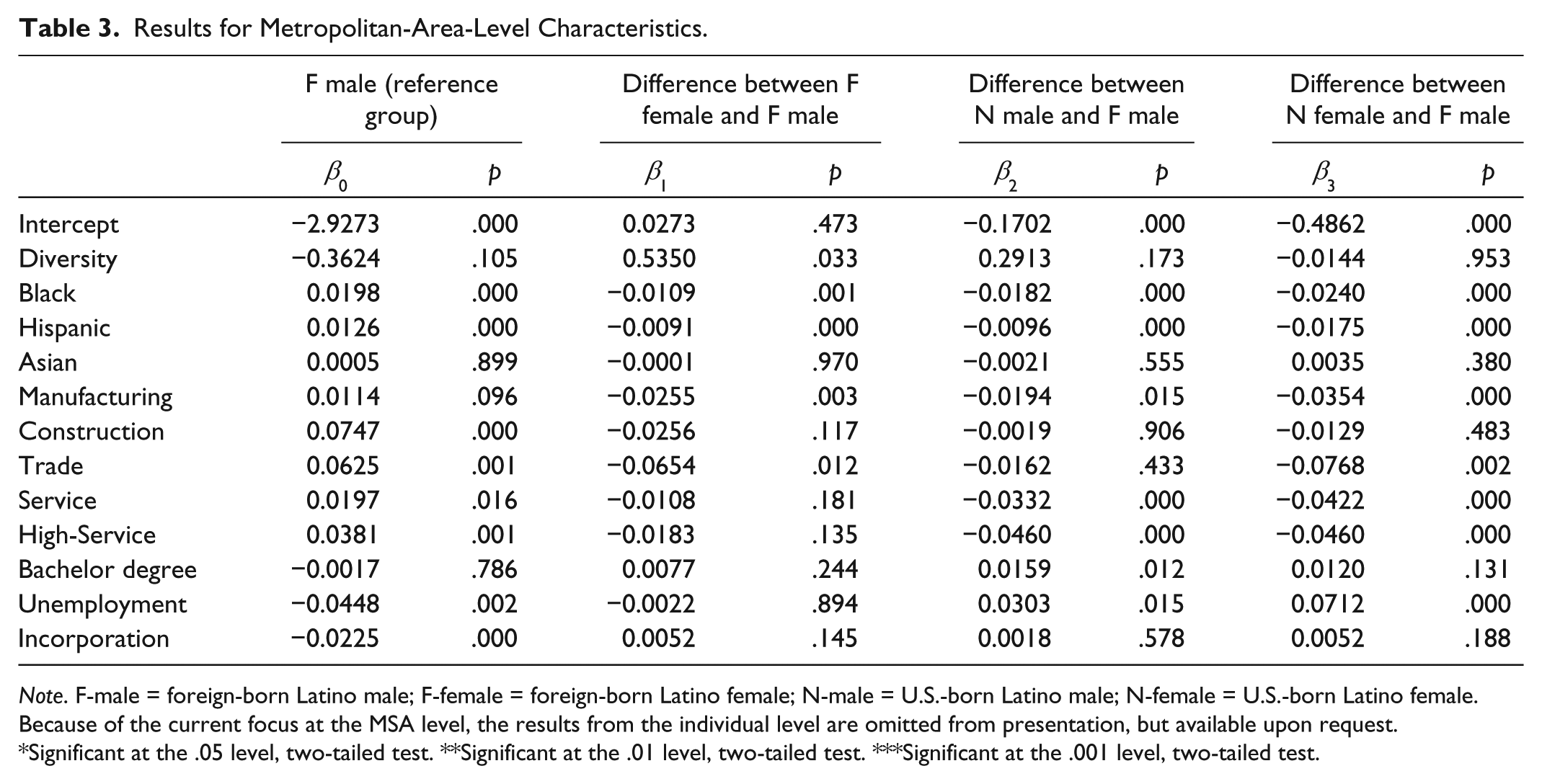
Because of the focus on the metropolitan-labor-market characteristics in this study, the regression results of other individual-level characteristics are omitted (but available on request). Table 3 presents the interaction effects between gender and foreign-born status and the metro-level characteristics on Latino business ownership, after controlling for other individual and household characteristics. On average, if holding the individual- and metro-level characteristics constant, the probability of business ownership for a U.S.-born Latino is significantly lower than for the foreign-born Latino, especially for U.S.-born women. Although Latino foreign-born women have a higher rate of business ownership than all other groups, as shown earlier, the advantage of Latino foreign-born women no longer carries statistical significance, after controlling for all the factors. The following discussion is focused on specific metro-level characteristics that are significantly associated with the likelihood of business ownership among gender and nativity groups.
Results for Metropolitan-Area-Level Characteristics.
Note. F-male = foreign-born Latino male; F-female = foreign-born Latino female; N-male = U.S.-born Latino male; N-female = U.S.-born Latino female. Because of the current focus at the MSA level, the results from the individual level are omitted from presentation, but available upon request.
Significant at the .05 level, two-tailed test. **Significant at the .01 level, two-tailed test. ***Significant at the .001 level, two-tailed test.
Ethnic Diversity and Ethnic Composition of Metropolitan Labor Markets
The proportion of the Black population in a metropolitan area is significantly associated with a higher probability of business ownership for foreign-born Latino men. For example, the likelihood of self-employment or business ownership for Latino foreign-born men will increase by 22% (= Exp[0.0198 × 10] − 1) when the percentage of Blacks increases by 10% in the total population at the metropolitan-area level. Compared with foreign-born Latino men, the probability of business ownership for all other gender and nativity groups will be significantly lower when the proportion of Blacks increases. Specifically, as compared with coethnic foreign-born men, the odds of business ownership for foreign-born women will decrease by 10% (= 1 − Exp[−0.0109 × 10]). But the overall effect from Black population percentage in a metropolitan area for foreign-born women is still positive. In contrast, the overall effect of Black population percentage in a metropolitan area for the native born, regardless of gender, is negative. The decreased percentage points are 17 and 22 for U.S.-born men and women, respectively.
The increase of the Latino population in a metropolitan area is positively related to a higher rate of business ownership for Hispanic males. Specifically, with every 10% increase in the Latino population, the odds of business ownership for Latino foreign-born men will increase by 13% (= Exp[0.013 × 10] − 1). The odds of business ownership for foreign-born women and U.S.-born men decrease by about 9% when compared with foreign-born males, and the overall effects are still positive. However, the odds of business ownership for U.S.-born females will be significantly lower when the coethnic population increases in a metropolitan area and the overall effect is negative. For a “hypothetical” Latino worker whose individual characteristics are at the “average” level of the entire Latino group, Figure 2 depicts the changes in the predicted probability of business ownership for the same Latino labor force when the Hispanic population increases at the metropolitan-area level, separately by gender and nativity. As shown in Figure 2, when holding other conditions constant, the different gender and nativity groups have significantly divergent prospects of business ownership when coethnic population increases in a metropolitan labor market.
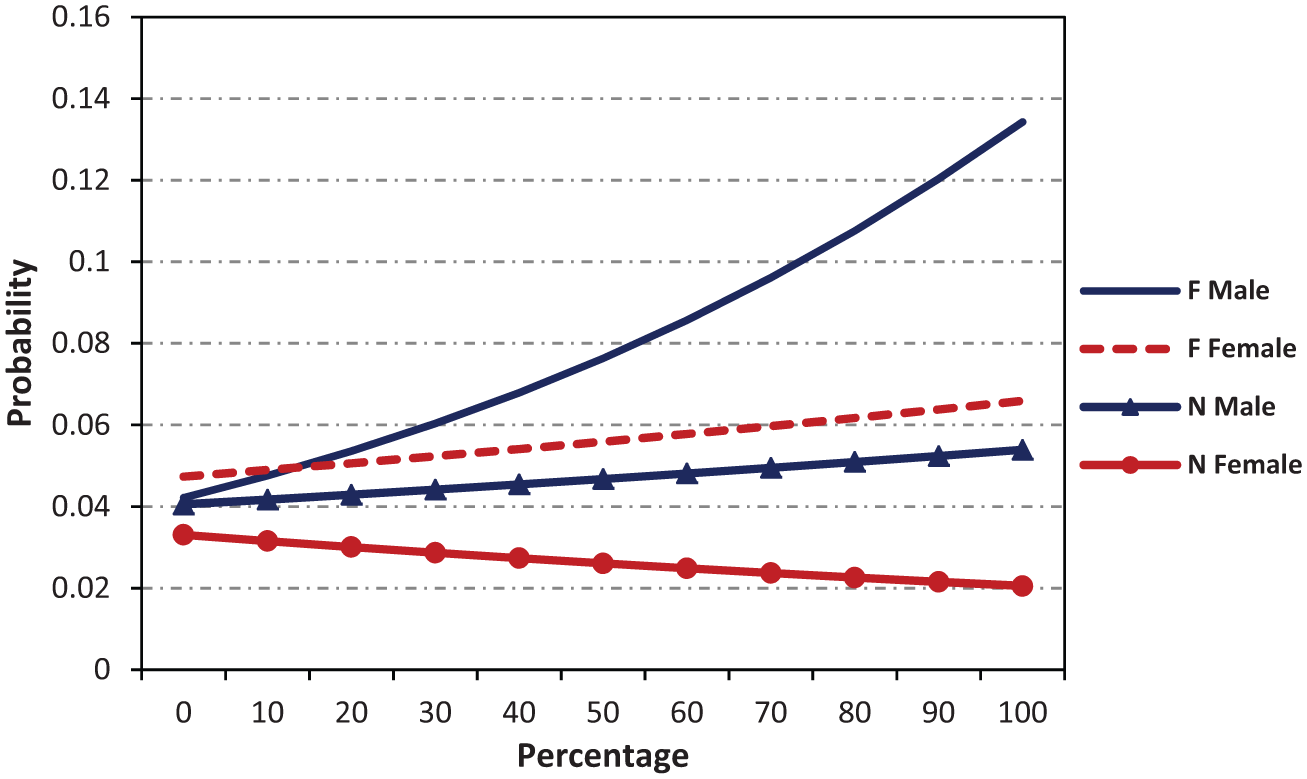
Predicted probability of self-employment with the changes of Latino population in a metropolitan area.
Some previous studies have discussed the impacts from the ethnic composition of the local population. For example, Borjas (1986) argues that the increased relative size of ethnic-minority populations affects their rates of business ownership in the United States. What we see here provides further insights. First of all, it is not the number of different ethnic groups (i.e., the “ethnic diversity” measured in this study) that matters. As shown by the results, ethnic diversity at the metropolitan-area level is not significant except for foreign-born Latinas. The relative size of the Hispanic population is much more significant, which strongly supports the idea that a larger coethnic population in a macro labor market could possibly provide more opportunities (e.g., market, labor force, and institutional supports) for Latino business ownership. At the same time, other visible ethnic minorities, especially Blacks, could cohabitate with Latinos in similar metropolitan labor markets conducive to Latino business ownership. Compared with the sheer numbers of the Hispanic and Black populations, the size of the Asian population at the metropolitan-area level is simply too small to count for much in shaping the self-employment patterns for Hispanics.
Furthermore, the positive effects are highly contingent on nativity and gender. In particular, regardless of gender, the impacts from coethnic concentration at the metropolitan-area level are stronger for the foreign born. In other words, foreign-born status blurs the line of gender in the current case. The differences in probability of business ownership between the foreign born and the U.S. born seem more prominent than the differences between men and women when conditions are held constant. Indeed, as we discussed earlier (Figure 1), regardless of gender, the rate of business ownership for the foreign born is much higher than that for U.S.-born Hispanics. This could reflect different mechanisms of the job-searching/matching process between immigrants and U.S.-born workers. Whereas many foreign-born workers rely on ethnic ties that can channel them into ethnic business niches, later generations of the same ethnicity who have better human capital may be more likely to choose jobs outside of business ownership (Luthra & Waldinger, 2010). For many of the native born, traditional ethnic businesses of low-skilled-sector jobs with long working hours are not that attractive anymore (Alba & Nee, 2003; Wong, 1998).
Industrial Structure at the Metropolitan-Area Level
A higher proportion of employment in manufacturing sectors is positively associated with a higher probability of business ownership for the foreign-born Latino male labor force, but only at the 90% (and above) significance level. Compared with Latino foreign-born men, having a higher percentage of the manufacturing industry in a metropolitan area is significantly associated with a lower probability of business ownership for all of the other three groups. The negative effect is particularly higher for female groups, regardless of whether or not they are foreign born. With the ongoing economic restructuring of the past several decades, the percentage of manufacturing industries has steadily declined. Following the same strategy of Figure 2 (for a “hypothetical” Latino worker whose individual characteristics are at the “average” level of the entire Latino group), Figure 3 depicts the predicted probability of business ownership for the four groups with the hypothetical decline of manufacturing industries from 50% to 0%. As shown by the graph, foreign-born Latino men see significant decreases in their predicted probability of business ownership, whereas the effect on U.S.-born men is minimal; in contrast, both female groups see a significant increase, especially U.S.-born women. In other words, with the decline of manufacturing industries, the differences between men and women become significantly smaller, even converge, if we hold other conditions the same.
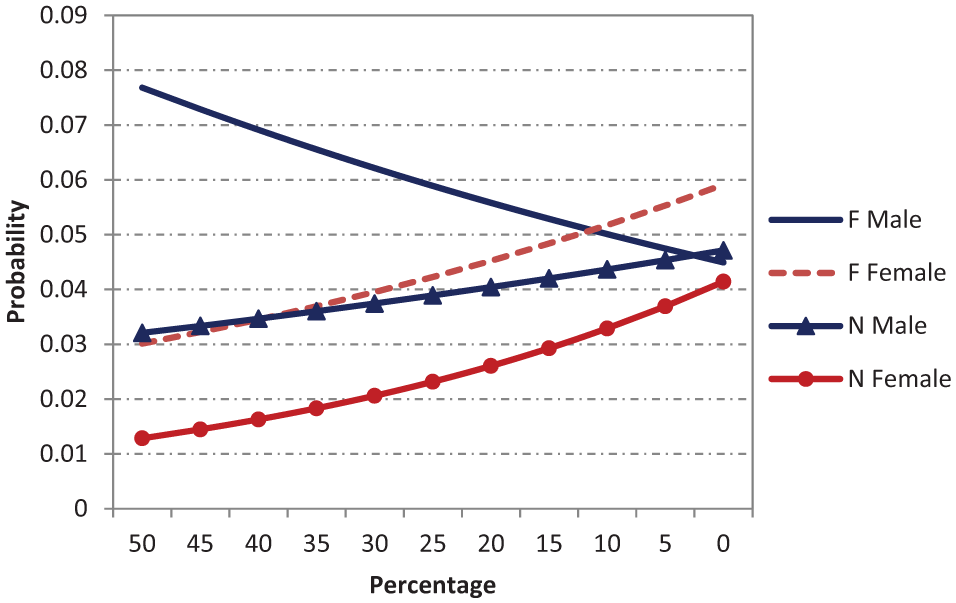
Predicted probability of self-employment with the decline of manufacturing industries in a metropolitan area.
For the services sector, a higher percentage of services in a metropolitan area is associated with a higher probability of business ownership for foreign-born Latino men. There is no significant difference between foreign-born men and women. However, compared with the foreign-born groups, both U.S.-born men and women are less likely to start their own businesses when service sectors become larger in a metropolitan area. Overall, with the increase of services (both producer services and social and personal services), the predicted probability of the U.S. born becoming business owners will decrease. For example, when producer services (finance, information, and real estate; communication and information; professionals; and management) increase by 10% in a metropolitan area, the odds of business ownership for Latino foreign-born males increase by about 50%, but the odds will decrease by 17% for foreign-born females and by almost 40% for both U.S.-born men and women when compared with foreign-born males. In addition, gender difference becomes more significant with the proportion of trade (wholesale or retail) in a metropolitan labor market. Specifically, the probability of business ownership for Latino men, foreign born or native, increases when the proportion of trade increases in a metropolitan area. However, the probability of business ownership for Latinas significantly decreases.
The relative size of the construction industry in a metropolitan area is significantly associated with Hispanic business ownership, and there is no significant difference between gender and nativity groups. For example, for every 10% increase in construction in a local economy, the odds of business ownership for foreign-born males will increase by 110% (= Exp[0.075 × 10] − 1). Such a strong impact reflects the strong concentration of Latino businesses in the construction sector across the nation (Golden & Skibniewski, 2010). The data sample shows that nearly a quarter of the total self-employed Latino civilian labor force works in the construction industry. The share of the construction industry for self-employed Latino foreign-born men, Latina foreign-born women, U.S.-born men, and U.S.-born women is 41.9%, 1.5%, 31.3%, and 2.7%, respectively.
Overall, compared with the impact from ethnic composition that makes significant differences between the foreign born and the U.S. born, the effect from regional industrial structure is more mixed. This has significantly changed the line between men and women, and between the foreign born and the U.S. born. This difference reflects the long-existing labor-market segmentation patterns between gender and nativity groups. The data show that self-employed Hispanic men and women differ significantly in their industrial distribution (the results are available from this author on request). For example, the professional and management sector is the largest sector for all of the four groups, with men having a higher concentration. Compared with women, men have a much higher concentration in construction, manufacturing, and the transportation and warehouse sector. In the construction sector, 74% of them are foreign-born males and 23% are U.S.-born males. Compared with men, women are much more concentrated in personal services, education, health care support, social services, and retail trade jobs. The proportion of self-employed foreign-born Latinas is 5 times that of the proportion of self-employed Latino men. At the same time, the difference between the foreign born and the native born could reflect the different career paths and trajectories of labor market upward mobility between first generation of Latino immigrants and their descendants. As discussed earlier (Alba & Nee, 2003; Luthra & Waldinger 2010; Wong, 1998), second and later generations of immigrants do not necessarily want to follow their forebears’ paths in business ownership, especially for Latino immigrants, who tend to concentrate in the lower level of the labor market hierarchy. Future research to look into the generational differences in business ownership will shed more light on this aspect.
General Metropolitan Labor Market Environment: The Control Variables
When the unemployment rate in a given metropolitan area increases, the foreign-born Latinos, regardless of gender, are less likely to own a business. In contrast, compared with the foreign born, U.S.-born Latino men and women are much more likely to own a business. Again, the difference by nativity could reflect different mechanisms of business ownership between the foreign born and the U.S. born; perhaps, the U.S.-born labor force is (or is able to be) more sensitive to macroeconomic recession.
The overall educational attainment at the metropolitan-area level does not make for significant differences across gender and nativity groups, except that U.S.-born Latino males are more likely to own a business than other groups when the percentage of bachelor’s degree holders increases. When incorporated businesses are more highly represented in a metropolitan area, the probability of business ownership for Latinos in the labor force, regardless of gender and nativity, decreases. This may indicate that having a larger number of small businesses in a regional labor market promotes a better business environment for everyone.
Exploring Different Metropolitan Areas
Putting all of the factors together, Figure 4 depicts the predicted probability of self-employment or business ownership in a set of metropolitan areas for a “hypothetical” Latino worker whose individual characteristics are at the “average” level of the entire data sample. Three groups of metropolitan areas are selected based on their economic condition, industrial structure, and immigration history. Among the national top 10 metropolitan areas with the largest number of foreign-born labor forces, New York, Los Angeles, and Miami are selected as traditional and established immigration gateways. Miami has a particularly high proportion of Latino population and Latino business ownership. Known as “emerging” immigration gateways, Washington, D.C., Atlanta, Georgia, and Charlotte, North Carolina are selected because of their rapid growth of immigration during recent decades (Singer, 2004; Singer, Hardwick, & Brettell, 2008). In addition, Detroit, Michigan, and Buffalo, New York are also selected. As “former Immigration gateways” (Singer, 2004), Detroit and Buffalo were two of the earliest immigration destinations for “old” immigrants (those from European countries) and were typically dominated by manufacturing jobs, although that has changed over time as these cities have gone through population decrease and economic restructuring. Although a similar exercise could be conducted with any metropolitan area in the United States, these different types of metropolitan areas together provide some interesting showcases for this study.

Predicted probability of self-employment for a hypothetical Latino labor force in different immigration gateways.
As shown in Figure 4, overall the rate of business ownership is lower for all of the Latino groups in the former immigration destinations (Detroit and Buffalo). For an “average” Latino civilian labor force, the foreign-born male is much more likely to start his own business in Miami than in any other place. The foreign-born-male rate of business ownership is also high in other established immigration destinations such as Los Angeles and New York. Foreign-born Latinas have a similar rate of business ownership in all three of these established immigration destinations. Interestingly, when holding other conditions constant, foreign Latinos, both men and women, have similarly high rates of business ownership in new immigration destinations; that is, Washington, D.C., Atlanta, and Charlotte. In these new destinations, the difference between foreign-born Latino men and women is minimal, except in Washington, D.C., where the predicted probability of business ownership for Latino foreign-born women is much higher than for all of the other three groups. The general pattern indicates more business ownership opportunities in new immigration destinations for Hispanics. 3 The U.S.-born Latinos, especially women, do not show significant differences across these metropolitan areas; however, U.S.-born Latino men are more likely to own businesses in Miami and Los Angeles than in other places.
Conclusions
Although traditional perspectives on ethnic entrepreneurship or business ownership have been dominantly shaped by the experiences of foreign-born male workers, insights from this study have demonstrated divergent paths for women and the later generations of immigrants. The results suggest that regional labor market characteristics, in terms of demographic composition, economic structure, and general labor market strength, provide important opportunity structures for Hispanic business ownership. Furthermore, as commented on below, the contextual effects from the metropolitan labor markets are contingent on the gender and foreign-born status of the individual labor force.
First of all, a higher concentration of coethnic population in a regional labor market could provide more resources and favorable environments for Latino business ownership. Such a positive effect is most likely shared within the foreign-born labor force, regardless of gender. The division in opportunities by place of birth indicates that foreign-born and U.S.-born Latinos may have different job-searching/matching mechanisms in the U.S. urban labor market. Higher human capital may provide better chances in the wage labor market for U.S.-born Latinos. Even if social networking plays a critical role in ethnic labor markets, as a large number of studies have suggested, it is likely that the actual operational conduits are very different between the foreign born and their later offspring. Obviously, the divide by place of birth has reshaped gender differences in the labor market outcomes.
Regional industrial structure also defines the opportunity structures for Hispanic business ownership in metropolitan labor markets. Consistent with the robust concentration of Hispanics in the construction industry, a higher percentage among various industries of the construction industry in a metropolitan area thus predicts significantly higher probabilities of business ownership for Latinos, regardless of gender and place of birth, in those same areas. The decline of manufacturing sector jobs and the increase of services and trade sector jobs, however, have profound impacts on the opportunities for business ownership between men and women, and the gender differences are further reshaped by nativity. The strong effects from regional industrial structure may have to do with gender and immigrant labor market concentration patterns. For several decades, researchers have documented gender and immigrant segregation in the labor market as that which negatively affects job earnings and prospects for upward mobility. Results here suggest that labor market segregation also affects entrepreneurial opportunities and that such impacts are reinforced by the regional economic structure.
A large number of case studies have documented the positive effects of business ownership and ethnic businesses on the upward mobility of ethnic minorities and immigrants. Findings from this study suggest that the opportunities of business ownership for the immigrant and ethnic-minority labor force differ by place, measured at the metropolitan-area level. Foreign-born status and gender not only directly define the ethnic minority labor force in terms of what they “have” and “have not” but they also interact with place to forge more nuanced lines across accessibility and upward mobility. These nuances provide further insights into the public policy arena in at least two respects: On one hand, for policies and practices addressing individual-level upward mobility for ethnic minorities and immigrants (such as social policies targeted at the personal level), a more place-based approach could shift the necessary focus onto the opportunities and constraints under a macro labor market environment. On the other hand, most regional economic development policies, especially those related to business ownership, should take into account ethnicity, gender, and foreign-born status, along with other social factors. The results of this study suggest it is a “must.”
This study has limitations. Because of endogeneity, it is impossible to provide a causal relationship between these metropolitan-labor-market conditions and Latino business ownership in the current analyses. Indeed, I have not intended to identify such causal relationships; rather, I have simply identified associations that exist within a range of independent variables net of other factors in the model and the dependent variable of interest, business ownership. Further analysis using longitudinal data will provide some insight into these issues. In addition, there is a significant difference among the sub-Hispanic groups. Detailed studies for each of the Hispanic subgroups will further the in-depth discussion for the current topic. Also, examining the self-employment or business ownership experiences by different immigration cohorts and generations should provide a more detailed understanding of the specific mechanisms of immigrant and ethnic entrepreneurship. Future studies in these directions could provide fruitful results.
Footnotes
Declaration of Conflicting Interests
The author(s) declared no potential conflicts of interest with respect to the research, authorship, and/or publication of this article.
Funding
The author(s) disclosed receipt of the following financial support for the research, authorship, and/or publication of this article: Research for this article is funded by National Science Foundation (BCS1127343).