



Abstract
How can local actors manage the regional-level impacts of trade liberalization? Most scholarship focuses on how given endowments, such as geographic location and existing industries, affect the local economic impacts of these contentious policies. This study considers local actors’ room for maneuver by focusing on a controlled case comparison of two city pairs along the Texas–Mexico border. These city pairs possessed very similar resource endowments and formal institutions prior to the enactment of the North American Free Trade Agreement, but diverged dramatically afterward in their economic growth patterns. A detailed comparison of policy implementation reveals that distinct local informal institutions were a key source of their economic divergence. The identification of the role of these “repertoires” of unwritten local habits and practices underscores the potential impact of collaborative efforts on long-term economic outcomes while adding to our understanding of the basis on which such collaborations are built.
How can actors at the city and regional levels mediate the economic impacts of trade liberalization? Recent and ongoing international political events have shown that liberalizing trade can both disrupt the distribution of economic opportunity as well as rouse destabilizing political and cultural tensions (Bhagwati, 2007; Castells, 1997; Rodrik, 1997; Stiglitz, 2003). If actors operating at the local level possess some capacity to affect the benefits their metropolitan regions can derive from trade, this would be significant for how researchers and practitioners assess the prospects of these economic, political, and legal changes. Several studies have demonstrated that specific forms of “collaborative governance” efforts across local public and private institutions can potentially enhance regional economic competitiveness, investment, and job quality (Gallardo & Stich, 2013; Jacobs, 2012; Lowe, 2014; Rich & Stoker, 2014). This study finds that collaborative avenues have the potential to significantly affect how individual metropolitan regions fare after trade liberalization. It also identifies an important underlying source of successful collaborative efforts in the form of the habits and practices shared by members of local elite groups who initiate and implement economic development policies. These “informal institutions” (Helmke & Levitsky, 2004) of unwritten behaviors for coordinating activity within and across formal institutions can significantly affect regional policy implementation, resource utilization, and the facilitation of the entry of outside capital. Such practices can, in turn, significantly affect economic results in terms of generating employment and business activity, creating infrastructure and public goods, and investing in human capital.
These findings are derived from a comparative case study of two cross-border metropolitan regions, or city pairs, along the U.S.–Mexico border. The city pairs diverged significantly after the 1994 enactment of the North American Free Trade Agreement (NAFTA) despite previously showing great demographic, institutional, and economic similarity. The McAllen (Texas)–Reynosa (Tamaulipas, Mexico) (M-R) and Brownsville (Texas)–Matamoros (Tamaulipas, Mexico) (B-M) metropolitan areas underwent a sustained divergence in which M-R became the site of far greater investment, employment growth, and economic and demographic centrality in the region than its neighbors. Based on site-based ethnographic fieldwork, and more than 100 transcribed interviews and archival research, the evidence suggests that this divergence emerged as a result of a difference in local habits of political collaboration and contestation among elites in each city pair—a type of informal institution that can also be referred to as their “repertoires” (Tilly, 1977, 1993).
These shared habits and practices affected how local actors marshaled resources as they attempted to harness the new growth possibilities brought by NAFTA. An important determinant of the success of these efforts was the demand of investors brought by NAFTA for local “gatekeeping skills” (Cañas, Coronado, Gilmer, & Saucedo, 2013) in reducing the risks, uncertainty, and costs of managing production systems that span the international border. The key elements of repertoire that distinguished these two city pairs were threefold: how actors represented their interests, how they responded to conflicts, and how they represented their local region to outsiders. Because the practices of the local repertoires involved different means for pursuing similar ends, the two city pairs reaped widely divergent benefits from the new trade agreement even though they were both pursuing largely the same goals with the same or similar policies. Thus, while formal institutions, existing networks of affiliation, and policy choices are all important elements of the economic development process, none of these show the consistent relationship to the case outcomes that repertoires do. Repertoires, therefore, can help increase our explanatory power over the regional impacts of trade liberalization, which may also apply to many forms of engagement between local economic development policy and broader forces of globalization.
These findings are relevant to research on local economic development policies attempting to maximize the efficacy of local resources and networks through combined efforts that increase the flow of information and the construction of collective capabilities. Such research often falls under headings such as third-wave economic development policy (Bradshaw & Blakely, 1999; Porter, 2000; Shaffer, Deller, & Marcouiller, 2006) or collaborative governance (Agranoff & McGuire, 2004; Ansell & Gash, 2008). The cases help illustrate that, apart from other factors, collaborative practices do seem to make a difference in long-term regional growth and economic transformation. Moreover, they illustrate the dynamics of collaboration at the level of the informal everyday practices that undergird and shape formal collaborative initiatives and policies, helping us to better understand what informs the fit between a particular policy and local capacities (Peters, 2000), as well as what guides processes of building collaboration (McGuire, 2000; Meléndez, Borges-Mendez, Visser, & Rosofsky, 2015; O’Leary & Vij, 2012).
Habits and Practices in Local Economic Divergence
Scholars tend to approach the regional impacts of trade liberalization largely as a special case of the overall phenomenon of divergent economic development. As with divergent development, the search for reasons usually begins with resource endowments and advantages given by geography, such as minerals, proximity to water, and distances to other urban areas. While some scholars give these factors significant weight in determining regional prosperity (Gallup, Sachs, & Mellinger, 1998; Sachs & Warner, 1995), others point out that the ability to realize the benefits of a given resource endowment is highly contingent on the proper structuring of formal institutions to facilitate their productive use (Acemoglu, Johnson, & Robinson, 2001; Kurtz & Brooks, 2011; Rodrik, Subramanian, & Trebbi, 2004).
In terms of the impacts of how an opening of trade creates shifts in relative regional advantages, a great deal of debate arises regarding who are the resulting “winners” and “losers” (O’Brien & Leichenko, 2003). Generally speaking, areas that lose some degree of relative advantage will be those that lose protection from directly competing industries (Autor, Dorn, & Hanson, 2013; Rodríguez-Pose, 2012; Silva, 2007; Silva & Leichenko, 2004). Some of these may be interior metropoles without significant advantages in the postliberalization geography of trade (Krugman & Elizondo, 1996). This suggests that the main geographic advantages in these cases relate to proximity to international borders or trade-related infrastructure, such as ports. At an institutional level, the potential benefits can be enhanced insofar as regions can lower costs and/or raise productivity in industries that will seek to take advantage of the new trade regime, whether by investing in infrastructure and/or by increasing forward and backward linkages between the stages of production essential to those industries (Cañas et al., 2013; Hanson, 1998).
These objectives are commonly approached from the perspective of formal institutional initiatives (e.g., consortia, regional programs, or place-based policies). Such initiatives are frequently discussed in the literature on third-wave local economic development (Bradshaw & Blakely, 1999; Eisinger, 1988; Porter, 2000; Shaffer et al., 2006). A related literature on local collaborative governance focuses on similar efforts, with an emphasis on local managers’ abilities to cultivate a balance of skills and organizations represented to establish an effective mix of horizontal and vertical relations (Kickert, Klijn, & Koppenjan, 1997; McGuire, 2006). Research by Lowe (2014) suggests that the successful capture of outside investment for long-term local benefits requires sustained cooperation between organizations in the public, private, and civil society sectors before, during, and long after the establishment of new production facilities. This is to produce the close fit between the capabilities and needs of industries, segments of the labor force, and communities that raise the benefits of maintaining local investments above those of following subsidies and incentives elsewhere.
A collaborative governance approach to local economic development would seem to hold considerable potential for regions seeking more room to maneuver beyond given resource endowments and institutions as they attempt to manage the risks and benefits of liberalized trade. The question then turns to how local actors achieve successful collaborative efforts together. Although research on local economic development and collaborative governance has helped us to see more clearly the features of successful efforts, our understanding of the sources of these characteristics remains incipient. Scholars observe a great deal of variation in the impacts of the same economic development policies in different cities and regions, leading to questions about how policy prescriptions take local mediating factors into account (Currid-Halkett & Stolarick, 2011; Fleischman, Green, & Kwong, 1992; Reese & Rosenfeld, 2001). Specific areas that scholars have cited as needing further examination are the processual dynamics of forming and maintaining collaborative efforts (Isett, Mergel, LeRoux, Mischen, & Rethemeyer, 2011; O’Leary & Vij, 2012; Weber & Khademian, 2008), and within that how tension and conflict are managed to assure that collaborative efforts are reinforcing rather than diverting energy from crucial economic development activities (Brass, Galaskiewicz, Greve, & Tsai, 2004; Cox & Mair, 1988; Goldsmith & Eggers, 2005; Teisman & Klijn, 2002; Wolman & Spitzley, 1996).
To understand the processes by which collaborative efforts form and successfully enhance regional economic development, it is necessary to gain more leverage on the informal dynamics of the collaborative process, and in particular, the sources of local differences in policy implementation (Dawes, Creswell, & Pardo, 2009; Weber & Khademian, 2008). The comparative case study in this research presents an opportunity to investigate how the same policies can be implemented very differently despite highly similar local structural contexts. The evidence from the cases speaks to the realm of informal institutions, which are regular behavior patterns that nevertheless are not written, established, or enforced by formal institutions of the state or other organizations (Helmke & Levitsky, 2004). Informal institutions often take the form of practices that help actors to adapt formal institutions to local contexts. Examples of important informal institutions elsewhere include the informal but patterned processes by which political parties choose their candidates (Langston, 2006), methods by which groups of officials consult and share power with each other (Siavelis, 2002), and locally distinct manners in which bureaucracies put formal rules into practice (Cousins, 1997; March & Olsen, 1989; Piore, 2011).
Informal institutions should play an especially important role at the metropolitan level insofar as governance at this scale tends to rely more on building connections across formal jurisdictional lines (Benner & Pastor, 2015; Storper & Harrison, 1991; Wheeler, 2002). Gaps in formal jurisdiction are accentuated when regional cooperation must cross international boundaries, such as the case of the city pairs compared in this study. Although McAllen and Brownsville are considered their own metropolitan statistical areas (MSAs) by the U.S. government, any visitor to the border will observe that both city pairs (M-R, B-M) are highly interdependent, with dense urban areas and a high degree of social and economic integration traversing the international boundary (Herzog, 1991; Office of Management and Budget, 2015; Sloan & West, 1977).
Informal institutions exist because formal institutions cannot, despite institution builders’ best efforts, prescribe what actions to take at every moment and in every situation. Actors tend to fill these inevitable gaps and uncertainties in formal procedures by drawing from shared expectations that in turn form through repeated experiences of interacting in a group over time (Fine, 2012). Shared expectations accrue for local political and business elites based on their circulation among actors with common resources and interests, which has been observed in research on loosely formed groups of elites that comprise “growth machines” and “urban regimes” (Logan & Molotch, 1987; Molotch, 1976; Stone, 1989).
In the cross-border city pairs, local elites express their own informal institutions involving practices for how they identify problems, discuss solutions, and seek collaboration as well as resolve tensions and conflicts encountered along the way. This type of informal institution is referred to here as a repertoire of behaviors for political collaboration and conflict. This term has been used in the past by social scientists to describe how repeated interactions within a group setting can lead to the articulation of a distinct set of shared tools, such as kinds of rhetoric or modes of interaction for self-expression and claim making that are clearly legible to other group members (Bourdieu, 1977; Fine, 2012; Goffman, 1983; Swidler, 1986; Tilly, 1977, 1993). Because different communities of local elites tend to share repeat interactions regarding the politics and business of their communities over time, it is possible that even geographically proximal yet institutionally separate communities can develop different repertoires − something the case comparison demonstrates. The distinct repertoires that elites practiced in each city pair underpinned divergent policy implementation trajectories that in turn significantly affected their ability to harness the potential growth benefits of NAFTA. The methods and empirical sections below turn to how the specific repertoires of the two city pairs were induced through field and documentary research, what behaviors they comprised, and how the observation of these informal institutions offers a better way to understand how two very structurally similar city pairs nevertheless extracted very different benefits from the arrival of a liberalized trade regime.
Divergent Development Despite Similar Factor Endowments on the U.S.–Mexico Border
In 1993, the imminent enactment of NAFTA raised unprecedented opportunities as well as risks for cities on the U.S.–Mexico border. Based on NAFTA’s premise of integrating high-productivity U.S.-based functions with low-cost Mexico-based ones (Pastor & Wise, 1994), NAFTA induced a far greater flow of goods, services, and logistical coordination across the U.S.–Mexico border. This would have a transformative effect on most border cities, which apart from the largest pairs of San Diego–Tijuana and El Paso–Juárez, had tended until that time to be more agricultural than industrial. NAFTA’s new regime of international economic relations placed much greater demand on border cities as “gatekeepers” of cross-border activity, with potential for growth and employment built around mediating activities involving legal, customs, and logistical services (Cañas et al., 2013, p. 433). Examples of such categories include warehousing and cold storage, post-assembly product processing, inspection and quality control, and legal assistance to corporations investing in Mexico. To the extent that a city pair could excel in these functions, it could potentially attract a disproportionate share of the new international economic activity generated by NAFTA. This in turn could also bring about significant secondary effects in terms of increased local consumption and investment in public goods, such as education and infrastructure. Such NAFTA-derived opportunities were crucial in increasing the potential for divergence between the two city pairs examined in this study.
NAFTA transformed the economic relationship between the United States and Mexico, and it brought about fundamental changes in the structure of the Mexican economy. From 1995 to 2010, U.S.–Mexico binational trade increased 250% in real terms (U.S. Census Bureau Foreign Trade Division, 2015). In 1995 alone, exports nearly doubled their share of Mexico’s economy to almost one third. By 1998, foreign-owned manufacturing firms increased their share of total incoming foreign investment in Mexico by nearly 350% (Dussel Peters, 2000). These impacts were accentuated in metropolitan areas along the U.S.–Mexico border, which as a region saw gross domestic product (GDP) growth several times the rate of states in the interior of either the United States or Mexico (López, 2006; “Survey: Mexico’s Mezzogiorno,” 2006).
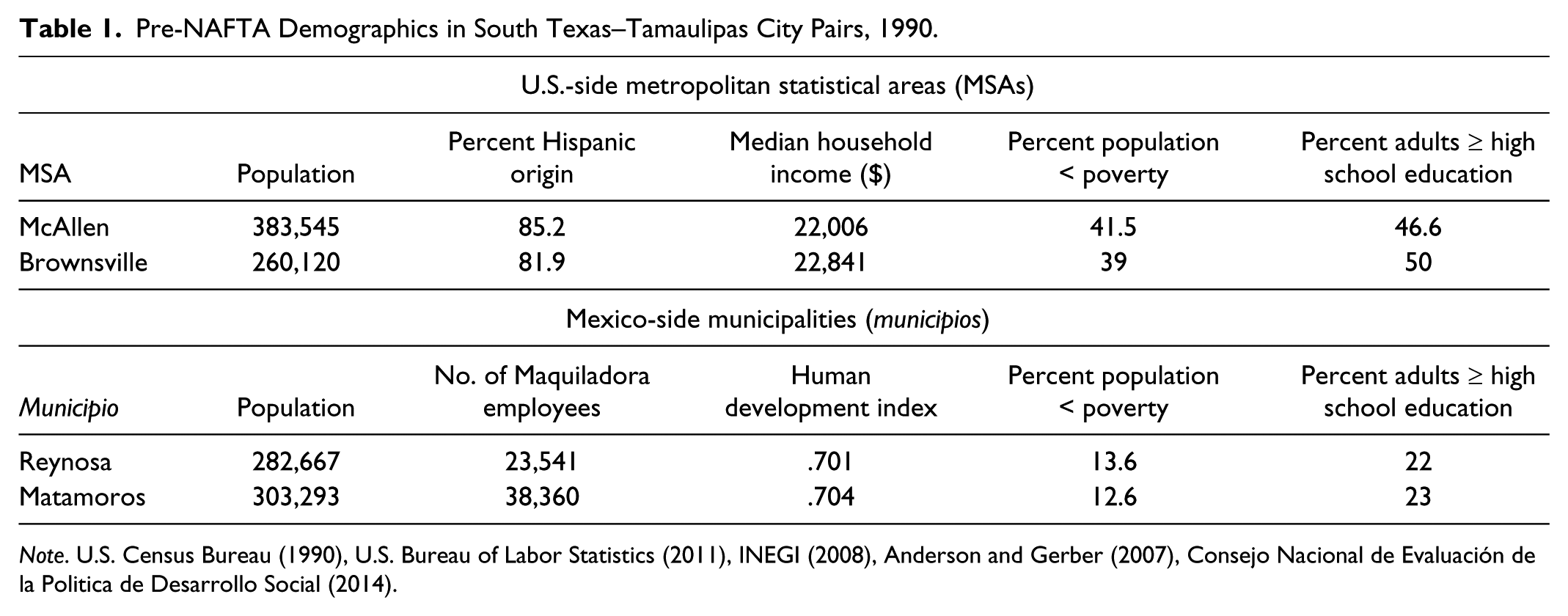
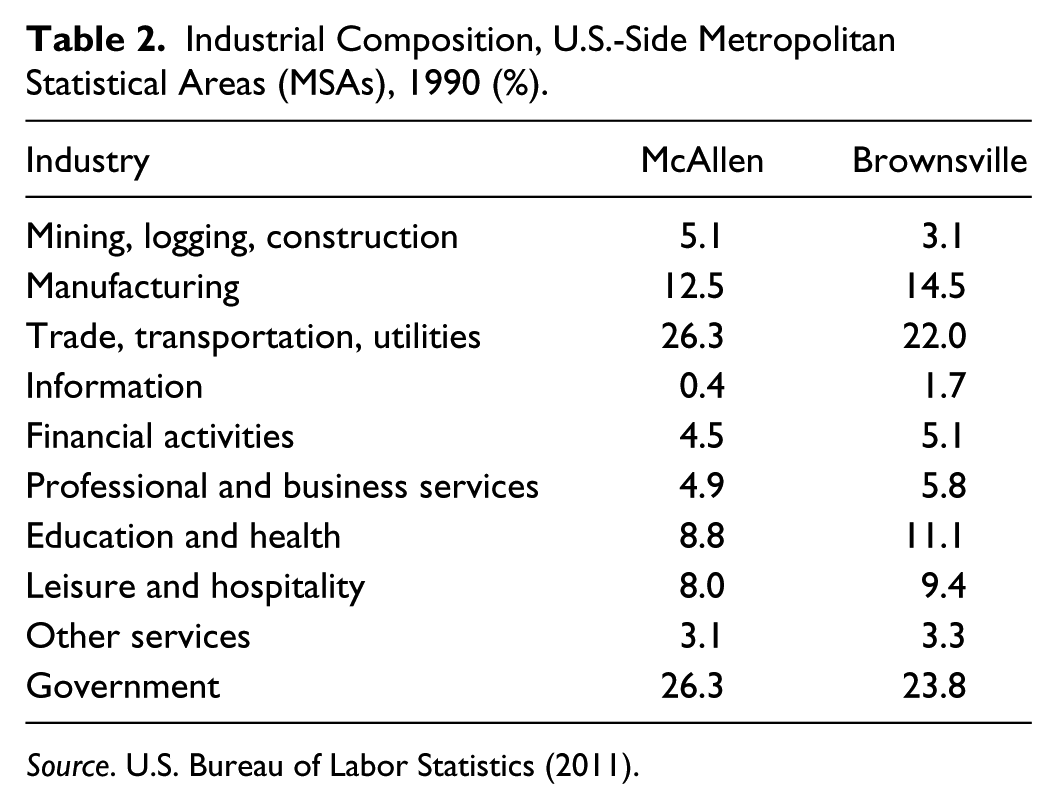
At the far eastern end of the almost 2,000-mile border between the United States and Mexico, two pairs of cities with remarkably similar resource endowments in terms of geography, population, and industry (see Tables 1-3, Figure 1) both aspired to seize the novel opportunities brought by NAFTA. McAllen and Brownsville are both situated in what is known as the Rio Grande Valley at the southernmost tip of Texas, an area that has historically been one of the poorest in the United States, as well as one of the least integrated into the United States and global economies (Graf, 1942; “One River,” 1997; Phillips & Cañas, 2008). In 1989, the median household incomes of McAllen’s and Brownsville’s MSAs were the two lowest in the country (U.S. Census Bureau, 1990). Through NAFTA’s new regime of North American integration, the Rio Grande Valley’s long estrangement from the flows of the global economy would come to an end. As Tables 1 and 3 also show, in terms of demographics and industrial base, their counterparts in Mexico—Reynosa across from McAllen and Matamoros across from Brownsville—were at least as similar as McAllen and Brownsville were to each other, if not more so.
Pre-NAFTA Demographics in South Texas–Tamaulipas City Pairs, 1990.
Industrial Composition, U.S.-Side Metropolitan Statistical Areas (MSAs), 1990 (%).
Industrial Composition, Mexico-Side municipios, 1990 (%).
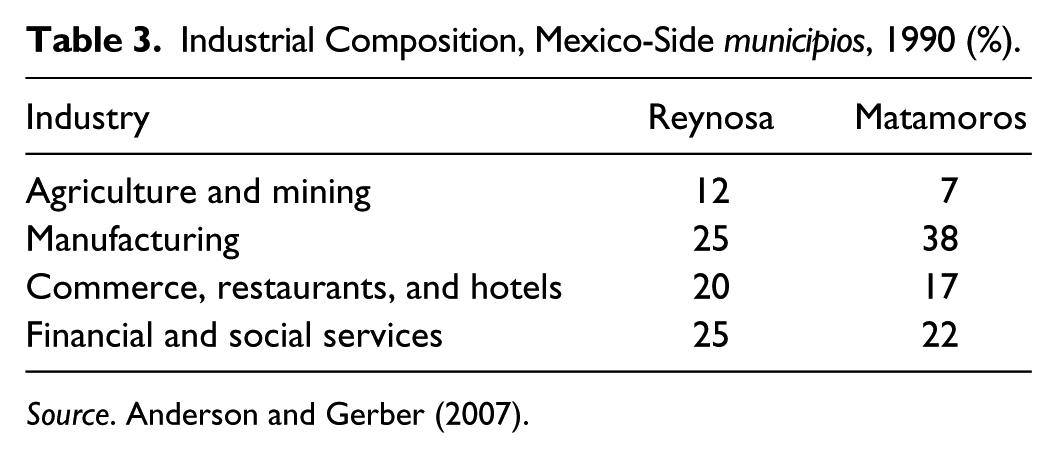
Source. Anderson and Gerber (2007).
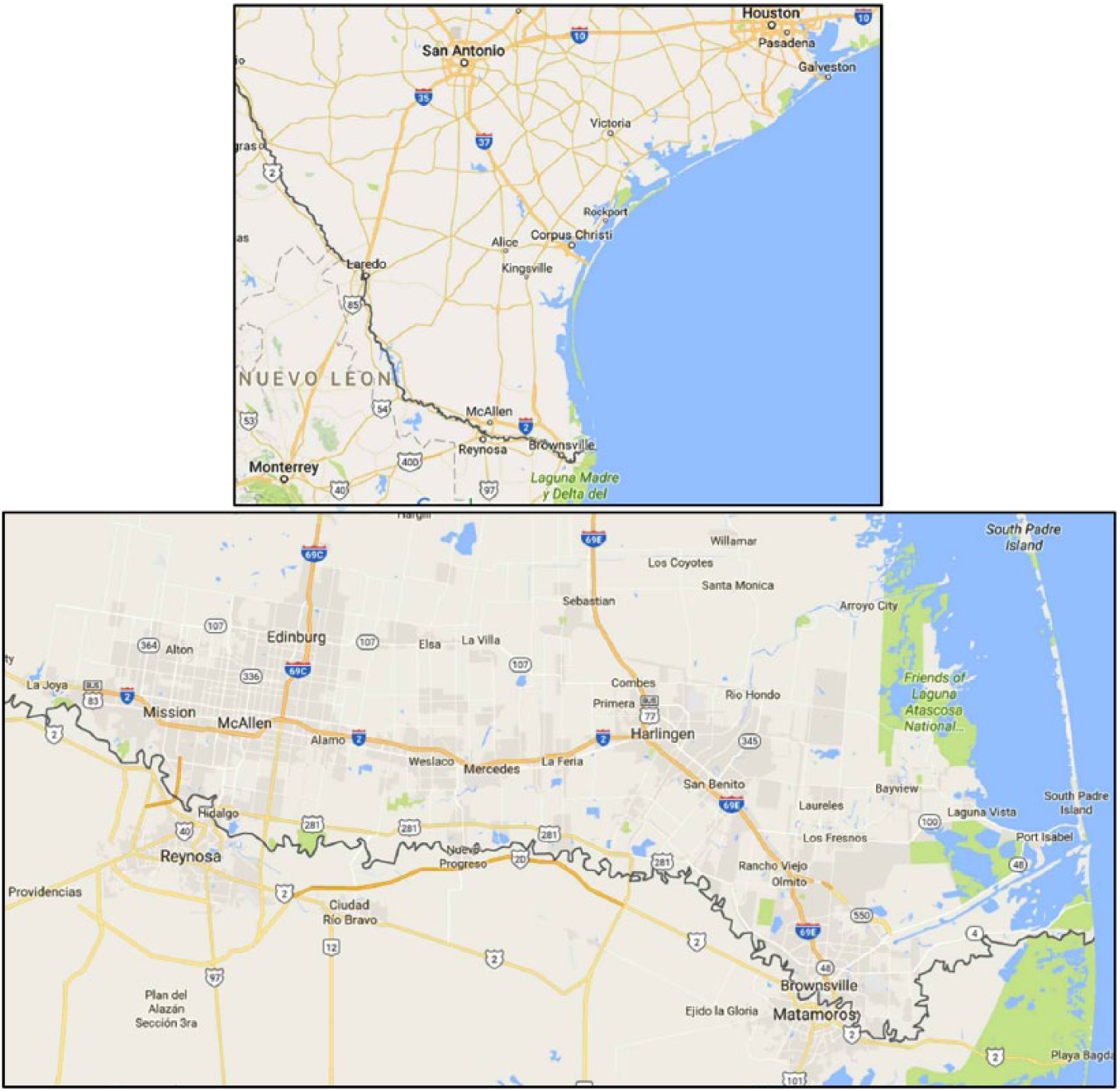
Map of the South Texas–Mexico border region and city pairs.
If anything, B-M arguably held a slight edge in terms of location on the Gulf of Mexico, which brought with it the deepwater Port of Brownsville, a rail crossing between the United States and Mexico, and a strong maquiladora manufacturing sector. B-M’s manufacturing sector was composed of exactly the types of firms, especially in the electronics and automotive sectors, that would be the most robust through the maquiladora downturn of the early 2000s (Cañas, Coronado, & Gilmer, 2004, 2007), and they had developed workforce agglomeration advantages in terms of an established base of high-productivity workers (Alvarado, 1993; Pérez Llanas, 1991). Thus, to surpass B-M in cross-border manufacturing, M-R would have to get better at what its neighbors were already doing. Regarding location, M-R had the potential advantage of greater proximity to the wealthy Mexican city of Monterrey. However, prior to NAFTA, the major crossing point between Monterrey and the United States was Laredo–Nuevo Laredo, making Monterrey’s greater connections to M-R than in B-M part of the outcome to be explained.
Just as M-R’s and B-M’s outcomes could not have been predicted by geographic, industry composition, or workforce factors, little purchase on their divergence is gained by considering their formal institutions, existing collaborative networks, or policy choices. McAllen and Brownsville both used council-manager forms of government with nonpartisan, at-large city council elections, whereas Reynosa and Matamoros had the same municipal system of partisan, one-term mayors (presidentes municipales) with strong powers of appointment, balanced somewhat by a city council (cabildo) with proportional representation by party (Brownsville Chamber of Commerce, 2014; City of McAllen, 2016; Garman, Harrard, & Willis, 2001; Rodríguez, 1997). At the same, time due to term limits, short bureaucratic tenure, and a lack of fiscal autonomy, Mexican municipal institutions were significantly less powerful than their much more independent U.S.-based counterparts (Logan & Molotch, 1987; Rodriguez, 1997), precipitating a cross-border dynamic where much of the policy initiative came from the U.S. side of the border (Eisinger, 1988; Grindle, 2006; Oliveras González, 2014).
In terms of policy networks, economic development in both city pairs were a nascent project. Elites on the U.S. side charged with promoting economic development had little training or background to help them navigate the institutions of their neighbors across the border (Interview No. 26, personal communication, October 16, 2009; Interview No. 62, personal communication, March 2, 2010; and Interview No. 64, personal communication, March 4, 2010). At the same time, this research documents a wide array of economic development policies where the two city pairs followed the same basic policy templates involving similar resources to very distinct ends. Moreover, the different economic development projects show that implementation patterns were consistent within the city pairs despite different individuals, institutions, resources, and policy goals from project to project. This consistency in local policy implementation pathways despite the variety of policy contexts reveals the local repertoires as important influences in building regional advantage through collaborative effort.
NAFTA created a bonanza of economic growth for the Rio Grande Valley, but surprisingly, the activity was centered in M-R, not B-M. From 1994 to 2000, Brownsville’s MSA added at total of 15,826 jobs for a 15.5% increase, whereas McAllen added 51,023 jobs, a 36.3% increase. This gap persisted in the subsequent decade when Brownsville increased its jobs by 19%, McAllen by 41% (U.S. Bureau of Labor Statistics, 2011). Like its U.S. counterpart, Reynosa grew far more quickly than Matamoros (Table 4). Not only were McAllen and Reynosa each increasing business activity, employment, and productivity far more quickly than Brownsville and Matamoros, they were integrating their economies more intensively. For every unit increase in manufacturing output from Reynosa, the corresponding employment impact on McAllen (6.6%) was three times as great as that of an equivalent increase in Matamoros on Brownsville (2.2%) (Cañas et al., 2013). How such a dramatic divergence took place, especially given the prior similarities, motivated a field investigation in these cross-border metropolitan areas.
Post-NAFTA Economic Outcomes.

Note. GDP = gross domestic product. M-R = McAllen–Reynosa; B-M = Brownsville–Matamoros. All U.S.-side indicators are at the metropolitan statistical area level; all Mexico-side indicators are at the municipio level. U.S. Bureau of Labor Statistics (2011), INEGI (2008), Texas Comptroller of Public Accounts (2009), U.S. Bureau of Transportation Statistics (2016), Cañas et al. (2013).
Research Methods
The surprising nature of these changes motivated a year of field research (July 2009 to July 2010) to better understand their sources. During that year, the author performed site-based observations at city meetings, including city council, public presentations, meetings of economic development organizations and business associations, and conferences. The author also performed 102 semistructured interviews of individuals from both sides of the border in both city pairs. Interviewees were sought for their firsthand involvement and/or expertise regarding key economic development projects in the post-NAFTA era. They included elected officials, public administrators, business owners and managers, business association leaders, service professionals (e.g., real estate, lawyers, consultants), journalists, academics, and activists. Interviews ranged from 30 minutes to 3 hours and covered interviewees’ experiences in the city (or cities) where they lived and worked, their experiences participating in and/or observing local economic development projects, and similarities and differences between local economic development projects and group dynamics.
In the first 8 to 10 weeks of field research, the main goal of interviewing was to maximize the breadth of organizations and institutions covered. As fieldwork progressed, the author used grounded theory principles, such as coding interviews while in the field (constant comparison) and allowing emerging analytic insights to guide sampling considerations (theoretical sampling) (Charmaz, 2006; Glaser & Strauss, 1968). Both during field research and afterward, more than 850 pages of single-spaced interview transcripts and field notes from site-based observations were read and coded multiple times in qualitative data analysis software (Atlas.ti) to track themes related to local differences in policy implementation. As time progressed, the focus of interviews and documentary research narrowed to those projects that were most important to the local economic development results in both city pairs. Examples of such projects include the construction of international bridges, the attraction of new employment, the promotion of retail growth, investment in higher education, local responses to federal-level proposals to construct segments of a U.S.–Mexico border wall in the metropolitan area, and responses to activists’ efforts in areas such as smart growth and living wage campaigns.
Interviews were analyzed both as data sources to reconstruct event sequences and for information regarding actors’ practical understandings of their work. The reconstruction of events focused on key economic development projects and policy processes, including actions taken, individuals involved, and the ordering of events and decisions in policy implementation. To the greatest extent possible, multiple interviewees with different institutional affiliations were sought to triangulate individual accounts. Interview data were also triangulated with archival research. Regarding practical understandings, interview as well as on-site observational data were analyzed for patterns in actors’ depictions of cause and effect, roles of groups and individuals, and sources of tension to better capture how they understood the work of economic development and the dynamics of policy implementation, and how individuals build and maintain relations in these processes. The data were repeatedly compared with ongoing field observations and archival data collection, forming a basis on which to analyze the role of group dynamics, as well as patterns in individuals’ own understandings in processes of policy implementation (Ewick & Silbey, 1998; Riessman, 1993). By focusing on the relationship between patterns in actors’ practical understandings and the iterative implementation of local policies, this analysis allowed a sustained intensive focus on the informal aspects of local economic development.
During field research, it became clear that interviewees from the two city pairs were recounting essentially the same economic development policies and projects, but with different implementation processes and results. Thus, to complement interviewees’ accounts, the author undertook archival research by gathering several thousand pages of city and organizational records, local historical materials, and local newspaper data. The goal was to minimize bias and maximize factual detail and within-case observation in policy implementation processes. These data allowed for process tracing analysis of the projects. Process tracing focuses on maximizing the number of within-case observations to test for the necessity and sufficiency of various possible causes in generating observed outcomes (Collier, 2011; George & Bennett, 2005; Mahoney, 2012).
Based on the data collection and analysis procedures described, it became clear that the divergence between the city pairs occurred despite highly similar policies and resources. It also became clear that the same policies and resources were leading to different local economic impacts because of informal institutions related to policy implementation in each city pair that were driving the different projects within the same city pair toward similar outcomes of consolidated efforts resulting in significant increases in investment and growth in M-R, and project fragmentation, underperformance, and abandonment in B-M.
Repertoires of Local Practices: Elements, Impacts on Policy Implementation, and Prevalence
Repertoire Elements
The distinct everyday practices of collaboration and problem solving that the two city pairs’ elites used can be distinguished on three main dimensions. On the dimension of the representation of interests, elites in M-R tend to discuss and evaluate proposals on whether they contribute to the region as a whole, which can be labeled as a collective approach. In contrast, elites in B-M tend to discuss an idea’s benefits in terms of individual people or organizations, demonstrating an atomized approach. When conflicts arise, elites in M-R tend to respond by finding a way to pay challengers to withdraw their opposition, which is labeled as a constructive type of local response. In B-M, the response tends to be a direct face-off in which advocates of competing proposals or ideas attempt to discredit or undermine each other until one remains, which here is referred to as an antagonistic type of practice. Finally, when local elites in M-R present their region to outsiders—whether to recruit employers, secure business deals, market to consumers, or request assistance from higher levels of government—they do so as a cosmopolitan locale; one where business is practiced as it is in financial centers and consumption and urban amenities are attuned to the needs of outsiders of all stripes. In presentation to outsiders, B-M projects an atypical image as an idiosyncratic locale carrying vestiges of the “Old West” that outsiders will either love for its distinctiveness or hate for its cryptic insularity. Based on this dimension of their repertoire, elites in M-R tend to cast themselves as catering to and competing with international firms and metropolitan regions at the highest echelons of the global economy. In contrast, B-M elites’ more atypical self-representation has led them to classify their region as a setting for smaller investors with more local competitors. Their sense of themselves as culturally and politically idiosyncratic has also led them to more frequently seek the services of outside consultants rather than locals to promote the region to outside investors and higher government authorities.
These practices are all salient to the demands of NAFTA insofar as the investment it brought from multinational corporations came with concerns about cross-border coordination, transactions costs, risk management, and infrastructure. These needs for gatekeeping skills elevated the impact of the differences between these local practices to a much higher degree than before, when the region was more agriculturally based and opportunities for cross-border investment were far fewer. To understand how the repeated use of practices from one repertoire versus another accumulates iteratively to produce very divergent outcomes from initially similar projects, one of these projects, international bridges, is narrated in detail in the following sections.
Repertoires in Policy Implementation Processes: International Bridges
Commerce across the U.S.–Mexico border is necessary to facilitate the integrated economic activity promoted by NAFTA. It is also a major source of employment and investment unto itself. Just more than 70% of the $530 billion in freight moved between the United States and Mexico in 2015 was carried across the border by truck. In 1995, 7.8% of all U.S.–Mexico truck crossings traveled through B-M, compared with 6.2% in M-R. By 2015 these proportions had reversed to 3.8% for B-M and 10.2% for M-R (U.S. Bureau of Transportation Statistics, 2016). This reversal in traffic flows represents a shift of roughly $15 billion per year in commercial activity from B-M to M-R. This difference in cross-border activity spills over into the broader economic competitiveness of a region based on the imperative of fast, fluid, supply chain coordination (Fullerton, Monzón, & Walke, 2013; Harris, 1994; Robinson, 2002). Examples of activities that thrive because of better coordinated border commerce include warehousing, processing, finishing and packaging of products, and the ability to attract and service the needs (e.g., legal, customs) of new production facilities in Mexico that compete on the speed with which they can manage their cross-border production processes.
Both city pairs followed the trend in the early 1990s to attempt to build as many new bridges as possible to capture a greater local share of NAFTA’s upcoming windfall. Since the mid- to late 1980s, it became clear that Mexico was pivoting away from protectionist and toward liberalized economic policies (Teichman, 1988). The joint announcement in 1990 by Mexican President Carlos Salinas and U.S. President George H.W. Bush of their shared intention to include Mexico in NAFTA alerted local actors on the border that their structural significance in the North American economy would soon change dramatically (Valverde, 1999). The two main bridge projects compared here, M-R’s Anzalduas International Bridge and B-M’s Port Bridge, had formal efforts initiated within 2 years of each other, in 1989 and 1991, respectively. They anticipated similar estimated local budgets of between $20 and $25 million for the U.S. portions (Bell, 2007; Pérez-Treviño, 2004a; Vindell, 1997). Like other international bridges, both faced formidable challenges, ranging from exhaustive environmental impact evaluations to multitiered bureaucratic approval processes with different agencies at the local, state, and national levels, to gathering necessary financial resources, and more holistically, making the strongest possible case for a costly and potentially risky project (Flyvbjerg, Holm, & Buhl, 2002). The U.S. government’s bar of skepticism was already rising in the early 1990s because two international bridges in south Texas—the Solidarity/Colombia Bridge in Laredo and the Los Indios Bridge in Harlingen—were operating at 3% and 30% of their projected capacity in their early years, a significant disappointment (Rangel, 1994). One of the main lessons of these two projects was that building a bridge would not be economically beneficial unless it was complemented by a wide array of supporting infrastructure. As a former president of the Mexico–Texas Bridge Owners Association put it, It doesn’t do any good to build a bridge if there are no adequate connecting roads, if there are no warehouses, if there is no adequate personnel from customs, the FDA, the Mexican health department, and all the required agencies from both countries. (Rangel, 1994)
These requirements make the project of building an international bridge a particularly apt example of a problem requiring the gatekeeping skills that were central to NAFTA’s economic model.
While they were similar projects undertaken at about the same time, M-R’s Anzalduas International Bridge and B-M’s Port Bridge quickly began to take on different implementation trajectories. Both projects faced skepticism and even stiff opposition from agencies both in the United States and Mexico. These challenges required proponents of each project to repeatedly find ways to overcome resistance without expending too many project resources. The locally distinct ways of responding to these similar challenges ultimately had a dramatic effect on what each city pair could accomplish and how they would position themselves as crossing points for NAFTA-driven economic activity.
The differences between the two bridge efforts began with the way proponents explained their rationales and project benefits. In M-R, the reasoning for the Anzalduas International Bridge was always presented as a matter of a bridge’s potential to increase regional commerce. The bridge sat at the western edge of Reynosa and McAllen, and once built, it promised to cut about one third of the travel time between Monterrey and McAllen by allowing vehicles to avoid the densest portions of M-R (Gaffney, 2009). Such a regional-level argument eluded proponents of the Port Bridge, who, although presupposing that growth at the port would benefit the region, focused on the specific purpose of carrying truck and rail traffic between the port and Mexico. This, too, was intended to relieve the costs associated with traffic through high-density urban areas, but it would only serve the port, missing an opportunity to find common cause with other actors who sought improved transit times.
Despite the ostensible benefits, conflicts with other local actors arose almost immediately for both proposed bridges. In Brownsville, the city and county wanted to move an existing rail bridge further to the west to remove it from the central urban portions of B-M. Feeling threatened that the Mexican government only had an appetite for one rail project in the area, they accused Port Bridge proponents of pushing forward a project that Mexico did not want, given that government reports issued in Mexico stated a preference for infrastructure on the west and not the east side of Matamoros (Pérez-Treviño, 2001, 2004a; Torteya, 2004) The two rival groups tentatively agreed to reserve rail traffic for the west side and truck traffic for the Port Bridge on the east. However, the Brownsville Navigation District (BND), which operates the Port of Brownsville, claimed that the county and city were selling the region out to the Union-Pacific Railroad, which owned the existing rail bridge, and repeatedly tried to reignite efforts for a rail bridge at the port. This more conflictive or antagonistic approach frustrated potential allies and precipitated more clashes over subsequent years, escalating to the point where supporters of one bridge would openly dispute public claims made about progress on the other (Pérez-Treviño, 2000, 2001, 2006; Pérez-Treviño & Negrete-Lares, 2004).
In M-R, similar challenges arose in response to the Anzalduas International Bridge, but they were dealt with differently. Several neighboring cities attempted to block the project by claiming it would harm their own bridges and would risk another waste like that of Colombia or Los Indios. Rather than impugn their rivals’ motives, as was the case for both sides in the Port Bridge debate, supporters of the Anzalduas International Bridge—whose core included McAllen’s bridge authority, municipal government, and economic development agency—offered their oppositional neighbors a share of the future bridge’s revenue in exchange for dropping their disputes. More than 55% of the bridge’s future revenue was committed to other cities, and the Anzalduas U.S. presidential permit application 1 proposed to delay commercial traffic to prevent destructive competition with nearby Pharr’s International Bridge (“Valley Cities,” 1999; Pinkerton, 1999; Villarreal, 2007). Anzalduas’ proponents made these concessions without requiring active support or risks borne by other cities, making them essentially side payments for relinquishing opposition. They justified them in the light of a project that was not for the sake of maximizing bridge revenue, but for maximizing regional commerce in the long run (Holeywell, 2009). As the director of McAllen’s bridge authority put it, “you cannot make unilateral decisions in a binational setting, which some communities have done. It takes a lot of time to come in and repair. It only makes for ill will, and it doesn’t make economic sense” (Interview No. 58, personal communication, February 19, 2010).
Resistance from various levels of the Mexican government also evoked locally distinct responses in the two city pairs. Promoters of B-M’s Port Bridge sought outside consultants from cities such as Houston and Mexico City to assuage skepticism in Mexico about a bridge on the east side of town. Mexican officials’ concerns had to do with local ecology, the spatial development of Matamoros, and the risk of direct competition with ports further south in Mexico. The recourse to outside consultants as project promoters 2 —something actors in M-R did not do in their bridge project or most of their other economic development efforts—reflects how actors in B-M saw themselves as incapable of acquitting their local causes in the eyes of outsiders. As one local mediator affiliated with the university’s government program put it, many saw it as a “missionary” cause to try to bring the best techniques and thinking from outside to Brownsville because they were “far from where the people are” (Interview No. 43, personal communication, December 16, 2009). All told, external consultants for B-M’s Port Bridge received $15.5 million of the original $21 million that BND raised for the project, much of which went into seeking political support in Mexico. Actors in M-R did not have more expertise than their counterparts in B-M in how to build international bridges, but their cosmopolitan view of themselves gave them confidence that they could make their own case successfully to outsiders. As McAllen’s mayor at the time of the bridge’s opening put it, he and other local politicians were focused on McAllen as a city with a “business feel” and a “diversity of products and price competition” for consumers to “attract young human capital” to be able to “outperform any city, anywhere” (Interview No. 95, personal communication, July 5, 2010).
Mexican authorities were also highly skeptical of M-R’s proposed Anzalduas International Bridge. In particular, they were concerned that a proliferation of bridges would essentially subsidize an outflow of wealthy Mexican consumers to the United States while sapping the resources of the Mexican state to provide infrastructure that would more directly benefit its low-income populations. These were the concerns that Mexico’s director of border affairs shared with the leader of the Anzalduas International Bridge effort when he visited her in Mexico City (Interview No. 58, personal communication, February 19, 2010). His immediate response was indicative of a different approach to conflict than in B-M. Rather than attack her motives or seek to circumvent her, the Anzalduas project leader asked how they could best address her concerns. Could they formulate a private concession that would relieve the Mexican government of its financial burden? This response led to a special concession where the builder of the Mexican half of the bridge, in exchange for taking on the $70 million in capital investment needed, would be entitled to all northbound bridge tolls for 30 years (Osborne, 2008).
Proponents of the Anzalduas International Bridge were also able to reduce skepticism on both sides of the border by seeking ways to create the surrounding infrastructure and economic activity that, as the president of the regional bridge owners’ association pointed out, are necessary to make such a project economically beneficial in the long run. This quasi “pump priming” effort was in keeping with an approach that evaluated projects in light of their role in regional development and sought alliances under that rubric. Anzalduas supporters brokered an agreement between private developers on both sides of the border to coordinate their investments by sharing the cost of one master plan for 22,000 acres of industrial parks, housing, and commercial developments that would straddle the border at the future end points of the Anzalduas International Bridge. These developments attracted approximately 40 manufacturers, accompanying logistics facilities, and residential areas for their employees before a U.S. presidential permit for the bridge was granted (Lee, 1998; Pinkerton, 1999). The cosmopolitan aspect of the local approach is evident both in the project’s design and in its lofty ambitions, which a U.S.-side project promoter voiced in claiming that “the fundamentals are there to be the top manufacturing location anywhere” (Pinkerton, 1999).
Meanwhile, by 2003, the Port Bridge project drained its initial $21 million by focusing on battles with the West Rail project and relying on consultants to curry favor for the project in Mexico. Supporters lost energy as it became clear that Mexican authorities were not on board despite more than 10 years of continuous effort. Not long after the BND announced that efforts on the Port Bridge would be placed on indefinite hold. Eventually, county authorities dropped any pretense of cooperation with BND by announcing that they would pursue truck lanes to accompany the West Rail Bridge project, thus eliminating the last justification for a separate Port Bridge. BND authorities again questioned the county’s motives on its alignment with the interests of the Union Pacific Railroad (Pérez-Trevino, 2004b, 2006; Pérez-Treviño & Negrete-Lares, 2004).
The Anzalduas International Bridge opened in 2009. The coordination established in its construction continued to have effects beyond its completion. For example, the construction of a major Mexican federal highway from the Pacific Ocean in Mazatlán to the Gulf of Mexico in Matamoros (Federal Highway 40D or the Carretera Interoceanica—Interocean Highway) has vaulted South Texas ahead of Arizona as the main entry point for Mexican agriculture into the United States. From 2008 to 2015, the volume of Mexican produce entering the United States through South Texas more than doubled (“Historic Anzalduas,” 2015), and industry observers note that “While the McAllen area has increased cold storage and traditional storage significantly . . . Brownsville has been slower to respond,” with B-M’s international crossings needing to be “whipped into shape” to accommodate the increased truck flow more effectively (Hawkes, 2013). In the future, energy transport may have similar or greater potential as a result of Mexico’s recent liberalization of that sector (Taylor, 2014a). Recently, local bridge operators in the M-R area agreed in principle to pool their revenues to allow each bridge to specialize in different kinds of traffic to increase regional efficiency without financially penalizing any one bridge. This agreement extends to using their pooled resources to lobby together for investments from the United States and Mexican governments. Moreover, cities in M-R have continued to explore creative ways to work directly with the Mexican government to increase investments in bridges, such as by allowing municipal governments on the U.S. side to use their own resources to fund investments for added lanes and inspection facilities on the Mexico side (“Historic Anzalduas,” 2015; Taylor, 2014a, 2014b). Based on the slow accumulation of these differential decisions over the course of more than 20 years, it is possible to see how local practices pushed one region above its expected potential and the other below it.
Consistency of Local Practices Across Structural Conditions
The behavior patterns described above were not unique to efforts at building international bridges. To the contrary, local behaviors quite consistent with those practiced in the bridge projects also appeared as actors worked to advance their city areas’ development prospects in a NAFTA regime in efforts ranging from employer recruitment to higher education, to local retail development. These projects alone can account for much of the change in the two city pairs with regard to job creation, workforce training and productivity, international commerce and logistics, cross-border consumption and tourism patterns, and local tax base. In these projects, at many junctures, several ways forward were available to each city pair, yet the decisions taken in each followed the predominant local pattern, significantly affecting the subsequent trajectory and economic impact of each project. The consistency of the repertoire across projects involving different individuals, institutions, resources, and networks demonstrates a degree of independence between the practices and other elements of structural context.
For example, when establishing similar economic development corporations (EDCs) at the end of the 1980s under the same legal mechanism (the Texas Development Corporation Act of 1979) for funding economic development entities with sales tax funds (Longley, Drake-Adams, Moore, & Fort, 2015), a collective approach in M-R led to a broader, more regional scope of activity for the McAllen Economic Development Corporation (MEDC) in M-R. From the start, MEDC recruited firms directly to both sides of the border, maintained unpaid board membership to reduce expectations for private returns, and emphasized the use of EDC funds for public goods over firm-specific incentives. This approach took root in MEDC despite a prior history of political enmity between the mayor and the EDC president, as well as a lack of previous coordination with Reynosa (Interview No. 21, personal communication, August 21, 2009; Interview No. 33, personal communication, October 30, 2009; Interview No. 64, personal communication, March 4, 2010). Elites in B-M created a similar EDC (the Brownsville Economic Development Council or BEDC) with implementation options like those of its nearby counterpart. Yet they made more atomized decisions by demanding that BEDC recruit businesses solely on the U.S. side of the border, requiring payments in exchange for EDC board positions and focusing the use of EDC funds on incentives for individual firms. These in turn affected each EDC’s approach to attracting employers. MEDC built broad cross-border coalitions to invest in public goods, especially in Reynosa, to help make the case for multinational firms to locate in their region. As the overview of economic divergence above shows, Reynosa’s surpassing of Matamoros in manufacturing created significant spillover benefits in McAllen. Meanwhile, BEDC’s awarding of firm-level incentives for jobs led to a series of controversies over which specific firms were deserving of EDC benefits and which were not. These conflicts compounded such that eventually BEDC was split into two smaller organizations (Beshur, 2003; Borunda, 2001; Hethcock & Waltz, 1998; Mahon, 2007; Rocha, 2003).
The border wall presents a case involving different local actors, especially county-level institutions and more involvement from individual private property owners. Yet the pattern persists. When the U.S. Department of Homeland Security (DHS) received a mandate from Congress in 2006 to build 700 miles of physical barriers in different sections along the almost 2,000-mile-long U.S.–Mexico border (Secure Fence Act of 2006), several of these segments were slated for construction in McAllen and Brownsville. Local responses to the same threat were quite distinct. Congress had empowered DHS to disregard several dozen federal laws, including the Endangered Species Act and the Federal Safe Drinking Water Act. Recognizing that they were dealing with an external actor with extraordinary powers, actors in M-R on both sides of the border and at different levels (e.g., city and county) proposed that DHS fulfill its mandate by rehabilitating and augmenting aging levees on the Rio Grande River and allowing these to qualify as a “wall” between the two countries. This solution was constructive in that it acknowledged and helped facilitate DHS’s mandate while minimizing local damage in the form of disruption to property and community. Meanwhile, rather than accept a de facto legitimacy to DHS’s perspective, most local actors in B-M set themselves against the construction of any border wall and took individual legal action. Given the DHS’s unprecedented discretionary authority, practically none of these held up in court, and hundreds of landowners, including the local university, saw portions of their property appropriated for fence construction. Although residents and leaders from both city pairs bristled at the incursion from Washington, when it came to navigating the situation, the two communities mustered very different approaches to negotiating (Garcia, 2007; Leatherman, 2008; Neeley, 2011; Sherman, 2008a, 2008b).
Group Practices and Habits in Local Economic Development Policy Analysis
Examining the prevalence of repertoires across many different projects that the two city pairs attempted in parallel allows us to see the consistent impacts of these behavior patterns across different local structural contexts. Without the evidence regarding local informal practices, the economic divergence between the two city pairs would be much more difficult to explain. In the context of trade liberalization, the cases show how local regions can distinguish themselves and establish room for maneuver beyond preexisting advantages in the form of geographic, industrial, or formal institutional endowments. They also illustrate significant room for variation in outcomes within the same economic policy choices. Bringing informal institutions such as repertoires into the picture can enhance our explanatory accounts by helping specify how local resource endowments are used.
The study of repertoires suggests that local actors can explore their room to maneuver in mediating the impacts of trade liberalization by exploring different matches between policies and local practices. Very often, local interpretations of policy failures in B-M either held that local elites had selected the wrong policy or that they suffered from a lack of capacity, with the latter more frequently voiced. That local practices might not be the same thing as local capacity and that they might have different economic impacts based on their suitability for a given problem was not voiced by participants in the field research, even though it might offer actors in B-M a more constructive method of learning from past experiences. It does not follow from the foregoing case analyses that M-R has an inherently superior repertoire for economic development to B-M; to say so would ignore the fact that the two city pairs were at parity for decades while expressing the same repertoires as those of the post-NAFTA era.
This is important as a matter of setting scope conditions for any argument emerging from these findings. M-R’s repertoire appears extraordinary in the context of NAFTA and the specific challenges and opportunities it presented—attracting outside capital, managing risk for multinational firms, and building supporting infrastructure for a cross-border manufacturing model. If one were to take NAFTA away, or otherwise alter its founding premises, both of which are live possibilities in today’s political discourse, we might expect M-R’s economic growth advantage over B-M to diminish. From a broader institutional perspective (e.g., Baumol, 1990; North, 1990), if changes in macro-level policies such as international trade agreements were to shift the reward structures for different types of entrepreneurial activities, we would expect the returns to local elites’ different methods of project implementation to also shift. If M-R’s local mix of practices for claim making, collaboration, and conflict show a decisive advantage when the surrounding reward structure encourages globalization and multinational firm-driven investment, B-M’s might fare relatively better under others, perhaps those more in the direction of favoring autarky and/or hierarchically organized activities.
Taking repertoires into account can also contribute to the topic of how particular local collaborative initiatives are shaped (Isett et al., 2011; O’Leary & Vij, 2012). The examination of the role of repertoires in forming collaborative governance efforts can help generate insight regarding how local actors can deal with the costs of building, maintaining, and supervising these initiatives (Kickert et al., 1997; Teisman & Klijn, 2002). Such an approach can also help reveal in more detail the dynamics of conflict among collaborators and better means of its management (Brass et al., 2004; Goldsmith & Eggers, 2005; Labianca & Brass, 2006). Up until now, much of the prescription for these pitfalls has been to advocate for persistence and an acceptance that network building and maintenance is resource intensive (Huxham & Vangen, 2005). Including informal institutions such as repertoires may have the potential to show how underlying local features affect such considerations.
This does not mean that direct attention to the role of repertoires will lift all previously existing constraints from B-M or other communities with similar policy implementation challenges. As one more element shaping the process, the repertoire can illuminate more possibilities than were perceptible when its role remained obscure. Further research, however, is necessary to better understand the dynamics and range of repertoires’ influence. For example, if the key contextual factor in these cases was the relatively growth-enhancing opportunity of a new trade agreement, then it might be beneficial to consider the relevance of repertoires in regions whose immediate relationship to trade liberalization may be more one of a direct threat (Kodrzycki & Muñoz, 2015; Safford, 2009; Wolman, Stokan, & Wial, 2015). Moreover, even qualifying as a winner in modern trade liberalization offers limited benefits, as persistent poverty in McAllen and the dangers of violence in Reynosa will attest (Cohen, 2013; Grayson, 2009). Therefore, future research should widen the scope of repertoires, problem contexts, and specific economic outcomes of interest to better establish how repertoires and their impacts may potentially vary.
Future research should also consider how the elite repertoires may have differential impacts on different economic and social groups in each region or society. The focus in the M-R and B-M comparison discussed here was almost exclusively on elite venues that included city commissions, business associations, and less formal, though no less exclusive, social networks. As a result, an important dimension of collaborative governance, the inclusion of nonelites into decision-making processes (Feldman & Khademian, 2007; Newman, Barnes, Sullivan, & Knops, 2004), remains largely unaddressed by the foregoing analysis. Future research could more explicitly focus on where and how less elite or nonelite groups access and interact with the types of elite venues examined here. Some preliminary evidence from the M-R and B-M cases suggests that while M-R’s repertoire does not eliminate issues of exclusion and corruption, their practices may ultimately be more amenable to compromise and accommodation across different economic classes and segments of the local population. For example, even though McAllen and Reynosa still have significant work ahead of them in their development processes, field research also showed that activist efforts for living wages, better political representation for low-income groups, and sustainable smart growth practices all advanced more rapidly in McAllen than in Brownsville in the post-NAFTA period.
One final question regarding the scope implications of repertoires is whether under any conditions B-M’s repertoire is suitable to high growth in any economic niche or scenario within NAFTA’s or any related globalized, international economic regime. Just because repertoires might help illuminate alternative possible economic niches and project structures, does not mean these alternatives will garner any more success than previous efforts. If that were the case, repertoires could still be another tool for targeting suitable fits between policy choices and local implementation styles. If B-M’s combination of interest representation, conflict response, and community representation were to strike out serially in attempts to raise growth and employment, their consideration could be turned to other worthwhile goals. Examples might include equity among local populations, local quality of life, and public trust in local institutions, all of which could contribute significantly to local well-being and institutional efficacy in the long run. Ultimately, one of the best possible benefits of developing a better understanding of what works for the community and what does not would be to reduce the likelihood of indefinitely seeking to reproduce efforts that are not locally appropriate.
Footnotes
Declaration of Conflicting Interests
The author declared no potential conflicts of interest with respect to the research, authorship, and/or publication of this article.
Funding
The author received no financial support for the research, authorship, and/or publication of this article.