




Abstract
To extract favorable terms from local governments, developers can take advantage of intermunicipal competition and threaten to relocate or abandon a land development project. Some say that model of regional competition undercuts the economic, environmental, and societal benefits of development while others claim it boosts the efficiency of municipal operations. The authors examine the likelihood that land developers will push local governments to compete against each other for projects. Their study of New York municipalities (N = 306) finds that one third of local governments have been threatened and that one third of those reacted by reducing burdens or increasing incentives for developers. Their logistic regression model reveals that more cooperative intermunicipal relations across a region decrease the chances of developers threatening to move projects. Interestingly, the model suggests that public participation increases the chances of a threat.
Keywords
In November 2018, Amazon finished up one of the most competitive bidding processes ever for a land development project. Amazon originally proclaimed that its additional headquarters would result in an investment of $5 billion and create more than 50,000 jobs in two new locations. The company was clear in its solicitations for proposals that the incentive packages provided by potential cities would weigh heavily in the decision-making process. Initially, Amazon was planning to receive about $1.5 billion in direct incentives from New York City and $573 million from Arlington, Virginia. Public officials in the two locations bragged about their victories, though some criticized the competition as unfair to taxpayers. (In February 2019, Amazon made the decision to withdraw from the planned New York City location due to public opposition related to the high incentives and to the impact on housing costs.) Just a few years earlier, and less than 100 miles up the Hudson River, a developer threatened to pull a mixed-use project with 384 residential units from Poughkeepsie, New York, if certain development demands were not met. The project, which is hoped to revitalize the waterfront area in this deindustrialized and declining city, was approved after local officials felt they had no choice, given the lack of economic development in the city (Gerlach, 2015).
The economic development process is considered very competitive (Bowman, 1988). While some companies such as Amazon engender national competition, many seek to find the best tax or amenity deals within a specific region, and local governments seem to respond. In New York State, two thirds of planners reported that their communities competed regionally for development projects and property tax dollars (Homsy, Mendelson, Warner, & Qian, 2014). Such competition between municipalities may force local governments to reduce fees and taxes and increase other benefits, so that they might be more attractive to developers. At the same time, such regional competition may reduce the ability of local governments to shape proposed projects (Been, 1991).
Private developers leverage this intermunicipal competitive environment by threatening to relocate or walk away from a land development project if local officials will not accommodate them. Developers can pressure a municipality to reduce development fees, make tax deals, or speed up approval processes because developers have the freedom to “exit” a jurisdiction (Been, 1991). Tensions between a municipality and a developer can be contentious and local officials, especially elected leaders, feel that they might lose out on job growth or property tax dollars when a developer threatens to take a proposed project (whether it is a residential, commercial/industrial, or mixed-use venture) to a neighboring municipality or to kill it altogether. These win–lose feelings can be particularly strong in regions without much intermunicipal cooperation and cause power imbalances in the relationships between developers and municipalities.
The pros and cons of regional competition have been discussed theoretically in the literature (Gordon, 2007; Tiebout, 1956; Wilson & Wildasin, 2004), but there is little empirical investigation into the scope of developer threats and what makes a municipality more likely to be threatened. These represent the essential questions around regional competition because the threat embodies the ability to exit a municipality. Our study seeks to understand the regional dynamics between private land developers and local governments by attempting to identify critical indicators that influence the conflict between private developers and local governments. This research examines two tensions that might drive threats. First is the tension among municipalities, which we investigate by examining regionalism and intermunicipal competition and cooperation. Second is the tension between municipalities (including citizens and planning boards) and developers around issues of tax incentives and other benefits.
This article seeks to fill the empirical gap in the literature regarding regional competition and threats over development, as well as to provide practical and relevant information to local planning officials responsible for promoting development in their communities. The main purpose of this research is to describe the extent to which threats happen, the reaction to the threats, and the factors that correlate to the likelihood whether communities get threatened. We examine regional economic dynamics among municipalities around land development projects as well as factors internal to local governments. We find that cooperative intermunicipal relations regarding development reduce the likelihood of a local government being threatened. Public involvement increases the odds of a threat.
In the following section, we provide a supporting theoretical framework and a review of the literature, which examines the factors that drive the two tensions and lead us to a series of hypotheses. In the data and method section, we explain the quantitative approach of this research and then present the statistical results of the study that examine our hypotheses related to developer’s threats. The final section describes the implications of this exploratory work.
Intermunicipal Cooperation and Competition
Traditionally, local economic development emphasizes competition among municipalities. A survey of 140 local governments in the Minneapolis/St. Paul region found that 85% of their local officials described their region as competitive (E. G. Goetz & Kayser, 1993). Gordon (2007) also found an ethos of regional competition in a 14-county region of Central Illinois, although her interview subjects could not identify which communities were considered “competitors” for economic development. Economic development often focuses on growth-oriented policies in the form of built projects and physical improvements (Wolman & Spitzley, 1996), which are the focus of this article. Often cities compete with others based on such growth-oriented policies, especially land development projects. The choice of a project location is the major concern for a municipality as it provides property tax dollars and jobs, and this gives developers considerable leverage; their mobility gives them power (Cox, 1995). Developer power is particularly acute because of local governments’ reliance on property taxes.
Governments use tax incentives to attract development and those actions can lead to tax competition (Francis, 2016). Tiebout (1956) claimed that municipalities compete for residents and then citizens can freely choose among different local governments in a region for the most preferred tax and service package. Similarly, competition can take place among business operations as they seek the optimal place for commercial or industrial projects. Such intermunicipal competition for tax dollars may reduce wasteful spending as governments cut costs to stay competitive (Wilson & Wildasin, 2004), which can lead to increased industrial productivity and employment (Bartik, 1991).
While economic development can be regionally competitive, Gordon (2007) found that communities understand the benefits of the intermunicipal collaboration and willingly interact with others in the region. Several researchers showed that regional cooperation is important in local emergency management (Kapucu, 2008; McGuire & Silvia, 2010). Factors, such as social capital and frequent communication among local government officials, have positive and significant influences on cooperation (Hawkins, 2010).
The importance of intermunicipal cooperation has increased because of local authorities’ financial difficulties and the recognition that competition can produce inequities and inefficiencies (Warner & Hefetz, 2002). Intermunicipal cooperation provides a positive financial gain to local governments in savings and balancing budgets of local governments (Homsy & Warner, 2014). Collaboration also presents more opportunities to improve efficiency in the production of public services, improves quality of these services, and offers a bottom-up approach on regional issues (Benton, 2013) such as infrastructure investments, which can help a community grow (LeRoux & Carr, 2007). Frequent contact with other local governments, the number of adjacent cities, and participation in a regional economic development partnership positively relate to joint ventures for economic development (Feiock, Steinacker, & Park, 2009).
Perhaps the epitome of intermunicipal cooperation is Minnesota’s regional tax-base sharing program. In the program, municipalities across a seven-county area must contribute 40% of the growth in the value of their commerce–industrial tax base to a regional pool, which pays out to local governments based on population size and the ratio of property value in a community versus the region. The program reduces local tax disparity significantly (Orfield & Wallace, 2007). Tax-base sharing reduces the incentives offered to developers and eliminates regional competition for development. It helps ease the fiscal problems as well as increases equity and efficiency of the land development (Reschovsky, 1980).
Collaborative economic development works better when there is a detailed purpose (Gordon, 2007) and when there is trust (Visser, 2004). Lackey, Freshwater, and Rupasingha (2002) argued that interpersonal relationships, which help build trust, are important to building cooperation among local governments. Local officials feel collaboration is risky due to the uncertainty around incentives, although sharing information and having relationships with other governments increases the amount of information available to elected officials (Feiock, Lee, Park, & Lee, 2010).
Given the novelty of this research, no literature links either regional competition or cooperation to threats made by developers. However, it follows that in regions with a significant amount of communication, trust, and cooperation among local governments, developer threats would be less effective than in places without such social capital or regional frameworks among officials in different communities. Hypothesis 1 examines this:
Staffing and Threats
Little literature describes the role of staffing in economic development efforts or regionalism more generally. Staff roles can vary but these officials often work with elected officials to make the development process more effective (International City/County Management Association, 2012) and having professional analytical staff helps communities spend less on development incentives (Patrick, 2014). In some places, municipal staff can analyze performance data and measure the outcomes of a new program or project (Berman & Wang, 2000). However, many rural municipalities have few, if any, professional staff and this lengthens the time to develop plans (Lackey et al., 2002). This can be challenging to local governments where few staff members have professional backgrounds or training to guide land use and community development processes (Hamin & Marcucci, 2008).
Staff also develop connections among other cities to encourage shared economic development goals and support each other (McFarland & Katie, 2010). Similarly, within communities successful program and project development occurs when elected officials trust municipal staff (McFarland & Katie, 2010). Modlin and Stewart (2014) found that local government staff members tend to participate more when more county managers or administrators involved them in the audit process and those involvements linked to satisfied outcomes.
Again, no research directly links the professionalization of staff to the likelihood of threats against the community. However, the positive correlation in the literature between trained staff members and satisfactory outcomes leads to the following hypothesis:
Public Participation
Tension exists in academic literature on the value of public participation. On one hand, citizen input supports better decision making and increases efficiencies (Bingham, Nabatchi, & O’Leary, 2005; Bryson, 2004) and participation boosts successful community outcomes (Wagenet & Pfeffer, 2007). It encourages people to share diverse opinions and has a positive influence on democracy (Michels & Graaf, 2010). Participation becomes more effective when community members can impact decisions directly and have ownership in the outcome (Loring, 2007). Fung (2015) claimed that citizen participation advances effectiveness, legitimacy, and social justice of democratic governance.
However, participation can have negative implications for the decision-making process. Participation can increase costs and consume time due to different expectations between planners and participants, the loss of control of decision making, and compromise the planning process (Cogan, Sharpe, & Hertzberg, 1986; Irvin & Stansbury, 2004). Power imbalances among participants may increase bias on project decision making (Jami & Walsh, 2014). Active participation on committees works better in small, homogenous groups (Ostrom, 2015). Community participation may cause discord when people start to feel limitations on their decision-making roles, and when there is a lack of trust and equity (Baxter, Eyles, & Elliott, 1999).
The exclusion of some groups also challenges citizen involvement because this can lower public trust (Michels & Graaf, 2010). This occurs especially when much of the public opposes a project due to a possible negative impact on community services or on the well-being of the participants (Schively, 2007). Participation can be less effective when a stakeholder has a large personal gain or financial incentive to act a particular way (Irvin & Stansbury, 2004). While more diverse places may engage in more participation to hear different opinions, the increased diversity may increase conflict (Forester, 2009). In some cases, citizen participation increases the tension between governments and the public (Irvin & Stansbury, 2004; Jami & Walsh, 2014).
Trust between the public and developers is important in decision making and makes a collaborative approach more effective (Eltham, Harrison, & Allen, 2008). Hartley and Wood (2005) found that developers often fail to present all important project facts, which undercuts trust and effective public participation. Developers should encourage the public to participate more, especially project opponents (Jami & Walsh, 2014).
Given the importance of public participation in the literature, we make the following hypothesis:
Data and Method
We use a 2013 survey that measures local government collaboration and strategies used for land use, planning, and economic development in New York State. Participants of this online survey are planners and elected officials in New York towns, counties, villages, and cities. New York City and its five counties were excluded. The data were collected from June 6, 2013, to July 23, 2013. A cover letter and link to the survey were e-mailed to local officials or planners in 1,607 municipalities. Our response rate for the developer threat questions was 19%, for a total sample size of 306 local governments.
Table 1 shows the raw data for the three questions on the survey about developer threats. Out of 306 respondents, 32% of municipalities reportedly experienced a threat from a developer to move a proposed project to another municipality. Of those reporting having been threatened, 94 answered the next question about how the threat influenced the behavior of local decision makers. Of these municipalities (n = 63), 67% stated that a developer’s threat did not influence perspectives on the project. One third reported that it did, with the majority of those reporting that the threat made local decision makers more eager to approve the project. In the end, survey respondents reported that one third of the time the project ended up in the originally threatened municipality. In just over one quarter of the cases, the threat was followed up on and the proposed project was moved to a neighboring municipality. About another quarter of the time, the project was never built.
Descriptive Results of Survey Questions.

Dependent Variable
As described by our three hypotheses, we want to test whether certain kinds of communities have higher odds of receiving a developer threat. For our model, we use a dependent variable that measured whether the municipality reported being threatened by a developer to take a proposed project to a neighboring municipality. The data for this came from a question on the survey as described in Table 1.
Independent Variables
To test our three hypotheses about the factors that might correlate to whether a municipality experienced developers’ threats, five indicators were selected based on the literature. The descriptive statistics for these variables can be found in Table 2. To examine the first hypothesis, we used three variables related to regional cooperation: regional environment for cooperation, communication with neighbors, and the sharing of a planning or zoning board. Although these cannot measure the total cooperation in a particular region, they indicate a community’s willingness to engage its neighbors. All were based on survey questions. First, we asked how officials judge the level of regional competition with regard to development projects and property tax dollars on a 6-point Likert-type scale, with higher scores indicating more cooperation among municipalities and lower scores indicating more competition. The second variable related to regional cooperation asked whether municipalities notify adjacent municipalities during a review of new land development projects. This dichotomous variable’s value is 1 if the municipality always notifies neighbors of building projects, showing a strong commitment to collaboration. If a community only notified neighbors sometimes or never, the value of this variable is zero. 1 The third variable in this category indicates whether the community shares a planning board with its neighbors, with a 1 indicating that it does and a 0 indicating that it does not.
Descriptive Statistics of Variables (N = 306).
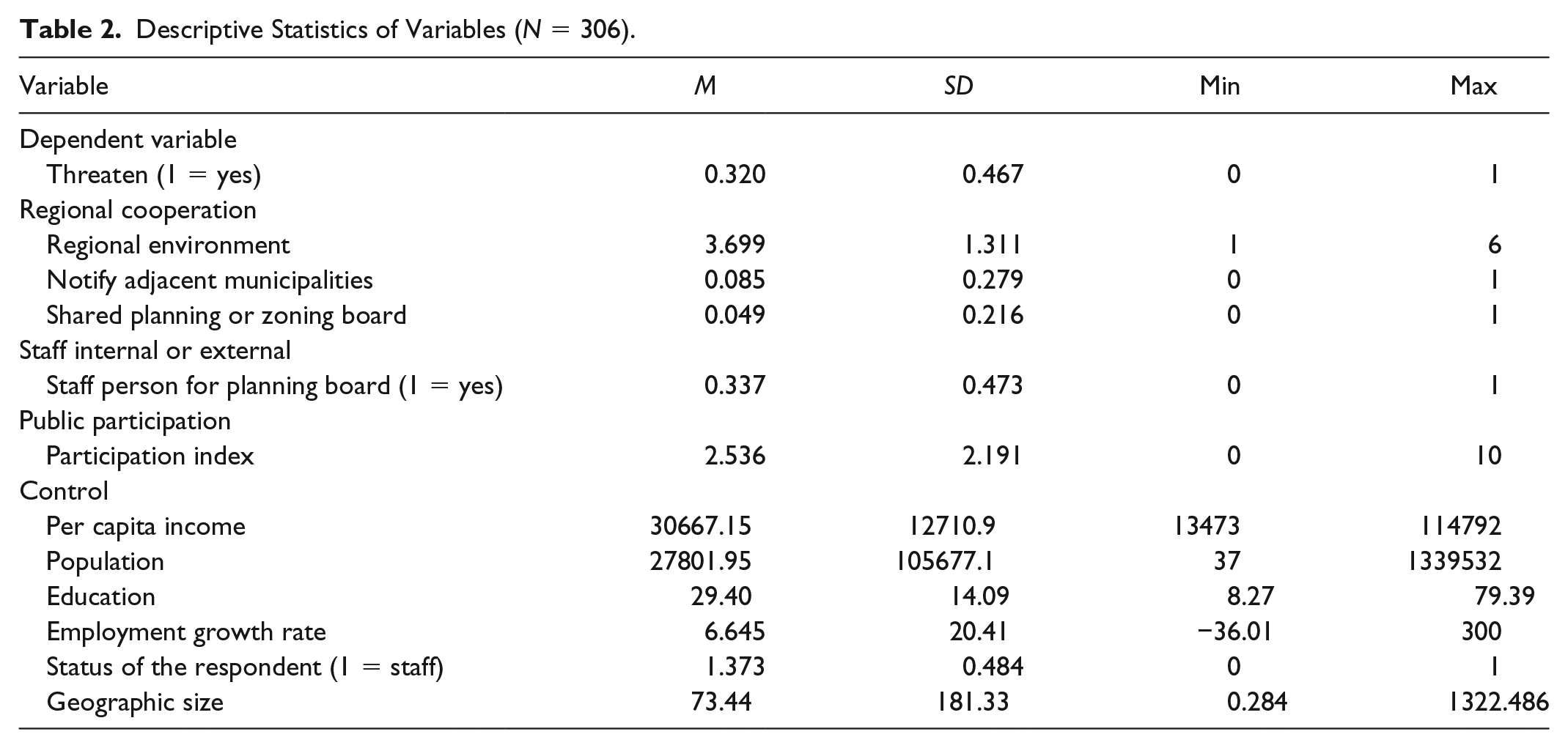
Second, we test whether having a municipally employed staff person working with the planning or zoning boards is important. This is also from a survey question. Third, we asked about public participation using a variable built on two survey questions. 2 Each question has five category options from 1 to 5. We combined the two questions to have a score of participation from 0 to 10, with 0 meaning no public participation and higher numbers indicating more public participation in that municipality.
A large amount of literature has analyzed the relationship between socioeconomic characteristics and economic development and growth related to economic disparities (Hanushek & Wößmann, 2007; Lobao, Jeanty, Partridge, & Kraybill, 2012). In general, studies include per capita income, population, and education level to understand economic development conditions. Betz, Partridge, Kraybill, and Lobao (2012) found that geographic and economic factors influence the number of development projects.
We also controlled for economic size and geographic size because developers might believe that smaller places with fewer development projects would be more susceptible to threats than economically important municipalities. All five variables are derived from the 2009 to 2013 American Community Survey 5-year average and the 2010 U.S. Decennial Census database. To measure economic growth, we calculated the employment growth rate between 2000 and 2012. Finally, we include a control for the type of respondent to the survey. This variable is 0 if respondents are elected officials and 1 if they are staff members.
Limitations
The study has two main limitations that should be noted. First, it is a study within a single state with a particular economic and land development climate. In addition, the sample size is fairly small. Given these limitations, the results are not generalizable to the nation, but rather an exploration of where a broader study might start. Second, we focus on land development projects generally. There may be different drivers of threats to communities based on the different kinds of land development projects (commercial, residential, or mixed-use). Broader surveys could check the generalizability of this work across the United States and examine whether threats are more likely based on the type of development and the community involved. Case studies in specific places experiencing developer threats are also warranted to understand the drivers explored in this study as well as the causal mechanisms that allow some places to resist such threats.
Findings
The dependent variable in this study is dichotomous so we ran a logistic regression to reveal the factors associated with a developer’s threat to move a proposed project. The results of the logistic regression analysis appear in Table 3. In examining Hypothesis 1, two of the three variables indicate that the regional environment around cooperation is significantly associated with a developer’s threat. First, the results show that local governments reporting stronger cooperative relations with neighbors decreases the chances of developers threatening a municipality. This supports, from a different perspective, previous literature indicating that collaboration helps economic development activities and collaboration among municipalities across the region supports financial gain to local governments and reduces inequities and inefficiencies (Feiock et al., 2009; E. G. Goetz & Kayser, 1993; Hawkins, 2010; Lee, Feiock, & Lee, 2012).
Model Results of Likelihood of Receiving a Developer’s Threat.
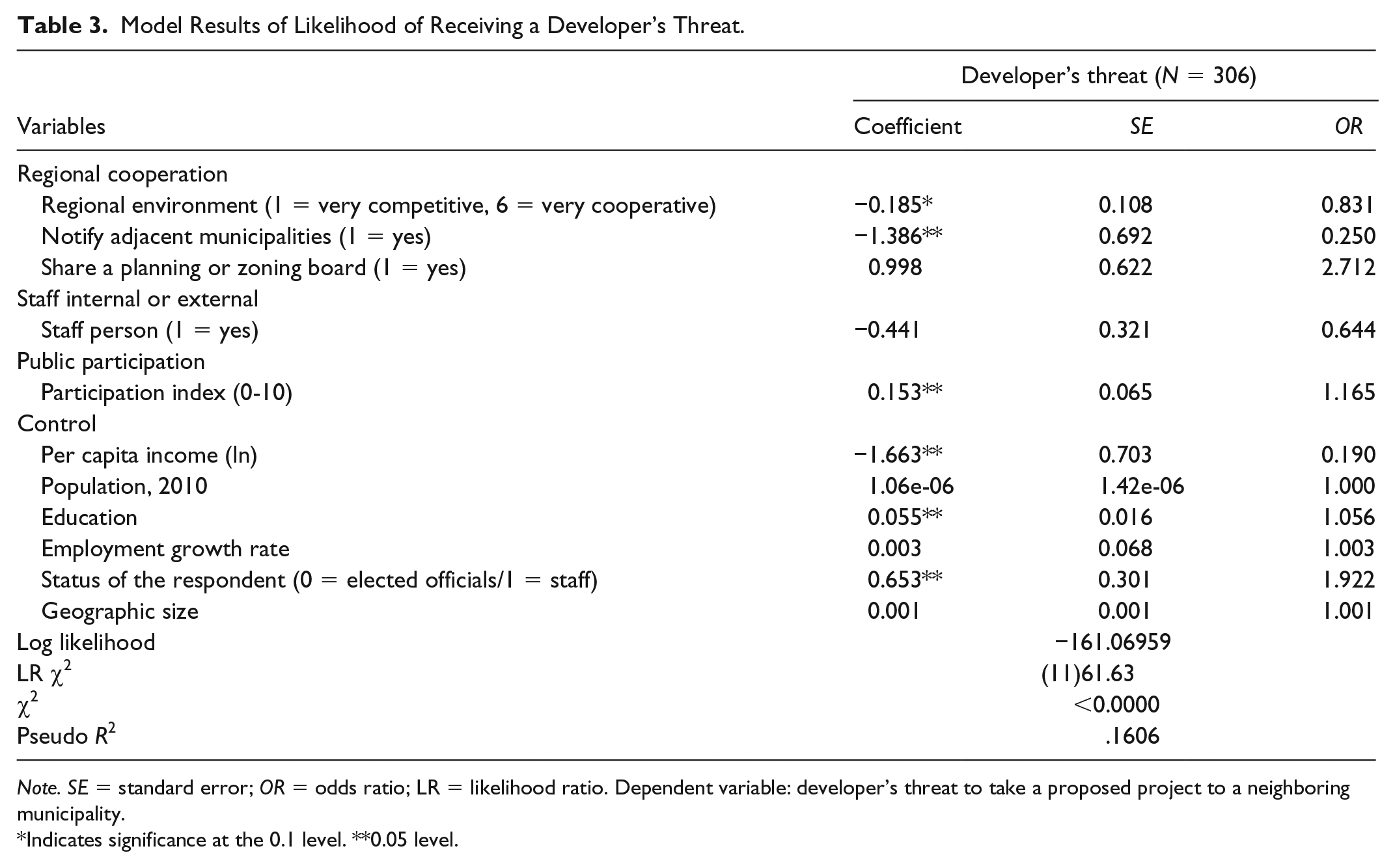
Note. SE = standard error; OR = odds ratio; LR = likelihood ratio. Dependent variable: developer’s threat to take a proposed project to a neighboring municipality.
Indicates significance at the 0.1 level. **0.05 level.
Similarly, we find that communicating with neighbors about land development projects reduces the chances that a developer will threaten to take a project to a different municipality. The results show that municipalities that always notify neighboring governments about new building proposals are less likely to experience a threat from developers than municipalities with occasional or no notification. However, the result of sharing a consolidated planning or zoning board with another municipality is not significant. This finding surprised us because one would think that the shared review of projects would make communication easier and lessen the likelihood of threats. Two reasons stand out as potential reasons for this finding and point to the need for more investigation. First, 95% of the respondents do not share a planning or zoning board with another municipality, which limits the power of the variable. Second, most of those instances of sharing likely occur between villages and the towns in which they sit; a quirk of New York municipal law that limits the chance that the two actually compete for land development projects.
The model results did not support Hypothesis 2, which having a municipally employed staff person working with the planning or zoning board reduces the chances of a threat. Also, the analysis did not support that public participation significantly decreases the chances of a developer’s threat. We had expected that a more open and democratic process would undercut the impact of a developer threat and thus reduce the chances of such a threat being issued. Drawing on the literature that identifies the negative impacts of public participation (Cogan et al., 1986; Hunter & Leyden, 1995; Jami & Walsh, 2014; Michels & Graaf, 2010; Schively, 2007), we believe that there may be two reasons for this finding. First, a development process that involves an extensive public participation process can be slow, and developers may push back and issue the threat to speed up the process. Second, developers may recognize that the diversity of voices around a public participation table opens the possibility that a threat could find solid footing with at least some people. Developers may hope that those stakeholders, fearful of losing a project, find their voice after issuing a threat and act, even unwittingly, as project supporters.
There are two interesting findings in the control variables. First, poorer places in the New York State data tend to be more threatened by developers. Perhaps this relates to the way that developers perceive whether a community desperately wants a project. Second, we find that when staff members filled out the survey, they seem to report more threats than when elected officials completed the instrument. We suspect staff may work in a particular place longer and therefore may be exposed to more developer threats than elected officials; or, perhaps developers feel that threatening a staff person is more fruitful. More research on the role of staff versus elected officials would enable a better understanding of this area.
Discussion
Our study indicates that regional collaboration can recapture some power from developers and for local governments. When developers threaten a municipality with the prospect of moving a project to another community, local governments in regional competition for tax base surrender some of their power to the developer as they seek to win the project. Such a land development framework sets up a “race to the bottom” as communities compete to provide greater and costly incentives for the built projects (S. J. Goetz, Partridge, Rickman, & Majumdar, 2011). Our research, among the first to empirically measure threats and their drivers, offers a different perspective on the challenges that local governments face developer threats within competitive regions. The more collaborative a region is perceived to be, the lower the likelihood that municipalities will face a developer’s threat. This returns some of the power to the local government, which can withstand the calls for more concessions and better shape land development projects.
Collaboration can come in various forms and determining the most relevant kind requires additional investigation. Our study finds that notifying nearby municipalities during the new building process is a significant and potentially powerful factor for reducing the likelihood of a developer’s threat. New York State, where we conducted our study, mandates notification of neighboring municipalities in some circumstances (such as when the project sits within a certain distance of a municipal boundary) in recognition of a project’s potential intermunicipal impacts. For our study, we sought to see the impact on developer threats of going beyond the state-required notice because we believe that notifying a neighbor municipality about projects builds trust and reduces the ability of a developer to pit one municipality against another. A lot of research describes the importance of trust in interlocal agreements and its development through various social, professional, and informal networks (Feiock et al., 2009; Lee et al., 2012; Thurmaier & Wood, 2002). These studies often focus on shared public service delivery. Collaboration that occurs as part of a notification process of a neighboring municipality’s development review adds a new dimension to the regional economic development literature.
Successful interlocal collaboration requires municipal staff members or local elected officials with the capacity to work together (Andranovich, 1995). Many local governments employ contract staff, such as lawyers or engineers, to support the work of planning boards. Although we thought that having a municipally employed staff person working with the planning or zoning board would decrease the likelihood of a threat, our results indicate that such a staff member is not an important factor for a developer threatening to move a project. This first study of the issue does not explain why, but other literature indicates that that privatization of government services leads to negative community or social impacts (Homsy, 2018; Warner & Hefetz, 2002). Local governments commonly use contracting when the municipality has difficulty finding permanent professional staff. In our sample, many of the local governments are small and in rural areas and there may not be the population that can cover the capacity. This question can benefit from continued investigation.
We hypothesized that public participation would play the same role within a community that collaboration plays across a region. This initial study indicates that may not to be the case, with public participation increasing the chances that a community will be threatened by a developer. Many researchers have pointed out the benefit of having public participation in a land development project (Beierle & Konisky, 2000; Bingham et al., 2005; Bryson, 2004; Michels & Graaf, 2010; Wagenet & Pfeffer, 2007). However, among others, Putnam (2000) pointed out that “urban gangs, NIMBY movements, and power elites often exploit social capital to achieve ends that are antisocial from a wider perspective” (pp. 21-22). Case study research could identify whether developers leverage social capital generated by public participation efforts to their own advantage by using residential proxies to make the case for them or by splitting opposition.
This study illustrates that low-income municipalities tend to have a greater likelihood of being threatened by developers than high-income municipalities. In most cases, developers initiate the land development project and planners respond to that. Developers can hire experts, have economic resources, and arrange financing (Forester, 1987). Despite the need for development, low-income neighborhoods likely wait until developers start the development proposals rather than proactively seek to attract the developers (Pothukuchi, 2005). Also, local governments, especially poorer ones, are often at a technological disadvantage. These low-income communities tend to use more business incentives than high-income communities (Zhang, Warner, & Homsy, 2017) and therefore may be perceived by developers as more open to projects and thus susceptible to threats.
Conclusion
This study adds to the economic development literature by identifying important factors related to the chances that a developer will threaten to take a land development project to a neighboring municipality. The research offers a new perspective on interlocal collaboration and regional planning for economic development. Intermunicipal conflict arises when local officials conclude regional development is a zero-sum game and seek to make better offers to developers. Communities desiring to be more sustainable will have to negotiate this tension to shape the development within their borders and find ways to work regionally so that they do not get caught in the zero-sum game of regional competition for new development.
Under current rules of the economic development game, municipalities seek to attract developers to their jurisdictions for the jobs or revenue benefits. We found that about 30% of municipalities reported being threatened. Often, the reason developers threaten to stop or move proposed development projects is because another municipality offered better benefits. Results show that regional cooperation is negatively related to a developer’s threat. Municipalities hoping to decrease the likelihood of developers’ threats may find that by working collaboratively and sharing information with neighboring municipalities puts them into a better position with regard to developers and the potential for threats. Strong cooperation, trust, and sharing knowledge or sources among local governments may be particularly important for low-income communities due to lack of resources.
The utility of public participation in this area is more challenging as our study finds that public participation significantly increases the chances of developers’ threats. Many factors play into whether public participation is important and further investigation is needed to identify whether and how local governments generate public participation in these cases. There are many kinds of public participation with varying intensity. Future study may help understand how different communities operationalize public participation differently and how that affects outcomes such as developer threats. Otherwise, this study helps local officials begin to understand the extent to which other places face similar threats and may help them understand what may predict whether a developer might threaten a particular place. By seeing the drivers of those threats, officials can start to understand the pressures facing their communities.
Footnotes
Declaration of Conflicting Interests
The author(s) declared no potential conflicts of interest with respect to the research, authorship, and/or publication of this article.
Funding
The author(s) received no financial support for the research, authorship, and/or publication of this article.
