




Abstract
Intersectionality has been adopted as the preferred term to refer to and to analyze multiple axes of oppression in feminist theory. However, less research examines if this term, and the political analyses it carries, has been adopted by women’s rights organizations in various contexts and to what effect. Drawing on interviews with activists working in a variety of women’s rights organizations in France and Canada, I show that intersectionality is only one of the repertoires that a women’s rights organization might use to analyze the social experience and the political interests of women situated at the intersection of several axes of domination. I propose a typology of four repertoires that activists use to reflect on intersectionality and inclusiveness. Drawing on a quantitative and qualitative analysis of the interview data, I show that hegemonic repertoires about racial or religious identity in one national context shape the way activists and organizations understand intersectionality and its challenges. The identity of organizations, as well as their main function (advocacy or providing service), also shape their understanding of intersectional issues.
The genealogy of the concept of intersectionality in feminist scholarship traces it back to the seminal and influential work of black feminists and feminists of color (Hancock 2007a; McCall 2005; Roth 2004). This intellectual tradition can be summarized by the following set of ideas: (1) The intersection of at least two axes of domination, such as race and gender, constitutes a social category with a specific experience of social life; (2) oppression is not experienced in a segmented but in a unified way, because social relations are interlocked rather than simply added one on top of the other; (3) this experience of a complex form of oppression shapes subjectivity and a specific standpoint and specific political interests; and (4) these political interests have been denied or misrepresented by theories or policies and need to be restored to the political agenda (e.g., Collins 1990; Crenshaw 1989, 1991; Hancock 2007a, 2007b; Jordan-Zachery 2008).
In this tradition, using the concept of intersectionality means, among other methodological challenges, “including the perspective of multiply-marginalized groups” and, stemming from this premise, challenging the “universal,” that is, the social experience of groups whose privileges define the norm against which other groups are considered (Choo and Ferree 2010). In this article, I investigate the extent to which the theoretical and political premises of intersectionality have been adopted, or not, by women’s rights organizations as their main framework to conceptualize the social experiences and identities of women situated at the intersection of several axes of domination, and to include what is perceived as their specific interests in the praxis and ideology of the organization. Drawing on comparative fieldwork in France and Canada, I argue that intersectionality is one of the repertoires a women’s organization can use, but it is not the only one. Hence, I document the various ways in which feminist organizations respond to the challenge of including women who are vulnerable to multiple types of oppression. By doing so, I bring attention to what is specific to the concept and the praxis of intersectionality. I also show that different repertoires come with opposing political consequences, both for racialized women and for the women’s movement in general. By comparing several feminist organizations in two contrasting national contexts, France and Canada, I also elucidate the factors that can explain why some organizations include intersectionality on their agenda while others dismiss its relevance.
Intersectionality and Women’s Movements
The concept of intersectionality has attracted both theoretical and methodological attention (McCall 2005). Recent research on intersectionality has called for new ways and metaphors to think about the race–class–gender nexus as the product of processes taking place at multiple levels and in various social settings (Choo and Ferree 2010; Glenn 2002; Yuval-Davis 2006). However, since its inception, the concept has also aimed at providing a tool to critically analyze social and political practices and, in particular, feminist practice. It has unveiled how differences rooted in social relations marked by oppression, political marginalization, imperialism, or economic exploitation have led to the marginalization and silencing of minority women’s voices inside the mainstream women’s movement (Collins 1990, 2012; Crenshaw 1989). I propose to explore this crucial question with an original comparative framework in order to identify the various forms that intersectional practices can take, and the factors that may help, or impede, the inclusion of disadvantaged intersectional groups’ interests.
The issue of the heterogeneity of the group “women” is not new for women’s movements. One of the ways in which bridging differences has been attempted historically in women’s movements is with the invocation of forms of “sisterhood” or “solidarity” (e.g., Lawston 2009; Smith 1995). Expressions such as “double oppression” and “triple jeopardy” (Nelson 2003, 62) used by many women’s movements in the 1970s pointed to the need to address the specific needs of disadvantaged intersectional groups inside the women’s movement properly. Contemporary women’s rights organizations face similar dilemmas, and a growing and promising body of research examines women’s rights organizations with an intersectional lens.
One strand of research examines the genealogy of “separate roads to feminism”—to use Benita Roth’s expression—shaped by the broader political context and the ways in which structures of inequality have differently shaped collective identities for intersectional groups such as white women, black women, or Chicanas in the U.S. (Roth 2004) and Europe (Predelli and Halsaa 2012). The resulting conflicts, negotiations, or strategic alliances among these separate movements are the focus of a second strand of research which explores more precisely the relationships between majority women’s movements and minority women’s movements, looking not only at politics of alliances but also exclusions (Breines 2006; Nelson 2003; Predelli and Halsaa 2012). For example, Line Nyhagen Predelli and Beatrice Halsaa’s comparative work on the UK, Spain, and Norway looks not only at conflicts but also instances of strategic sisterhoods between women’s organizations separated by racial and ethnic identities (Predelli and Halsaa 2012). Looking at similar organizations at the European level, Lise Rolandsen Agustín describes the various strategies they have adopted to address diversity (Rolandsen Agustín 2013, 80). An adjacent strand of research focuses on intersectionality in the context of coalition building, at the national level (Cole 2008; Townsend-Bell 2011, on Uruguay) or the international level (Giraud and Dufour 2010; Weldon 2006).
Hence, most of the focus so far, including Crenshaw’s seminal work, has been on the important issue of the relationships among separate organizations, and the possible inclusion of minority women’s organizations into majority women’s organizational platforms or in the context of coalitions. Less attention has been given to how minority and majority women’s rights organizations conceive of and practice intersectionality internally. An exception is the work of Dara Strolovitch, who looked into whether advocacy organizations for women, racial minorities, and the poor include in their political agenda the interests of underprivileged groups among their constituencies (Strolovitch 2007). Strolovitch documents the mechanisms by which these organizations tend to privilege claims and issues that will benefit a majority of their constituency, or the advantaged subgroup in this constituency, thereby automatically marginalizing disadvantaged subgroups’ interests. Following Strolovitch’s focus on intersectionality inside organizations, I propose to deepen our understanding of inclusion and intersectionality in women’s movements by (1) positing that intersectionality, as it is defined in feminist theory, is only one of the possible ways for an organization to frame and represent the political interests of disadvantaged intersectional groups, and (2) adopting a comparative perspective between minority women and majority women’s organizations in two contrasting national contexts, France and Canada.
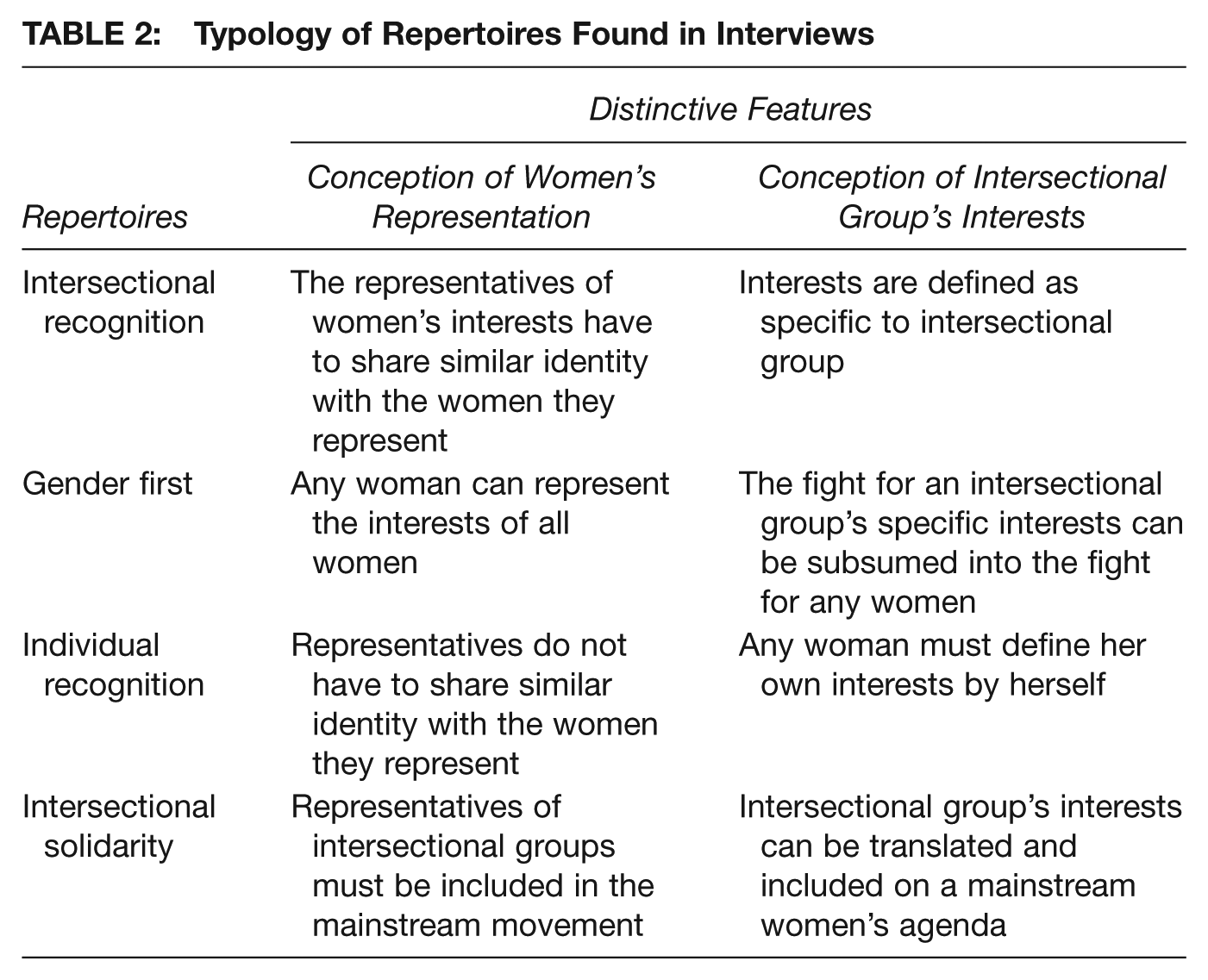
Much research that proposes to analyze intersectional inclusion does so in a binary way: Either minority women and/or their interests are included or they are not. For example, in Strolovitch’s work, intersectional advocacy means including minority groups’ political priorities in the platform of the organization. What those intersectional interests are, who defines them, and how they are perceived as subsumable into the agenda of the organization is not the focus of attention. On the contrary, I propose to focus on how intersectional interests are articulated, perceived, and defined by women’s rights organizations. I look in particular at who is conceived as the legitimate bearer of these interests, and I explore whether those interests are conceived as separate or included in the dominant feminist agenda (see Table 2). Hence, I investigate, for example, if for activists intersectional interests can be subsumed under other more “universal interests,” if women who share similar social traits must represent them, or if any feminist can defend them. To answer these questions, I use the concept of repertoires, borrowed from the sociology of culture, to capture the various ways in which women’s organizations understand, conceptualize, and include the identities and interests of women vulnerable to oppression other than gender oppression. Cultural repertoires are “schemas of evaluation mobilized at the discursive or interactional level” (Lamont and Thévenot 2000, 8) that are of particular import in the process of drawing symbolic boundaries between social groups. Hence the concept is particularly useful to study how the actors’ meaning-making activities have an impact on the social dynamics of inequality. Typically, in a given context, various cultural repertoires will be available to social actors to explain, evaluate, or justify the course of action they will take. I therefore document the various repertoires that organizations might use to think about and implement the imperative of inclusion of minority women.
Second, in contrast with case studies that focus on one national context and/or one type of organization (e.g., Roth 2004; Strolovitch 2007; Townsend-Bell 2011), the comparative framework I propose makes it possible to analyze when and why organizations use one repertoire rather than another, and allows us to reflect on the conditions that favor or impede the use of intersectionality. So far, two factors have been identified in the literature as conducive to greater inclusion of minority women’s interests in coalitions or political platforms. The first is institutional, that is, the existence of procedures ensuring the descriptive representation of minority women and the institutionalization of dissent through formal procedures (Giraud and Dufour 2010; Weldon 2006). A second important dimension is the political and historical context within which the identity of a women’s movement develops, shaping how it defines patriarchy and gender oppression with relation to class or race (Lépinard 2007; Nelson 2003; Roth 2004). This political legacy can indeed impact the ability of women’s organizations to include intersectional claims or not. Focusing on how various women’s rights organizations define intersectional claims and evaluate their legitimacy in two different national contexts allows me to bring to the fore new factors that I discuss.
Data and Method
Because the case studies under scrutiny are from France and Canada, this article takes as its object the matrix of domination (Collins 1990) formed by gender, ethnicity, and migration, understood not as identities but as historical structures that shape patterns of inequality and marginalization. The choice to focus on ethnicity/migration stems from the salience of these issues in public debates and the ever more visible role these interlocked social structures play in racializing specific social groups, shaping contrasting experiences of citizenship, and producing patterns of discrimination in many countries, including the two under study (El-Tayeb 2011).
To answer the questions raised by intersectionality for women’s organizations, I have developed a three-level comparative framework. The literature on comparative social movements and on gender and social movements has emphasized the role that political opportunity structures play in shaping women’s movements (Beckwith 2000; Taylor and Whittier 1998). Various elements of the political opportunity structure may matter depending on the issue a social movement engages in (McAdam 1996). Scholarship on intersectional policy debates, such as those about the Islamic veil in Europe, has shown that a crucial dimension of the political opportunity structure is a country’s citizenship regime, and in particular the norms and policy frames for immigration and ethnic/religious difference that it promotes (Rosenberger and Sauer 2012). Hence, to assess the extent to which citizenship regimes shape women’s organizations’ relationship to intersectionality, I compare two countries marked by opposite public policies and dominant policy frames when it comes to the issue of diversity: France and Canada.
France and Canada present solid examples of two contrasting national models of citizenship, especially when it comes to the issue of migrants and minority groups’ inclusion. Since the 1980s, Canada’s official policy of multiculturalism has meant a rejection of cultural assimilation and the valorization of cultural diversity as the very fabric of Canadian society (Kymlicka 1998, ch. 3). 1 Mobilization around ethnic identity is common and very much encouraged by public authorities (Bloemraad 2006). Conversely, what has been labeled the French “republican model” promotes a contrasting philosophy of integration emphasizing a common, national, civic culture instead of pluralism, an abstract concept of citizenship, color-blindness, and civic and cultural assimilation on the part of migrants (Frader and Chapman 2004) as well as religious minorities. In this context, ethnic categories are deemed suspicious in public debates and are often controversial, making mobilization around ethnic identity difficult.
As a consequence, ethnicity does not have the same relevance, to borrow Erica Townsend-Bell’s term (2011), for women’s rights organizations in both countries. Although not all members of Canadian women’s rights organizations were familiar with the term intersectionality, many of them knew what it meant, and the question of multiple discriminations or accommodating cultural differences is common knowledge for activists who frame it as part of their commitment to “intercultural dialogue.” In France, since the mid-2000s, the translation, adoption, and use of the term intersectionality by feminist scholars (e.g., Dorlin 2009) 2 testifies to the increasing relevance of ethnicity and race for French feminist theory, contrasting with earlier decades during which French academic feminism focused mostly on the intersection of gender and class, called consubstantialité (consubstantiality), imbrication (intertwining), or entrecroisement (crisscrossing) (Kergoat 2000). However, interviews revealed that the term intersectionality remains unknown for the vast majority of French women’s rights activists. Historically, some French organizations focused on women migrants as early as the 1980s (Lesselier 2007) and used the term “double violence.” However, this term was rarely mentioned by interviewees who preferred circumlocutions such as “taking into account differences” in order to refer to issues linked with intersectionality.
In each country, feminist organizations have taken diverging positions in political debates, for example, on Muslim veiling issues, promoting different visions of how religious/cultural difference should be tolerated and accommodated (on the Ontarian case, see Bakht 2007, Bassel 2012, Korteweg 2008, Lépinard 2010, and Razack 2007; on the Québécois case, see Baines 2009; and on France, see Scott 2007). The variety of feminist positioning on the issue of multiculturalism and minority women’s religious rights in both countries suggests that explanations based on the national political structure of opportunity cannot account for the full range of feminist attitudes, nor for the important conflicts these issues raise within feminist movements and women’s organizations.
In addition to comparing women’s organizations in two contrasting national contexts, my comparative framework adds two variables in order to tease out which factors may account for the ways in which women’s organizations approach intersectionality. Indeed, organizational processes and characteristics also matter when explaining the frames and the political priorities adopted by a social movement. The first characteristic that should be explored is the organization’s identity (e.g., Morris and Mueller 1992). Thus, the sample was divided between women’s organizations that present themselves as representing one or several immigrant or ethnic groups and serve specifically women from these groups, which I call dual axes organizations, and women’s organizations that do not claim to represent a specific group of women but rather frame their identity and claims on the basis of gender alone, which I call single axis organizations. This categorization does not imply that dual axes organizations do not participate in networks or actions focusing on women’s rights more generally, nor that single axis organizations do not address issues of migrant or ethnic women in their platforms or actions. The main difference lies in how they frame their identity and the constituency they target or claim to represent. 3
The second characteristic is the function of the organization, that is, its main purpose or strategy, which determines the type of concrete work it engages in (Minkoff 1995). I compare organizations focused on advocacy with organizations acting as service providers. These two distinctions overlap to a certain extent: While not all service provider organizations are dedicated to minority women, dual axes organizations tend overall to be service providers rather than advocacy-oriented organizations; however, they are clearly analytically distinct and therefore are both useful.
This analysis is based on interviews with feminist activists working in fifty women’s organizations, as officers or heads of the organization. Most of the time, only one person was interviewed for each organization. The distribution of interviews and organizations within the sample is presented in Table 1.
The Distribution of Organizations in the Sample

Organizations were chosen in the biggest cities in two Canadian provinces, Ontario and Québec, as well as in Paris and neighboring cities in France. In order to select organizations, in Canada I consulted listings of women’s organizations compiled by official agencies (such as the Québec’s Conseil du Statut de la Femme) and selected organizations representing a variety of ethnic backgrounds and maintaining a balance between advocacy-type organizations and service providers in my sample. 4 All the organizations I contacted responded positively. In France, no exhaustive listing exists, but I relied on prior knowledge of the landscape of the women’s movements, as well as a snowball sampling technique, to identify service-oriented organizations claiming an ethnic/immigrant identity. Given the existing networks among service provider organizations and advocacy organizations (on issues such as violence against women, for example), after the first round of interviews I was able to identify almost all organizations that were relevant for this research and to interview representatives from all but one. Potential bias in the sample is in favor of organizations that have a permanent structure and several officers. Smaller community groups with no regular activities and a very small constituency, which particularly exist in Canada, were not always selected for interview.
During interviews, I asked each activist general questions about her organization, its history, priorities, funding sources, coalition work, relationships with other women’s rights organizations, and positioning on controversial issues, such as legislative initiatives to ban Islamic veiling or Shari’a courts. I also asked how each interviewee conceived of the question of ethnic, cultural, and religious differences among women both at the abstract level—how important they are, to what extent they should be reflected in the organization’s priorities—and at the concrete level—how they deal with issues relating to ethnic, cultural, or religious differences in their daily practices. I asked for specific examples of differences that my interviewees believe should be accommodated, recognized, or included in the organization’s political platform or in its concrete practices, and why. These practical examples from interviewees cannot fill the gap between what people say and what they actually do, but they provide an important window on how interviewees reflect on and give meaning to their own practices. Finally, I asked them if they were familiar with the term intersectionality and what it meant for them. The interviews lasted between 60 and 180 minutes and were coded using ATLAS.ti. Seven hundred seventy-eight quotations in total were coded with more than 25 different codes. Of the extracted quotes, 166 refer directly to intersectional issues and were coded in accordance with the repertoires presented (for a similar methodology, see Lamont, Mallard, and Guetzkow 2009). The remaining quotes relate to other topics addressed during the interview.
Doing Intersectionality: Four Repertoires
From the data collected, I elaborated inductively a typology of four repertoires that activists use to talk about differences among women, structural intersectionality, and modalities of inclusion of differences other than gender in their feminist praxis. These repertoires are ideal-types that present relatively coherent approaches and rationales; they are not mutually exclusive. Sometimes, interviewees mobilized more than one, combined them, or used them consecutively without mentioning their potential contradictions.
Typology of Repertoires Found in Interviews
“On Our Own Terms”: Intersectional Recognition
The first repertoire used to address the question of differences among women and complex oppression is the claim that racialized/immigrant women have specific needs and interests, and that minority women are better placed to respond to these needs. This discourse, most predominant among dual axes organizations devoted to women from specific ethnocultural groups, also underscores single axis feminist organizations’ tendency to be ignorant or indifferent to these needs, leading to the development of dual axes organizations in the first place. The matrix of domination is understood as the product of a complex dynamic, including the need to integrate into the host society as an immigrant, the specific position of women in their own community, and their position as women who are also part of a racialized minority group. Hence, most of the time “immigrant woman,” “South Asian woman,” or “daughter of immigrants” refers to this complex nexus of power relations that characterize their identity rather than to an additive conception of oppression.
With this repertoire, activists emphasize specific needs that justify a community-based or ethnic-based approach. Nandita,
5
a feminist activist in her fifties originally from Pakistan, who now heads a South Asian Women community center in Toronto, explains the approach of her organization, anchored in the community’s cultural specificity and the specific needs of immigrant women: There was a need. Because there was at start . . . gaps were identified. Gaps related to language, related to culture, related to religious practices, related to marriage, related to family life in Canada, related to the whole issue of the immigrant experience, and then things started emerging about employment and, you know, recognition of credentials.
The specific needs that dual axes organizations address are related to immigration status (to help women find employment or file for permanent residency) and to language (providing service in native language for recent immigrants). A common experience, in terms of cultural or migrant background, shared by the social workers and the women they serve, is presented as crucial—a prerequisite for trust, authenticity, and solidarity (for similar findings, see Ku 2009). As Samira, in her fifties and of Algerian migrant descent, who founded and heads a French organization devoted to girls in deprived neighborhoods near Paris, summarizes: Girls who came to us were mostly of immigrant descent. . . . We just did not feel like going and meeting a social worker, a nurse, or a teacher, or I don’t know who, because their attitude was always full of prejudice towards foreigners, towards immigrants . . . so to cut this crap it was way better to be among ourselves . . . the idea was not to be framed at all by anybody . . . to be listened to without prejudice.
However, sometimes more than a politics of needs and shared experience is at stake: The elaboration of a collective political interest, which differs from the ones represented by single axis women’s rights groups, might be at play. Hints at cultural and racial difference often point towards practices of exclusion, for example, in shelters that do not accommodate minority women’s needs in terms of food or language. More broadly, Nandita also suggests that political priorities do not always overlap. Discussing the dissolution of the National Action Committee on the Status of Women (NAC), the oldest federal coalition for women’s rights in Canada, due to internal conflicts relating to the exclusion of minority women’s issues (Dobrowolsky 2000), she declares: We may have parallel movements. Movements that are different because there was a notion of the equality for mainstream that may be an issue related to choice. The issue of equality for women of color may be an issue related to inclusion practices, immigrant rights, immigration, deportation, and all of those issues. . . . Yes, there are bridges, but there has to be a giving up of space, a giving up of power and a willing to embrace that, you know, this is not the other, but this woman is also part of the entire picture.
The hierarchy of political interests might differ from the one proposed by single axis women’s groups and lead minority women activists to self-organize on a specific identity basis. A representative of a French group defending lesbians of color explains this dynamic: We needed a space for lesbians of color where we could meet without pressure, without having to justify ourselves, where we could organize autonomously our thinking, and politically as well, with a greater consistency between our experiences and our claims with respect to oppressions croisées (intersecting oppressions), racism, sexism, lesbophobia, and class struggle. . . . In the previous organization [with white lesbians] we have had great projects and actions. It was a passionate moment of activism. But obviously [white] lesbians and feminists could not evolve on the question of the croisement (intersection) of racism, sexism, and capitalism . . . so there was this hierarchy between struggles, which I could not bear anymore.
This observation encapsulates the articulation between what Crenshaw (1989) labeled structural intersectionality (lived and embodied social experience at the intersection of several axes of oppression) and political intersectionality, that is, the translation of these social experiences into specific political claims that are marginalized by single axis organizations. In this repertoire strategic and punctual alliances can be made with other feminist organizations, but organizational autonomy is claimed as necessary to ensure that the political interests that derive from an intersectional location can be expressed and heard.
A Gender-First Approach: Universalizing, Subsuming, and Erasing Differences
A common rationale among single axis advocacy-oriented organizations tends to subsume “other” differences under gender difference. In this case, structural intersectionality is understood in an additive manner. The argument runs as follows: Some women are discriminated against more than others for various reasons, but in the end they are discriminated against as women, and this is what needs to be addressed. Minority women, disabled women, and immigrant women are perceived as subcategories of the primary category “women.” Hence, the elaboration of a political interest must focus on what is common to all women. It can include a focus on some women who are particularly discriminated against, but the overall framework is gender oppression. Hence, subcategories do not challenge the collective identity “women” that these organizations represent, and they do not challenge the hierarchy of political interests that they identify as priorities for “women.” Eliane, a white Québécois feminist in her fifties who is employed at an independent agency for women’s rights, explains: I think there’s generally a serious systemic discrimination against women. It’s even more exacerbated if it concerns migrant women, and we’re very concerned by this. Especially in employment. Migrant women are very much discriminated against. We’re very attentive to this. But the first cause of this discrimination, it’s because they are women, first and foremost. And then you add to that. But if they were men, they would not experience this discrimination.
Catherine, a white French woman in her forties who heads the French advocacy-oriented women’s rights organization Decide! also suggests focusing on what’s common to all women rather than on potential divisions. Reflecting on her organization’s position in favor of the 2004 law prohibiting the Muslim headscarf in French public schools, she states: We agree [with feminists and minority women against the headscarf ban] on other things. Maybe our position is very sharp on the veil issue, but we can be allies on other issues, and the most important struggle, after all, is gender equality, and it’s parity, it’s equal pay. And that’s our core lobbying, violence against women. . . . I think that beyond the veil we have lots of common ground on these issues, which are not solved for women today. The veil is a specific issue, but there are many more important issues.
In this case, the insistence on common causes erases minority women’s political priorities that are labeled “specific.” The focus on advocacy tends to homogenize the category “women” which is the collective subject and the raison d’être of this type of organization aspiring to represent “all” women. Julie, a young public relations officer of a French organization identifying as representing women and girls from the “projects” (i.e., daughters of immigrants) clarifies: This logic [to organize on an ethnic or national origin basis] is not ours. And I think it’s not the right way to do it. Today we are the voice of all the women who believe in the feminist conception of equality under the republic, that’s our conception, and who need help at one point or another, whatever their origin, their color, their sexual orientation.
However, the subsuming of differences under gender does not automatically entail exclusions in practice. When questioned about the concept of intersectionality, Corinne, a white French woman in her forties who heads a large French network of women’s rights groups focused on feminist advocacy and providing counseling services to women, remarks: No, I don’t know the term. But we take that in consideration when we do counseling. When we receive migrant women who are victims of domestic violence. Of course, then we have a different analysis depending on the country they come from. . . . When we don’t know, because we have a very diverse workforce, we ask our colleagues, what’s going on in this country? . . . Maybe it’s something [intersectionality] we do without knowing. . . . So that’s also . . . it’s the same, you need a specific analysis. So here it is, our universalism is not completely blind and stupid.
“On Her Own Terms”: Individual Recognition
Corinne’s remarks suggest that although an organization might, in principle, put the emphasis on women’s common political interests, its feminist praxis may be more open to intersectionality than the discourse suggests. Indeed, a common feminist praxis runs through French and Canadian feminist organizations oriented toward providing counseling and other services to women. This approach is based on the feminist view that a woman should be counseled on her own terms; that is, she should not be judged for her choices nor have a specific choice imposed on her. This approach implies respecting differences and recognizing their importance for the individual. These differences are not understood as shaped by structures of oppression, which could form the basis of a collective political subject. On the contrary, they are conceived as embedded in a woman’s life, context, and experience and must be respected so that she can, through counseling, make her own choices. Hence, the intersectional positioning of women is taken into consideration in a pragmatic way by the organization.
When tensions linked to cultural, religious, ethnic, or class differences arise between a counselor and her client, the feminist praxis of listening to her and helping her on her own terms is supposed to guarantee an inclusive approach. However, it is clearly based on the individual’s experience, and not on her identity as a member of a particular group, subjected, for instance, to racialization. For example, Martine, a white French woman in her forties, who co-heads a French feminist network of organizations dedicated to women’s health, summarizes her organization’s approach: We’re having a hard time believing that there can be such a thing as Muslim feminists because it seems to us self-contradictory . . . but . . . we are confronted [with] the question of differences. For example, territorial difference, when we work in the French Guinea and the French Caribbean . . . part of the picture is about culture. . . . But even if it’s cultural, we try to understand what’s going on for each girl, by listening to them, by working with them so that they can make the tools theirs. We always start from the individual, from what she is living, not what she represents. We never enter a case through religion; for example . . . our question is, how can we give her the tools to compose her own decision, to find herself, her own balance? We don’t give her the tools, she finds them.
In the case of the Islamic veil, Martine admits that some counselors don’t feel comfortable with women who come to the centers wearing what they perceive as a sign of submission to men. Similarly, when young Muslim women come to the centers to ask for false proof of their virginity so that they can get married with their family’s or community’s approval, the organization applies a double standard: The official position is that Women’s Health does not deliver virginity certificates because the organization does not want to encourage the perpetuation of the stigmatization of female sexuality. However, in practice, there is a lot of leeway: For some counselors these cases are really difficult ones. There is always this tension, and it’s even more tense for certificates of virginity. There’s a tension because it’s difficult to perceive them as alienated . . . it’s not right, either. Some counselors are okay with it; it depends on their individual history if they can help, if they can discuss with the girls, to try to understand why they wear the veil, why they don’t, what it means for them. When a girl comes to the center veiled, it’s true—it’s a real question for us. It questions feminism. This fact that a woman can accept this ideological domination . . . it questions us.
This pragmatic approach is highly individualized. It depends on the counselor and on each woman who comes with a story, a question, a need to be addressed. Inclusion is never guaranteed. It does help counselors to mediate the tensions that they experience between their own definition of good feminist action (e.g., refuse religious and patriarchal norms) and the action these minority women ask of them. But this repertoire of individual recognition does not lead practitioners to imagine that there might be collective interests based on an intersectional identity that should be included in the political platform of the organization. Neither does this repertoire lead organizations to address questions of representation or inclusion of racialized women at the organizational level. This repertoire thus promotes a praxis of difference that can lead to individual inclusion and recognition of ethnic or religious differences but without the political element. Typically, while several French service provider organizations welcome veiled women in need, they have simultaneously taken a position in favor of laws banning Islamic veils in public schools and full veils in the public space.
Intersectional Solidarity
A last repertoire emphasizes the need for single axis feminist organizations to include the political priorities of minority women and to improve their representation inside the women’s movement. Only Women for Québec (WFQ), a broad and inclusive umbrella organization, has consistently developed this repertoire and attempts to apply it in the training it offers to feminist activists and social workers, in the political agenda it promotes, and in its official discourse. Caroline, a Québécois black employee and feminist activist in her thirties in charge of intersectionality issues, explains what intersectionality means at WFQ: That’s how we ensure that when we’re looking at a problem, we haven’t forgotten half of the women. How to do an analysis that puts in perspective common struggles—because there are some common struggles—that’s the basis of the women’s movement, and that did not change with diversity. To be able to look into specificities, because it’s true that to be, like me, a black woman born in Québec, or to be a woman with a low-skill job, a part-time job, it’s not the same. And the same goes for being a lesbian, a woman with a disability, or everything at the same time. The basis of the movement is to work on common ground. You need this double perspective, looking transversally, and at the same time looking into the specificities.
The issue of migrant women has been prominent on the agenda of WFQ. This focus has led to the creation of a two-day training seminar on women and racism for member organizations and a research study on migrant and racialized women’s status inside the feminist movement examining whether they are well represented in the movement’s organizations, whether they have stable jobs in women’s rights groups, and in what type of activities they are predominantly working. Finally, migrant women’s priorities have been included on the agenda of WFQ: For example, the issue of the recognition [by the Québec government] of foreign diplomas and work experiences for migrant and racialized women. It’s a very specific issue, but it’s totally consistent and linked with the analyses of the feminist movement about professional integration for women or the idea that women have their place everywhere in society.
The ability to translate minority women’s needs and political priorities into mainstream feminist language enables WFQ to link immigration issues with broader themes of economic independence and professional achievement for women. Such a strategy ensures that immigrant women’s interests are placed high on the political agenda of the organization, and is likely to convince the organization’s non-minority women that these issues are of importance to them as well. This repertoire also focuses on structures of power that situate women differently. This approach implies new political priorities for the women’s movement while deepening or “updating” the traditional agenda: We realize that immigration policies impact women adversely. They have more precarious jobs because they come under the family reunification type of immigration. Globally the majority of immigrants asking for permanent residency are men, so women are totally dependent. . . . So these are important hurdles. That’s an example of how we have to update our feminist analysis—concrete feminist issues that arise when you take diversity into account.
Explaining Variations
The distribution of repertoires in this sample of organizations reveals some stable patterns suggesting that the features of an organization, as well as the national context, determine its preference to mobilize one repertoire over another. One factor that explains the variation among feminist organizations is the model of citizenship dominant in the country (and its relationship to difference). While dual axes organizations in Canada take for granted that cultural and ethnic identity are important elements to consider when providing counseling, French feminist organizations across the board prefer a “gender-first” repertoire. Although they do recognize that cultural proximity or similar backgrounds foster comprehension, when they refer to the logic of ethnic-based services for women, they tend to combine it with a strong commitment to universalist principles. The gender-first repertoire represents 94.7 percent of all repertoires used by French single axis organizations, and 51.9 percent of all repertoires used by French dual axes organizations, compared with 44.6 percent and 15.6 percent, respectively, for Canadian single axis and dual axes organizations.
The Frequency Distribution of Repertoires of Inclusion by Country and Identity of Organization

The numbers in each cell represent the absolute number of occurrences of each repertoire (and not just whether the repertoire appeared once in the interview). In this cell, the percentage represents the frequency of the repertoire “on our own terms” among the interviews with workers in France in dual axes organizations.
The Canadian pattern of women’s rights organizations’ acceptance of the importance of ethnic and cultural identity follows the precept of governmental multicultural policies. In fact, mobilization by minority women who organize to provide help for migrant women to integrate is a direct response to the incentives given by the federal government to ethnic communities to self-organize, especially in the field of immigrant integration (Bloemraad 2006; Ku 2009). Funding received by the dual axes organizations I interviewed comes primarily from the Ministry of Cultural Communities and Integration and the Fonds d’Aide à l’Action Communautaire Autonome, a program that funds grassroots organizations, including women and ethnic minorities. This might explain why dual axes organizations do not feel they have to mobilize a gender-first repertoire to legitimize their work, and why single axis organizations often deem intercultural action as part of their job. However, taking into account cultural diversity can also reduce it to issues of differences in traditional cuisine or to ascribed cultural traits, without considering processes of racialization or discrimination. An officer in a women’s center located in a multicultural neighborhood of Montréal provides a good example of this approach: I would prefer to say that diversity is better because if it’s just all from the same, you don’t learn as much. . . . I think that diversity is really great because . . . like when we prepare our meal. . . . We have somebody from Bangladesh who is gonna prepare a chicken a different way than somebody from the West Indies would prepare a chicken. And they use a different kind of spice.
This type of multicultural perspective shifts attention away from political intersectionality and tends to reproduce the dominant narrative of Canadian multiculturalism as being about recognition of essentialized cultural differences rather than about power relations among racialized groups (Ku 2009).
In France, too, dual axes women’s organizations receive funding from governmental agencies dedicated to immigrant integration, but, following the French concept of immigrant integration, these agencies encourage organizations to present themselves as defined territorially (an identity bounded by the quartier, i.e., neighborhood) rather than ethnically. Of importance is social work carried out in specific deprived neighborhoods where a majority of the population is of migrant descent, and not catering to a specific ethnic community. French feminist activists appear clearly in line with the dominant French concept of abstract citizenship and difference-blind universalism that reject the use of ethnic categories in the French public sphere. However, this does not mean that there is no potential for intersectionality in the French context. The historical acknowledgment of the intersection of gender and class, as well as the emergence of small activists’ groups identifying as “Indigenous Feminists of the Republic” (a reference to colonial indigenous subjects) or as “Lesbians of Color,” shows that intersectional politics can exist, although at the margins of the political and feminist landscape, and question the dominant narratives within the French feminist movement.
When examining the data according to organizations’ identities, both national specificities and the differences between dual axes and single axis organizations stand out. Logically, dual axes organizations use relatively more often “on our own terms” and “on her own terms” repertoires than single axis organizations do. In both countries, they tend to favor a discourse of intersectional recognition “on our own terms,” highlighting their role in serving their own communities’ needs, which is, quite logically, totally absent from single axis organizations.
The Frequency Distribution of Repertoires of Inclusion by Country and Function of Organization

The numbers in each cell represent the absolute number of occurrences of each repertoire (and not just whether the repertoire appeared once in the interview). In this cell, the percentage represents the frequency of the repertoire “on our own terms” among the interviews with workers in France in service-provider organizations.
A third important factor revealed by the data is the function of the organization. The sample is divided between organizations that do mostly advocacy work and organizations that devote most of their resources to providing services to women. Data show that although the distribution varies again between the two countries, in each case, there is a noticeable variation in the use of the repertoires depending on the function of the organization. In France, the favored repertoire of both advocacy-oriented organizations and service-provider organizations is the gender-first repertoire, which confirms the hegemony of this repertoire in France. However, service-provider organizations do use both “on her own terms” and “intersectional solidarity” repertoires, which are simply absent in advocacy-oriented organizations. Advocacy-oriented organizations find their legitimacy in their ability to claim to represent all women, or at least a majority of them: The ability to represent a large constituency is key and it might seem logical to focus effort on the majority group within the organization (Strolovitch 2007).
In Canada the picture is more complex. Indeed, while gender-first is also the favored repertoire among advocacy-oriented organizations, the distribution is more even among the four repertoires, suggesting that these organizations can legitimately draw from the other rationales as well. On the contrary, the distribution among service-provider organizations reveals a preference for the repertoire “on her own terms,” which might be explained again by the function of the organization. Service-oriented organizations have to be pragmatic and work with the reality of women’s lives if they want their action to be efficient.
Interestingly, the use of the repertoire of intersectional solidarity also varies depending on the function of the organization, as well as on the country, representing 30.2 percent of repertoires used by Canadian advocacy organizations and 10.4 percent of Canadian service-oriented organizations, compared with 0 and 12 percent, respectively, in the similar French categories. A closer reading of the Canadian interviews shows that it is mostly advocacy organizations, which are in fact umbrella organizations, uniting various constituencies, that use the intersectional solidarity repertoire. Hence, the Canadian case confirms the findings of other scholars, which suggest that coalitions can offer a favorable environment to consider intersectionality (Cole 2008; Weldon 2006). The qualitative data from the interviews suggest that, in Canada, specific circumstances have led the prominent women’s rights umbrella organizations in Québec to be aware of intersectional issues since the mid-1990s. In particular, the involvement of organizations in a broad transnational coalition, the World Women’s March, at the turn of the 2000s (Giraud and Dufour 2010), and the increasing self-organization of migrant women in Québec have encouraged coalitions such as WFQ to adopt intersectional solidarity as their preferred repertoire.
Interviews in France reveal that intersectional solidarity might be used when referring to class issues (feminization of poverty, forced part-time work) but not when referring to race or religion. 6 This difference between coalition organizations across the Atlantic confirms again the role that national repertoires on citizenship and inclusion plays in shaping not only the rationales and praxis of women’s organizations, but also the role of each women’s movement’s history. Indeed, in France, since the second wave, issues of intersectionality with class have been at the heart of many conflicts inside the movement, whereas race or ethnicity has not been pre-eminent in feminist debates. This long history of divisions and coalitions around the relationship between class and gender explains why intersectional solidarity might be a repertoire used to frame the issue of the intersection of class and gender but not of gender and race/ethnicity.
Conclusions
I have identified four repertoires that women’s rights organizations use to guide their practice when including minoritized women’s interests and identities in their feminist project. Two repertoires closely match the theoretical definition of intersectionality. The first, labeled intersectional recognition, follows the logic of political intersectionality described by Crenshaw (1989). It assumes that women at the intersection of various axes of domination have specific needs and political interests that are better addressed and represented by women who share a similar identity and similar social position. Consistent with analyses from intersectionality scholars such as Crenshaw (1989) and Collins (1990), the prevalence of this repertoire shows the continuing need for minority women to self-organize in order to define and address their own interests.
The repertoire I call intersectional solidarity recognizes that many structural power relations impact women differently, and tries to be attentive to issues specific to minority women. The main difference is that it elaborates intersectionality from the center rather than from the margins. Whereas intersectional recognition stresses differences so as to claim for recognition, intersectional solidarity translates political claims specific to minority women into a more recognizable mainstream feminist vocabulary in order to connect those political priorities with objectives familiar to mainstream feminists. Consistent with other studies on instances of women’s rights coalitions (Giraud and Dufour 2010; Predelli and Halsaa 2012; Weldon 2006), this repertoire was found more prevalent in umbrella/coalition organizations.
Although the last two repertoires that this research identifies do not share many features with the concept of intersectionality, both constitute discursive tools to make sense of difference in the context of feminist practice and therefore contribute to the theoretical discussion on intersectionality. In the third repertoire, differences among women create subcategories of women whose members are indeed vulnerable to more discriminatory practices than privileged women, but these subcategories are subsumed under the paradigm of gender oppression. This gender-first approach tends to erase differences and to sideline political claims that cannot pretend to address issues relevant for “all” women.
The fourth repertoire, used mostly by service-provider organizations, is rooted in their daily practices that aim to ensure the individual recognition of the singularity of each woman’s experience. Activists respect or work with cultural or religious difference and it might lead their organizations to respond to the specific needs of minority women on their own terms, but it is less likely to lead to a better representation of their needs and interests at the level of the organization or of the political priorities of the women’s movement. Hence, these four repertoires do not conceive of political interests, collective identities, constituencies, and solidarities in the same manner, and some repertoires seem more apt to foster the project of an inclusive feminist political agenda than others.
Finally, the stark contrast between women’s organizations in France and Canada sheds light on the importance of the broader political context in particular narratives of citizenship, immigration, and secularism (Rosenberger and Sauer 2012). The tendency of French organizations to subsume or disregard ethnic differences mirrors the dominant republican imperative to ignore processes of racialization, while the tendency of Canadian organizations to essentialize cultural differences reflects the dominant narrative of multiculturalism. This suggests that in both contexts women’s organizations must find new resources, in particular alternative narratives of feminist identity detached from nationalist projects, to forge new repertoires of inclusion to address the issues raised by intersectionality (Lépinard 2014).
This research exemplifies the relevance of the concept of intersectionality for gender theory and for research on social movements. However, it also shows that what intersectionality means for social actors may differ from academic definitions of the term. Hence, it is crucial to develop feminist research that investigates intersectionality in a grounded way in order to document and understand the myriad ways in which individuals make sense of social differences, and the type of feminist politics that might stem from these various understandings of intersectionality. Although some of the repertoires I delineate do not fit neatly with the academic definition of intersectionality, they capture the ways in which feminist activists try to address the challenges raised by intersectionality, and how they sometimes fail and how they might succeed. Without such knowledge the possibility of a vibrant and inclusive feminist movement for the twenty-first century will remain only a vague promise.
Footnotes
Acknowledgements
I acknowledge the generous funding from the Fonds Québécois de la Recherche sur la Société et la Culture (Grant “Jeune Chercheur” no. 139954) which made possible this research, as well as the formidable research assistance provided by Marie Laperrière and Mireille Paquet. A previous version of this paper was awarded the best paper prize from the Women and Politics research section of the American Political Science Association. I am very grateful to Leah Bassel, Grégoire Mallard, and Leslie McCall as well as the anonymous reviewers for comments and suggestions that greatly improved the paper.
Notes
Éléonore Lépinard is associate professor of gender studies and director of the Gender Studies Center at Lausanne University. Her research focuses on women’s movements, intersectionality, gender quotas, and the inclusion of minoritized groups in France and in comparative perspective.