



Abstract
The study aimed to identify the influence of head teachers’ change facilitator styles (CFS) on teachers’ concerns about ICT integration. The three CFS (responder, manager and initiator) were studied in relation to its influence on teachers’ seven stages of concern (unconcerned, informational, personal, management, consequence, collaboration and refocusing) about ICT integration. Both styles and concerns are embodied in the concerns-based adoption model, which guided the theoretical framework of the study. This quantitative study used CFS and stages of concerns questionnaire to collect data from 276 secondary school teachers. Initially, teachers’ concerns were explored, followed by head teachers’ CFS and their influence on teachers’ concerns about ICT integration. The results showed that secondary school teachers’ concerns, regarding ICT integration, were at the initial stages as reflected by their high mean scores on personal and informational stages. Findings inform about the responder as a dominant CFS used by secondary school head teachers. The data suggest differences in terms of the influence of head teachers’ three CFS on teachers’ concerns about ICT integration.
Introduction
School leadership has been found influential towards ICT integration in teaching and learning (Al-Harthi, 2016; Al-Sharija, 2012; Niekerk and Blignaut, 2014; Ottestad, 2013; Schrum and Levin, 2016; Sheninger, 2014; Yuen et al., 2003). Research (e.g. Al-Sharija, 2012; Chang, 2012; Dexter, 2011) about the successful implementation of ICT integration, as an educational change, emphasizes the role of school head teachers. Many studies (e.g. Chen et al., 2013; Hadjithoma-Garstka, 2011; Vermeulen et al., 2017) have investigated the leadership styles and characteristics of school head teachers about ICT implementation. In this regard, different terms like ICT leadership (Yee, 2000), IT leadership (Hollingsworth and Mrazek, 2004), educational technology leadership (Kearsley and Lynch, 1994), school technology leadership (Anderson and Dexter, 2005; Tan, 2010) and e-leadership (Gurr, 2004) have been introduced. Anderson and Dexter’s (2005) technology leadership has been referred to as head teachers’ involvement in technology-related responsibilities at schools introducing ICT gadgets. Similarly, e-leadership refers to the usage of a school management system for exchanging updated pedagogical data and for e-communication to increase school effectiveness through the data-based decision-making and instant interactions among different stakeholders (Blau and Presser, 2013).
ICT-related leadership styles have been rooted in certain traits of school head teachers that make them effective ICT leaders. However, ICT integration in schools in Pakistan, as still in its infancy (Jogezai, 2019), may have left head teachers with less or no ICT integration capacity to act as ICT leaders. ICT integration is a complex and challenging process; since it is an ongoing course of action with having frequent changes in its forms and use (Mishra and Koehler, 2006), the head teachers may need more time to perform technology-related leadership styles.
Looking at Pakistani head teachers’ ICT-related capacity and expecting them to perform different ICT-related leadership roles may not be possible as Bruke and Barron (2012) rightly state that selection of the right leadership style comes with some experience. Nevertheless, it is imperative to explore at the initial stages how head teachers in Pakistan respond to ICT integration as change facilitators through enabling and supporting teachers. Because it is essential to consider how teachers ‘as primary implementers’ perceive ICT integration facilitated by head teachers when it comes to integrating ICT into teaching and learning. Fullan (2007) brings in the most crucial aspect as he argues that ‘Educational change [ICT integration] depends on what teachers do and think’ (p. 129). The successful implementation of ICT integration apparently could be measured through the concerns and attitudes of teachers (Demetriadis et al., 2003; Fullan, 2007). Teachers’ concerns on technology adoption or educational innovations represent their attitude or reactions to technology usage, which influence their willingness to implement technology in their classrooms (Liu and Huang, 2005). Otherwise, as Hall and Hord (2011), as well as Cheung and Yip (2004), argued, many innovations failed because teachers’ concerns about these innovations did not get proper attention. It is essential to look at the relationship between school head teachers’ leadership styles and teachers’ attitudes and concerns towards implementing a change (Park and Jeong, 2013; Samancioglu et al., 2015). Though research (Faisal et al., 2012; Niazi, 2012; Qutoshi and Khaki, 2014) in the context of Pakistan considers the head teacher role very pivotal in implementing an educational innovation, however, the perspective of their influence on teachers’ concerns about implementing an innovation remains ignored. This study, thus, investigates the influence of head teachers’ leadership styles on teachers’ concerns about ICT integration in schools in Pakistan.
Head teachers’ change facilitation styles
Style is more an element of personality and relates to the motivation behind the behaviour (Hall and Hord, 1987). Change facilitation styles have been categorized into responder, manager and initiator.
Responders are relationship-oriented and are concerned with perceptions. They place heavy emphasis on allowing teachers the opportunity to take the lead. The responders perceive the smooth running of the school as their ultimate responsibility. They mostly focus on traditional administrative tasks, keeping teachers pleased, and treating students well. Their focus is on immediate concerns rather than having long-term goals. They do not easily change the decisions once made (Hall and Hord, 1987).
Managers strive for a balance in consideration of teachers and the central office. They do not prefer change but get involved with the teachers to make any implementation happen when they see that the central office or the higher authorities want it to happen. Managers are perceived to have demonstrated the ability of both responsive behaviour in answer to people and situations. They respond to teachers’ needs and keep them informed about decisions. They, in the meantime, intend to defend their teachers from what they perceive as excessive demands. Managers mostly follow the guidelines of the central office rather than taking initiatives on their own.
The initiators have a clear long-range vision for their school. They tend to have strong beliefs about effective schools and the kind of teaching behaviour to accomplish the purpose of the school. Their expectations for teachers and students are high, and they make frequent contact with people in the school to convey expectations and to monitor progress. They make changes, as necessary, for what they feel is in the best interest of the school. They are primarily student-oriented. Although they are interested in their followers, they are forceful; they allow suggestions but make the decisions (Hall and Hord, 1987); Thomas and Bennis, 1972).
Teachers’ concerns
Introducing concerns-based adoption model (CBAM) Hall et al. (1973) acknowledged constructing heavily on Fuller’s (1969) work. They hypothesized that ‘Fuller’s developmental concept of concerns and their sequence can be generalized to the innovation process’ (p. 6). They came up with the notion of concerns as the composite representation of the feelings, preoccupations, thoughts and considerations given to an issue. They argued that depending on their make-up, knowledge and experience, each person perceives and mentally contends with a given issue differently; thus, there are different kinds of concerns. To be concerned meant to be in a mentally aroused state about something. Concerns have been categorized into seven stages, from unconcerned (stage 0) to refocusing (stage 6). Table 1 presents descriptions of the teachers’ concerns.
Description of stages of concerns.

Previous research on head teachers’ leadership change facilitator styles and teachers’ concerns
Research on leadership change facilitator styles (CFS) (e.g. Baglibel et al., 2014; Park and Jeong, 2013; Sarafidou and Nikolaidis, 2009; Senun, 2002) informs about differences in the preferences of school head teachers for opting a particular or a mix of different leadership styles. The study of Baglibel et al. (2014) found the majority of the principals (48%) with responder CFS. In contrast, Park and Jeong (2013) and Sarafidou and Nikolaidis (2009) find the majority of the head teachers with manager CFS. Studies have found school leadership, as a change facilitator (Hall and Hord, 2011), with a phenomenal influence on school-level change implementation. The influence, for example, has been observed on students’ academic performance (Hall et al., 2013), school-level programme implementation (Baglibel et al., 2014) and teachers’ resistance to change (Park and Jeong, 2013). The majority of the studies have found the initiator as more effective among the three CFS.
The effectiveness of leadership CFS requires head teachers to act as change facilitators if schools are to implement ICT in the process of teaching and learning successfully. Previously, leadership change facilitation has been looked into from the perspective of its association with teachers’ attitude (Baglibel et al., 2014), students’ academic achievements (Hall et al., 2013; Stewart, 2012), school culture (Hall and George, 1999) and school climate (Senun, 2002), school improvement (Hall et al., 1984) and teachers’ resistance to change (Park and Jeong, 2013). However, there have been no efforts made to investigate the influence of school leadership on the implementation of ICT integration from the perspective of the relationship between leadership styles and teachers’ concerns. It is the teachers’ concerns and attitudes that define the successful implementation of ICT integration (Demetriadis et al., 2003). Research (e.g. Al-Furaih and Al-Awidi, 2018; Al-Rawajfih et al., 2010; Cetinkaya, 2012; Hao and Lee, 2017) informs about the importance of teachers’ concerns in implementing school-level interventions.
It is evident that ICT integration, as an educational change, should be seen from the perspective of what teachers do and think (Fullan, 2007) about it. Research (e.g. Al-Furaih and Al-Awidi, 2018; Cetinkaya, 2012; Hao and Lee, 2017; Jong and Tsai, 2016; Puteh et al., 2011; Sultana, 2015) finds teachers’ concerns very much decisive in this regard. Otherwise, as Hall and Hord (2011), as well as Cheung and Yip (2004), argued, ICT integration may not be successful if teachers’ concerns do not get proper attention. So, to effectively implement ICT integration, it is important to know how much teachers are concerned about it. It is because teachers’ concerns represent their attitude or reactions towards ICT integration, which influence their willingness to implement. Teachers’ concerns also determine the adoption and success of ICT integration (Puteh et al., 2011).
Research about finding teachers’ concerns regarding implementing ICT integration (Hao and Lee, 2017; Pepe, 2016; Sultana, 2015) or other interventions (Cetinkaya, 2012) has produced significant results. Knowing teachers’ concerns has helped to understand what they consider about the implementation of an intervention. Studies using the CBAM suggest the model very much viable to gauge teachers’ concerns about the implementation of ICT integration to predict its successful implementation.
Studies have found principals’ CFS with influencing students’ academic performance (Hall et al., 2013; Stewart, 2012), teachers’ attitude (Baglibel et al., 2014; Sarafidou and Nikolaidis, 2009), teachers’ resistance towards change (Park and Jeong, 2013) and improving school climate (Senun, 2002). Research suggests a compelling correlation between teachers’ attitudes towards change and the CFS of school head teachers (Baglibel et al., 2014). Teachers’ concerns being more related to the implementation of ICT integration (Jogezai et al., 2018) needs consideration from the perspective of head teachers’ change facilitation styles.
The previous studies using CBAM as a theoretical framework have either identified teachers’ concerns about the implementation of ICT-related interventions or investigated head teachers’ change facilitation styles. However, the previous research has not probed into the influence of head teachers’ CFS in this regard. This study has, therefore, conceptualized both teachers’ concerns and change facilitation styles of school head teachers at the same time, with looking at the influence of leadership CFS on teachers’ concerns about ICT integration.
Purpose of the study
The purpose of the study was to explore the influence of head teachers’ leadership CFS on teachers’ concerns about ICT integration in the process of teaching and learning in secondary schools in Pakistan. The successful implementation of innovation, such as ICT integration, apparently could be measured through the concerns and attitudes of teachers (Hao and Lee, 2017; Pepe, 2016; Sultana, 2015). Therefore, effective ICT integration in schools in Pakistan is perceived by teachers’ concerns. More importantly, conceptualizing teachers’ concerns being gradual and continuous in nature (Hall et al., 1973) could be associated with the different leadership styles used by head teachers as change facilitators (Hall and George, 1999). So, the CBAM provided a conceptual framework for the study. Knowing whether there is any influence of head teachers’ role on teachers’ concerns about ICT integration, the identification of the relationship between head teacher’s different CFS, such as responder, manager and initiator, needed exploration.
The following research questions were formulated to achieve the purpose of the study: What are the teachers’ concerns about ICT integration in teaching and learning? What are the CFS used by secondary school head teachers? Is there any influence of head teachers’ CFS on teachers’ concerns about ICT integration in teaching and learning?
Methodology
The study used the quantitative research method to examine the influence of head teachers’ CFS on teachers’ concerns about ICT integration in secondary schools in Pakistan. Quantitative research also meant for testing objective theories by examining the relationship among variables (Creswell, 2009; Johnson and Christensen, 2004) that included head teachers’ CFS and teachers’ concerns about ICT integration.
The researchers collected the data from secondary school head teachers from June to September 2018. For this purpose, a sample of 297 secondary school head teachers in the Balochistan province of Pakistan was selected through the probability sampling technique (Neuman, 2014) to ensure that each element or research participant had a chance of selection. This study used a systematic random sampling technique (Stangor, 1998).
Before collecting the data in the field, the researchers informed the participants about the research procedure, scope and the role of the research participants through an information letter. The researchers also sent the consent letters to the selected participants and earned their written consent.
This study adopted and used stages of concern questionnaire (SoCQ) (George et al., 2006) and CFS questionnaire (CFSQ) (Hall and George, 1999). SoCQ, aiming to investigate teachers’ concerns, had three sections. The first section included the instructions, which explained how to respond to the items in the questionnaire, while the second section had 35 items. Responding to the eight-point Likert-type scale (0–7), respondents indicated the degree or intensity of their concerns about ICT integration. The zero represents irrelevant; 1 and 2 represent not true of me now; 3, 4 and 5 represent somewhat true of me now; and 6 and 7 represent very true of me now (George et al., 2006).
The CFSQ used in this study consisted of 30 Likert-type questions relating to six scales under three dimensions. Each dimension had five constructs. These dimensions included the scales of social/informal, formal/meaningful, trust in others/administrative efficiency, day-to-day/vision and planning. The five questions related to each scale had a ‘common thread of meaning’ (Hall and George, 1999) and were marked with numerical value from 1 (never or not true) to 6 (always or very true). The identification of CFS was based on the perception of each respondent of the head teachers’ behaviour related to each statement in the questionnaire.
Reliability and validity of the instruments
Before full-scale implementation of the questionnaires, the researchers conducted piloting for a reliability check. The piloting was carried out with 40 secondary school teachers. All the seven stages had higher reliability in both the pilot and main study. Similarly, the intercorrelation of the six scales on the CFS remained highly significant (Tables 2 and 3).
Coefficient of internal reliability for SoCQ (N = 40 and N = 276).

SoCQ: stages of concern questionnaire.
Coefficient of internal reliability for CFSQ (N = 40 and N = 276).

CFSQ: change facilitator styles questionnaire.
Data analysis
The study used both descriptive and inferential statistics for data analysis. Descriptive statistics were used to identify teachers’ stages of concern and head teachers’ change facilitation styles. The SoCQ and CFSQ standard guidelines for data analysis were followed at the same time. For stages of concern, the researchers calculated respondents’ raw scores of each of the seven stages. For example, the sum of scores of questions 6, 14, 15, 26 and 35 produced the raw score of respondent’s informational concern (stage 1). The higher score demonstrates more intense concern in that particular stage (George et al., 2006).
Head teachers’ CFS were calculated through classification function (CLF), which is a mathematical formula (CLF = (−10 × S1 + 8 × S2 − 13 × S3 + 8 × S4 − 20 × S5 + 9 × S6)/100) introduced by George et al. (2006) for the analysis of CFSQ data. CFL produces a single value for each respondent. CLF is based on a discriminate analysis in which each of CFSQ forms in the norm group is assigned a tentative classification based on a least-squares fit to a theoretical pattern of scores on the six scales (Hall and George, 1999). The expectation is that the initiator ratings would have low scores on scales 1, 3 and 5, and high scores on scales 2, 4 and 6. Responder ratings would be high on 2, 4 and 6, and low on 1, 3 and 5. Manager ratings would be average on all six scales. The CLF was used to classify each of the 276 CFSQ ratings.
Analysis of variance (ANOVA) was used to identify the influence of head teachers’ CFS (independent variable) on teachers’ stages of concern about ICT integration (dependent variable). The CBAM manual recommends the raw scores to be used for grouped data for all statistical analyses (George et al., 2006). The higher mean scores indicated greater intensity to the corresponding stage of concern. Cohen’s (1988) partial eta squared (
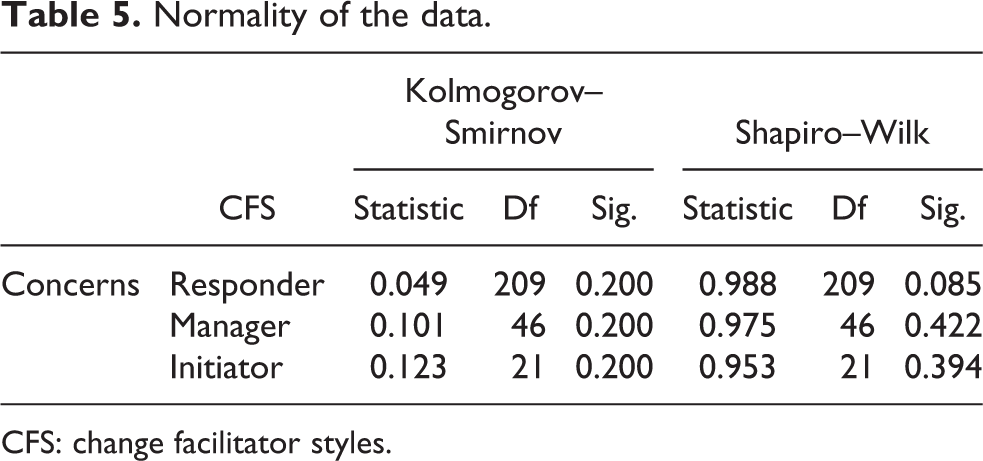
Before proceeding with the one-way ANOVA, the researchers performed an exploratory analysis to check the normality of data and verify that there are mean differences between groups to justify ANOVA (Hinkle et al., 2003). The results (Table 4) show that no missing values surfaced in the data, which satisfies the data to be appropriate. The data (Table 5) met the assumption of normality with Shapiro–Wilk value >0.005 for three groups of independent variables (responder, manager and initiator) against the dependent variable of teachers’ concerns.
Case processing summary.

CFS: change facilitator styles.
Normality of the data.
CFS: change facilitator styles.
Results
Teachers’ concerns about ICT integration
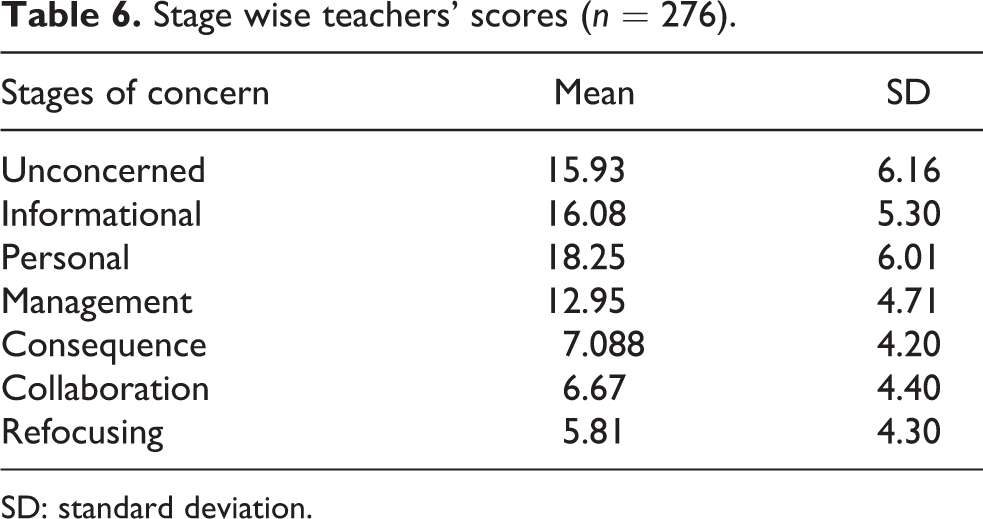
The statistics (Table 6) show personal concern standing higher with the mean score of M = 18.25. Teachers’ informational concerns remained with the second higher mean score of M = 16.08 and unconcerned with the mean score of M = 15.93 as the third higher concern. Management comparatively remains with a low mean score of M = 12.95. However, consequence (M = 7.08), collaboration (M = 6.67) and refocusing (M = 5.81) concerns regarding ICT integration remained lower.
Stage wise teachers’ scores (n = 276).
SD: standard deviation.
The data indicate that teachers’ concerns scores are higher on unconcerned, informational and personal stages and comparatively low on the consequence, collaboration and refocusing. The interpretation of such a profile informs about a non-ICT user profile of teachers (George et al., 2006). The profile, as per its interpretation (George et al., 2006), illustrates that teachers are not aware of the use of ICT in teaching and learning. Non-user profile also indicates the need for more information in this regard so they can get out of the self-cluster towards impacts cluster of concerns regarding ICT integration.
CFS of school head teachers
The analysis (Table 7) revealed responders as a dominant CFS of the secondary school head teachers. A proportion of 75.7% (n = 209) of the head teachers were found as responders and 16.7% (n = 46) as managers while7.6% (n = 21) as initiator.
Head teachers’ CFS.

CFS: change facilitator styles.
The influence of secondary school head teacher’s CFS on teacher’ concerns about ICT integration
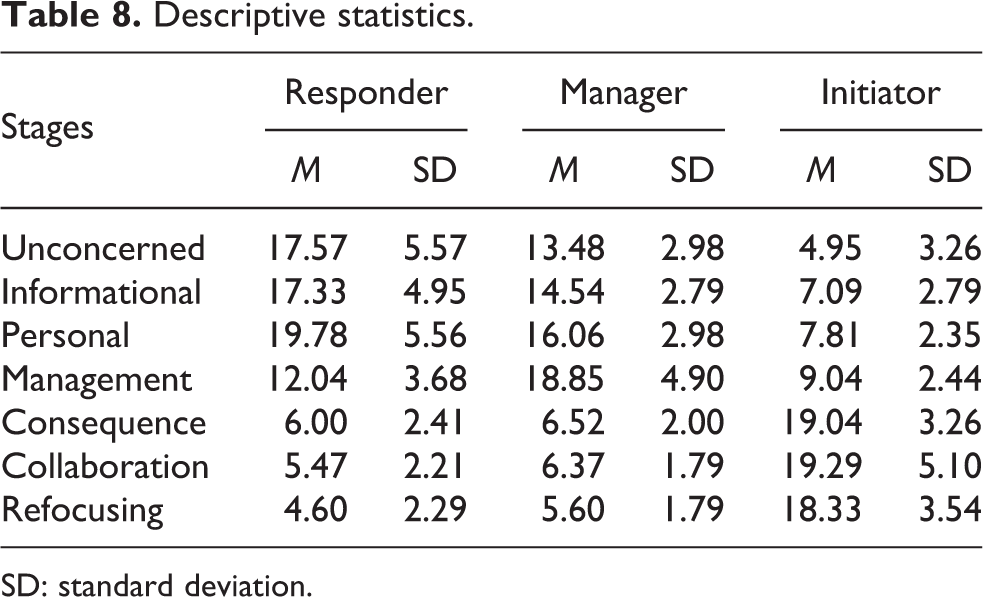
Responder CFS of the head teacher, in contrast to responder and manager, was found associated with numerically higher mean scores on unconcerned (M = 17.57), informational (M = 17.33) and personal stages of concern (M = 19.78). On the management stage of teachers’ concerns, the data (Table 8) depict the manager with the highest mean score (M = 18.85), responder as 12.04 and initiator as 9.04. Stages of consequence (M = 19.04), collaboration (M = 19.26) and refocusing (M = 18.33) exhibit the initiator with the higher mean scores as compared to manager and responder.
Descriptive statistics.
SD: standard deviation.
The results of one-way ANOVA show a significant effect (p < 0.05) of head teachers’ CFS on teachers’ concerns about ICT integration. The ANOVA results for unconcerned (F(2273) = 65.13, p = 0.00), informational (F(2273) = 51.88, p = 0.00) and personal (F(2273) = 59.01, p = 0.00) were equally significant. Similar significant results were observed at management (F(2273) = 70.99, p = 0.00), consequence (F(2273) = 277.48, p = 0.00), collaboration (F(2273) = 295.86, p = 0.00) and refocusing (F(2273) = 330.93, p = 0.00). Looking at the
ANOVA table.

ANOVA: analysis of variance;
The Tukey post hoc test transpired the actual differences between the mean scores of the CFS on each of the seven stages of teachers’ concerns (Table 10). The data suggested responder and manager equally influential on the unconcerned, information and personal stages of teachers’ concerns while initiator on refocusing, collaboration and consequence stages. It can be seen that responder (M = 17.57, SD = 5.57) is significantly different than initiator (M = 4.095, SD = 3.26) and manager (M = 13.48, SD = 2.98).
Multiple comparisons.

CFS: change facilitator styles.
*The mean difference is significant at the 0.05 level.
Similarly, on the informational stage, responder (M = 17.33, SD = 4.95) was significantly different than initiator (M = 7.09, SD = 2.79) and manager (M = 14.54, SD = 2.79). The personal stage of concern exhibits responder (M = 19.78, SD = 5.56) significantly different than the initiator (M = 7.81, SD = 2.35) and manager (M = 16.06, SD = 2.98).
At the management stage of concern, post hoc results show manager (M = 18.85, SD = 4.90) with a significant difference to the initiator (M = 9.04, SD = 2.44) and responder (M = 12.04, SD = 3.68). So, the manager stands highly influential at this stage as compared to the responder and initiator.
Looking at the difference between the scores among the CFS on the consequence stage, the initiator (M = 19.04, SD = 3.26) shows a significant level of difference as compared to the responder (M = 6.00, SD = 2.41) and manager (M = 6.52, SD = 2.0). However, the manager and responder showed no significant difference (p > 0.05) at the collaboration stage of concern. Similarly, the initiator significantly differed from the responder (M = 5.47, SD = 2.21) and manager (M = 6.37, SD = 1.79) at the collaboration stage of teacher concerns. The manager and responder at the collaboration stage also showed insignificant differences (p ≥ 0.05). Post hoc statistics on the refocusing stage of teachers’ concern portray initiator (M = 18.33, SD = 3.54) with a significant difference as compared to the manager (M = 5.60, SD = 1.79) and responder (M = 4.60, SD = 2.29).
Discussion
The findings of the study portray head teachers’ CFS as a key determinant of ICT integration through influencing teachers’ concerns. The results informed that the majority of the head teachers had responders as a dominant CFS. The findings of this study are similar to the study of Baglibel et al. (2014), who found the majority of the principals (48%) with responder CFS. They also found initiators with a proportion of only 6%. In contrary to this study, they found manager CFS of principal with a comparatively higher proportion (46%). Similarly, an earlier study (Senun, 2002) found principals with the manager as a dominant style. Accordingly, the study by Park and Jeong (2013) found 47% of the principals with manager, 43% with responder and 10% with initiator change facilitation styles. Sarafidou and Nikolaidis (2009) found that 50% of teachers considered their principals as managers, 33% as responders and 17% as initiators. In all the previous studies, as similar to this one, the initiator was found in less proportion as compared to the manager and responder. The majority of the previous studies (Park and Jeong, 2013; Sarafidou and Nikolaidis, 2009; Senun, 2002), in contrast, reported the manager as a dominant CFS of school principals. The findings are in contrast to this study in this regard. Only one study (Baglibel et al., 2014) supports the findings of this study by identifying the responder as a prominent CFS of school principals.
Looking at how leadership influences teachers’ concerns, it was imperative to identify teachers’ concerns on seven stages (from unconcerned to refocusing). Teachers’ concerns being higher at personal, informational and unconcerned stages, as George et al. (2006) state, indicated teacher’s uncertainty about the demands of ICT, and it still being new for them (George et al., 2006). They, as a result, showed inadequacy to meet the purpose of ICT integration. At the same time, their low mean scores on last three concerns (consequence to refocusing) interpret that majority of the teachers were not considering the use of ICT in their teaching in learning from the perspective of its impacts on their own and student learning outcomes (George et al., 2006).
The realization of considering the implementation of ICT integration at the personal level, similar to the previous studies (Al-Furaih and Al-Awidi, 2018; Al-Rawajfih et al., 2010; Cetinkaya, 2012; Hao and Lee, 2017), appeared to be very much critical for teachers. It could be interpreted that teachers’ perception of implementing ICT integration is highly influenced by the consequences it may have on them. Their higher personal concerns, as argued by George et al. (2006), had made teachers uncertain about ICT integration as they were also not sure about their role in this regard.
Informational as the second peak concern of teachers, as George et al. (2006) explain, exhibited teachers’ ICT integration in teaching and learning to be quite new to them. Higher informational concern, stated by Hall and Hord (2011), did not mean that they were concerned about ‘nitty-gritty’ details about the concept but, rather, wanted basic information about what ICT integration meant, what it would do and what its use would involve. These findings are similar to Cetinkaya (2012), where teachers were more at the informational concerns. Their findings indicated that teachers were generally confused about implementing curriculum reforms and could not grasp the content and ways of its implementation. However, in this study, teachers’ collaborative concern is very low as compared to the previous studies (Hao and Lee, 2017; Pepe, 2016). The previous studies rightly suggest that teachers with a deeper collaborative concern may quite help them overcome their informational concerns via sharing their learning (Pepe, 2016). In this study, teachers with low collaboration concerns may not be able to work together towards shared learning regarding ICT integration. Collaborative learning has always been considered very much pivotal in the context of Pakistan due to less capacity building opportunities available to teachers (Baloch, 2007). More importantly, less collaboration among the teachers may also not help them make ICT integration as a sustainable reform agenda as desired by the government. Because ICT integration as a complex and ongoing process requires shared learning and practices among the teachers. In shared learning, the instructional practices of every teacher improve; it has a widespread impact on students, other teachers and the overall school environment (Pepe, 2016).
After the realization of less information about ICT integration, teachers in this study were relatively unconcerned, as shown by their high mean score at the unconcerned stage. Their unconcerned stage may be either caused because of having less information about ICT integration or by their engagement with the priorities other than ICT integration. These priorities, as George et al. (2006) also highlight, may include already assigned tasks that teachers preferred to perform.
The requirement of time and energy to perform those prioritized tasks was also reflected with teachers showing some level of management concern. The management concerns of the teachers were at a minimal level as compared to the initial three stages of their concerns (unconcerned, informational and personal). The findings of this study are in line with Al-Rawajfih et al. (2010) that teachers in Jordan had minimal concern on the management stage. This study does not support the findings of Jong and Tsai (2016), who found teachers with intense management concern towards leveraging mobile technology to support social learning inquiry. The findings are also similar to what George et al. (2006) identify that teachers with management concern considered the efficiency of organizing, managing, scheduling and time demands related aspects of utmost importance for ICT integration. In this study, teachers’ higher management concerns may be interpreted as teachers already struggling with managing their workload and time and hence leaving less or no room for ICT integration. It could be assumed that enabling teachers towards managing their workload or decreased workload may help in addressing their management concerns. The association of tasks or workload and teachers’ concerns needs further investigation.
The overall findings of this study somehow confirm the findings of a recent study of Hao and Lee (2017) who found that in Taiwan, the teachers’ concern was most intense in the self-concern and fluctuated from task-concern to impact-concern within a small range in the implementation of Web 2.0 integration in instructions. In this study, a similar pattern of teachers with higher mean scores of unconcerned, informational and personal stages and low on the consequence, refocusing and collaboration concerns were observed. Nevertheless, teachers’ more serious informational concerns, as George et al. (2006) explain, show their interest in learning about ICT integration in teaching and learning. Their eagerness towards learning more about ICT integration seems a positive indicator of useful future ICT integration in schools in Pakistan.
The study found the initiator head teachers being more influential at teachers’ impact stages of concerns about ICT integration. These stages included consequence, collaboration and refocusing stages. The findings support the previous studies regarding the initiator being more influential in relation to the implementation of a programme (Baglibel et al., 2014) or overall school improvement, including student academic performance (Hall et al., 2013). Similarly, the study of Park and Jeong (2013) found the principal’s initiator CFS strongly associated with positive changes in resistance towards change implementation in schools. In contrast, the responder was found influential at the unrelated stages, which refer them, being ineffective regarding their influence on teachers’ concerns towards ICT integration. The manager was found more concerned and influential on teachers’ concerns about managing ICT resources. They had made teachers concerned about the procedures and rules involved in using ICT tools rather than making them think about using ICT as an instructional tool.
Concerning the influence of head teachers’ three CFS, this could be concluded that though all the three CFS were influential at different stages of concern, however, the initiator change facilitation style was more effective in this regard and could be effective towards ICT integration. The effectiveness could be interpreted in terms of teachers being more concerned about the impacts of ICT on students and their learning. The findings suggested that responder head teachers were influential on the initial stages that encompassed the personal and informational stages of concern but were not found effective to settle those initial concern as they were not able to support teachers in this regard. Moreover, they could not influence the later stages of concern, including consequence, collaboration and refocusing, to make teachers think about the impacts ICT integration may have on students learning. Manager head teachers seem to be more influential towards making teachers follow the rules and procedures in a proper way or as stated. The head teachers if want to be effective towards ICT integration need to perform more as initiator to make ICT integration a real success. Initiator change facilitation style may make them more useful in terms of making teachers feel the importance of ICT integration from the perspective of its impact on learning outcomes and enable teachers in this regard to create a supportive environment at their schools.
Implications
The influence of leadership styles is associated with teachers’ concerns about the implementation of ICT integration and needs to be understood while planning and implementing ICT integration. Head teachers are among the most influential actors when it comes to influencing the implementation of ICT integration at schools. Their influence is intense on teachers’ concerns in this regard. However, it depends on what styles do the head teachers use as their different styles (responder, manager and initiator) has a different effect on teachers’ concerns. The study did not consider the actual use of ICT by teachers about head teachers’ leadership styles; future research requires looking into the relationship between leadership styles and teachers’ use of ICT in teaching and learning.
Conclusion
The study concludes that head teachers’ change facilitation styles had a significant effect on teachers’ concerns about ICT integration. However, there was enough variation in terms of their effectiveness in this regard. The majority of the head teachers in Pakistan were with the responder CFS of leadership. The responder head teachers were although influential on teachers’ initial stages of concerns, including unconcerned, informational and personal, but these head teachers were not influential on teachers’ later stages of concerns that are related more to effective ICT integration in teaching and learning. Similarly, manager head teachers influenced teacher’s management concern wherein they were more anxious about managing ICT resources rather than its use in their instructions. The prominent among the CFS of the head teachers in terms of its influence on teachers’ consequence, collaboration and refocusing concerns about ICT integration was the initiator. These three stages encompass teachers’ consideration of the impacts or outcomes of ICT integration. So, this is concluded that though all the three CFS of the head teachers had shown some influence on different stages of teachers’ concerns, however, if the teachers are to be made more concerned about the impact of ICT integration, there is a need of initiator CFS of the head teachers in schools in Pakistan or elsewhere.
Supplemental material
Supplemental Material, Questionnaires_CFS_and_SOC - Head teachers’ change facilitation styles and teachers’ concerns about ICT integration
Supplemental Material, Questionnaires_CFS_and_SOC for Head teachers’ change facilitation styles and teachers’ concerns about ICT integration by Nazir Ahmed Jogezai, Shaik Abdul Malik Mohamed Ismail and Fozia Ahmed Baloch in Management in Education
Footnotes
Declaration of conflicting interests
The author(s) declared no potential conflicts of interest with respect to the research, authorship and/or publication of this article.
Funding
The author(s) received no financial support for the research, authorship and/or publication of this article.

Supplemental material
Supplemental material for this article is available online.
References
Supplementary Material
Please find the following supplemental material available below.
For Open Access articles published under a Creative Commons License, all supplemental material carries the same license as the article it is associated with.
For non-Open Access articles published, all supplemental material carries a non-exclusive license, and permission requests for re-use of supplemental material or any part of supplemental material shall be sent directly to the copyright owner as specified in the copyright notice associated with the article.
