



Abstract
This study explored the professional identities of four Arab women holding academic middle leadership roles in higher education within the Arab States Region. Employing a narrative inquiry approach and guided by the Dynamic Systems Model of Role Identity, the research investigates how these women leaders perceived their career trajectories and navigated their role identities. The study sheds light on the multifaceted nature of their identity negotiations, influenced by a complex interplay of circumstances, social processes, critical incidents, key individuals, and opportunities. Notably, the study brings attention to the pervasive challenges faced by these women, not only externally but also from internalized biases ingrained within the system, perpetuated even by fellow women. The intricacies of these identity negotiations are further contextualized within micro-political processes and the inherent asymmetrical distribution of power in organizational hierarchies, marked by androcentric dominance, and lack of trust. Despite these challenges, the narratives suggest that women in these roles actively embrace collaborative and inclusive leadership styles, potentially enhancing their effectiveness in navigating the complexities of higher education leadership.
Introduction
In the complex ecosystem of higher education, middle leadership (ML) occupies a critical juncture between strategic decision-making at the institutional level and the day-to-day operations within academic departments (Hulme et al., 2023). Academic middle leaders, often department chairs, coordinators, or program directors, wield significant influence in shaping the educational landscape in their institutions (Branson et al., 2016). They are the linchpins that translate institutional visions into actionable plans while managing the dynamics of their academic units. Defined by their intermediary position between senior management and frontline educators, individuals in ML roles play a pivotal role in fostering collaboration, implementing policies, and contributing to the overall efficacy of higher education institutions (Hollweck et al., 2022).
Despite the transformative potential embedded in ML roles, the ascent of women to these positions has been a gradual and, at times, arduous process (Evers and Lakomski, 2022). Historically, gender imbalances in higher education leadership have been pronounced, with women underrepresented in roles that wield considerable influence (Manongsong and Ghosh, 2021). However, a shift seems to be underway, with an increasing number of women breaking through the glass ceiling to assume ML roles (García-Peñalvo et al., 2022). This shift is particularly pronounced in the Arab States Region, where women are navigating and redefining their roles within the intricate fabric of higher education leadership (Bin Bakr and Alfayez, 2022).
The literature suggests a profound impact of role self-identity on the effectiveness and dynamism of women in ML positions (Brue and Brue, 2018). The formation and articulation of one's identity within the professional context significantly influence decision-making, communication, and relationship-building. The self-perception of women in ML roles becomes a crucible where personal values, cultural expectations, and professional aspirations converge (Yip et al., 2020). Understanding how these leaders define themselves in their roles is imperative for comprehending the intricate interplay between individual agency and institutional structures.
While progress has been made in recognizing the importance of women in leadership roles, a literature gap persists, particularly in the context of Arab women in ML positions within higher education (Hayo and Caris, 2013; Tlaiss and Kauser, 2019). The intricacies of their experiences, the negotiation of identity in a cultural context, and the unique challenges they face remain underexplored. This study aimed to fill this void by undertaking a qualitative phenomenological study focused on Arab women in academic ML roles, unraveling the complexities of their identities within higher education institutions in the Arab States Region. It was guided by the following research question: How do Arab women in ML in higher education perceive their leadership role identities?
Professional identities
Professional identity refers to the perceptions, beliefs, and self-acknowledgment of individuals within their professional communities (Fejes and Köpsén, 2014; Li and Qiu, 2016). This comprehensive concept extends to encapsulate professional preferences, objectives, values, and ideas (Ruohotie-Lyhty and Moate, 2016). It is a fluid concept that outlines one's professional beliefs regarding the attributes of roles, evolving within the tension created by the interplay of personal attitudes and the demands and expectations of the professional sphere (Beauchamp and Thomas, 2009).
Embedded within educators’ professional identity is the crucial element of professional commitment, which integrates their preferences, values, aspirations, identifications, and perspectives into significant roles (Tao and Gao, 2017). This multidimensional understanding of identity, as described by Vignoles et al. (2006), emphasizes subjective mental experiences, contrasting with the notion of objective facts related to the “real self.” Individuals construct social or professional identities based on the dimensions of their roles within their careers or organizations, signifying the complex interaction between personal and professional dimensions (Slay and Smith, 2011).
The literature suggests that when professionals are appointed for a leadership role, they utilize their prior knowledge and skills to meet the role requirements, apart from any leadership training they might receive (Braun et al., 2016; Evans, 2017). Their professional identity signifies how they perceive themselves professionally, and it is predominantly centered on their expertise in their specific domain (McGivern et al., 2015). Leader identity is defined as the “sub-component of one's identity that relates to being a leader or how one thinks of oneself as a leader” (Day and Harrison, 2007: 365). Studies suggest that leadership self-identity significantly influences both positive and negative leader behaviors and correlates with leadership effectiveness (Day and Sin, 2011; Epitropaki et al., 2017).
Gender in higher education
Fitzgerald (2020) and Fuller (2018) collectively shed light on the intricate dynamics within academia, emphasizing the persistent challenges women face in shaping their identities. Fitzgerald (2020) observes that despite increased visibility, women confront male hegemony as they progress to senior positions. This examination of power dynamics aligns with Fuller's (2018) research, which concurrently unveils a paradox within higher education. Together, these studies highlight the nuanced struggles women undergo in defining their identities amidst the complex interplay of ideological, political, and economic contexts, encouraging thoughtful contemplation on the dual role of education.
In a parallel vein, Morley (2010) posits that in instances of elevated women's participation rates, the feminization of higher education is primarily linked to quantitative, rather than qualitative, transformations. This assertion raises inquiries into the substance of what women acquire concerning gender-sensitive contexts and opportunities. Furthermore, there are deliberations about the intersections of gender with other dimensions of inequality, encompassing socioeconomic status, ethnicity, and age. For many women, pursuing higher education becomes a strategic response to mitigate gender-based oppression. However, this endeavor frequently gives rise to contradictions and tensions as women encounter discriminatory practices, gender-specific procedures, and exclusions within the higher education system, as noted by Morley (2010).
Divergences in managerial approaches between men and women present obstacles for women aspiring to secure high-ranking positions in universities and other organizations. In an examination of the glass ceiling phenomenon regarding the advancement of women's capabilities within organizations, Omran et al. (2015) discovered that 96% of female managers identified the adoption of male management styles as a significant factor impeding the ascent of women into upper management roles. This creates a disincentive for women to pursue leadership roles, often compelling them to assimilate into a masculine culture and navigate the challenges associated with what is termed the masculine management style (Read and Kehm, 2016). Consequently, women may encounter difficulties in aligning with the male-biased management style, resulting in their exclusion from consideration for top-tier management positions. The widely recognized prevalence of male-dominated methods and characteristics in current university management styles contributes to the scarcity of women in leadership positions (Gallant, 2014; Zhao and Jones, 2017).
Finally, Blackmore (2014), based on the critical gender theory, suggests that gender is a socially constructed concept produced and reproduced through interactions in specific contexts. Gender, according to Blackmore (2014), involves an active process of negotiation, contributing to the creation and perpetuation of gender roles. These negotiations sustain structured inequalities between men and women, attaching different traits to masculinities and femininities. In essence, gender serves as a structural framework that determines what attributes are privileged and marginalized within societal norms.
Theoretical framework
This study is guided by the Dynamic Systems Model of Role Identity (DSMRI) formulated by Kaplan and Garner (2018) and Garner and Kaplan (2019), emphasizing the pivotal role of individuals’ identity within professional roles and broader social-cultural contexts (Kaplan and Garner, 2017). Focused on Arab women in ML roles within higher education, the study explores four DSMRI dimensions: self-perceptions, epistemological beliefs, purpose and goal, and perceived action possibilities. These dimensions are crucial for unraveling the intricacies of identity within this specific cohort (Kaplan and Garner, 2017). Additionally, the study acknowledges the impact of culture and social context on role identities for Arab women, shaped by perceptions of disciplinary domains, personal dispositions, interactions, institutional factors, and societal norms (Kaplan and Garner, 2017).
The DSMRI framework, traditionally applied in diverse contexts, provides a unique lens for exploring academic leadership, particularly focusing on the gendered experiences of Arab women in ML roles within higher education. The research aims to unravel how these women perceive their leadership identities regarding beliefs, goals, roles, and action possibilities, while also understanding the nature of their preparation and challenges within the distinctive context of higher education (Kaplan and Garner, 2017).
Methods
Research design
The research design employed in this study embraces a narrative inquiry framework, with the aim of exploring the experiences and identity constructions of four Arab women holding ML roles within the higher education sector, utilizing a life history approach, and employing the Dynamic System Model of Role Identity (DSMRI) as a theoretical foundation. This methodology helps to illuminate the complex connections between the intrapersonal experiences and emotions of individual leaders, offering valuable insights into how they interpret their interactions within the specific contexts of higher educational institutions (Damiani et al., 2017). Additionally, it provides an avenue to amplify the voices of under-represented groups (Tucker and Fushell, 2014). The chosen method for data collection involved semi-structured interviews, designed to encourage participants to authentically share their personal narratives. These interviews addressed participants’ perspectives on their roles, challenges encountered, and the navigation of their identities as women in ML positions.
Participants
To engage with women in ML positions across higher education institutions in various Arab States, the board of an online community that unites educators from all levels was approached. According to the community board, there were 43 women members holding ML roles, such as department chairs, program directors, assessment coordinators, academic coordinators, directors of student affairs, chairs of curriculum committees, among others, spanning six countries. Employing a stratified purposeful sampling strategy (Cash et al., 2022), all 11 women who had served as middle leaders in public universities for a minimum of five years and were presently in such roles were invited. Within the research timeframe, four out of the 11 invited women voluntarily participated in the study. The average age of the participants was 48 years, falling within the age bracket of [46–52 years]. Two of the participants held associate professor ranks, and the other two were full professors; and they boasted over 15 years of teaching experience. The size of the teams they led ranged between [23–61]. The countries they came from were: Lebanon, Jordan, United Arab Emirates, and Egypt.
Semi-structured interviews were conducted with participants via Google Meet, with closed cameras and spanned an average of 45 min. The interview schedule included six principal areas. These encompassed: (a) the daily routines of participants in managing their teams; (b) the challenges linked to balancing and prioritizing various tasks and roles; (c) the participants’ expression of professional identity; (d) the motivations propelling their journey into ML; (e) their perception of achievement within ML; and (f) their understanding of leadership and their self-perception as leaders.
Each participant underwent two interviews, serving the purpose of establishing rapport, building trust, and enabling a comprehensive exploration of their experiences. This iterative approach captured temporal changes and emerging themes, enhancing data richness, validity through triangulation, and fostering a nuanced understanding. The initial focus extended beyond specific roles and tasks to a broader exploration of participants’ perceptions as professionals, providing a holistic view of their professional identities and interpretation of formal leadership roles.
All three researchers involved in this study were women professors of education within higher education, with two of them having dedicated over a decade to serving in ML roles. Their journeys in ML were marked by challenges, providing them with a unique perspective that enabled them to empathize and listen attentively to the stories shared by participant women leaders. This shared experience facilitated a deeper connection and understanding between the researchers and participants, fostering a sense of rapport and trust. Moreover, being Arab women themselves allowed the researchers to exhibit shared cultural backgrounds and values with the women leaders in the study. This shared identity not only contributed to a more nuanced exploration of the research topics but also played a pivotal role in navigating potential cultural sensitivities, fostering openness, and addressing differential power relationships within the research context.
Fairclough's (2015) critical discourse analysis (CDA) was employed to interpret participants’ discourse. CDA, a comprehensive framework, delves into the intricate relationship between language, power, and social structures, surpassing traditional linguistic analysis to explore the broader social context of discourse. Fairclough (2015) highlights a dialectical relationship among three dimensions: (a) text, involving surface-level language analysis; (b) discourse practice, investigating the production and consumption of discourse in specific contexts; and (c) sociocultural practice, exploring broader social and cultural structures shaped by discourse. This systematic approach unveiled power relations, ideologies, and social inequalities in the language use of Arab women middle leaders, offering insights into their leadership identities and the construction of social realities and power dynamics.
Data analysis
The study employed narrative analysis, utilizing a qualitative content analysis approach guided by a coding process and codebook adapted from Kaplan and Garner (2017). Following an open coding approach (Creswell, 2013), multiple rounds of coding were conducted, progressively broadening the conceptual scope. Inspired by Saldana's (2013) pragmatic eclecticism, the initial cycle involved open reading and re-reading of the data, creating tentative labels based on emergent meanings. The subsequent axial coding aimed at identifying relationships among open codes and seeking themes across participants’ transcripts (Saldana, 2013). Thematic coding, guided by Garner and Kaplan (2019), explored the dynamic role identity system within the social context, personal dispositions, domain, and culture surrounding the individual.
To ensure trustworthiness, the study followed Guba and Lincoln's (2005) recommendations, prioritizing participant involvement in data interpretation and incorporating their feedback through iterative questions during informal conversations. The research team conducted multiple rounds of transcript analysis individually and collaboratively, resulting in consensus between researchers and participants on the presentation of stories, reinforcing study credibility (Guba and Lincoln, 2005).
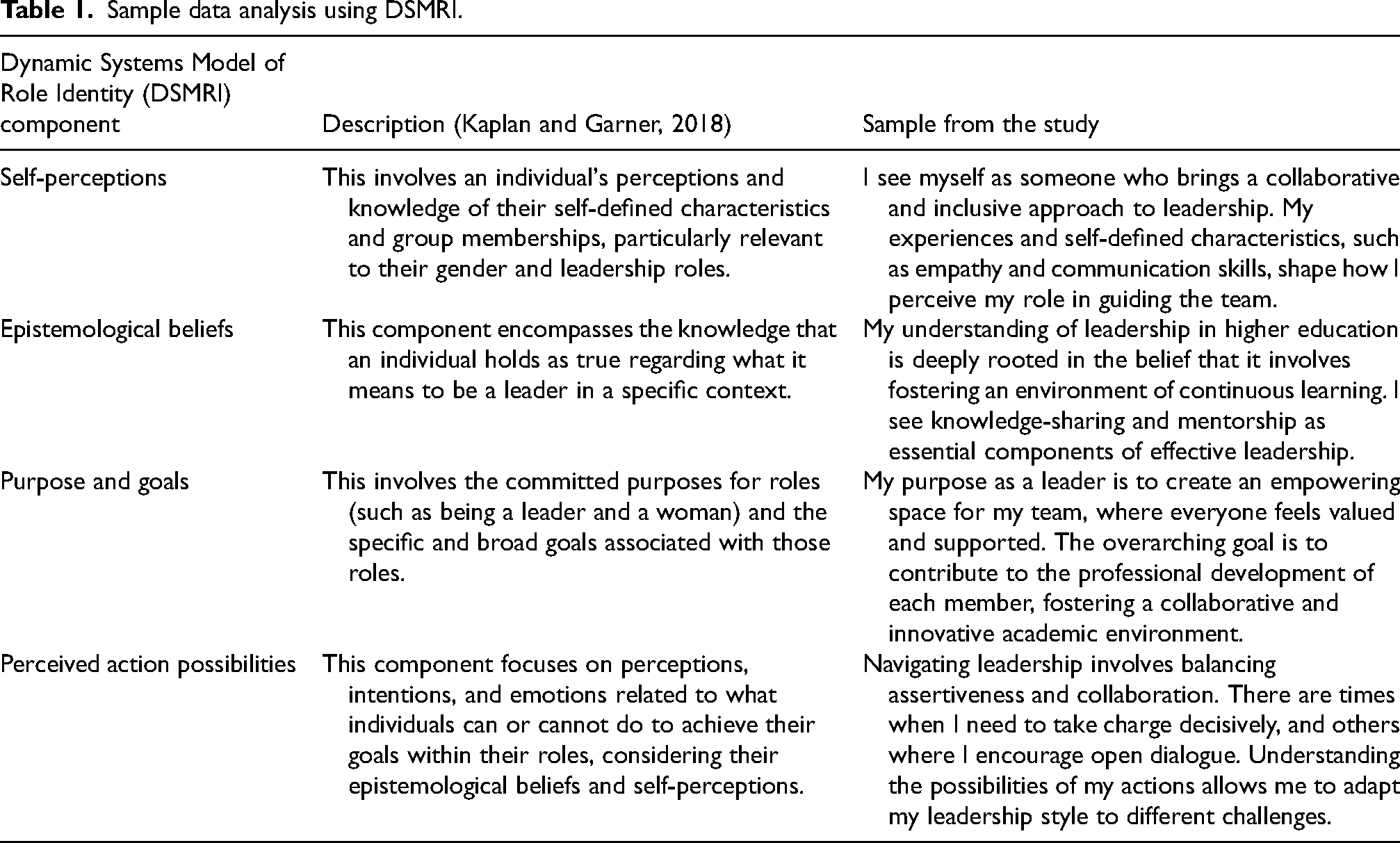
An example illustrating the data analysis process using DSMRI is provided in Table 1.
Sample data analysis using DSMRI.
Finally, the data were presented through vignettes extracted from participants’ narratives and accounts, aiming for an authentic representation. These vignettes constitute a constructed narrative developed through code development, analysis leading to categories, and themes examined through the lens of DSMRI, providing insights into how Arab women in ML express themselves as leaders. The presentation heavily relies on direct quotes, following the recommendation of Clandinin and Connelly (2000), with sensitive personal information omitted to ensure participant confidentiality. Participants were assigned pseudonyms to maintain anonymity.
Hadia's story
Becoming a head of department
Hadia's journey into education was unplanned. Initially a Biology major aspiring to work in Biomedical Technology, she discovered a passion for teaching during a senior-year elective. Despite the unexpected shift, she earned a Master's in Education and taught for ten years in secondary school. Seeking more knowledge, she pursued a PhD in Education in the United States and returned to her home country to teach at a public university. Transitioning to a faculty position was smooth, but becoming the department head faced resistance from male colleagues. Undeterred, Hadia defied gendered expectations and became the Head of the Department.
Role identity
Perceived role
Hadia perceives her role to be more administrative in nature rather than centered on leadership. She thinks that she was not accepted within a male-dominated medium to serve but as an administrator whose role was to ensure things were moving in accord with policies already set up. Her innovative ideas seemed to be blocked by other Head of Departments (HoDs) who were predominantly males, and both the dean and his assistants. She states that “It is always ok to discuss how to run the department based on already set policies, but I feel that I am not heard in the council of the Faculty of Education, when I would like to propose new schemes for running things in different ways. I believe this is because this male dominated council has no trust in a female leaders.”
Beliefs
Hadia thought that she became the HoD by mere chance. In her context, HoDs should be ranked as full professors. At the time of her appointment, she was the only one who had this rank, with many colleagues retiring. So, she became the HoD just because she was the only one to fit the full professor criterion. She states that “I wasn't consciously seeking the HoD position; it just happened due to the circumstances, especially the retirement of senior colleagues, and I was the only available full professor at that time.”
Goals
Hadia thought that, as she was not accepted as a female leader within the senior male-dominated council for the faculty, she set goals to practise leadership with her subordinates by delegating power and sharing in decision-making. She stated that “In a context where my role was not readily embraced, I aimed to lead by collaboration. I believed in empowering my team, granting them authority, and involving them in decision-making processes to foster a collaborative and inclusive environment.”
Actions
Hadia explained how she could realize her goals by stating that “To achieve this, I established a committee for our annual planning process. This committee, comprised of dedicated department members, engaged in analyzing critical issues, setting department objectives aligned with our vision, and determining the competitions and programs we would participate in.” Through this collaborative approach, Hadia thought that she worked diligently to accomplish each of her objectives, fostering a sense of shared responsibility and ownership within the department.
Zainab's story
Becoming a program coordinator
Growing up with both parents as dedicated teachers, Zainab developed a profound appreciation for education. Inspired by a childhood surrounded by the values of learning and community, her journey was purposeful, aiming to contribute significantly to education. Choosing to major in English, she envisioned not only being a teacher but also a leader fostering growth and inclusivity, viewing teaching as a calling to shape young minds.
After obtaining her Master's in Education, Zainab spent five years teaching in an elementary school. Driven to make a broader impact, she pursued a PhD in Physical Education in the UK. Returning home, she aimed to contribute to the academic community in a public university.
After a decade as a teaching faculty member, Zainab was selected by her male HoD to be a program coordinator in the Physical Education Department, where the majority of faculty were males. Despite facing gender biases from colleagues, she worked hard to establish herself, receiving support from her HoD, who expressed confidence in her leadership abilities.
Perceived role
Zainab perceives her role as a program coordinator to be multifaceted, extending beyond administrative tasks. She articulates, “Being a program coordinator is not just about managing schedules and paperwork; it's about fostering an environment where both students and faculty can thrive. I see my role as someone who creates a positive and inclusive academic atmosphere.” Zainab's perspective underscores her commitment to a holistic approach that encompasses both administrative responsibilities and a broader vision for the overall wellbeing of the academic community.
Beliefs
Zainab firmly believes that her journey to the role of program coordinator was not solely a matter of chance but a testament to her capabilities recognized by her HoD. She expresses, “I hold the belief that leadership is about potential and capability. My HoD saw the leader in me and entrusted me with the responsibility of program coordinator, breaking through the barriers of gender biases that often persist in our professional settings.” Zainab's beliefs emphasize the importance of recognizing and nurturing leadership qualities, irrespective of gender-based expectations. She thinks that because of trust she nourished into an effective leader in her workplace.
Goals
For Zainab, assuming the role of program coordinator is not just about personal achievement but also about fostering positive change within the academic community. She articulates her goals by stating, “My vision as a program coordinator is to create an inclusive and dynamic learning environment. I aim to develop strategies that promote collaboration, innovation, and student engagement.” Zainab's goals reflect her commitment to transformative leadership and a vision for creating an environment that encourages continuous improvement and shared success.
Actions
To translate her goals into tangible outcomes, Zainab has implemented a series of strategic actions as the program coordinator. She shares her approach, saying, “ Inclusivity is a cornerstone of my actions, as I actively seek input from both seasoned educators and newer faculty members, fostering a sense of shared responsibility and commitment to the program's success.” Zainab's hands-on approach emphasizes the importance of proactive leadership in driving positive change and elevating the overall quality of the program.
Hind's story
Becoming director of student affairs
Hind's journey into education was inspired by her high school chemistry teacher, whose passion for teaching left a lasting impression on her. Armed with a BA in elementary education, she furthered her academic pursuits with an MA and PhD in Curriculum and Instruction in France, focusing on the teaching of French. Returning to her home country, she joined the teaching faculty at a public university, driven by her commitment to education.
Perceived role
Hind's perceived role as the Director of Student Affairs was one she aspired to fulfill but faced challenges along the way. She reflects, “Being constantly interrupted in my pursuit of the directorship by the female dean was disheartening, because it was blocked by a female dean who explicitly told me that this position is better suited for a male.”
Beliefs
Despite the challenges, Hind held firm beliefs about her capabilities and the role she envisioned. She shares, “I believe in the transformative power of education, and the role of the Director of Student Affairs is pivotal in shaping a positive and enriching university experience. My qualifications, dedication, and attention to include and involve everyone, positioned me well for this role.” With determination, Hind sought to transcend gender stereotypes and make a meaningful impact in her envisioned role.
Goals
Hind set forth clear goals for her tenure as the Director of Student Affairs. She states, “My primary goal was to create a student-centric environment that fosters growth, inclusivity, and a sense of belonging. I aimed to implement programs that address the diverse needs of students, ensuring their academic success and personal development.” With these goals, Hind envisioned a transformative impact on the student community, aspiring to enhance their overall university journey.
Actions
To actualize her goals, Hind implemented strategic actions as the Director of Student Affairs. She notes, “I initiated regular forums for students to voice their concerns and suggestions, ensuring their perspectives were integral to decision-making processes. Collaborating with faculty members, I worked towards enhancing student engagement through extracurricular activities and support services.” Through these strategic initiatives, Hind actively worked towards building a dynamic and inclusive university environment that prioritized the wellbeing and success of its student body.
Rana's story
Becoming a head of department
Rana pursued a degree in physics at university and later earned a PhD in Science Education in the United States. Upon returning to her home country, she became a faculty member at a public university. Identifying as a passionate professor, Rana successfully drew more students to the program by adopting a highly student-centered approach to teaching physics education. Despite her popularity among students, she encountered challenges with her female colleagues who seemed uneasy about the attention she received. This strained relationship became evident when, upon self-nomination for the position of HoD, her colleagues refrained from electing her. However, over time, Rana's continuous support in matters of learning, teaching, and ICT led to a shift in perception. Eventually, she earned the trust of the same colleagues who later elected her as the HoD.
Perceived role
Rana perceived her role as a professor and later as the HoD as pivotal in creating a student-centered and collaborative learning environment. Reflecting on her approach, she stated, “As a professor, I saw my role not only as an educator but as a facilitator of meaningful learning experiences. Transitioning to the HoD role, I envisioned fostering a collaborative department where faculty and students thrive together.” Rana believed in maintaining an inclusive and supportive atmosphere that encouraged both teaching innovation and student success.
Beliefs
Rana's beliefs centered on the transformative power of education and the importance of a student-centered approach. She firmly stated, “I believe in the profound impact education can have on individuals. My teaching philosophy has always revolved around putting students at the center of the learning process, empowering them to actively engage and take ownership of their education.” Rana advocated for an academic community where innovative teaching methods and collaborative learning were fundamental principles.
Goals
Rana set ambitious goals during her tenure as the HoD, aiming to foster a collaborative and innovative academic environment. She articulated her goals, stating, “My primary goal was to bridge the gap among faculty members, fostering a united department that thrives on shared values and goals. I aspired to enhance the overall quality of education by creating an atmosphere where everyone feels supported and engaged.” Specifically, Rana sought to improve collaboration among faculty members, elevate learning outcomes, and create a positive and inclusive work environment.
Actions
Rana dedicated her efforts to implementing and activating professional learning communities within her department. Recognizing the importance of collaborative learning, she worked towards fostering an environment where faculty members could engage in meaningful discussions, share insights, and collectively enhance their professional development. In her words, “I firmly believe in the power of collaboration. By establishing and nurturing professional learning communities within our department, we created a space for continuous learning, innovation, and mutual support among colleagues.”
Discussion
This study explored the professional identities of four Arab women in academic ML roles in higher education in the Arab States Region. Using a narrative inquiry approach and guided by DSMRI, the study investigates how these women perceive their career trajectories and negotiate their role identities. The narratives offer valuable insights into their journeys, perceived roles, beliefs, goals, and actions as educational middle leaders, capturing both unique challenges and shared experiences.
The identified crosscutting themes in this study encompass gender challenges, trust, collaborative leadership, and inclusivity. The study suggests that the path for women towards ML positions in higher education is far from straightforward. This observation aligns with previous studies, such as those conducted by Brabazon and Schulz (2020), and Selzer and Robles (2019); who have reported on the significant hurdles faced by women striving to assume leadership roles within the higher education sector.
In fact, women grapple with the dominance of male hegemony as they ascend to senior positions. This phenomenon reflects a persistent challenge for women in organizational structures, where power dynamics continue to be shaped by traditional gender norms. Fitzgerald (2020) and Fuller (2018) also contribute to this narrative, emphasizing the enduring nature of these challenges and reinforcing the idea that the struggle against male hegemony is an ongoing concern in the professional realm. These insights highlight the need for addressing the ingrained power imbalances to foster more equitable professional environments. Likewise, our findings corroborate with earlier studies conducted in the Arab States Region, such as Abadi et al. (2022) and Arar (2019), who echo similar challenges, emphasizing gender parity struggles.
On the other hand, the study suggests that trust is crucial for women aspiring to and thriving in ML positions in higher education. It serves as a foundation for collaboration, effective communication, and the recognition of capabilities, as emphasized in the literature (Manongsong and Ghosh, 2021; Post et al., 2019). Like men, women often require trust from colleagues, supervisors, and the institution to reach and succeed in ML roles. Once in these positions, trust is vital for women to receive support in practising leadership. Our findings suggest that a trusting environment fosters empowerment, enabling women leaders to initiate, make decisions, and implement strategies with confidence, contributing to the development of inclusive and supportive academic environments (Manongsong and Ghosh, 2021; Post et al., 2019).
The narratives of women in ML roles in higher education reveal pervasive challenges, aligning with existing literature (Tran and Nguyen, 2022). Women encounter intricate obstacles, facing heightened scrutiny to prove their qualifications compared to their male counterparts. Societal perceptions still link leadership with men, creating a bias women must actively counter. The study suggests these challenges are not solely external; they are ingrained within the system, leading to internalized biases among women. The struggle is twofold, with women confronting societal norms and biases perpetuated by fellow women. Despite qualifications, women must challenge deep-rooted stereotypes questioning their suitability for leadership roles. The narratives emphasize the urgent need for systemic change and the dismantling of persistent gender biases hindering women's progression in academia (Tran and Nguyen, 2022).
Moreover, the women participating in this study adopted collaborative leadership approaches, actively participating in practices like shared decision-making, collective problem-solving, and nurturing a sense of community within their teams. This alignment with the concept of distributed leadership, characterized by the decentralization of responsibilities rather than concentrating authority on a single individual, underscores a distinctive leadership style among women in middle-level positions. This comes in line with studies that have shown that women in educational leadership roles are frequently characterized by collaborative and democratic leadership styles, contrasting with the more direct and authoritative approaches traditionally expected in these positions (Allred et al., 2017; Robinson et al., 2017).
Finally, women who participated in this study demonstrated a pronounced commitment to the concept of inclusivity within their professional environments. Demonstrating proactive engagement, they actively endeavored to instill inclusive practices within their respective departments, ensuring not only the welcoming of diverse perspectives but also their active integration. The commitment to fostering inclusivity was palpable in their conscientious initiatives to involve individuals from varied backgrounds and experiences in collaborative discussions and decision-making processes.
Conclusion
In conclusion, the narratives shared by women in academic ML roles underscore the arduous journey they face in reaching these positions, characterized by inherent difficulties compounded by androcentric dominance. The androcentric barriers that persist in the academic landscape pose formidable challenges for women aspiring to attain ML roles, reflecting a persistent gender bias that permeates organizational structures. Furthermore, the of trust among women, further compounds the hurdles encountered on their professional paths. Despite these challenges, a compelling revelation emerges from the narratives—women actively embrace collaborative and inclusive leadership styles. This inclination aligns with the literature on educational leadership, suggesting that, despite the obstacles, women's commitment to collaborative practices may enhance their effectiveness in these roles. The dichotomy of arduous barriers and resilient leadership styles underscores the complex landscape women navigate in academic ML, shedding light on the imperative need for systemic changes to dismantle androcentric biases and foster a more equitable and supportive environment within higher education.
Finally, this study demonstrates the utility of the DSMRI in conceptualizing the contextualized and dynamic identity of academic middle leaders. It showcases how the DSMRI framework effectively captures the nuanced and evolving nature of identity within the specific context of ML roles. This not only reinforces the relevance of DSMRI in understanding complex identity dynamics, but also highlights its practical applicability in shedding light on the intricacies of middle leaders’ roles within diverse and dynamic organizational contexts.
Footnotes
Declaration of conflicting interests
The author declared no potential conflicts of interest with respect to the research, authorship, and/or publication of this articles.
Funding
The authors received no financial support for the research, authorship, and/or publication of this article.
Informed consent
All participants in this study were informed of the purpose of the study and how data will be used. They were assured that their identities would remain anonymous across the study.
Researchers positionality
The researchers are all women who hold strong beliefs in the right of women to ascend to academic leadership roles.

Authors’ biographies