



Abstract
The benefit corporation (BC) in the United States is a new type of corporation legally required to generate profit for its shareholders and to pursue public benefit. BCs explicitly work to balance profit maximization and social mission, which is an ongoing challenge for businesses with an expansive view of the bottom line. This multiple case study extends scholarship on identity formation (IF) in nontraditional organizations, such as BCs, by providing empirical evidence of how identities develop in relation to prevailing cultural sentiments. In particular, we demonstrate how BC struggles over organizational identity (OI) reference broader socioeconomic discourses, identify mechanisms through which perceived pressures suppress alternative interpretations of OI at a micro-level of member interaction, and expose tensions between dominant and alternative frames for business enterprise.
The benefit corporation (BC) is a new type of a for-profit corporation in the United States, initiated in 2010. The BC is required to generate profit for its shareholders and also create a measurable positive impact on society at large and for the physical environment. The BC voluntarily agrees to evaluate and enhance its outcomes for employees, community, and the environment: also, to adhere to higher than typical standards of purpose and transparency. The new legal entity has been gaining popularity. There are various reasons why some businesses incorporate as BCs: from making a public declaration of commitment to a greater societal purpose to attracting purpose-driven talent and investors to protecting mission in a publicly traded company. Currently, BCs have legal status in 33 states and the District of Columbia. According to B Lab, a certification nonprofit, there are more than 2,770 certified B Corporations in 60 countries (see www.bcorporation.net). Some of the best-known U.S. B Corps are Seventh Generation, Patagonia, and Etsy.
Here, we treat organizational identity (OI) as (a) a formal and informal point of reference in the representation of the organization, (b) a complex of symbolic and material associations with the organization, and (c) “an ongoing process of construction, reconstruction, performance, legitimation” (Gioia & Patvardhan, 2012, p. 51). From the point of view of OI with an emphasis on social and business values, the BC presents a rich category for investigation. First, the BC is a still-emergent type of value-defined business, whose legal status, motivation, and, above all, identity, have generated reflection and debate in the business community (Schiller, 2017). Some commentators, for example, call the BC a “game changer” (Robson, 2016) that builds the infrastructure for stakeholder-oriented capitalism (Alexander, 2016) and creates promising synergies between business and human rights (Bauer & Umlas, 2017). Other observers say BCs inhibit corporate social responsibility, increase corporate greenwashing, and enhance public cynicism about all corporations (André, 2015). As extant scholarship shows, identities “are formed in part by dialogue with external stakeholders” (He & Brown, 2013, p. 6). Moreover, alignment between identity, image, and organizational culture can be advantageous in the marketplace (Hatch & Schultz, 2008). In this light, studying BCs provides insights into the process of identity formation (IF) amidst often conflicting values, identities, and expectations.
Second, BCs “mix and match logics, practices, and organizational identities of purpose-driven and profit-driven organizations” (Rawhouser, Cummings, & Crane, 2015, p. 15). Like many other forms of value-driven businesses (such as co-operatives and mutuals), BCs explicitly work to balance profit maximization and social mission, which has been proven difficult by its predecessors. For example, Cheney, Cruz, Peredo, and Nazareno (2014) observe that co-operatives and related alternative enterprises experience tensions “between maintenance of core social values and the demands of market globalism” (p. 593, emphasis in original). Unlike other socially oriented business forms, however, aspects such as ownership, governance, and forms of participation are not prescribed within the broadly established framework for BCs. This diversity in structure and practices within the broad category of BCs is itself worthy of study, especially in how the tensions between bottom line and social values are understood and expressed by members, that is, by both leaders and employees.
Finally, BCs’ identities are formed on a set of values that are significantly at odds with mainstream business and industry standards. BCs operate in a system where shareholder primacy has become a matter of course and is supported both by corporate law and popular discourse (Jonsen, 2016). This is true despite four decades of development of the social responsibility movement (see, for example, Carroll & Shabana, 2010). It is important to explicate the relationship between the newly forming BC identity and wider discourses on business, not only to expose the tensions between the mainstream and alternative OIs but also to help the business community find points of leverage to make alternative relationships between business and society a viable possibility.
Despite their growing popularity in the business world, BCs have received scant attention in academic literature. Extant academic articles have focused almost exclusively on BC legislation, governance, and accountability. Although the emergence of a new OI catalyzed by the BC law was proposed by Robson (2016), this study is the first to offer an empirical investigation of values and identities within BCs. Our contribution to current scholarship is threefold. First, we demonstrate how struggles over OI reference and reflect broader socioeconomic discourses. Second, we identify mechanisms through which perceived economic pressures suppress alternative interpretations of OI at a micro-level of member interaction. Third, we expose dynamic tensions between dominant and alternative discourses for business enterprise, showing that the discourses do not simply coexist in a BC identity but continuously interact with each other. In addition, this study extends the model of “crystallized self” proposed by Tracy and Trethewey (2005), particularly by applying the concept to the organizational rather than individual identity. Part of this application and extension is attending to multiple influences from the larger social and economic environments in terms of how they make their way into the formation and expression of a complex and fluid OI.
As a matter of terminological clarification, it is important that BCs not be confused with officially designated B Corps. B Corp certification is a voluntary certification program provided by B Lab, a nonprofit organization that has been a driving force behind the development of BC state statutes and the BC movement in general. Although any business that is incorporated as a BC under its state statute can be selected to be evaluated by B Lab, there is no requirement to do that. Conversely, certified B Corps do not have to be BCs. Some corporations, however, opt to be both. Such was the case with all the three companies that participated in this study.
Theoretical Framework
OI
This project draws on three relevant streams of research on OI. The first stream of research is largely interpretive scholarship on OI that approaches identities as multiple and to a significant extent negotiated, even when organizations make declarations to the contrary by insisting on unitary identities and consistent, often regulated, expressions of them. Many organizational researchers and practitioners have predominantly viewed OI as a manager’s project and responsibility, thus disregarding the constitutive role of employee-based opinions and discourses. Gioia, Price, Hamilton, and Thomas (2010) noted that the managerial perspective operates on “an apparent presumption that understanding identity formation processes is largely unnecessary because an organization’s identity can be readily inferred from . . . the founder’s vision” (p. 2). With a few exceptions (e.g., Henderson, Cheney, & Weaver, 2015; Kopaneva, 2019), IF research is often biased toward official, managerial (including consultants’) values and projects. From a broader, employee-centered perspective, “identity involves members’ negotiation of shared meanings about ‘who we are as an organization’ and places the focus of attention on the shared interpretive schemes that members collectively construct to provide meaning to their organizational experience” (Gioia et al., 2010, p. 5). The collective sense of self or in other words an organization’s “common substance . . . must be negotiated and renegotiated during day-to-day interactions” (Chaput, Brummans, & Cooren, 2011, p. 254). Given the relative newness of the BC, as well as its emphasis on social values, we argue that employee contribution to IF can be substantial. This study demonstrates how organizational members view—in positive, negative, or mixed terms—the organization’s overall identity as a BC.
Another stream of research we utilize in this study is the one that acknowledges the fragmented, unstable, and shifting nature of identity. From this point of view, identity is not a stable, immutable sense of self or an “inviolable core of an organization that shapes its choices and defines its integrity” (Cheney, Christensen, & Dailey, 2014, p. 697). Rather, identity is subject to “unfolding and stylized narratives about the ‘soul’ or essence of the organization” (Ashforth & Mael, 1989, p. 21). Moreover, identity remains contested for an individual or organization in a field of moving referents and meanings, even when identity appears to be unitary or it is in the interest of the organization to present it so (Cheney, 1991).
Applying this perspective to the constructions of personal identities, Sveningsson and Alvesson (2003) conceptualized identity as a struggle between the desire of an individual (in their case, a manager) for self-definition and discursive and material forces that affect identity construction. Importantly, they show that the identity of the manager forms at the intersection of conflicting pressures: one coming from the “grandiose [in other words, socially dominating] discourse on leadership” (Sveningsson & Alvesson, 2003, p. 1188) and the other emanating from her convictions. As Gioia, Patvardhan, Hamilton, and Corley (2013) observed, there is a shortage of studies closely investigating the IF process itself. We explore IF process, with a focus on the conflictual and fragmented nature of OI, through uncovering influences in a type of organization that operates amidst often conflicting value systems and discourses, as well as industry conditions.
The third stream of research we draw on is scholarship that acknowledges the influences of a broader socioeconomic-political context on IF within the organization in a way that shapes meanings while distorting alternative interpretations. Here, our point of departure is a critical-interpretive perspective on identity. As Larson and Gill (2017) noted, critical approaches posit that identities are shaped by discourses that are adopted and promoted by various social groups, thereby reflecting different values and interests. Our goal is to understand the applications of dominant discourses “through the promotion of discursive challenges from diverse or alternative interests and voices” (Larson & Gill, 2017, p. 19). In this study, we are not analyzing these broader discourses per se. Rather, we use them as reference points as they influence, impinge upon, and are interpreted by participants at a nonmainstream business organization.
Specifically, we draw from Tracy and Trethewey’s (2005) discussion of individual identity as influenced by discourses of power. Following Foucault, Tracy and Trethewey (2005) conceptualized discourse as “an assemblage of knowledge that creates truth effects’” (p. 169). They show how discourses of power both construct individual identities and “fundamentally articulate an ‘ideal’ core self” that “reflects the interests of the organization more than the interests of the individual” (p. 176). Although the self in this view is to a great extent discursively constituted, it is of course not devoid of agency. Indeed, it is in the space between domination and resistance that identities frequently emerge. Tracy and Trethewey proposed the metaphor of the “crystallized self” that presents individual identity as politicized, multidimensional, and constantly growing. The “crystallized self” has multiple facets, and its shape is influenced by the various discourses that both construct and constrain the self. The metaphor is vivid and has been influential in other organizational communication research (Meisenbach, 2008; Wieland, 2010).
We extrapolate the concept of the crystallized self to OI to uncover the influences of various discourses on IF in an organization that combines two systems of values. Previous research, albeit very limited, has pointed to cultural influences on IF. For example, Jack and Lorbiecki (2007) showed how national identity influenced the construction of organizational and personal identities. Papa, Auwal, and Singhal (1995) demonstrated how OI at the Grameen Bank challenged prevailing cultural systems of meaning in Bangladesh by emancipating the poorest of the poor and at the same time developed systems of concertive control that silenced the voices of participants. Glynn and Watkiss (2012) revealed that an organization constructs identity through reflection of cultural themes and interpretation of cultural resources. They suggested that alignment with prevailing cultural sensibilities helps organizations gain legitimacy. According to Gioia et al. (2013), although extant research points to important cultural influences on IF, they “have not been thoroughly examined in the context of organizational identity formation” (p. 163). As Glynn and Watkiss (2012) stated, research “demonstrates that societal culture affects the organization but stops short of articulating the particular mechanisms by which culture exerts its influence” (p. 65).
By examining communicative practices and discursive resources, we aim to fill the gaps described above. We provide empirical evidence of how identities are formulated and reformulated in relation to prevailing expectations for business at an organization that strives to change current norms. Furthermore, we identify specific mechanisms by which discourses enable and constrain IF. Next, we show how a multitude of voices across the levels of organizational structure contribute to the formation of OIs. Finally, we point to how a critical examination of the interplay between the organization and its economic, social, and discursive environment creates a richer understanding of the complexity of OI.
Although an in-depth discussion of image and reputation—two concepts directly related to OI—is beyond the scope of this article, we would like to acknowledge their tight interdependencies. Whetten and Mackey (2002) called identity, image, and reputation “fundamental components of the self-management project—the effectiveness of which is central to the success of organizations” (p. 400). Whereas reputation forms as a result of an organization’s actions influenced by its OI (Whetten & Mackey, 2002), stakeholder images serve as “a mirror in which the organization sees itself reflected in the eyes of others” (Hatch & Schultz, 2008, p. 51). IF in BCs both informs their reputation and is informed by stakeholder perceptions. Understanding the challenges alternative organizations face in their IF process can provide important insights into how they can maintain their OIs in a system that supports traditional forms of organizing.
Business Values and the Nonconventional Business Model
Our exploration of IF in the BC would not be complete without directly addressing values—the core of identity in a value-driven organization (Cheney, 2002). Broadly speaking, this line of work can be traced to Weber’s (1978) so-called “missing fourth type of authority” (Rothschild-Whitt, 1979; Satow, 1975): value-based authority and associated types of organization. On one hand, the conventional business model has long functioned on the idea of profit as an overriding logic. In most businesses that profit is directed above all to shareholders or other owners. Although U.S. corporations have performed various social functions since the 19th century, organizational success is usually treated as synonymous with profit, with social goals being subordinated. As Friedman (1962) famously stated, “there is one and only one social responsibility of business—to use its resources and engage in activities designed to increase its profits” (p. 133). Social values gradually progressed from relatively insignificant to downright detrimental. Consider the following example from Wartick and Cochran (1985), which illustrates the viewpoint supported by the proponents of a strict profit orientation for business: To the extent that managers use corporate resources to promote socially responsible activities, they are “stealing” from owners’ dividends, from customers’ wealth, or from employees’ wages. Thus, even on ethical grounds, the concept of social responsibility as anything more than profit maximization is inappropriate. (p. 760)
Of course, from a voluntaristic perspective, this view is attenuated by philanthropic policy and practice (Frumkin, 2006).
As Nelson et al. (2016) noted, “though not legally prescribed, the profit-generating return to shareholders model of business is normative. It is held to be the way things are and should be” (p. 291). Because the dominant economic paradigm defines what values should guide a business, its impact on the formation of OI in most businesses can hardly be overestimated. This observation has been even more applicable during the period of dominant neo-liberal economic policies, from about 1980 onward.
On the other hand, nonmainstream business models developed in response to the limitations of this strictly profit-centered formula, for example, employing the Triple Bottom Line (Elkington & Zeitz, 2014). They offered tools to seek and promote a meaningful experience beyond financial gain. To give social values a stronger legal and organizational foundation, new legal forms (e.g., flexible purpose corporations, BCs, and other types) emerged. As Hiller (2013) observed, “whether [the BC] will effectively promote corporate social responsibility is yet to be seen. However, corporate law has stymied full consideration of social and environmental considerations because of shareholder primacy and wealth maximization duties” (p. 299). Because the value of the “business case” is so widespread and accepted, even ethical practices often require empirically documented support for their bottom-line contributions (Carroll & Shabana, 2010; Cheney, Lair, Ritz, & Kendall, 2010). Although the contemporary business community uses a variety of concepts (such as sustainability, corporate citizenship), corporate social responsibility has been the most prominent movement whose development is a vivid illustration of the profitability versus responsibility dilemma.
In this context, IF in BCs presents a particularly important research object. Because BCs commit to both profit and social impact, their members may need to not only make sense of the two value systems but to somehow reconcile, or at least acknowledge them, as parts of their OI. BCs also forge their identity in the context of widespread distrust of corporations (see, for example, Adams, Highouse, & Zickar, 2010). If BCs are authentically driven by social values, then they need to explain and defend the legitimacy of these values to the public while distancing themselves from those who taint the idea of socially driven business. If members engage in identity work “not for its own sake, but to facilitate legitimacy formation” (Clegg, Rhodes, & Kornberger, 2007, p. 509), then members have to make sense of the conflicts between their companies’ values and mainstream business values. Studying values can thus provide us with important insights into the process of IF in organizations choosing to function substantially at odds with the prevailing business-economic “common sense.”
To explore the interplay of these factors in the formation of OI, we turn to an analysis of three BCs, guided by the following research question:
Method
The analysis presented here is based on an ethnographic study of three BCs whose names have been changed for confidentiality: Altruico, Wind of Change (WoC), and Sellgood. The multimethod case analysis of three BCs representing different industries—not to mention having varied organizational cultures and social objectives—allowed us to explore differences and clarify logics while getting one step closer to understanding the common core of the BC identity. Although not intended to arrive at widely generalizable conclusions, our analysis offers a first glimpse of the identity variations in a nonconventional type of organization.
Data Collection
Over a period of 5 months in 2015, we gathered three kinds of data. First, the first author spent more than 120 hr (roughly 40 hr with each organization) observing common areas where participants could be easily seen and heard, shadowing leaders and employees, attending meetings, trainings, and other events. The field of observation ranged from the headquarters to satellite offices to supplemental spaces (e.g., a warehouse). Direct observations and analytic reflections were recorded in a field journal (with notes totaling 264 pages). Entering three different companies, each with its own interpersonal dynamics, meant that the researcher’s role would fluctuate between a play participant (Tracy, 2013), who would enjoy playing by the rules of the company at one time but could easily opt out from the participant role at other times, and a “reactive” observer (Angrosino, 2005), who had a clear researcher status and a set agenda for the day.
The second source of data consisted of 44 one-on-one in-depth interviews (14 at Altruico, 16 at WoC, and 14 at Sellgood) that included open-ended questions that probed different components of identity (such as values and uniqueness); the company’s image in the community, industry, and in the nation; as well as challenges and future of the organization. We interviewed six founders, six top managers, 29 full-time employees, and three contractors. Founders had been with the companies since their inception (24 years at Altruico, 8 years at WoC, and 27 years at Sellgood). Managers’ and employees’ tenure at the organizations ranged from 2.5 months to 25 years. The interviews lasted from 9 to 80 min and were transcribed.
Finally, we examined an extensive range of printed and electronic documents. We analyzed reports on corporate social responsibility and social performance, key advertisements and marketing efforts, mission/vision statements, values/ethics statements, organizational charts, websites, and web pages on Facebook, LinkedIn, Twitter, and YouTube. Although all three types of data were essential for identifying themes during data analysis, we rely mainly on direct quotations from interviews in this report because of the vividness of these accounts and the concise expressions of key aspects of IF.
Data Analysis
Data analysis was informed by a critical-interpretive approach: an approach that begins with the assumption of multiple identities and honors participants’ representations of key concepts and issues, yet is attuned to tensions, contradictions, and voices perhaps unheard or unexpressed. Our approach to the data collection and initial representation of interviewees’ expressions was inductive and open-ended. To analyze multiple forms of data, we used a two-stage analytic procedure of open and axial coding (Miles, Huberman, & Saldaña, 2013). We began generating a list of first-phase codes for recurring themes, such as definitions of BC identity, descriptions of external business environment, significance of profit, significance of social mission, and definitions of success. During the second phase of coding, categories for our clustering of responses emerged in conversation with the literature, especially on identity and values and with an eye toward internal (in)consistencies, conflicts between different individuals’ interpretations, and finally, with respect to the broader socioeconomic context. Coding at both stages went through multiple iterations as we refined initial codes and subsequent patterns. For example, the code for perceptions of the market changed from “market as a place,” to “market as objective reality,” to “market as a personified force.”
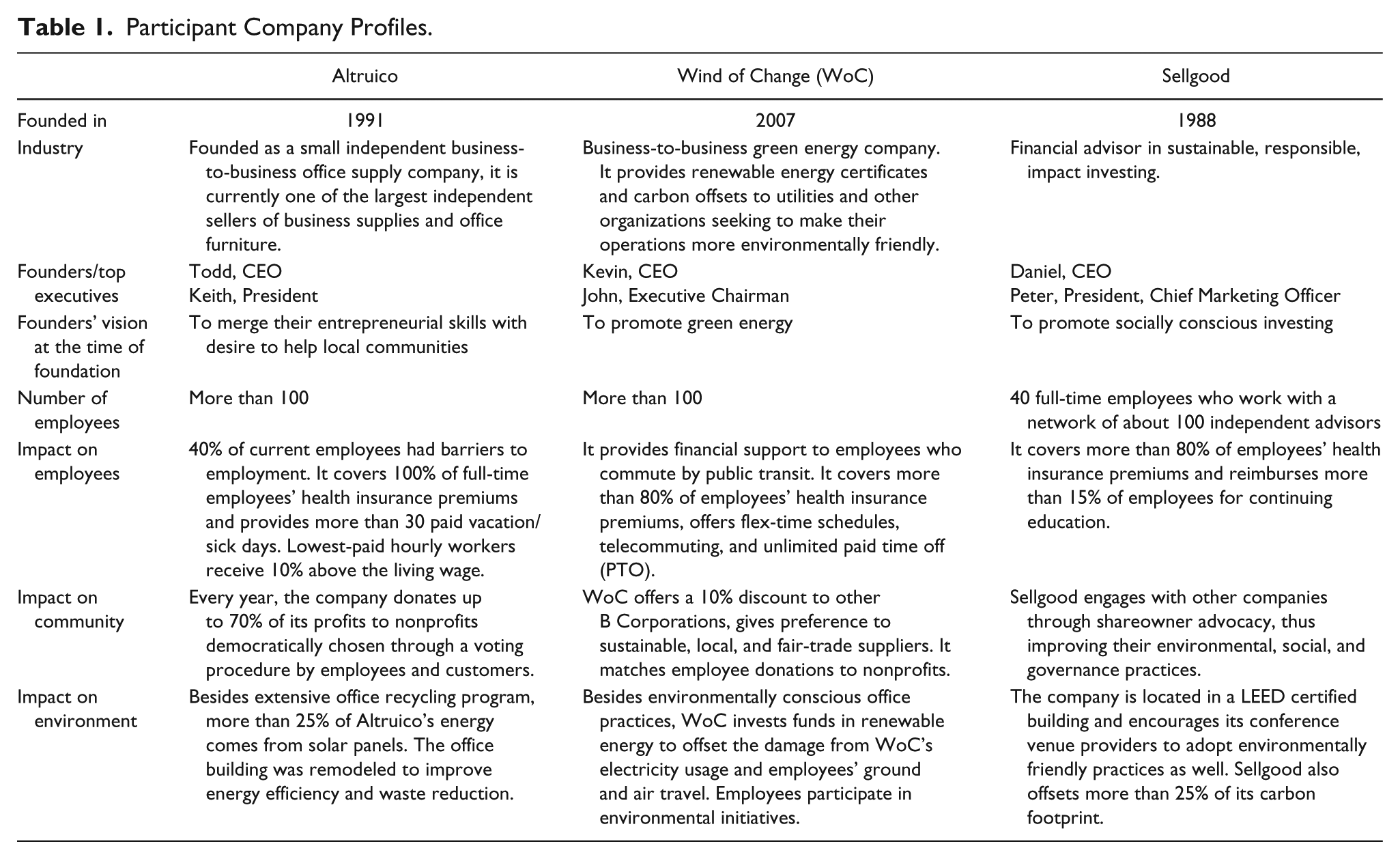
We began analyzing each company separately from the other two. Consistent with an iterative and implicitly hermeneutic data-analytic strategy, where the understanding of each individual part of text is revisited in terms of the whole, we returned to our data multiple times, refining and crystallizing our understanding with each new interpretation. After performing initial coding for themes within one kind of data (e.g., interviews), we examined the other two kinds (observation and documents) for those initial, as well as new, themes. In addition to “merciless cross-checking” (Miles et al., 2013) between different types of data, we compared verbal (such as conversations and posters) and nonverbal data (such as images on websites). We also looked for traces of the themes in rhetorical features (notably, metaphors). As a final step in our analysis, we examined how the identified patterns played out across all three organizations. The three cases are outlined in Table 1.
Participant Company Profiles.
Results
As Tracy and Trethewey (2005) noted, “discourses work to ‘fix’ identities in particular ways that favor some interests over others and thus constrain alternative truths” (p. 171). The ever-present goal and ever-developing process of solidifying identities are at the same time a reminder of their very fluidity. Our analysis reveals that OIs in BCs form under the influences of two compelling and competing ideologies: one traditional and currently prevailing ideology that prioritizes profit maximization and shareholder primacy and the other alternative ideology that insists on a significant social impact. Each BC we studied balances the two value systems in unique ways to forge a tailored OI. Regardless of the specific identity, IF in all three organizations is influenced by two clusters of factors. The first cluster influences the formation of what we call “the conforming self,” the facet of identity that most directly reflects the dominant discourses and popular ideas on business. The other cluster affects the formation of “the transforming self,” the facet of identity that seeks to solve or at least confront an important social issue and ultimately to transform the prevailing business norm. For each cluster, we first present the popular ideas that form the facet and then discuss specific mechanisms through which IF occurs.
The Conforming Self
The three BCs are anything but radical in the broader context of political economics. They all started as traditional for-profit corporations; they operate under the material conditions of the current system; and, to a large extent, the formation of their OIs is influenced by prevailing cultural assumptions about what it means to be a for-profit business in the United States. The following three themes are the most prominent in the data.
The market as a personified force
The idea that the market has not only material but also symbolic significance is not new. It has been problematized in insightful ways in communication (e.g., Cheney, 1994), economics (notably, McCloskey, 1985), ethics (Painter-Morland & Slegers, 2018), and other disciplines. Important to us are the specific qualities BCs attribute to the market and how they see their place in its context. The BCs live and abide by the rules of the market: They watch competition, innovate, strategize, and execute. As Keith (Altruico) put it, “You have to meet the market in order to function” (emphasis added). The market is viewed as part of an objective reality, almost like gravity that business has to live with. Unlike gravity, however, the market is personified, that is, attributed human-like powers of cognition and will. According to Peter, Sellgood’s president, his employees know how the company is positioned “in the mind of the marketplace.” The market knows the true and fair value of labor. When Altruico donates up to 70% of its profits to local communities, some of its employees do not understand why the money could not be used for pay-raises. As Vanessa, the HR director at Altruico, explained, “What we cannot do is say, ‘The country pays 15 dollars an hour for this position, but we pay you double’ because then you are out of the business model, you are not a profitable business model.” The market is constantly changing, making it harder for businesses to survive. As Kevin (WoC) stated, “The needs of all markets are changing, and we need to evolve accordingly.” BCs, just like traditional corporations, make considerable efforts trying to predict what “the market will do” in the future. The market is also viewed as merciless. When asked about the future of his company, Keith said, “That’s one possibility . . . Oblivion. The destruction that the marketplace imposes on low performers, which could be us.” Besides its presumed harsh and unforgiving nature, the market is evolving in such a way that makes it more difficult for business to connect with community. As Todd, Altruico’s CEO, observed, There is always tensions going on in the market. I would say one of those tensions is depersonalization. (. . .) Even though there is all these social networking websites now, there is a lot less human interaction (. . .) which potentially creates sort of a disconnect with this notion of serving others. Because serving others is really about connection.
The system’s tendency toward depersonalization, or loss of connection (see, for example, Cheney et al., 2010), may be particularly difficult to BCs as one of their core principles is serving various groups of stakeholders.
Performance as a survival tactic
Organizational performance is ordinarily defined as achievement of desired organizational outcomes: both financial, particularly profit maximization, and nonfinancial, such as fulfilling community needs and corporate citizenship (e.g., Kotlar, De Massis, Wright, & Frattini, 2018). It is axiomatic in the current socioeconomic system that high financial performance is key to survival. At BCs, neither managers nor employees question the axiom because they know: The market destroys low performers. For example, at Altruico sales people lose their jobs in 60 days if they cannot sell. In the call center, a white board displays each employee’s performance rate. Representatives add their performance numbers to the board at the end of each day. While this board serves as a daily reminder of how successful (or worthy) each employee is compared with co-workers, another white board shows the numeric worth of the call center—its overall sales year-to-date. It is not uncommon for people to work overtime in person or over email from home. What makes the heavy workload more bearable is the sense of the bigger purpose shared widely by people at BCs. Chris (Altruico) explained, If you have the level of social consciousness, you are not driven by success or monetary means or by title or whatever, then it allows the fulfillment. Because of that you can work hard. I, unfortunately, (. . .) spend probably 12 hours to 14 hours a day doing what I do. (. . .) I don’t mind doing that because the end goal is good.
The motivation for high performance in value-based organizations is tied to intrinsic values, that is, values based on moral judgment (rather than extrinsic ones such as monetary compensation), and that is why pressure to perform may be perceived as justified and even necessary. From the organization’s standpoint, however, employees’ satisfaction is often viewed as a means to ensure the health of the organization. As Vanessa, HR Director at Altruico, put it, “just like in any other business, you need good happy employees for maximum productivity.”
Growth as a gateway into the future
When we asked participants where they saw their company in the future, we got an almost unanimous response: the company must grow. The leaders talked about the necessity to “grow revenues,” “dominate the marketplace,” and the challenge of finding a way “to get a bigger piece of the growing pie.” As Peter (Sellgood) stated, “we are not different in that regard than any other business and being a B Corp doesn’t impact that in one way or the other.” The explanation provided by Keith (Altruico) gives us insight into the reasoning behind this necessity. He said, I see us either much bigger or gone (. . .) If we are the same size five years from now, (. . .) I don’t think the company will survive (. . .) Now the two biggest competitors Staples and Office Depot are merging because they’re not going to be able to make it alone. I think (. . .) the industry is going to shake out the companies that are not able to consolidate and grow. It’s not going to be viable for a company to maintain a small little position in the marketplace without being either gobbled up or destroyed by more powerful competitors.
To our participants, there is no future without growth. What Keith framed as an either-or perspective (either much bigger or gone) is really a development trajectory that leaves no options: If the companies want to stay in business, they have no other alternative but to grow. Moreover, growth is constructed as virtually limitless (see, for example, Hamilton, 2004). Even giants such as Staples and Office Depot find it hard to continue without perpetual growth. Finally, growth is associated with power. Bigger means more powerful, and to BCs that entails a possibility of greater influence on social and environmental matters. As John (WoC) stated, “we’re hoping to be a much bigger, larger company with much more impact on society.”
The formative mechanisms of the conforming self
How exactly do the above ideas influence the formation of the conforming self? The data indicate the dual influence of popular ideas and dominant discourses on IF. On one hand, they have an enabling effect; if a business conforms, then it is deemed worthy of and accepted by the system: the wider business community, ranking agents, renowned experts (see, for example, Jackson, 2001, rhetorical critique of management gurus), customers, investors, and so on. On the other hand, the dominant system constrains the formation of the other, alternative part of identity, the transforming self. The constraining effect works through two mechanisms: internal doubts and external perceptions. Any deviation from the traditional path plants the seeds of doubt about the viability of the BC—or any socially driven business model for that matter—in the minds of organizational members. Jonathan recalled his early days at Altruico, “I started as their first sales manager. We saw quickly that a lot of sales people even at that time didn’t feel comfortable enough that we can go out and compete in the market.” Slowed growth or lack thereof is worrisome. Besides the prospect of being destroyed or gobbled up by more powerful competitors, it can create staffing and financial issues. As John (WoC) explained, If you stop growing, your employees might want to be at organizations where they are working on tomorrow’s problems, not yesterday’s problems. And then we want to be financially stable with the risks that we are taking up to develop tomorrow’s solutions.
Lower numbers on any traditional markers of success erode confidence. As Vicky (Altruico) observed, We need more people that believe in the company in the heart (. . .) We just feel beat up because we are not making as much money as we used to. I think we just need to build a little confidence.
The second constraining mechanism of the dominant discourse we identified works through the voices of external stakeholders. BCs build their identities against the backdrop of audiences’ limited knowledge and misconceptions: According to members, these are the two main obstacles BCs face. The novelty of the BC concept together with the dominant discourse that teaches audiences which businesses should be counted as successful and trustworthy (see, for example, Ghoshal’s (2005) discussion of how academic research has shaped the worldview of managers) create the environment of disrespect and suspicion toward BCs. For example, Vicky said, Sometimes I get angry because I feel like those new hires especially in sales who . . . came in from other bigger corporations and kind of take us as a joke. For me, it’s like, “No! We are not a joke! We are legit!”
Customers believe that a business cannot afford to be a BC, so they expect some catch, for example, products of lower quality or inflated prices making customers pay for the social contributions of such businesses. As John (WoC) noted, some of their partners inappropriately think of them as “softies,” questioning their ability to run the business rigorously and thoroughly. Terms such as this are poignant reminders of pressures to conform.
At Sellgood, too, people are aware of the fight for legitimacy their company has to wedge when dealing with external perceptions. Lance (Sellgood) stated, They [competitors] have the resources to make us look like we are amateurs. So, in that respect, they may think of us as we are just a small little firm, let them stay there in [their state] and they won’t mess with us in New York City or Boston or LA. So, I think that’s the perception that we always have to fight.
The perception of BCs as softies, amateurs, or a joke is a vivid illustration of how alternative perspectives on business can be positioned as naïve, theorized by Foucault (1980). To be taken seriously, a business has to position itself in the market as “no nonsense.” In that regard, the formation of BCs’ other part of identity, the transforming self, proves challenging.
The Transforming Self
To Tracy and Trethewey (2005), individual “resistance lies in rebelling against the ways in which we have already been defined” (p. 171). Similarly, the collective sense of self at BCs exemplifies both the pressures to conform and resistance. Whereas the conforming self reflects the current business norm, the other facet of BCs’ OI resists the norm. Although the introduction of BC legislation has provided a structure for socially conscious businesses, our participants highlighted the need for a broader cultural transformation that would not only accept the ability of business to help society but would also expect business to do so. As the data indicate, the following three influences contribute most strongly to the construction of the transforming self.
Leaders’ bilateral vision
All founders wanted to build a company that would compete successfully in the market and would also address a social issue. Importantly, rather than seeing their social goals supplemental, to be added or removed depending on the company’s financial performance, founders viewed them as an inalienable part of their company’s future identity. Their bilateral vision was rooted in the belief that business could be used as a force for broader social contribution beyond their organization’s immediate product or service. As Todd, Altruico’s CEO, recalls on the company website, “As a sales manager, I was very successful, but I was disillusioned with the priorities of my peers. Focus on material wealth and a lack of concern for world problems did not fit with my upbringing.” When Keith approached him with the idea of starting a company that would donate some of its profits to local communities, Todd “jumped at the chance.” In our interview, Keith said, “I’m interested in moving the needle on broad economic issues. [. . .] I’m not interested in creating a small island of justice and equality. I am interested in creating an environment that produces justice and equality through the economy.” WoC and Sellgood founders shared similar sentiments: awareness of wider social problems, dissatisfaction with the profit-only orientation of business, and belief in the power of business to catalyze social change.
Employees’ broad-based social values
In all three companies, employees’ “extracurricular” values played a noticeable role in IF. Each company, however, had its own unique “flavor” to the kinds of values employees shared. At Altruico, members believed in giving. As Lorena, a call center operator, put it, “These are people that are trying to give back to society, to the community, rather than higher ups lining their pockets.” The company’s value proposition resonated with her so strongly that after applying for a job at Altruico and being rejected she brought a hard copy of her resume and left it with a receptionist. The employees regularly went to a food bank to package food and many genuinely cared for local nonprofits. Fred (Altruico) recalled, I was watching TV one day and there was a nonprofit for the blind that was going to shut down their doors (. . .) So I brought this to the attention of Vanessa and immediately within a matter of two days we had a donation check.
In the past, WoC employees followed paths that allowed them to make a positive impact. For example, Blake was in the Peace Corps, Don used to be “an extreme hippie,” and Xavier used to work with the Appalachian Mountain Club. But what united them at WoC was concern for the environment. Ken, an accounting specialist, stated, There is a lot of people who are really passionate about the environment and they are choosing to do this because they care about it. It’s not so much that is overtly spoken but you can definitely sense it. Everyone is working their a***s off because they want to make a difference with this company and there is a good amount of momentum.
At Sellgood, while some members valued the company’s workplace practices that viewed employees holistically, others valued its power to positively influence society through socially responsible investing. Members’ diverse values came together into a jigsaw puzzle that in multiple ways reinforced the company’s vision of positive impact: “We envision a world in which every child is safe, healthy, and free. We work with money as a tool for transformation toward a socially just, truly sustainable future for all.” Here, the social transformational objective is quite explicit and reminiscent of co-operative principles (International Co-Operative Alliance, n.d.).
As a point of clarification, we do not wish to claim that every BC member chose to work for a BC because of his or her values (although many participants did exactly that). Neither do we wish to say that BCs are the only types of business that care about social problems. What we want to show is the influence that employees’ broad social values have on IF. In contrast to contemporary management literature where the presumption that the individual needs to be shaped to the interests of the organization (through instilling a sense of oneness with the organization and even developing the individual’s moral skills, see, for example, Ebrahim, Battilana, & Mair, 2014) is rarely challenged, our data show how OIs are shaped by the interests and values of the individual. It is not necessarily the organization that has instilled the importance of community, environmental protection, and so on, into participants. Their values formed as a response to wider social processes and migrated with them to the organizations where these values now influence organizational decisions and culture.
The B Corp movement
Although extant research shows the importance of network embeddedness and alliances (e.g., Nelson et al., 2016), the BC founders and top managers express ambivalent feelings toward the B Corp movement. On one hand, all three companies voluntarily choose to go through the certification process by B Lab in addition to achieving their legal status as BCs under state laws. In all three companies, the decision to become a certified B Corp was motivated not only by self-interest (e.g., having the B Corp logo on the website) but also by the desire to help the movement gain traction. They all see the important role of the movement in uniting B Corps, giving them voice and spearheading a broader cultural change. To them, it is “an up and coming,” “leading edge” movement that struggles to gain legitimacy in the profit-centered world. As Daniel (Sellgood) pointed out, for the change to happen, BCs would first need to prove that there was a business case for it.
On the other hand, in all three cases, leaders distanced themselves from B Lab. They repeatedly told us that the B Corp was only a label on the OI that they developed long before BCs or B Corps came to being; the new status was a natural fit to the identity they already had in place. They pointed out a few aspects of the B Corp identity that they did not want to be associated with. For example, Lindsay, a top manager at Altruico, said, Maybe there is in my mind a slight—not really snobbishness—but a sense of “there is a better way and we are just going to continue to educate the public on what that is so that we can convince everybody that there is value.”
John (WoC) discussed the sense of superiority over “typical corporate America.” He said, Painting the for-profit sector singularly as bad is naïve and not reflective of reality . . . But I hear this come out of the leadership of B Lab. And I think this movement will be more successful in drawing in non-benefit corps by not being judgmental and by making a really welcoming on-ramp.
In short, while the BCs we studied share the value proposition offered by the B Corp movement, they do not identify with the movement completely. To them, the evaluative discourse that B Lab uses to position the movement in the eyes of the wider business community and general public does not reflect their OI.
The formative mechanisms of the transforming self
Regarding mechanisms through which the transforming self is formed, our analysis indicates that critical reflection on the prevailing norm is at the heart of this process. Both employees’ broad social values and leaders’ bilateral vision are rooted in the conviction that the prevailing system does not work as well as it should. Drawing from their previous experiences, members see the BC identity as an improvement over the conventional model. In all three cases, participants talked about the conventional companies they used to work at as less friendly, less people-oriented, and more oriented toward profit. Victoria (Sellgood) compared her previous experience to “a pressure cooker environment” with “not a lot of room to be a whole person.” Importantly, the sense of dissatisfaction is not limited to conventional workplace practices; a strong moral stance lacking in many traditional for-profits is yet another facet of identity employees seek in BCs. For example, Vicky (Altruico) recalled, “I felt like working at the law firm I was working for the rich . . . I didn’t feel like I was doing anything good, I was just working, working, working.” In the interviews, participants often shared their thoughts on the bigger impact of business: employees wanted to see the company was concerned with more than the bottom line, they needed more purpose, they felt guilty or uneasy if that was not the case, and they watched if their company walked the talk. As Sara (WoC) noted, for-profit companies “might say, ‘Oh, we care about these things’, but in their actions it went much more back to that reflex of meeting shareholder expectations.” In short, employees want companies that treat them better, help solve social problems, and allow them to make a positive difference.
The degree of critical reflection on these social matters by BC leaders varies dramatically. WoC embraces the traditional for-profit model and sees the B Corporation status as an improvement to the model’s specific imperfection while confining its positive impact within the niche of alternative energy. John (WoC) believed there is room for social contribution within the conventional for-profit model but noted that the dominant system works as a punitive mechanism that severely limits the freedom of the executive board. He stated that being a BC “reduces the risk of shareholder lawsuits on the board for the board making decisions that don’t singularly maximize long term shareholder value.” Sellgood relied on the for-profit ideology and its major tool—capital—as an imperfect inevitability that can be harmful or helpful depending on how it is used. Sellgood used it to address a wide range of social issues. Questioning the system as a whole, Altruico had little concern for its industry and hopes to change the prevailing business ideology. Keith saw current socioeconomic conditions as unjust and ineffective. As he said, I see our company in the context of the broader economic landscape of America. This is a country that is fabulously wealthy, but it is a country where (. . .) most people’s economic and social conditions have deteriorated dramatically over the last 25 years. And it’s not because the resources are not available, it’s because they are not made available to the community as a whole. They are concentrated in a very limited fashion at the top of the economic social chain. (. . .) Government action, nonprofit action, philanthropic action has proven itself unable to turn that situation around to find more of the resources that are available in America connected to the broad community needs. So you look at what’s happening in public education, public health, the infrastructure, the bridges, the highways, there is a relatively diminishing investment into the common space.
Leaders’ perceptions of the locus and magnitude of the problem were related to how they viewed the transforming self of their organization’s identity. To WoC, it was about being a more responsible company that helped to solve environmental problems. To Sellgood, it was about growing a more responsible industry that allowed people to address multiple social issues. To Altruico, it was about “rewiring” the economic system, including taken-for-granted beliefs about what was possible.
Importantly, BCs did not rush to fully identify with the BC movement. When the BCs claimed that the BC movement had not had any influence on them, or when they confined its impact to practical utility of the B Corp certification that “provides them more structures and ideas for how they can further improve,” they discursively constructed a space between the movement and themselves. In that space, critical reflection on the movement and its relation to the BCs’ identity became possible.
Discussion
The IF process in BCs exposes both a profound influence of two broad-based and often implicit ideologies on OI and an inherent tension between them. BCs construct their identity as both mainstream and fringe. In doing so, they face multiple challenges. First, they need to appeal to diverse constituencies whose diverse—and often conflicting—interests they need to balance in the decision-making process. The second challenge relates to the formation of image among these diverse constituencies that would both signal acceptance of BCs and reflect their true sense of self. Finally, BC members need to make sense of the two value systems and reconcile them, at least tentatively, in an OI.
Relying and building on Tracy and Trethewey’s (2005) model of the “crystallized self,” this study makes several theoretical contributions to understanding the IF process while also extending and complicating the understanding of organizational IF in the following important ways. First, we extrapolate the concept of the crystallized self to OI to uncover the influences of various discourses on IF. In doing so, we show the politicized, multidimensional, and growing OI at an emerging type of alternative organization. The two facets of BC identity we identified—the conforming and the transforming self—are created with regard to ideas and discourses popular in today’s U.S. and global business landscape. Discourses of power, shaping the conforming self, convey a prescribed organizational ideal that, in the words of Tracy and Trethewey, “comes to be understood and experienced as real and of one’s own choosing” (p. 176). The transforming self, shaped by leaders’ and employees’ values, is created in relation to alternative discourses on corporate social responsibility. This article suggests that consideration of competing discursive influences allows us to see more vividly the fluid, fragmented, and politicized nature of OIs, especially in alternative organizations, such as BCs, where identity forms between what insiders want it to be and what outsiders are ready to accept. Just like an individual’s identity in Sveningsson and Alvesson’s study (2003), OIs in BCs reflect a struggle between convictions of their members and grandiose discourses on business.
Second, we identify the mechanisms through which dominant discourses enable and constrain the formation of the alternative OI. Discourses of power provide a blueprint of an OI where key points of reference (such as values and actions) are the conditions for acceptance by the system. At the same time, they disqualify alternative viewpoints through internal doubts and external perceptions. Glynn and Watkiss (2012) explained that culture functions as a set of resources from which organizations choose those values and beliefs that differentiate them from other firms within the field. In an extension of this claim, we suggest that organizations are not completely free in their choice of OI. When the preferred self becomes tied to the idea of survival, development of alternative OIs becomes problematic.
Finally, our analyses also reveal that dominant and alternative discourses do not simply coexist in the crystallized OI side by side as different facets. Rather, they continuously interact with each other. As Tracy and Trethewey (2005) mentioned, “a space for agency lies in the ability to traverse, intersect, and hold in tension competing discourses” (p. 188, emphasis added). To extend this claim further, we provide examples uncovering the specific mechanisms through which such interaction occurs. As we show above, in the case of BCs, the interaction works through dynamic tensions between the conforming and transforming selves where the former suppresses the formation of the latter through questioning its viability, whereas the latter seeks to change the former through questioning its morality. These conclusions highlight the concurrent influence of multiple discourses on IF and identity-related challenges in BCs, as well as underscore the importance and perhaps inevitability of identity negotiation in alternative organizations.
Being the first to examine IF in BCs, this study has important practical implications that could be extrapolated to other types of alternative organizations. First, understanding cultural influences on IF in organizations can create possibilities for critical reflection on the types of identity prescribed as normal or preferred in a specific socioeconomic context. Second, exposing tensions between the mainstream and alternative OIs, as well as highlighting specific mechanisms of influence, is likely to help the business community contemplate alternative relationships between business and society. Finally, we call into question the assumed passive role of employees in such big-picture questions as the purpose of the organization, its role in a wide socioeconomic context, and its overall identity. Building sustainable channels of communication internally would not only bring different perspectives to light but would also help members see their direct impact on the ethical stances of the organization.
This article offers an initial foray into the IF process for alternative business organizations. There is a need for further exploration of the relationships between ideologies and OI. For example, researchers could explore how alternative organizations navigate tensions between multiple value systems and how they assemble their OI from available cultural resources. Of great importance would be studies exploring IF across different types of organizations, for example, traditional for-profits, nonprofits, and co-operatives.
In sum, the study explores the complex interrelations of identity expressions and prevailing cultural sentiments for members in a type of business where a social mission is a priori positioned as central. The significance of BCs goes beyond the matter of socially conscious individuals starting mission-driven organizations. The BC business category institutionalizes a structural, legal, and moral alternative to the still-prevailing wisdom about the primacy of returns for specific owning individuals or groups. In this regard, the three cases we presented here are more than three stories about how identity takes shape in a new type of business organization. The three cases, taken together, help to show how the organization is inextricably tied to its cultural field. Examining competing discourses and the variety of informal as well as formal ways they contribute to IF can help us to understand better leverage points and pivotal moments for transforming businesses toward a stronger social responsibility orientation. Addressing these topics helps us not only highlight the politicized nature of OI but also set the stage for further conversations among scholars and practitioners about a wide range of conceptions of the business–society relationship and how they are expressed and enacted in practice.
Footnotes
Acknowledgements
We thank the four anonymous reviewers and the associate editor, Boris H.J.M Brummans, for helping us develop this manuscript. We thank the editor-in-chief, Patricia M. Sias, for her guidance throughout the review process. We would also like to extend our appreciation to the three companies for participating in this study.
Declaration of Conflicting Interests
The author(s) declared no potential conflicts of interest with respect to the research, authorship, and/or publication of this article.
Funding
The author(s) received no financial support for the research, authorship, and/or publication of this article.
