



Abstract
Individuals in work teams frequently cross boundaries across teams, often by using information and communication technologies (ICTs). The current study investigates the effects of members’ boundary work and the visibility affordance of teams’ ICTs on Transactive Memory Systems (TMS) in teams. Survey data from 212 full-time employees whose work hours were divided between multiple teams reveals that boundary spanning enhances the focal team’s TMS specialization and credibility and negatively influences TMS coordination. Additionally, boundary reinforcement positively affects TMS credibility and coordination. The visibility affordance has a direct positive effect on all three dimensions of TMS and a moderating effect for boundary reinforcement such that higher visibility overrides the positive direct effect of boundary reinforcement on TMS. These findings suggest that different types of boundary work contribute to different dimensions of TMS and that teams might consider prioritizing the use of ICTs with high visibility to enhance their TMS.
Work teams in contemporary organizations are characterized as fluid with often shorter-term life cycles, shifting and overlapping memberships, and geographic dispersions between team members (Mortensen & Haas, 2018; Seibold et al., 2014; Wimmer et al., 2019). In this dynamic team environment, individuals manage multiple team projects and multiple relationships simultaneously in and outside their primary team. It is estimated that “65 to 95 percent of knowledge workers across a wide range of industries and occupations in the United States and Europe are members of more than one project team at a time” (O’Leary et al., 2011, p. 461). Members of work teams frequently cross team boundaries by interacting with individuals outside their focal team and exchanging resources with them. Furthermore, these boundary-crossing activities have become more common and easier with the advancement of Information and Communication Technologies (ICTs) that enable team members to share information not only within the focal team but also with a wider network of people within and outside the embedding organization (Yan et al., 2019).
How workers engage in boundary management activities has significant implications for team functioning (Margolis, 2020), particularly for team knowledge sharing. When navigating multiple projects and team boundaries simultaneously, individuals are faced with both advantages and challenges. They may benefit from the knowledge and experiences gained from multiple team memberships but also must respond to competing task demands and split time and energy between those demands; this can lead to the lack of shared understanding about team members’ knowledge, skills, and abilities, and to more challenges in coordinating knowledge sharing in a focal team (Gupta & Woolley, 2018). Furthermore, boundary work––the ways in which individuals establish and maintain their team boundaries and manage relationships across the boundaries––may significantly influence how team members develop a shared mental model about each other’s expertise and coordinate tasks among members.
The current study investigates how different types of boundary work affect the development of a Transactive Memory System (TMS)––a team’s cognitive division of labor representing who knows what and who does what (Wegner, 1987). Additionally, in light of the role ICTs play in facilitating boundary work, we hypothesize that the visibility affordance––the extent to which ICTs are perceived to make one’s behaviors, knowledge, and relational connections visible to others (Treem & Leonardi, 2012)––moderates the relationship between boundary work and TMS development.
This study contributes to the current body of research on team knowledge sharing in several ways. First, we examine the contemporary networked and technology-mediated team environment, in which team boundaries are increasingly fluid and blurry, as a critical context that warrants further investigation of team knowledge sharing processes (Mortensen & Haas, 2018; Wageman et al., 2012). By focusing on team members’ boundary work as a key variable that influences team knowledge sharing and simultaneously examining the role that ICTs’ visibility affordance plays, this study expands our understanding of how knowledge sharing occurs in a team environment in which team members freely and actively cross team boundaries using ICTs.
Another contribution is a theoretical extension of TMS theory in team environments with fluid team boundaries. With few exceptions (Gupta & Woolley, 2018; Mortensen, 2014), there is little empirical research on TMS in the networked environment, let alone research focusing on the impact of boundary work on TMS. The knowledge gained from this empirical investigation about the relationships between boundary work, TMS, and the visibility affordance offers new insights for conceptual development in extending TMS theory beyond the contained view of work teams (Olabisi & Lewis, 2018).
Theory and Hypotheses
Transactive Memory Systems in Teams
Transactive memory refers to the shared division of cognitive labor regarding encoding, storing, and retrieving information that develops through interactions among individuals in dyads or groups (Wegner, 1987). A core idea of transactive memory theory is that in a dyad or a group, people use each other as external sources of information and develop a system to process more information as a group than as individuals alone. Forming TMS is theorized to be a foundational part of human development, whereby humans learn to engage with a complex network of social partners (e.g., teachers, friends, family, etc.) who possess varied knowledge (Fischer et al., 2015). Although early TMS research focused on dyads, TMS was quickly adapted to explain how work teams’ cognitive processes affected key outcomes including task accomplishment and team performance (Hollingshead et al., 2011). In addition, TMS is a better predictor of team performance than other team cognition variables (DeChurch & Mesmer-Magnus, 2010).
Though workers in contemporary organizational environments routinely engage in multiple projects at the same time, TMS research has primarily explored interactions within a single team (cf. Gupta & Woolley, 2018). Some studies have examined TMS development in multidisciplinary or cross-functional teams whose members came from diverse expertise domains or functional areas (e.g., Kotlarsky et al., 2015; Liao et al., 2015), but focused on how knowledge coordination occurs across individual members with differentiated knowledge within a team rather than examining member boundary-crossing activities beyond the team.
Given our limited understanding of the impact of teams’ embedding environment on TMS (Bachrach et al., 2019; Ren & Argote, 2011), this gap in the literature is important to fill as fluid team boundaries have significant implications for the focal team’s TMS development. For instance, workers who frequently cross team boundaries may find it difficult to maintain attention on the members and tasks of the focal team. Divided attention may also create challenges to developing an effective TMS for the team as it may result in a limited understanding of others’ areas of expertise. On the other hand, those who have extensive exposure to the external environment beyond the focal team through frequent boundary crossing can also bring in more diverse and new information and knowledge; this could help their domain expertise be recognized by others and facilitate transactive retrieval processes in the focal team.
One common approach to examining TMS in teams is to measure behavioral manifestations of TMS in three dimensions––specialization, credibility, and coordination (Lewis, 2003). Specialization focuses on the distributed and differentiated nature of knowledge members hold or have access to. Teams with a high degree of specialization delegate expertise across members creating a differentiated expertise structure that is recognizable to members. Credibility emphasizes trust in other team members’ knowledge, skills, and abilities (Moreland & Myaskovsky, 2000). When credibility is high, individuals are willing to influence and be influenced by others in the TMS (Piercy & Zhu, 2021). Coordination refers to the ability of team members to work together efficiently for “orchestrated knowledge processing” (Lewis, 2003, p. 589). Teams with high coordination work more seamlessly and have less confusion about how tasks should be performed. Taken together, teams with a well-developed TMS have a specialized expertise structure in which members trust one another’s expertise and effectively manage interdependent tasks and relationships.
Each dimension of TMS is relevant to the overall system, so studies have treated TMS as both a unidimensional second-order construct (e.g., Lewis, 2004) as well as distinct dimensions with important implications for how teamwork is accomplished (e.g., Huang et al., 2013; Wang et al., 2018). In this study, we explore how the two types of boundary work (boundary spanning and reinforcement) might have varying influences on the three dimensions of TMS.
Boundary Work
Team boundary work refers to “the activities that a team engages in to establish and maintain boundaries and manage interactions across those boundaries” (Faraj & Yan, 2009, p. 604). The research on boundary work offers unique insights into both the specific ways individuals manage boundaries and the impact of boundary work on the focal team’s knowledge sharing. Boundary work can affect individuals and teams in both positive and negative ways.
The positive impact of boundary work is largely attributed to enhanced individual and team learning (Margolis, 2020), which predicts team innovation and high performance in product development and research teams (Allen, 1984; Chung & Jackson, 2013; Somech & Khalaili, 2014), software development teams (Faraj & Yan, 2009), cross-organizational teams (Harvey et al., 2014), and automotive design teams (Wu et al., 2020). Particularly, a team leader’s or a gatekeeper’s boundary work that garners external resources for the focal team (Allen, 1984), as well as activities that protect the team from external interference, have both been found to positively affect the implementation of new ideas, employee creativity, and team innovation (Benoliel & Somech, 2015; Qu & Liu, 2021). Additionally, the positive impact of boundary work is heightened when the nature of the team task is highly complex and non-routine (Chung & Jackson, 2013; Wu et al., 2020) and when the team task environment poses a high level of uncertainty around external demands and resources (Faraj & Yan, 2009).
Boundary work can also negatively affect individual productivity. Allen (1984) found that individuals find information-seeking across boundaries costly because it involves the risk of being perceived as incompetent and damaging one’s reputation. Individuals also experience challenges when they belong to multiple project teams. These include difficulty switching between tasks (Yaghootkar & Gil, 2012), handling information overload and maintaining attention and focus (Crawford et al., 2019; van de Brake et al., 2018), and coping with increased stress associated with playing multiple roles across the team boundaries (Rapp & Mathieu, 2019).
The impacts of boundary work on team outcomes is explained by two mechanisms that signify different types of boundary activities. One mechanism is resource expansion, often referred to as boundary-loosening or outward activities (Harvey et al., 2014; Somech & Khalaili, 2014). Boundary-loosening activities include scouting and coordinating with external stakeholders, representing the focal team externally, and seeking information and knowledge relevant to the focal team’s task at hand. These activities essentially expand the focal team’s pool of resources by increasing the likelihood of gaining new knowledge and perspectives, which in turn facilitates innovation (Chung & Jackson, 2013).
The other boundary work mechanism is boundary-tightening or inward activities (Wu et al., 2020), which strengthen or protect team boundaries for internal coordination and identity preservation. Although less studied (Dey & Ganesh, 2017), boundary-tightening activities have been found to positively affect team performance by protecting focal teams from external influence, preventing information leakage outside the team (Wu et al., 2020), and sharpening team identity (Faraj & Yan, 2009). We next theorize how these two types of boundary work may affect TMS development, particularly the three dimensions of TMS (Lewis, 2003).
The Effects of Boundary Work on TMS
As discussed earlier, previous research documents robust empirical findings for the relationship between boundary work and team performance and innovation, but empirical investigations on the effects of boundary work on TMS development are scarce. A few empirical studies on cross-functional teams and multi-team environments suggest a link between boundary work and TMS. For instance, knowledge boundaries––differences in terminologies, expressions, interests, and goals––that exist across members from different functional domains in multidisciplinary healthcare teams have been found to negatively affect their TMS (Kotlarsky et al., 2015). Also, Liao et al. (2015) found that a subgroup identity (e.g., professional identity) in addition to the focal team identity serves as a resource for knowledge coordination and thus positively affects the focal team’s TMS. Additionally, the multi-team environment has been found to negatively affect the focal team’s TMS development due to time and attention demands across multiple teams, constant context-switching, and blurred and divergent understandings about team membership across members (Gupta & Woolley, 2018; Mortensen, 2014).
Although these studies offer insights on both positive and negative consequences of various characteristics of inter-group relations and the multi-team environment, they do not specifically speak to activities and actions that members of a focal team take to manage boundaries and how those activities affect the focal team’s TMS development. We argue that because boundary work represents ways in which team members interact with internal and external stakeholders—a common occurance in modern organizations—boundary work deserves focused examination when it comes to its effects on TMS.
In our examination of the effects of boundary activities on TMS, we adopt Faraj and Yan’s (2009) typology as an operational framework for the two types of boundary activities. Boundary spanning, representing boundary-loosening activities, refers to the activities that focal team members engage in to reach out to the external environment to acquire information, resources, and support. Boundary spanning typically involves coordinating and negotiating with external stakeholders, searching for or securing human and knowledge resources, and representing/championing the focal team to external audiences. In contrast, boundary reinforcement, representing boundary-tightening activities, is defined as activities that clarify and mark team boundaries distinguishing the focal team from other teams or the external environment. Boundary reinforcement focuses on increasing members’ awareness of team boundaries and strengthening team identity toward the focal team’s central goals and missions.
The two types of boundary work can affect TMS specialization, credibility, and coordination both positively and negatively. For TMS specialization, boundary spanning may enhance and deepen individuals’ specialization in the focal team’s TMS through its role in facilitating the acquisition of up-to-date information about a certain knowledge domain, developing new connections with other experts outside the focal team, and individual learning (O’Leary et al., 2011). In contrast, as boundary reinforcement entails boundary maintenance and protection, which limits knowledge flow across team boundaries, it is more likely to negatively affect TMS specialization because insulated team members have fewer opportunities to learn from external sources, broaden their knowledge networks, and stay up-to-date on environmental changes, which may hamper individual learning and expertise development necessary for specialized knowledge structure at the team level.
We argue that both boundary spanning and reinforcement will have a positive impact on TMS credibility but via different mechanisms. Boundary spanning could enhance TMS credibility by providing opportunities to validate one’s expertise through connections external to the focal team. For instance, when a team member shares a new piece of knowledge acquired from their interactions with experts outside the focal team, the new knowledge is substantiated by the broader knowledge network and becomes more trustworthy. Also, boundary reinforcement could help build TMS credibility by affording more focused attention to the team’s internal dynamics (e.g., trust building) and fostering a stronger sense of team identity and belonging, which helps team members trust each other’s knowledge.
For TMS coordination, while boundary spanning brings in additional information and resources from outside, it can also create information and role overload (Crawford et al., 2019; Marrone et al., 2007) and distract attention from primary responsibilities (Allen, 1984); this could challenge the focal team’s TMS coordination (Dibble & Gibson, 2018). On the other hand, boundary reinforcement could positively affect TMS coordination by reducing workload, time, and energy exerted on boundary-crossing activities and by facilitating the process of encoding knowledge within the focal team (Crawford et al., 2019; Lewis et al., 2005). Taken together, we propose the following hypotheses predicting positive and negative relationships between the two types of boundary work and the three dimensions of TMS:
(a) Boundary spanning positively affects the focal team’s TMS specialization, while (b) boundary reinforcement negatively affects TMS specialization.
Both (a) boundary spanning and (b) reinforcement positively affect the focal team’s TMS credibility.
(a) Boundary spanning negatively affects the focal team’s TMS coordination, while (b) boundary reinforcement positively affects TMS coordination.
Effects of the Visibility Affordance
Organizations have become more structurally flat (Faraj & Yan, 2009) and network-oriented (de Vries et al., 2014), contributing to the prevalence of boundary work. This trend is further expedited by ICTs (e.g., Slack, Microsoft Teams) that are easily accessible and widely adopted across organizations in all industries (Van Zoonen et al., 2023). ICTs provide a ubiquitous communication environment that enables team members to stay connected and up-to-date anytime and anywhere (Bingham & Conner, 2015). ICTs also improve awareness of both the knowledge others possess and relationships among co-workers (Leonardi & Treem, 2020).
We adopt the affordance lens in examining the role of technology in the relationship between boundary work and TMS. Affordances refer to users’ subjective perceptions about what a certain technology enables them to do. Among various types of affordances identified for workplace ICTs (see Treem & Leonardi, 2012), we focus on the visibility affordance. The visibility affordance refers to users’ perceptions of communication technology’s ability “to make employees’ behaviors, knowledge, preferences, and communication network connections that were once invisible (or very hard to see) visible to others” (Treem & Leonardi, 2012, p. 150). Because the visibility affordance makes work behaviors, relational ties, and streams of organizational activities visible, it is considered a “root affordance” (Van Zoonen et al., 2023, p. 14). When team members use technologies which afford high visibility, they likely know more about how others in their team are engaging in boundary work. For example, LinkedIn makes it possible for individuals to see their team members seek or share expert information with individuals outside their teams and organizations (i.e., boundary spanning). Similarly, messages on a team Slack channel might allow members to demonstrate and share their sense of belonging to the team and may heighten team identity and morale (i.e., boundary reinforcement) through tagging or liking each other’s accomplishments and archiving shared experiences.
Direct Effects of the Visibility Affordance
We argue that the visibility affordance has a direct positive impact on each of the three dimensions of TMS. Leonardi (2015) and Yuan et al. (2013) found that communication visibility of enterprise social media technologies improved the accuracy of individuals’ metaknowledge of who knows what and who knows whom. Similarly, Yoon and Zhu (2022) revealed that the visibility affordance positively affected the accuracy of the perceptions of team member expertise and the delegation of tasks. Also, Gupta and Woolley (2018) found that communication visibility afforded by an online team dashboard that specified members’ skills enabled team members to keep track of members’ expertise more easily in a multi-team environment. These findings suggest that the visibility of others’ communication messages and network structures facilitates the development of TMS specialization by allowing individuals to establish accurate understandings of their coworkers’ differentiated areas of expertise.
Communication visibility also likely affects TMS credibility positively. When people are not able to see which tasks others are performing and when and how they perform those tasks in distributed teams, they are more likely to experience mistrust among members (Cramton et al., 2007). Therefore, the transparency of others’ activities made possible by high visibility—including message contents they share as well as whom they share messages with—will help team members trust and reliably seek and retrieve each other’s expertise.
For TMS coordination, when individuals can see information related to the status of ongoing projects and activities through social media in their workplace, they are more likely to actively communicate with coworkers to coordinate their efforts (Wattal et al., 2009). Further, Leonardi (2014) found that communication visibility helped avoid task duplication by uncovering hidden experts, pre-existing knowledge, and established relationships between individuals and work units that would have otherwise been unknown. These findings suggest that the visibility affordance will likely reduce confusion and misunderstanding around how team tasks are accomplished and who performs which role and positively affect TMS coordination.
The visibility affordance has a direct positive relationship with TMS (a) specialization, (b) credibility, and (c) coordination.
Moderating Effects of the Visibility Affordance
The visibility affordance is also likely to moderate the relationships between the types of boundary work and TMS hypothesized in the previous section. By definition, the visibility affordance makes the presentation of all information and activities communal, making it easy to locate and view information about team member relationships and work (Treem & Leonardi, 2012). This suggests that the visibility affordance may make both types of boundary work more readily accessible for others to see, which may make the impact of boundary activities on TMS more pronounced. For instance, a team member’s external activities and relational connections outside the focal team that could have been invisible to the rest of the team in the traditional media environment become highly visible through advanced ICTs. Thus, with increased visibility, team members can better recognize each other’s areas of expertise and develop a differentiated knowledge structure at the team level (TMS specialization). In a similar vein, the increased visibility of boundary-spanning activities may further exacerbate information overload and, in turn, strengthen its negative impact on the focal team’s TMS coordination. Therefore, the following hypotheses are advanced:
The visibility affordance moderates the previously hypothesized relationships––boundary spanning-TMS specialization (a), boundary reinforcement-TMS specialization (b), boundary spanning-TMS credibility (c), boundary reinforcement-TMS credibility (d), boundary spanning-coordination (e), and boundary reinforcement-TMS coordination (f)—such that the relationships are stronger with higher levels of visibility affordance.
Method
Survey Data Collection
Survey data were collected through Qualtrics panel service as part of a larger project. Target participants were individuals in the United States who were 18 years or older, worked full-time, and worked on a team. Panel providers pre-screened respondents with the following criteria: all respondents' identities were verified (via RelevantID and Verity) and the survey included automatic security measures including IP verification, geographic limits, and automatic removal of completions which were unreasonably fast. In addition, our research team carefully screened the data during data collection and removed 25 cases for implausible team membership estimates (e.g., 500 teams), 94 participants for illogical answers to open-ended questions (e.g., too simple or repetitious answers, writing random letters/numbers), and 40 participants who missed either an open-ended or multiple-choice attention check question (e.g., “Please write the word blue backwards”) for a 66% response rate. To focus on the present hypotheses, we also excluded 80 participants who did not use any technology as part of their teamwork.
We also asked participants what percent of the work-related time they spent on tasks with their primary team (M = 54.12%, SD = 28.16%). Because the allocation of time with a primary team necessarily limits the ability to span boundaries, we excluded 19 participants who reported working 100% of the time with their primary team. The final sample included 212 participants. Results with fewer responses are due to listwise exclusion in testing. In the survey, participants were prompted to think about their work with their primary team (the team that they spend the most working hours with) when responding to each of the relevant measures. Each measure was presented in a random order to avoid order or demand effects associated with the measurement process.
Participants
Participants were 40.66 years old on average (SD = 12.97) and included 121 women (57.1%), 72 men (33.9%), one non-binary participant, and one agender participant. Half (50%, n = 106) worked at companies with 250 or fewer employees, and about half (51.9%) made $60,000 or less per year. 63.2% (n = 134) were employed in private for-profit companies, and 22.6% (n = 48) worked for the government. Around a third of participants were in management/professional roles (n = 73, 34.6%); 17.1% were in service industries; 9% in sales/office; 6.2% in construction, extraction, or maintenance; 6.6% in production/transportation/material moving; 8.5% in other government-roles; 1.4% in farming/fishing/forestry; and 15.2% in other. 82.9% of participants (n = 175) were white, 13.3% (n = 28) were Black, the remainder were Asian (n = 4), American Indian or Alaskan Native (n = 6), or another race. In terms of ethnicity, only 6.6% were Hispanic or Latinx.
Participants worked in an average of 3.42 teams (SD = 4.85). For the primary teams participants responded about, almost 85% of participants (n = 195) worked on teams with 10 or fewer members, with a mode of 5 members (n = 42, 19.8%). Participants varied in how many hours per week they worked with their primary team (M = 19.07, SD = 13.76).
We invited participants to respond about their use of various types of technology. Briefly, 93 participants reported using synchronous audio technologies (e.g., Discord, Yammer), 43 participants used synchronous video (e.g., MS Teams, Zoom), 90 synchronous text (e.g., Slack, GroupMe), 59 asynchronous text (e.g., Exchange, Gmail), 123 project management technology (e.g., Basecamp, Asana), 87 file sharing technology (e.g., Dropbox, SharePoint), and 159 mentioned other technologies (e.g., DocuSign, Facebook). Participants could enter all technologies which applied. Thus, participants utilized a wide variety of technology with their primary teams with 4.07 different technologies on average (SD = 2.12).
Measures
Types of Boundary Work
We measured two types of boundary work using the 8-items developed by Faraj and Yan (2009). We chose to use two dimensions of Faraj and Yan’s (2009) conceptual framework—boundary spanning and boundary reinforcement—to capture the constructs of boundary loosening and boundary tightening, respectively. This instrument has four items for each type of boundary work. Each question began with the stem “To what extent” and was measured on a five-point scale ranging from 1 = to a very small extent to 5 = to a very great extent. Boundary spanning was measured using items including “Does the team value team members for making use of their relationships with others on behalf of the team?,” and “Does your primary team encourage its members to solicit information and resources from elsewhere in and/or beyond the team?” (α = .72). Boundary reinforcement was measured using items including: “Is this team’s image clear to important outsiders with whom team members interact?” and “Has this team tried to create a clear sense of its identity and purpose?” (α = .78).
Transactive Memory System
To measure TMS, we used the validated scale developed by Lewis (2003). This scale has demonstrated good validity across both individual and team ratings. The scale is composed of three dimensions that together capture TMS: specialization, credibility, and coordination. In our study, reliabilities for these TMS sub-scales were initially a bit low: specialization (α = .69), credibility (α = .65), and coordination (α =.66). Excluding reverse-coded items in credibility and coordination and one poorly-loading item in specialization (i.e., “The specialized knowledge of several different team members is needed to complete our project deliverables”) resulted in higher reliability for each dimension; thus, we used the reduced measures. Other scholars have opted for these reduced scales in light of poor loadings for the reverse-coded TMS items (see Huang et al., 2013; Wang et al., 2018). These reduced and more reliable scales did not substantively change results.
The specialization dimension was measured with four items (α = .78). Example prompts include: “I have knowledge about an aspect of the project that no other team member has” and “Each team member has specialized knowledge of some aspects of our project.” The credibility dimension was measured with three items, excluding two reverse-coded items (α = .76). Example prompts include: “I trust that other members' knowledge about a given response is credible,” and “I am confident relying on the information that other team members bring to the discussion.” The coordination dimension was measured with three items, excluding two reverse-coded items (α = .76). Example prompts include: “Our team works together in a well-coordinated fashion,” and “We accomplish our tasks smoothly and efficiently.”
Lewis’s (2003) original conceptualization of TMS treats the concept “as a second-order TMS factor, indicated by three first-order factors” (p. 593). Since then, some scholars have treated combined TMS scale as unidimensional, while many separate out the components. To validate the factor structure using the pruned scales with fewer items described above, we conducted a confirmatory factor analysis in the R package lavaan .6–14 (Rosseel, 2012). Lewis’ (2003) second-order factor, with three distinct dimensions of TMS, fit the data well: χ2 (32) = 56.70, RMSEA = .073, SRMR = .045, CFI = .963. In contrast, a model treating these dimensions as a single-factor fit significantly worse: Δχ2 (3) = 56.70, p < .001; χ2 (35) = 124.47, RMSEA = .110, SRMR = .059, CFI = .906. This model fit comparison adds confidence to analyzing each TMS dimension independently, while acknowledging specialization, coordination, and credibility collectively represent a team’s TMS.
Visibility Affordance
Means, Standard Deviations, Ranges, and Correlations Among Key Study Variables.
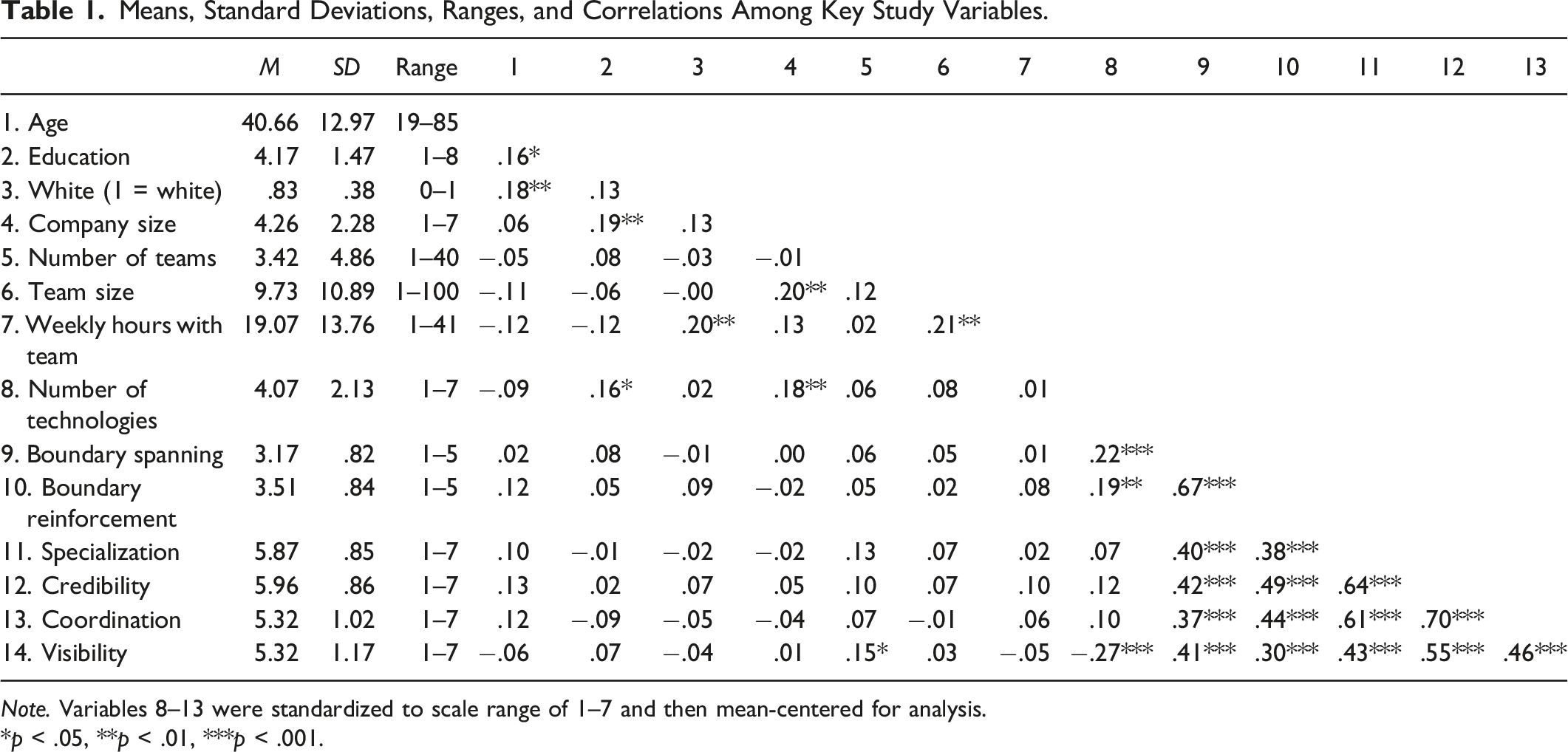
Note. Variables 8–13 were standardized to scale range of 1–7 and then mean-centered for analysis.
*p < .05, **p < .01, ***p < .001.
Results
Modeling Approach
To test our hypotheses, we created three hierarchical linear regressions with the outcome variables of each TMS dimension: specialization, credibility, and coordination. Because we tested moderation relationships (H5), we mean-centered the predictors tested in this interaction (i.e., boundary work variables and the visibility affordance; Hayes, 2022). We also tested for multicollinearity using criteria and techniques (i.e., VIF and condition index) outlined by Tabachnik and Fidell (2019). The assumptions of collinearity were not violated, so the results are reported without caveat or correction.
Results of Hierarchical Regressions.
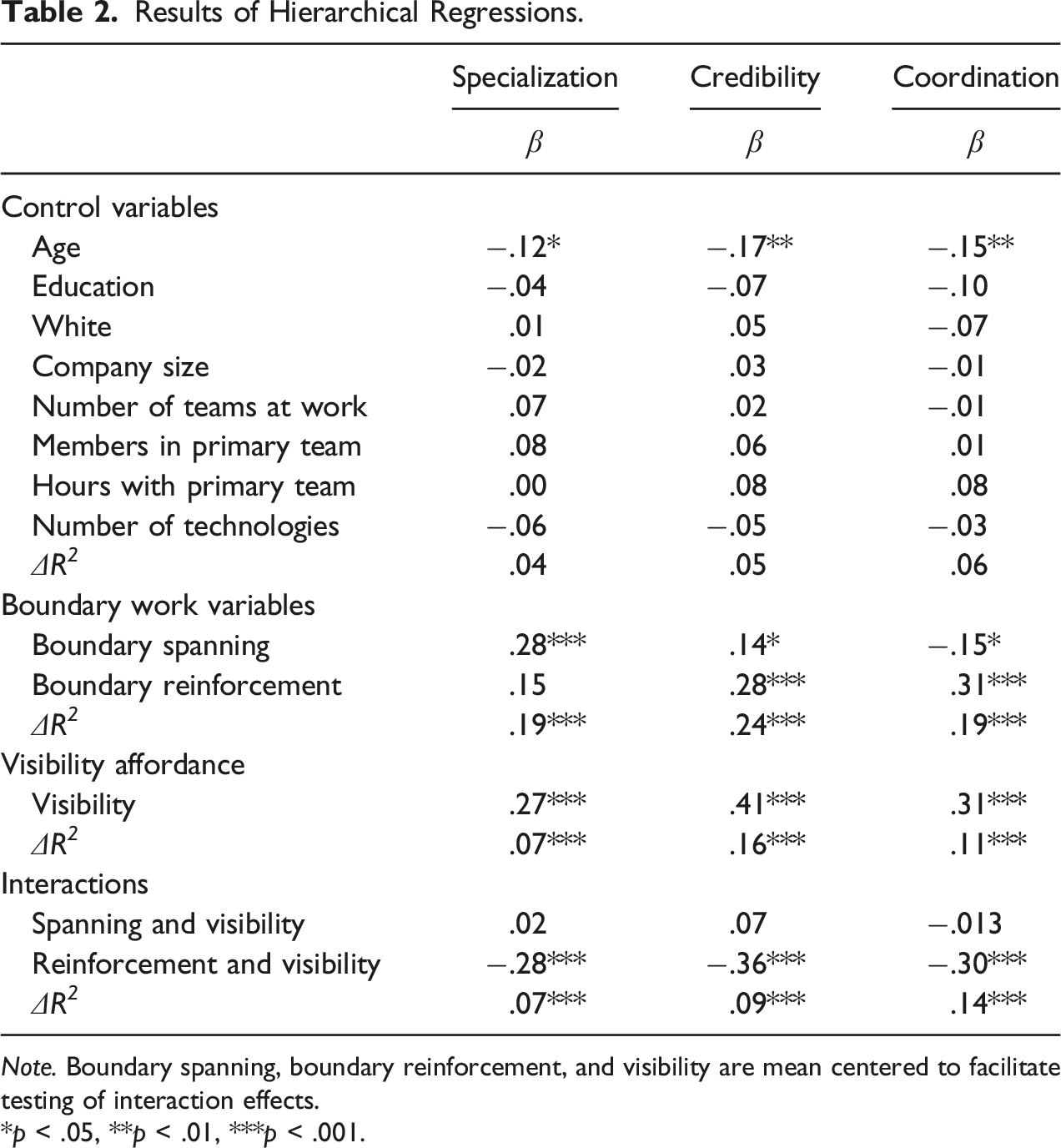
Note. Boundary spanning, boundary reinforcement, and visibility are mean centered to facilitate testing of interaction effects.
*p < .05, **p < .01, ***p < .001.
TMS Specialization Model
The model predicting specialization was significant, F(13, 189) = 8.49, p < .001, R 2 = .37, R 2 adjusted = .33. Control variables were not significantly associated with specialization (p = .35). The addition of types of boundary work was associated with a 19% increase in variance explained in specialization. Boundary spanning had a positive relationship with specialization supporting H1a. Boundary reinforcement was unrelated to specialization (H1b not supported). The visibility affordance was also positively related to specialization supporting H4a and accounted for an additional 7% of the variance.
Finally, the interactions significantly explained an additional 7% of the variance. The interaction between boundary spanning and visibility was not significantly associated with TMS specialization, while the interaction between boundary reinforcement and visibility was negatively associated. We decomposed each significant interaction using Dawson’s (2014) tool which models the interaction at +/−1 SD above and below the mean. Results show that at lower levels of visibility, there was a positive relationship between boundary reinforcement and TMS specialization. In contrast, at high levels of visibility, boundary reinforcement did not affect TMS specialization. This result indicates that visibility does not affect the relationship between boundary spanning and TMS specialization and that boundary reinforcement has a positive relationship with TMS specialization only when visibility is low. Thus H5a and H5b were not supported (see Figure 1). Interaction between boundary reinforcement and visibility on specialization. Note. The y-axis range is limited to 4–7, data are modeled at +/− 1 SD. This Figure is based on estimates from the model reported in the results.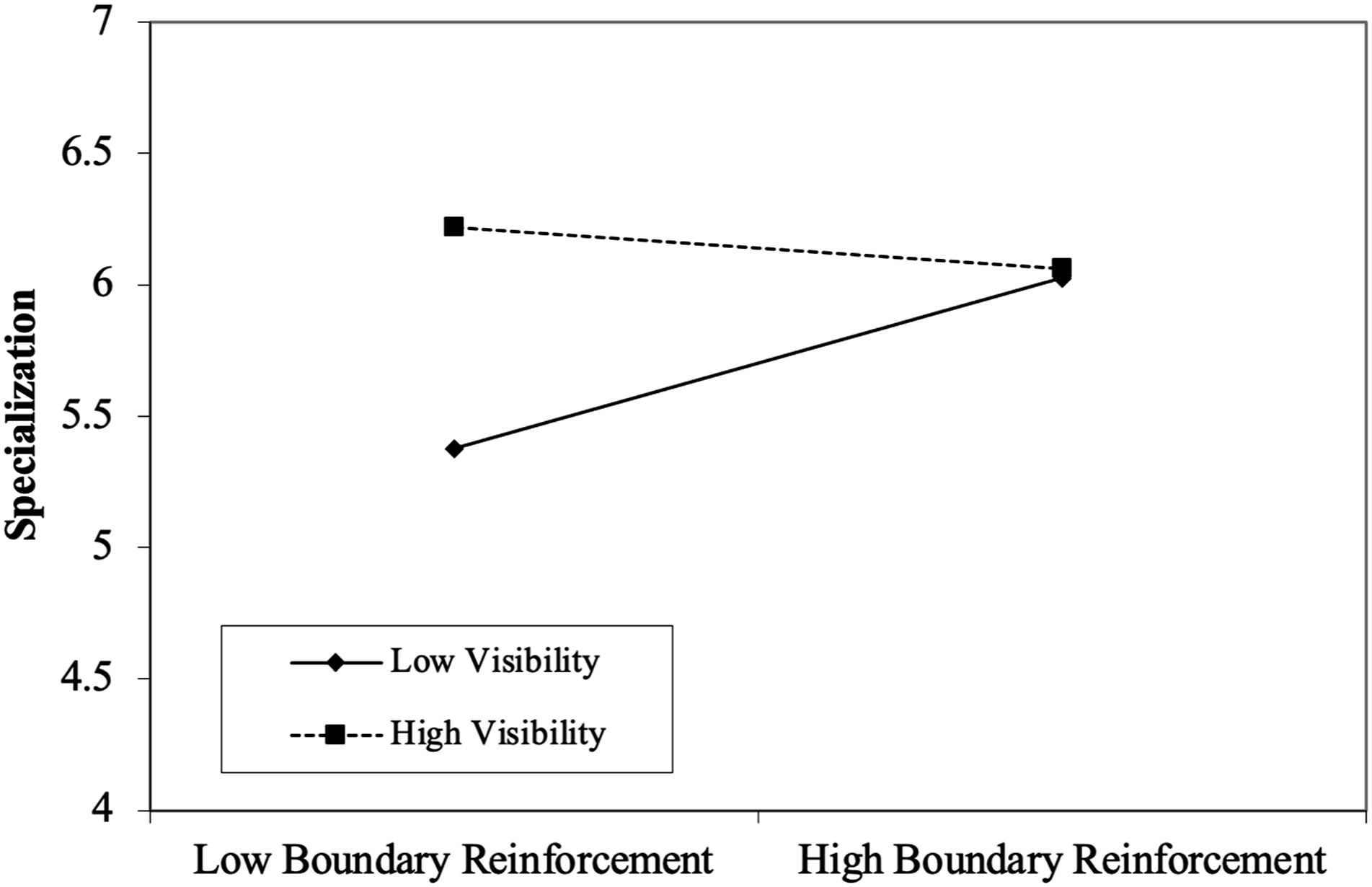
TMS Credibility Model
The model predicting credibility was significant, F(13, 189) = 18.25, p < .001, R 2 = .56, R 2 adjusted = .53. The control variables were not significant (p = .09). The addition of types of boundary work was associated with a 24% increase in variance explained. Both boundary spanning and reinforcement had a positive relationship with TMS credibility, supporting H2a and H2b. The visibility affordance was also positively related to TMS credibility and accounted for an additional 16% of the variance, supporting H4b.
Finally, the interactions significantly explained 9% of the variance. The interaction between boundary reinforcement and visibility was negatively associated with TMS credibility, whereas there was no significant interaction effect between boundary spanning and visibility on TMS credibility. Results of the decomposed relationship show that the relationship between boundary reinforcement and credibility is negligible when visibility is high, and positive when visibility is lower, as shown in Figure 2. These results do not support H5c or H5d. Interaction between boundary reinforcement and visibility on credibility. Note. The y-axis range is limited to 4–7. Data are modeled at +/− 1 SD. This Figure is based on estimates from the model reported in the results.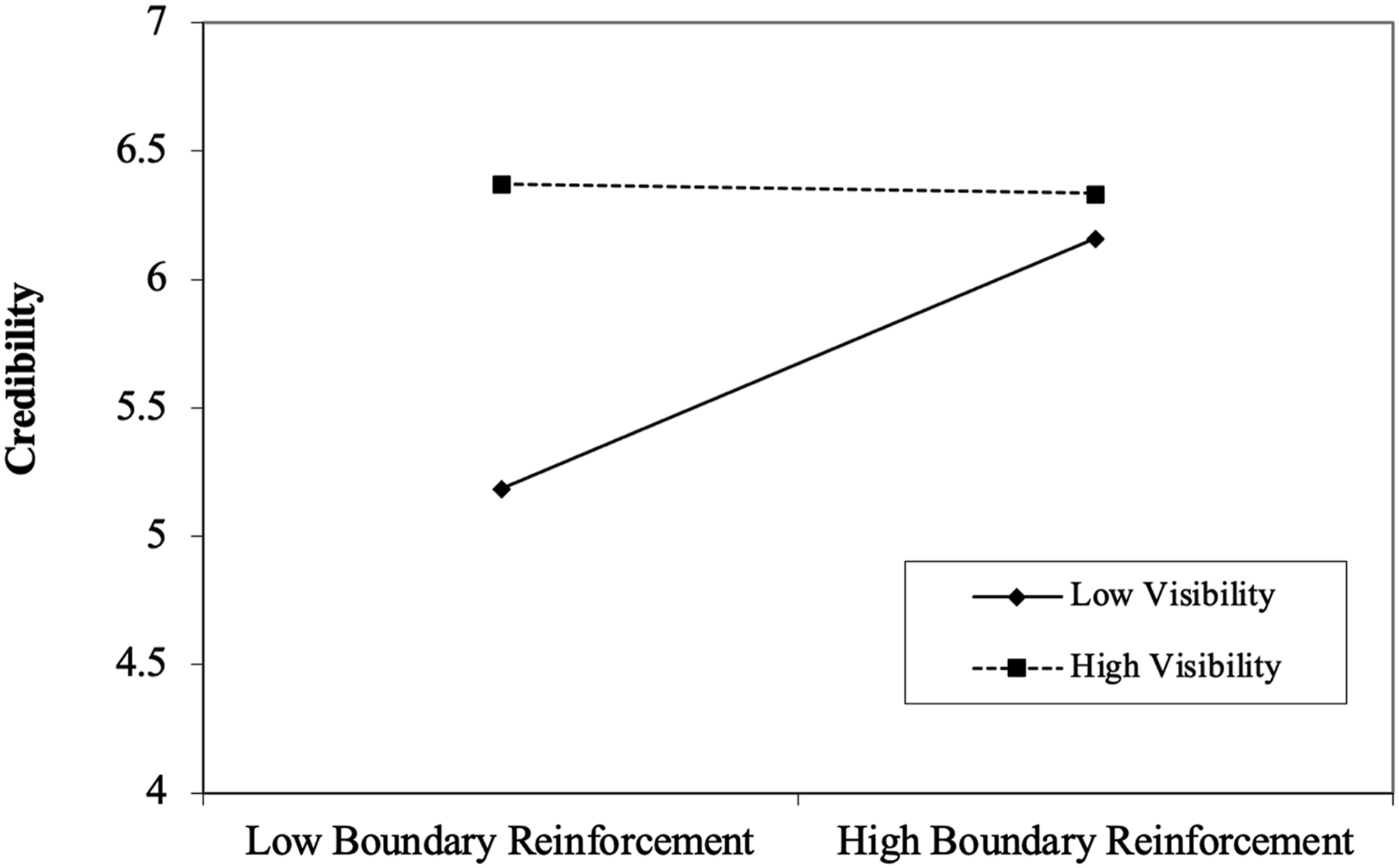
TMS Coordination Model
The model predicting coordination was significant, F(13, 189) = 14.81, p < .001, R 2 = .51, R 2 adjusted = .47. The control variables did not significantly predict TMS coordination (p = .12). The addition of types of boundary work was associated with a 19% increase in variance explained. Boundary spanning had a negative relationship with TMS coordination, supporting H3a; further, boundary reinforcement had a positive relationship with TMS coordination, supporting H3b. The visibility affordance was significantly and positively related to TMS coordination, and explained 11% of the variance in TMS coordination, supporting H4c (see Figure 3).
Finally, the interactions significantly explained 14% of the variance; the interaction between boundary spanning and visibility was nonsignificant while the interaction between boundary reinforcement and visibility was significant. Results of the decomposed relationship show that when visibility is high, the relationship between boundary reinforcement and TMS coordination is negligible. In contrast, at low levels of visibility, the relationship between boundary reinforcement and TMS coordination is positive. Neither H5e nor H5f was supported. Interaction between boundary reinforcement and visibility on coordination. Note. The y-axis range is limited to 4–7. Data are modeled at +/− 1 SD. This Figure is based on estimates from the model reported in the results.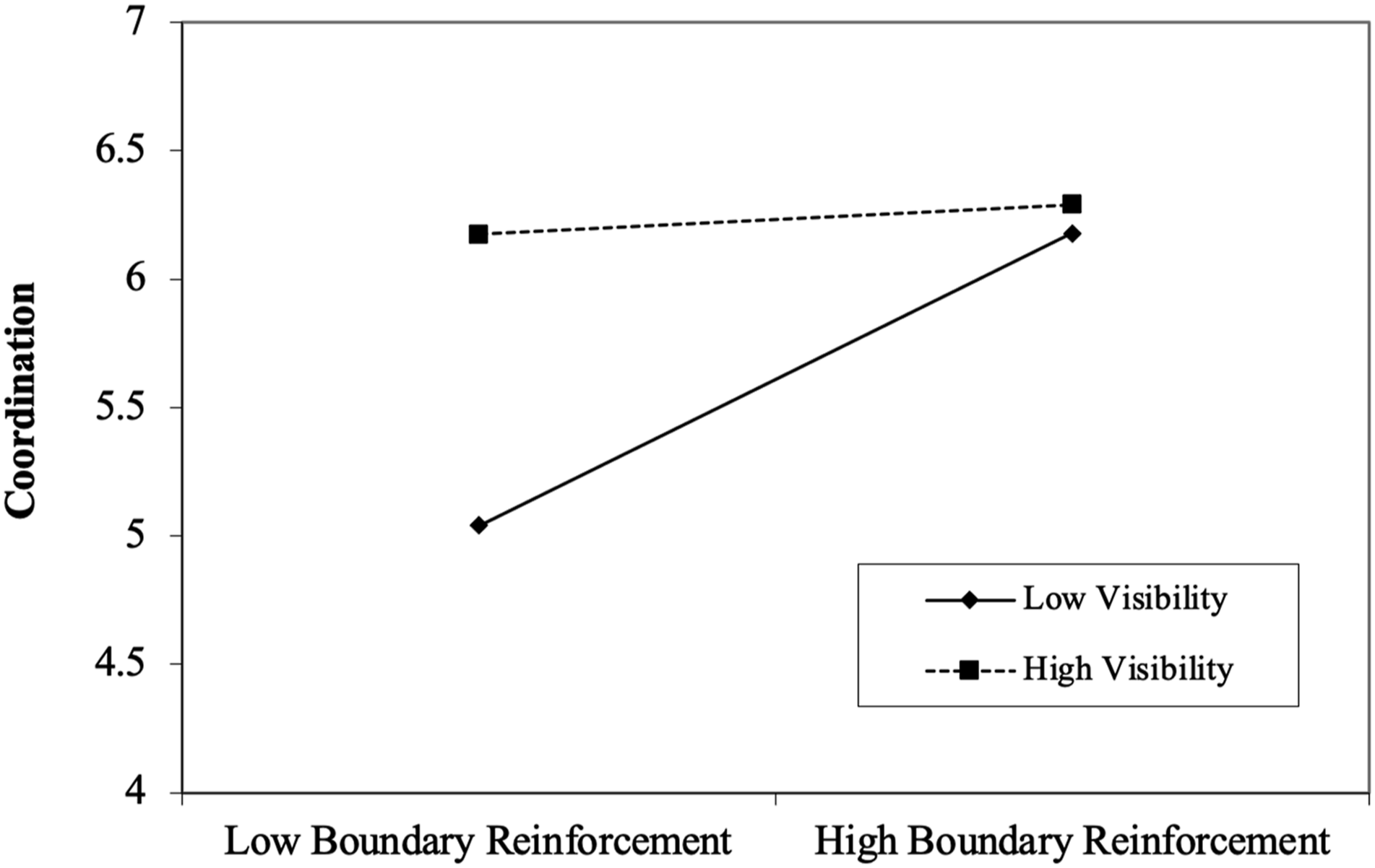
Discussion
This study explored how team members’ boundary work affects the focal team’s TMS development. The two types of boundary work (boundary spanning and boundary reinforcement), the visibility affordance of ICTs the team uses, and the interactions between the types of boundary work and the visibility affordance account for substantial variance in the team’s TMS specialization, credibility, and coordination. Specifically, our results show that boundary spanning positively affects TMS specialization and credibility and negatively affects coordination, while boundary reinforcement positively affects TMS credibility and coordination. Additionally, the visibility affordance has a direct positive effect on all three dimensions of TMS and, contrary to our predictions, moderates the relationships between boundary reinforcement and all three dimensions of TMS such that the direct positive effects of boundary reinforcement are prominent when the level of visibility is low. Below we explore the theoretical and practical implications of these findings and conclude with limitations and suggestions for future research.
Theoretical and Practical Implications
The current study is a novel empirical investigation examining the impact of boundary work on TMS. The findings make important contributions to extending TMS theory by explicating how TMS development can be affected by the external environment in which teams are embedded as well as the ways in which team members engage with the environment through boundary management. Theorization about TMS development and ensuing empirical research have primarily focused on internal team communication and relationships among members in bounded team environments (e.g., Littlepage et al., 2008). This study showcases how TMS development can be understood when team members interact internally with one another as well as externally with members outside their focal team. Our findings suggest that individuals’ boundary work significantly affects TMS development in both beneficial and detrimental ways and that more attention and empirical research are warranted for the extension of TMS theory beyond a focus on intra-team interactions.
The findings of the study also offer practical implications for how work teams may manage boundary activities to develop their TMS effectively. Our findings revealed that different types of boundary work contribute to different aspects of TMS development. Specifically, boundary spanning positively affected specialization and credibility, while boundary reinforcement positively affected credibility and coordination. Simultaneously, boundary spanning may also harm internal coordination for the team’s TMS. These findings help us refute a simplistic notion of either positive or negative effects of boundary work in its entirety and instead develop a more nuanced understanding of the implications for both internal and external realities teams face.
It is well documented that boundary spanning benefits individuals, teams, and organizations (Burt, 2004). Still, teams consistently face a tension between internal and external forces (Piercy & Kramer, 2017). Our findings help reconcile these competing tensions and provide different pathways to leverage both internal and external influences and possibly balance boundary spanning and reinforcement. Teams could benefit from boundary-spanning activities by expanding cognitive resources with additional knowledge brought on from external environments and by supporting individual members’ learning in their areas of specialty and the development of differentiated knowledge structures within the team. Additionally, boundary-spanning activities can serve as a mechanism to validate one’s expertise through external engagement, and boundary spanning might be encouraged to build credibility for team members’ expertise. It is also important to point out the challenges that arise from boundary spanning, an unusual conclusion for a typically celebrated activity for teams and individuals, as it reduces the team’s ability to coordinate.
Increased team cohesion via elevated sense of purpose or identity through boundary reinforcement also benefits TMS. Prioritizing boundary-tightening activities aids in accomplishing critical tasks that require internal task coordination. Further, teams seeking to increase cohesion, trust, and member reliance (i.e., credibility) benefit from boundary reinforcement practices, which increase members’ awareness of team boundaries and strengthen team identity. This is important because teams with more shared mental models about who the team is, what the team does, and how the team is situated in a broader work environment, are better situated to both coordinate and perform more effectively (Wu et al., 2020).
The moderating effects of the visibility affordance are also promising. Our results showed that although the visibility affordance had a direct positive effect on all three dimensions of TMS, when it interacted with boundary work—contrary to our hypothesis—it ameliorated the direct positive effects of boundary reinforcement. In other words, the positive effect of boundary reinforcement on TMS specialization, credibility, and coordination was attenuated when the level of visibility affordance was high. This suggests that high visibility does not make the effects of boundary work more pronounced as predicted, but instead eliminates them by compensating for low boundary-reinforcement activities.
Notably, the moderating effect of the visibility affordance was found only for boundary reinforcement, not for boundary spanning. One possible explanation for this finding is that different types of communication visibility may have varying influence on boundary spanning. The current study treated the visibility affordance as a single construct, but visibility can be teased out into two distinct properties––message transparency and network translucence (Leonardi, 2015). Message transparency refers to a technology’s ability to make communication content (who knows what) visible and public, whereas network translucence refers to the extent to which technology affords users to view others’ communication networks (who knows whom). We speculate that as boundary-spanning activities hinge on interactions and relationships with external audiences and stakeholders, it is possible that network translucence, compared with message transparency, has a more salient influence on boundary spanning and, in turn, moderates the relationship between boundary spanning and the three dimensions of TMS. Therefore, a separation of the two types of the visibility affordance may reveal their moderating effects on boundary spanning and is recommended for future studies.
The predicted negative effect of boundary reinforcement on TMS specialization was not supported in our data, and the relationship between the two variables was, in fact, in the positive direction although not significant (p = .059). Furthermore, similar to the other two dimensions of TMS, the positive effect of boundary reinforcement on TMS specialization was evidenced when the visibility affordance was low. Contrary to our prediction, boundary reinforcement likely enhances TMS specialization by directing the focal team’s communication inward, particularly in a technology environment with low visibility, and thereby helping team members recognize each other’s unique areas of expertise and develop their differentiated knowledge structure. This may also suggest that the benefit of more focused internal team communication through boundary reinforcement can override a potential negative impact of limited knowledge acquisition and learning that boundary reinforcement may bring about.
Limitations and Future Research
Our findings need to be interpreted with a few limitations in mind. First, our measurement of TMS was at the individual level, capturing single member’s perception of their team’s TMS. Fortunately, the TMS measure used in this study has been validated between individual and team perceptions, with high correlations in individual-to-aggregate estimations (Lewis, 2003). Still, team-level data (e.g., aggregation of all team members’ perceptions of TMS) would elevate the measurement of TMS as a team construct, capturing the collective representation of the cognitive structure.
Second, while participants were generally demographically diverse (e.g., race and age), our sample did not consider base rate ethnic makeup and under-sampled Hispanic and Latinx workers who make up nearly one in five U.S. workers (Krogstad et al., 2022). Given these dynamics, future research might benefit from quota sampling based on ethnicity or further focusing on this unique and growing ethnic group.
As mentioned earlier, future research that investigates the disparate impact of the two types of visibility affordance on boundary work and the three dimensions of TMS will provide a more nuanced understanding of the role of visibility affordance. The two types of visibility affordance may differentially affect the three dimensions of TMS. Both message transparency and network translucence may positively affect TMS specialization, as one’s domain expertise can be better recognized and clearly established through communication content as well as network connections. However, the effect of message transparency may be more salient for TMS coordination than the effect of network translucence, because a team’s efficiency in coordinating task performance may depend more on communication content than relational ties.
Finally, consistent with most previous empirical research on boundary work, our study focused on the impact of boundary work on focal teams’ TMS. Boundary management is an important aspect of how individuals and teams operate and function, which implicates both within-team and between-team processes. In response to calls for more research on how team-based constructs that have traditionally been studied in single-team environments, like TMS, can be applied to multi-team environments (Margolis, 2020), future research could expand the target of examination beyond focal teams and explore boundary management between multiple teams. For instance, while boundary spanning may benefit a primary team to whom one has allegiance, it may be detrimental to coordination on secondary or tertiary teams with which a member feels more peripherally affiliated. The fact that a particular boundary activity may benefit one team but harm others in a multi-team environment poses significant challenges to resource sharing across teams. While previous research has suggested that the balance between boundary spanning and reinforcement could be achieved by assigning different roles to team members (Allen, 1984), future research ought to explore how boundary work variously affects teams based on identification, priority, commitment, or other core organizational constructs and how boundary work implicates both intra- and inter-team knowledge sharing.
Footnotes
Declaration of Conflicting Interests
The author(s) declared no potential conflicts of interest with respect to the research, authorship, and/or publication of this article.
Funding
The author(s) disclosed receipt of the following financial support for the research, authorship, and/or publication of this article: This research is based upon work supported by a Committee on Research and Creative Works seed grant at University of Colorado Colorado Springs awarded to the first author.
Author Biographies
 ) and is interested in socio-technical networks and organizational identity/identification.