




Abstract
This study documents how sports officials negotiate aggression from cisgender male athletes as a key feature of their occupational role. Through an ethnographic case study of a collegiate intramural athletic organization, sports officials (N = 24) were observed while officiating and interviewed about their experiences with athlete aggression. Utilizing a phronetic iterative approach and positioning theory as an analytic framework, three organizational storylines were identified that contribute to the implicit, often gendered, rules related to the experience and expression of aggression in this context. Findings also indicated that male and female officials differed in their positioning strategies in response to athlete aggression, through (a) confidence positioning, (b) stoic positioning, (c) expert positioning, and (d) coercive positioning. Implications for how aggression work and positioning theory might build on past emotion management literature are discussed.
While discourses of professionalism maintain that the modern workplace is stoic and rational (Mumby & Putnam, 1992), all work is emotional (Miller et al., 2007). Not only is work emotional, but contemporary organizations capitalize on workers’ genuine and fabricated emotional displays to further organizational goals (Hochschild, 1983). This prescribed emotional labor, or the expression or suppression of specific emotions as job requirement (Riforgiate et al., 2022), results in explicit and implicit rules about workers' emotional displays in the workplace.
Scholars have recently begun to consider how emotional display rules are discursively constructed among organizational actors (Malvini Redden & Scarduzio, 2018; Scarduzio & Tracy, 2015; Town et al., 2021). This interactional perspective demonstrates how emotion management is a co-constructed, value-laden process in which emotion rules may not apply to all organizational actors equally (Malvini Redden & Scarduzio, 2018). As evidence, several studies have demonstrated that emotion rules are gendered (e.g., Hochschild, 1983), such that positive emotional displays (e.g., compassion) are stereotyped as feminine, whereas negative or neutral emotional displays (e.g., aggression, stoicism) are associated with masculinity (Tracy & Malvini Redden, 2019).
One area of focus that might add to this literature is considering how discursive processes of emotion management influence gender disparities related to employee recruitment and retention in certain occupations. Sport officiating is an emotion laden occupational context where large gender disparities exist at amateur and professional levels (National Association of Sports Officials, 2017) and gendered emotional display rules would likely be observable. As evidence, researchers and sport media have recorded several egregious instances of fan and player aggression toward sport officials (Avalos, 2023; Mojtahedi et al., 2022). However, emotional display rules—rooted in professionalism—obligate officials to remain emotionally neutral (Avalos, 2023; Scarduzio & Malvini Redden, 2015). This inherent occupational aggression and required emotional labor may contribute to low retention rates of officials (Anastasia, 2019). Given that gendered emotional display norms likely constrain female officials’ ability to respond (see Erickson & Ritter, 2001; Sloan, 2012), this paradox may also contribute to gender disparities in officiating and other similar emotion work contexts.
A theoretical approach that has the potential to provide insight into how workers negotiate and respond to aggression as a feature of their occupation is positioning theory. The main premise of positioning theory is that people manage their own and others’ identity through discursive positioning within interaction (Harré & Secord, 1972; Harré & van Langenhove, 1999). In short, people place others into temporary identity “positions” through everyday turns of talk. For example, an athlete may position a sport official as a figure of authority by requesting a rule clarification, rather than responding to a call with aggression. By focusing on the patterned behavior within interactions, moral positioning reveals who has the “right” to take up certain identity positions (e.g., a manager calling a staff meeting, a teacher asking for the class’s attention) and who has the “duty” to take up identity positions into which others place them (e.g., an employee complying with a manager’s request, a physician responding to a medical emergency in public).
Moreover, self and other positioning can be unintentional, rooted in biases, stereotypes, or past socialization experiences within and outside of the organizational context (Harré & van Langenhove, 1999). For example, a female manager with positional authority may not be positioned by colleagues and followers as having the same “rights” as her male counterparts in the same role due to gender bias ascribed to feminine identities (see also Malvini Redden & Scarduzio, 2018). Given the feminine identity stereotypes present in sport contexts and aggression display norms in athletics (Kimble et al., 2010; Visek et al., 2010), positioning theory provides a nuanced lens to observe the discursive negotiation of aggression management in relation to intersectional identities. Furthermore, these findings may translate to other workplace contexts where routine aggression management is a job expectation (e.g., police officers, correctional officers; see Ward et al., 2020). With this theoretical and practical foregrounding, the aim of this study is to reveal the specific discursive practices perpetuating gender disparities in sport officiating, with a particular focus on intersectional identity positions and emotion management in occupations with routine aggression. Toward this aim, we employ a positioning theory analytic lens to an ethnographic case study of a collegiate intramural sports officiating organization.
Literature Review
To situate the current study within past literature, the following sections review: (a) emotional labor, (b) co-constructed emotion management, (c) negative emotion management in relation to gender, and (d) positioning theory as a theoretical lens to further detail the co-construction of negative emotion management in relation to identity.
Emotional Labor and Emotion Management at Work
A concept first identified by Hochschild (1983), emotional labor is the expression and/or suppression of emotion as a job requirement (Riforgiate et al., 2022). Emotional labor requires “effort, planning, and control necessary for expressing organizationally desired emotion” during interaction (Hochschild, 1983; Morris & Feldman, 1996, p. 987). In her pioneering work, Hochschild (1983) identified two primary ways that workers manage the display of inauthentic emotions and the resultant emotional dissonance: surface acting and deep acting. When employees engage in surface acting they display feigned organizationally prescribed emotions while concealing their true inner feelings. In contrast, deep acting occurs when workers attempt to alter their felt emotions to align with organizationally prescribed emotion display norms (Hochschild, 1983; Tracy & Malvini Redden, 2019). Prolonged surface acting is related to several negative outcomes including employee exhaustion, cynicism (Powers & Myers, 2020), and burnout (Riforgiate et al., 2022), whereas deep acting can lead to alienation from authentic inner feelings (Tracy & Malvini Redden, 2019).
Extending the construct of emotional labor, scholars have distinguished between the organizational prescription of feigned positive emotional displays (e.g., customer service workers; Ashforth & Humphrey, 1993), neutral/suppressed emotional displays (e.g., transportation security officers; (Malvini Redden, 2013); police officers, prison officers; Ward et al., 2020), and negative emotional displays (e.g., bill collectors; Sutton, 1991). Communication scholars have built on this literature by considering how emotional labor functions within social interaction. In their study on 911 call-takers, Tracy and Tracy (1998) identified this interactional perspective of emotional labor as double-faced emotion management in which workers engaging in emotional labor must both manage their own internal feelings and display emotions to manage another person’s emotions (e.g., a 911 call-taker managing their own feelings of irritation while also calming an angry caller). In recent extensions, studies have explored the co-construction of emotion management as a process during which organizational members manage their own and others’ felt emotions and displayed emotions (Malvini Redden & Scarduzio, 2018; Tumbat, 2011). This emotion management process often functions as a cycle that (re)produces particular emotional display rules from within and outside of the organization (Malvini Redden & Scarduzio, 2018; Scarduzio & Tracy, 2015; Town et al., 2021).
Managing Negative Emotions of Others
A subset of emotional labor research has focused on emotion display rules in relation to negative emotion from co-workers, clients, customers, and the public (e.g., Kramer & Hess, 2002; Ward & McMurray, 2016). For example, Rivera’s (2015) study of border patrol agents described how agents engaged in both “feminine” and “masculine” emotional labor in response to aggression from multiple groups (e.g., immigrant rights activists, local ranchers, motorists). Similarly, Ward et al. (2020) detailed the unique types of emotional labor that “social control agents” (i.e., prison guards, police officers, and nightclub bouncers) engaged in as a result of “their routine exposure to the threat of physical and emotional violence” (p. 86). These unique types included: (a) empathic—emotional labor in which workers identify with and respond with empathy to other’s expression of aggression, (b) neutral—emotional labor in which workers suppress felt emotions while displaying unemotional behavior, and (c) antipathetic—emotional labor in which workers perform aggression or intimidation in response to other’s aggression to control a situation (Ward et al., 2020).
In addition, researchers have found a host of negative outcomes for workers who are obligated to endure regular customer aggression as a feature of their occupation. For example, Grandey et al. (2004) found a positive relationship between frequency of customer aggression and emotional exhaustion. Similarly, a survey-study conducted by Kim and Leach (2021) found that customer service workers who experienced unfounded complaints, verbal aggression, and displaced blame engaged in increased emotional labor, which in turn exacerbated their disengagement and exhaustion. Similar to, yet distinct from, other service industries, sports officiating provides a context in which emotion management in response to frequent aggression might be observed and nuanced theoretically by focusing on the turns of talk within aggression interactions.
A Case for Studying Gender and Workers’ Responses to Aggression
Notably, several studies have focused on the intersections of gender display norms and emotional labor. One branch of this research has established that care work (e.g., nursing, teaching, counseling) is often associated with femininity and therefore employees, often women, in these occupations are expected to perform care and concern (Tracy & Malvini Redden, 2019). Similarly, Macdonald and Sirianni (1996) found that service work where workers are required to perform deference to customers and display friendliness are stereotyped as feminine jobs.
A second branch of these gender and emotion studies have focused on the display of emotion in relation to gender differences. For example, Erickson and Ritter (2001) found that women were more likely than men to hide their feelings of agitation—a finding potentially influenced by women in the sample tending to hold jobs requiring higher levels of emotional labor. Similarly, Domagalski and Steelman (2007) found that lower status males expressed anger more frequently in the presence of higher status organizational members than lower status females—suggesting different emotional display rules for men and women working in the same organization. This study also confirmed findings related to Hochschild (1983) discussion of “status shields” for male employees. An organizational norm that shields male employees from experiencing negative emotion (e.g., verbal abuse, complaints) and allows them to engage in masculine emotion displays (e.g., aggression, toughness, verbal abuse; Tracy & Malvini Redden, 2019).
Malvini Redden and Scarduzio (2018) added to the complexity of the emotion management literature by considering how intersectional, power-laden identities of workers can facilitate or stigmatize the expression or suppression of particular emotions. Pertinent to the current study, the authors documented how stereotypical masculine emotional displays (e.g., sarcasm, irritation, and neutrality) were privileged in bureaucratic organizations, whereas stereotypical feminine emotional displays (e.g., care, concern, and compassion) were sanctioned (Malvini Redden & Scarduzio, 2018). Moreover, the study confirmed differing emotional display rules for male and female judges (i.e., female judges were both expected to show neutrality as a judge and compassion as a woman; Malvini Redden & Scarduzio, 2018; Tracy & Malvini Redden, 2019).
Positioning Theory as a Lens for Detailing Gendered Emotion Management
Harré and van Langenhove’s (1999) positioning theory offers some insight into how gendered emotion display norms might emerge both from within and outside an organization. The main premise of positioning theory is that people discursively construct their own and others’ social reality (e.g., identity, organizational rules, social norms) through patterned everyday talk (Harré & Secord, 1972; Harré & van Langenhove, 1999). Parrott (2003) explained that the action of positioning is the “dynamic construction of personal identities relative to those of others” within social interaction (p. 29). As a result, “positions” are those temporary or shifting identities individuals take up, or reject, through turns of talk, which contrast with more stable organizationally assigned roles (e.g., sports official, manager, athlete).
The main assumptions of positioning theory are rooted in speech act theory, such that people engage in positioning within interaction by reproducing particular “storylines” through speech acts (Harré & van Langenhove, 1999). Storylines are patterned interactions that reproduce implicit rules related to who does or does not have a right or duty to act in a particular situation and guides how people in particular positions may act (Harré & van Langenhove, 1999). Speech acts are verbal messages that accomplish some social action such as a threat, promise, or apology (Searle, 1969). Speech acts have both illocutionary force (i.e., the speaker’s intention) and perlocutionary effect (i.e., the achievement or effect of the speech act). Consider, for example, a sports official who asks their manager “Can you move me to the scorekeeper? The fan heckling is really getting to me.” The illocutionary force of this speech act is both a request for support and an emotional disclosure, whereas the perlocutionary effect is whether or not the manager provides social support to the official and fulfills the position change request.
Harré and Moghaddam (2003) argued that the tracing of storylines or interactional episodes enables scholars to reveal hidden assumptions and patterned social interaction. Within interaction, storylines can be followed like scripts, but also altered or abandoned by one or multiple actors (see Zanin, 2022). Storylines “already follow established patterns of development” given that they reproduce assumptions about who does or does not have a right or duty to act (Harré & Moghaddam, 2003, p. 6). These assumptions are predicated on moral positioning, which occurs when a person behaves in accordance with the rights, duties and obligations of their role. For example, sports officials have a “duty” to ensure a fair and safe environment for athletes, whereas athletes have a “right” to advocate for fair calls from officials.
Moreover, actors both position themselves and others through turns of talk. This positioning can be intentional or unintentional. Unintentional positioning or “tacit” positioning is often grounded in biases, stereotypes, or past socialization experiences (Harré & van Langenhove, 1999). Intentional or “forced” positioning of the self and others is often motivated by pressure to maintain a positive identity position or an authority position (Zanin & Bisel, 2018). For example, Zanin and Bisel (2018) utilized positioning theory to understand how one forced positioning message from a power holder resulted in collective resistance.
In the context of sport officiating, female officials hold dual identity positions of both female and official. Feminine identities often necessitate the negotiation of tacit positioning from others into lower positions of authority rooted in feminine stereotypes (Harré & van Langenhove, 1999). In contrast, sports officials are imbued with particular authority positions, rights, and duties within a sport context (Avalos, 2023). Given that sport culture privileges performances of stereotypical masculinity related to emotion (e.g., aggression, competitiveness, violence; Kimble et al., 2010; Visek et al., 2010), it is likely female officials’ dual identity positions have consequences for the storylines, gendered emotion display rules, and subsequent emotion management that unfolds in this context (see also Malvini Redden & Scarduzio, 2018). Taken together, this body of research indicates that utilizing positioning theory as a lens to understand the discursive process of gendered emotion management in response to aggression warrants further study. Therefore, the following research questions were posed:
What storylines do study participants articulate in the reproduction of aggression norms in the context of RFC sport officiating?
In what ways do RFC sports officials position themselves and athletes in response to athlete aggression?
Method
The data utilized to answer the research questions posed was collected during a longitudinal ethnographic study of a collegiate intramural athletic organization located in the southern United States. Intramural athletics are recreational sports leagues and competitions that are held within one university. The first author was approached by organizational leaders to aid in reducing gender disparities in their intramural program—both in athlete participation and staff hiring. For this portion of the study, the three-person research team (i.e., the primary investigator and two doctoral research assistants) chose to focus on the gender disparities present among sport officials in this organization. This focused data collection was purposely selected given the suitability to the research question and potential practical insights for the organization (Tracy, 2020). During their study design process, the team also considered the feasibility of completing data collection, access and yield of data, as well as the compatibility of the research team member identities to the research site (Tracy, 2020).
Research Context
Recreational Fitness Center 1 (RFC) is a collegiate athletic facility located on a large U.S. university campus. Approximately ten intramural sports are offered by RFC in both the spring and fall semesters. Each intramural sport has a 5-week season played in the fall, winter, or spring and culminates in a playoff tournament. Each intramural sport is also separated into divisions, including: all-gender, men’s, and women’s. These divisions are also at times further divided into skill level (e.g., the men’s division for flag football may be divided into men’s fraternity and men’s recreational). RFC employs approximately 75 part-time student worker employees to officiate and staff the intramural games. Data were collected during a time when RFC had a 4 to 1 ratio of male to female officials employed with RFC intramurals. RFC sports officials have a high rate of turnover–approximately 40 to 50 new sports officials are hired each fall.
As a part of their orientation process, RFC sports officials receive both online training and 8 hours of in-person training. RFC officials must pass a written test regarding rules and regulations associated with their sport prior to serving as an official. Often, new RFC sports officials will also serve in supporting roles (e.g., time-keeping, line judge) prior to serving as the leading official for a game. All entry-level sports officials were paid minimum wage (i.e., $12.25 at the time of data collection). Notably, part-time sport officiating is an on-campus job that is accessible to international students searching for employment due to restrictions on U.S. work permits for international students. Therefore, a large portion of RFC sports officials are also international students. 2
Participants
All participants (N = 24) were employed as officials by the RFC and students of the university. Their ages ranged from 18 to 28 (M = 22.13, SD = 2.61). A majority of sport officials interviewed identified as male (n = 18, 75%), while 6 identified as female (25%). The gender composition of our sample mirrors the overall population of RFC’s sport officials. Sixteen of the officials in our sample self-reported their race as Asian (66.67%), three were White (12.5%), two (8.33%) were Hispanic/Latinx, two were Biracial (8.33%), and one was Black/African American (4.16%). The racial composition of our sample is reflective of the RFC’s reliance on international students to serve as sports officials. In fact, half (n = 12) of participants considered their home to be a country other than the United States. The racial distribution of our participant sample was generally consistent across gender groups. Participants officiated a variety of intramural sports, including soccer, flag football, volleyball, softball, basketball, and cricket. Participants also varied in their length of experience with sports officiating, ranging from 1 month to 4 years (M = 14.25 months; SD = 14.95). Two participants, one male and one female, also held student manager roles and officiated games; their responses were not distinct from other veteran officials within the sample.
Interview Data Collection
After obtaining approval from the university institutional review board and a letter of support from RFC leaders, the research team began participant recruitment at an orientation meeting for new sport officials at the beginning of the fall semester. Recruitment continued throughout the school year at intramural sporting events (i.e., RFC fields, courts, and pitches). First, potential participants were asked to share their contact information with the research team. Next, a team member contacted participants to schedule both an online interview and officiating observation. Prior to the interview, participants completed an online consent form and demographic survey. All participants were then both observed and interviewed.
Due to overlap among participant recruitment, observations, and interviews, the research team collected data according to the greatest yield and feasibility (Tracy, 2020) by considering participants’ constrained time. Therefore, observations were at times completed prior to the interview. Researchers would then describe a scene from their fieldnotes and ask: Do you remember this interaction/game? What were you thinking at the time? In retrospect, are you glad it unfolded the way it did? or Do you wish it would have unfolded differently? If yes, how so? Otherwise, observations were completed following the participant interview. In those instances, research team members asked participants to recall past experiences as an official, by asking for example: Can you tell me about the challenges of being an official? Can you share a story or two that exemplifies these experiences? In what ways does gender (or gender stereotypes) surface during your officiating experiences? All interviews were recorded via Zoom conferencing software and audio files for each interview were professionally transcribed. Interview length ranged from 18 minutes to 76 minutes (M = 36.5, SD = 13.0) and yielded 367 pages of transcribed interview data.
Observational Data Collection
After obtaining RFC organizational consent to conduct observations at intramural games and notifying RFC officials they would be observed during a staff meeting, each of the three research team members completed non-participant observations, approximately 5–7 per team member (Tracy, 2020). All team members met and received formal training on fieldnotes collection as well as the theoretical and practical aims of the study prior to conducting their observations. Each observation took place during a RFC intramural sporting event (i.e., basketball, football, indoor soccer, volleyball, and softball games). Length of observation ranged from 45 to 120 minutes, with a total of 27.25 hours of RFC official interactions observed. The variation in length meant that multiple games, officials, and team interactions were, at times, observed during one observation.
During each observation, research team members took scratch notes (i.e., time-stamped outlines of non-verbal interactional observations and verbatim dialogue; Lindlof & Taylor, 2017) on notepads, computers or smartphones on the sidelines of the intramural field or court. Within 48 hours of the observation, researchers expanded their scratch notes into longer detailed fieldnotes (Tracy, 2020) which included expanded descriptions of the scene and context of the interactions. These detailed fieldnotes also included bracketed contextual information (i.e., researchers’ knowledge of past relationships, issues, theoretical memos, or practical insights) separated from the observational data (Tracy, 2020). The research team chose to first focus on sports that were recommended to them by officials as particularly challenging due to aggressive fans and athletes (i.e., fraternity indoor basketball, fraternity flag football, and men’s indoor soccer). Co-ed volleyball and softball were also observed to supplement and contrast findings in these contexts. All participants officiated one or more of these sports. This process yielded 109 pages of double-spaced fieldnotes.
Data Analysis
Collection and analysis of the combined corpus of data overlapped and unfolded through a phronetic iterative approach (Tracy, 2020), with subsequent steps guided by emergent findings and preliminary interpretations from the research team. To begin, the research team engaged in a primary-cycle coding process based on the questions of theoretical interest (i.e., gender disparities and emotion norms). The primary-cycle coding process was accomplished by reviewing and reducing the dataset (see Bisel et al., 2014) to include all discussions of gender, emotional expression, and emotional suppression. During the primary cycle coding process, each team member was delegated a subset of interview transcripts and/or fieldnotes to code (i.e., 4–5 transcripts or fieldnotes per week over 3 weeks). Team members were assigned data collected by another team member in order for the whole team to be familiar with the majority of the dataset.
Sport Official Aggression Storylines.
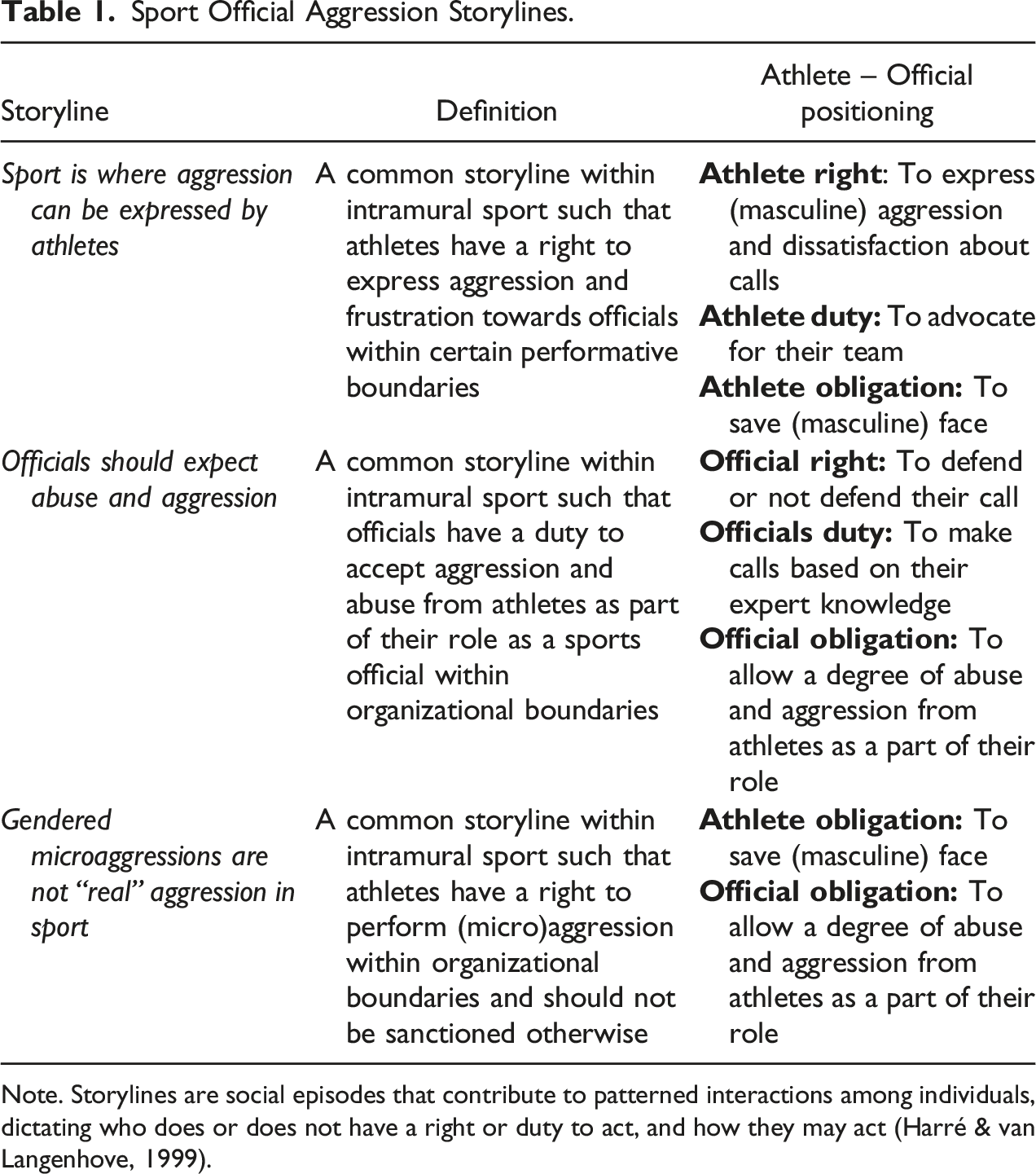
Note. Storylines are social episodes that contribute to patterned interactions among individuals, dictating who does or does not have a right or duty to act, and how they may act (Harré & van Langenhove, 1999).
Sport Officials Positioning Responses to Male Athlete Aggression.
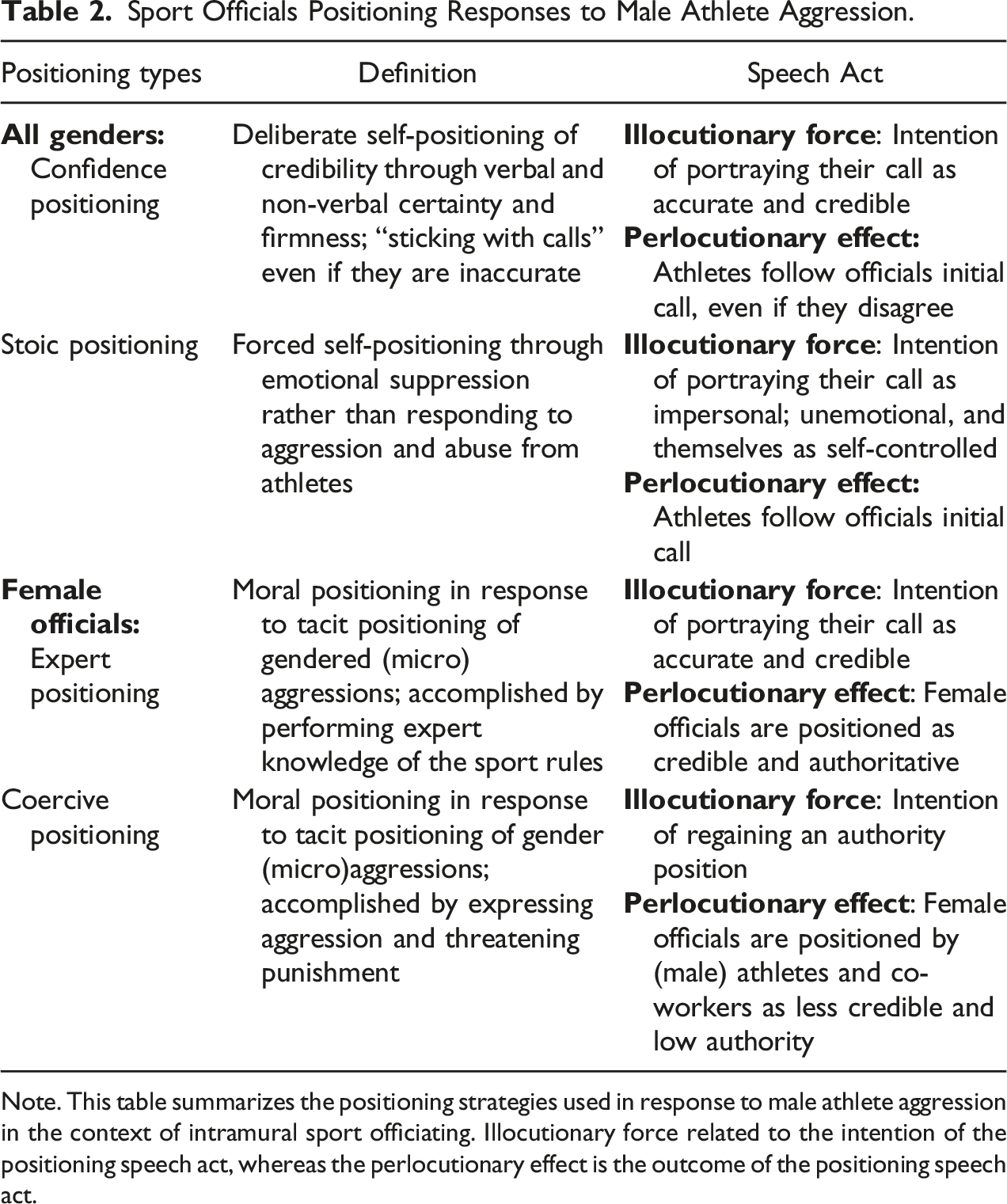
Note. This table summarizes the positioning strategies used in response to male athlete aggression in the context of intramural sport officiating. Illocutionary force related to the intention of the positioning speech act, whereas the perlocutionary effect is the outcome of the positioning speech act.
Qualitative Quality Procedures
Several steps were taken to ensure high-quality qualitative research and improve the interpretive credibility of the findings (Tracy, 2020). First, this study included data from multiple participants and utilized multiple methods (i.e., interviews, field observations) in a variety of sport contexts collected over an extended period of time until data saturation (i.e., new data yielded redundant responses; Tracy, 2020) in regards to the research aims was achieved. These multiple perspectives and methods allowed for multivocality—“analyzing social action from a variety of participants’ points of view and highlighting divergent or disagreeable standpoints” (Tracy, 2020, p. 277)—in presenting divergent findings among male and female officials. Second, to enhance the rich description of the RFC cultural context, the first author conducted an informant interview (i.e., a cultural insider, who can articulate stories and cultural explanations that others cannot, Lindlof & Taylor, 2017) with RFC intramural director Kevin.
Third, similar to Lindemann (2008), the study protocol allowed for data-referencing questions to be posed during interviews completed after field observations. Data referencing questions enhance interpretive credibility as they allow participants to explain in their own words what the researcher has observed in the data (Tracy, 2020). Finally, nearing the end of data collection, the final six semi-structured interviews concluded with member reflection questions, where the researcher “posits a certain understanding of the data collected thus far and asks that respondent to comment upon it” (Tracy, 2020, p. 168). Participant member reflections were incorporated in the final version of the findings, particularly in relation to the three storylines presented.
Findings
Through our iterative analysis, we offer the theoretical concept of aggression work as occupations that require employees to endure aggression from others while suppressing felt emotions. Data analysis, guided by the primary research question, yielded three storylines that contributed to gendered aggression norms (see Table 1) in this aggression work context. Guided by the second research question, analysis revealed that four types of positioning (i.e., confidence positioning, stoic positioning, expert positioning, and coercive positioning) sustained gender norms toward the reproduction of aggression work (see Table 2). The following sections highlight exemplar data for both the storylines and positioning found in this case study.
Setting the Scene: RFC Sports Official Storylines
Storylines are normative social episodes that contribute to patterned interactions or “scripts” that relate to who does or does not have a right or duty to act in a particular situation and guides how people in particular positions may act (Harré & van Langenhove, 1999). Within interaction, storylines can be started, abandoned, taken up, and/or rejected. Given the ubiquity of sport officials and athletes positional roles within sport culture broadly, the following storylines were rarely rejected or abandoned in this case context. We argue that these particular storylines reinforced the emergence of specific gendered positioning strategies detailed in the subsequent sections.
Intramural Sport is Where Male Athletes Can Express Aggression
First, all participants described an allowed norm of athletes expressing aggression toward officials. RFC training manuals explained that sport officials are allowed to eject players, teams, and fans who traverse organizational boundaries of aggression. These boundaries were framed during RFC official training and by officials as “the Five No Nos,” which include expressions of (a) sexism, (b) racism, (c) religious discrimination, (d) profanity, and (e) physical violence. However, in practice, the use of less egregious and/or ambiguous aggression, including sexism and profanity, towards officials was allowed and expected by RFC and the officials. Maria, a female official, explained that “sometimes when players lose … they yell at their referees, which is normal as long as they don’t raise any no-nos. … as long as they don’t use any bad words or no-nos, they’re venting their frustration at you, but not [all female officials are] okay with getting yelled at.” Here, Maria highlights the normative practice of allowing players to “vent their frustration” at officials, however she also acknowledges the emotional burden this normative practice has on female official recruitment and retention within RFC.
In this storyline, athletes have a right to express aggression and dissatisfaction about calls in an attempt to save face. Officials frequently explained that aggression from athletes about calls often increased as they became desperate to win (e.g., “since they want to win, they will shout at everything,” Manuel, male official). Moreover, when asked about when and how this aggression unfolds, many officials explained that the majority of serious issues and overt aggression occurs from male athletes—often during fraternity league games. In fact, no aggression displays from female athletes were recorded in fieldnotes or described by sports officials in interview data. As Penny, a female official, observed “There is this aggression in men that I don’t see that in women, … [female players] are sporty and they play very well and they have that sportsmanship, but they’re not aggressive and they do not pass comments [i.e., question calls].” In this excerpt, Penny highlights the gendered aggression display rules within this context, such that male athletes are allowed to express aggression towards officials. Several officials explained that all-gender and all women’s leagues and teams are easier to officiate because “girls play more soft, and they aren’t fighting, shouting, and everything like that. It mainly happens with the men’s games” (Cindy, female official). This evidence indicates that the expression of aggression was not a storyline taken up by female and all-gender intramural athletes.
Several officials explained that particular sports like all-male flag football and basketball had reputations for being particularly “obnoxious,” “violent,” and “annoying” in comparison to other sports (Rayme, a female official, Flag Football Fieldnote, September 22nd). All officials were told stories about witnessing or hearing about physical violence during or after fraternity games. For example, Aaron, a male official, recalled a time a “player got very agitated after the game and he threw a bench just to show his frustration,” which narrowly missed a female official. In response, Aaron explained, “[the female official] remained quiet, very reserved … she never came forward. She never even raised her voice.” While Aaron reported this player’s aggressive behavior as it violated the “Five No Nos,” this excerpt highlights the expected tolerance from officials to male aggression emotion norms in this context.
Officials Should Expect Abuse
Second, officials explained that this storyline of athlete aggression was reinforced through their duties and obligations as a sport official (see Table 1). Officials both have a duty to make calls based on their expert knowledge to ensure fair play, and—given the athlete aggression storyline—an obligation to accept a degree of abuse from athletes. Maria, a female sport official, explained: “during our trainings … especially in our basketball training, we are told that, ‘You are going to get yelled at a lot.’ That’s the first thing that will be put out in the training since that is the most yelled at job.” Carrisa, a female official, echoes Maria, by stating that in training, “they kind of warn everyone about the fact that they’re going to yell at you. It’s kind of just inevitable in basketball.” These excerpts about formal organizational messaging highlight the acceptance of aggression from male athletes as “inevitable,” and allowing abuse is part of the obligation of sports officials’ formal organizational role.
Gendered Microaggressions are Acceptable
Third, given a degree of aggression towards officials is accepted, determining what types of aggression are egregious and warrant sanctioning from the official is up to the officials’ discretion and experience. Kevin, the RFC director cited his own officiating experience for reference, explaining that “my fuse is probably a lot longer than somebody who this is their first game they’ve ever done.” Given this ambiguity and obligation to expect and accept a degree of aggression from male athletes, female officials did not formally report or sanction gendered microaggressions they experienced while officiating, even though sexist comments violate the “Five No Nos.”
For example, Samantha, a female official, relayed a story of a male athlete on the losing team approaching her after the game. She explained, he said “‘Hey, thanks, girl. You did a really good job. I really appreciate you, ma’am.’… I was like, ‘Well you already called me girl. And then you just called me ma’am. I get it, I’m a girl.’” While on the surface the statement could be interpreted as an expression of gratitude towards an official, the reinforcement of Samantha’s gender identity functions as a passive-aggressive insult to her credibility as an official. Given the ambiguity of the statement, Samantha did not respond to the athlete and did not formally report this issue to her supervisor.
Other female officials described gendered microaggressions and did not formally report them. Examples include being asked by male athletes upon their arrival to the field or court “Is this your first game?” and “Oh, can we get a different ref? Can we just change [to a male official]?” These comments function as gendered microaggressions because they imply and attribute incompetence to an embodied feminine identity, rather than actual role performance as a sports official. Maria, a female official, elaborated on this assumption unrelated to performance as an official. She explained “When players question my ability [before the game] … it needn’t be big statements that make you feel like that. … One of the players did ask me, ‘Do you know the rules?’ I was like, ‘Why do you think I’m here?’” When asked how they responded, both female and male officials did not formally report experiencing or witnessing gendered microaggressions. Instead, due to these storylines, they engaged in several types of positioning to negotiate their duties and obligations of aggression work in their roles as sports officials, as discussed in the next section.
Gendered Positioning within an Aggression Work Context
Analysis indicated that these storylines positioned sports officials to respond to athlete aggression in four main ways: (a) confidence positioning, (b) stoic positioning, (c) expert positioning, and (d) coercive positioning (see Table 2). Notably, several participants stated that female officials had to engage in additional positioning strategies (i.e., expert and coercive) to attain and maintain credibility and respect in response to male athlete aggression. The following section details and provides evidence for each positioning strategy.
Confidence Positioning
First, all officials interviewed discussed how the performance of confidence was essential in the role of officiating. As evidence, “confidence” or “confident” was referenced organically 133 times across fieldnotes and 21 of 24 interviews. Confidence positioning is defined as deliberate self-positioning of credibility through verbal and nonverbal certainty and firmness (e.g., loud whistle blowing, forceful hand gestures). Confidence positioning occurred when officials would stick with their calls even if they were wrong—a practice observed and identified through interviews. Confidence positioning occurs when an individual wants to portray something as reality (e.g., a foul call in basketball), regardless of accuracy, to achieve a particular goal (i.e., to maintain credibility as an official). Luke, a male official, explained this positioning strategy: It’s just important to have that confidence …. Because if you throw a flag and the team’s like, ‘Oh no, that wasn’t a flag.’ And then you pick it back up. It’s almost like you’re letting them push you around and they’re going to remember that. And they’re going to … believe they can do that even for calls that you’re getting right.
In this excerpt, Luke explained the first order position of assuming the rights and duties of an official by confidently making the initial call. Additionally, sticking with the call, even if the call is inaccurate, is an example of deliberate self-positioning to stick with the storyline that officials make the final decision. Similarly, Aaron, a male official, explained that this positioning is important for the role of officiating, regardless of accuracy. He distinguished this difference between “good” (i.e., confident) and “accurate” calls: It’s just the confidence that the referee has in that sport and the call that he or she’s making. In fact, I’ve seen a lot of female [officials] also making really good calls, really strong and confident calls, but it’s all because of experience. … they have a good tendency on how to actually act during a call, even if they make a bad call.
In this interview excerpt, Aaron highlights how this type of positioning is essential to remain in the authority position within the game, regardless of gender. Importantly, Aaron stresses to the interviewer that female officials can “in fact” make good, confident calls, implying that there is a general assumption of inferiority attributed to female officials by male athletes.
Confidence positioning was achieved through several types of messaging, but mainly through nonverbal performances of confidence, such as forcefully and quickly raising their arms to indicate a three-point shot in basketball. During an informal interview between basketball games, one official explained, “[Officials] can make the wrong and right calls as long as they look good. A big part of it is confidence. If you look like you’re right, the players will believe that you’re right” (informal interview, male official, Men’s Basketball Fieldnote, April 13th). Nonverbal confidence positioning included assertive whistle-blowing, decisive hand and arms gestures when making calls, and raised vocal volume (fieldnote data). At times, this type of positioning was challenging for newcomers, both male and female officials, due to inexperience (e.g., not knowing rules, call signs) and minimal training prior to officiating their first game.
Stoic Positioning
Second, all officials interviewed discussed a goal of being able to fully ignore and suppress an emotional response to male athlete aggression. Stoic positioning is defined as forced self-positioning through emotional suppression rather than responding to aggression and abuse from athletes. This (non)response to athlete aggression is a forced self-position because the emotional suppression is an obligatory response as a result of their formal role as a sports official. As evidence of this role obligation, Cindy, a female official, explained that during training, in response to aggressive athletes, her supervisors “told us that we have to ignore it. We just have to ignore it.” Similarly, Maria, a relatively new female official, explained that she emulated the emotional suppression of her male co-workers with more experience: [Her male co-workers] don’t take it to heart. They just listen. They don’t even listen. They just stand there like a rock. And it’s just done after the player leaves. I like that in them. They’re more used to this work than me. So I look forward to being that immune. I still get a little affected when I’m yelled at.
In this interview excerpt, Maria detailed the emotional labor she engages in to maintain stoic positioning in her role as an official. She further explained that she would like to be desensitized to being the target of aggression. She strives to shift from surface acting (i.e., expressing feigned emotional displays; Hochschild, 1983) in her stoic positioning, to be “immune” like her veteran co-workers. In short, Maria would prefer to engage in deep acting emotional labor (i.e., the authentic regulation of inner emotions in response to aggression; see Hochschild, 1983).
However, stoic positioning likely sustains rather than reforms male athlete aggression. For example, Penny, a female official, told a story about officiating a challenging softball game. When she first arrived the male athletes, “passed comments related to ‘just go,’” similar to the gendered microaggression other female officials experienced as a result of assumptions of female inferiority in sport officiating roles. In the same game, Penny recalled that one male athlete quietly heckled her after a call by “saying that I’m on my period.” This particularly blatant gendered microaggression functions differently than other forms of male athlete aggression. Indeed, this message not only draws attention to Penny’s femininity as evidence of her inferiority as an official, it also implies that her call as a female official cannot be trusted because being “on her period” is an indication of her hormonal emotionality. Here, Penny encountered the irony of her intersectional gender-authority position—while the male athlete is allowed to express emotionality in the form of aggression, she is obligated to remain stoic, while being accused of using her feminine emotions to determine calls. When asked by the interviewer how she responded to this gendered aggression, she explained, “I actually tend to ignore it.”
Penny’s example demonstrates the insidious nature of obligating employees to engage in aggression work, particularly for workers who belong to marginalized identity groups (see also Malvini Redden & Scarduzio, 2018). Given that the storylines in this context train sport officials to expect and accept aggression from male athletes, a sexist statement uttered quietly, rather than yelled, often went unreported and unsanctioned. In sum, a stoic positioning response then enables aggression in all forms to continue to be allowed and expected in this aggression work context.
Feminine Identity Positions in Officiating
Several officials, both men and women, described how female officials were obligated to engage in additional positioning in response to athlete aggression, likely as a result of their layered identity positions of “female” and “official” in this context. For example, Milton, a male official, explained this gendered positioning of female athletes, by stating “people just discount what they do because they’re female even if they know the rules really well.” Similarly, Carrisa explained, “I think [male athletes] just assume a girl knows less about sports so she’s going to make the wrong calls.” As participants indicated in this context, male athletes are positioned as experts, and female officials are positioned as non-expert, regardless of training and experience. Luke, a male official, observed a disparity in how male athletes treated female officials. He explained, “[male athletes] view the [female] gender as someone who’s incapable of watching these sports. This is a male sport… I think there’s a subconscious layer to it that definitely affects those aggressive behaviors.” Given this gendered (micro)aggression disparity by male athletes, female officials were obligated to respond by utilizing additional positioning strategies to fulfill their role as an official.
Expert Positioning
A third strategy participants described was expert positioning, which is defined as a moral positioning in response to tacit positioning of gendered (micro)aggression. Expert position is an example of moral positioning given that officials are behaving in accordance with the rights, duties, and obligations of their formal role in the organization (Harré & van Langenhove, 1999). This positioning was accomplished by relaying and performing expert knowledge of sport rules. For example, Rayme, a former volleyball player and veteran volleyball official, recalled an incident nearing playoffs where she provided an explanation by stating: “‘Hey, playoffs are coming up, I’m going to start calling more doubles and lifts 4 .’ And … surprisingly, both teams were like, ‘Thank you for actually doing that.’ And it was a fraternity.” In this excerpt, Rayme demonstrated how as a female official she is obligated to engage in additional discursive positioning to maintain her authority position. Moreover, she highlighted that this response of gratitude was from a “fraternity” and in doing so demonstrated that the typical response to official calls from male fraternity athletes is not gratitude. She also recalled teaching her male managers about volleyball rules as well, stating that “if I explain it well enough, usually my managers and my down ref will be like, ‘Yeah, just listen to her.’” Here expert positioning is used again to attain and maintain her authority position as sports official.
Samantha, a female official, also reinforced her expert position by responding to players who questioned her calls by stating “I’m so sorry you feel that way. Maybe you should be the ref if you wanna make the rules,” (Flag Football Fieldnote, February 24th). In her interview, she elaborated that when ignoring aggression does not stop the behavior, she responds, “‘If you don’t agree with the rules or you want to call your own rules, then you be a ref. We’re always hiring. You can come be a ref.’ And then that usually shuts them up.” In this explanation, Samantha highlighted how stoic positioning does not always work as well for female officials, which necessitated alternative positioning responses from female officials.
Similarly, Victor, a male official, provided an example of his female co-worker: If someone goes … you did not make this call right … She’ll go and bash him in the left, right, center. She’s like, “I’m the official. I understand the game more than you do. I play the game as well.” If you have any questions, she’ll be like, “Rulebook, page number eight, point number four. Read this.”
In this interview excerpt, Victor commended his female co-worker for utilizing expert positioning to retain her authority position as an official. He described how she cites the rulebook from memory to demonstrate her expert position in this context.
However, this strategy is also related to confidence positioning. Victor recalled that he asked his co-worker if she was sure about the page in the rulebook, and she responded “No, I’m not sure. It may not even be on that page, there might not even be page eight. But when I say that with this confidence. Go check, go page eight, point four, the other person’s like ‘oh, she understands the game.’” Confidence positioning, paired with expert positioning enabled female officials to maintain their authority when their authority position was questioned.
Coercive Positioning and the Erosion of Female Officials’ Authority Positions
Last, a few officials described the use of coercive positioning by female officials in response to male athlete aggression. We define coercive positioning as moral positioning in response to tacit positioning of gendered aggression and is accomplished by threatening punishment and counter-aggression. This type functions as moral positioning given that female officials are obligated to respond to heightened aggression by male athletes due to the tacit positioning of their gender as a lower authority position. As an example, Vincent, a veteran male official, explained that female officials, because of gender bias they experience, might use the sportsmanship points docking system more frequently, “where men just stand their ground [and] say, ‘I said what I said, you continue.’” He went on to explain how this situation would likely unfold discursively: [female officials will] probably say stuff like “If you say anything like this I will dock your points.” Which again, reduces your credibility because it kind of seems like what I say is final. It’s not what I say is right, it’s what I say is final.
Notably, in this excerpt, Vincent explained how and why the use of coercive positioning in the form of threats further erodes the tenuous authority positions female officials try to maintain. He explained that while the threat is made with the intention of retaining her authority, the effect is reduced credibility and decreased authority. Vincent implied that relying on a threat of docking sportsmanship points, which is an authority external to the speaker, rather than relying on their positional authority (e.g., the rights of an official or demonstrating expert knowledge) reduces the speaker’s authority in this context.
As further evidence, Samantha, a female official, explained an interaction where she responded to a male athlete’s aggression by utilizing aggression and coercive positioning to regain her authority position. She recalled: So they were just picking on me the whole game. It was a frat game, and they had tons of fans. … And then [they] just kept going on and on. And I finally was like, “Can you just shut the fuck up? How do you know what I saw?”… And then [my manager] was standing right next to me. And he was like, ‘[Samantha], I understand your frustration, but you can’t be talking like that to the players.”
In this excerpt, Samantha describes how she felt “picked on” more than usual given the context of a fraternity game, which resulted in her own aggressive response. Yet, instead of addressing the frequent male athletes’ aggression displays toward Samantha, or supporting her officiating calls, the manager reproduced the storylines of gendered emotional work in this context by sanctioning Samantha for her display of aggression. 5 This sanctioning supported the positioning of female officials into non-expert and lower authority positions, rather than addressing the problematic behaviors of male athletes, given the storylines in this context.
Discussion
The aims of this study were threefold: (a) to document the intersections of aggression and gender emotional display norms in the context of sports officiating, (b) to reveal the discursive and interactional identity and emotion management that occurs in sports officiating, and (c) to detail the social practices affecting gender disparities in sport officiating. Towards these aims, we conducted an iterative analysis (Tracy, 2020) guided by RQ1 and RQ2, which resulted in the identification of three aggression storylines that moralized the aggressive behavior of cisgender (i.e., a person whose gender identity corresponds with the sex assigned at birth) male athletes as well as obligated tolerance and stoicism from all officials. The analysis also revealed four positioning types officials engaged in to manage their own and others identity positions and emotions in response to male athlete aggression. With these findings, we build on past literature such that this type of emotion management resulted in different positioning strategies for cisgender male and female workers.
Emotion Management in Aggression Work
First, we offer the theoretical term aggression work as occupations that require employees to endure aggression from others while suppressing felt emotions. Past research on emotional labor and emotion management has identified occupations where workers are required to express negative emotions (e.g., Malvini Redden & Scarduzio, 2018; Scarduzio & Malvini Redden, 2015; Sutton, 1991). However, only a few studies (e.g., Malvini Redden & Scarduzio, 2018; Tracy, 2005; Ward et al., 2020) have considered how workers engage in co-constructed emotion management in response to obligatory routine exposure to aggression behavior from other organizational actors.
As a result, our findings within an aggression work context extend past research on emotional labor and emotion management. Specifically, Malvini Redden and Scarduzio (2018) demonstrated how actors' intersectional identities (e.g., female, latina, judge) affect how they engage in emotion management and how particular emotional displays are perceived. For example, emotional neutrality is perceived by defendants as anger for female judges and by passengers as robotic for TSO agents (Malvini Redden & Scarduzio, 2018). Our study builds on this literature by detailing how actors (re)produce and respond to particular storylines that perpetuate particular rights, duties, and obligations in relation to emotion management rules associated with differing identity positions (e.g., sports official, athlete, male, female). Interestingly, overlapping identity positions of “female” and “official” resulted in increased aggression from male athletes, but not female athletes—a phenomenon acknowledged both by male and female officials in this context.
While aggression displays from male athletes were expected and permitted in this aggression work context, our analysis revealed how embodied identity positions (e.g., gender) might exacerbate aggression displays and increase microaggressions through intentional and tacit positioning. As Harré and van Langenhove (1999) explained, intentional positioning is often motivated by pressure to maintain power or save face (e.g., how a person might engage in different positioning scripts with a supervisor versus a co-worker). In contrast, tacit or unintentional positioning is rooted in biases and stereotypes about particular identity positions (e.g., how a person might engage in differing positioning scripts with a male versus a female supervisor). This study highlights the specific ways these layered identity positions (e.g., an interactant’s formal organizational role, gender identity) affect patterned turns of talk among interactants as well as who has the right, duty, and/or obligation to take up, reject, or acquiesce to particular positions.
Gendered Positioning within Aggression Work
Second, our findings build on and nuance past research on gendered emotional labor and emotion management. Hochschild (1983) explained, “The more she [the worker] seems natural at it, the more her labor does not show as labor, the more successfully it is disguised as the absence of other, more prized qualities” (p. 169). In this case, female officials were obligated to negotiate additional abuse and aggression from male athletes due to tacit positioning of women as sport non-experts. This tacit positioning obligated female officials to engage in additional attempts to maintain their identity position of authority to fulfill the duties of their organizational role (e.g., expert and coercive positioning) with varying degrees of success. For example, the use of coercive positioning by threatening to dock sportsmanship points, while within their rights and duties as a sports official, ultimately eroded their authority position.
Notably, past emotion management research notes that this type of emotional labor is particularly gendered due to societal gender norms regulating women’s expression of anger and agitation. As evidence, Erickson and Ritter (2001) argued that “the management of agitation is the form of emotional labor most likely to be associated with increased feelings of burnout and inauthenticity and that this negative effect on well-being should be more common among women” (p.146). Similarly, Malvini Redden and Scarduzio (2018) found that transportation security officers experienced hidden taint (i.e., prestigious work that becomes stigmatized as “dirty work” due to intersectional identities and power dynamics) when feminine emotional expressions were stigmatized during their work. The current case supports and extends these past findings at the intersection of gender and emotional labor, given that both female athletes and female officials managed and suppressed their aggression and agitation, while male athletes did not. Moreover, the formal messaging from organizational management (e.g., “you will be yelled at”) sustained aggression storylines about who (i.e., cisgender male athletes) in the context of intramural sport had the right to express aggression. This finding has implications for how organizations might reform storylines about who should expect and accept abuse as their role, duty, or obligation to the organization.
Gendered Deep and Surface Acting within Stoic and Confidence Positioning
A third contribution is the documentation of stoic and confidence positioning. While both male and female officials responded to aggression from athletes with these positioning strategies, several female officials, who were also newcomers, emulated their male counterparts for not taking the aggression “to heart” or being “immune” to the aggression from athletes. Here, participants describe Hoschschild’s (1983) distinction among surface acting (i.e., feigned emotional displays prescribed by their organizational role) and deep acting (i.e., the alignment of felt emotion to organizationally prescribed emotions). Some participants described surface acting as a part of their emotional labor in response to their aggression work. In contrast, other participants, mainly male officials, described being “immune” from the targeted aggression which implicates deep acting or the regulation of authentic internal feelings to maintain worker emotional display norms (see also Grandey, 2000). Research on the outcomes of deep acting in the workplace is ambivalent. Some scholars argue that deep acting reduces emotional dissonance (Ashforth & Humphrey, 1993) thus contributing to positive outcomes for workers. Other researchers maintain that deep acting for organizational aims further exploits workers and erases their ability to feel authentic emotion at work (e.g., Riforgiate et al., 2022; Tracy, 2000).
Within RFC intramural sports, female officials experienced more aggression and therefore had to engage in more emotional labor. This pressure or goal to eventually engage in stoic deep acting as a response to heightened aggression likely relates to low recruitment and retention rates of female officials. As further evidence, Grandey et al. (2004) found that employees who felt more threatened by customer aggression used surface acting or vented emotions, while those who felt less threatened used deep acting. Similarly, it was clear that stoic positioning and confidence positioning were more challenging for female officials to achieve their intended perlocutionary effect due to their gender (i.e., they were still questioned by athletes even after ignoring aggression)—similar to Malvini Redden and Scarduzio’s (2018) findings about the different perceptions of male and female judges' emotional neutrality.
Furthermore, coercive positioning was a moral positioning complicated by intersectional identity positions of “female” and “sport official.” While female officials held the same rights, duties, and obligations of their male peers, gender stereotypes about who should have authority in a sports context exacerbated the burden of aggression work on female officials. As a result, they engaged in additional positioning strategies, which ironically at times reduced their credibility and authority positions as officials. These findings translate clearly to other research on intersectionality and emotion management (e.g., Malvini Redden & Scarduzio, 2018; Rivera, 2015), such that fluid identity positions of authority are harder to maintain for women in the context of aggression work.
Practical Implications
The findings presented in this study likely transfer to other similar aggression work contexts (e.g., prison guards, police officers, night club bouncers, see Ward et al., 2020), and other organizations where aggression displays are normalized for some interactants and sanctioned for others (e.g., customer service occupations). We offer the following practical recommendations for stakeholders in aggression work contexts. First, stakeholders, particularly those in authority positions, should (re)consider explicitly prescribed emotional labor in the context of intersectional identities. This practice might involve reviewing what types of emotional labor may be perceived differently based on gender, race, class, formal position. As an example, given the proportion of international students in the current study, the “Five No Nos” rule was ineffective at reducing microaggressions related to race, gender, and nationality (e.g., a white male athlete questioning a south Asian female official if she knows the rules to the sport upon their first encounter), given that officials believed these microaggressions were too ambiguous to be reported. Second, stakeholders should consider hidden emotion management rules and positioning storylines, and make them discussable (e.g., Are women expected to perform additional or different types of emotional labor or management? Is this work recognized and compensated?). Third, stakeholders should consider what benefits might be yielded from adaptive organizational emotion management training. As Scarduzio and Malvini Redden (2015) documented, there are some benefits to negative emotional displays at the individual, dyadic, team, and organizational level (e.g., professional identification, camaraderie, organizational efficiency). An adaptive emotion management training program might aid workers in an aggression work context to collectively manage and reduce routine aggression.
Limitations and Conclusion
As is the case with all empirical research, this study has limitations. Primarily, this research was conducted from a privileged Western perspective. Even though we attempted to provide a variety of intersectional perspectives, the findings presented here likely differ in other cultural and professional contexts. Specifically, future research might consider how gendered emotional display norms may differ by cultural and organizational context (see Cordaro et al., 2018). Secondly, while all participants self-identified as cisgender, considering how transgender and gender expansive identities might challenge and complicate emotion management display norms in sport contexts would also be a fruitful extension of this research. Third, observational data collection in this context was challenging given the loud sport arenas and large sport fields, which limited the amount of verbatim dialogue collected among players and sports officials during games. Extensions of this research might consider how participant observation (i.e., a researcher collecting data as a sports official) might yield different findings. Finally, we had a relatively limited sample of female official participants in the study, due to the low proportion of female officials generally participating in the organization. Collecting additional female worker accounts of aggression work could extend the current findings.
Footnotes
Acknowledgments
The authors wish to thank “Recreational Fitness Center” and study participants for sharing their emotional work lives with us.
Declaration of Conflicting Interests
The author(s) declared no potential conflicts of interest with respect to the research, authorship, and/or publication of this article.
Funding
The author(s) disclosed receipt of the following financial support for the research, authorship, and/or publication of this article: The authors wish to thank the Arizona State University Global Sport Institute for funding, supporting and promoting our research.
