




Abstract
This study proposes the Work-Related Emotional Communication model of burnout to explicate the relationships between processes of emotional work and emotional labor leading to burnout. The model was validated drawing on survey data from 2,067 practicing attorneys. Our analyses found emotional contagion to have a stronger positive influence on burnout through its direct effect on exhaustion than through its indirect effect on communicative responsiveness. Sensitivity to the Expressive Behavior of Others was a prominent influence on empathic communication. Inefficacy partially mediated the positive effects of exhaustion on cynicism. Surface acting did not contribute to inefficacy but had positive effects on exhaustion and cynicism. Deep acting had no apparent effect on burnout, whereas automatic regulation negatively influenced burnout. We conclude with theoretical and practical implications for future research and offer suggestions for management to work toward the reduction of worker burnout.
Early organizational scholarship assumed that organizational settings were functions of rational systems and processes. Further research indicated that these expectations were incommensurate with the realities of social interaction in the workplace and perpetuated a myth of rationality (i.e., the erroneous belief that rationality cannot exist without complete control of emotionality; Putnam & Mumby, 1993). Accordingly, researchers have increasingly recognized and investigated the integral role of emotion in organizational life (Tracy, 2008), including the influence of organizationally proscribed emotions.
Hochschild (1983) introduced the construct of emotional labor, describing it as emotional communication required of workers to comply with expectations of management in furtherance of their employing organization’s objective to generate profits (e.g., customer service with a smile). Subsequent scholarship recognized organizational and occupational norms as sources of emotional labor expectations that can be imposed by professional associations, management, coworkers, or oneself (Ashforth & Humphrey, 1993; Steinberg & Figart, 1999; Tracy, 2000). Miller (2002) introduced emotional work to describe emotion that is “part of the job” and a “natural outgrowth of job-related communication” with clients or patients (Miller et al., 2007, p. 233).
Although Hochschild (1983) distinguished emotional labor from other acts of emotion regulation in terms of its exchange value (i.e., emotional labor is “sold for a wage”), both emotional labor and emotional work involve the management of emotions specifically tied to one’s job duties. Emotional labor occurs when the work is to display specific emotion; emotional work occurs when the work evokes emotions that must be managed in carrying out one’s work. Thus, collectively, emotional labor and emotional work are emotional communication related to one’s work, or work-related emotional communication.
Over time, work-related emotional communication can lead to job burnout, which is an outcome of chronic exposure to stressors at work (e.g., workload and workplace incivility) characterized by slow progressive loss of energy, involvement, and work efficacy (Bakker et al., 2014; Maslach & Leiter, 1997). Emotional labor and emotional work function as stressors causing strain that leads to burnout (e.g., Martínez-Iñigo et al., 2007; Snyder, 2012), but their mutual influence on burnout have not been tested.
The current study proposes the Work-Related Emotional Communication model of burnout (WREC model)—a model that represents the influence of both emotional labor and emotional work on burnout. This study extends research by using structural equation modeling (SEM) to examine the relationships between each of the variables that constitute these three constructs (emotional labor, emotional work, and burnout) in one model. In doing so, this research contributes to the extant literature by revealing how emotional labor and emotional work operate simultaneously in influencing burnout.
Literature Review
Burnout
The original dimensions of burnout are emotional exhaustion, depersonalization, and personal accomplishment (Maslach & Jackson, 1981). Still used today, the initial model was developed for the study of health and human service workers (e.g., health care providers and social workers) due to the highly emotional and interpersonal nature of their work. The first dimension of burnout proposed by this model, emotional exhaustion, is characterized by feelings of being depleted of energy and emotionally spent by interpersonal interactions with patients/clients (Bakker et al., 2014; Maslach et al., 2001). The second dimension, depersonalization, is the emotional distancing of oneself from patients/clients, characterized by detachment, negativity, or callousness (Bakker et al., 2014; Maslach et al., 2001). Finally, personal accomplishment refers to feelings of competence and achievement (Bakker et al., 2014; Maslach & Jackson, 1981). This dimension was later changed to its opposite—lack of or reduced personal accomplishment (i.e., feelings of incompetence or lack of achievement)—so that it would operate in the same direction as the other two dimensions. Cordes and Dougherty (1993) described this dimension as a feeling of not making any progress or losing ground in one’s achievements.
This study uses the three dimensions of burnout from the Maslach Burnout Inventory–General Survey (MBI-GS), developed and validated by Maslach and colleagues to measure burnout across a wide range of occupations and organizations (Bakker et al., 2002; Leiter & Schaufeli, 1996; Maslach et al., 2001). The MBI-GS measures the experience of burnout more broadly with respect to one’s job or work than the original dimensions, which focus on the personal relationships that are part of the job (Maslach et al., 2001). Thus, instead of emotional exhaustion, exhaustion is measured more generally without emphases on emotions or service to clients/patients (Bakker et al., 2002). In the MBI-GS, depersonalization is changed to cynicism, including subscale items that capture detachment from and negativity toward one’s job or work in general, instead of exclusively pertaining to workers’ regard of clients/patients (Bakker et al., 2002). Finally, reduced personal accomplishment was changed in the MBI-GS to reduced professional efficacy (aka inefficacy) to include “both social and non-social aspects of occupational accomplishments” and focus more directly on feelings of self-efficacy (Bakker et al., 2002, p. 246).
Work-Related Emotional Communication
Emotional labor
The two most researched types of emotional labor are surface acting and deep acting (Hochschild, 1983). Surface acting is when workers do not feel the emotion that they are expected to display in their work but modify their emotional expressions accordingly (e.g., displaying calm and composure when serving an aggravating customer). In deep acting, a worker does not initially feel the expected emotion, but internalizes it so their feelings (and then their emotion displays) match what is expected (e.g., a wedding planner motivated to coordinate a joyful wedding even though personally in the midst of a bitter divorce).
A third type of emotional labor that has not received as much attention in emotional labor research is automatic regulation (Martínez-Iñigo et al., 2007). Also known as passive deep acting (Hochschild, 1983), automatic regulation involves authentically felt emotions that are instinctually enhanced or tempered in their expression. Although an automatic, unconscious process, automatic regulation still involves a conscious awareness of and exertion to display the expected emotions. Surface and deep acting are more controlled forms of emotion regulation than automatic regulation (Martínez-Iñigo et al., 2007), yet all three types of emotional labor implicate inauthentic emotion displays. Surface and deep acting are inauthentic emotion displays because the emotion expressed did not arise from the worker naturally. Automatic regulation involves an inauthentic emotion display because the emotion conveyed is not an authentic representation of the emotion as it naturally arose.
Miller et al. (2007) compared emotional labor with emotional work as inauthentic emotion versus authentic emotion, respectively. However, this is an oversimplification, given the role of authentic emotion in automatic regulation. Therefore, a more accurate distinction between the two constructs can be made by focusing on the impetus for the emotional communication associated with each. Emotional work involves emotions that arise as a consequence of work-related interpersonal interactions, resulting in responsive emotional communication. Comparatively, in emotional labor the emotional communication is responsive to organizational or occupational norms imposing emotion display rules for work-related interpersonal interactions.
Emotional work
Emotional work 1 has been primarily researched in the context of human service workers’ interactions with patients or clients. Although a variety of emotions may be evoked in patient–client interactions, the two that have received the most scholarly attention are empathy and compassion. 2
Empathic communication
Empathic communication implicates empathic concern and/or emotional contagion (Stiff et al., 1988). Empathic concern is sharing the emotion of someone’s personal experience, while also maintaining an emotional distance to avoid feeling consumed by the emotionality of the person’s condition or circumstances. Emotional contagion is sharing the emotion of someone’s personal experience without maintaining an emotional distance, thereby personally experiencing the same emotional intensity of the situation. Miller et al. (1995) distinguished between these two kinds of empathy as feeling for (empathic concern) versus feeling with (emotional contagion).
Compassionate communication
Organizational communication research on compassionate communication has often been based upon Kanov et al.’s (2004) theoretical model of compassion. According to Kanov et al., to exercise compassionate communication, an individual must first be sufficiently open and receptive to the experiences of others to recognize another person’s suffering (noticing). Second, a compassionate person must feel empathy for the person who is suffering (feeling). Third, compassion also requires acting in a way to help alleviate the person’s suffering (responding).
In Miller’s (2007) interviews of human service workers about the compassionate communication their work required, participants described empathy as connecting and not just a feeling. Furthermore, Miller noted a need in compassionate communication for detached concern to manage the “boundaries in interaction and coping with the possible dangers of connection in human relationships” (p. 236). Miller explained that “over-involvement with clients can have detrimental effects on both participants in the care relationship,” suggesting that “when possible, human service workers should attempt to ‘feel for’ clients without succumbing to the tendency to ‘feel with’ the client as well” (p. 239).
Way and Tracy (2012) further extended Kanov et al.’s (2004) model of compassionate communication by relabeling the original three subprocesses of noticing, feeling, and responding as recognizing, relating, and (re)acting, respectively. Based on their study of hospice workers, Way and Tracy explained that compassionate communication involves more than just noticing. It also entails “noting the meanings of communication behaviors as well as the meanings of what is not being communicated” (p. 301, emphases in original). Therefore, they renamed the first of the subprocesses of compassionate communication as recognizing, defining it as being open and receptive (Kanov et al., 2004), as well as actively attending to the verbal and nonverbal messages that convey the clients’ needs. Way and Tracy also built upon Miller’s (2007) emphasis on the connecting involved in the second subprocess of compassionate communication by clarifying that feeling and connecting are not mutually dependent, which they based on some of their participants describing one without the other. Accordingly, they redesignated this subprocess as relating to provide for either feeling or connecting without privileging one over the other. Finally, Way and Tracy renamed the third subprocess of compassionate communication to broaden the nature of the original term, responding. Way and Tracy explained that sometimes not acting is the appropriate response to compassion needs. Way and Tracy chose (re)acting as a better term to account for these nuances.
As described in the literature—including Miller’s (2007) promotion of empathic concern (to feel for instead of with) in the second subprocess of compassionate communication and Way and Tracy’s (2012) emphasis on appropriately responding to the individual’s compassion needs for the third subprocess—compassionate communication seems strikingly similar to empathic communication. The only distinction apparent between the two constructs is compassionate communication’s first subprocess of noticing (or recognizing). Therefore, the addition of a measure for recognizing to the variables that constitute empathic communication in Miller et al.’s (1988) Empathic Communication Model (ECM) of burnout (described below) accounts for the measurement of compassionate communication and empathic communication.
Work-Related Emotional Communication and Burnout
Figure 1 depicts the hypothesized paths that make up the proposed Work-Related Emotional Communication model of burnout (WREC model). Next, we describe the bases for these predictions.
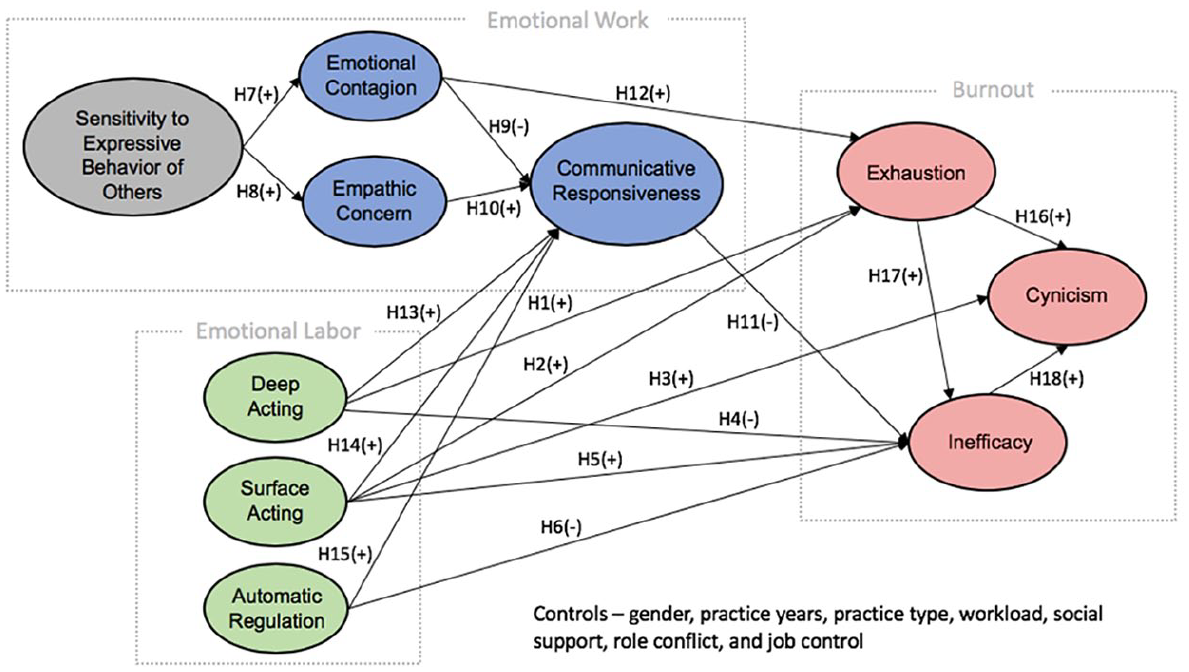
Hypothesized WREC model.
Emotional Labor and Burnout (Hypotheses 1–6 [H1–H6])
Most research on emotional labor and burnout has measured only the relationships of surface acting and deep acting (not automatic regulation) with burnout. Rationales given for the relationships include resource depletion, authenticity, and social interaction effects (Hülsheger & Schewe, 2011). The resource depletion rationale supports the predictions that surface acting and deep acting positively influence exhaustion (H1 and H2) due to the cognitive effort they each require. Surface acting involves conscious effort in constantly monitoring one’s emotion displays to conform to the expectations of one’s work (Hülsheger & Schewe, 2011; Martínez-Iñigo et al., 2007). Deep acting requires cognitive resources for the internalization of emotion for one’s emotional expression to match the desired emotion (Hülsheger & Schewe, 2011).
In the only known study of emotional labor and burnout that evaluated automatic regulation in addition to surface and deep acting, Martínez-Iñigo et al. (2007) found automatic regulation to be negatively related to emotional exhaustion when positive emotions are modified to conform with positive emotion display rules. Their findings, along with the resource depletion rationale, support an argument that automatic regulation does not involve the same psychological effort as does deep acting because the required emotion is already felt and does not need to be internalized, only moderated. Automatic regulation also does not involve the psychological effort required by surface acting to fake the emotion display required by one’s work. However, given that the current study measures emotional labor of both positive and negative emotion displays without distinction, it is believed that the unconscious nature of automatic regulation will not provide the measure of psychological ease to justify a prediction of a negative relationship with exhaustion (particularly given that Martínez-Iñigo et al. only found a small correlation of –.27 between automatic regulation and exhaustion in their study).
Emotional dissonance (Kruml & Geddes, 2000) felt by surface actors (who are consciously aware of required displays of unfelt emotions that they are not motivated to internalize) may engender resentment. People are more comfortable when their external displays of emotion match their internal emotions (Hochschild, 1983), and they experience strain when the internal and external emotions do not match (Erickson & Wharton, 1997). Therefore, a positive influence from surface acting on cynicism is predicted (H3). This same prediction is not made for deep acting due to its internalization of emotion, nor for automatic regulation because of the consistency of the felt emotion with the displayed emotion.
Deep actors’ internalization of required emotions makes their emotion displays appear more authentic than those created by surface acting (Hülsheger & Schewe, 2011). Clients react more favorably to more authentic displays of emotion, thus making client interactions more positive and, in turn, increasing workers’ feelings of professional efficacy (Brotheridge & Lee, 2002; Hülsheger & Schewe, 2011). Therefore, deep acting is predicted to have a negative association with inefficacy, whereas surface acting is predicted to have a positive one (H4 and H5).
The absence of prior research testing the relationship between automatic regulation and inefficacy requires that any such prediction be based on inference. Just as it is predicted that deep acting has a negative influence on inefficacy because of seeming authenticity in emotion displays after internalizing the required emotion (Hülsheger & Schewe, 2011), we predict that automatic regulation will also have a negative association with inefficacy due to the emotion displays being consistent with the authentically felt emotions (regardless of whether the emotions are required to be tempered or enhanced; H6).
Emotional Work and Burnout (H7–H12)
In proposing the ECM of burnout, Miller et al. (1988) investigated the relationships of emotional contagion and empathic concern in human service work (e.g., nursing and social work). Their findings supported their hypotheses that empathic concern increases communicative responsiveness (i.e., providing the appropriate verbal and nonverbal communication that is attentive to patients’/clients’ needs) but that emotional contagion decreases communicative responsiveness. They reasoned that empathy increases human service workers’ abilities to provide good service or care to their patients/clients if psychological detachment is maintained and they do not vicariously experience their patients’/clients’ emotional distress.
As described above, empathic communication is similar to compassionate communication except for the absence of the subprocess of recognizing (or noticing) in conceptualizations of the processes of empathic communication. A measure for compassionate communication has yet to be developed. However, based on the similarities between the two constructs, compassionate communication can be measured with the ECM if combined with a measure for recognizing. Accordingly, a subscale of Lennox and Wolfe’s (1984) Revised Self-Monitoring Scale, referred to as Sensitivity to the Expressive Behavior of Others (SEBO) is sufficiently similar to the compassionate communication subprocess of recognizing to serve as its indicator. A more detailed description of SEBO is provided in Table 1. Therefore, the measurement of SEBO in conjunction with empathic concern, emotional contagion, and communicative responsiveness provides the closest approximation to measuring compassionate communication possible, given currently available measures.
Scales Used, Prior and Current Cronbach’s Alpha Coefficients, and Example Items.

Note. SEBO = Sensitivity to the Expressive Behavior of Others; MBI-GS = Maslach Burnout Inventory–General Survey; QWI = Quantitative Workload Inventory; NIOSH = National Institute for Occupational Safety and Health.
Minimally modified to emphasize communication with clients or with others on behalf of clients, instead of with patients. bThe first item, which reads, “I show feelings to clients that are different from what I feel inside,” was modified to read, “I show empathy or compassion to others even when they are different from what I feel inside,” to reduce the anticipated likelihood that the item would otherwise cross-load onto surface acting. cAfter deleting the first (modified) item to the communicative responsiveness scale, the Cronbach’s alpha coefficient increased to .72. dUsed to measure noticing/recognizing—the supplemental component of emotional work that the construct of compassionate communication adds to Miller and colleagues’ operationalization of empathic communication, as described in the “Literature Review” section (see Miller, 2007; Way & Tracy, 2012). eReproduction of example items by special permission of the publisher, Mind Garden, Inc., www.mindgarden.com from the Maslach Burnout Inventory–General Survey by Wilmar B. Schaufeli, Michael P. Leiter, Christina Maslach, & Susan E. Jackson. Copyright © 1996 by Wilmar B. Schaufeli, Michael P. Leiter, Christina Maslach, and Susan E. Jackson. Further reproduction is prohibited without the publisher’s written consent. fDespite the notoriousness of lawyers’ billable hours, the QWI, which measures perceived amount of work in terms of pace and volume, was chosen as the more accurate measure of workload for all study participants. First, billable hours are primarily only the concern of (but not necessarily the concern of all) private practice civil defense and transactional attorneys. There are alternative fee structures not involving billable hours that transactional attorneys utilize (e.g., flat fee or tiered), which are also becoming increasingly favored by clients in civil litigation; also, contingency fee arrangements are frequently used by plaintiff’s attorneys and flat fee arrangements are often utilized by private criminal defense attorneys. Moreover, prosecutors, public defenders, and in-house attorneys are salaried employees who do not provide their services pursuant to billable hours. Second, in practice, there is great variation in individual attorneys’ methods of timekeeping, upon which they base their billable hour calculations. Third, there are factors that contribute to higher workload other than hours billed (or worked). Workload represents a stressor that can evoke a strain response in employees who perceive their work as imposing greater demands upon them than they can meet. Recognizing that a primary inducement of the strain experienced related to workload is the employee’s uncertainty as to whether the work can be satisfactorily and timely completed, Spector and Jex’s (1998) QWI was developed to assess both the quantity of work and time constraints imposed by individuals’ work obligations. Fourth, the authors believe that the use of the QWI instead of billable hours to measure workload makes this study’s findings more relevant to nonlegal professions. gMinor changes to the scale items were made for its use in this study to tailor the questions to ask about participants’ “work” or “workplace” instead of “job” or “assignment,” given the high number of self-employed attorneys and law firm partnerships in the practice of law.
The ability to recognize the verbal and nonverbal messages that convey a clients’ needs (measured by SEBO) is integral to compassionate communication and also a prerequisite to feeling empathy (Kanov et al., 2004). Accordingly, it is predicted that SEBO will positively influence both emotional contagion and empathic concern (H7 and H8)—the exogenous variables in the ECM. Original path analyses in the development of the ECM (Miller et al., 1988) indicated that empathic concern was positively related to communicative responsiveness, which, in turn, was negatively related to depersonalization and positively related to personal accomplishment. Conversely, emotional contagion was negatively related to communicative responsiveness, thereby leading to more depersonalization and less personal accomplishment. Later, the model was revised to show no direct effect on depersonalization, with the positive direct effect from communicative responsiveness on personal accomplishment remaining and adding a negative direct effect from emotional contagion to personal accomplishment (Miller et al., 1995). More recent research has shown the only direct effect from emotional contagion to a burnout dimension to be exhaustion (e.g., Snyder, 2012). Regardless, emotional contagion has consistently been shown to contribute to more burnout than has empathic concern, including in a study of financial planners’ client interactions (Miller & Koesten, 2008).
Based on these findings, the following relationships are predicted: emotional contagion will negatively influence communicative responsiveness (H9), whereas empathic concern will positively influence communicative responsiveness (H10), and communicative responsiveness will negatively influence inefficacy (H11). It seems logical that a professional providing client service would feel less inefficacy (or more professional efficacy) if their communication is responsive to the needs of their client. Moreover, the rationale of resource depletion supports the prediction that emotional contagion will positively influence exhaustion, due to the additional cognitive and emotional burden imposed by emotional contagion (H12).
Emotional Labor and Emotional Work (H13–H15)
In addition, recognizing that the scale for communicative responsiveness was created to measure empathic communication that is responsive to patients’/clients’ needs, it is predicted that the emotional labor variables (deep acting, surface acting, and automatic regulation) will each have a positive relationship with communicative responsiveness (at least to the extent that the relevant emotion display rules requiring emotional labor include empathy; H13, H14, and H15, respectively).
Burnout (H16–H18)
Because of the positive correlations consistently found among exhaustion, cynicism, and inefficacy (e.g., Lee & Ashforth, 1996), these concepts are often collectively referred to as burnout (with an increase in one dimension casually referenced as a general increase in burnout). Yet, the dimensions are customarily measured individually because empirical evidence has shown various workplace variables to associate differently with each dimension (Cordes & Dougherty, 1993). In addition, the extant literature shows a lack of consensus on the underlying causal order of the three dimensions of burnout (Houkes et al., 2011; Taris et al., 2005). For the WREC model, the current study subscribes to Lee and Ashforth’s (1996) contention that emotional exhaustion (exhaustion) results from chronic exposures to stressors, followed by depersonalization (cynicism; H16) as a coping mechanism pursuant to conservation of resources theory (Hobfoll, 1989), and that exhaustion also leads to reduced personal accomplishment (inefficacy; H17). However, contrary to Lee and Ashforth’s model, the current study also predicts a positive influence from inefficacy to cynicism (H18) as an outgrowth of self-serving bias per attribution theory (i.e., individuals blame their job or their clients instead of themselves for their reduced performance; Ross & Nisbett, 1991). This prediction is also supported by findings from Dierendonck et al.’s (2001) longitudinal study testing causal relations among the dimensions of burnout.
Hypothesized WREC Model
The hypothesized model for this study was a full structural equation model. The measurement model consisted of the following latent variables, including the specified number of indicator variables regressed on their respective latent variables with their associated error terms: (a) three emotional labor factors—deep acting (three indicators), surface acting (three indicators), and automatic regulation (four indicators); (b) four emotional work factors—sensitivity to expressive behavior of others (six indicators), empathic concern (five indicators), emotional contagion (six indicators), and communicative responsiveness (three indicators); and (c) three dimensions of burnout—exhaustion (five indicators), cynicism (five indicators), and inefficacy (six indicators). The structural model consisted of the 10 factors with 18 paths between the factors, depicting the hypothesized relationships between them as explained above and depicted in Figure 1.
Method
Population
As an institutionalized occupation, 3 the legal profession was chosen to test the proposed model in this study because of its status as (a) an understudied population in empirical research, and (b) an example of professional service-based occupations with fiduciary client relationships that implicate both emotional labor and emotional work. Lawyers are a particularly interesting population for the study of work-related emotional communication because they are institutionalized to zealously represent their clients within the bounds of the law, regardless of how they feel about their client or the relative merits or culpability of the client’s position (Yakren, 2008). In addition, similar to Miller and Koesten’s (2008) financial planners, lawyers are perceived as highly rational, but must engage in work-related emotional communication to develop and maintain their client relationships. Moreover, the legal services that lawyers provide their clients often have emotionally charged and/or high-stakes implications.
An example of service-oriented emotional labor in the practice of law is a lawyer’s suppression of negative feelings toward a particularly repugnant client or due to personal moral objections to client’s actions (Yakren, 2008). Some lawyers engage in emotional labor with opposing parties or their counsel, feigning hostility or anger in an effort to intimidate, or they manipulate “strategic friendliness” (Franklin, 1996) in an effort to achieve a desired outcome for clients (e.g., prevailing in litigation or gaining more favorable terms in a business contract or settlement agreement). These emotional communication tactics may be performed on behalf of clients or in the presence of clients and are sometimes directed at one’s client, necessitating double-faced emotion management (i.e., emotional labor to neutralize or otherwise manage one’s own emotions to facilitate the management of the client’s emotions; Tracy & Tracy, 1998).
Examples of situations requiring emotional work in the practice of law include lawyers’ clients facing loss of parental rights in a divorce, risk of substantial loss in a failed business transaction, imprisonment if found liable for criminal charges, or financial hardship if unsuccessful in defending a civil claim. Consequently, it is not unusual for clients to be highly emotional in their interactions with their legal counsel. As a result, lawyers may find themselves emotionally invested in the outcomes of their clients’ legal matters (Yakren, 2008), sometimes experiencing what is termed as secondary or vicarious traumatic stress, akin to burnout resulting from emotional contagion (Rosen, 1999).
Participants
Survey participants included 2,067 attorneys licensed to practice in a southeastern U.S. state. The gender identification of the sample was 52.8% male (n = 1,092) and 46.8% female (n = 967), with almost half of the participants (48.1%) reporting their ages as below 45. Almost 85% of participants identified as White (n = 1,753, 84.8%), 10.4% as Hispanic, Latino, or Spanish origin (n = 214), 4.5% as Black (n = 94), and 2% as Asian (n = 41). In addition, 13 (0.6%) participants identified as American Indian/Alaska Native, six (0.3%) as Native Hawaiian/Other Pacific Islander, and 45 (2.2%) responded as “Other.” The gender identification of the sample included more women (46.8%) than reflected in the subject state’s population of lawyers (38%), according to the bar associations’ membership records. This disproportionately greater response from women is a common outcome in survey research and is the reason that gender was included as a control variable in the survey data analysis, but the results of this study should be viewed in light of this response bias. In contrast, there was no statistically significant difference in the sample’s racial/ethnic composition (White vs. people of color) compared with the state bar membership.
Participants were recruited through an email sent to all attorneys eligible to practice and in good standing with the state’s attorney bar association. The email provided a description of the research and link to the survey questionnaire. Participants were eligible for a drawing for one of 10 US$50 Amazon.com gift cards. Of 81,131 emails that were sent, 2,605 attorneys consented to participate in the survey. This response rate of 3.2% exceeded expectations, given that recruitment was via mass email without any ability to account for the number of emails likely never received due to spam filters.
Of the participants who completed the survey, 250 were disqualified as not currently practicing law or no longer representing/counseling clients. One case was eliminated due to spurious responses and 13 cases were eliminated during the data screening process described below, leaving a total of N = 2,067. The data were randomly split in half to provide a calibration sample (n = 1,034) and a validation sample (n = 1,033) for purposes of cross-validation of the model fit and findings from the SEM analyses.
Instrumentation
Data were collected via an online survey. Questions were assembled by the first author, who is a licensed attorney and former legal practitioner in the subject state. The questionnaire was pilot tested and revised based on feedback from nine attorneys with experience spanning public, private, and nonprofit sectors. Model and control variables were measured with previously validated scales. Model variables included the three types of emotional labor (surface acting, deep acting, and automatic regulation), the four variables associated with emotional work (SEBO, empathic concern, emotional contagion, and communicative responsiveness), and the three dimensions of burnout (exhaustion, cynicism, and inefficacy). Control variables included those known to predict or moderate burnout (workload, role conflict, social support, and job control), as well as gender, age, type of practice (litigation and transactional), 4 and practice years (i.e., total years practicing law), to investigate the unique influence of emotional labor and emotional work on the dimensions of burnout. See Table 1 for detailed measurement information, including results of reliability analyses confirming the internal consistency of each factor.
Data Analysis
The data were examined using SPSS 24.0 to detect and correct for errors, screen for missing values, and test for assumptions (i.e., absence of multicollinearity and singularity, and presence of normality, linearity, and homoscedasticity of residuals). In addition, descriptive statistics and correlation analyses were run followed by the SEM analyses using AMOS 24.0.
The hypothesized model for this study was a full structural equation model consisting of two parts: the measurement model and the structural model. The measurement model included all latent model and control variables, each of their indicator variables, and the error terms associated with each indicator variable. The structural model additionally included the parameters indicating the predicted relationships between the latent model variables, the latent and observed control variables, and residual terms for each endogenous variable. Pursuant to SEM procedures, the validity of a measurement model must be determined through confirmatory factor analysis (CFA) prior to the assessment of the structural model. First, CFA was performed on the measurement model of the originally hypothesized model based on data from the calibration sample. Once the measurement model was confirmed, the calibration sample was used to test the fit of the structural model and make subsequent modifications to obtain a better fit to the data through post hoc analyses. Finally, cross-validation of these SEM results was achieved by testing the validity of the final well-fitting model based on the validation sample.
Model Fit
A model is deemed a good fit to the data if its chi-square value and degrees of freedom are reported with a p value greater than .05, meaning that there is not a significant difference between the model being tested and a perfectly fitting model. However, the chi-square statistic is very sensitive to sample size. In large samples, such as in the current study, even slight discrepancies in model fit can result in a significant model chi-square (p < .05; Kline, 2016). Due to this limitation, alternative indices are more appropriately relied upon in evaluating model fit (Brown & Moore, 2012; Byrne, 2016), including the root mean square error of approximation (RMSEA) and its 90% confidence interval (CI), the comparative fit index (CFI), and the standardized root mean square residual (SRMR). In addition, the expected cross-validation index (ECVI) and chi-square change provide bases for comparing the relative fit of alternative models.
RMSEA ≤.06 is generally considered an indication of good fit (Hu & Bentler, 1999), with values as high as .08 considered acceptable by some (e.g., Browne & Cudeck, 1993) but deemed a poor fit if greater than .10 (MacCallum et al., 1996). A p value for the RMSEA CI of >.50 is desirable (Jöreskog & Sörbom, 1996). CFI values close to .95 or greater are recognized as indicating a good fit (Hu & Bentler, 1999), but values of at least .90 are considered adequate (Yuan, 2005). An SRMR >.10 indicates a poor fit (Kline, 2016), but if it is ≤.08 the fit can be considered adequate (Hu & Bentler, 1999), while values ≤.05 are indicative of a well-fitting model (Byrne, 2016). There is no consensus on the acceptable value for χ2/df, but suggestions range from <2.0 (Tabachnick & Fidell, 2013) to ≤5.0 (Kline, 2016) as indicating good fit.
After the fit of the hypothesized model was evaluated, modification indices (MIs) provided by AMOS were considered for potential respecification of the model by the addition of parameters to be freely estimated. MIs show the anticipated decrease in the overall chi-square value (and estimated positive or negative change for each fixed parameter in the model) by the addition of a particular parameter (Byrne, 2016). It is important to note that MIs are based on statistical estimations, but new parameters should not be added to the model unless they also make theoretical and/or practical sense (Byrne, 2016). Significant changes in chi-square and decreasing values for the ECVI provide indications that modifications made to a model make it a better fit than before. In SEM, the same model fit statistics are used to evaluate both the CFA of the measurement model and the fit of the structural model.
In the current study, once a final well-fitting model was derived from post hoc analyses (final model), the validity of its structure was tested based on the data from the validation sample. More specifically, for purposes of cross-validation of the SEM results, AMOS’ Multiple-Group Analysis was used to compare a sequence of models to test whether all factor loadings, structural paths, factor covariances, factor residual variances, and measurement error variances in the final model were invariant (or operating equivalently) across the calibration and validation samples. Evidence of equivalence is determined by a change in CFI of <.01 (Cheung & Rensvold, 2002) between each of the models.
Results
Table 2 shows descriptive statistics and the correlation matrix for the model variables. As expected, given the large sample size, the CFA on the measurement model produced a chi-square statistic (χ2 = 7,912.857, df = 2,240, p < .001), indicating poor fit. An adequate fit was indicated by χ2/df = 3.533, SRMR = 0.0537, and RMSEA = .050 (90% CI = [.048, .051], p = .749), while CFI = .872 showed room for improvement. MIs indicated that the covariance of error terms for two of the indicators for each of a total of five latent factors (cynicism, exhaustion, role conflict, SEBO, and contagion) would improve the model fit (see Table 3). It made theoretical and practical sense to covary the error terms for the items as reported in Table 3 because the items measuring each of these factors were reflexive (i.e., each of the items were generally asking the same question, using alternative words or phrasing with essentially the same meanings). For example, the error terms for the contagion items “I become nervous if others around me are nervous” and “The people around me have a great influence on my moods” were covaried. With the fit of the measurement model confirmed, the fit of the structural model was then tested.
Factor Correlations, Means, Standard Deviations, and Minimum and Maximum Scores.
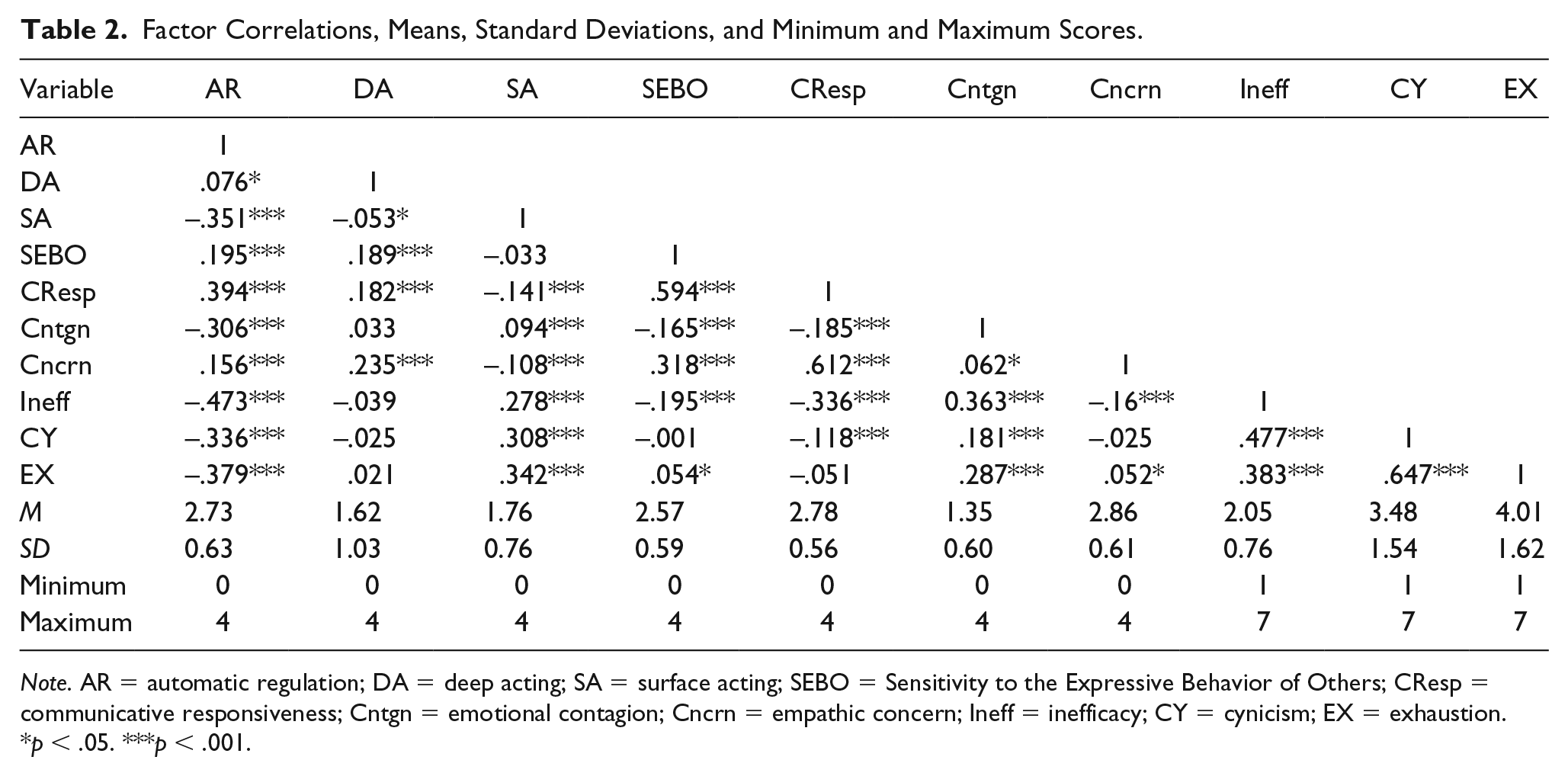
Note. AR = automatic regulation; DA = deep acting; SA = surface acting; SEBO = Sensitivity to the Expressive Behavior of Others; CResp = communicative responsiveness; Cntgn = emotional contagion; Cncrn = empathic concern; Ineff = inefficacy; CY = cynicism; EX = exhaustion.
p < .05. ***p < .001.
Indicators for Which Error Terms Were Covaried in the CFA of the Measurement Model, Corresponding MIs and Parameter Change values, and Resulting Model Fit Indices.
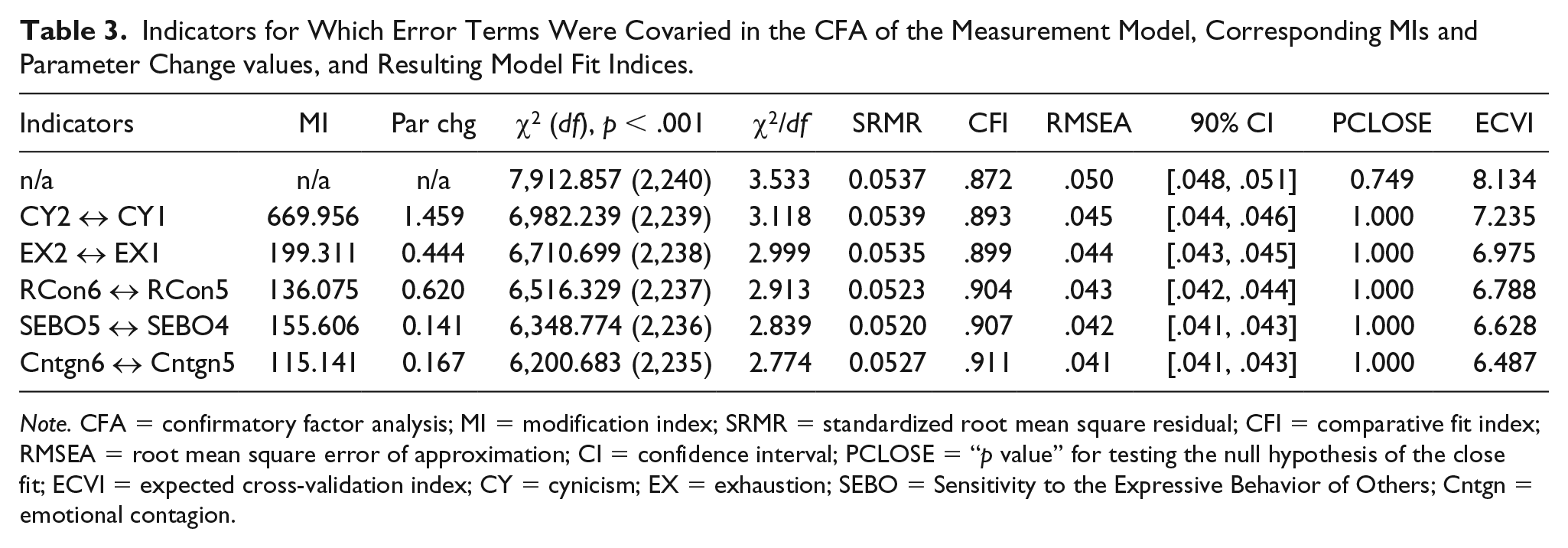
Note. CFA = confirmatory factor analysis; MI = modification index; SRMR = standardized root mean square residual; CFI = comparative fit index; RMSEA = root mean square error of approximation; CI = confidence interval; PCLOSE = “p value” for testing the null hypothesis of the close fit; ECVI = expected cross-validation index; CY = cynicism; EX = exhaustion; SEBO = Sensitivity to the Expressive Behavior of Others; Cntgn = emotional contagion.
Again, as expected, the chi-square statistic for the SEM indicated poor overall fit (χ2 = 7,005.025, df = 2,528, p < .001); however, other fit indices showed that the hypothesized model was an adequate-to-good fit to the calibration data: χ2/df = 2.771; SRMR = 0.0554; CFI = .904; and RMSEA = .041, CI = [.040, .043], p = 1.000. Still, the MIs showed that the model fit would improve (MI = 98.374; par chg = .306) with the addition of a path from SEBO to communicative responsiveness. The fit of the model improved with this modification, showing Δχ2(1) = 144.298, p < .001, and a decrease in ECVI from 7.405 to 7.267. Overall, this final model constituted a good fit to the calibration data, excepting the chi-square statistic (χ2 = 6,860.727,df = 2,527, p < .001): χ2/df = 2.715; SRMR = 0.0540; CFI = .907; and RMSEA = .041, CI = [.040, .043], p = 1.000.
AMOS’ Multiple-Group Analysis confirmed the invariance of the fit of the final model across the calibration and validation samples. The change in the CFI between each of the models was far below <.01, ranging from 0 to .001. Thus, the final model was deemed to be operating equivalently across the samples. Table 4 shows the standardized regression weights for the final model as tested based on the calibration sample, the validation sample, and then the complete data set (calibration and the validation samples combined). Of those paths found to be significant, all confirmed effects in the directions that were hypothesized (positive or negative), except for the predicted influence of SEBO on emotional contagion (found to be negative when it was predicted to be positive).
Standardized Regression Weights for Structural Paths in the Final Model for Calibration, Validation, and Combined Samples.
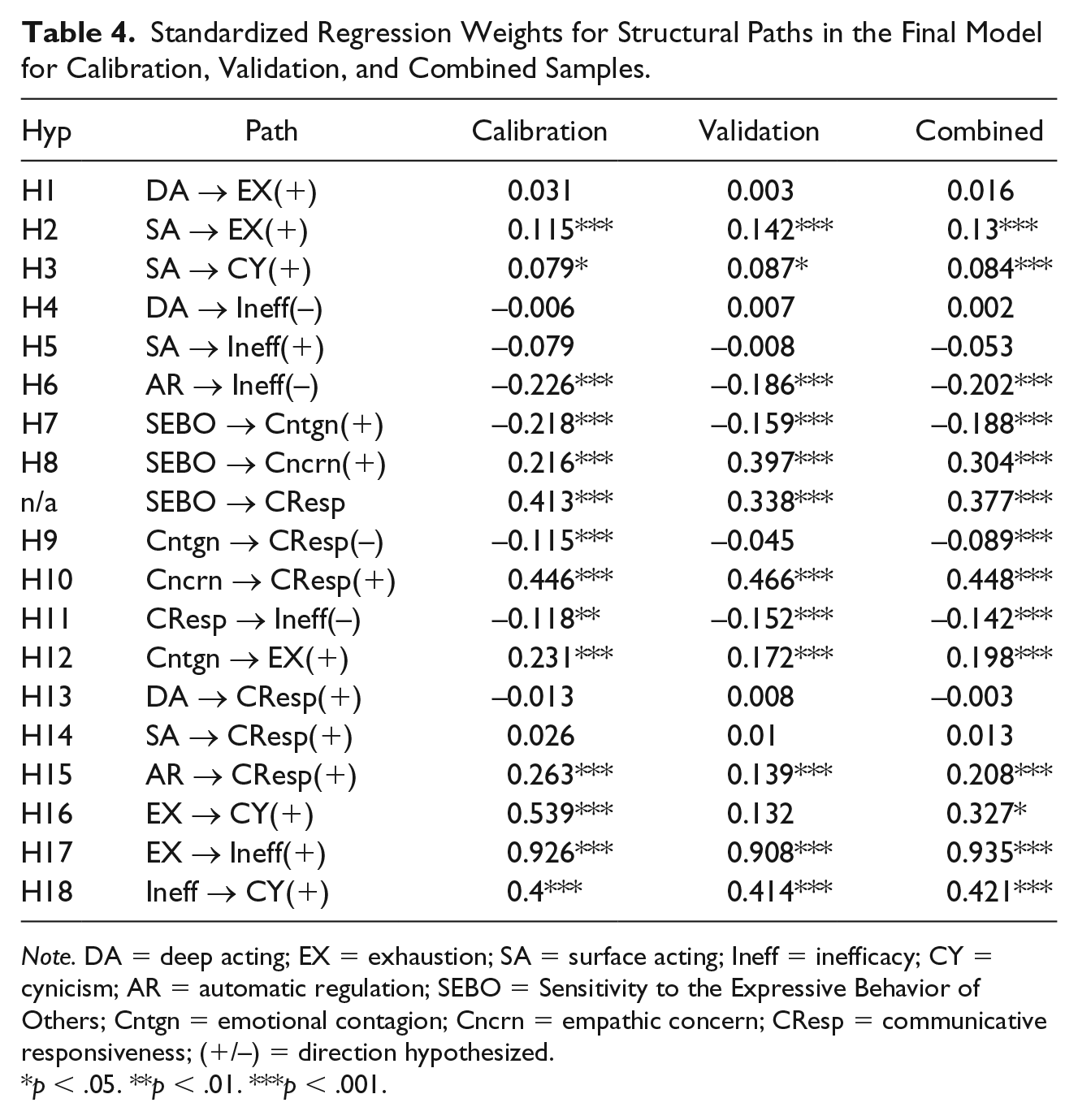
Note. DA = deep acting; EX = exhaustion; SA = surface acting; Ineff = inefficacy; CY = cynicism; AR = automatic regulation; SEBO = Sensitivity to the Expressive Behavior of Others; Cntgn = emotional contagion; Cncrn = empathic concern; CResp = communicative responsiveness; (+/–) = direction hypothesized.
p < .05. **p < .01. ***p < .001.
There were inconsistent results between the final model tested on the calibration and the validation samples pertaining to the relationships between emotional contagion and communicative responsiveness and between exhaustion and cynicism (each found insignificant for the validation sample, but significant for the calibration and combined samples). The finding of invariance of the model fit across both samples and the results of the combined data suggest that these differences were anomalies likely due to sampling error. See Figure 2 for the final model depicting the standardized regression weights for each path based on the combined sample. See Table 5 for the indirect, direct, and total effects of the model variables on the dimensions of burnout.
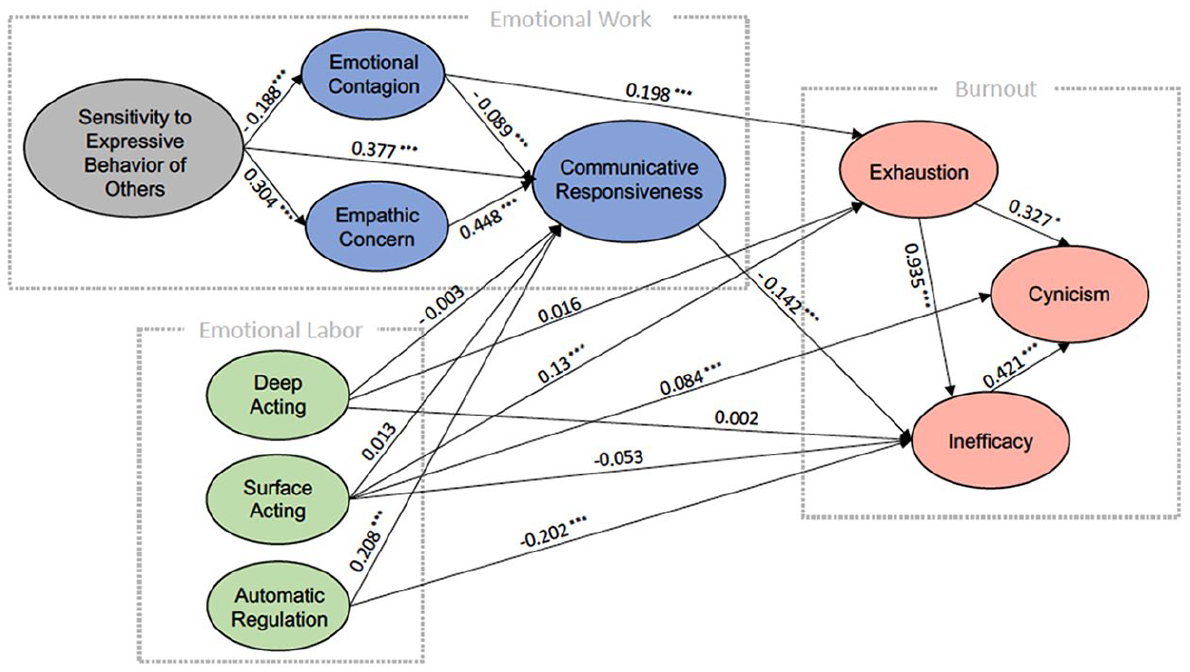
Final WREC model with standardized regression weights from the combined data set.
Total Effects of Model Variables by Construct on Burnout Dimensions Based on Combined Data.
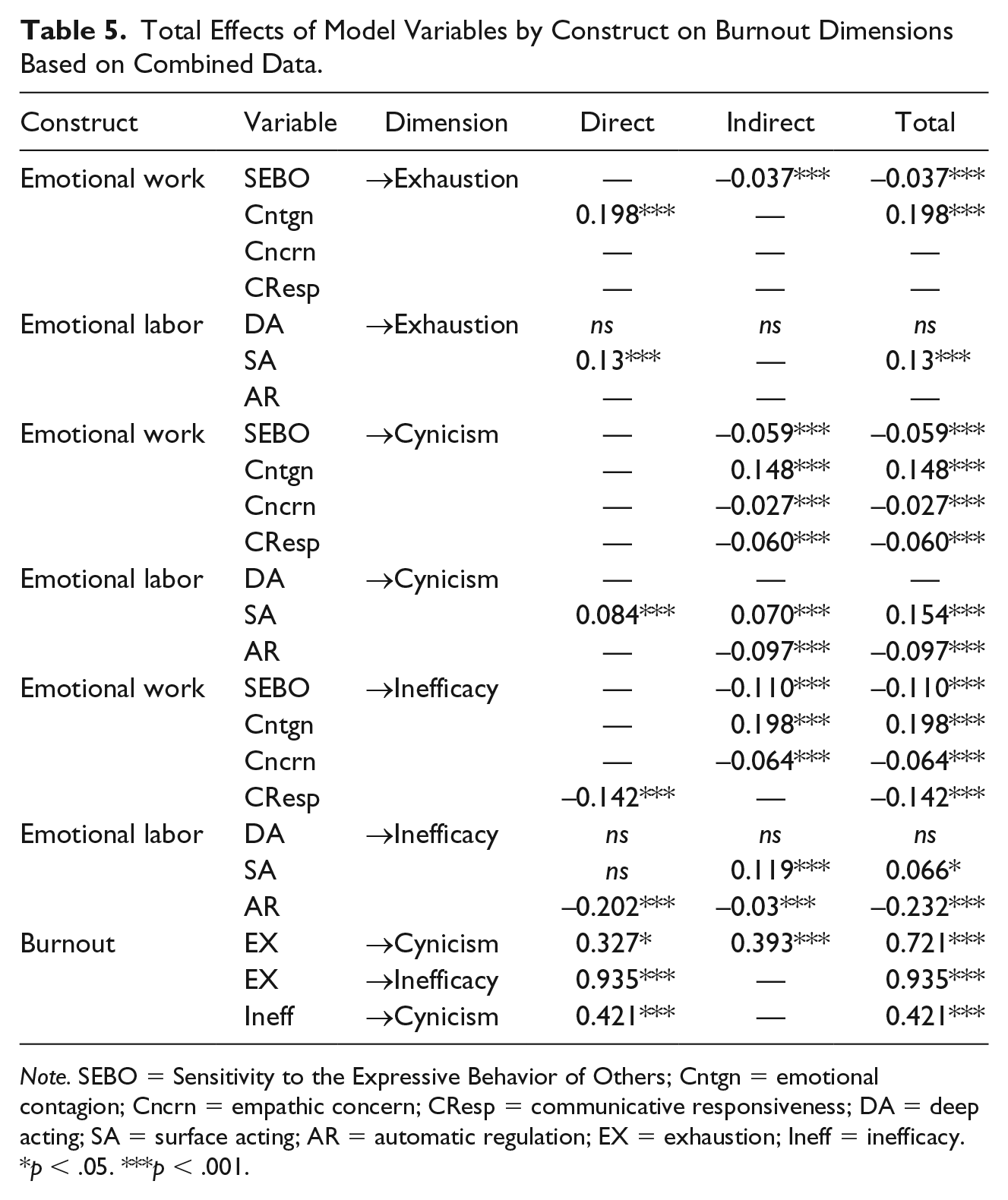
Note. SEBO = Sensitivity to the Expressive Behavior of Others; Cntgn = emotional contagion; Cncrn = empathic concern; CResp = communicative responsiveness; DA = deep acting; SA = surface acting; AR = automatic regulation; EX = exhaustion; Ineff = inefficacy.
p < .05. ***p < .001.
Discussion and Conclusion
The primary objective of this study was to propose and test the WREC model—a model of work-related emotional communication (emotional labor and emotional work) and burnout. The model was tested on a sample of attorneys, an appropriate group, given the prevalence of emotional labor and emotional work in the practice of law. The results of this study both support prior research and provide new insight on the effects of emotional labor and emotional work on the dimensions of burnout.
The final WREC model showed work-related emotional communication to have both positive and negative influences on burnout. Among the emotional labor constructs, surface acting positively influenced burnout through its direct effects on exhaustion and cynicism and indirect effects on cynicism and inefficacy. However, as predicted, automatic regulation demonstrated a negative influence on burnout through its direct and indirect effects on inefficacy and indirect effect on cynicism. This finding provides needed empirical support for Hülsheger and Schewe’s (2011) conjecture that automatic regulation (i.e., when the expected emotion is authentically felt, but the magnitude of its display is unconsciously increased or decreased to match display rules) may actually lead to improved performance and employee well-being. Thus, to illustrate, a litigator whose client expects her to convey annoyance toward the opposing party and his attorney for a lowball settlement offer would be engaged in surface acting when doing so if she did not actually feel annoyed (e.g., she actually appreciates the negotiation process and the opposing counsel’s strategy and would do the same if in the same position). Pursuant to the WREC model, however, the surface acting (the emotion display of annoyance that is not actually felt) would lead to increased feelings of exhaustion and cynicism, and the increased exhaustion would lead to greater cynicism and increased feelings of inefficacy. Alternatively, if the litigator had a history with opposing counsel giving lowball offers and was actually somewhat irritated with him doing so again, then the conveyance of heightened annoyance would be automatic regulation leading to decreased feelings of inefficacy (directly and indirectly mediated by communicative responsiveness) and a concomitant decrease in cynicism.
We also hypothesized that inefficacy would be influenced by a negative direct effect from deep acting and a positive direct effect from surface acting—neither of which were found. Thus, if the litigator who was initially not annoyed by the lowball settlement offer reflected upon opposing counsel’s history of lowball offers to engender and internalize annoyance so that she would express the annoyance her client expected to be shown to the opposition (i.e., deep acting), there would not be any corresponding decrease in inefficacy. Also, there would not be a direct increase in inefficacy by her just faking annoyance (i.e., surface acting), notwithstanding its indirect effect mediated by exhaustion. We based our unsupported predictions on the rationale that individuals react more favorably to the authentic emotion displays of deep acting, leading to more positive client interactions and increased feelings of professional efficacy (Brotheridge & Lee, 2002; Hülsheger & Schewe, 2011). Perhaps client expectations of attorneys differ from other client/professional relationships, with attorneys’ “acting” taken for granted, given the role they play as zealous advocates for their clients. There might be more emphasis on the relative merits (or successes/failures) of attorneys’ arguments on behalf of clients than on the authenticity of their emotion displays. Similar results may be found for other professionals who represent or advocate for clients (e.g., public relations professionals, real estate agents, and talent agents or managers).
The finding of no significant influence by deep acting on exhaustion supports an argument that, on its own, deep acting may not involve effort that is sufficiently resource depleting to lead to exhaustion-related burnout. The fact that only surface acting exhibited a positive direct effect on exhaustion supports the rationale that surface acting involves greater resource depletion through the conscious effort it requires to constantly monitor one’s emotion displays to be sure they do not deviate from work expectations (Hülsheger & Schewe, 2011; Martínez-Iñigo et al., 2007; Totterdell & Holman, 2003). In other words, the litigator who is not annoyed with the lowball settlement offer has to use more energy to continue the charade of appearing annoyed and, as a result, experiences greater exhaustion that is not experienced by deep acting. Moreover, due to the aforementioned role of attorneys as zealous advocates, acting might be perceived as so integral to practicing law that the profession attracts (or retains) individuals who are motivated to internalize the emotions they must display (i.e., deep acting) and do not find it to be particularly energy depleting to do so.
As predicted, only surface acting had a positive influence on cynicism, with no other paths to cynicism suggested by the MIs in the SEM. This result supports the authors’ rationale that deep acting and automatic regulation do not engender the same resentment as does surface acting due to the emotional dissonance experienced only in surface acting at the time of the emotion display. Thus, the litigator would experience an increase in cynicism by displaying annoyance only if she does not actually feel that way at all.
In regard to the emotional work variables, the negative effect between communicative responsiveness and inefficacy, as well as the positive effect between emotional contagion and exhaustion, mirrors what has been found in prior research. More interesting is the stronger total effects by emotional contagion on each of the dimensions of burnout, compared with empathic concern (see Table 5). In addition, the influence of emotional contagion on burnout is much stronger through its direct effect on exhaustion (plus subsequent indirect effects on inefficacy and cynicism through exhaustion) than its indirect effect through communicative responsiveness on inefficacy (plus subsequent indirect effect on cynicism). When compared with what are only indirect effects of empathic concern (mediated by communicative responsiveness) on inefficacy and cynicism, it is apparent that empathic concern on its own does not do much to avoid burnout. Instead, it is favoring empathic concern over emotional contagion that serves to avoid burnout. Moreover, the greater risk of burnout from emotional contagion is largely independent of communicative responsiveness. Therefore, should a divorce attorney representing a parent in a custody battle empathize too much with his client (to the point of vicariously experiencing the same fear and concern about the outcome of the dispute), then the WREC model indicates that he would experience increases in all three dimensions of burnout (through direct and indirect effects) and at a larger magnitude than if he had maintained the detachment associated with empathic concern, which would only increase inefficacy and cynicism through lesser indirect effects.
Worthy of note is the contribution of the measure of SEBO to the construct of emotional work. A relatively strong positive direct effect was found between SEBO and communicative responsiveness, suggesting that one needs to be aware of others’ emotions to respond appropriately. Although SEBO evidenced a positive direct effect on empathic concern, it showed a negative direct effect on emotional contagion (the opposite direction as hypothesized). Greater sensitivity to the emotions of others may be found in people who are more emotionally and cognitively aware and, therefore, less prone to contagion. Moreover, being sensitive to others’ emotions does not necessitate making these emotions your own, as implicated by emotional contagion.
Recognizing that the scale for communicative responsiveness was created to measure empathic communication that is responsive to patient/clients’ needs, we predicted that the emotional labor variables would each have a positive relationship with communicative responsiveness (at least to the extent that the relevant emotion display rules required empathic communication). However, only automatic regulation showed a positive direct effect on communicative responsiveness, with deep acting and surface acting demonstrating no significant effects. Whether these results should be interpreted as automatic regulation being uniquely more communicatively responsive than the other types of emotional labor is unclear. Arguably, automatic regulation may be perceived as more authentic than surface and deep acting, so that only automatic regulation met the threshold of responsive communication that the scale was intended to measure. It seems more likely, though, that the current measure for communicative responsiveness does not account for the full range of work-related emotional communication.
The results finding direct effects from exhaustion on cynicism and on inefficacy support Lee and Ashforth’s (1996) rationale that cynicism is an individual mechanism in response to feelings of exhaustion to conserve resources. The additional finding of the predicted positive effect from inefficacy to cynicism suggests that individuals may also cope with the inefficacy they experience as a result of exhaustion by shifting the blame for any perceived professional inefficacy to their clients, their job, or others.
Implications and Future Research
The most important theoretical contribution of this study is its validation of a complex model demonstrating the relationships between work-related emotional communication (emotional labor and emotional work) and the three dimensions of burnout. Research examining all three types of emotional labor is sparse. This study demonstrates the importance of including automatic regulation in studies of emotional labor and burnout, given that automatic regulation showed a negative influence on burnout (as opposed to the positive influences of surface acting and deep acting consistently found in prior research). Unlike surface and deep acting (which are considered job demands, or stressors), automatic regulation seems to function as a job resource. This study only examined lawyers’ automatic regulation; thus, future research is required to better understand how this process affects individuals across a range of occupations.
In addition, this study makes apparent the need for a broader measure of communication that occurs in work-related emotional communication—one that is applicable to both emotional work and emotional labor, assessing emotions that meet the empathic needs of the patient/client as well as the other emotion display rules of one’s job. Furthermore, given that the subscale items for communicative responsiveness rely on individuals’ perceptions of communicative behavior of others, as well as the variable’s relatively smaller influence on burnout compared with the other model variables, continued research on the (re)acting (Way & Tracy, 2012) that is most responsive to compassion needs could facilitate the development of a more comprehensive measure of the communication implicated in work-related emotional communication.
The results of this study also have practical implications at both an individual and organizational level related to the socialization of professionals who must engage in work-related emotional communication. For individuals, the closer aligned one’s authentic emotions are to the emotion display requirements of their work, the lower the risk of experiencing inefficacy-induced burnout. Therefore, individuals should seek to learn more about the emotional communication requirements of certain careers. Also, as individuals consider employment options, they should investigate an organization’s emotion display expectations to assess their personal compatibility. Because of the benefit of authentic emotions in emotional labor, individuals who shy away from emotionally charged jobs based on a belief that they “care too much” might need to reevaluate this conclusion. With this knowledge, individuals can be better prepared to join professions and organizations to optimize their person–job and person–organization fit.
Organizations should favor realistic job previews in their recruitment efforts and, when feasible, make job placement decisions based on employee training programs including job rotation (Wexley & Latham, 2002) to expose new employees to multiple positions and ensure the best fit. For example, law firms should assign new attorneys a range of legal matters and mentor them in choosing a practice area that is compatible with their dispositions toward the required emotion displays for that work. Organizations can also help by assessing and describing the emotional communication requirements of their positions in job descriptions to acquaint prospective (and current) organizational members with the emotional demands of their jobs. These results can also guide organizations in developing services that better support workers and their abilities to manage these stressors long term, with the potential to reduce worker absenteeism and turnover.
These findings offer several implications for lawyers and organizational communication in general. Individuals who work in legal professions are particularly vulnerable to the negative effects of work-related emotional communication, including burnout, linked to mental and physical health issues (Chan, 2014). Although professionals may feel compelled to express emotions that do not represent their felt emotions to support clients, a better course appears to be regulating their expressions, which can reduce feelings of inefficacy and exhaustion. When lawyers have concern for, but do not adopt, the emotions of their clients, they can offer empathic concern and better demonstrate communicative responsiveness to their clients, which appears to offer lawyers some protection from burnout.
Overall, these findings offer implications for organizational professionals and especially those who work on behalf of and frequently develop relationships with clients. As previous research demonstrates, shouldering feelings and the related expression of emotions can have long-term, potentially negative, implications for organizational members. Many professionals may believe that tuning into and taking on their clients’ feelings can help them to be more supportive of their clients’ circumstances, but a more effective strategy may be to monitor how much they allow themselves to become emotionally entangled. By regulating emotional burdens and expressions, they can better serve their clients and also benefit their own well-being and ability to remain in their profession.
Limitations
The limitations of this study should be considered in interpreting its results and in designing future research to build upon its findings. To begin, all data were self-reported, which may raise an issue of social desirability bias. The emphasis on the confidentiality of the survey in the recruitment email and the informed consent, as well as the ability for participants to complete the survey online in a private setting, should have ameliorated this issue. Another concern of the self-report nature of the data is that some of the phenomena being measured occur in social interactions, therefore calling into question the accuracy of participants’ one-sided perceptions of interpersonal exchanges. However, these same constructs also involve assessing internal cognitive processes and attitudes, making self-report measures the most appropriate.
An a priori limitation of the self-report, retrospective nature of the survey instrument is that it made it impracticable to collect data on participants’ general experiences with work-related emotional communication while also distinguishing between the involvement of both positive and negative emotions, specifically. The research design also raises concern of common method bias, which was mitigated with reverse-scored items and examining the data for unengaged respondents. Finally, it should be emphasized that although SEM analysis is used to test proposed causal effects, there were not and cannot be any claims of causation due to the cross-sectional nature of the study.
Footnotes
Acknowledgements
This article is based on the first author’s dissertation directed by the second author, Karen K. Myers, who the first author thanks broadly for her unwavering support and specifically for the seed of inspiration for this study. A formal statement of appreciation is also owed to dissertation committee members Linda L. Putnam, Ronald E. Rice, and Kyle Lewis for their invaluable input. The authors also thank Patty Sias for her helpful feedback on an earlier draft of this article.
Declaration of Conflicting Interests
The author(s) declared no potential conflicts of interest with respect to the research, authorship, and/or publication of this article.
Funding
The author(s) disclosed receipt of the following financial support for the research, authorship and/or publication of this article: Funding for this project was provided by the Office of the Executive Vice Chancellor, UC Santa Barbara.
