




Abstract
The present study seeks to expand our understanding of leadership in the public sector by examining the link between servant leadership and work engagement of street-level bureaucrats through the mediating roles of leader motivating language and perceived organizational support. Drawing on theories of social exchange, social learning, motivating language, and job demands-resources, the research proposed that servant leaders can enhance employee work engagement by utilizing motivating language and boosting perceptions of organizational support. Using a survey of 553 police officers and first-line supervisors in Turkey, the results of structural equation modeling reveal that officers’ perceptions of their supervisors’ servant leadership are related to work engagement both directly and indirectly through motivating language and perceived organizational support. This study is the first to investigate the role of leader motivating language as a mediator between servant leadership and work engagement in public sector organizations.
Keywords
Introduction
Work engagement (WE) has been studied with growing interest within the fields of human resource management and organizational communication as it has been associated with employee well-being and performance (Fletcher et al., 2020; Vogelgesang et al., 2013). WE is defined as a “positive, fulfilling, work-related state of mind that is characterized by vigor, dedication, and absorption” (Schaufeli et al., 2002, p. 74). Engaged employees are more likely to be enthusiastically committed to achieving organizational goals and strive to provide better services to citizens; further, they are better able to sustain motivation and energy in their work while preserving their psychological well-being. Given these factors, work engagement has become a priority for many organizations (Schaufeli et al., 2002, 2006). A systematic review suggests that work engagement is associated with desirable employee and organizational outcomes (Fletcher et al., 2020).
WE is particularly crucial for street-level bureaucrats (SLBs) (e.g., police officers), because they deliver public services by interacting with citizens daily (Lipsky, 2010). Street-level bureaucrats exercise a great deal of discretion and autonomy in their day-to-day operations; however, they often lack the time, information, and other resources required to respond appropriately to specific instances (Lipsky, 2010). Furthermore, the nature of policing is different from the work of other street-level bureaucrats (e.g., teachers, physicians, nurses, and social workers); police officers are in a unique position as their jobs involves high stress, challenging work, high risk, and often unpredictable events (T. Lan et al., 2020). Because policing demands a higher level of commitment to assigned tasks and responsibilities, pride in service, and ethical workplace behavior, police departments need engaged employees to provide effective and efficient policing services to the communities they serve (Ahmad et al., 2019). Therefore, the level of WE among police officers is a crucial issue for police management that requires for further research.
Leadership has been identified as one of the main predictors of work engagement (Zahari & Kaliannan, 2022). Because of organizational scandals and leadership crises (Brown & Treviño, 2006), the servant leadership style has received increasing scholarly attention in recent years (Eva et al., 2019; van Dierendonck, 2011). Moreover, it is argued that servant leadership (SL) is more appropriate for public organizations because it emphasizes personal integrity, ethics, and service culture (Hunter et al., 2013; Liden et al., 2015; Schwarz et al., 2016). Although a systematic review by Eva et al. (2019) shows that SL is positively associated with favorable work-related outcomes, including WE, more research is needed to investigate the link between SL and WE (Eva et al., 2019), particularly among SLBs (Shim et al., 2021).
In addition to the direct effects of SL on WE, this study aims to discover the mediating mechanisms of motivating language (ML) and perceived organizational support (POS) from the perspective of the Job Demands-Resources (JD-R) model. This model has been applied to predict employee WE (Bakker & Demerouti, 2007, 2017). According to Bakker and Demerouti (2007), job resources have a positive impact on WE whereas job demands have a negative impact. Furthermore, according to the JD-R model, leaders can indirectly enhance work engagement by influencing job demands and resources (Bakker & Demerouti, 2017). Thus, this study proposes that ML is a valuable job resource that leaders use to improve the motivation and positive outcome of their followers (Madlock & Hildebrand Clubbs, 2019; J. Mayfield et al., 2021). In addition to ML, POS is an important job resource that improves favorable work-related outcomes (Aldabbas et al., 2023; T. Lan et al., 2020).
The policing sector offers a rich environment for examining the relationship between leadership and WE in the context of street-level bureaucracy. The objective of the present study is twofold. First, this study attempts to answer calls for more research exploring the possible effects of SL on employee WE. Second, the study aims to contribute to the literature on policing, leadership, public management, and organizational communication by focusing on particular job resources (i.e., ML and POS) that underpin the linkage between SL and WE in the context of the police department in Turkey, a non-Western context.
Theoretical Background and Hypotheses
Servant Leadership and Work Engagement
Leadership has received increasing attention in many disciplines, including public management and organizational communication (Chapman et al., 2016; Fairhurst & Uhl-Bien, 2012; Jian et al., 2014; Men, 2014). Leadership is defined by Northouse as “a process whereby an individual influences a group of individuals to achieve a common goal” (2016, p. 6). Communication, defined as a relationship (Manning, 2020) is at the heart of management, as it encompassess a large portion of leaders’ behaviors (Mintzberg, 1973). Communication is regarded as an integral component of leadership (de Vries et al., 2010), as leadership includes a relational process between leaders and followers (Barge, 2014; Barge & Fairhurst, 2008; Cunliffe & Eriksen, 2011; Fairhurst & Uhl-Bien, 2012). From a communication perspective, Johnson and Hackman defined leadership as “human (symbolic) communication that modifies the attitudes and behaviors of others in order to meet shared group goals and needs” (2018, p. 34). Therefore, communication is a central element that defines and builds leadership (Fairhurst & Connaughton, 2014). Different leadership styles promote different interpersonal communication styles (de Vries et al., 2010); for example, SL is recommended for fostering long-lasting bonds with followers, prioritizing others’ needs, empowering followers, and collaborating (Yukl, 2013).
Moreover, because public leadership is expected to create value (Getha-Taylor et al., 2011) by prioritizing the needs of the public and providing service with compassion, SL is considered one of the most effective leadership styles for enhancing the values and delivery of public service (Liu et al., 2015). SL is mainly concerned with the interests, needs, and well-being of followers (Barbuto & Wheeler, 2006; Graham, 1991; Liden et al., 2008). According to Liden et al. (2008), servant leaders communicate with their followers one-on-one to motivate them to perform at their best by fully comprehending their abilities, needs, desires, objectives, and potential. Moreover, servant leaders serve as role models for followers, inspire them with excitement and motivation, and encourage them to question the status quo and express differing viewpoints (Graham, 1991). Therefore, SL is considered “a viable leadership theory that helps organizations and the well-being of followers” (Parris & Peachey, 2013, p. 390).
The servant leadership theory has been further extended and various models have been developed to provide a more explicit descripton of essential values (van Dierendonck, 2011; Yukl, 2013). In this study, we used the conceptualization of SL based on the model developed by Sendjaya et al. (2008, 2019). In this model, SL is conceptualized as having six dimensions: Voluntary subordination, authentic self, covenantal relationship, responsible morality, transcendental spirituality, and transforming influence (Sendjaya et al., 2008, p. 406). According to Sendjaya and colleagues, servant leaders are willing to serve others, are capable of manifesting their authentic selves, interact with and accept others as they are, employ moral reasoning to accomplish ethically justified ends, give importance to spiritual values, and transforming people through visioning, modeling, mentoring, empowerment, and trust.
Engagement is regarded as the positive antithesis of burnout (Maslach et al., 2001). According to Maslach and Leiter (1997), burnout occurs as a result of an erosion of work engagement. In this process, a job seen as important, meaningful, and challenging turns unpleasant, unsatisfying, and meaningless over time (Maslach et al., 2001). According to Schaufeli and colleagues (2006), engaged employees present higher levels of vigor, dedication, and absorption in their work. Vigor refers to “high levels of energy and mental resilience while working,” dedication refers to “a sense of significance, enthusiasm, inspiration, and pride,” and absorption refers to “being concentrated and deeply engrossed in one’s work” (Schaufeli et al., 2002, pp. 74–75). As a result, in contrast to those who are burnt out, employees who are engaged at work feel energized and effectively connected to their work activities, and they believe they are capable of handling the demands of their occupations (Schaufeli et al., 2006).
A growing body of research indicates that SL promotes desirable work-related attitudes and behaviors, such as organizational commitment (Miao et al., 2014), work engagement (Aboramadan et al., 2020; Bao et al., 2018; Shim et al., 2021), organizational citizenship behavior (Liden et al., 2015; Newman et al., 2017), and job performance (Chiniara & Bentein, 2018; Schwarz et al., 2016). Furthermore, a meta-analysis by Lee et al. (2020) indicates that SL positively affects job performance and organizational citizenship behavior, whereas it negatively affects counterproductive work behavior.
Servant leaders influence their followers’ behavior through the mechanisms of social exchange and social learning (Eva et al., 2019; Hunter et al., 2013). Social exchange theory (SET) (Blau, 1964) is generally used as the theoretical foundation for explaining the relationship between SL and employee outcomes (Hunter et al., 2013; Liden et al., 2008, 2015; Miao et al., 2014). The norm of reciprocity lies at the heart of SET, which assumes that when people believe someone has done something beneficial for them, they will feel compelled to return good faith action (Cropanzano & Mitchell, 2005). According to SET, when leaders consider the needs and expectations of followers, a social exchange relationship is established; this relationship promotes productive work behavior and a healthy work environment (Cropanzano & Mitchell, 2005). According to Cropanzano and Mitchell, social exchange leads to the development of a relationship that “evolves over time into trusting, loyal, and mutual commitments” (2005, p. 875).
Servant leaders act ethically, empathize with their followers, provide support for their personal and professional development, and prioritize their needs; this results in trustworthy relationships between leaders and followers (Liden et al., 2008). The behaviors of servant leaders also enhance followers’ trust in the leader (Haq et al., 2022), organizational identification (Chughtai, 2016), self-efficacy (Khatri et al., 2023), psychological safety (Chughtai, 2016; Lv et al., 2022), a sense of fairness (Schwepker, 2016), and psychological ownership (Aboramadan et al., 2020). Following these findings, this study proposes that followers of servant leaders are more likely to engage at work because of social exchange relationships in response to their leaders’ supportive and caring treatment (Hunter et al., 2013; Liden et al., 2015). In addition, by assisting and supporting followers and creating a serving culture in the workplace (Liden et al., 2014), servant leaders may acquire psychological resources (Panaccio et al., 2015) such as self-actualization, pride, and well-being (Eva et al., 2019).
Furthermore, social learning theory (SLT) helps explain the relationship between SL and WE (Eva et al., 2019; Hunter et al., 2013; Ruiz-Palomino & Zoghbi-Manrique-de-Lara, 2020). According to SLT (Bandura, 1977), individuals learn through observing and imitating the attitudes, values, and behaviors of leaders they regard as role models because of their attractiveness and reliability (Brown & Treviño, 2006). Supervisors are perceived as important sources of learning for followers when they are regarded as credible role models (Schwarz et al., 2016). The social learning perspective on servant leadership suggests that leaders influence the attitudes and behaviors of followers through modeling (Liden et al., 2014). According to Bass (2000), one of the distinct characteristics of servant leadership is helping followers grow and develop as individuals and become servant leaders. Because the behaviors of servant leaders are mainly based on altruism, empathy, and a sense of community stewardship (Chiniara & Bentein, 2018; Greenleaf, 1977; Liden et al., 2008), they are seen as role models (Liden et al., 2008) and thus enhance followers’ servant attitudes (Ruiz-Palomino & Zoghbi-Manrique-de-Lara, 2020) and public service motivation (Schwarz et al., 2016; Shim et al., 2021). Accordingly, followers are more likely to learn and imitate the behaviors of servant leaders because employees respect and admire them (Hunter et al., 2013; Liden et al., 2014). Therefore, this study proposes that because SL creates a “service climate” (Hunter et al., 2013) or “serving culture” (Liden et al., 2014) within public organizations (Schwarz et al., 2016), followers are inclined to follow in the footsteps of their role models and become more engaged at work in order to serve the community.
Hence, based on the above discussions, the following hypothesis is proposed:
Servant leadership is positively associated with work engagement.
Servant Leadership and Job Resources
The current study integrates social exchange and social learning theories with the JD-R theory by emphasizing that servant leaders may affect work engagement of SLBs by increasing job resources (i.e., ML and POS). The job demands-resources (JD-R) model (Bakker & Demerouti, 2007) claims that while every organization is different, all work environments may be classified based on job demands and resources. Job demands are those characteristics of a job that involve persistent physical and/or psychological effort or abilities and are thus linked to physical and/or psychological expenses. Job resources are those characteristics of a job that assist employees in dealing with job demands, encouraging personal development, and accomplishing organizational objectives (Bakker & Demerouti, 2017). According to JD-R theory, job demands and job resources have distinct effects on employee motivation. More specifically, while job demands may lead to stress, fatigue and health problems, hindering employee motivation and job performance, job resources may improve employee motivation and their commitment to the organization (Bakker & Demerouti, 2007).
According to Bakker and Demerouti (2007), job resources (physical, social, or organizational aspects of the job) are the primary factors positively influencing work engagement. We propose to examine ML (J. Mayfield et al., 2021) and POS (T. Lan et al., 2020) as social-level resources within the scope of the JD-R theory. Moreover, drawing on the recommendations of a systematic review by Tummers and Bakker (2021), who suggested that positive leadership may indirectly influence employee well-being through the mediating effects of job resources, this study integrates servant leadership theory into the JD-R model to examine the indirect effect of SL on WE. Thus, we propose that servant leaders may indirectly affect work engagement through the mediating roles of ML and POS.
The Mediating Role of Motivational Language
This study applied the Motivating Language Theory (MLT) (J. R. Mayfield & Mayfield, 1995; Sullivan, 1988) as a lens to investigate the communication behaviors of leaders (Madlock & Hildebrand Clubbs, 2019). MLT proposes employing a variety of communication methods to meet employee demands for understanding, confirmation, and meaning. Thus, MLT functions as a framework that guides leaders in deciding the most effective style of communication when communicating with their subordinates to enhance employee motivation and outcomes (Madlock & Hildebrand Clubbs, 2019; J. Mayfield et al., 2021). As a leadership communication theory, MLT suggests that the strategic use of a leader’s oral language improves individual and organizational outcomes (J. Mayfield & Mayfield, 2018).
The original conceptualization of MLT (Sullivan, 1988) as a linguistic framework was subsequently extended by Mayfield and colleagues, who developed a measurement scale to assess three dimensions of leaders’ motivating language: direction-giving, empathetic language, and meaning-making (J. Mayfield & Mayfield, 2007; J. R. Mayfield & Mayfield, 1995). Leaders’ direction-giving language eliminates ambiguity about tasks, defines responsibilities and objectives, and communicates reward expectancies. Empathetic language refers to leaders’ expressions of concern and humanity toward their subordinates which improves leader-follower relationships. Leaders’ meaning-making language conveys the organizational culture, values, and norms to subordinates and enables them to see their work as meaningful (J. Mayfield & Mayfield, 2018).
Guided by the JD-R model, this study argues that ML acts as a job resource because it is “functional in achieving work-related goals” and “stimulates personal growth and development” (Xanthopoulou et al., 2007, p. 122). A number of studies have reported leader motivating language be a significant and positive predictor of work-related outcomes and well-being, including job satisfaction (J. Mayfield et al., 2021), job performance (Elsner Twesme et al., 2021; Guo & Ling, 2020; J. Mayfield et al., 2021), and work engagement (Rabiul & Yean, 2021; Tao et al., 2022). Police officers daily operate in demanding, stressful, and unpredictable working conditions which requires mental, physical, and emotional resources (Zeng et al., 2020). Available job resources enable employees to cope with job demands such as interacting with demanding citizens and meeting department goals, as well as acting as a buffer in the relationship between job demands and burnout, leading to positive work-related outcomes (Bakker & Demerouti, 2007; Xanthopoulou et al., 2007). Accordingly, we argue that SLBs will experience the use of ML by their supervisors as a valuable job resource that improves their psychological well-being, leading to increased work engagement.
In addition to the direct positive impact of ML, ML will likely mediate the effect of SL on WE. Based on the JD-R model, Tummers and Bakker (2021) argue that leadership can directly affect followers’ job demands and resources, which in turn influences employee outcomes. Accordingly, leadership plays a crucial role in fostering a resourceful work environment, which in turn enhances employee work engagement (Bakker & Demerouti, 2017). Previous research indicates that servant leaders can increase job resources, such as psychological safety (Lv et al., 2022), psychological meaningfulness (Y. Lan et al., 2022), psychological empowerment (S. Allen et al., 2018), job autonomy, organizational trust, goal specificity, and public service motivation (Shim et al., 2021), leading to desired outcomes.
Research also indicates that leadership behaviors affect internal communication (Jacobsen & Salomonsen, 2021; Men, 2014), defined as “all formal and informal communication taking place internally at all levels of an organization” (Kalla, 2005, p. 304). Internal communication practices play an important role in shaping and communicating an organization’s values and missions to employees, thereby engaging them in achieving organizational goals (Y. Lee & Dong, 2023; Men & Yue, 2019). Therefore, effective leaders use appropriate communication styles to effectively manage internal communication and to motivate and enhance followers’ engagement in the workplace (de Vries et al., 2010; Men, 2015). The importance of the managerial communication process on individual and organizational outcomes has been acknowledged by researchers (Jacobsen & Salomonsen, 2021; Jian & Dalisay, 2018; Men, 2014). Research reveals that human-oriented leaders 1 are more communicative than task-oriented ones regarding knowledge sharing, perceived leader performance, satisfaction with the leader, and employee commitment (de Vries et al., 2010).
Given that servant leaders can successfully communicate both verbally and nonverbally (Hunter et al., 2013; Liden et al., 2008), engage in two-way communication (van Dierendonck, 2011), and foster a supportive communication climate (Abu Bakar & McCann, 2016), this study proposes that servant leaders will likely use ML more successfully, which in turn will increase followers’ work engagement. The behaviors of servant leaders—such as ethical responsibility, trust, integrity, empathy, and interest in others (Graham, 1991; Hunter et al., 2013)—can create an ethical work climate, which in turn leads to better individual and organizational outcomes (Jaramillo et al., 2015) through the use of ML. More specifically, servant leaders provide support and mentoring for the personal and professional growth and development of their followers (Liden et al., 2014). Thus, servant leaders are likely to use direction-giving language to explain work procedures, dispel role ambiguity, and transparently share work expectations (J. Mayfield & Mayfield, 2018). Servant leaders demonstrate conceptual skills such as creating visions, understanding organizational goals, and solving complex problems (Liden et al., 2008). Therefore, servant leaders can employ meaning-making language to encourage followers to adopt the organization’s vision and values and guide their motivation and behavior toward the achievement of organizational goals (J. Mayfield & Mayfield, 2018). In addition, servant leaders develop long-term relationships with followers, prioritize their needs, empower them (Liden et al., 2008), and demonstrate genuine humility and empathy to followers (Graham, 1991). Hence, servant leaders likely employ empathetic language to develop long-term relationships with followers and attend to their emotional needs (Liden et al., 2008).
Drawing on SL and JD-R theories and based on our previous claim that ML acts a a job resource to enhance work engagement and SL influences job resources, we propose that servant leaders can improve WE by exercising ML. Therefore, the following hypothesis is suggested:
Motivating language mediates the relationship between servant leadership and work engagement.
The Mediating Role of Perceived Organizational Support
Perceived organizational support (POS), a concept developed from organizational support theory, refers to “employees’ perceptions about the extent to which the organization values their contributions and cares about their general well-being” (Eisenberger et al., 1986, p. 501). POS is a good indicator of the quality of the relationship between the organization and its employees as employees with high POS will believe they have favorable treatment from the organization, including fairness, supervisor support, rewards, and better job conditions (Kurtessis et al., 2017; Rhoades & Eisenberger, 2002). The relationship between POS and employee outcomes can be explained in terms of social exchange theory because when the organization makes a positive contribution to the exchange relationship, employees are more likely to reciprocate. Furthermore, POS that considers employees’ socio-emotional needs and psychological well-being fosters higher organizational identity and commitment, which in turn motivates them to contribute to the success of the organization (Eisenberger et al., 1986; Rhoades & Eisenberger, 2002).
Moreover, the JD-R model extends SET because POS is perceived as a valuable job resource that helps employees both reduce job demands and improve personal growth and development (Bakker & Demerouti, 2007). Employees’ perception of higher levels of support from the organization will help them satisfy their socio-emotional needs and better cope with job demands and stress, thus positively affecting work engagement (Bakker & Demerouti, 2007). A meta-analysis by Kurtessis and colleagues (2017) confirms the positive impact of POS on favorable work-related outcomes. Research reveals that POS serves as a job resource, and employees show more WE when they perceive higher levels of organizational support (Aldabbas et al., 2023). Moreover, research in policing shows that the existence of POS among officers serves as a valuable job resource, influencing work engagement (T. Lan et al., 2020) and burnout (Zeng et al., 2020).
Leadership behaviors and supervisor support are identified among the key predictors of POS (Kurtessis et al., 2017). Supervisors are regarded as representatives of the organization because they frequently interact with employees and convey the objectives of the organization (Rhoades & Eisenberger, 2002). Eisenberger and colleagues (2020) argue that supportive leaders—i.e., who treat their followers fairly, show concern for them, and coach them—may increase followers’ POS, which in turn enhances WE. Previous research has demonstrated that POS mediates the relationship between positive leadership behaviors (e.g., transformational leadership, authentic leadership, and ethical leadership) and employee outcomes (Kim & Vandenberghe, 2021; Kleynhans et al., 2022; Stinglhamber et al., 2015).
In line with this view, we argue that servant leaders, by empowering followers to solve work-related problems using their own judgment, showing followers that meeting their work needs is important, and providing support and mentorship to followers to increase their professional advancement (Liden et al., 2008), contribute to a sense of autonomy, competence, and relatedness and, as a result, enhance employees’ POS. Thus, SL is likely to be perceived as a valuable resource that increase followers’ POS through providing support to cope with job demands and stress. Research indicates that SL enhances POS among employees (Lamprinou et al., 2021; Otero-Neira et al., 2016). Accordingly, drawing on JD-R theory, it is proposed that servant leaders, by prioritizing integrity and fairness, as well as caring for the needs and development of followers by fostering a desirable working environment (Yukl, 2013), increase employees’ POS and, in turn, improve WE. Thus, the following hypothesis is proposed:
Perceived organizational support mediates the relationship between servant leadership and work engagement.
The Serial Mediation of Motivating Language and Perceived Organizational Support
Drawing from MLT and the JD-R model, we hypothesize that motivating language and perceived organizational support serially mediate the relationship between SL and WE. Because high-level managers create policies and goals and supervisors convey these messages to employees, effective managerial communication is especially effective in increasing POS (Neves & Eisenberger, 2012). Therefore, open communication with management demonstrates that the organization is concerned with its employees’ well-being and values their contributions, thereby improving POS (Neves & Eisenberger, 2012). POS also reflects emotional dimension of the employee-organization relationship that is potentially affected by the messages conveyed implicitly and explicitly by supervisors’ actions and statements (M.W.Allen,1992). Research indicates that management communication positively influences POS (M. W. Allen, 1992; Neves & Eisenberger, 2012).
Previous research suggests that leaders’ use of motivating language improves feedback quality (Guo & Ling, 2020), feedback orientation (Elsner Twesme et al., 2021), organizational identification (Men et al., 2021), communication competence (Madlock & Hildebrand Clubbs, 2019), meaningfulness at work (Binyamin & Brender-Ilan, 2018), psychological safety (M. Mayfield & Mayfield, 2021), and trust in leadership and organization (Men et al., 2022). Drawing on MLT, this study claims that each of the ML dimensions can positively influence POS. For example, leaders can use ML to eliminate role ambiguity and transparently share information (direction-giving language), convey a vision and values to provide guidance to intersect followers’ unique abilities with organizational objectives (meaning-making language), and convey words of support, compassion, and concern for followers (empathetic language) (J. Mayfield & Mayfield, 2018). Therefore, because supervisors are seen as representatives of the organization (Miao et al., 2014; Rhoades & Eisenberger, 2002), followers may see their leaders’ use of ML as a sign of organizational support.
Motivating Language Theory also assumes that “leaders must walk the talk” (J. Mayfield & Mayfield, 2018, p. 16), meaning that leaders must demonstrate integrity by acting in a way consistent with their words. Therefore, ML shares similarities with SL, including the use of persuasion to lead others and serving as a role model for subordinates (walking the talk) (Gutierrez-Wirsching et al., 2015). Accordingly, when followers feel their supervisors displaying servant leadership behaviors and using motivating language, they are more likely to perceive these behaviors as a sign of organizational support. As discussed earlier, servant leaders are more likely to use motivating language, as they serve as role models for followers and consider the needs and interests of followers (Eva et al., 2019; Hunter et al., 2013), which in turn may increase followers’ POS and ultimately work engagement. Therefore, it is hypothesized that:
The relationship between servant leadership and work engagement is serially mediated by leader motivating language and perceived organizational support.
Method
Participants and Procedure
Descriptive Statistics.
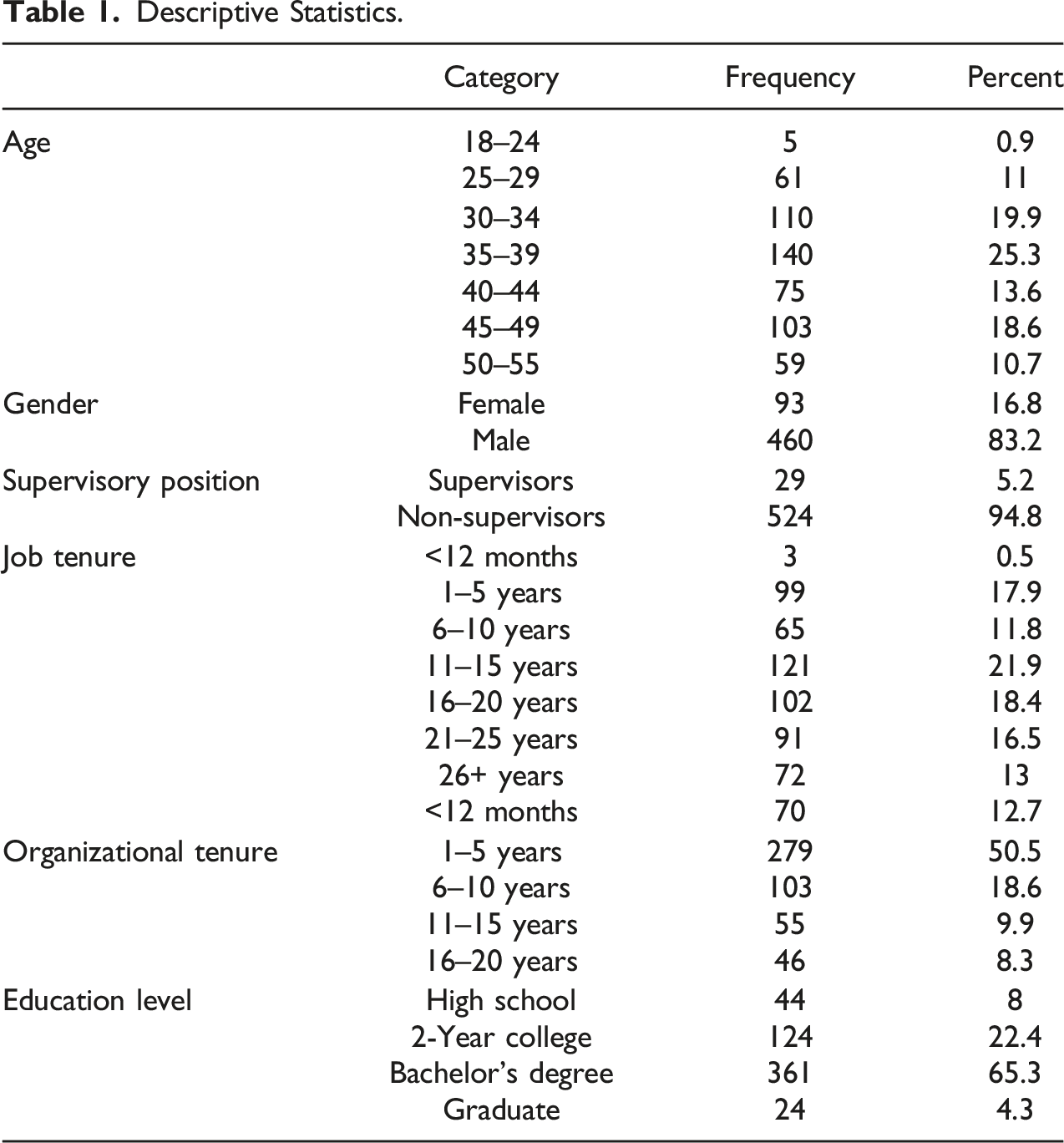
Testing Common Method Bias
Because data were collected from the same source for both the dependent and independent variables, common method bias could be a problem. Following the recommendation of Podsakoff et al. (2003), procedural remedies were adopted to minimize common method bias (CMB). First, the survey included a cover letter explaining the purpose of the study, stating the voluntary basis, and assuring the anonymity and confidentiality of the responses. Second, the proximal separation method was applied by placing questions measuring independent, dependent and mediating variables in various sections of the survey, along with various response formats. Third, previously validated instruments were used to eliminate ambiguity. Finally, the Harman’s single factor test indicated that common method bias was not a serious issue in this study as one component only accounted for 43% of the variance, less than 50% threshold (Podsakoff et al., 2003).
Measures
The survey was conducted in Turkish. Prior to the distribution of the questionnaire, a back-translation procedure (Brislin, 1970) was applied to ensure that the questionnaire was properly translated from English to Turkish.
Servant leadership was measured using a five-item scale developed by Sendjaya et al. (2008, 2019) and recommended by Eva and colleagues (2019) following a systematic review of servant leadership measures. Although the original scale included six items, one of the items (“gives me the right to question his or her actions and decisions”) was excluded by the ethical committee. Participants rated their immediate supervisor’s servant leadership orientation on a five-point Likert-type scale ranging from 1 (strongly disagree) to 5 (strongly agree). A sample item included “My supervisor uses power in service to others, not for his or her ambition.” It is important to emphasize that this study examined the supervisor’s servant leadership orientation as perceived by the officers rather than the actual behaviors of supervisors. The Cronbach’s alpha for SL measure was .93.
Motivating language was measured with a nine-item short version of the ML scale developed by Mayfield and Mayfield (2007). The scale included the three dimensions of motivating language: direction-giving, empathetic language, and meaning-making language. Participants rated their immediate supervisor’s use of motivating language on a five-point Likert-type scale ranging from 1 (very little) to 5 (a whole lot). Sample items included “My supervisor gives me useful explanations of what needs to be done in my work” (direction-giving), “Shows me encouragement for my work efforts” (empathetic language), “Offers me advice about how to behave at the organization’s social gatherings” (meaning-making). Overall, Cronbach’s alpha for ML measure was .92.
Perceived Organizational Support was measured with four items from the scale of Eisenberger et al. (1986). Respondents were asked to express their agreement or disagreement with each statement on a five-point Likert scale ranging from 1 (strongly disagree) to 5 (strongly agree). An example item is “My organization realy cares about my well-being.” The Cronbach’s alpha for the POS measure was .93.
Work Engagement was measured using the 9-item Ultrecht Work Engagement Scale (UWES-9) developed by Schaufeli et al. (2006). The shortened version of this scale assesses the three dimensions of work engagement with three items each. Sample items include “At my work, I feel bursting with energy” (vigor), “I am enthusiastic about my job” (dedication), and “I feel happy when I am working intensely” (absorption). Participants were asked to rate their responses on a six-point Likert scale ranging from 1 (never) to 6 (always) as in the study of Gutermann et al. (2017). Consistent with recent research (Luu et al., 2019; Rabiul & Yean, 2021), the instrument was used as a unidimensional construct and indicated excellent reliability (alpha = .95).
Control Variables. In line with prior research (Rabiul & Yean, 2021; Tao et al., 2022), socio-demographic characteristics such as age, gender, education, job tenure, department tenure, and supervisory position, were controlled in this research.
Data Analysis
The SPSS and AMOS software packages were used to analyze the data. As suggested by Anderson and Gerbing (1988), this study used a two-step approach to explore the relationship within the proposed model. First, the measurement model was validated through confirmatory factor analysis (CFA), and then the hypothesized structural model was tested using structural equation modeling (SEM). In addition to testing first order factor models, second-order factor analyses were performed to determine whether the motivating language sub-dimensions were good indicators of their respective latent variables. The measurement model included four latent variables and nine manifest variables consisting of three dimensions of ML.
This study also used the bias-corrected (BC) bootstrapping procedures with 5000 iterations recommended by Preacher and Hayes (2008) to test multiple-mediator model (Preacher & Kelley, 2011). Furthermore, this study used a user-defined estimand to examine the specific indirect effects of servant leadership through each mediating variable in AMOS (Crowson, 2021).
Results
Measurement Model and Descriptive Statistics
First, a first-order CFA was performed separately on the three measures of ML using a maximum likelihood estimation in AMOS. The results of the measurement model for ML showed a good fit to the data, χ2 (24) = 48.072, χ2/df = 2.003, GFI = .98, RMSEA = .04, TLI = .99, CFI = .99, with the factor loadings ranging from .70 to .89. Subsequently, the hypothesized four-factor measurement model (i.e., SL, ML, POS, and WE) was assessed. The four-factor model indicated an acceptable fit to the data with χ2 (307) = 680.422, χ2/df = 2.216, GFI = .92, RMSEA = .05, TLI = .97, CFI = .97. All indicators significantly loaded onto their respective latent variables (p < .001). The factor loading range for SL was .75–.90, .70 to .89 for ML, .81 to .89 for POS, and .73 to .92 for WE. To improve the fit of the measurement model, modification indices were used to allow for error correlations. Because some items of SL and WE overlapped with each other, post-hoc optimization was applied, as in previous research (Schaufeli, 2015).
Descriptive statistics, Correlations, Cronbach's alpha, composite reliability, and average variance extracted.
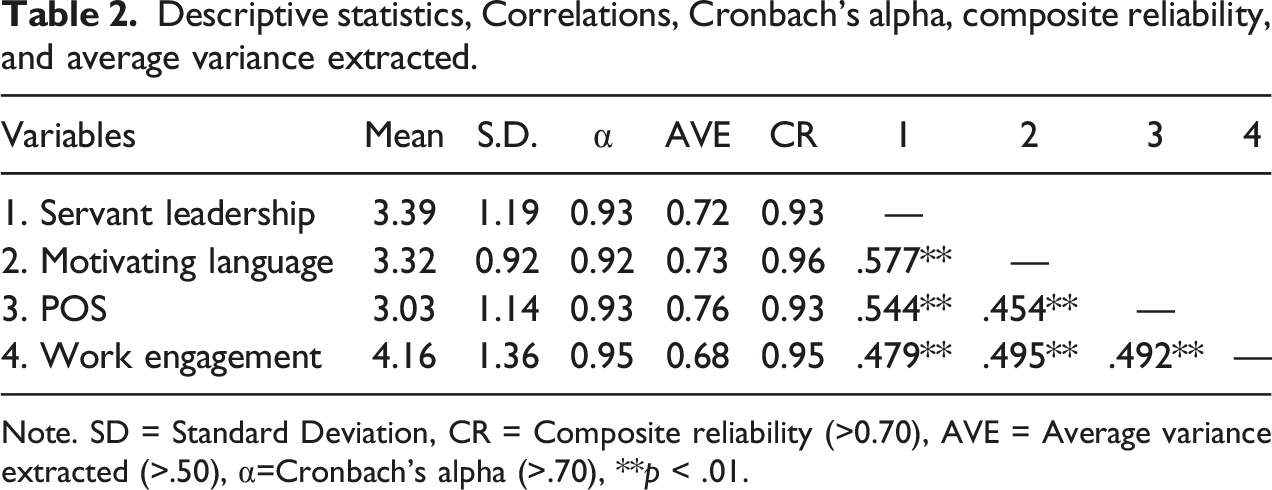
Note. SD = Standard Deviation, CR = Composite reliability (>0.70), AVE = Average variance extracted (>.50), α=Cronbach's alpha (>.70), **p < .01.
As recommended by Becker (2005), demographic variables were examined to understand whether they were related to SL (independent variable), ML, POS (mediators), and WE (outcome). Gender and supervisory position were not correlated with any of the variables. Age, education, and tenure were found to correlate with some study variables. Therefore, SEM analyses were conducted with and without controlling age, education, and tenure. None of the control variables were found to have significant effects on WE, and the significance of the coefficients did not change when the analyses were performed without control variables. Therefore the results of the SEM analysis are reported below without control variables (see Table 3) (Becker, 2005).
Structural Model and Hypotheses Testing
Goodness-of-fit indices of the examined models.
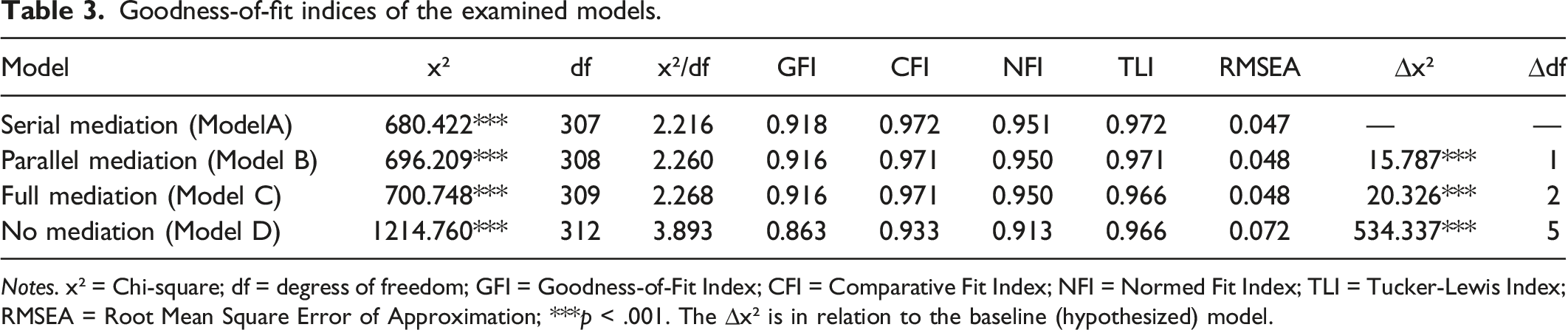
Notes. x² = Chi-square; df = degress of freedom; GFI = Goodness-of-Fit Index; CFI = Comparative Fit Index; NFI = Normed Fit Index; TLI = Tucker-Lewis Index; RMSEA = Root Mean Square Error of Approximation; ***p < .001. The ∆x² is in relation to the baseline (hypothesized) model.

Results of structural equation modeling.
Hypothesis 1 predicted that SL would be positively related to WE. Supporting H1, SL significantly and positively influenced WE (β = .14, p < .05). Moreover, as shown in Figure 1, all the coefficients of the paths between variables were significant.
Structural equation modeling results of unstandardized indirect effects and 95% confidence intervals (CIs) using a bias-corrected (BC) bootstrapping procedure.
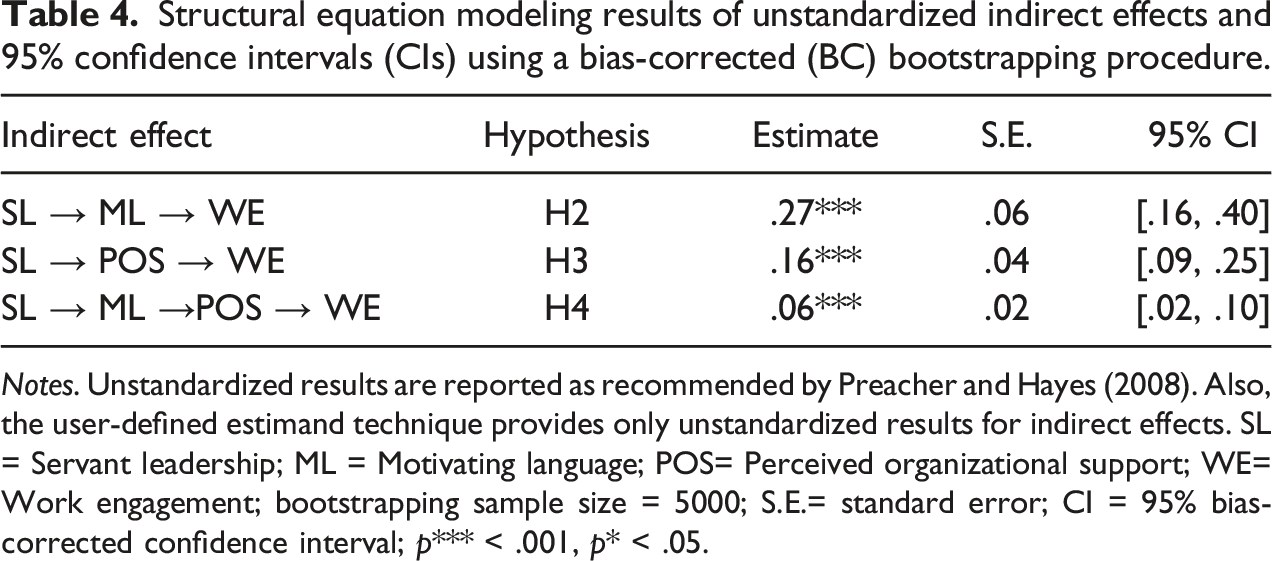
Notes. Unstandardized results are reported as recommended by Preacher and Hayes (2008). Also, the user-defined estimand technique provides only unstandardized results for indirect effects. SL = Servant leadership; ML = Motivating language; POS= Perceived organizational support; WE= Work engagement; bootstrapping sample size = 5000; S.E.= standard error; CI = 95% bias-corrected confidence interval; p*** < .001, p* < .05.
Discussion
The current study aimed to respond to calls to examine the role of leadership in understanding employee work engagement in public organizations (Van Wart, 2013). More specifically, the current study investigated the contribution of ML and POS as mediators in order to shed light on the relationship between SL and SLBs’ WE. This study contributes to the body of knowledge by indicating that, consistent with previous studies, SL is a significant predictor of WE among SLBs (Aboramadan et al., 2020; Bao et al., 2018; Shim et al., 2021). Moreover, the findings demonstrated that ML and POS serially mediate the relationship between SL and WE. The findings of the current study have significant theoretical and practical implications.
Theoretical Implications
Overall, the results of this research provide support for the proposed research model. Drawing from SET, SLT, MLT, and the JD-R model, this study provides valuable interdisciplinary insights into how SL influences SLBs’ WE through ML and POS. First, the findings show that servant leaders can stimulate work engagement through the social exchange process. That is, consistent with SET (Blau, 1964), when followers are encouraged, supported, treated fairly, and appreciated by their leaders, they feel obligated to reciprocate with favorable work-related attitudes (Brown & Treviño, 2006; Cropanzano & Mitchell, 2005; Eva et al., 2019) and feel more engaged at work. This result is consistent with prior research (Bao et al., 2018; Miao et al., 2014) showing that servant leaders, who demonstrate positive attitudes and treat their followers transparently and fairly are likely to have followers who respond in the form of desirable work attitudes.
Second, the relationship between servant leadership and work engagement can also be explained from the perspective of SLT. In line with SLT (Bandura, 1977), this study suggests that followers are more likely to emulate the behaviors of servant leaders and show higher work engagement as servant leaders exhibit integrity, express humility, and act as credible role models (Liden et al., 2008; van Dierendonck, 2011). This result is in line with previous research (Liden et al., 2014; Schwarz et al., 2016) which has shown that followers of servant leaders are more likely to learn and emulate positive behaviors from their leaders through role modeling.
Third, consistent with the JD-R theory (Bakker & Demerouti, 2007, 2017), the findings indicate that ML and POS are valuable job resources that not only predict WE but also partially mediate the relationship between SL and WE. Therefore, this study extends the literature by responding to the call to integrate leadership into the JD-R model and examining the impact of leadership behaviors on employee well-being through job resources (Bakker & Demerouti, 2017). This finding also contributes to the servant leadership literature by shedding light on the mechanisms underlying the relationship between SL and WE (Eva et al., 2019).
Finally, this study expands the literature on leadership communication by integrating servant leadership theory with motivating language theory. Specifically, this study highlights the notions of transparent leadership communication (Y. Lee & Dong, 2023; Rawlins, 2008), relational leadership (Cunliffe & Eriksen, 2011), and empathic leadership (Jian, 2022) by demonstrating that SL, a holistic approach to leadership including relational, empathy, transparency, and emotional dimensions (Eva et al., 2019; van Dierendonck, 2011), enables leaders to effectively use ML. This study also extends MLT (J. R. Mayfield & Mayfield, 1995) by showing that leaders’ use of ML creates a positive working environment where followers feel higher organizational support, which in turn leads to increased work engagement. These results highlight the importance of leadership communication for creating productive work environments and promoting employee well-being.
Practical Implications
This study has a number of practical implications for public-sector organizations, particularly police departments. First, the findings emphasize the effectiveness of SL in boosting SLBs’ WE. In the early 2000s, Turkey initiated public and political reforms to create a transparent, accountable, efficient, and service-oriented government on its way to becoming a member of the European Union (Demir, 2020). This study suggests that public organizations in Turkey should encourage their leaders to adopt a servant leadership style for the successful implementation of these reforms. Moreover, servant leadership, a human-oriented leadership style (Liden et al., 2008; Sendjaya et al., 2020), is in line Turkish cultural values and therefore could be readily adopted by organizations.
Culture can significantly influence individuals’ perceptions of leaders and communication practices within organizations (Dickson et al., 2012). Considering the cultural dimensions of Hofstede et al. (2010), the results of this study can help us understand how culture influences leadership and communication practices in a highly collectivist, strong uncertainty avoidance, and high-power distance country like Turkey (Hofstede et al., 2010). In such a society, because employees need clarity and formalization (strong uncertainty avoidance), they are more likely to express stress in ambiguous situations (Hofstede et al., 2010). Therefore, servant leaders using ML can clarify work ambiguity, understand individual needs, motivate, and provide support, resulting in reduced uncertainty and anxiety among followers (Liden et al., 2008, 2014). Moreover, in a collectivistic and high-power distance country, employees respect leaders’ authority, trust their communication, and view the employee-employer relationship as moral, resembling a family link (Hofstede et al., 2010). Therefore, supervisors using servant leader behaviors and ML can foster emotional ties and trusting relationships with followers by acting as credible role models, which may result in followers feeling secure and emotionally satisfied (J. Mayfield & Mayfield, 2018).
Motivating police supervisors and managers at all levels to exercise servant leadership behaviors is particularly important for police departments in Turkey. According to the findings of Vito and colleagues (2011), police managers from various U.S. states believe they should follow servant leadership principles rather than an autocratic or command-and-control style of leadership. In Turkey, policing has been heavily influenced by cultural and socio-political environments. The army has had a strong militarizing effect on the police, as the army has taken over the duties of the police during protracted military interventions in Turkey’s internal security (Yilmaz, 2020). The pro-democracy movements in the 2000s led to the normalization of civil-military relations and police autonomy (Esen & Gumuscu, 2021; Yilmaz, 2020), while the adoption of community-oriented policing (COP) in 2006 led to democratic policing practices. Research has indicated that most police officers strongly support the implementation of COP in Turkey (Demirkol & Nalla, 2019). Nevertheless, the declaration of a state of emergency after the coup attempt in 2016 reversed the democratic transformation process in Turkey and deeply affected the police department (Yilmaz, 2020). Esen and Gumuscu (2021) argue that national institutions that play a critical role in creating checks and balances, essential for the sustainability of democracy, have been gradually eroded. Therefore, servant leadership behaviors in police departments may be a mechanism that not only enhances employee work engagement but also curbs the negative effects of police culture and improves democratic policing.
In order to increase police officers’ work engagement, police departments need to train their current first-line supervisors and managers to be servant leaders and place a strong emphasis on promoting servant leadership in the department. Accordingly, police departments should recognize the crucial role of servant leadership and develop training programs and policies to develop servant leaders.
The findings also demonstrated that ML plays a critical role in the relationship between SL and WE, highlighting the importance of communication behaviors in boosting WE. Moreover, the results suggest that servant leaders can increase the level of POS and, consequently, WE through the use of ML. Therefore, given the substantial role of ML in fostering WE, the selection, training, and promotion of police managers with strong leadership communication skills would be advantageous for police departments.
Finally, it would be advantageous to create a positive work environment in which officers feel more organizational support. SL has an impact on teams as well as individuals by creating a serving culture (Liden et al., 2014). Thus, a serving culture may assist officers in feeling support from their coworkers, facilitating the development of relationships, improving self-efficacy, and consequently delivering effective public services.
As a result, through these training programs and policies, police departments can develop servant leaders who effectively use ML, creating an engaged working environment. These results emphasize the critical role of HR management and leadership communication in developing job resources to foster a productive workplace.
Limitations and Future Studies
Despite its contributions, this study has a number of limitations that need to be addressed. First, because of the study’s cross-sectional design, causal relationships cannot be established. Therefore, an experimental or longitudinal design should be used to establish causal links between the study variables. Second, the data were collected from police officers in one large police department in Turkey, potentially limiting the generalizability of the findings. Research should be conducted in the future to replicate this study in other law enforcement agencies. Moreover, a replication of this study should be conducted with other street-level bureaucrats, including public school teachers and healthcare workers. Third, although several remedies were applied to alleviate the problem, the study was based on data gathered from same source using self-report questionnaires which can result in common method bias. However, according to Spector (2006), common method bias problem is rarely strong enough to jeopardize the validity of findings. Future research, therefore, should gather data from multiple sources and at different time points. Furthermore, more research should examine how servant leadership influences work engagement through various mediating mechanisms such as leader-member exchange, social support, and organizational culture.
Footnotes
Acknowledgments
I would like to thank the MCQ Editor-in-Chief, Matthew Koschmann, and the associate editor, Guowei Jian, for their guidance, as well as the anonymous reviewers for their valuable comments and suggestions on earlier versions of this article.
Declaration of Conflicting Interests
The author(s) declared no potential conflicts of interest with respect to the research, authorship, and/or publication of this article.
Funding
The author(s) received no financial support for the research, authorship, and/or publication of this article.
Ethical Statement

Data Availability Statement
Data available from the author(s) upon reasonable request.