




Abstract
This study examines the relationship between individuals’ networking interests and a group’s networked structure. The data set includes 25,651 members and 12,638 mentions from Twitter-mediated communities in South Korea. Using social network and web impact analyses, we investigated the micro- and macro linkage between individuals’ interests and groups’ structure, the meso-level analysis of individual-to-individual relationships, and the hyperlinked content shared in each community. Findings suggest that different interests of individuals in joining online communities were associated with variations in those communities’ network structures: Communities with sociopolitical goals had a denser network structure and communities for interpersonal interests had a more reciprocated network. Communities for information access exhibited greater dependence on a single member, contrary to the communities for information sharing. Types of content shared in the communities also varied by interests. These findings led us to compose a network topology with visual representation, based on sociopolitical, informational, and interpersonal interests.
Keywords
Introduction
Many previous studies have assumed network structure as a given (Sewell, 1992; Zeggelink, 1995), intensively studying how different network structures generate different motivations, rewards, and performance; however, few studies have analyzed how each individual’s motives or interests may shape a network. For instance, would a community composed of individuals interested in obtaining financial news and information structurally differ from a community composed of individuals interested in making friends? In line with this stream of thought, the present study questions whether and how different interests in joining a community affect the network structure of online communities.
This study examined online communities rather than offline groups, as the former is less influenced by extraneous factors, such as transaction costs and distance and time constraints. Additionally, their network data are more easily obtainable and have fewer measurement errors and less respondent or nonrespondent bias, compared to offline networks constructed from name/position/resource generators (Sams, Lim, & Park, 2011). Furthermore, based on preceding interests or motives, people select particular communities from a myriad of choices available on the Internet. This feature helps us to investigate how individual interests are associated with network structure. Specifically, we examine the communication networks of Twitter communities comprised of different member interests in South Korea.
By addressing social web use, the present study expands the body of information science literature that has mostly examined academic web use, such as hyperlinking scholarly electronic articles (e.g., Kim, 2000), interlinking academic web sites (e.g., Park, 2010; Wilkinson, Harries, Thelwall, & Price, 2003), citing URLs (e.g., Kousha & Thelwall, 2006), and searching online information for class projects (e.g., Large & Beheshti, 2000). In addition, information science studies mostly focus on how network structure looks like and what characteristics this structure has (e.g., Goel, Watts, & Goldstein, 2012; Lorentzen, 2014), whereas the present study attempts to address how individual sociocommunicational interests are associated with a group’s network structure. Unlike prior studies, the object of the present study is not to examine network structure per se, but the relationship between individuals’ networking interests and a group’s networked structure as a consequence of those interests. Moreover, online communities in South Korea can provide an interesting comparison with studies conducted in a Western context.
The present study employs network analysis to investigate a group’s networked structure based on its individuals’ networking interests. Considering that network analysis enable us to explore different levels of analysis (from individual to system level or vice versa; Chen & Tan, 2009), the present study conducts a network analysis of online communities to examine the meso link of micro-actions to the macro network. In this context, micro-actions refer to each individual’s interest in joining an online community, meso link refers to the relationship among those individuals, and macro network refers to the community’s overall network structure.
The next section explores research on individual agency and network structure, followed by a discussion of different types of interests in joining online communities. These interests are extrapolated from a review of previous social psychological studies of motives for participating in online communities. Based on these discussions, a list of research questions is framed by the level of analysis. In the Method section, we explain the case selection of online communities and the measures of network structures, including an overview of Twitter use in South Korea. The Results section discusses the relationship between individuals’ interests with the community’s macro network, the meso links among community members, and the content hyperlinked and shared within the community through tweets. In the same section, each community’s network structure is visualized and interpreted based on quantitative evaluation of the network. After identifying the study’s limitations and suggestions for future research, concluding remarks are given.
Individual Agency and Network Structure
According to Wellman (1983), in network analysis, constraints and opportunities of a given social structure are assumed to limit behavior that is guided by an individual’s motivation. Burt (1995) also argued that, since opportunities for access to resources in a network closely relate to the probability of success, opportunities embedded in a network take precedence over individual motivations. Moreover, whether or not one’s motivation affects the network, Burt (1995, p. 36) stated, “the network is its own explanation of motive.” Since the causes and consequences of network structure do not seem to be clearly discernible, most prior research has assumed network structure as a given, rather than a varying precondition, and has focused on the effect of this structure on the individual (Zeggelink, 1995).
Previous research has mostly focused on how a society’s network structure influences its members’ motives. For example, Sherman and Smith (1984), using a regression analysis on a survey of churches (as a sample of voluntary organizations), found that an increase in the size of an organizational structure contributed to undermining its members’ intrinsic motivation, while a high degree of hierarchy and centralization supported extrinsic motivation. Additionally, Haynie (2001) found that dense network structure conditioned delinquency involvement in adolescent friendships. These approaches that assume structure exerts a unidirectional effect on actors tend to negate human agency and reduce actors to automatons programmed by the structure (Sewell, 1992). From this perspective, structure is always reproduced by actors and remains stable; however, this approach fails to explain how structure changes over time.
In contrast to the aforementioned perspective, Giddens (1984, p. 25) mentioned the “duality of structure”: Not only does structure empower or constrain human agency but human agency also reproduces structure. This perspective does not subordinate human agency to structure, but emphasizes the interaction between the two, regarding structure as the product of “structuration” and human agents as knowledgeable actors. Acknowledging that previous studies have mainly focused on one side of the structuration process by examining the influence of the network structure on the individual, the association of individual agency with network formation should also be considered in order to fully understand how structure evolves.
Among the few studies that have addressed the influence of individual agency on networks, Kadushin (2002) found that the motive of safety is associated with higher density and network constraint, while the motive of efficacy corresponds to lower network constraint with structural holes. Since people innately carry both motives, he suggested that cohesion and brokerage are inseparable, with one becoming more salient than the other in different sociocultural contexts. This finding contradicted the general assumption that both characteristics are incompatible with networks; further investigation of the motivational origin of social networks (Kadushin, 2002, 2004) casts doubt on the widely accepted notion that network cohesion and brokerage are inherently opposed. This indirectly indicates the importance of studying an individual agency and its impact on network structure. Additionally, Zeggelink (1995) found that individual friendship choices, based on the need for social contact and the preference for friends similar to oneself, affected the dynamics of friendship network structures. At the very least, all of these findings indicate that the network is not the sole determinant of an individual’s agency, motives, choices, or interests, nor is its structure predetermined or static.
Methodologically, previous studies (Kadushin, 2002; Zeggelink, 1995) have conducted a literature review or a simulation focusing on the individual level of an ego network. In contrast, the present research conducted an empirical analysis of real cases and explored the whole network composed of individual actors.
Types of Interests in Online Community Participation
From a social psychological perspective, the most relevant motive to participation in social groups is affiliation (Hogg & Abrams, 1993). Affiliation has four submotives: (i) “positive stimulation” (enjoyable affective and cognitive stimulation from close interpersonal contact, such as friendship); (ii) “attention” (praise and focus from others on oneself); (iii) “social comparison” (acquiring self-relevant information through comparison with others); and (iv) “emotional support or sympathy” (Hill, 1987). Based on these motivational constructs, the present study extrapolates motives that are most pertinent to online communities from the relevant literature. 1
Using a social psychological perspective, Ridings and Gefen (2004) examined motivations to join an online group by conducting a survey on members of online community bulletin boards. Their findings suggested that exchanging information, building friendships, and obtaining social support (in order of importance) accounted for about 85% of total responses. Additionally, Ren and Kraut (2013) defined motivation as benefits achieved from groups. By integrating the collective effort model with theories of group identity and interpersonal bonds and information overload theory, they devised three types of motivation: social benefit, informational benefit, and other (recreational) benefit. Wang and Fesenmaier (2003) also found that group attachment, relationship building, and self-esteem enhancement were important motivational constructs for contributing to a community.
Based on previous research, the present study defines the following relevant motives: sociopolitical, informational, and interpersonal. The sociopolitical motive derives from group attachment: that is, the sense of belonging and affiliation to a group (Joinson, 2008; Ridings & Gefen, 2004; Wang & Fesenmaier, 2003). Distinct from interpersonal attachment to members, the sociopolitical motive in the present research focuses on the identification of members with a group that shares their common interests and other similarities. This distinction is in line with Ridings and Gefen’s (2004) separation of “social support exchange” from “friendship” and Joinson’s (2008) division of “shared identities” from “social connection.”
The informational motive can be subdivided into accessing information and sharing information, each of which is grounded in different rationales. The need to access information stems from information overload theory (Beaudoin, 2008; Ren & Kraut, 2013). Since people have limited capacity to cognitively processing information, they are motivated to join groups that provide information relevant to their own interests. In contrast, the need to share information is motivated by members’ desire to obtain positive self-evaluation and social acceptance through the altruistic behaviors of sharing information and contributing to group outcomes (Ren & Kraut, 2013). Group outcomes can include communal knowledge or evaluation based on a collective effort to share information.
The interpersonal motive refers to friendship and bond-based attachment to members. People utilize the interactivity of the Internet by joining online communities for socializing and networking. As Ridings and Gefen (2004) pointed out, friendships can provide information and social support, but these motives do not define friendship. Considering that one can satisfy one’s need for information or attachment to a group without seeking friendship, the interpersonal motive is a separate construct from sociopolitical and informational motives, as also acknowledged by Joinson (2008).
Considering the previous studies, we can conclude that people participate in online communities for sociopolitical, informational (accessing/sharing information), and interpersonal goals. Guided by this conclusion, we examined Twitter communities that expressed at least one of those goals and assumed that individual interest in joining these communities was in accordance with these stated goals; given each community’s goal is announced up-front, this would appear to be a reasonable assumption. Although we were not able to directly ask each individual about his or her motive for joining online communities, we can regard each as having a preceding, self-identified interest in the relevant community’s sociopolitical, informational, or interpersonal goal.
Research Questions by the Level of Analysis
This research attempted to enrich the literature on social networks by exploring networks as a whole. A whole network is content-free and provides information on the characteristics of both the network structure itself and the relationship between alters (Lewis, Kaufmana, Gonzaleza, Wimmerb, & Christakis, 2008). This approach can also address why certain individuals stand in a certain position in the network (Hogan, 2008). One disadvantage with this approach is the arbitrary specification of network boundaries (Chen & Tan, 2009); however, this can be overcome by analyzing online communities that have natural boundaries without any intervention from the researcher. This holistic analysis can explain whether an individual’s interest at the micro level has an influence on the network structure at the macro level.
In addition to macro-level analysis of the holistic network, the meso level of node-to-node relationships must be addressed to examine how individual interests affect network formation. Such relationships reflect the distribution of power, influence, or resources within a network. Though two systems own the same amount of resources, it does not necessarily mean that each member of the two systems possesses the same amount of resources (Hanneman & Riddle, 2005), similar to the difference between the concepts of network centralization and centrality. The distribution of resources within a community cannot be captured at the system level, but in node-to-node relations, since it is relation dependent: One’s possession of resources means others’ deprivation. An actor located at a favorable position in the network may take advantage of exchanging more or better resources and having greater influence than those in less favorable positions. A closer examination of node-to-node relationships can explain how different individual interests in joining online communities can affect the distribution of power, influence, or resources, which in turn can affect network structure.
Finally, not only was online communities’ network structure explored but also the content shared in the communities. By analyzing hyperlinked content in tweets, this study explores types of content shared in online communities with different members’ interests.
Method
Twitter in South Korea
Online communities on Twitter, one of the world’s most popular social network sites, were selected for this study’s analysis. Compared to other social network sites, Twitter is more open to the public, as users are generally not required to be each other’s “friends” to see their content. It also facilitates communications by allowing “anytime, anywhere” access with its mobile-ready interface. As such, Twitter’s characteristics are conducive to conducting many-to-many communication and fostering public debate.
In South Korea, Twitter has become a major platform for social networking and discussion (Hsu, Park, & Park, 2013; Otterbacher, Shapiro, & Hemphill, 2013). More than 10% of the country’s population used Twitter as of November 5, 2011 (Etnews, 2011). According to an online survey conducted by Korea Information Society Development Institute (Lee, Cha, & Park, 2010), 70% of respondents used Twitter once to several times a day. On average, respondents sent out 3.7 tweets to other users, retweeted 2.65 messages, and posted 2.22 tweets daily.
For the present analysis, online communities were selected from Twitaddons.com, a site introduced on March 4, 2010, that has since been widely adopted by Twitter users in South Korea (Jung, 2011). As an add-on application to the Twitter platform, Twitaddons.com has the additional function of facilitating online social gatherings (Choi & Park, 2014). Through the add-on, a Twitter user can create and organize an online community to discuss any issues with its members, enabling users to have “thematic” discussions (Choi, Park, & Park, 2012). An organizer who establishes a Twitter community announces the community’s goal or mission statement; Twitter users whose interests align with that of the community can “follow” it and become members. By clearly stating community goals and attracting users based on those goals, online communities on Twitaddons.com serve the aim of the present research to investigate the relationship between individuals’ networking interests and a group’s networked structure.
Case Selection
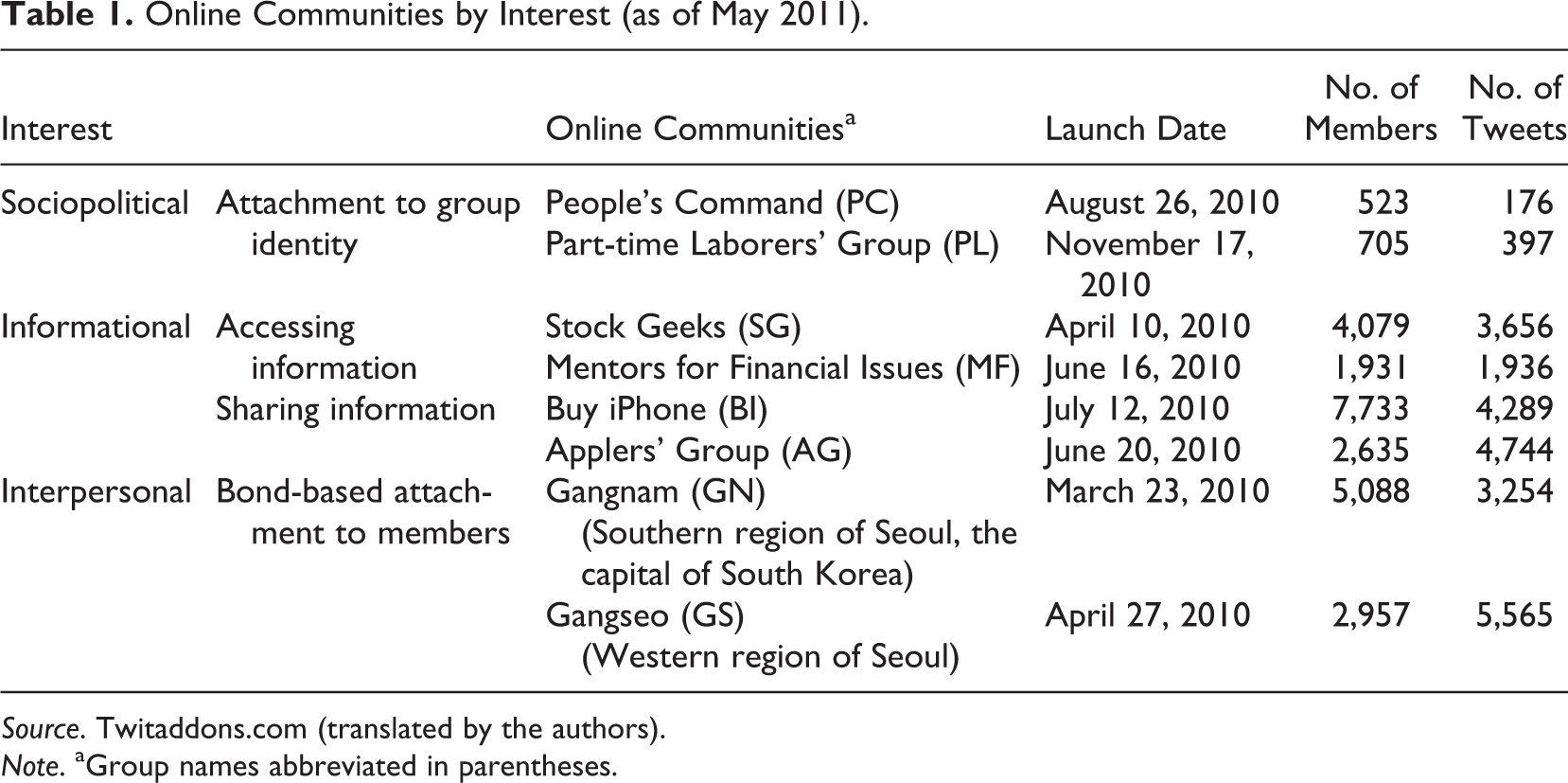
Of the various available Twitter communities, communities whose mission statements can be categorized into informational, sociopolitical, and interpersonal interests were chosen. Based on their current activities in terms of number of members and tweets, eight communities were selected as follows (see Table 1).
Online Communities by Interest (as of May 2011).
Source. Twitaddons.com (translated by the authors).
Note. aGroup names abbreviated in parentheses.
Online communities that show strong attachment to group identity are People’s Command and Part-time Laborers’ Group, both of which fell into the sociopolitical interest category. These communities are concerned with social activism and involve criticizing sociopolitical affairs and advocating for the improvement of part-time workers’ legal rights. Online communities classified as informational (accessing information) were Mentors for Financial Issues and Stock Geeks, both of which were related to financial topics. As expressed in each community’s mission statement, members join these communities to obtain practical information and specific tips for financial investment. These community activities help them to extract highly relevant information from a glut of economic news, thereby reducing information overload. In contrast, Buy iPhone and Applers’ Group were categorized as informational (sharing information). While members of these communities are also interested in obtaining information, the communities are more explicitly devoted to communally judging certain products or product-related issues, rather than reducing information overload. Communities related to interpersonal interest were Gangnam and Gangseo, whose names indicate their geographical locations in the southern and western regions (respectively) of Seoul, the capital of South Korea.
To retrieve these communities’ relational data, this study collected public mentions. On Twitter, a mention functions similarly to a reply: While all replies are mentions, not all mentions are replies (Barash & Golder, 2010). Mentions of each group were collected for a full 2-month period (March and April 2011); the data set included 25,651 members and 12,638 mentions. Each group’s network was constructed from this data set of mentions between members. In this network, nodes are members, and ties indicate mention relationships between members. If Member A mentions Member B, the network between A and B is constructed as follows: A → B. The strength of the tie is defined by the number of mentions shared. Thus, we were able to form a directed valued network of each online community.
Network Structure and Content
Whole-network structure (macro-level analysis)
The suitability of Twitaddons.com to this study lies not only in its communities’ clearly self-identified goals but also to these ease with which the whole network of each group can be obtained. Additionally, networks of Twitaddons communities have their own self-defined boundaries, freeing this study from the problem of boundary specification. This study measured structural characteristics of each network as a whole by focusing on the extent to which each network is connected, inclusive, concentrated, and reciprocated.
First, to measure network’s connectedness, network density is calculated by dividing the number of a network’s actual ties by the number of its possible ties. Given the valued network in the present analysis, the total of all values was applied instead of the number of actual ties. Each group’s density was compared using Z scores generated via bootstrapping (Snijders & Borgatti, 1999). This study’s network data set satisfied the bootstrap assumption, since the nodes were interchangeable without any inherently structural organization. The expected density was set at one to test the idea that all members are connected to each other.
Second, inclusiveness indicates the ratio of connected members to all members who were using Twitter within the community during the studied period. The number of connected members was calculated by subtracting the number of isolated actors who did not send or receive any ties from the number of members who posted or exchanged tweets. Members who did not show any Twitter activity within the 2-month data period were not included in the data set.
Third, based on the coreness of actors, a Gini coefficient was used to indicate how equally the scores are spread across the overall network (i.e., how concentrated each network is). A value of 0 indicates perfect equality (with all members having the same score), while a value of 1 denotes perfect inequality (with one actor having all the resources and the others having none).
Finally, reciprocity is the amount of reciprocated ties (indicating a bidirectional relationship) in the network. Overall group reciprocity is represented by the proportion of reciprocated dyads to the dyads that are connected but not necessarily reciprocated.
Node-to-node relationships (meso-level analysis)
For meso-level analysis, degree centrality, betweenness centrality, and geodesic distance can be measured to determine the relationship between nodes (Hogan, 2008).
First, Freeman’s concept of degree centrality (Hanneman & Riddle, 2005) is calculated based on the sums of the values of ties. For this analysis, the network data were symmetrized into the maximum value of two nodes.
Second, Freeman’s concept of betweenness centrality (Hanneman & Riddle, 2005) indicates how many times a given node appears on the shortest path between two other nodes. This means that the two nodes should contact a given node to connect to each other. Considering that Freeman’s betweenness centrality is calculated by dichotomizing the data by the presence or absence of a connection, this study used flow betweenness centrality, rather than Freeman’s betweenness centrality, in order to fully embrace the information provided from the valued data. Flow betweenness centrality illustrates the amount of flow between two nodes passing through the given node for any maximum flow. This concept assumes actors use all linked pathways proportionally to pathway length, rather than the shortest path only (i.e., Freeman’s betweenness centrality). For this analysis, the network data were symmetrized into the maximum value of two nodes.
Finally, geodesic distance refers to the shortest path length between two nodes. Since the network was not fully connected, geodesic distance was calculated among connected nodes rather than closeness centrality. This measure dichotomizes the network data by presence and absence of ties.
These indices of both macro and meso levels of analysis were calculated using UCINET 6.0 (Borgatti, Everett, & Freeman, 1999). The network structure of each online community was visualized by using NetDraw’s spring embedding method in UCINET 6.0. Through network analysis, the present study focused on finding the differences between communities with different joining interests. If no differences were observed between the characteristics of such communities’ network structures, the notion of network structure as given would earn more support than that of network structure as constructed by individual interests.
Content (Hyperlink analyses)
Because of Twitter’s 140-character posting limit, many tweets contain hyperlinks (which are usually automatically abbreviated) to websites relevant to the discussion. This study extracted hyperlinks from tweets, traced original addresses from those hyperlinks, and conducted a web impact analysis via Thelwall’s (2009) Webometric Analyst software. This URL analysis (Cho, Jung, & Park, 2013; Sams & Park, 2014) can reveal the websites most frequently hyperlinked in the analyzed tweets.
Results
Networking Interest (Micro) and Networked Structure (Macro)
To evaluate network density, online communities were compared on a Z-score scale (see Figure 1). As illustrated by the large negative Z-scores, the expected density value of 1 (reflecting perfect connectedness between all members within a community) was not supported in all online communities. This means that all communities had far fewer actual connections than possible connections. Although new technologies tend to facilitate communication far more than previous tools, in this case, it appears that, by sending or receiving mentions, online communities seemed to have developed communities that are far from densely knit. While increase in network size can sometimes lead to a decline in overall network density, this inverse relationship did not explain the variability of network size and density in the analyzed communities, as not all larger communities were less dense than smaller communities were.

Setting this commonality aside, communities with sociopolitical goals were found to be relatively well connected. In this denser network, information can be diffused at a higher speed and to a wider reach, allowing information senders to communicate more efficiently with members than in other communities. Additionally, denser relationships in the network can increase social constraints to follow norms and obligations (Burt, 1995; Hanneman & Riddle, 2005). These features can contribute to consolidating community identity and increasing the possibility of collective actions (Kim & Bearman, 1997).
Regarding inclusiveness, as noted in Figure 2, a larger proportion of members in information sharing communities were isolated from other members. Some of these members might be “free riders” who enjoy benefiting from others’ altruistic motives to share information and contribute to communal knowledge. In contrast, communities with the goal of accessing information exhibited higher inclusiveness that might have stemmed from more active participation to obtain filtered information in the communities and thus lessen information overload.
When it came to concentration (as measured by the Gini coefficient), communities with the goal of accessing information had the lowest value, indicating these communities had less inequality than others (see Figure 3). This means that coreness scores were spread across members, rather than concentrated on a few.

Analysis for reciprocity revealed that communities with the goal of social interaction had the highest proportion of reciprocated dyads (see Figure 4). Reciprocal connections represent members’ intention to form mutual relationships by joining the community. Unlike asymmetric ties, reciprocated ties are based on mutuality rather than admiration or social prominence (Hammer, 1984) and are stronger than asymmetric connections (Lin, 1999). As they exhibit more reciprocity, networks joined for interpersonal interests contained higher equality and greater tie strength in dyadic relations and might have more stable relationships (Hanneman & Riddle, 2005) than other communities.
Examining networks’ system-level patterns in terms of connection, inclusiveness, concentration, and reciprocity, different individual interests seemed to generate different network structures. Sociopolitical interests were related to a more connected network structure, interests in sharing information to a less inclusive network, interests in accessing information to a less concentrated network, and interpersonal interests to a more reciprocated network.
Networking Interest (Micro) and Node-to-Node Relationships (Meso)
Figure 5 illustrates each member’s share of degree centrality by community. The sum of shares presented in the figure is over 50%; we can therefore infer from this figure the approximate number of members who accounted for over 50% of mentions shared and thus the extent to which a few members dominated communication. Communities with the goal of accessing information demonstrated the highest share of centrality, while information sharing communities had the lowest share. However, the latter had a relatively larger number of members whose share of degree centrality summed up to over 50%. This indicates that members who joined communities to share information tended to communicate with a wide range of members, whereas people who joined the information access communities tended to focus on a few core members. In the case of communities with sociopolitical goals, the members’ highest degree centralities were relatively lower than that of other communities, and relatively few members contributed to the overall share of degree centrality. This shows that communications in the community were not concentrated on one or two members, but dispersed to several key members, unlike the information-oriented communities.

Results of flow betweenness centrality correspond to the aforementioned findings (see Figure 6). In information access communities, most of the flow betweenness centrality was accounted for by one member whose share was over 50%. However, in information sharing communities, flow betweenness was spread among several members—the widest spread of all analyzed communities. This means that, in the former community, the large amount of information flow was controlled by a single member, while in the latter community, many members helped to mediate the spread of information to others.
Regarding geodesic distance, information sharing communities had the longest average distance; only 14–15% of members were reachable in one or two paths, while other communities were at least over 25% (see Figure 7). Communities devoted to sharing information might exchange information less efficiently owing to longer distances. In the case of communities with sociopolitical goals, 10% of members were found to be connected to each other by a single path, a share that is double that of other communities. These direct connections between members might help them more efficiently mobilize each other.
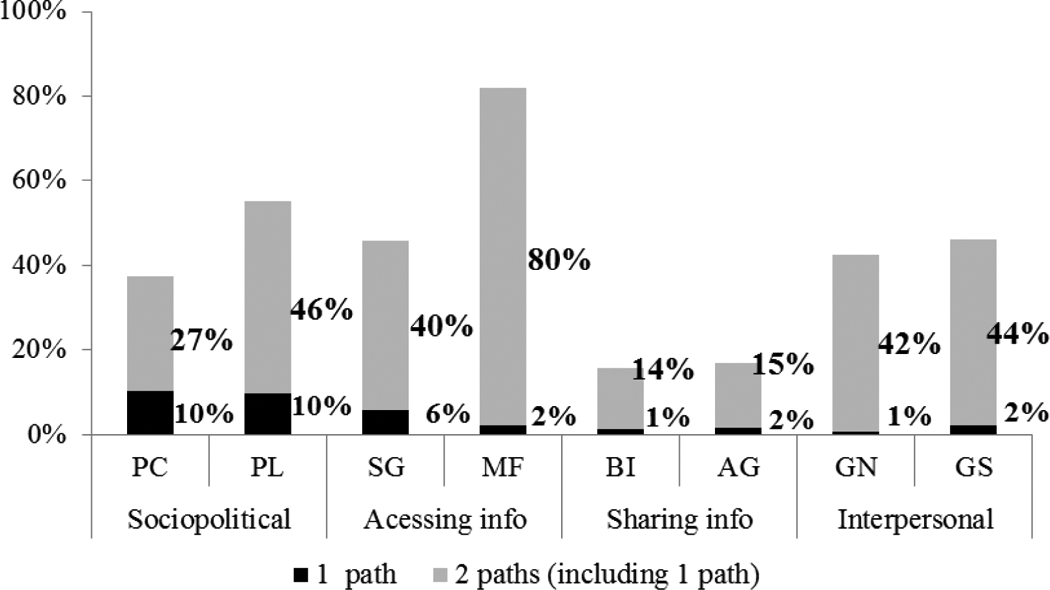
Share of geodesic distance.
Meso level of analysis reveals that different joining interests tend to be associated with different member relationships. Members who had sociopolitical interests were connected to several key members, rather than relying heavily on one or two members. Additionally, compared to other communities, members of these communities more were directly connected to each other, which allowed them communicate more efficiently. Members with the goal of information access showed great dependence on a single member who not only accounted for a third of links but also played a mediating role in over 50% of the information flow within the community. In contrast, members who joined communities to share information had less reliance on a few core members. Rather than depending on one or two gatekeepers, several members were found to act as mediators; however, communication efficiency seemed to be lower in these communities than in others.
Content (hyperlink analysis)
Analysis revealed that 10–70% of tweets in each community contained hyperlinks (see Figure 8). Messages generated by communities with interpersonal goals had a much lower share of hyperlinks than others did. Sites for sharing pictures and video clips were among the most frequently hyperlinked sites in the analyzed communities, irrespective of community goal (see Figure 9). In this respect, communities with interpersonal goals tended to post more hyperlinks to such sites than the other communities.
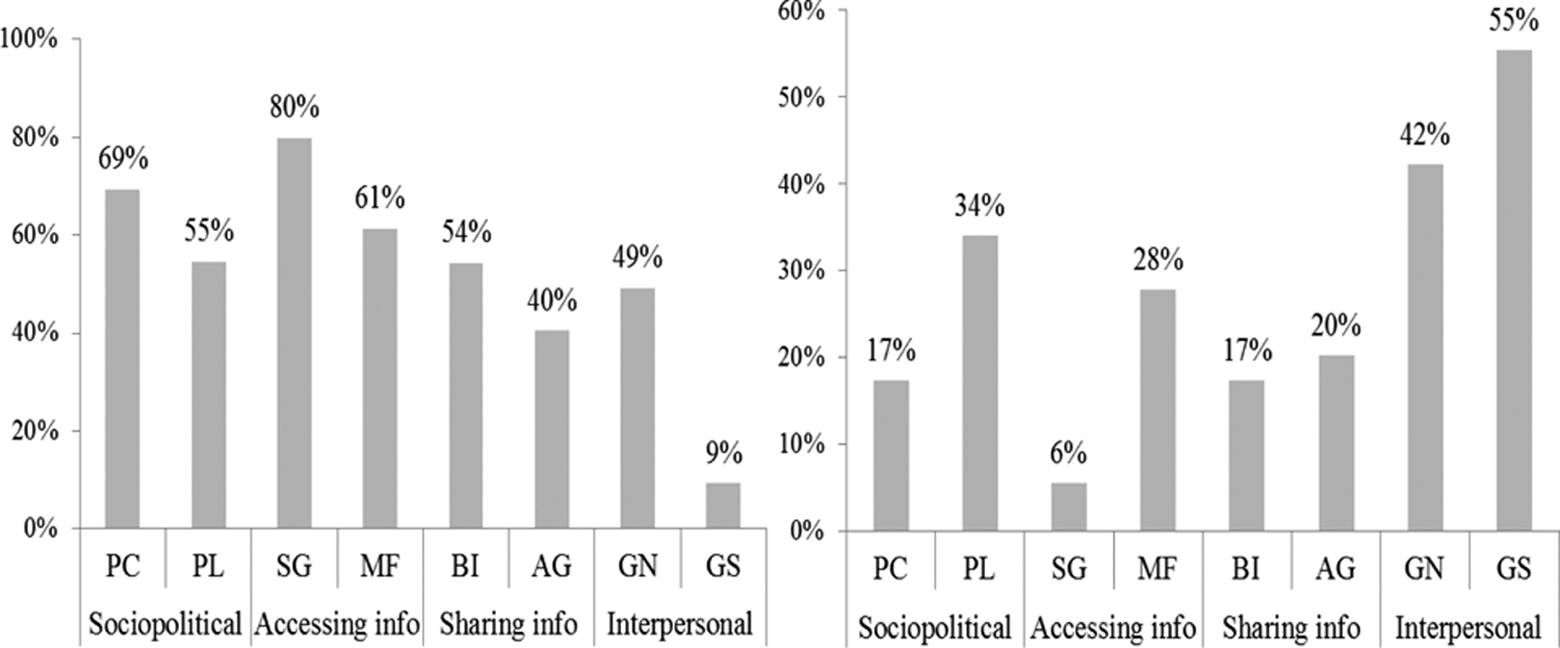
Analysis of a random selection of 20 picture and video sharing websites hyperlinked by each community revealed that communities with sociopolitical goals tended to upload pictures of street protests and political slogans. In comparison, most pictures shared by information access communities were graphics of stock indices. Communities for sharing information uploaded pictures of new technological products and applications, some of which explained how to use the product. Communities for interpersonal goals, meanwhile, tended to post maps noting locations of offline gatherings, as well as members’ photographs of food and scenery. Additionally, daily life pictures, humorous images, and political parodies were found throughout all communities.
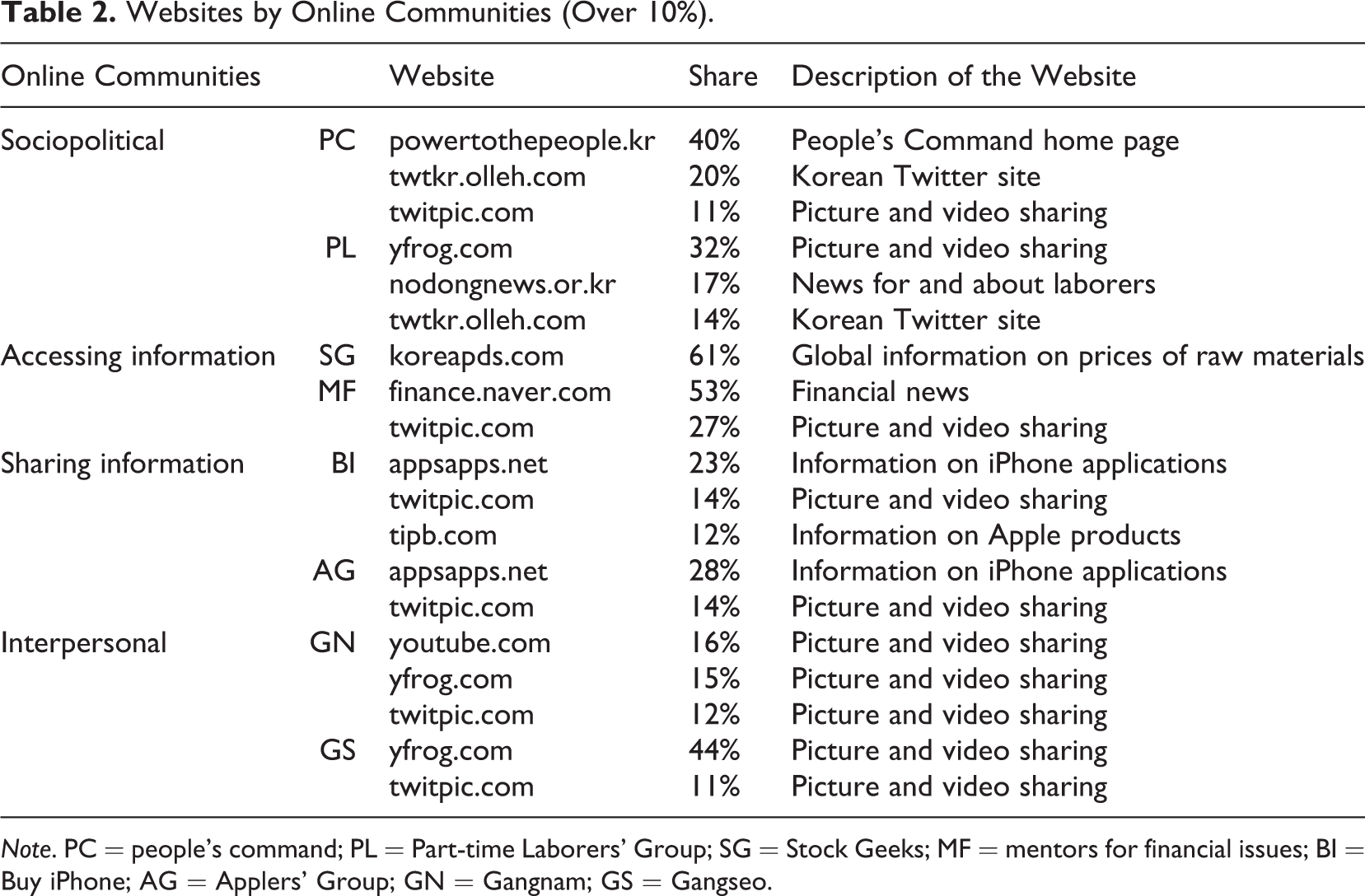
Next, websites with more than a 10% share of all hyperlinked sites were closely examined by community (Table 2). Analysis revealed that communities with sociopolitical goals tended to most frequently refer to the community’s home page and news articles about and for laborers. Communities for accessing information most frequently hyperlinked to financial information sites, while communities for sharing information tended to link to sites about Apple products and software. As previously noted (Figure 9), communities devoted to interpersonal goals rarely referred to informational websites and mostly linked to picture and video sharing sites. These communities also frequently linked to websites like foursquare.com, which shows users’ current location (as registered on their smartphones).
Websites by Online Communities (Over 10%).
Note. PC = people’s command; PL = Part-time Laborers’ Group; SG = Stock Geeks; MF = mentors for financial issues; BI = Buy iPhone; AG = Applers’ Group; GN = Gangnam; GS = Gangseo.
Network Topology
This section explains the topology of analyzed networks based on the above analyses of overall network structure, relationships among participants, and content use.
As observed in Figure 10, communities for sociopolitical goals exhibited a network structure of linkages between several star networks. This structure accorded with the higher network density, shorter distances between members, and shared degree centrality among several key members (positioned as the centers of the star networks). These communities mostly referred to news relevant to their sociopolitical goals and uploaded pictures of their street protests. This shared reminiscence based on face-to-face contact, in turn, might have strengthened connections among members.

Network visualization.
Communities devoted to information access were composed of one large component surrounded by several clusters. These structures were associated with relatively lower centralization of the overall network. However, a single member of each community positioned at the center of the large component was found to significantly influence members considering the degree of connection and control of information flow. Websites on financial information were frequently shared.
Communities for sharing information were not tightly connected, with a substantial number of members located outside and unconnected to the large component. This network pattern corresponded to these communities’ lower density, lower inclusiveness, and longer distance between members, as compared to other communities. While no single member demonstrated as much influence as the core member in the information access communities, several members in these communities mediated and bridged information flow. In keeping with the communities’ stated purpose, most hyperlinked websites related to Apple products and applications.
The network structure of the communities devoted to interpersonal goals demonstrated many reciprocated relationships, which was in line with their higher reciprocity than other communities. In the case of the Gangseo community, one node in the middle right-hand corner exhibited ties with many other members. This actor, identified as the community organizer, demonstrated the highest flow betweenness centrality in the community. These communities hyperlinked picture and video sharing websites more than any other community, perhaps because sharing pictures taken by members when they were in a certain place or may help initiate conversations and share experiences with other members.
Limitations and Suggestions for Future Research
While this study contributes to the literature by examining the influence of individuals’ interests on network structure, it contains several limitations. First, this study assumed that community members had prior self-identified interests before joining the communities. This assumption was made based on the rationale that, because online communities examined in this study had publicly announced goals, the people who joined those communities were interested in those goals. We believe this assumption is valid, but acknowledging it may not be applicable to every user, since we were not able to directly ask each member about the reason for joining.
Second, this study focused on how different interests in joining online communities are associated with different network structures and did not examine the opposite relationship. As Giddens’ concept of “duality of structure” notes, individuals’ networking interests might affect a group’s networked structure, and in turn, the group’s networked structure might affect individuals’ future choices. Investigating the latter was beyond the scope of the present analysis; however, we can speculate from previous studies that network structure does influence individual members. We leave the simultaneous examination of both relationships for future research.
Third, this study would have been more generalizable if we were able to select more than two cases for each community type. However, considering the difficulty of implementing traditional sampling methods in online environments, we had to select only a handful of top-ranking cases for analysis. We believe that our analysis of the top two communities of each type (in terms of the number of members and tweets) may not distort the overall understanding of whether and how different interests in joining online communities is associated with differences in those communities’ networked structure.
Fourth, this study examined three types of online communities whose members had sociopolitical, informational, and interpersonal interests. These three interests were drawn from previous studies that identified these interests as common reasons for joining online communities. However, we do acknowledge that these three interests do not comprehensively account for all motivations to join online communities.
Finally, this study did not consider the manner in which the above three interests may interact. In the present analysis, if an individual entered an online community with sociopolitical goals, we assumed that the individual’s sociopolitical interest takes precedence over other interests and thus focused on the more salient interest. However, it is possible that one can join an online community not only out of interest in its explicitly stated goals but also for other implicit reasons. The question of how this mix of interests may influence network structure could be another interesting question for future research.
Conclusion
Unlike the unidirectional approach of previous studies, which assumed network structure as given and individuals’ choices as determined by that structure, this study found that different individual interests in joining online communities were associated with different community network structures. This micro- and macro linkage between individuals’ interests and groups’ structure was explained by a meso-level analysis of individual-to-individual relationships within the analyzed communities. As noted by Hanneman and Riddle (2005, p. 60), “power is a consequence of patterns of relations”; that is, one’s power causes others’ dependence. These relational patterns vary by community or society, with some showing higher concentrations of power and others having more equal and horizontal relations.
In the case of communities with sociopolitical goals, several key members had direct connections with other members, rather than relationships radiating out from a single influential member. This pattern is associated with efficient communication and organization of activism. The contrast between information access and information sharing communities also implies different community cultures. The former had more centralized control by a single, highly popular member. In these communities, network resources might be concentrated to a single member, and top-down culture might prevail over bottom-up diversity. However, communities devoted to sharing information appeared to be more open to diversity of information, as shown by the existence of several mediators. These communities’ lower inclusiveness and lower network density may indicate the lack of tight social norms. Meanwhile, communities for interpersonal goals, having more reciprocal relationships than other communities, tend to have a more egalitarian culture based on mutual respect than communities devoted to sociopolitical goals and information access. As such, the overwhelming majority of interpersonal communities’ shared hyperlinks referred to video and picture sharing websites. Referring back to Giddens (1984), the process of structuration involves network structure affecting human agency and human agency affecting network structure, the latter of which was explored in the present study. Based on the social relationships of human agents, communities composed of individuals with different interests seem to exhibit different distributions of power or resources.
This study examined eight online communities (two online communities for each joining interests), which limits the generalizability of the research results. We attempted to mitigate this limitation by comparing communities across interests and identifying structural similarities that aligned with similar interests. Future research could empirically investigate this premise by analyzing a larger number of online communities. Additionally, a survey or an interview of online community members, paired with network analysis, might improve understanding of the present findings about individuals’ networking interests and groups’ networked structures.
Footnotes
Acknowledgments
The authors acknowledge the use of software tools for data analyses developed by the WCU Webometrics Institute. Additionally, the authors are grateful to Ji-Young Park for her assistance in organizing data and preparing this article.
Declaration of Conflicting Interests
The authors declared no potential conflicts of interest with respect to the research, authorship, and/or publication of this article.
Funding
The authors disclosed receipt of the following financial support for the research, authorship, and/or publication of this article: This research was supported by the World Class University program of the National Research Foundation of Korea, funded by the Ministry of Education, Science and Technology (No. 515-82-06574).