



Abstract
Smart cities (SCs) are a recent but emerging phenomenon, aiming at using high technology and especially information and communications technology (ICT) to implement better living conditions in large metropolises, to involve citizens in city government, and to support sustainable economic development and city attractiveness. The final goal is to improve the quality of city life for all stakeholders. Until now, SCs have been developing as bottom-up projects, bringing together smart initiatives driven by public bodies, enterprises, citizens, and not-for-profit organizations. However, to build a long-term smart strategy capable of producing better returns from investments and deciding priorities regarding each city, a comprehensive SC governance framework is needed. The aim of this paper is to collect empirical evidences regarding government structures implemented in SCs and to outline a framework for the roles of local governments, nongovernmental agencies, and administrative officials. The survey shows that no consolidated standards or best practices for governing SCs are implemented in the examined cities; however, each city applies its own governance framework. Moreover, the study reveals some interesting experiences that may be useful for involving citizens and civil society in SC governance.
Introduction
Even though smart cities (SCs) represent an increasingly varied research topic, they are, until now, an immature practice. Recently, several cities around the world have begun calling themselves “smart” cities (Hollands, 2008), starting to implement various smart initiatives involving one or more aspects of urban life. This trend has been producing a bottom-up smart wave, driven particularly by private initiatives and public initiatives focused on different topics but often lacking an integrated strategic urban plan for a comprehensive SC program (McKinsey, 2013).
However, an SC vision requires a well-conceived governance framework, capable of both integrating all of the political, social, and economic aspects of a city and managing the investments required to produce the best returns in terms of public value and benefits. It is, therefore, crucial to govern the effective implementation of SC programs, grounding political and administrative activities on a well-conceived governance system. The lack of governance instruments for SCs could represent the most serious barrier to their successful implementation (European Parliament, 2014); thus, several local public bodies have begun to organize themselves to formulate policies to develop SCs in the most effective way.
The aim of this paper is to investigate the role of local governments, nongovernmental agencies, and administrative officials in governing SCs. It aims to trace the map of involvement of political elements (e.g., city council, city government, and city mayor) in governing SCs. Its final goal is to understand whether the empirical implementations of SCs reflect the theoretical frameworks, which require strong institutional and political bodies as critical factors for SC success (Chourabi et al., 2012; Nam & Pardo, 2011).
This article is based on both a deep literature analysis and a large empirical survey of all 117 Italian cities with province seats. The study has been designed to investigate the involvement of political and nonpolitical actors in SC governance and to answer to the following research questions: How many municipalities are formally committed to SC governance? Who is engaged in formulating SC policies? Which governmental actors and social agents are involved in SC governance? Have nongovernment agencies been assigned to govern the SC implementation? Do best practices exist?
Italy is recognized as the European country with the highest number and the highest percentage of cities implementing at least one smart initiative (European Parliament, 2014). It is, therefore, a good empirical case. Findings permit us to trace a real map of SC government and governance in Italian cities as well as to argue interesting conclusions and implications for future research studies and extensions to other countries. The added value of this study derives from its innovative focus on primary aspects regarding government support and policies for SC governance, which have been claimed by several authors to be fundamental to the design and implementation of SC initiatives but which have never empirically investigated until now.
Government and Governance in a Smart City
In 2050, 66% of world population will live in cities. The increase in city dimensions will be greater in Asia and Africa than in Europe and America (United Nations, 2014).
In most industrialized countries, cities are old and complex, largely due to their historical roots. This situation causes several problems related to security, resilience, traffic, pollution, energy needs, and mobility (Caragliu, Del Bo, & Nijcamp, 2011). For all these cities, becoming smarter is an important challenge as well as an instrument to reduce their environmental footprint and grant their citizens greater quality of life (Boston Consulting Group, 2014).
Similarly, in emerging countries, urbanization is rapidly affecting existing cities but also generating the foundation of new cities conceived to host large numbers of people (United Nations, 2014). In China, for example, city populations are increasing very rapidly, but the country can afford to have strong local and central governments capable of making quick decisions about urban planning (Hao, Lei, Yan, & ChunLi, 2012).
In all of these cases, the smart strategy could be considered the right choice, both for implementing better infrastructure and services in old cities and for creating smart “greenfield cities” which include good information and communications technology (ICT) infrastructure to support e-services and e-government (Hodgkinson, 2011; Komninos, Schaffers, & Pallot, 2011).
The literature review suggests that, even though the SC concept is not particularly recent (the first paper dates back 20 years), the topic did not become a primary research theme until 2009 (Dameri & Cocchia, 2013). Before then, the digital city theme was more recurrent, and other city labels were used to refer to innovation in urban strategies, including knowledge city, wired city, learning city, green city, and so on (Komninos, 2008; Nam & Pardo, 2011; Shmelev & Shmeleva, 2009).
SC appears to join all these aspects in a unique, comprehensive vision. Even if such a shared vision of an SC is still lacking, we can say that an SC is a complex, long-term vision of a better urban area aimed at reducing the city’s environmental footprint and creating a better quality of life for citizens (Dameri, 2012; Hall, 2000). Over the last 5 years, SC scientific papers have been increasing exponentially. At present, we can explore a wide body of SC literature in several fields, such as engineering, information technology, environmental science, geography, and regional studies.
Fewer papers are available in relation to SC government and governance, though several papers on SCs claim that the further success and development of SCs require well-conceived and effective governance frameworks (Chourabi et al., 2012; Giffinger et al., 2007; Nam & Pardo, 2011).
An SC is a territorial system and community, and it requires government (i.e., formal institutions) in order to govern its implementation and functions (Stoker, 1998). The term “government” encompasses both the political tasks and the political bodies charged with these tasks, and it refers to formal and institutional processes. Each city has its own political and administrative subjects (e.g., mayor, College of Aldermen, city council, etc.), which have various competencies, powers, and authorities to address and drive SC strategy. These bodies also manage technical and economic management in the urban context.
However, an SC is not only a technical and economic subject but also a social system, in which several independent stakeholders compete with one another to reach their own goals (Chourabi et al., 2012). Therefore, an SC’s government should include, not only formal institutions, but also other stakeholders. For this reason, a governance framework is essential.
Governance refers to the relationships among individuals, interest groups, institutions, and service providers in the ongoing business of government (Odendaal, 2003; Rhodes, 1996). Civil society is a key player in government processes. The exercise of governance requires not only subjects and actors but also mechanisms, instruments, and processes. Governance includes both formal political instruments, such as laws, rules, municipal ordinances, and territorial policies, and noninstitutional mechanisms, such as public–private partnerships, subsidiaries, negotiations, citizen participation, the role of the so-called “civil society,” and many of the ways in which subjects other than institutional bodies cooperate to lead a community (Crouch, Le Gales, Trigilia, & Voelzkow, 2004). Governance requires a network of actors involved in community leadership (Kooiman, 2003), as well as the use of practices emerging from the empirical implementation of governance (Grote, 2008), “in which boundaries between and within public and private sectors have become blurred” (Stoker, 1998, p. 17).
The study of SC governance is pivotal to understanding how to face and support the complex government needs of an SC as well as the change processes required to manage a changing vision of a city. Indeed, in SC, there is a shift in responsibility, a stepping back of the municipality, and an increased involvement by different stakeholders. All of these coordinate with a well-structured governance framework; otherwise, a lack of control is the direct consequence (Pierre, 1999; Rosenau & Czempiel, 1992; Treib, Bähr, & Falkner, 2007).
However, very few papers exist on this specific topic, especially with regard to the role of political actors in governing SCs (Himmelreich, 2013; Kehoe et al., 2011; Scholl, Jurisch, Krcmar, & Scholl, 2014). Whereas the scientific literature on city governance is very wide, SC governance is discussed only within papers regarding the comprehensive planning and implementation of SCs (Chourabi et al., 2012; Giffinger et al., 2007; Nam & Pardo, 2011).
For example, Giffinger et al. (2007) define six fundamental dimensions of an SC, employing the concept of smart governance as the exercise of good political governance in the city. Their definition implies citizens’ participation, high-quality public services, transparent governance, and clear and effective political strategies and perspectives.
However, smart governance does not define the government of an SC. Rather, smart governance refers to a style of governing. In contrast, SC government and governance involve the transition from city to SC, which should be driven by both institutional and noninstitutional actors. Nam and Pardo (2011) explicitly include institutional factors in their SC model. They also address the relevant political powers and outline the crucial role of political institutions in implementing smart initiatives.
To better analyze all findings concerning SC government and governance collected from our SC literature review, we classified all of the topics as summarized in Table 1, reporting the most important authors who have addressed each topic. We identify five SC governance labels: government; leadership; actors and stakeholders; urban governance and participatory governance; and participation, collaboration, and partnership.
Governance Labels and Typical Issues in SC-Related Literature.
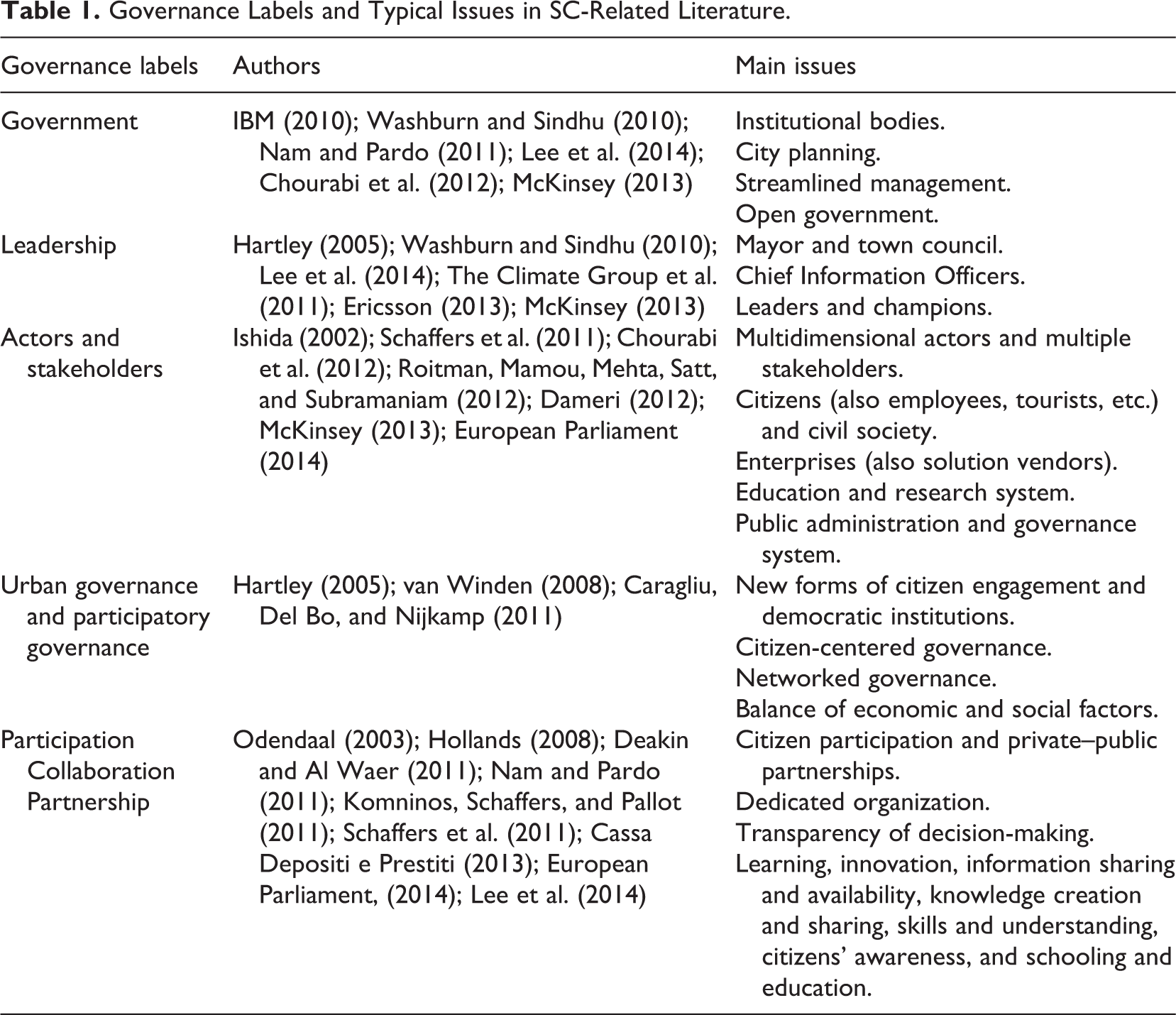
Under the government label, local government bodies are the core components of SC government (Chourabi et al., 2012; Lee, Hancock, & Hu, 2014; McKinsey, 2013; Nam & Pardo, 2011). They have the powers, competencies, and resources to carry on the SC vision, but they are bounded by rules and limited by a lack of long-term political continuity. The role of the mayor is sometimes individuated as the “winning trigger” to drive optimal SC implementation (Washburn & Sindhu, 2010), but there is no empirical evidence to support this assertion. Some authors consider open government (or smart government), which involves making operations and services truly citizen centric, to be the crucial method for implementing a good SC government system (IBM, 2010; Washburn & Sindhu, 2010).
The leadership of institutional bodies (e.g., mayor and city council) is another crucial weapon for implementing effective SC projects and involving civil servants (Hartley, 2005; Ericsson, 2013; The Climate Group et al., 2011; Washburn & Sindhu, 2010). A city needs a champion or a leader capable of driving the path to innovation, and the mayor is considered the best actor for playing this role (Mooij, 2003; Lam, 2005). However, in an SC, the roles of these actors should be completely renewed. Top-down political leadership is no longer required; instead, the city will need political coordination capable of transforming shared innovative visions in concrete initiatives (Lee et al., 2014). Moreover, Chourabi et al. (2012) consider institutional readiness, incorporating both the subjective roles of political and nonpolitical agencies and the operational roles of processes, rules, policies, and best practices, to be a key success factor for SC.
SC strategy involves additional actors with respect to political bodies. The literature classifies these into three main categories as follows (Chourabi et al., 2012; Dameri, 2012; European Parliament, 2014; Ishida, 2002; McKinsey, 2013; Schaffers et al., 2011; Roitman, Mamou, Mehta, Satt, & Subramaniam, 2012):
citizens, civil society, people, and communities; firms, included those offering specific solutions for SC implementation; and public and private organizations supplying public services (e.g., health, education, etc.).
All of these are no longer passive subjects; instead, they are active players in defining the smart innovations of their cities.
Urban governance and participatory governance are the instruments used to involve citizens and stakeholders in the participated governance of an SC transition. However, this topic is too wide for the present paper and requires future proper study. Citizens’ participation and private–public partnerships are fundamental to formulating an innovative SC strategy (Caragliu et al., 2011; Hartley, 2005; van Winden, 2008). We can find several ways to deepen citizens’ participation through the use of ICT instruments, such as Web 2.0, cloud services, social networks, living labs, user-driven innovation, user-centered design, user cocreation perspectives, and user-created content (Cassa Depositi e Prestiti, 2013; Deakin & Al Waer, 2011; Komninos et al., 2011; Odendaal, 2003).
In an SC, participation, collaboration, and partnership can be empowered through ICT, which can facilitate democratic and inclusive governance as well as through dedicated nongovernment organizations, such as associations, foundations, and similar groups (Lee et al., 2014; Odendaal, 2003), composed of citizens, firms, research bodies, universities, and not-for-profit organizations.
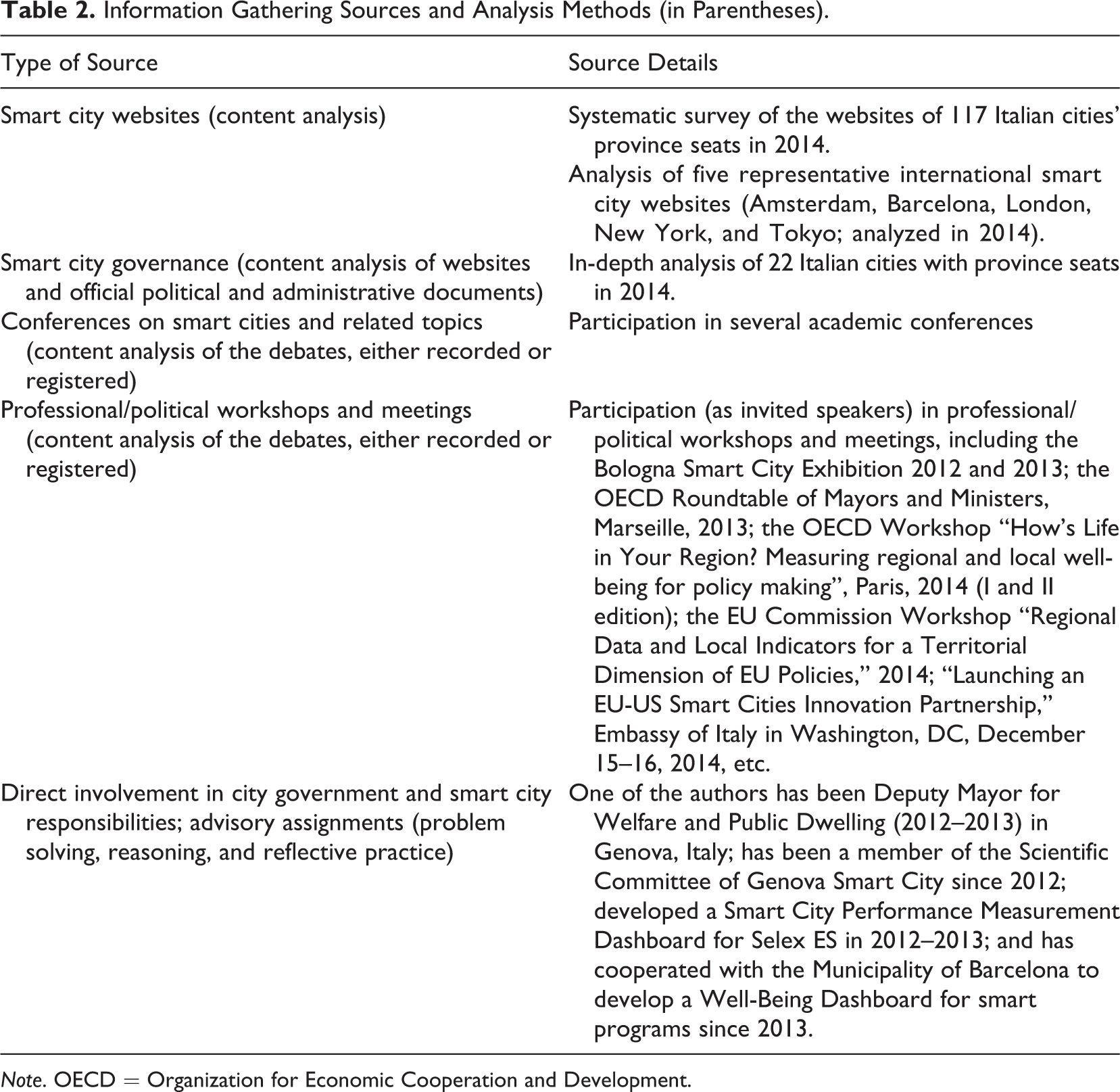
These government and governance bodies and instruments yet to be empirically investigated, particularly because SCs are still work-in-progress programs, with fuzzy or totally absent governance frameworks. Our work aims to empirically investigate government and leadership, with a focus on the first two rows of Table 2. Further works will explore the other governance categories.
Information Gathering Sources and Analysis Methods (in Parentheses).
Note. OECD = Organization for Economic Cooperation and Development.
Method
Our work aims to explore the existing SCs to investigate the role and involvement of institutional government actors in SC governance. We focus particularly on addressing the formal appointment of aldermen and city officials as leaders of SC management or political tasks as well the direct involvement of the city mayor as a champion or leader of SC strategy. Finally, we investigate the eventual settlement of dedicated organizations, which are conceived as public–private partnerships to govern SC transformation and involve citizens’ participation in the process. The methodology of our research is both theoretical and empirical; the empirical knowledge sources have been summarized in Table 2.
The theoretical research is based on an international literature survey. Academic literature, institutional, and corporate reports have been examined to understand the concepts of smart governance, SC government and governance, as well as the claimed pivotal role of local government and effective governance mechanisms in SC implementation (see the previous section). What emerges is a lack of a sound theory of SC government and governance, of best practices regarding coordination and control mechanisms, and of any deep empirical analysis and observation of SC governance in practice.
The empirical aspect of our research comprises two streams of work. The former concerns concrete involvement in several SC programs driven by Italian and European cities and research institutions. Being an alderwoman in a large Italian city (from May 2012 to November 2012) and serving as a personal advisor to the mayor on SC (from October 2013 till now) is one of our atout. It permits us to belong to the steering committee and to witness the difficulties and paths followed by the city in implementing its own smart strategy and vision; it is also a better approach to understand how political, technical, and research dynamics work together—both in accordance and in conflict—in SC implementation. Moreover, our involvement in other European SC programs and our participation in professional and political workshops and meetings support our direct experience with this topic. This direct, personal involvement in SC governance is the distinctive knowledge source of this research. Indeed, several aspects of political choices regarding SC are not written; instead, they emerge only from formal and, especially, informal meetings and workshops.
The latter empirical stream takes the form of a large survey on the concrete presence of SC governance frameworks in large and medium Italian cities. This empirical study was conducted in the summer of 2014, and it provides us with a large base of knowledge on how a city is—or is not—self-organizing to govern its smart strategy. SC websites are the basis of our quantitative empirical survey on the formal appointment of political and administrative officials in SC governance and management. These websites are also useful for investigating the presence or absence of SC governing mechanisms, such as strategic plans, municipal ordinances, and performance measurements.
The empirical survey includes all 117 Italian cities with province seats, which have populations ranging from tens of thousands to nearly 3 million inhabitants. This set permits the analysis of a well-defined and complete population of cities, selected through a formal requirement, that is, their political role in the country. Including all cities (i.e., the whole population, instead of a sample) would prevent the deduction of conclusions not supported by evidence.
This research was conducted through a content analysis of city official websites, including:
the websites of municipalities (i.e., the political bodies in charge of the government of the cities) and the websites of public–private bodies that are sometimes in charge of SC governance led by the municipality itself (when one exists).
This choice is motivated by the affordability of official websites of public administration, which are governed in Italy by a specific Act (Law 14.03.2013 no. 33). This permits us to trust the information contained in these webpages.
Content analysis incorporates texts of various types, including writing, images, recordings, and cultural artifacts. In our case, we engaged in content research by applying key words to the official websites of the 117 cities between September and October 2014, using the sequences: “smart city,” “smart cities,” “smart+city,” “smart+cities,” “smart AND city,” and “smart AND cities” (Hodder, 1994; Krippendorff & Bock, 2009). Then, we examined all of the webpages of municipal websites, including the searched key words, and extracted all of the information regarding the subjects, structures, processes, and other organizations charged to govern smart projects, initiatives, and political or technical tasks. To organize this content, we used Atlas.ti to locate, code, and annotate data in our data materials as well as to discover topics and relationships within the data (Hwang, 2008).
In particular, we mapped which organizational bodies were in charge of the political and operational government of SC strategy in each city. We referred especially to the administrative and political powers assigned by rules to each body and classifies the bodies with respect to their roles, their nature, and their relationships with both the municipality and its citizens.
Italian SCs Governance Models
Our research concerns the collection, analysis, and classification of political, administrative, and nongovernmental actors in charge of the governance of SCs. Of the 117 cities in Italy with province seats, 106 implemented at least one smart project (European Parliament, 2014). Therefore, the survey regards only this subset.
In accordance with the results of the literature survey shown in Paragraph 2, we investigate two groups of governance subjects:
government actors and roles and nongovernment actors, especially organizations dedicated to SC governance.
Group A is composed of political, administrative, and operational roles inside the municipality. These actors therefore play the public role of territorial government.
Group B is composed of private structures that differ from public bodies. These generally include the municipality as a leading role but also involve private bodies, such as enterprises, citizens, or their representatives, not-for-profit organizations and, more generally, the so-called civil society.
With regard to the government role and structure, only 22 (i.e., 20.75%) of 106 cities have at least one formal structure or role charged with the political or operational government of SC. These structures and roles can be classified into two groups, as follows:
political roles in the municipality (e.g., mayor, deputy mayor, aldermen, city counsellors) and administrative roles (e.g., public managers, public officials).
Upon deeper analysis of the political roles, it emerges that 15 (68%) of 22 cities have a formal involvement of the college of aldermen. This means that the political relevance of smart strategies is recognized by the majority of municipalities. More differentiated is the type of alderman involved: It is not possible to individuate a unique relationship between the SC and a certain city scope. For example, aldermen may be in charge of the environment, innovation, economic development, mobility, and so on. This confirms the SC is a multidisciplinary topic but also that each city can implement and adapt the concept of SC in a city-specific way, designing its own strategies, which may differ from those of other cities.
However, rarely did we find a municipal department especially devoted to SC (only 2 cases out of 22), and only in 1 case did we find the mayor to be directly involved in the SC government, with the role of coordinating and involving all of the aldermen in the SC strategy; in 2 cases, the deputy mayor was in charge of this role.
Since an SC represents a comprehensive vision of the quality of urban life, allocating responsibility for a smart strategy to an alderman means preventing the shared commitment of all the municipal government. In the examined cases, when a task regarding an SC was allocated to a specific alderman, institutional coordination appeared to be lacking. However, the mayor was found to be directly involved in SC governance, particularly as the leader of a private body specially designated to govern the SC planning through a public–private partnership. This is the case, for example, in Genova. With regard to administrative roles, in 14 cities, we found that some public managers or officials were formally charged with SC programs. These subjects supported political tasks with executive or managerial tasks, especially regarding the project management of certain smart initiatives or a subset of the initiative portfolio. With regard to the administrative roles, we could not find a single topic connected with the SC concept; however, there was a heterogeneous set of roles depending on the specific vision of smartness that a city attempted to implement. The official or public manager was linked with the alderman who had responsibility for the SC program, if present. For example:
in Barletta, SC management is assigned to the manager of territorial development, in Genova, SC management is assigned to the manager for European projects and strategic planning, in La Spezia, SC management is assigned to the manager for innovation, in L’Aquila, SC management is assigned to the manager for environment, and so on.
We found a manager for the SC in only three cities. However, more cities had smaller offices charged with SC planning, which depended on a larger department (e.g., the city innovation department, the European projects department, and so on). This evidence shows that cities are still organizing their structures to face this new topic; some have top managers working for SC programs, but the majority are facing the theme with a small group of officials who also work toward other aims. Since SC programs have often been funded by the European Union (EU) Commission, it is frequent to find officials working for both European projects and SC programs.
We also consider dedicated nongovernment organizations, in which the municipality participates with a more or less leading role (Group B). Since our aim is to analyze those structures settled or used to govern the SC in a comprehensive way, instead of only one smart initiative or project, our analysis excludes informal agreements or plans designed to coordinate more actors in realizing smart projects or initiatives. The legal subject is an association or foundation characterized by the direct involvement of several stakeholders. Only in some cases is the municipal government (i.e., the political body) involved. The external private body (even when led by the municipality) and, especially, the association emerge interesting solutions to govern SC. Indeed, the role of an external governance body, as illustrated by our investigation, has several aims:
to extend the goals of the SC strategy beyond the municipal boundaries to the city, which is conceived as a territory and as a social and economic ecosystem, to involve citizens and firms in concrete participation in the SC program as well as in the improved sharing of goals and actions, to improve the long-term sustainability of an SC strategy by involving both private funding and large and heterogeneous competences to support the multidisciplinary evolution of a smart strategy, and to create a private body capable of receiving funding and sponsorships and of doing business with the SC brand.
In the few cases in which an association is already settled and functioning, it is conceived as a flexible body, involving a large number of partners of different natures. It permits the creation of a multidisciplinary organization, in which many actors can contribute with specific and different competences. Moreover, an association is open to new members, and it is easy to enlarge the association as the smart program expands.
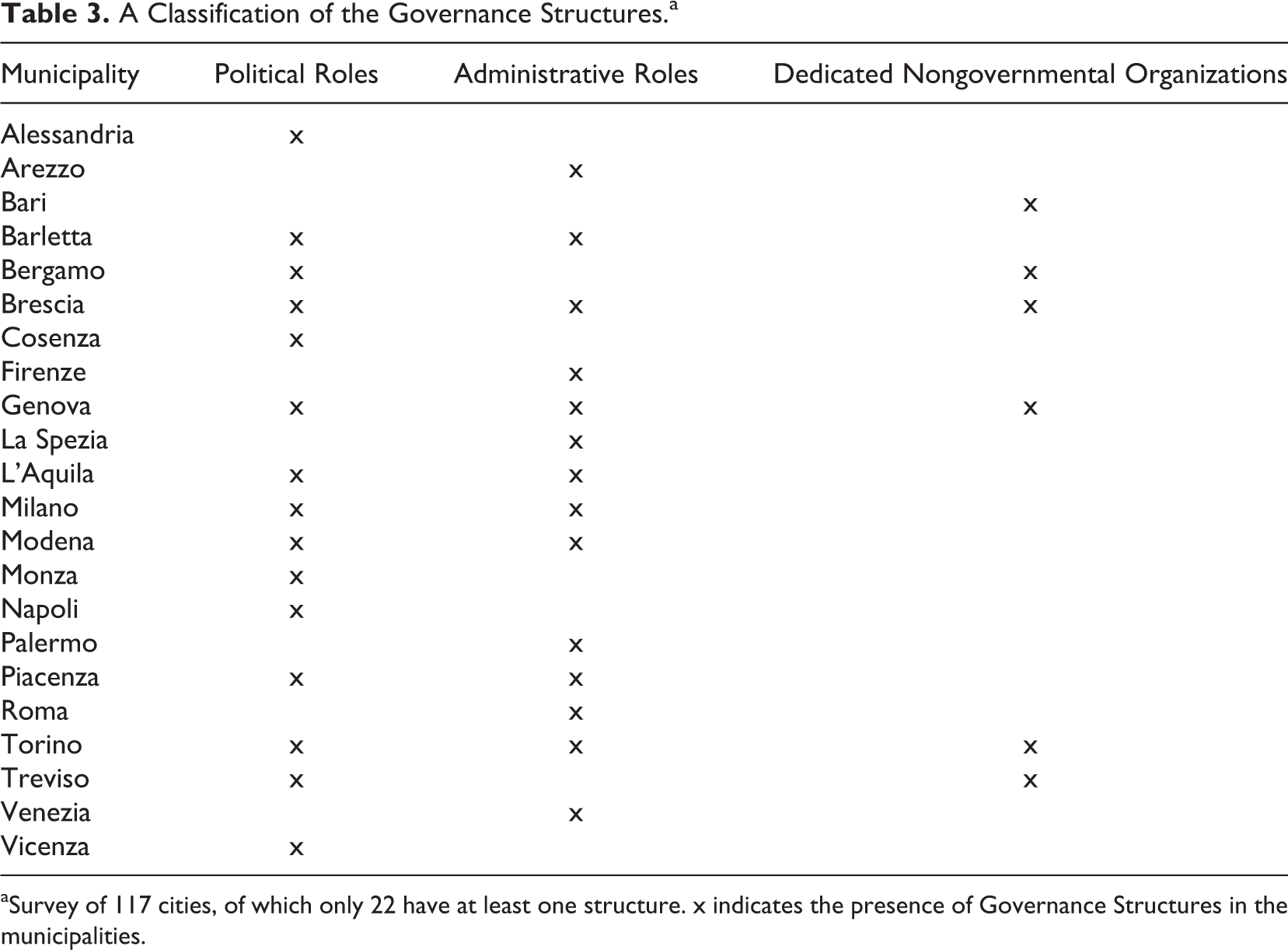
Table 3 resumes the survey, classifying the structures involved in the perimeter of our empirical survey, as previously defined in:
political roles, administrative roles, and dedicated nongovernment organizations.
A Classification of the Governance Structures.a
aSurvey of 117 cities, of which only 22 have at least one structure. x indicates the presence of Governance Structures in the municipalities.
Table 3 illustrates that few cities have structured governance systems based on a multilevel governance plan. Only seven cities have two of the three types of structures, and only three (Brescia, Genova, and Torino) have all of the structure types (i.e., political, administrative, and external). The presence of political and administrative structures means that a city has both a political, long-term vision for its SC strategy and a practical, operational activity aimed at implementing concrete smart initiatives. Cities with both political and administrative structures, as well as dedicated organizations realizing the public–private partnership, are likely to be in a more mature phase of the SC life cycle. In this case, the city no longer assumes the role of a simple service supplier; instead, it takes on the role of a proactive actor sustaining participated and shared innovation (Nam & Pardo, 2011). The presence of an association or foundation (as in Genova or Torino) emphasizes the less evident presence of a dense network of actors, stakeholders, civil servants, and research institutions working together toward a shared aim.
The leading role of the SC association as an effective governance body emerges in two international best practices: Genova and Amsterdam. Genova is the first Italian city to have implemented a comprehensive smart strategy, which it did in 2009. From the beginning, an association was settled: the Genova Smart City Association (GSCA). This private body is chaired by the Mayor of Genova and involves, at present, more than 40 members, including public bodies, research bodies, large companies, small- and medium-sized enterprises (SMEs), trade associations, and not-for-profit organizations. The aim of the association is to implement the Genova SC, and the association involves all of the stakeholders in defining future plans and considering the benefits expected from all of them, which are represented as goals to be reached. All of these projects compose the initiative portfolio. The GSCA is the leading team joining public interests, research activities (e.g., to sustain the innovative aims of an SC), the business aims of private companies, and the societal outcomes expected by civil society. The GSCA is an open association, which means that—respecting the association charter—each subject can become a member, even if citizens’ participation is granted by relatively few representative bodies.
In Amsterdam, which is generally considered the leading European SC, the Amsterdam Smart City Association (ASCA) was settled from the beginning of the smart program. In Amsterdam, the association is a closed body (i.e., no further members are admitted), and all stakeholders are represented: the municipality, the university, some large private companies, and representatives of the civil society. The ASCA aims to involve all SC actors in defining and implementing its aims, since it considers participation the most important success factor of the SC in the long term (Dameri, 2014).
Amsterdam and Genova demonstrate that the smartness of a city could become its leitmotiv, driving all long-term programs and merging economic development, environmental sustainability, and social inclusion in a paramount goal capable of really creating well-being and improving the quality of life in the city for everybody. In this way, SC best governance could become a veritable driver of social and economic value creation.
These two cases—one Italian and one Dutch—are interesting also for studying the quality of interactions between different SC concepts. A deep case study must be conducted in a further work to further explore this topic.
Empirical Findings
The survey conducted on 106 Italian cities that have each implemented at least one smart project (hereafter Italian SCs, or ISCs) allows to us to reach the following empirical findings.
Local government involvement. Only 20.75% of the cities examined included the formal involvement of political roles, such as the mayor, the local government, and the aldermen. This reveals that SCs still represent an immature topic and that political actors are still trying to integrate this urban strategy into their plans and activities. This finding confirms that SCs are part of a bottom-up wave, which starts in academia and with technology vendors, rather than a top-down movement, which starts with central and local governments. Indeed, few national governments have thus far issued laws or regulations regarding a national policy for SCs. The Italian government, for example, is more focused on various aspects of the smart city, such as the urban digital agenda; however, a national, comprehensive policy for Italian SC does not yet exist. Further support for this empirical evidence emerges from the survey of all urban strategic plans issued by the Italian province seats (Fontana, 2014)—that is, the same population of cities examined in our work. No strategic plan explicitly includes SCs among the strategies for urban planning and development pursued in an administrative cycle. However, political involvement is important for at least three reasons. The first is that, especially in the EU, SC initiatives are strongly supported and primarily founded by the EU Commission; therefore, municipalities aiming to implement smart projects should have a political address and the commitment to fight for and win EU funds. The second reason is that a bottom-up wave might drive urban policies toward the specific interests of one or a few solution vendors, instead of the main needs of a city. Third, an SC needs to harmonize numerous different dimensions into a unique, long-term political and strategic vision. Giffinger et al. (2007), Nam and Pardo (2011), Chourabi et al. (2012) and other frequently cited authors, as explained in Paragraph 2, describe an SC as a multitopic strategy, including ICT, energy, transport, environmental preservation, e-government, e-democracy, and so on. Not all of these topics pertain to the municipal political level, for example, some pertain to regions or to central governments. The formal, political involvement of the municipal government is crucial to permit multilevel governance actions to support a comprehensive SC strategy (Organization for Economic Cooperation and Development, 2013). Mayor involvement. It emerges that only three mayors among the 22 ISCs were personally charged with SC policies. If we consider deputy mayors, the number is reduced to five. According to Chourabi et al. (2012), Nam and Pardo (2011), Lee et al. (2014), and Mooji (2003), one of the critical success factors of SC is the role of a champion—a leader capable of not only concentrating all the heterogeneous aspects and programs under one integrated strategy but also motivating and leading all the other actors and stakeholders toward a shared vision of the city. SC strategies are, indeed, innovative, explorative, long-term strategies, and they require a strong focus on shared goals to increase the probability of success and positive synergies. The scarce political involvement of mayors in SC strategic planning is also confirmed by an examination of the electoral programs of three mayors of ISCs (in Genova, Torino, and Milano), which was conducted in a national survey (Between, 2014). No mayor explicitly included an SC in his electoral program. Aldermen involvement. The political actors involved in SCs were primarily aldermen. A total of 12 aldermen in ISCs were charged with smart policies. Through an examination of the websites of these cities, it emerged that their functions are diverse, since these aldermen address the environment, transport, culture, innovation, economic development, and others. This means that there is not a primary approach to SC implementation that is common to all or many cities. Moreover, aldermen’s powers are limited to specific topics and do not encompass the whole city. Appointing an alderman of SC policies means choosing—knowingly or not—a specific domain as the most important to be transformed using smart principles. It also means neglecting the multitopic character of an SC, as previously pointed out, and preventing the creation of positive synergies through the concurrent implementation of smart initiatives regarding different domains. To better understand this point, a further and deeper analysis of ISC portfolios and their relationships with the alderman function would be useful. Nongovernmental agency involvement. Several authors (e.g., Chourabi et al., 2012; Deakin & Al Waer, 2011; Roitman et al., 2012; and others; see Table 2) claim that one of the SC success factors is the involvement of such stakeholders as citizens, firms, not-for-profit organizations, and the so-called civil society in the SC governance. To accomplish this goal, nongovernment agencies could be created particularly to govern SCs and to implement processes and mechanisms not usable by public agencies, such as the local government, and linking different types of urban actors. Only three ISCs have already implemented such an agency, namely, an association. The survey, however, reveals that many ISCs declare that they are about to create such a body, especially to actively involve citizens’ organizations in SC policies and initiatives. Moreover, this instrument is not widespread, particularly because SC plans are recent and cities are still organizing their own governance systems to be applied to smart initiatives. The three SC associations settled at present have been examined, but they are very different from one another, and it is not possible to gain findings from such a small sample of experiences.
Finally, the overall findings suggest that there are not, at present, common or shared best practices for the involvement of political actors and nongovernment agencies in SC governance. This could derive from both the immaturity of this experience and the lack of a sound address issued by both the national central government and the European government.
Conclusions, Limits, and Further Works
SC is an emerging urban strategy that concerns the governance of urban areas and, therefore, is deeply interested in the political programs and visions of a city. In spite of this, few political actors are currently formally involved in SC governance, and city strategic plans contain few or no points regarding SC initiatives, such as the electoral programs of city mayors.
The survey has been useful for creating a map of the spread of political involvement in ISCs, since it includes all of the Italian province seats. The findings provide a good starting point to enlarge the research to the governance mechanisms, structures, and instruments applied to the governance of an SC plan by both political and nonpolitical actors, especially when conceived for such a specific and innovative urban strategy as SC.
Our work is characterized by the direct involvement of one author in SC government. This permitted to us to collect informal opinions and behavioral observations of mayors, aldermen, and city managers or officials. Relatedly, a limit of our work is that its findings are not yet completely formalized. A more accurate investigation of the role of each actor—and, especially, of the nongovernmental agencies—is needed. Thus far, however, SC associations are immature, changing organizations that are still looking for their own identities. In many cases, these associations have yet to be settled and are still only proposals for the future.
Further works will address overcoming these limits, since, in the meantime, cities are continuing to implement smart projects—and they will necessarily need more formal government structures supported by proper governance mechanisms.
We will especially investigate the relationship between the city vision and how this vision impacts city governance as well as whether and how the future consolidation of successful SCs could influence the choice of a specific governance framework through best practice imitation.
With regard to nongovernmental bodies, it will be particularly interesting to determine their powers and competencies in SC governance and whether their role implies opportunistic behaviors or unintended effects or not.
The authors are already working on two additional research streams. The first concerns the analysis of political involvement in SC in countries other than Italy, and the latter concerns a deep case study applied to SC associations both in Italy and in other EU countries.
Footnotes
Declaration of Conflicting Interests
The authors declared no potential conflicts of interest with respect to the research, authorship, and/or publication of this article.
Funding
The authors received no financial support for the research, authorship, and/or publication of this article.