




Abstract
There are three issues that are crucial to advancing our academic understanding of smart cities: (1) contextual conditions, (2) governance models, and (3) the assessment of public value. A brief review of recent literature and the analysis of the included papers provide support for the assumption that cities cannot simply copy good practices but must develop approaches that fit their own situation (contingency) and concord with their own organization in terms of broader strategies, human resource policies, information policies, and so on (configuration). A variety of insights into the mechanisms and building blocks of smart city practices are presented, and issues for further research are identified.
Introduction
A smart city is a utopian vision of a city that produces wealth, sustainability, and well-being by using technologies to tackle wicked problems (Greenfield, 2013). The idea of a smart city is attractive to policy makers, but empirical research is needed to advance our academic understanding of the new “marriage” between technology and urban governance (Meijer & Rodríguez Bolívar, 2015). A strong understanding of contextual conditions, governance models, and public value is needed to develop realistic smart city strategies. This special issue presents a diverse set of papers that provide state-of-the-art insights into these pressing issues of smart city research.
The focus of “smart cities” research for governments has typically been on how cities might improve urban economies, quality of life, and myriad problems by employing information and communication technologies (ICTs; Gil-Garcia, Helbig, & Ojo, 2014). The key argument is that cities must be responsive to the changing context within which they operate, especially when that context is offering significantly improved capability or efficiency (Cosgrave, Doody, & Walt, 2014). While the discourse originally focused on universal patterns, the role of context is increasingly emphasized (e.g., Meijer, 2015): What should be considered as “smart” depends on various contextual conditions such as political system, geographical situation, and technology diffusion. According to the European Parliament (2014), different patterns of actor roles and relations, policy instruments, and implementation methods have been used by European smart cities. Smart solutions cannot be simply copied but need to be assessed on their value for different contexts and translated to fit other conditions. The role of context has been highlighted, but our knowledge about the relation between context and approaches to smart cities is underdeveloped and requires a more sophisticated understanding.
Many of the challenges faced by smart cities surpass the capacities, capabilities, and reaches of their traditional institutions and their classical processes of governing, and therefore require new and innovative forms of governance (Rodríguez, 2015). These new and innovative forms of governance have been included into the term “smart governance” under which the government manages and implements policies toward the improvement in quality of life of citizens by leveraging ICTs and institutions and by actively involving and collaborating with stakeholders (Bertot, Jaeger, & Grimes, 2012; Gil-Garcia, 2012). Indeed, the current debate about smart governance is rather confusing (Meijer & Rodríguez, 2013). Many questions remain concerning issues such as government leadership, participative models of governance, and the collaborative structures needed to foster smart city development, and research is needed to provide answers to these questions about governance models for smart cities.
A third issue that requires a better understanding is the outcome of smart cities: public value. All the smart city frameworks that have been suggested in the literature acknowledge that smart cities are multidimensional systems, and even the frameworks more focused on a particular dimension do not fail to acknowledge the importance of the other dimensions as well (Gil-Garcia, Pardo, & Nam, 2015; Meijer & Rodríguez, 2013). Nonetheless, all of them seem to highlight the creation of public value as the main outcome of smart cities, directly or indirectly through business models that involve public actors (Walravens & Ballon, 2013). More research is necessary to deal with the definition and measurement of public value within the context of smart cities.
This introductory article is organized into five sections, including the foregoing introduction. Section 2 builds upon this introduction and presents three unsolved questions in smart city research. Section 3 describes the set of papers in this special issue and analyzes them in terms of answers to the questions about contextual conditions, governance models, and public value. Finally, Section 4 provides some concluding remarks about smart city research and practice and suggests areas for future research in this topic. We conclude that the papers generate confusion at a higher level, and we identify the need for more research to understand smart city governance in context.
Smart Cities: Some Unsolved Research Questions
In general terms, smart cities involve the creation of new relations between technology and society. As noted previously, an extensive array of literature has been addressed to define the smart city concept. Despite this literature, there is still not a clear and consistent understanding of the concept among practitioners and academia because different perspectives have been taken from different fields of knowledge to achieve this aim (e.g., e-government, information science, urban studies, and public administration; Söderström, Paasche, & Klauser, 2014; Tranos & Gertner, 2012). Indeed, an in-depth analysis of the literature reveals that the meaning of a smart city is multifaceted (Albino, Berardi, & Dangelico, 2015; Gil-Garcia et al., 2015; Meijer & Rodríguez, 2013).
Although the concept of smart cities remains vague, it has a great deal of potential in framing some particular challenges cities face today and provides new ways of thinking about potential future issues (Walravens & Ballon, 2013). One main challenge is to analyze the conditions that can make a city to become smart (Allwinkle & Cruickshank, 2011; Gil-Garcia et al., 2014). Although there is no one route to becoming smart, and different cities have adopted different approaches that reflect their particular circumstances, three general principles seem to guide smart city agendas. These principles have included the integration with economic development and public service delivery plans; the pragmatic focus with the bulk of investment going on projects that are practical, achievable, and financially viable; and, finally, the participation of community representatives, local businesses, and residents to ensure projects is relevant to the city’s opportunities and challenges (Centre for Cities, 2014). However, little is actually known about the more fundamental conditions underlying the smart city as a model. Therefore, a first question unsolved in the smart city literature is:
In addition, the vagueness of the concept of smart cities and the difficulty in its consistency has led some authors to propose some dimensions (Giffinger et al., 2007) as well as elements that characterize a smart city, which emerged from the analysis of the existing literature (Albino et al., 2015; Gil-Garcia et al., 2015).
According to Hollands (2013), the real smart city has to begin to think with its collective social and political brain, rather than through its “technological tools.” It puts on the forefront the question of collective action of different actors in creating the smart city (European Parliament, 2014) and the possible government leadership for good governance under this framework (Lam, 2005; Mooij, 2003).
To date, smart city modes of urban governance have clearly been shaped and steered by large and influential commercial players in the hardware, software, and infrastructure sectors, such as IBM, General Electric, Cisco Systems, Hitachi, and Siemens, among others (Frost & Sullivan, 2013; Hitachi, 2013; IBM Global Services, 2011; Siemens AG, 2011; Townsend, 2013). However, a main element of a smart city is the smart government (Gil-Garcia, 2012; Scholl & Scholl, 2014) and the role played by governments in these cities seems to be essential (Rodríguez, 2015).
In this regard, some authors indicate that smart governance is about making the right policy choices and implementing these in an effective and efficient manner but, in this perspective, this can be done within the existing administrative structures (Batty et al., 2012). Others point out that city administrators should not aim to solve all problems in the city but rather that they strengthen the capacity of urban systems to tackle a wide variety of problems (Caragliu, Del Bo, & Nijkamp, 2011). City governments become, this way, inactive participants within the ecosystem of stakeholders and play a key role in connecting organizations across the city that have common goals and complementary skills (Cosgrave et al., 2014).
On the other hand, smart city research has typically been focused on how governments might improve urban economies, quality of life, and myriad problems by employing an often technodeterministic outlook on the uses of ICTs (Sadoway & Shekhar, 2014). In this context, looking at smart cities as the places where the concentration and interconnection of “big data” in cities lies, Kitchin (2014) raises questions of technocratic governance, corporatization of city governance or vulnerability, and surveillance.
Finally, some prior research affirms the central role of citizens both in the decision-making process (in terms of codesign and codecision) and in the implementation of smart city initiatives, giving them the ultimate decision in the adoption of the city’s services and the creation and management of public value out of them (in terms of value cocreation and coevaluation; Castelnovo et al., 2015).
A systematic understanding of the nature of the governance models used in smart cities is lacking. Therefore, the second unsolved research question is:
Finally, prior research suggests that the main outcome of smart cities is the production of a wide range of public value through innovative collaborations (Meijer & Rodríguez, 2013). According to Stoker (2006), local administration becomes the main actor in the process of creating public value but not the only one (Alford & Hughes, 2008). The components of public value can be identified not only in a tangible dimension but also, and above all, from an intangible dimension (Bounfour & Edvinson, 2012; Bounfour, 2013). In general, the creation of public value means to have a vision for a better future in a variety of different forms, which has been included in several definitions of smart cities (Gil-Garcia et al., 2015).
In this regard, into the smart cities framework, some authors indicate that the creation of public value must be split into two different approaches: the financial architecture and the value proposition approaches (Walravens & Ballon, 2013). The first one (financial architecture) is related to the financial return of public actions, whereas the second approach (value proposition) examines public value from the perspective of the end user and refers to the justification a government provides in taking the initiative to deliver a specific service, rather than leaving its deployment to the market.
In any case, the core of this parameter is the question of whether or not an evaluation of the public value generated is performed (Walravens & Ballon, 2013). Since the public value has a consumer approach (Moore, 1995), it is the needs and wants of the collective citizenry that should count in this evaluation (Alford & Hughes, 2008). Therefore, it is expected that future research be focused on models for evaluating performance and the generation of public value within smart cities. Thus, the last unsolved research question is:
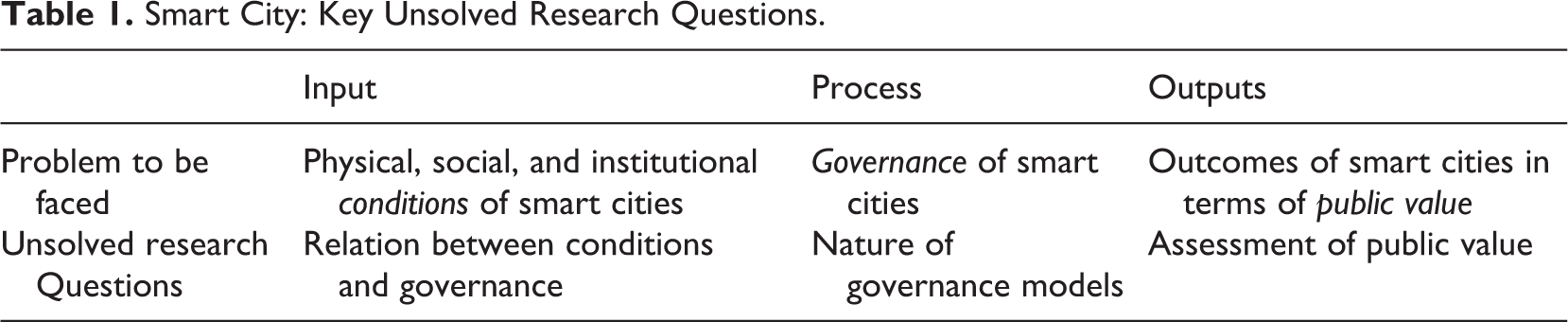
Table 1 summarizes three key unsolved research questions on smart cities. In summary, smart city initiatives are a response to the challenges that cities face when attempting to meet myriad objectives regarding socioeconomic development and quality of life (Schaffers et al., 2011). In this regard, there is an increasing need to develop new ways of looking at the city of the future and think about structured approaches to provide answers to the diverse and complex questions companies, citizens, and governments face there. Nonetheless, as mentioned before, some important research questions from the perspective of public management remain unsolved.
Smart City: Key Unsolved Research Questions.
New Insights Into Contextual Conditions, Governance Models, and Public Value
This special issue presents a set of papers that are varied both in research approach and in focus. The special issue presents a mix of theoretical, qualitative, and quantitative research. In addition, it presents empirical studies from Africa, Europe, and Asia. This collection of paper presents a rich variation in empirical and theoretical insights that help to advance our academic understanding of smart cities (see Table 2). More specifically, the papers provide some interesting answers into the three unresolved research questions previously identified.
Overview of the Papers in This Special Issue.

Contextual Conditions
The importance of context is increasingly stressed in publications on smart cities but a systematic analysis of the role of context is rare.
The paper by Caragliu and Del Bo in this special issue addresses this question and provides some highly interesting insights as to the role of context. Their first key finding is that smart city policies are more likely to be designed and implemented in cities that are already endowed with smart characteristics. Their second finding is that smart city policies are more likely to be implemented in denser and wealthier urban areas. This finding counters the idea that a smart city policy may be used by cities to make a leap forward and confirms the Matthew effect that “the rich get richer and the poor get poorer.” The context for smart city policies is much more favorable in cities that are already smart and wealthy. At the same time, the paper also generates some hope for other cities since the authors suggest that the smart city model can be viewed as a model of urban development with different cities at different points along the path. So, almost every city could be seen as having certain degree of smartness.
Governance Models
Many publications in this special issue advance our understanding of governance models for smart cities and much attention is paid to citizen participation and bottom-up innovation.
While the literature sometimes puts an emphasis on structures and policies, Chatfield and Reddick highlight the importance of a shared vision and adaptive use of informal social governance mechanisms. Based on an empirical study of the Japanese city Kitakyushu, citizen-centric e-governance, a leadership network based on resource dependence and cross-sectoral collaboration based on social embeddedness are found to be central to these informal governance mechanisms for the implementation of the smart city.
Rodríguez and Meijer conducted a literature review and a survey among smart city practitioners in Europe to develop a model and their model encompasses many similar arguments. They add, however, that a vision by itself does not suffice and actions in terms of legislation, policy, and organizational transformation are also needed. In addition, they highlight the importance of building an innovation capacity for the city.
Dameri and Benevolo conducted a survey among Italian cities and concluded that political involvement in smart city projects and policies is limited. They highlight that this involvement is important to embed smart city development in democratic institutions but, possibly for a lack of knowledge and a technocratic framing of the issue, political attention for smart city development is limited.
Van Waart, Mulder, and De Bont analyzed the Dutch city of Rotterdam and highlight the desired interplay between top-down and bottom-up approaches. They conclude that the multilevel perspective described in transition management studies is crucial to our understanding of these dynamics of smart cities. They conclude that embracing the (vertical and horizontal) networking element may be crucial to the practice of cocreative future city making.
Boukhris, Ayachi, Elouedi, Mellouli, and Amor take us to a more specific analysis of smart city governance, as they develop a tool based on Multi-Criteria Decision Making to provide decision makers with the best alternative(s) that are based on citizens’ opinions. They conclude that the tool that they have developed allows involving citizens in a transparent manner in government decision making.
Assessing Public Value
The question of performance—when does a smart city do well?—is often not answered explicitly, but this issue contains two papers that provide some important insights.
Rodríguez and Meijer make a distinction between first-, second-, and third-order outcomes of smart governance. First-order outcomes are changes to the government organization such as efficient government and readiness for disaster management. Second-order outcomes entail changes in the position of government vis-à-vis other urban actors such as citizen-centric services and interactions with citizens. Third-order outcomes are improvements to the city such as economic growth, social inclusion, ecological performance, and highly educated citizens.
Castelnovo, Misuraca, and Savoldelli highlight the need for a holistic approach to the assessment of smart city governance. They develop a performance assessment framework that consists of five dimensions: community building and management, vision and strategy formulation, public value generation, asset management, and economic and financial sustainability. They highlight that four perspectives from which smart city governance can be measured can be identified at the intersections of these dimensions.
Although their foci differ, the models that Rodríguez and Meijer and Castelnovo, Misuraca, and Savoldelli developed both stress that the assessment of smart city governance is a multidimensional and coupled endeavor that should focus on the relations between organizational and governmental change and overall outcomes in terms of economic and financial sustainability, which is clearly related to the generation of public value. Together, the articles provide important insights and initial answers to the questions proposed at the beginning of this article.
Concluding Remarks
This special issue rejects the idea of a one-best approach to smart cities and replaces it by an emphasis on differences in contextual conditions, governance models, and public value assessments. The papers highlight that cities cannot simply copy good practices but must develop approaches that fit their own situation (contingency) and concord with their own organization in terms of broader strategies, human resource policies, information policies, and so on (configuration). A smart city out of a box is not an option that is supported by current research and the papers in this special issue make this point very clear.
At the same time, this collection of papers provides insights in the mechanisms and building blocks of smart city practices. We would like to highlight the following lessons that we can draw from the papers:
Multilevel smart city governance. Building a smart city requires actions at different levels in municipal organizations and in the social fabric of the city. Grand visions in city hall need to go hand in hand with practices in local neighborhoods. The fit between the variety of (bottom up) initiatives and the overarching (city wide) strategy is a key challenge for all cities. Sociotechnical smart city governance. Building a smart city requires a reinforcing dynamic between human collaboration and technological systems. This is the challenge of creating “synergy” between the social organization and the technological backbone. The nature of the synergy depends on the context and a fitting governance model is needed to produce this synergy. Smart city governance for diverse public value. Realizing a smart city is not only about bringing environmental sustainability to cities but about acknowledging that a city realizes a diverse set of public values. As a consequence, efforts to improve urban governance with new technologies should aim to contribute to this variety and embrace the political nature of sociotechnological choices. Generating public value within a smart city strategy could mean many things depending on the specific context and problem to be solved.
How these challenges are dealt with depends on contextual conditions, results in specific governance models, and ends, hopefully, with the production of a diversity of public value.
This special issue has probably resulted in more new questions than in answers to the many questions about smart city governance and hence there is a great need for more specific analyses of smart city governance in context. These questions that have been identified, however, take the debate about smart cities from a universal, prescriptive—maybe even idealistic—level to the local, descriptive, and pragmatic level. Feldman and Orlikowski (2011) would emphasize that we need a practice lens to understand smart cities. The papers in this special issue help to construct this practice lens and to generate nuanced insights that require a local translation to construct contingent smart cities.
Footnotes
Authors’ Note
The views and conclusions expressed in this article are those of the authors and do not necessarily reflect the views of the Social Sciences and Humanities Research Council or their home institutions.
Declaration of Conflicting Interests
The authors declared no potential conflicts of interest with respect to the research, authorship, and/or publication of this article.
Funding
The authors disclosed receipt of the following financial support for the research, authorship, and/or publication of this article: This research was partially funded by the Regional Government of Andalusia (Spain), Department of Innovation, Science and Enterprise (Research project number P11-SEJ-7700). This article was also partially supported by a grant from the Social Sciences and Humanities Research Council of Canada entitled “Smart Cities and Service Integration.”