



Abstract
This study examined the relationship between elite news media agendas and campaign agendas during the 2016 presidential primary season. Computer-assisted content analysis was used to assess issue emphasis within Twitter feeds of U.S. presidential primary candidates and their campaigns as well as the nation’s top newspapers. The relationship between the overall Twitter agenda and that of newspapers, as well as the influence of front-runners Clinton, Cruz, Sanders, and Trump, was investigated using time series analysis. Aggregate and candidate-specific findings reveal some reciprocal relationships, but overall greater influence of newspapers on the Twitter agenda was detected. Findings suggest that Twitter has the potential to break free from and influence traditional media gatekeeping.
Twitter regularly made headlines during the 2016 U.S. presidential election. From Donald Trump’s “tweetstorms” (Barbaro, Haberman, & Rappeport, 2016) to Hillary Clinton’s throwback photos (North, 2016), anecdotal evidence suggests elite news media followed candidate Twitter use. Previous tests of agenda-building theory suggest as much (Conway, Kenski, & Wang, 2015; Parmelee, 2013a). Despite the eccentricities of the 2016 election cycle, it is fertile ground for assessing the impact of social media agendas on elite news media agendas. Such replication is crucial as we contemplate the general impact of social media on political communication and elections (Towner & Dulio, 2012) and specifically on agenda-setting theory (Bennett & Iyengar, 2008).
The ramifications of new media for the political communication environment have been considered by scholars. Today, social media adoption is no longer at issue. “Politicians know that they have to be present in these [social media] venues” (Kenski & Conway, 2016, p. 203). The 2012 election saw practiced social media use by all presidential campaigns (Stromer-Galley, 2014). At this level of saturation, it is important to study the strategies used to exploit digital media on behalf of politicians and parties (Bimber, 2014; Kreiss, 2014). Campaign members are aware of the impact social media messaging has on the flow of information (Jamieson, 2013), something that can ultimately result in agenda-setting power (Kreiss, 2014).
Research not only suggests that a relationship exists between traditional and new media but also that this relationship may be reciprocal (Conway, Kenski, & Wang, 2015; Groshek & Groshek, 2013; Jacobson, 2013; Meraz, 2009; Sayre, Bode, Shah, Wilcox, & Shah, 2010; Wallsten, 2007). In a previous study, we examined issue emphasis on Twitter during the 2012 presidential primaries and found a symbiotic relationship between the two, with newspapers exhibiting greater influence than tweets (Conway, Kenski, & Wang, 2015). We replicated these findings in a recent chapter in which we again explored the Twitter-to-newspaper relationship in the 2016 presidential primaries (Conway-Silva, Filer, Kenski, & Tsetsi, 2017). The aforementioned studies focused on the issue ownership hypothesis—the extent to which issue emphasis and influence are driven by party-issue affiliations. 1 To add nuance to these findings, here we examined the aggregate relationship between the nation’s top newspapers and tweets by the 2016 presidential nominees and their campaigns as well as the power of front-runners in forecasting the press agenda. Did Twitter’s predictive power increase in 2016? To what extent do front-runners leverage the power of Twitter in the agenda-building process? Findings reveal reciprocal relationships, with the greatest predictive power lying with newspapers. Among the front-runners, Clinton appears to have harnessed Twitter’s potential to emphasize national political issues and predict the issue agenda of national newspapers to a greater extent than did other candidates.
Intermedia Agenda Setting and Social Media
The impact of campaign media on the news agenda is frequently studied under the banners of agenda building and intermedia agenda setting (Weaver & Choi, 2014). The original agenda-setting hypothesis suggests the news media agenda is adopted by the public (McCombs & Valenzuela, 2014). Agenda building and intermedia agenda setting focus on who/what sets the news media agenda. Generally, agenda building focuses on the macrolevel influences that determine the spread of issues among the three pillars of political communication: political elites, mass media, and the public (Lang & Lang, 1981). Underneath this label lies intermedia agenda setting (Denham, 2010), which focuses on the transference of issue salience across media (McCombs, 2004). Information subsidies disseminated by political campaigns and parties, including advertisements, websites, and blogs, fall under this heading, as do social media. Social networking sites (SNSs) can thus impact media agenda-building processes.
Social media have offered politicians a growing audience of voters and journalists since the 2008 election. As of the 2016 general election, 62% of Americans received news from SNSs (Gottfried & Shearer, 2016). When asked about information gathering on the election in the last week, 44% said they did so on SNSs (Gottfried, Barthel, Shearer, & Mitchell, 2016). Facebook remains the most popular SNS overall. However, of those adults who do use Twitter (about 24% of the Internet users), most do so for news and current events, and more than 60% of the content they see focuses on politics either “a lot” or “some” (Duggan & Smith, 2016; Greenwood, Perrin, & Duggan, 2016). Beyond voters, journalists also use Twitter for political information. Studies show journalists actively use Twitter to gather leads on breaking news and follow politicians, equating Twitter content with traditional information subsidies such as press releases and ads (Farhi, 2009; Parmelee, 2013b).
Candidates and their campaigns recognize this potential visibility and approach microblogging strategically. Studies across a number of countries indicate heavy emphasis on campaign activities (for an overview, see Jungherr, 2016). One notable finding is the lack of interactivity and the abundance of self-promotion or one-way message dissemination (Adams & McCorkindale, 2013; Golbeck, Grimes, & Rogers, 2010; Graham, Jackson, & Broersma, 2014; Grant, Moon, & Grant, 2010; Stromer-Galley, 2014). These findings, coupled with research showing that message output patterns on Twitter somewhat mirror those of traditional news (Jungherr, 2014), imply that for some users, Twitter serves a reactionary purpose rather than a place for interaction or dialogue with voters.
That politicians choose to use Twitter for one-way broadcasting also has implications for intermedia agenda setting. The goal of this study was to test agenda-building dynamics during the 2016 presidential nomination season, comparing these findings to previous results and documenting the developing role of Twitter in the political communication environment. Previous research on agenda building and agenda setting on Twitter reveals three potential outcomes: (1) top-down dominance of news media, (2) reciprocal relationships, or (3) “bottom-up” messaging in which SNSs lessen or even override the agenda-setting power of traditional media (Ceron, Curini, & Iacus, 2016; Meraz & Papacharissi, 2012). Most evidence aligns with the first two conclusions.
Supporting the top-down conceptualization, one study found that traditional media predicted the Twitter agenda with regard to the mortgage and housing crisis and the Deepwater Horizon/BP oil spill (Vargo, Basilaia, & Shaw, 2015). Further, Ceron and colleagues (2016) found that the agenda of online news on two Italian political debates preceded that of Twitter. In a study of Twitter and mainstream news agendas, Rogstad (2016) also detected greater influence on behalf of mainstream media than Twitter. Such findings echo previous research on blogs. Although bidirectional or reciprocal relationships exist, traditional media still hold greater agenda-setting power (Meraz, 2009; Wallsten, 2007).
Still, there is evidence that the bottom-up conceptualization can and does happen (Kenski & Jamieson, 2016). Social media are often used to push a unique agenda (Metzgar & Maruggi, 2009; Sayre et al., 2010). Overall, newspapers predicted Twitter feeds to a greater extent than the reverse in our previous study. However, Twitter did predict newspaper issue emphasis on certain issues, exhibiting greater power than newspapers within at least one reciprocal relationship (Conway, Kenski, & Wang, 2015). Such findings are attributable to the dynamics of agenda building during the campaign season. Overall, agenda-building research prior to the advent of SNSs suggests that during campaigns, “the media’s impact on candidates’ and parties’ agendas is limited or even absent” (Walgrave & Van Aelst, 2006, p. 96). Candidates and campaigns may capitalize on a unique agenda on Twitter that is then adopted by news media.
Putting forth a unique agenda on Twitter is increasingly likely if political tweets shape the issue agendas of political journalists (Parmelee, 2013a, 2013b) and journalists are intermingling with political elites on Twitter (Chadwick, 2013). A recent study on Trump’s Twitter use by Wells and colleagues (2016) suggests Trump may have successfully influenced news coverage. Their time series analysis incorporated various information subsidies, including press releases, events, and Twitter posts, and revealed that the volume of Trump’s tweets was not predicted by news stories and that his tweets positively predicted the amount of news coverage. Thus, preliminary findings for the 2016 presidential campaign align with the bottom-up hypothesis.
Because most findings suggest reciprocal relationships, with news media exhibiting greater influence than social media, we predicted that:
Wells and colleagues found a Trump effect; however, they did not analyze candidates besides Trump who was perhaps more influential in his Twitter messaging than were other candidates. They also focused on the frequency of media use, not issue agendas. Ergo we explore whether Trump, who led the Republican nomination polls from January 2016 to the end of the primary season, predicted the newspaper agenda to a greater extent than Hillary Clinton, who also led her party’s nomination polling during the time frame in question (realclearpolitics.com). For comparison, we also explored the predictive power of Ted Cruz and Bernie Sanders, who were second in the polls during this study’s time frame.
Method
This study used computer-assisted content analysis to determine issue emphasis within Twitter feeds of U.S. presidential primary candidates and their campaigns as well as the nation’s top newspapers. Time series analysis was then used to determine the strength of relationships between the overall Twitter agendas and those of newspapers and the influence of Republicans Cruz and Trump and Democrats Clinton and Sanders.
Data Set
Newspapers examined in this study were The Wall Street Journal, The New York Times, USA Today, The Los Angeles Times, and The Washington Post. The first four were chosen primarily because they are the largest circulation newspapers in the United States (Pew, 2013). Following Conway, Kenski, and Wang (2015), The Los Angeles Times was also included as representative of the West Coast. The Washington Post was included due to its emphasis on national politics. Articles published from January 1 to June 7 were collected using LexisNexis and ProQuest. The date January 1 was one month prior to the Iowa caucuses. On June 6, Hillary Clinton officially garnered enough delegates to secure the nomination (Chozik & Healy, 2016). Articles were retrieved using the term “president*” in combination with “Republican Primar*,” “Republican Caucus*,” “Republican nomination,” “Democratic Primar*,” “Democratic Caucus*,” “Democratic nomination,” or any of the names of the primary candidates. All news articles and editorials that mentioned any of the candidates were included. If any of the returned articles did not reference one of the nominees, they were discarded, resulting in a total of 6,434 relevant articles, of which The New York Times had 1,775, The Wall Street Journal had 1,623, USA Today had 593, The Los Angeles Times had 818, and The Washington Post had 1,625. 2
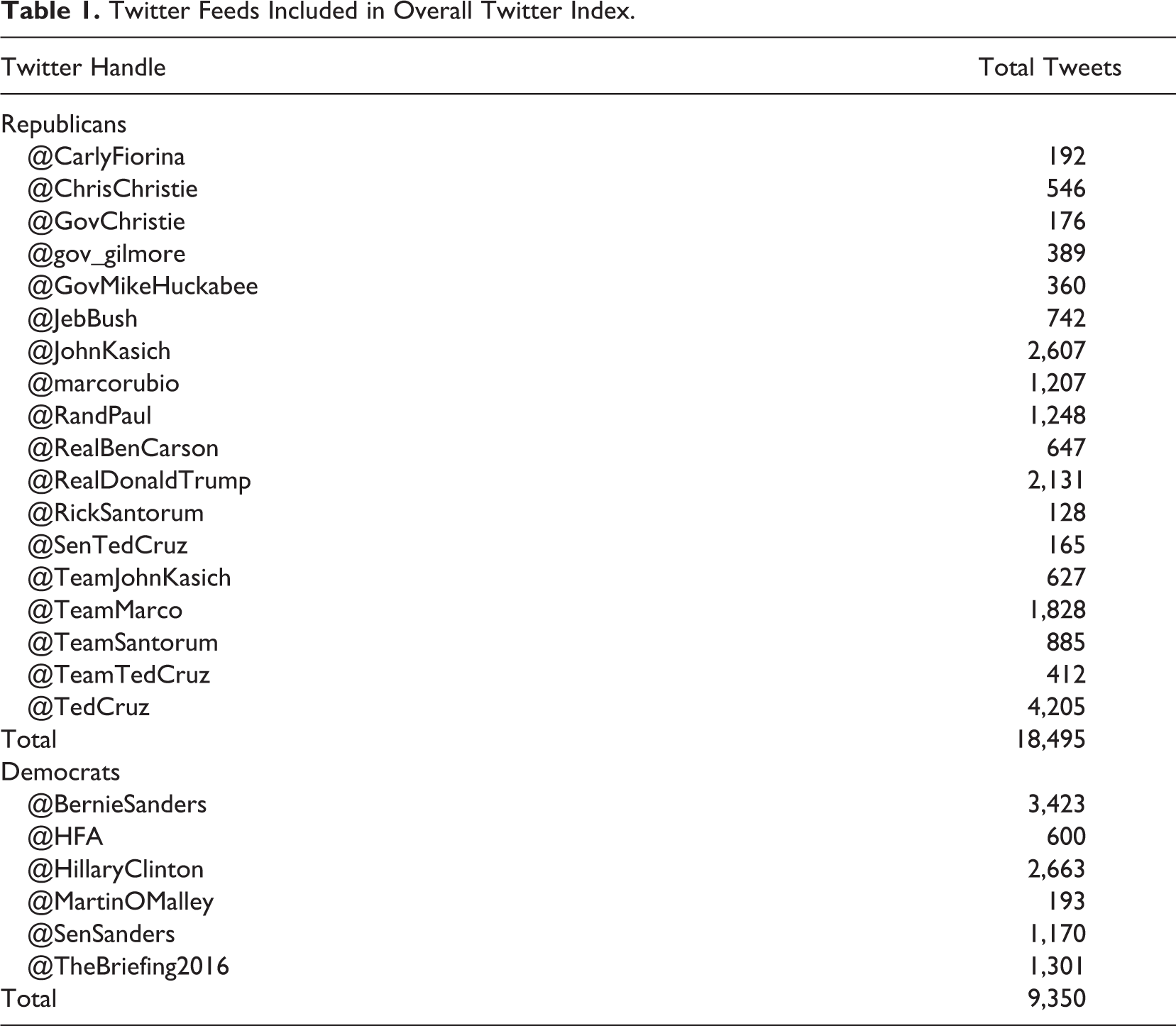
All tweets posted on the feeds of major party candidates and their campaigns from January 1 to June 7 were included in this project to create a Twitter index (N = 27,845). This Twitter index was then used to establish the extent to which the Twitter agenda of presidential candidates and their campaigns preceded that of the news media. Included feeds are displayed in Table 1. For the purposes of this study, if a candidate also had an individual feed that was not necessarily linked to their campaign (e.g., Chris Christie had both a feed representing his presidential candidacy [@ChrisChristie] and a feed representing his role as governor of New Jersey [@GovChristie]), both were included. In the final data set, candidate and campaign tweets were included up to the day an individual dropped out of the race (e.g., the last tweet included for Ted Cruz occurred on May 3). Twitter feeds were gathered weekly using the statistical program R to query Twitter’s REST application programming interface (API). The REST API allows researchers to “query Twitter’s databases for data corresponding to specific parameters,” including tweets posted by specific users (Jungherr, 2016, p. 82). These data were exported into Excel files, which included the tweet, user name, and date posted.
Twitter Feeds Included in Overall Twitter Index.
Coding
The coding program QDA Miner and its companion program WordStat were used to tally issue frequencies within Twitter feeds and newspapers. While QDA Miner is mainly used for qualitative coding, its quantitative component Wordstat allows researchers to examine the frequency of words and phrases and implement coding rules. For newspapers, the unit of analysis was all news content published in a newspaper that mentioned any of the candidates or the presidential nomination contests on a given day. For Twitter feeds, the unit of analysis was all tweets posted to an individual account on a given day.
Coding employed a combination of automated and manual analysis to ensure that the former was coded as intended by the researcher (Dang-Xuan, Stieglitz, Wladarsch, & Neuberger, 2013).
3
First, we created a list of national political issues examined in previous studies (Conway, Kenski, & Wang, 2015; Tedesco, 2001). Based on these topics, thousands of words that appeared in news articles and tweets were analyzed in WordStat to detect additional categories and fully develop previously established categories. This resulted in a total of 27 issues.
4
Words were included if they appeared 10 times or more. This included hashtags that were placed in the appropriate category based on their original intent. For example, in our data set, #FIXTHEDEBT was placed in the budget category. Replicating the steps of our previous study, after adding words to the project dictionary based on this initial run through, the data were analyzed using the issue categories developed thus far, and leftover words (those not included in the dictionary) were examined to make sure none were left out of the proposed categories. (Conway, Kenski, & Wang, 2015, p. 368)
If the placement of a word was unclear, the authors investigated the word in context to determine its use.
Overall, issue emphasis similarities across studies dominate (see Conway, Kenski, & Wang, 2015; Tedesco, 2001). For example, previous studies also included “abortion,” “affirmative action,” “agriculture,” “health care,” “economy,” and “immigration.” Nevertheless, issue emphasis does change across elections depending on historical events and campaign priorities—differences over time lie with narrow, emergent issues specific to a given time period. This election cycle, for example, required that we add “Clinton’s e-mail scandal” and “Zika” to the list. Agenda-setting studies should always include slightly different lists of issues if meant to represent the context they examine.
Analysis
To examine the overall relationship between Twitter feeds and news media, we first identified the top five issues that appeared within each medium: the newspaper index, the Twitter index, and the candidate/campaign feeds of Clinton, Cruz, Sanders, and Trump. This resulted in a total of 13 issues (see Table 2). To test Hypotheses 1 and 2, we focused on the top five issues within the newspaper index and the Twitter index for the sake of parsimony, resulting in a total of eight issues: the economy, education, employment, foreign policy, health care, immigration, national security/terrorism, and taxes. For the candidate-specific analyses, we focused on the top five issues in Trump’s feed, Sanders’ candidate and senator feeds, the combined candidate/campaign feeds for Clinton, and the combined candidate/senator/campaign feeds for Cruz, resulting in 11 issues: affirmative action, banking, education, employment, foreign policy, gun control, health care, immigration, military spending/veterans, national security/terrorism, and social welfare. We recognize that some issues are left out of this analysis but observe that those included are fairly representative of what the public considered to be the top issues in 2016 (Gallup, 2016). It is important to note that case occurrence was low across issues. For example, the issue that occurred the most (employment) within the Twitter index only occurred in 2.65% of tweets. Still, it occurred in 737 cases, a relatively large volume.
Total Case Occurrences by Issue Between January 1, 2016, and June 6, 2016.

Note. Newspaper index represents overall issue emphasis in newspapers. Twitter index represents overall issue emphasis in primary candidate/campaign/party Twitter feeds. Percentages represent the percent of case occurrences.
Before examining the relationship between the two media, we first inspected the data for linear and quadratic trends (underlying patterns across time series data). When working with data that include a temporal element, patterns that are associated with time within each series suggest that a variable’s error terms are correlated. The newspaper index, Twitter index, and the tweets of Clinton, Cruz, Sanders, and Trump were then detrended if the linear or quadratic trends were statistically significant, allowing the relationship between the days to be analyzed without concerns of autocorrelation (Romer, 2006). Then, the cross-lagged correlations between the detrended time series were calculated to evaluate the strength of the relationship (i.e., predictive value) among the sources of interest. To test Hypothesis 2, we evaluated the number of lags and leads. This test of relationships should not be equated with causality, but such patterns, especially consistent patterns over time, do suggest a nonrandom relationship (Sayre et al., 2010).
Results
After creating newspaper and Twitter indices, daily frequencies were examined for linear and quadratic trends within each series. Trends were detected in newspaper indices for the economy (quadratic function with R2 = .09, p < .01), education (quadratic function with R2 = .08, p < .01), employment (quadratic function with R2 = .13, p < .01), foreign policy (quadratic function with R2 = .10, p < .01), health care (linear function with R2 = .09, p < .01), immigration (linear function with R2 = .06, p < .01), and national security/terrorism (linear function with R2 = .13, p < .01). Trends were detected in Twitter indices for the economy (linear function with R2 = .16, p < .01), education (linear function with R2 = .23, p < .01), foreign policy (linear function with R2 = .09, p < .01), health care (linear function with R2 = .19, p < .01), immigration (linear function with R2 = .16, p < .01), national security/terrorism (linear function with R2 = .18, p < .01), and taxes (linear function with R2 = .05, p < .01). These trends were removed prior to analysis. 5
Hypotheses 1 and 2 focus on the overall relationships between newspapers and Twitter, testing whether the relationships were reciprocal and if one medium exhibited greater influence than did the other. Leads shown in Table 3 indicate that newspapers predicted emphasis on Twitter on six of the eight issues (education, employment, health care, foreign policy, immigration, and national security/terrorism). For example, newspapers led on education 2, 5, and 7 days prior. Still, tweets predicted newspapers 1–7 days prior on four of the eight issues (the economy, employment, foreign policy, and taxes), with reciprocal relationships on employment and foreign policy supporting Hypothesis 1. There were also many contemporaneous relationships, indicating that issues appeared simultaneously in newspapers and tweets. Based on the number of issues on which newspapers led, as well as the number of leads for newspapers (nine) and Twitter (five), overall newspapers had more predictive power than Twitter, supporting Hypothesis 2.
Significant Cross-Correlations Between the Newspaper Index and the Primary Candidate/Campaign Twitter Index.

Note. All cross-lagged correlations shown here are significant, p < .05. Leads shown indicate that newspapers predicted tweet emphasis a given number of days prior to the contemporary frequencies. Lags indicate that tweets predicted newspaper mentions a given number of days prior to the contemporary frequencies. Lag 0 indicates a contemporaneous relationship. Negative correlations indicate low incidence on Twitter.
Research Question 1 asked whether the front-runners’ Twitter agendas influenced the newspaper agenda (and vice versa). First, we investigated trends on issues within newspapers that were not included in the previous analysis. Trends were detected for affirmative action (quadratic function with R2 = .06, p < .01), banking (quadratic function with R2 = .07, p < .01), gun control (quadratic function with R2 = .23, p < .01), and social welfare (linear function with R2 = .03, p < .05). Trends were detected for Clinton’s tweets on banking (quadratic function with R2 = .07, p < .01), employment (linear function with R2 = .03, p < .05), gun control (linear function with R2 = .08, p < .05), heath care (linear function with R2 = .12, p < .01), and social welfare (quadratic function with R2 = .04, p < .05). Trends were detected for Cruz on affirmative action (linear function with R2 = .05, p < .05), employment (linear function with R2 = .25, p < .01), gun control (linear function with R2 = .04, p < .05), and military spending (linear function with R2 = .12, p < .05). Trends were detected for Sanders’ tweets on banking (linear function with R2 = .04, p < .01), education (linear function with R2 = .02, p = .05), foreign policy (quadratic function with R2 = .04, p < .05), gun control (linear function with R2 = .04, p < .05), health care (linear function with R2 = .07, p < .01), and immigration (linear function with R2 = .02, p = .05). Trends were detected for Trump’s tweets on banking (quadratic function with R2 = .04, p < .05) and education (linear function with R2 = .03, p < .05). These trends were removed prior to analysis to prevent autocorrelation.
As shown in Table 4, Clinton’s tweets predicted newspaper emphasis anywhere from 2 to 7 days on four of the 11 issues (banking, gun control, immigration, and social welfare)—more than any other candidate. Trump’s tweets predicted newspapers 3 to 6 days prior on three issues (banking, foreign policy, and health care). The tweets of Sanders (affirmative action and gun control) and Cruz (employment and social welfare) predicted newspaper emphasis on two issues each from 3 to 6 days prior. On the other hand, newspapers led Clinton on seven issues, Cruz on four issues, Sanders on five issues, and Trump on four issues anywhere from 1 to 7 days prior. Therefore, newspapers out-predicted all Twitter sources in terms of leads. Some of these relationships were also reciprocal (e.g., banking and gun control for Clinton and health care for Trump). Cruz and Sanders had one issue each on which they predicted newspapers and the reverse did not occur (bottom-up relationships), while Trump had two. But there were 17 instances in which newspaper issue emphasis predicted candidate emphasis and not the reverse (top-down relationships). Contemporaneous relationships were also discovered on several issues.
Significant Cross-Correlations Between the Newspaper Index and the Front-runners.
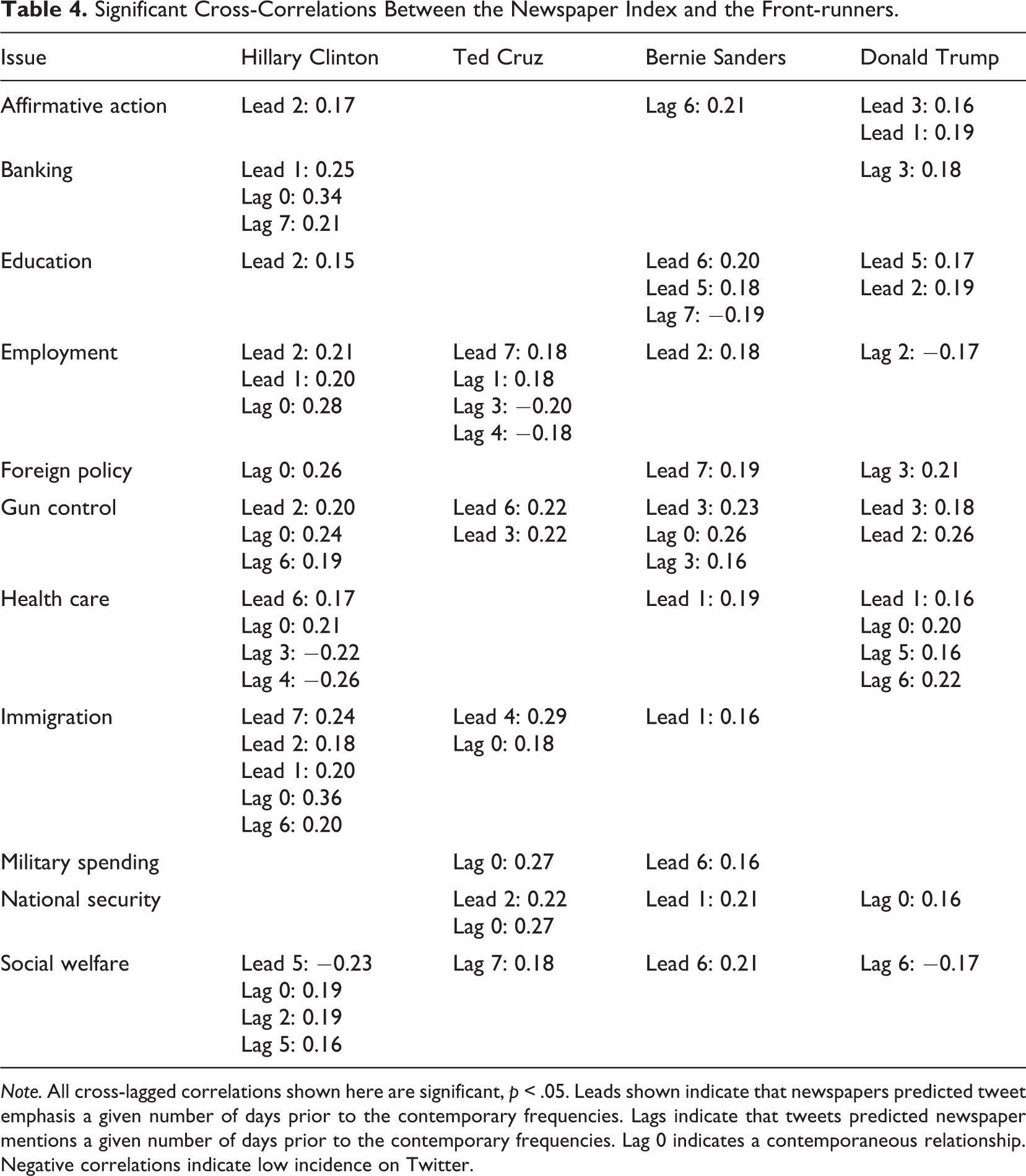
Note. All cross-lagged correlations shown here are significant, p < .05. Leads shown indicate that newspapers predicted tweet emphasis a given number of days prior to the contemporary frequencies. Lags indicate that tweets predicted newspaper mentions a given number of days prior to the contemporary frequencies. Lag 0 indicates a contemporaneous relationship. Negative correlations indicate low incidence on Twitter.
Discussion
This study builds on previous intermedia agenda-setting work by examining relationships among the issue agendas of the nation’s top newspapers and the Twitter feeds of 2016 presidential candidates and their campaigns. Focusing specifically on national political issues, findings suggest a symbiotic relationship between the two. This was also the case in our study of the 2012 election, as was the finding that newspapers predicted the Twitter agenda to a greater extent than the reverse (Conway, Kenski, & Wang, 2015). Still, candidate Twitter feeds predicted the news agenda on a variety of issues, some of which were not owned by their party (e.g., Clinton on immigration and Trump on affirmative action). This was also the case in 2012. Our candidate-centered analyses further reveal that the agenda-building relationship is likely candidate specific.
Focusing on the overall analysis, there are interesting patterns when we look at the length of leads. Based on the number of leads, newspapers were somewhat successful in predicting issue emphasis on Twitter. They often did so 1 to 2 days prior, but there are also 6 and 7 day leads. We know that newspapers are confined to a certain extent by their publication cycle and that they can set the agenda for other news media, such as television news (Roberts & McCombs, 1994). If this is the case, longer lag times could be related to a buildup of coverage across different news media over time. This finding might also support the argument of scholars who believe the time frame for agenda setting by online media is swifter than that of traditional media (Jacobson, 2013; Lee, Lancendorfer, & Lee, 2005; Roberts, Wanta, & Dzwo, 2002).
That said, large contemporaneous relationships on all issues, which were also highly prevalent in our 2012 analysis, speak to the similarities of Twitter and traditional newspapers. Both are commenting on the issues of the day in a rapid fashion. Such contemporaneous relationships were also prevalent in our analysis of the front-runners, suggesting that candidates and their campaigns are mindful of the event-driven nature of Twitter. We cannot mistake correlations for causation, but findings suggest issues may be transferred from Twitter to other media at a quicker rate than that of newspapers to Twitter. This could be not only due to monitoring and quick response by newspaper journalists to candidate/campaign tweets but also to worldwide events—events on which candidates/campaigns commented on the previous day.
On candidate-specific analyses, compared to others, Clinton may have done a slightly better job using Twitter to emphasize national political issues that were in turn covered by the press agenda. The Trump effect suggested by Wells and colleagues (2016) did not emerge in our examination of issue emphasis. Of course, Trump was criticized for a lack of issue knowledge and vague or false statements on the issues (Kopan, 2016; Politifact, 2017). Across candidates, average case occurrence on the 13 issues in question was higher for Clinton (2.33%) and Sanders (3.54%) than for Cruz (1.19%) and Trump (1.20%). It is possible that Trump’s influence manifested in nonpolicy-related statements, which is beyond the scope of the present study. Future research should investigate what agendas, other than issue agendas, might be important in the Twitter to newspaper relationship.
Issue mentions are theorized to be less frequent during nomination campaigns than in the general election period (Kendall, 2016), but issue emphasis was not overwhelmingly absent on Twitter during the primaries. Across candidates, the percentages of tweets that included at least one issue mention were Trump = 14.45%, Cruz = 15.72%, Clinton = 32.32%, and Sanders = 48.65%. These numbers are not inconsequential, nor are issues in a political campaign. As we contemplate the ramifications of new media for democratic outcomes, issue emphasis (as opposed to entertainment-laden content) begs future research (Van Aelst et al., 2017).
This study does not account for the tone with which candidates were portrayed in news media. The ability to predict the news media agenda does not necessarily mean that the news content was positive. Clinton, for example, “had by far the most negative coverage of any candidate” in 2015 (Patterson, 2016, para. 3). While Clinton operated within existing political structures, helping build news media agendas in terms of issue focus, this tactic did not necessarily result in a major advantage for her campaign. Tweets by Clinton and her campaign were also predicted by newspapers to a greater extent than the other three candidates. Thus, her campaign may have used Twitter in an effort to reframe news media coverage.
Trump’s rhetorical style on social media about issues was also focused in part on reframing news stories and encouraging news media distrust after stories had been published. It is clear looking back on the 2016 election cycle that Trump was heavily invested in being the consummate political outsider, which included attacking news media credibility and breaking free from traditional news outlets as gatekeepers. “Though he regularly bashes the media as dishonest, scum and the ‘absolute worst,’ Donald Trump disproportionately benefited from the Fourth Estate’s coverage” (Gass, 2016, para. 1). Future research should investigate how news coverage and candidate tweets, both issue focused and not, are taken up and interpreted. For example, investigating news coverage of Trump’s tweets about Ted Cruz’s wife Heidi Cruz and other incendiary comments would be enlightening. Future research should also investigate different news media as well as local newspapers covering state primaries.
The largest limitation of this study is that we cannot suggest causality. Time series analysis has a temporal/predictive component, but we are limited in the strength with which we can argue that these relationships are Twitter specific. These findings are based on Twitter and newspaper indices and do not take into account the various other types of campaign media that can influence the press (ads, press releases, rallies, and so on). Of note, our study of candidate tweets and campaign ads in the 2012 presidential campaign detected issue overlap (Conway, Filer, & Kenski, 2015). One should also ask the extent to which Twitter and newspaper agendas are driven by public concern. Arguably, much work is also needed on the impact of social media use by candidates on the public, although excellent research is already being done. Another limitation of this study is the reliance on dictionary work, which may result in false negatives (Guo, Vargo, Pan, Ding, & Ishwar, 2016). Our study employed a more succinct dictionary compared to Guo and colleagues (2016) in their test of dictionary coding versus LDA. We included all relevant words that appeared 10 times or more (see Note 3). Given that dictionary work is more conservative than LDA, our approach is on the conservative side and relationships may be larger than those reported here.
This study has limitations but is an important step in the way of replication. Candidates can and do use Twitter as an agenda-building tool. Three studies now suggest that candidate/campaign Twitter feeds can predict newspaper emphasis and vice versa during American presidential primary campaigns. That the news agenda predicted that of Twitter to a greater extent than the reverse is a positive indicator to those who believe agenda setting exists in the new media environment. Although scholars anticipated that new media would enhance the agenda-building process at the expense of the agenda-setting function of news media (Chaffee & Metzger, 2001), the results of this study, combined with findings from 2012 (Conway, Kenski, & Wang, 2015), suggest that traditional news gatekeepers continue to shape the political campaign environment by setting the agenda.
Footnotes
Declaration of Conflicting Interests
The authors declared no potential conflicts of interest with respect to the research, authorship, and/or publication of this article.
Funding
The authors received no financial support for the research, authorship, and/or publication of this article.