




Abstract
The social aspect of human functioning seems to play a considerable role in the explanation of the Facebook intrusion phenomenon. The present article examines the relation between social support and Facebook intrusion, with hope of success and positive orientation controlled for. We administered the Facebook Intrusion Questionnaire, the Multidimensional Scale of Perceived Social Support, the Positive Orientation Scale, and the Hope of Success Questionnaire. The participants in the online study were 611 Polish Facebook users, whose mean age was 20.79 years (SD = 2.38). The results show that there is no direct relationship between social support and Facebook intrusion, but there is an indirect one, with hope of success and positive orientation as mediators. We have found that social support weakens Facebook intrusion via positive orientation in both genders and via hope of success in men. Moreover, a low level of personal resources contributes to problematic Facebook use. The study has also revealed that individuals who use social media in a problematic way focus on the present rather than on the future.
Every day millions of people log on to Facebook, Twitter, LinkedIn, or MySpace. In 2019, there were over 2.5 billion monthly active Facebook (2020) users. Users want to be in touch with friends and maintain acquaintances. Facebook is a source of entertainment, a site where people meet and discuss, a platform of promotion, and a way of spending free time. These are the bright sides of this site, but there is a dark side as well. More and more is known about the phenomenon of excessive Facebook use, also referred to as Facebook intrusion (Andreassen et al., 2012; Błachnio & Przepiorka, 2019; Brailovskaia & Margraf, 2017; Caci et al., 2017; Hormes et al., 2014). The site that helps develop social life may also be a source of problems. A great body of literature suggests that there are certain characteristics that may make some of its users more inclined to engage in problematic Facebook use (Bergman et al., 2011; Błachnio & Przepiorka, 2016; Błachnio, Przepiorka, & Rudnicka, 2016). What often induces people to use Facebook is social support seeking. As research shows, single people are at greater risk of excessive Facebook use (Błachnio, Przepiorka, Boruch, & Bałakier, 2016). One of the main functions of social networking is to maintain existing relationships and build new ones (e.g., Ellison et al., 2007). Moreover, Facebook use is associated with the need to affiliate and the need for acceptance from others (Nadkarni & Hofmann, 2012); it is also linked with expressing one’s identity (Brandtzæg & Heim, 2009). On the one hand, it has been found that a large number of Facebook friends contribute to higher perceived social support but only on Facebook (Nabi et al., 2013). On the other hand, Facebook users perceive stronger social support in general if they perceive online social support (C.-Y. Liu & Yu, 2013). There arises the question of which variables can be mediators in the relationship between problematic Facebook use and general perceived social support. The main aim of our study was to examine the relationship between perceived social support and Facebook intrusion and the mediating role of hope of success and positive orientation.
Facebook Intrusion
In the literature, there are several terms referring to excessive Facebook use, such as Facebook addiction disorder (Brailovskaia & Margraf, 2017), problematic Facebook use (Lee-Won et al., 2015; Satici & Uysal, 2015), Facebook dependence (Wolniczak et al., 2013), and Facebook intrusion (Elphinston & Noller, 2011). Sometimes these terms are used interchangeably (Błachnio, Przepiorka, & Pantic, 2016; Saeed Abbasi, 2018). In our study, we have chosen “Facebook intrusion,” defined as excessive Facebook use that affects everyday activities and social relations (Elphinston & Noller, 2011). Facebook intrusion comprises several aspects such as withdrawal, relapse and reinstatement, or euphoria (Elphinston & Noller, 2011). Previous studies indicated that Facebook intrusion was related to personality traits (Przepiorka et al., 2018), social aspects (Błachnio, Przepiórka, Wołońciej, et al., 2018), time variables (Przepiorka & Błachnio, 2016), chronobiological factors (Błachnio et al., 2015), and culture (Błachnio, Przepiorka, Benvenuti, et al., 2016). It is negatively related to romantic relationships, as it intensifies jealousy and lowers satisfaction (Elphinston & Noller, 2011).
Self-Beliefs
Numerous studies have shown that self-beliefs are predictors of behaviors associated with different aspects of human life, such as health (e.g., Schwarzer & Renner, 2000), education (Bong et al., 2012), or work (Cunningham et al., 2005). It is possible to distinguish the following self-beliefs making up the so-called psychological capital: hope of success, optimism, self-efficacy, and self-esteem (Luthans et al., 2007). Snyder (2002) defines hope of success as a positive motivational state comprising two components: agency thinking and perceived capability to derive pathways to desired goals. People with high hope of success can see more possibilities of success than of failure, have more goals, and perceive goals as a challenge. It has also been found that future time perspective (associated with goal setting) is related to Internet and Facebook addictions (Przepiorka & Błachnio, 2016; Przepiorka et al., 2018). Having more long-term goals serves as a form of buffer against these behavioral addictions. Previous studies also confirmed the role of self-beliefs in maladaptive Internet use and showed that people with lower self-esteem were more prone to Internet addiction (Błachnio, Przepiorka, & Pantic, 2016). Considering the broader context of intentional behaviors and numerous studies (Emmons, 2005), one can conclude that people with more goals feel a stronger sense of meaning in life and have a higher level of life satisfaction, which in turn translates into a lower tendency to engage in problematic use of the Internet and Facebook (Błachnio, Przepiorka, & Pantic, 2016). In the literature, there is a positive orientation construct, defined as positive evaluation of oneself and one’s life combined with the expectation of positive events in the future. It has three dimensions: self-esteem, optimism, and satisfaction with life (Heikamp et al., 2014). Positive orientation is highly beneficial, resulting in better adjustment (Alessandri et al., 2012) and more efficient coping (Caprara et al., 2009). A previous study revealed a negative link between positive orientation and Internet and Facebook addictions (Błachnio & Przepiorka, 2016). Based on previous studies, we formulated the following hypotheses:
Social Support and Facebook Use
In the literature, authors distinguish between emotional, instrumental, informational, and appraisal support (Langford et al., 1997; Malecki & Demaray, 2003). Perceived social support refers to the sense that one is loved and needed, one enjoys recognition, and one belongs to a social group (Cobb, 1976). It is an important indicator of emotional well-being (Rueger et al., 2010). Having friends is an important source of social support particularly in adolescents, who need a reference group in the formation of their identity (e.g., Bokhorst et al., 2010). Social support has a positive effect on mental health; for instance, it can reduce the symptoms of depression (e.g., Murberg & Bru, 2004; Rueger et al., 2010). Also, receiving support may have a positive impact on the treatment process in psychiatric illness (Smolak et al., 2013; Veretilo & Billick, 2012) and in somatic illness (Garay-Sevilla et al., 1995; Miller & DiMatteo, 2013). Previous studies showed that perceived social support played a preventive role against behavioral addictions (Esen & Gündoğdu, 2010). Those who felt more support were at the same time more satisfied with their life and had lower levels of stress and depression (Yalçin, 2015); these characteristics are crucial in the prevention of Internet and Facebook addictions (Błachnio, Przepiorka, & Pantic, 2016). The social aspect of human functioning seems to play a considerable role in explaining the Facebook intrusion phenomenon. There are studies suggesting a relationship between online social support and Facebook use (C.-Y. Liu & Yu, 2013; Tang et al., 2016). In the group of young people, online support on Facebook can positively influence well-being and have gratifying effects similar to those of face-to-face contacts (Frison & Eggermont, 2015). Moreover, perceived social support turned out to be a mediator between Facebook use and depressive states (Frison & Eggermont, 2016). Research shows that passive and active Facebook use may have different effects on users (Gerson et al., 2017; Ng, 2020; Young et al., 2017); for instance, public Facebook activity (status updating or sharing photos) is a positive predictor of depressive states regardless of perceived social support, while private Facebook activity is positively associated with perceived social support (Burke et al., 2010), which confirms Kraut’s hypothesis: Rich ones become richer. Passive Facebook use intensifies depressive states (Burke et al., 2010; Escobar-Viera et al., 2018; Krasnova et al., 2013). Porter et al. (2012) found that pathological use of social media was related to low satisfaction with interpersonal relations with individuals in their real offline environment. A study found that a larger number of Facebook friends translated into higher perceived general social support (Nabi et al., 2013). A different study revealed that satisfaction with interpersonal relations and perceived social support on the web were positively related to Facebook addiction (Tang et al., 2016). A meta-analysis showed that social media use might have a positive effect on emotional and informational support and a negative effect on tangible and esteem support (D. Liu et al., 2018). Social support played an important role for young social media users and had an impact on their attitude toward suicide (D. Choi & Noh, 2019). Another study showed that emotional support received via social media was positively related to depression odds (Shensa et al., 2019). There is some evidence that Facebook usage contributes to perceived online social support and that online social support translates into perceived general social support (C.-Y. Liu & Yu, 2013). Previous studies suggested that social support from Facebook friends was positively related to Facebook addiction (Tang et al., 2016). Additionally, as previous results tend not to indicate a direct relationship between problematic social media use and general social support (C.-Y. Liu & Yu, 2013), we suspected that there were mediators between these two variables and formulated the following hypotheses:
The Present Study
The main aim of our study was to examine the relation between social support and Facebook intrusion with hope of success and positive orientation controlled for. The hypothetical relationships were examined in the form of the proposed model (see Figure 1). The theoretical framework for the hypotheses was Davis’s (2001) cognitive behavioral model of Internet addiction, according to which Facebook addiction can be understood as a specific type of Internet addiction. One of the levels of addiction development is the user level, where individual differences concerning the combination of personality, cognitive, and environmental factors should be taken into account as well as the needs and goals behind the user’s activities (Brand et al., 2014).

Structural model of relations between the analyzed variables in the female group. *p < .05. **p < .01. ***p < .001.
Method
Participants and Procedure
The sample consisted of N = 611 participants ranging in age from 19 to 33 years (M = 20.79, SD = 2.38); n = 411 of them were women (aged 19–32, M = 20.62, SD = 2.25), and n = 200 were men (aged 19–33, M = 21.12, SD = 2.59).
When recruiting the participants, we applied the snowball procedure. First, we prepared an electronic version of the questionnaires. Second, we invited undergraduate psychology students to take part in the study. The participants were informed about the aims of the study and assured that they were free to withdraw at any time. Informed consent was obtained from all individual participants. The participants volunteered for the study and did not receive any compensation for their participation. They were informed about the anonymity of the research. After completing the questionnaire, they were also requested to share the link with their Facebook friends and to invite them to participate in the study. The study was approved by the Research Ethics Board at The John Paul II Catholic University of Lublin, Poland.
Measures
The Facebook Intrusion Questionnaire, developed by Elphinston and Noller (2011), is based on behavioral addiction components and on a scale measuring Facebook involvement. It consists of eight items (e.g., “I have been unable to reduce my Facebook use”) measuring the relations between the Facebook involvement tendency and eight aspects of behavioral addiction, namely: cognitive salience, behavioral salience, interpersonal conflict, conflict with other activities, euphoria, loss of control, withdrawal, and relapse and reinstatement. Its items are rated on a Likert-type scale from 1 (strongly disagree) to 7 (strongly agree). We standardized the items and then computed the sum score. Cronbach’s α was .84.
The Multidimensional Scale of Perceived Social Support (Zimet et al., 1990) consists of 12 items measuring perceived social support from three group of people: friends (e.g., “I can talk about my problems with my friends”), family (e.g., “My family really tries to help me”), and significant others (e.g., “There is a special person with whom I can share my joys and sorrows”), rated on a scale from 1 (completely disagree) to 5 (completely agree). The values of Cronbach’s α were .93, .89, and .87, respectively.
The Positive Orientation Scale (Caprara et al., 2010; Cronbach’s α was .84) as adapted into Polish by Łaguna et al. (2011) consists of eight items measuring the tendency to see positive aspects of life, which comprises three components: self-esteem, optimism, and satisfaction with life (e.g., “I have great faith in the future”; “I look forward to the future with hope and enthusiasm”) rated on a scale from 1 (completely disagree) to 5 (completely agree). Cronbach’s α for the Polish version was .83.
The Hope of Success Questionnaire by Łaguna et al. (2005) measures hope of success. The questionnaire consists of 12 items (e.g., “There are many ways of solving every problem”). Subjects indicate their answers on a scale from 1 to 8. Cronbach’s α was .83.
Statistical Analysis
In the first step, descriptive statistics were presented in the form of arithmetic means and standard deviations. Additionally, we applied Pearson’s correlation coefficient to determine the relationships between the variables. In order to assess the differences between the female and male groups, we performed independent samples Student’s t tests and compared mean differences. Where variances between the groups were heterogeneous, we applied the Cochran–Cox adjustment (Cochran & Cox, 1957). The magnitude of differences was measured as Cohen’s d effect size and interpreted in accordance with Cohen’s (1988) guidelines: small d = 0.2, moderate d = 0.5, and large d = 0.8.
In the next step, in order to test the hypotheses and analyze the relations between social support, hope of success, positive orientation, daily Internet use time, and Facebook intrusion in the female and male groups, we examined a structural model using the maximum likelihood method (Byrne, 2010; Kline, 2011). Taking previous research into account (Błachnio & Przepiorka, 2016; C.-Y. Liu & Yu, 2013; Tang et al., 2016), we developed a model with social support, hope of success, positive orientation, and daily Internet use time as predictors of Facebook intrusion and with positive orientation as a predictor of hope of success. The following statistics were applied as measures of model fit: χ2, χ2/df, root mean square error of approximation (RMSEA), standardized root mean square residual (SRMR), goodness of fit (GFI), comparative fit index (CFI), incremental fit index (IFI), Tucker-Lewis Index (TLI), and normed fit Index (NFI) (Byrne, 2010; Kline, 2011). Statistically nonsignificant (p > .05) χ2 values indicate that the proposed model fits the data well. The value of χ2/df ratio lower than 2 indicates a good fit to the data set. Also, RMSEA lower than .06 and SRMR lower than .08 indicate a good fit of the model. GFI, CFI, IFI, TLI, NFI values higher than .95 allow the conclusion that the model fits the data well (Byrne, 2010; Hu & Bentler, 1999; Kline, 2011). We applied bootstrapping (5,000 samples) with the bias-corrected percentile method to estimate standardized regression weights, correlations, R 2 values, and indirect effects with 95% confidence intervals (CIs).
In order to test the Hypotheses 3, 4, and 5, we analyzed the indirect effect of social support on Facebook intrusion mediated by positive orientation, hope of success, and daily Internet use by means of bootstrapping (5,000 samples) with the bias-corrected percentile method to estimate indirect effects with a 95% CI (Bollen & Stine, 1990; Shrout & Bolger, 2002). Additionally, to examine the potential differences in regression weights between the groups, we performed pairwise parameter comparisons between the female (N = 411) and male (N = 200) groups. The critical ratios for differences in parameters between the groups with a z-score ≥ 1.96 were considered to be significant (Byrne, 2010; Hu & Bentler, 1999; Kline, 2011).
Results
The descriptive statistics—namely, means and standard deviations—and Pearson’s r correlations between the variables are presented in Table 1. Facebook intrusion correlated positively with the daily number of hours spent online (r = .17, p < .001) and negatively with hope of success (r = −.15, p < .001) and positive orientation (r = −.15, p < .001). However, it should be noted that the effect size of these relations was small. Additionally, gender correlated positively with Facebook intrusion (r = .17, p < .001), family support (r = .11, p = .007), friend support (r = .16, p < .001), and other support (r = .23, p < .001). In these cases, effect size was small to medium. There were also positive correlations between hope of success, positive orientation, and the three types of social support, with medium to strong effect sizes (see Table 1).
Descriptive Statistics and Correlations Between Variables for Whole Participants.

Note. N = 611.
a gender: 0 = men; 1 = women.
*p < .05. **p < .01. ***p < .001.
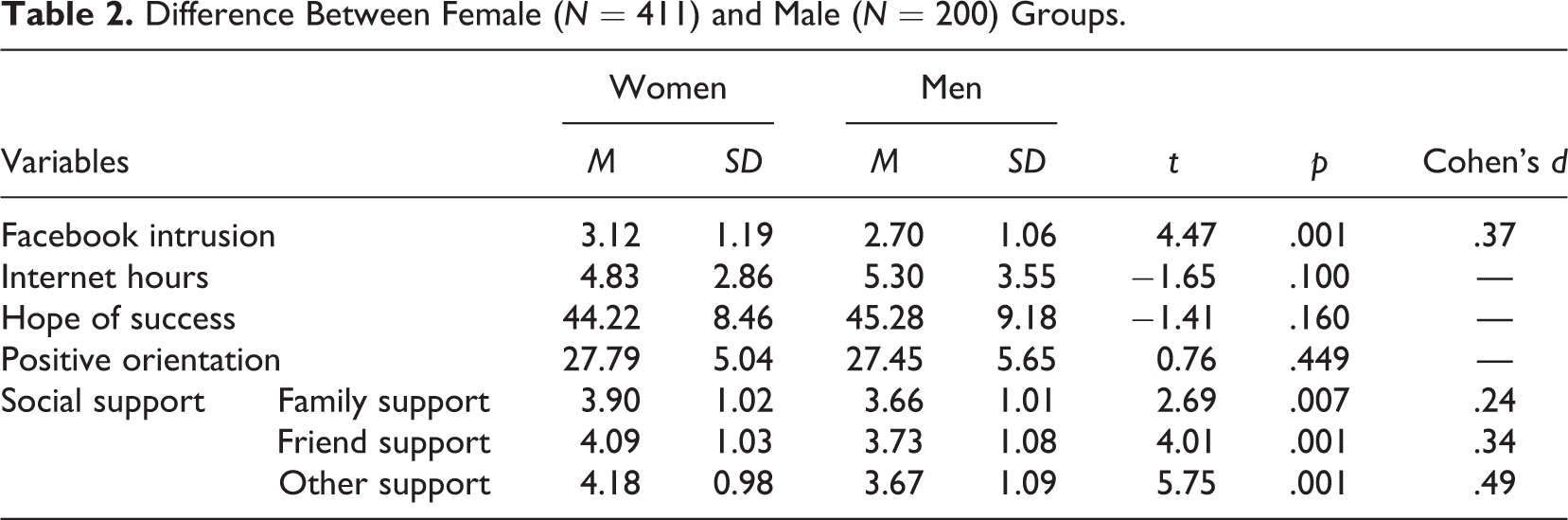
Statistical analysis revealed differences between the female and male groups in Facebook intrusion, family support, friend support, and other support. The effect size of these differences ranged from small to moderate. The female group had a higher level of Facebook intrusion (M = 3.12, SD = 1.19), family support (M = 3.90, SD = 1.02), friend support (M = 4.09, SD = 1.03), and other support (M = 4.18, SD = 1.09) than the male group (Facebook intrusion: M = 2.70, SD = 1.06; family support: M = 3.66, SD = 1.01; friend support: M = 3.73, SD = 1.08; other support: M = 3.67, SD = 1.09). Detailed results are presented in Table 2.
Difference Between Female (N = 411) and Male (N = 200) Groups.
Structural equation analyses showed that the model was fully fitted: χ2 (df = 4) = 5.96, p = .202, χ2/df = 1.49, RMSEA = .028, SRMR = .025, GFI = .997, CFI = .998, IFI = .998, NFI = .994, TLI = .979. In the female group, our results revealed that low positive orientation (β = −0.18, p = .014, 95% CI [−0.31, −0.04]) was a predictor of Facebook intrusion, as hypothesized (Hypothesis 1). However, contrary to the hypothesis (Hypothesis 2), there was no significant path between hope of success and Facebook intrusion (β = −.02, p = .744, 95% CI [−.15, .10]). Additionally, family support (β = .26, p < .001, 95% CI [.17, .35]), friend support (β = .23, p < .001, 95% CI [.11, .34]), and other support (β = .17, p = .007, 95% CI [.06, .29]) were positively and significantly related to positive orientation. Our results revealed that daily Internet use (β = .22, p = .001, 95% CI [.09, .33]) was a predictor of Facebook intrusion. There was also a positive relationship between positive orientation (β = .60, p < .001, 95% CI [.51, .68]) as well as family support (β = .11, p = .008, 95% CI [.03, .19]) and hope of success. Additionally, family support (β = −.10, p = .034, 95% CI [−.22, −.01]) was negatively and significantly related to daily Internet use. Detailed results are shown in Figure 1.
In the male group, hope of success (β = −.20, p = .024, 95% CI [−.36, −.03]) was negatively and significantly related to Facebook intrusion, as hypothesized (Hypothesis 2). However, contrary to the hypothesis (Hypothesis 1), there was no significant path between positive orientation and Facebook intrusion (β = −.05, p = .613, 95% CI [−.24, .15]). Additionally, family support (β = .20, p = .027, 95% CI [.03, .37]) and friend support (β = .23, p = .008, 95% CI [.06, .40]) were positively and significantly related to positive orientation. There was also a positive relationship between positive orientation (β = .65, p < .001, 95% CI [.53, .76]) and hope of success. Other paths were not statistically significant. Detailed results are shown in Figure 2.

Structural model of relations between the analyzed variables in the male group. *p < .05. **p < .01. ***p < .001.
Based on the bootstrapping procedures, we found significant mediation effects of positive orientation in the female group. Empirical 95% CIs did not include zero, indicating that the standardized indirect effect was statistically significant. Social support (i.e., family support, friend support, and other support) exerted a significant indirect effect on Facebook intrusion via positive orientation. This may indicate that positive orientation was a mediator in the relationship between social support and Facebook intrusion as hypothesized (Hypothesis 3).
Additionally, there was a significant indirect effect between family support and Facebook intrusion via daily Internet use time (see Table 3). This result partially supported the hypothesis postulating that daily Internet use mediated the relation between social support and Facebook intrusion (Hypothesis 5). However, there was no mediation effect of hope of success, which means Hypothesis 4 was not supported. In the male group, we observed that family support and friend support exerted a significant indirect effect on Facebook intrusion via positive orientation and hope of success. This may indicate that hope of success and positive orientation together acted as a mediator in the relationship between two types of social support and Facebook intrusion, which partially supports Hypotheses 3 and 4. There was a nonsignificant indirect effect between social support and Facebook intrusion via daily Internet use time (see Table 3), which means Hypothesis 5 was not supported.
Bootstrapping Standardized Indirect Effects With 95% Confidence Intervals.

Note. FI = Facebook intrusion.
The pairwise parameter comparisons showed differences in regression weights between the female and male groups in the case of the relationship between Facebook intrusion and the amount of time spent using the Internet per day (z = −2.03, p = .042). The path was significant for the female group (β = .22, p = .001, 95% CI [.09, .33]) but not significant for the male group (β = .11, p = .126, 95% CI [−.03, .27]). In the case of the relationship between family support and hope of success, we also found significant differences between the analyzed groups (z = −2.09, p = .037). The path was significant for female group (β = .11, p = .008, 95% CI [.03, .19]) but not significant for male group (β = −.06, p = .358, 95% CI [−.20, .08]). Additionally, the pairwise parameter comparisons showed differences in correlations between the female and male groups in the case of the relationship between family support and friend support (z = 2.08, p = .038). The correlation was higher in male group (r = .56, p < .001, 95% CI [.44, .66]) than in female group (β = .37, p < .001, 95% CI [.26, .47]).
Discussion
The main aim of our study was to examine the relationship between social support and Facebook intrusion, with hope of success and positive orientation controlled for. Our results indicated that there was no direct relationship between social support and Facebook intrusion. There was, however, an indirect relationship between these variables, with hope of success and positive orientation as mediators.
As postulated, Facebook intrusion proved to be negatively related to positive orientation (Hypothesis 1). In the model for women, positive orientation was a negative predictor of Facebook intrusion. These results are consistent with the previous study (Błachnio & Przepiorka, 2016), where the subjects who had a problem with excessive Facebook use exhibited a low level of positive orientation. The current study provides additional evidence that self-beliefs—namely, self-esteem (Błachnio, Przepiorka, & Rudnicka, 2016; Błachnio, Przepiorka, Benvenuti, 2018; Kraut et al., 2002), self-efficacy, and self-control (Przepiórka et al., 2019)—are related to problematic Facebook use. The lower the level of personal resources, the higher the tendency to use Facebook in problematic ways.
Next, as we predicted (Hypothesis 2), Facebook intrusion was negatively related to hope of success. This is in line with other studies reporting that self-beliefs are negatively related to Internet or Facebook addiction (Błachnio, Przepiorka, & Pantic, 2016; Błachnio, Przepiorka, & Rudnicka, 2016). In the model for men, hope of success was a negative predictor of Facebook intrusion. A previous study also found that Facebook addiction was related to future time perspective (Przepiorka & Błachnio, 2016), which is linked with formulating future goals. Hope of success implies having more goals and perceiving goals as a challenge (Snyder, 2002). On the other hand, it has been found that those who use social media in a problematic way focus on the present, not on the future. Positive orientation, defined as positive thinking about oneself, life, and the future (Caprara et al., 2012), and hope of success, a construct strictly associated with the future (Snyder, 2002), are negatively related to Facebook intrusion. Thus, it can be concluded that problematic use of social networking sites is linked with how users view their future. Studies have shown that also other addictions, such as Internet addiction (Przepiorka & Błachnio, 2016), problematic substance use (Peters et al., 2005), and alcoholism (Smart, 1968), are negatively related to the future time perspective. People involved in addictive activities or substance use are focused on the present and have problems with delayed gratification (Cosenza et al., 2017). People more strongly oriented toward the present are more likely to get addicted than future-oriented people.
Furthermore, we hypothesized the role of possible mediators in the relationship between social support and Facebook intrusion: positive orientation, hope of success, and daily Internet use (Hypotheses 3–5). The study revealed significant differences between women and men in the role of specific variables. As postulated in Hypothesis 3, positive orientation was a mediator between social support (i.e., family support, friend support, and other support) and Facebook intrusion. We have found that not only social support but also a positive view of the future and positive evaluation of one’s life and oneself constitute a protective barrier against the development of a negative pattern of Facebook use. This seems to be consistent with the literature on future time perspective, whose significant preventive role has been pointed out many times in research on Internet and Facebook addictions (Przepiorka & Błachnio, 2016). As postulated in Hypothesis 4, daily Internet use mediated the relationship between social support and Facebook intrusion only in the group of women. Numerous studies have shown gender differences in Facebook use motivations; for instance, women use Facebook more often, have a larger number of contacts, and are more often at risk of addiction (e.g., J. Choi & Kim, 2014; Muscanell & Guadagno, 2012; Thompson & Lougheed, 2012). A meta-analysis revealed only a small gender effect; namely, the relationship between problematic Facebook use and time spent online was stronger for women, which can be explained by the fact that women spend more time on social activities, such as using Facebook (Marino et al., 2018), and more often use certain Facebook functionalities in problematic ways (Kimpton et al., 2016). Our study also confirmed that women scored higher on Facebook intrusion. By contrast, the hypothesis that positive orientation and hope of success mediate between social support (family and friend support) and Facebook intrusion was partly confirmed only for the group of men. This may indicate that what also plays an important role in the case of men is the aspect of activity manifesting itself in formulating goals combined with a positive view of the future, one’s life, and oneself. This would be consistent with the broader picture rooted in the evolutionary perspective, where men’s activity stemmed from their roles.
We found no relationship between Facebook intrusion and social support, and we found that the role of mediators differed between the two genders. In women, positive orientation is a mediator of the relationship between all types of social support (family, friend, and other) and Facebook intrusion, while in men, both positive orientation and hope of success are mediators of this relationship. This means that social support weakens Facebook intrusion via positive orientation in both genders and, additionally, via hope of success in men. Having social support alone does not protect a person against Facebook intrusion, but personal resources do play a protective and supportive role in the functional use of new technologies. Certain personal characteristics may serve as a buffer against excessive Facebook use. It is not enough to have friends: What is also necessary is a positive view of the world, oneself, and the future as well as faith and efficiency in goal achievement.
Limitations and Future Studies
Some limitations of this study should be pointed out. First of all, we used only self-report methods. The participants indicated their Facebook use themselves, which may have led to bias. In the present study, we used social support as a single, undifferentiated measure. It would be recommendable in future studies to distinguish different types of social support: emotional, instrumental, and informational (Langford et al., 1997). This distinction may yield deeper insight into the phenomenon of relations between social support and Facebook use. We did not control for the number of Facebook friends, either, so it may be worth including this variable in future research. Moreover, we used nonrandom snowball sampling, which means the results cannot be generalized to the whole population. What is more, the number of female participants in our sample was two times larger than the number of male participants. Another limitation stems from the fact that the study was conducted in one homogeneous culture. Cross-cultural research would yield a better understanding of the role of social support in Facebook intrusion. The role culture in Facebook intrusion was suggested by a previous study (Błachnio, Przepiorka, Benvenuti, et al., 2016). In the future, it is recommended to conduct longitudinal studies, too, as the present one was cross-sectional and does not allow for drawing causal conclusions. Other variables that may affect the relationship between Facebook intrusion and social support should be taken into consideration, such as self-control, loneliness, or extroversion versus introversion. Social networking sites other than Facebook, such as Instagram or Snapchat, should also be considered.
Conclusion
Despite its limitations, our study introduced new aspects to research on the Facebook phenomenon. Its aim was to shed new light on the link between Facebook intrusion and social support. Although earlier studies suggested a relationship between social media use and social support (D. Liu et al., 2018), we have found that this relationship is not direct. More specifically, certain personal resources may lead to social support having a positive effect, reducing Facebook intrusion. This result has practical implications, pointing to the need for therapy programs designed in the future to include the development of individuals’ personal resources, particularly the development of thinking oriented toward future consequences and the development of confidence in one’s ability to cope in difficult situations and to set and achieve goals—the self-beliefs that are associated with hope of success. To sum up, the general conclusion to be drawn from the study may be that there is no direct relationship between social support and Facebook intrusion. We have found that the former weakens the latter via positive orientation in both genders and via hope of success in men and that a low level of personal resources contributes to problematic Facebook use. The study has also revealed that those who use social media in a problematic way focus on the present rather than on the future.
Footnotes
Authors’ Note
The study was approved by the Research Ethics Board at The John Paul II Catholic University of Lublin. Informed consent was obtained from all individual participants included in the study. In this form, the article has not previously been rejected by another journal. We confirm that the wording of the manuscript is at least 80% different from any related article I have published. Also, no table or figure included in it has appeared in any related article. I confirm that there is not to be any online appendix file to accompany the manuscript.
Data Availability
The anonymized data are available from the author, who can be contacted at
Declaration of Conflicting Interests
The authors declared no potential conflicts of interest with respect to the research, authorship, and/or publication of this article.
Funding
The authors disclosed receipt of the following financial support for the research, authorship, and/or publication of this article: This research was supported by grant no. 2017/26/M/HS6/00779 from the National Science Centre (NCN), Poland.
Software Information
All statistical analyses were performed using the SPSS 25.0 software (IBM, 2017) with AMOS 23.0 (Arbuckle, 2014).