




Abstract
This study examined how, from the family business advisor’s perspective, knowledge sharing among external individual advisors can affect the quality of services provided to the family business client. Using qualitative research methods, we found that knowledge sharing improved the quality of advising services through four mechanisms: (a) by improving the accuracy of issue identification, (b) by achieving a systematic analysis of the issue, (c) by arriving at an integrated total solution, and (d) by increasing the credibility of the provided solution. This study has important implications for literature in the field of family business advising, as it explains the underlying mechanisms through which knowledge sharing among individual external advisors enhances the quality of advising services.
Introduction
Family businesses generally place a high priority on maintaining family control over the business (Gomez-Mejia, Haynes, Nunez-Nickel, Jacobson, & Moyano-Fuentes, 2007; Handler, 1990; Olson et al., 2003). To maintain sole control over the business, family businesses tend to fill important management positions with family members and are inclined to transfer control of the business to their progeny (D. S. Lee, Lim, & Lim, 2003). However, as the business grows, the family will inevitably face the challenge of being short of talented and capable people. Therefore, they will need to look outside the family for external resources that they can bring into the business in order to broaden their skill sets and meet their ever-growing needs. External advisors are often the first choice for family businesses seeking outside talent because of their unique knowledge and their independence, which will not threaten the family’s control.
The quality of services provided by family firm advisors varies. Only those advisors who devote their efforts to building long-term relationships with their clients are likely to win their clients’ trust and provide them with good and relevant advising services (Kaye & Hamilton, 2004; Upton, Vinton, Seaman, & Moore, 1993). Advisors also must possess certain qualities in order to work effectively with family business clients—for example, being trustworthy. Because privacy and confidentiality are often top priorities among family businesses (Lester & Cannella, 2006), such clients need to be reassured that the information they share with their advisors will not be disclosed to any third party.
Moreover, this independent advising relationship is typically built on a personal, trust-based connection with the client. Such a personal relationship enables advisors to go beyond the issues presented to them in order to probe for the real issues facing the client, thereby enabling the advisor to provide better services to the client (Babicky, 1987). External advisors play an instrumental role in the growth of family businesses, especially in the early stages of a business’s development. However, as the family business becomes more complicated—for instance, as the family expands, the business grows, and ownership transitions from one generation to the next—many of the issues encountered become increasingly difficult and multidimensional (Kaye & Hamilton, 2004). Oftentimes, individual advisors tend to feel constrained by the limited knowledge they possess of the family business and find it difficult to provide effective recommendations and solutions to their client. A total solution that integrates multiple perspectives is required to address these challenging issues. As J. H. Lee and Danes (2012) indicated, the issues faced by family businesses are too complicated to be adequately understood and resolved through access to a single professional’s perspective. Advice based on a single perspective can be biased and can do more harm than good to the family business (F. H. Brown, 1998).
To fill their knowledge gap and broaden their perspectives on the issues facing the client, individual external advisors can acquire knowledge from other advisors through informal networks. However, the current literature has not addressed the issue of how knowledge sharing among advisors from different disciplines can influence the quality of advising services provided to family business clients. Based on this gap in the extant literature, the present article will seek to address the following research question:
From the family business advisor’s perspective, how does knowledge sharing among advisors affect the quality of services provided to the family business client?
We used qualitative research methods to study the above question, interviewing 20 family business advisors from Canada and the United States. All 20 advisors have experience with sharing knowledge with and seeking knowledge from other advisors who have worked or are still working with the same family business client. Based on the data collected, primarily from the advisors’ perspectives, we were able to preliminarily identify four mechanisms by which knowledge sharing among advisors can potentially affect the advising services provided to the client.
This article makes significant contributions to the literature on family business advising and to cross-functional team literature. First, our study identified the underlying mechanisms that explain how knowledge sharing among advisors from different disciplines affects the quality of advising services. It also opens up a new area of study by exploring the role and nature of individual advisors as external resources for the family business. The focus in prior research has been on developing the internal resources of family businesses; this study instead offers insights into how external resources such as advisors can also facilitate the development of distinct advantages on the part of family-owned and -operated businesses. Second, we used qualitative research methods to investigate our research question. Since the majority of prior research in this field has been based on advisors’ personal work experiences or descriptive explanations of their advising experiences, using qualitative methods to disclose the cause-and-effect relationships that exist between knowledge sharing among advisors and the quality of services provided to the client allows us to make an empirical contribution to the body of family business advising literature and to advance our understanding of this topic. Third, this study sheds light on the process of family business advising by helping advisors determine the right issues facing their clients and explains why some advisors enjoy greater influence with their family-business clients than do others. The study shows that knowledge sharing can help advisors both identify the right issues facing the client and build a trust-based relationship with their clients. Last, our study contributes to the body of cross-functional team literature by highlighting how knowledge sharing among advisors potentially benefits team performance.
The managerial implications of this study are also significant. The findings presented below contribute to our understanding of the factors that can improve the quality of advising services provided to clients and provide insights into how external advisors can better serve their family business clients.
The remaining sections of this article are organized as follows. First, we review the relevant family business advising literature. Second, we explain the qualitative research methods applied to investigate the main research question we have posed in this article. Third, we elaborate on our findings. Fourth, we discuss how this study extends our theoretical understanding of family business advising. Finally, we conclude by explaining the article’s contributions to the relevant literature.
Theoretical Background
Family business advising did not exist as a distinct discipline until the 1960s, when business advisors realized that a large number of their clients were actually controlled by large family units. However, family business advising as a distinct field of study has only begun to emerge over the past two decades (Kaslow, 2006). Today, the extant literature in this field remains fragmented (Strike, 2012).
Advising family businesses is fundamentally different from advising mainstream businesses. Family business advisors need to have a different set of skills, including skills that allow them to manage family dynamics and deal with family conflicts, among others. Family business advisors also need to balance the needs of the business and the concerns of the family when providing advising services (Upton et al., 1993).
The work of family business advisors typically concerns one or more of the following three systems: business, family, and ownership (Tagiuri & Davis, 1996). For example, lawyers help the family business with developing an ownership structure and thus work in the ownership system; accountants may help the business with developing an estate plan and thus work in the business system; family therapists work on family relationships in the family system. The family business advising service can also be sorted into two areas: (a) technical advising, such as legal advice, financial recommendations, tax assistance, and so on; and (b) nontechnical advising, such as the managing of family conflicts or the facilitating of family meetings. Technical advising is more closely related to the business than the family system and is also regarded as “content advising,” whereas nontechnical advising is more specific to the family system and is seen as “process advising” (Bork, Jaffe, Lane, Dashew, & Heisler, 1996; Strike, 2012).
Empirical studies on family business advising are limited (Astrachan & McMillan, 2006). Many such studies show the results of advising practices rather than presenting the findings of rigorous academic studies (e.g., Chua, Chrisman, & Sharma, 2003; Strike, 2012). The extant literature suggests that external advisors are valuable resources for family businesses and can contribute to the family and to the business’s outcomes. For example, an independent outside advisory board can be a valuable source of advice for a family business. Such a body can help family members make more rational business decisions (Corbetta & Salvato, 2004; Ward & Handy, 1988) and supplement the CEO’s knowledge, thereby enhancing the firm’s performance (S. H. Lee, Phan, & Yoshikawa, 2008). External advisors can also help separate the business issues from the emotionally charged family issues, a distinction that is helpful to efforts at improving family relationships (Adendorff, Boshoff, Court, & Radloff, 2005; Poza, Hanlon, & Kishida, 2004). The improved family relationship can further help build trust among family members and increase family unity (Jaffe & Lane, 2004; Lambrecht, & Lievens, 2008).
Researchers are in agreement that external advisors can add value to family businesses; however, there is no extant literature that studies the impact of knowledge sharing among advisors on the results of advising services provided to the family business (Strike, 2012). Due to the inherent differences associated with various disciplines, family business advisors tend to work independent of one another (Swartz, 1989). Such independent advising may lead to the family business client receiving different or even conflicting advice from different advisors. Studies have shown that family therapists working with family businesses have different consulting approaches from more traditional business consultants in areas such as problem assessment, consultation, goal orientation, and the focus of intervention strategies, among others (J. H. Lee & Danes, 2012). For example, family therapist advisors consider conflicts and emotional bonds among family members to be central to problem assessment, whereas business consultants consider business management effectiveness to be more important (J. H. Lee & Danes, 2012). The consultation goals for family therapists and business consultants also differ—the former tend to focus on resolving the conflicts among family members, whereas the latter focus on efforts to improve organizational functions (J. H. Lee & Danes, 2012).
To improve the quality of advising services, past researchers have suggested that advisors from different disciplines work collaboratively and take all three systems—that is, family, business, and ownership—into account in addressing the issues facing the client (e.g., Dyer, 1994; Swartz, 1989). This concept of multidisciplinary advising is similar to Leo Danco’s notion of a “council of advisors,” in which advisors are encouraged to meet and act collectively in order to provide better solutions for their family business clients (Sidwell, 1989). Other researchers, meanwhile, have suggested that technical and nontechnical advisors work together to come up with different insights and generate better solutions (e.g., Upton et al., 1993). More recently, Hilburt-Davis and Dyer (2003) suggested that family business advisors work at the boundaries where the family, business, and ownership systems overlap. By working at the boundaries, advisors can consider perspectives from other systems as opposed to focusing solely on the system in which their discipline resides (Hilburt-Davis & Dyer, 2003). Although the extant literature asserts the benefits of collaboration and knowledge sharing across different disciplines, we are not clear as to exactly how knowledge sharing among advisors affects the advising services provided to clients.
Furthermore, researchers have endeavored to understand the primary characteristics of an effective advisor in order to better understand family business advising. An effective advisor is generally believed to have characteristics and skills such as systems thinking, trustworthiness, listening, empathy, courage, patience, and so on (Cross & Sprenkle, 2006; Eddy, 1996; Kaye & Hamilton, 2004; Strike, 2012). However, it is still unclear as to what leads to the cultivation of these characteristics, and particularly to systems thinking and trustworthiness. It is also uncertain if or how knowledge sharing among advisors is conducive to the cultivation of these characteristics.
In addition, the literature on cross-functional teams can provide some insight into our research question. Past studies have shown that communication among team members from different functional backgrounds can aid in efforts to recognize different interpretations and perspectives of an issue, and thus can benefit product design and lead the team to better understand the needs of their customers (Dougherty, 1992). Similar arguments have been made in top management team (TMT) studies. Researchers of TMTs have demonstrated that interaction among TMT members is positively related to the quality of the strategic decisions made by the team (Amason, 1996). Discussion, asking questions, and seeking feedback from one another can help TMT members make better decisions (Edmondson, 1999). The concept of a transactive memory system—which refers to the collaborative system established to disseminate knowledge between team members (Lewis, 2003; Wegner, 1987)—also highlights the positive relationship between team members’ knowledge sharing and team performance (Austin, 2003; Zhang, Hempel, Ham, & Tjosvold, 2007). The importance of sharing and communicating in order to improve team effectiveness is further emphasized in the team mental model, which explains how team members affect team performance through the establishing of a shared understanding and knowledge about team procedures, team members’ responsibilities, each member’s respective body of knowledge and set of skills, and the environmental conditions (Lim & Klein, 2006; Mohammed & Dumville, 2001). These streams of research support the assertion that knowledge sharing and communication across functions benefit overall team performance.
In summary, the literature on family business advising and cross-functional teams provides insights into how knowledge sharing among advisors from different disciplines can improve the quality of advising services. These literatures indicate that knowledge sharing among individuals from different disciplines can improve the services provided and lead to better outcomes as a result of a broadened perspective and diverse interpretations of key issues. The extant literature does not explain, however, the mechanisms underlying the relationship between knowledge sharing and advising services. Thus, to reiterate, the purpose of this article is to address the following research question:
From the family business advisor’s perspective, how does knowledge sharing among advisors affect the quality of services provided to the family business client?
Method
When family business advisors need a second opinion about their advice or want to improve their advising services, they will seek feedback from other advisors, especially advisors from other disciplines. Advisors typically rely on their personal or social networks to find other advisors with whom to collaborate. In addition to face-to-face communication, advisors use other communication tools such as phone calls, e-mails, and teleconferencing to share knowledge. It was most often the principal advisor—that is, the advisor who initiated the knowledge-sharing process—who coordinates the communication process.
Research Design
In the present study we use a qualitative and inductive multiple-case study approach to address our inquiry. Past researchers (e.g., Yin, 1984) suggested that qualitative research designs were more appropriate for answering “how” questions; a qualitative approach is also appropriate according to the principle of methodological fit (Edmondson & McManus, 2007). This qualitative study also helps fill a persisting gap in the extant literature—that is, the lack of rigorous academic research on family business advising (Strike, 2012).
Data Collection
To collect data, we used in-depth, open-ended, and semistructured personal interviews with individual advisors, which were followed up via e-mails and phone calls if further clarification was needed. We considered interviews with individual advisors appropriate for this study because the majority of family business advisors work with their clients independent of any consulting firms and regardless of the presence of some consulting firms—for example, the Aspen Family Business Group and the Family Business Consulting Group, both based in the United States.
The advisors were identified through personal connections with the first author of this article. These advisors are from a variety of disciplines, including family meeting facilitators, lawyers, accountants, insurance brokers, family therapists, mediators, and psychologists. All have been working in the field of family business advising for at least a decade. Although some are part of a firm (e.g., an accounting firm), most work independent of any particular firm. All of the advisors that participated in the study have experience with sharing knowledge with or acquiring knowledge from other advisors who have worked or are working with the same client.
Data collection proceeded until we reached “theoretical saturation” or the point at which incremental learning from new data was deemed to be minimal (Eisenhardt, 1989, p. 545). This process resulted in a total of 20 family business advisors being included in the study. Each interview was 60 to 90 minutes in length. After assuring them of the confidentiality of their remarks, the advisors were first asked to provide demographic information, including their field of service, the number of years they had been working with family businesses, and so on. We then asked the following questions: (a) Do you usually share knowledge with other advisors when you provide services to the same family business client? (b) If yes, do you see any changes in the services as a result of sharing knowledge? (c) If yes, what kind of changes do you see?
Data Analysis
Data analysis in this study closely followed two major steps typical in inductive, multicase research (e.g., Graebner, 2004; Graebner & Eisenhardt, 2004; Maurer & Ebers, 2006): (a) build individual cases and (b) draw comparisons across cases to construct a conceptual framework.
The within-case analysis focused on identifying the underlying mechanisms through which knowledge sharing among individual family business advisors was able to influence the quality of their services. In each coding, we (the two authors) read the materials independently to identify the patterns related to the major research questions. Disagreements in coding were resolved via joint review of the materials until consensus was reached, after which procedures relating to inductive category development—as recommended by Mayring (2000)—were carried out to identify underlying patterns and themes in order to contribute to an understanding of the underlying mechanisms.
We manually transcribed each of the 20 interviews. The raw data allowed us to understand the advisors’ perspectives on how knowledge sharing with other advisors might affect the quality of their services. The unit of analysis used in the study was a complete thought, ranging from an 11-word sentence to a several-sentence paragraph. We analyzed the interview transcripts to identify patterns and group segments into similar categories and then labeled such items by category or theme (Weber, 1990). To enhance the reliability of data analysis, we coded segments of data, discussed the outcome, agreed on changes, and then coded the data from another informant. The data from these interviews were then recoded after a 7-day interval; the coding was found to be consistent. The coding scheme was then applied to a reanalysis of all coded data. Both of us reviewed and discussed 100% of the coding of the interviews to ensure consistency.
We conducted cross-case analysis only after the within-case analyses had been completed. Specifically, we first investigated whether similar or different themes and patterns emerged in multiple cases and then took into consideration the differences in patterns in refining and modifying the mechanisms through which knowledge sharing among individual family business advisors influences their service quality. After the cross-case analysis had been completed we reexamined the original interviews to ensure that the conceptual model was consistent with the data.
Findings
The use of within- and cross-case analyses has allowed us to provide some preliminary answers to the research question raised at the beginning of this article. Although the logic of analytic induction was strictly followed and the cases were analyzed one by one in an incremental manner, due to space limitations, we are only able to report here on the final revised model.
Our data analysis indicated that knowledge sharing among individual family business advisors can influence the quality of services they provide to their clients through four different but complementary mechanisms: (a) improving the accuracy of question identification, (b) achieving a systematic analysis of the question, (c) arriving at an integrated total solution, and (d) increasing the credibility of the provided solution.
The process of advising a family business can be seen as a process of resolving a particular issue for the family/business. We can therefore understand these four mechanisms as affecting different stages of the resolution process, starting from the stage in which the issue is first identified and advancing through to the stage in which the advisee implements the recommended solution. Using the collected data, we will explain these four mechanisms in detail in the following section (see Table 1).
Four Mechanisms by Which Knowledge Sharing Among Individual Advisors Affects the Quality of Advising Services.

Mechanism 1: Improving the Accuracy of Issue Identification
The process of resolving an issue starts with correctly identifying the issue. An ambiguously defined issue can make the process of resolution counterproductive and can even cause harm to the individual or the organization. Einstein said that the mere formulation of a problem is often far more essential than its solution. However, family businesses or their advisors often find it difficult to clearly define the issue(s) facing the family and/or the business. As Mathieu, Strassler, and Pearl (2010) pointed out, understanding the real needs and expectations of a family business is a challenge common to many family business advisors. The issues that are presented often are not the “true” or “real” issues facing the client (Prince, 1990). For example, one informant explained, “Family businesses usually do not know what their needs are and have difficulty clearly articulating the issues they are facing; lack of a clearly defined issue definitely affects my advising services.”
Our data show that knowledge sharing among advisors can in some ways address the challenge of an inaccurately identified or incompletely defined issue set. For example, some advisors mentioned that sharing knowledge with other advisors about the client can improve the likelihood that they will be able to accurately identify the core issue. In fact, such sharing can facilitate the discovery and clarification of such issues, especially those issues that are involved with the business, family, and ownership dimensions. For example, one advisor noted, “Through sharing knowledge, we can discover issues facing the client in more than one single dimension.” Similarly, another interviewee pointed out, By talking to one another and sharing with one another information related to the client, we can get a better picture about the expectations of the family business client. Sharing information also helps clarify family visions and mission, and ensures the advice will be based on the family vision.
Furthermore, another advisor noted, “Sharing information with other advisors helps me clarify the issues and gets us on the same page regarding the issues facing the client.”
As for the logic that underpins this mechanism, we know of many issues that occur in family businesses that can be seen to be a result of the interconnected relationship among the component systems—the family, business, and ownership (Tagiuri & Davis, 1996). Consequently, these issues are too complicated to be addressed by focusing on any single system. The perspectives gained from a single system also cannot give us an accurate understanding of, or good insights into, the core problem (Gersick, Davis, Hampton, & Lansberg, 1997). The real issues are often more complicated and interconnected than the issues presented to a single advisor. As family business scholars have elsewhere argued (e.g., Montgomery & Sinclair, 2000), family business advisors need to look beyond the superficial issues in order to understand the true issues. In identifying the core issue, we also must consider the discovery of past issues and anticipate potential issues that might occur in the future. As one interviewee pointed out, As an accountant, if I follow the traditional succession planning approach, I might just focus on the tax-efficient transfer of assets. However, sharing knowledge with other advisors allows me to surface problems that would not be attended by a traditional approach.
The breadth of knowledge required to address these complex issues is often beyond the capabilities of an individual family business advisor to provide. Knowledge sharing among advisors from different disciplines can, to a certain degree, help identify the right issue. Based on these findings and arguments, we suggest the following proposition:
Proposition 1: Knowledge sharing among advisors from different disciplines improves the accuracy of issue identification, thereby improving the quality of the services provided.
Mechanism 2: Achieving a Systematic Analysis of the Issue
The data reported on here indicate that knowledge sharing among different advisors can allow for the systematic analysis of an issue. Most of the advisors interviewed confirmed the functioning of this mechanism. At least six interviewees pointed out this mechanism two or more times. Based on the data we collected, we can understand this mechanism in the following two ways.
First, as we mentioned earlier, the issues facing family businesses are often complicated and multidimensional. Privacy is also a top concern for many family businesses (e.g., Lester & Cannella, 2006). Individual advisors working in one system (i.e., business, family, or ownership) are unlikely to obtain or otherwise form a full picture about the issues facing the client without the information and input from advisors working in other systems. Individual advisors therefore often find it difficult to gain a systematic understanding of the issues facing the client. When advisors from different disciplines engage in knowledge sharing, they can achieve a better understanding of the relevant issues. For example, knowledge sharing between the accountant tasked with developing the tax plan for the family business and the family therapist working to strengthen the family’s relationships can improve each advisor’s overall understanding about the issues facing their shared client. Knowledge sharing among advisors from different disciplines also can be seen as them engaging in a “community of practice” (Lave & Wenger, 1991), in which people with a common concern or shared interest learn to do things better through regular interactions (Wenger, 2006). According to J. S. Brown and Duguid (1991), a “community of practice” provides a common structure and meaning for the transfer of experience between community members. By the same token, sharing knowledge among advisors working with or who have worked with the same client provides those advisors with opportunities for regular interaction with one another and thus helps them gain a common understanding of their family business client. This helps advisors to both form a holistic view of the issues facing their client and gain a better understanding of those issues. This is confirmed by one advisor, who said, “When I feel stuck and don’t know what to do with the issue, other advisors can help me out by sharing their perspectives about the issue.” This point was confirmed by another advisor, who said, “I often gain more information about the client and have a better understanding about the issue after talking and sharing perspectives with advisors who are also working with the client.”
Second, based on March and Simon’s (1958) concept of “bounded rationality,” people can be assumed to possess limited mental capabilities. People are unlikely to have all the knowledge and skills needed to address all of the issues they might encounter (Jensen & Meckling, 1995). As Lansberg (2012) has indicated, it is impossible for any professional to develop the breadth of knowledge needed to attend to all of the issues facing family business clients. To provide good quality service to their clients, family business advisors need to increase the breadth of their knowledge by gaining knowledge and insights from other advisors. For instance, one interviewee said, Sharing information with other advisors benefits my practice, as I cannot be all things to all clients. Through sharing, I can broaden the breadth of my knowledge toward the client and work more effectively toward the goals of the client.
Furthermore, a holistic view of the issues facing the client is important if advisors are to provide good quality service. For instance, one interviewee said, As a family business advisor, working in an integrated context with other professionals provides me with good insights into how a particular solution for one part of the system may cause a breakdown in another part of the system of the family business if not done thoughtfully and carefully.
As Goodman (1998) argued, a multidisciplinary approach to advising is effective in addressing the full spectrum of issues facing a client. The advisors can integrate their specialist knowledge through knowledge sharing undertaken with other advisors; knowledge sharing should therefore be seen as leading to better problem solving and decision making (Grant, 1996). It is particularly important to integrate advice obtained from multidisciplinary perspectives in order to resolve complex issues (Perrow, 1967), such as those facing family businesses. For example, one interviewee said, “We [different advisors] see needs and issues from different angles and are likely to have different solutions to those issues. When we interact and share knowledge together, we are more creative and thoughtful with our recommendations.” These arguments and findings lead to the following proposition:
Proposition 2: Knowledge sharing among advisors from different disciplines achieves or facilitates a systematic analysis of the issue, thereby improving the quality of the services provided.
Mechanism 3: Arriving at an Integrated Total Solution
As family businesses grow, they face a number of increasingly complicated issues (Kaye & Hamilton, 2004). To resolve these issues, it is necessary to seek out a total solution that integrates the different perspectives gained from having accessed multiple advisors. Due to the inherent differences associated with the various professions, advisors from different disciplines are likely to offer different perspectives on the same issue. This may lead the family business clients to feel confused when they receive different, sometimes even conflicting, advice. For example, one interviewee indicated that their client often gets many different opinions from their different advisors that would lead them down drastically different paths. This is becoming an ever-larger problem in the field of family business advising.
To address this problem, some scholars have suggested that advisors from different disciplines work together—for instance, that content advisors work with process advisors (Upton et al., 1993). Through collaboration, a given roster of advisors will be better able to understand and address the issues and respond to the family firm’s needs from a holistic perspective (Swartz, 1989). Such interaction and sharing will also at least lessen the likelihood that any one advisor has formulated their advice based on a partial understanding of the situation and, by extension, increase the likelihood that their recommendations take into account both the family and the business dimensions (Swartz, 1989). Moreover, sharing knowledge also increases the emotional distance of the issue and helps in efforts to distinguish business issues from family issues (Astrachan & Astrachan, 1996). Such distinctions are important for successful advising.
The data indicate that knowledge sharing among advisors can lead to an integrated, total solution. Most of the advisors interviewed as part of this research explicitly mentioned this mechanism. For instance, one advisor said, Each profession may view the same issue slightly differently and therefore sharing knowledge among multiple professionals would ensure all perspectives are considered for the benefit of the client, taking into account all the dynamics involved in helping the family communicate and make better decisions.
Another advisor said, “Knowledge sharing among advisors prevents the client from getting conflicting advice and ensures all the advisers are ‘on the same page.’”
Moreover, knowledge sharing can help advisors develop “common knowledge” (Grant, 1996), a body of knowledge that is common to all the relevant actors. Specifically, common knowledge can be manifested in the following two forms: (a) a common language about the family business client—for example, the family’s culture, values, and business mission; and (b) a recognition of individual knowledge domains—that is, knowledge sharing allows individual advisors to be aware of one another’s knowledge repertoire and domain. Knowledge of the family’s culture, values, and business mission as shared by all advisors can improve the chances that the client will receive consistent advice from their various advisors. Moreover, common knowledge can lead to “mutual adjustment” among the concerned parties (Thompson, 1967, p. 56). For instance, common knowledge of the family business client can help advisors from different disciplines make the necessary adjustments to their perspectives, which will ensure that they collaborate more smoothly, thereby leading to a more relevant, integrated solution. The above arguments therefore lead to the following proposition:
Proposition 3: Knowledge sharing among advisors from different disciplines helps provide an integrated total solution to the client, thereby improving the quality of the services provided.
Mechanism 4: Increasing the Credibility of the Solution
Family businesses are inherently resistant to change (Blank, 1987; F. H. Brown, 1998; Strike, 2012). Advisors generally find it difficult to implement change with their family business clients (Strike, 2012). Unless there is a sincere desire on the part of the client to do so, the results of any efforts at change will tend to be unsatisfactory (Blank, 1987), as it is typically the case that the family member seeking advice is the one with pain but no power. For example, Levinson (1983) noted that the most difficult part of advising is that the head of the family firm typically has not experienced “enough pain to change” (p. 76). It is often only when their own efforts have failed that they will turn to an advisor (Vago, 2004).
To implement change in a family business, the client’s total commitment is essential (Gersick et al., 1997). As some scholars have argued, the relationship between advisor and client is a form of partnership (Block, 1999; Goodman, 1998). The client’s commitment and participation are essential for any recommendation to be put in place.
The data collected show that knowledge sharing among different advisors can help improve the confidence the client will have in the solution provided and can increase the likelihood of the client implementing the recommended solution. Many advisors mentioned the importance of this mechanism, which was most clearly illustrated by the comments of an interviewee, who said, No single individual can know all things. When we integrate various perspectives given by different advisors, we will better help the client ensure they choose the best course of action for their family business. Sharing knowledge with other advisors can ensure the family/business vision is clear and enables the family business client to have the best plan.
To further illustrate the point, a second advisor noted, As an accountant, I often help my clients create tax-effective, estate-planning solutions. The solutions will be successful only when family members perceive them to be just. Effective communication among family members around the proposed ownership structure is necessary. Family therapists or family meeting facilitators will be helpful in providing necessary insights to family dynamics, which can help me with my estate plan. This is also helpful for the client to eventually adopt of the plan.
The following proposition summarizes how knowledge sharing among advisors from different disciplines acts to increase family members’ commitment to implementing the recommended total solution:
Proposition 4: Knowledge sharing among advisors from different disciplines improves the credibility of the solutions provided to the client, thereby improving the quality of the services provided.
The model that describes the mechanisms that underpin the relationship between knowledge sharing among external advisors from different disciplines and the quality of the advising services that group of advisers is able to provide is summarized in Figure 1.
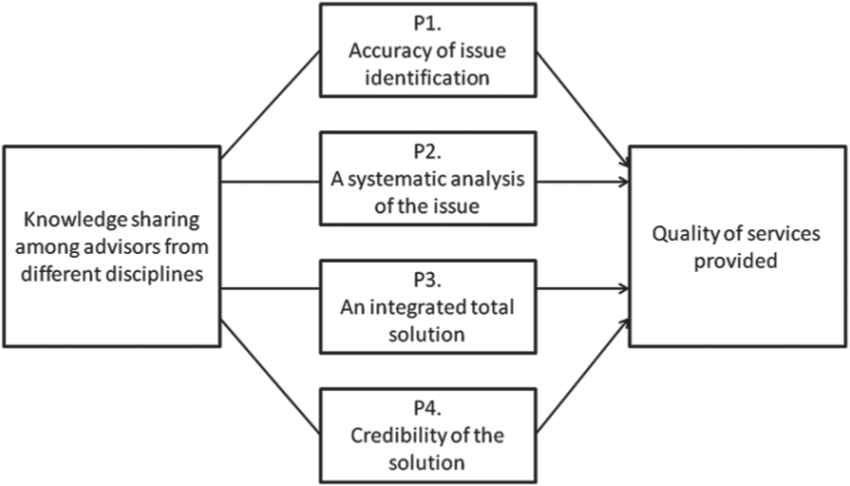
A model of mechanisms underlying the influence of knowledge sharing among external advisors on the quality of advising services provided.
Discussion
As the external environment becomes increasingly volatile and the many issues with which family businesses are confronted continue to grow more complicated, family businesses need to rely to ever-greater extents on external resources such as advisors to resolve their issues. The field of family business advising has seen a rapid growth in recent years. Little empirical work has been conducted on the topic, however; in particular, there is still great uncertainty surrounding how knowledge sharing among advisors from different disciplines affects the advising services provided to the client. The present article set out to address this gap in the extant literature, and we have approached the question primarily from advisors’ perspective. This article makes four primary contributions.
First, this article contributes to the family business advising literature. Scholars have argued that a multidisciplinary approach to advising, or knowledge sharing among advisors from different disciplines, can improve advising services (Dyer, 1994; Swartz, 1989). The underlying assumption of this argument is that the multidisciplinary approach is superior to advice received from an individual advisor. However, up until now there has been no empirical work that examined the validity of this argument, nor can we find the theoretical foundations that explain the underlying mechanisms of this argument. We know a major purpose of theoretical studies is to understand the cause-and-effect relationship of a phenomenon (Reay & Whetten, 2011; Whetten 1989). The focus of this article therefore was on our efforts to investigate the underlying mechanisms of how knowledge sharing among advisors from different disciplines affects the quality of services provided to the family business client. Based on interviews conducted with 20 external advisors, the present article identified four mechanisms through which knowledge sharing among advisors is able to affect the quality of advising services. These findings help address the gap in the extant literature discussed above. However, due to limitations associated with data collection, we did not collect data from family business clients and therefore could not draw a direct link between these four mechanisms and the quality of service. We therefore still lack a sound understanding of whether and how knowledge sharing among advisors affects the actual advising services that family business clients receive. We suggest that future studies collect data from family businesses to further our understanding of this cause-and-effect relationship. A multisource body of data can be used to verify the data and ensure the objectivity and reliability of the study.
Second, this study furthers our understanding of how knowledge sharing facilitates the cultivation of characteristics associated with an effective family business advisor. Researchers in the field of family business advisors have also tried to understand different types of advisors and the characteristics of an effective family business advisor (Strike, 2012). Advisors typically belong to one of two categories—either a content or a process advisor—and an effective advisor possesses such characteristics as systems thinking, trustworthiness, a good reputation, patience, and so on (Strike, 2012). However, there has been no prior research devoted to understanding how knowledge sharing among different advisors helps advisors develop these characteristics. Using qualitative research methods, we found that knowledge sharing among advisors can help advisors develop systems thinking and also gain the client’s trust in the solution provided, thereby improving the quality of services provided. However, more research of this kind should be conducted in the future in order to draw further conclusions. In particular, we need to compare the effect of advising without knowledge sharing with advising that actively engages in knowledge sharing among a host of advisors. Our work represents only a first step in addressing the empirical challenge of opening the “black box” of how knowledge sharing among advisors affects the quality of services. It is also part of a broader program of research meant to provide insight into the factors that affect the quality of services the family business receives.
Third, the process of family business advising has not been adequately addressed in the extant literature. According to Strike (2012), we still need to study the following questions: How do advisors determine the right issues their clients face and how to address these issues? Why are some advisors able to have a greater influence than others? The findings derived from the present study, to a certain extent, address these questions. We found that knowledge sharing among advisors can help determine the right, most pressing issues facing the client. Knowledge sharing can also enable advisors to provide an integrated, total solution to the client, thereby avoiding scenarios in which the client receives conflicting advice from different advisors. By sharing knowledge among advisors, advisors are able to win their client’s trust and better help them implement the recommended solution, and hence exert a greater influence on the future actions of their client.
Last, this study contributes to the body of cross-functional team literature by confirming the benefits of knowledge sharing among advisors on the advising services in the context of family business advising. This contribution demonstrates that a diversity of backgrounds is beneficial. Researchers have previously argued that similarities (e.g., similar backgrounds) among individuals can enhance the outcome of group work (e.g., Cannon-Bowers, Salas, & Converse, 1990, 1993; Mohammed & Dumville, 2001). However, our study has shown that differences that exist between advisors from different professions are helpful in identifying the issues, approaching them from different perspectives and providing the client with an integrated solution.
Conclusions
In this article, we have studied how knowledge sharing among external advisors to family businesses from diverse disciplines affects the quality of the advising services they provide to their clients. Using qualitative research methods, we found that, in individual advisors’ opinions, knowledge sharing improves advising services through the following four mechanisms: (a) by improving the accuracy of question and issue identification, (b) by achieving a systematic analysis of the question, (c) by arriving at an integrated total solution, and (d) by increasing the credibility of the provided solution.
Our study adds to the body of theory pertaining to family business advising by noting that knowledge sharing among advisors can contribute to the quality of advising services and that it helps us understand the family business advising process. Like all research, however, our study has limitations. One limitation is that we collected data only from family business advisors and examined how knowledge sharing affects the advising services from advisors’ perspectives. We still need to understand whether and how knowledge sharing affects the advising services from the clients’ perspectives. It is possible that the clients’ perspectives differ from those of the advisors. A second limitation of this study relates to the fact that the data collected cannot be used to draw a direct connection with the quality of advising services but do explain the mechanisms that underpin knowledge sharing and advising services.
This study has important implications for future research and raises important questions for future research into family business advising. For instance, future studies can compare the impact of advising services that do not share knowledge between different subject-matter experts with that of advising services that actively engage in knowledge sharing among advisors. Future research can also attempt to better understand how knowledge sharing improves advising services from the clients’ perspective.
This study also has important practical implications, especially for family business advisors. One implication stems from the known benefits of knowledge sharing and interaction among advisors in improving the advising services provided to family business clients. Our study suggests that it is valuable for advisors to work with advisors from other disciplines to provide their clients with better services and thereby enhance their trustworthiness.
Footnotes
Declaration of Conflicting Interests
The author(s) declared no potential conflicts of interest with respect to the research, authorship, and/or publication of this article.
Funding
The author(s) disclosed receipt of the following financial support for the research, authorship, and/or publication of this article: This work was supported by the National Natural Science Foundation of China [grant numbers 70902057]; the Ministry of Education of China Humanities and Social Sciences Research Project (grant no.09YJC630196).
Author Biographies
References
Supplementary Material
Please find the following supplemental material available below.
For Open Access articles published under a Creative Commons License, all supplemental material carries the same license as the article it is associated with.
For non-Open Access articles published, all supplemental material carries a non-exclusive license, and permission requests for re-use of supplemental material or any part of supplemental material shall be sent directly to the copyright owner as specified in the copyright notice associated with the article.
