




Abstract

Introduction
Family business research has been flourishing in the past two decades (De Massis, Sharma, Chua, & Chrisman, 2012; Neubaum, 2018). This is manifest in an increasing number of family business studies published in top-tier management journals (e.g., Kotlar, Signori, De Massis, & Vismara, 2018; Neckebrouck, Schulze, & Zellweger, 2018) and an accumulating body of knowledge about the distinctive characteristics and behaviors of family enterprises and the outcomes of such behaviors. However, many of the mechanisms driving family business phenomena involve the micro-level of analysis, and family business researchers have yet to fully embrace this level of analysis in order to build more sophisticated and more robust theory.
In this essay, we highlight and explain the need to apply a microfoundational lens in order to build and test theory that allows scholars to extend, enrich, and refine current knowledge on family enterprises. We also offer specific suggestions concerning how scholars can draw on microfoundations to advance family business research. While microfoundations has swept across (macro-) management research over the past decade or so (Barney & Felin, 2013; Felin & Foss, 2005; Felin, Foss, & Ployhart, 2015; Gavetti, 2005), it has so far had little impact on family business research. Our main point is that claims about “macro”-level phenomena require hypotheses about the underlying local circumstances of purposive agents that are embedded within social structures and make choices that bring about the macro-outcome—a general point that applies to family business research.
In general, microfoundations are about explaining macro-level phenomena in terms of the actions and interactions of lower level entities. Thus, microfoundational explanations are reductionist and mechanism based. In social science, the micro typically (but not necessarily) involves individuals and their interactions, the macro may be, for example, firm-level outcomes, and furnishing microfoundations then means providing a theoretically informed explanation of how firm-level outcomes emerge from the characteristics, behaviors, and interactions of individuals (Felin et al., 2015). Although family business research has substantially increased in rigor over the years, much research on family business phenomena still does not specify theoretically and empirically the mechanisms of choice and action at the levels of analysis lower than that of the phenomenon itself. Ignoring the micro level is problematic because the predictions of our theory for macro-level phenomena may be wrong or incomplete (Coleman, 1990).
With this essay, we encourage scholars to reflect on the importance of applying a microfoundational lens to study family business phenomena, reflect on possible ways to account for microfoundations in future research on different family business topics, and discuss a microfoundational agenda for future family business research.
What Are Microfoundations?
Here we provide a brief characterization of microfoundations in management. Microfoundations derive from a general scientific quest to reduce the use of explanatory black boxes or open these up. Historically, microfoundations has been a theme in the methodology of the social sciences for more than two centuries. Philosophers and social scientists of the Scottish Enlightenment in the 18th century (Adam Ferguson, David Hume, Adam Smith, and others), for example, argued that the task of the then emerging social sciences was to explain phenomena that are the “results of human action, but not of human design” (Hayek, 1967, p. 96). Such phenomena included not only market outcomes but also fundamental institutions, such as morals, property rights, and so on. In the 19th century, Austrian school economists (Carl Menger, in particular) emphasized the spontaneous, order-producing properties of decentralized market processes, a theme that was further elaborated by later Austrians like Hayek in the 20th century (Felin et al., 2015). That century also saw many debates in the philosophy of science on “methodological individualism” versus “holism” (involving, e.g., Karl Popper), debates that spilled over to the social sciences. For example, a key project in macroeconomics since World War II has been to furnish microfoundations for macroeconomics, specifically, to link microeconomics, which starts from individuals, and macroeconomics which involves collective concepts, such as aggregate income or investment. In the context of management theory, explicit attention to microfoundations is, however, much more recent.
As Felin et al. (2015) explain, the basic impetus of what has been dubbed the “microfoundations project” (Winter, 2011) is to unpack some of macro-management’s preferred aggregate concepts (e.g., “capabilities,” “absorptive capacity,” “routines,” and “institutions”) in terms of individual action and interaction; to understand how individual-level factors impact organizations; and to understand the processes that aggregate individual actions into resultant firm behavior outcomes (cf. also Aguinis, Boyd, Pierce, & Short, 2011). An implication of microfoundational thinking is that it is not, strictly speaking, organizations that create value, are innovative or perform other behaviors; rather, what we call firm behavior is the aggregate outcome of many individuals interacting within the rules, plans, beliefs, and so on that characterize the firm (and which are themselves given to analysis in microfoundational terms).
As the characterization so far suggests, microfoundations is not a theory but is more correctly seen as a set of high-level heuristics—prescriptions on the dos and the don’ts—concerning theory building, and per implication, theory-based empiricism. Moreover, these are not very constraining, as we will see.
In the context of management research, microfoundations entails accounting for the causal mechanisms that produce firm-level characteristics and behaviors, based on the characteristics, actions, and interactions of organizational members. 1 This reflects that microfoundational explanation is causal and time-dimensioned and involves paying attention to individual-level heterogeneity (Felin & Hesterly, 2007). In particular, the mechanisms that are highlighted in microfoundational explanation span (minimum two) levels of analysis: Microfoundations are about identifying the proximate causes of a given phenomenon at a level of analysis lower than that of the phenomenon itself. 2 An account of these causes and how these are linked in mechanisms constitutes the explanation. Research that involves being systematic about generalizing this account and defining its boundary conditions is microfoundational theory. When the account involves empirics that detail the events and the mechanisms producing these events, and these empirically informed mechanisms span levels of analysis, we are engaged in microfoundational empirics.
The essence of microfoundations is often depicted by means of the famous “Coleman boat” (Abell, Felin, & Foss, 2008; Felin et al., 2015; Felin, Foss, Heimeriks, & Madsen, 2012) (Figure 1), which is a simple, directed, noncyclical graph with three edges and four nodes (however, it can be expanded both vertically, i.e., stacked boats, and horizontally, i.e., boats next to each other).
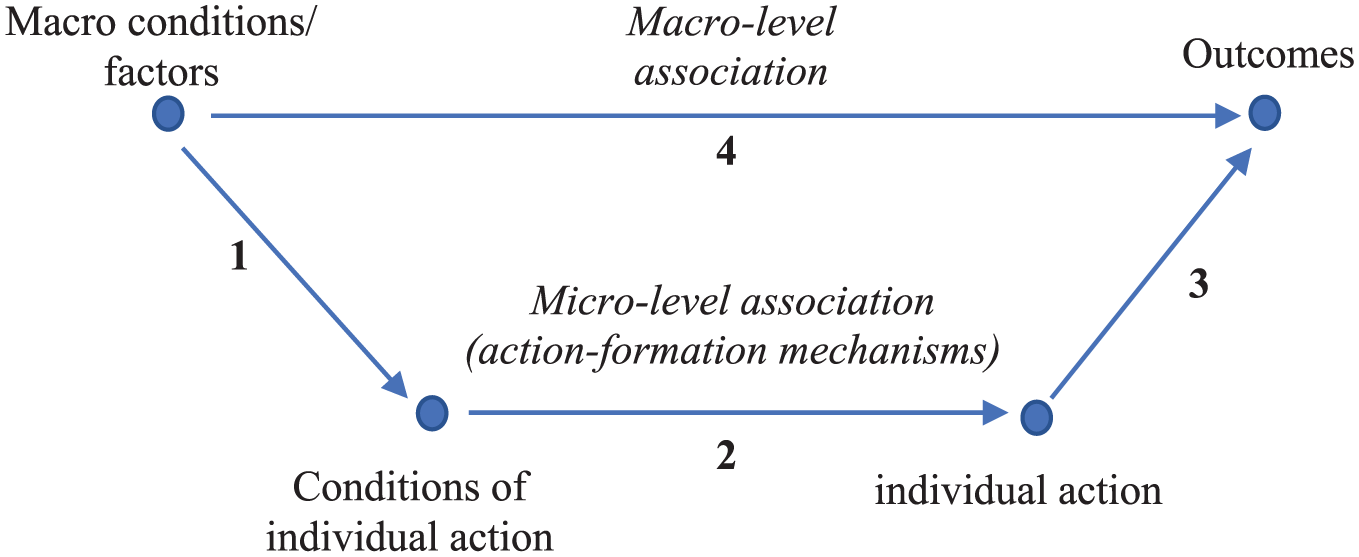
Micro–macro relations in explanation of social science phenomena.
The boat has two levels, a micro level and a macro level, and the edges represent macro–micro links (Edge 1), micro–micro (Edge 2), and micro–macro (Edge 3). These links are to be thought of as involving causal mechanisms (that it is up to the analyst to specify). The phenomenon that the researcher seeks to explain is placed at the north-eastern node. The conditions influencing the individual (i.e., the opportunities and constraints he or she faces) will influence his or her actions (Edge 2). The macro factors represented by the north-western node (e.g., organizational structure and control) influence the conditions faced by individuals (Edge 1). Individual actions aggregate to the explanandum phenomenon (Edge 3). The other three nodes than the north-eastern one and the three edges represent the full microfoundational explanation, but it is clear from the diagram that the full boat is composed of subexplanations. Thus, the parent to the north-eastern node is the south-eastern node, and the edge between them is the mechanism of aggregation. This is an explanation, albeit of a limited nature. Expanding the explanation involves considering the parent of the south-eastern node, namely the south-western node and the parent of this node, namely, the node at the north-western corner, and theorizing the mechanisms linking these nodes (in turn, one may push the explanation further by asking about the parent of this node, etc.).
The Coleman boat implies that the only way through which macro can exert an influence on macro is through the micro level (i.e., macro–micro, micro–micro, micro–macro), and it more generally implies that no explanation in social science can be complete without involving this level. In other words, microfoundations preclude pure structural causation and functional arguments and call for “methodological localism” (Little, 2006), that is, identifying the mechanisms at the local level. 3 The microfoundations perspective has so far been successful with respect to stimulating management research on a host of issues (cf. Note 1). We submit that a microfoundations lens can also further family business research.
A Microfoundational Agenda for Family Business Research
In the following we identify and briefly discuss a set of family business topics/firm behaviors, for which a microfoundational approach is not only needed but also likely to be particularly fruitful. Table 1 summarizes an agenda for future research based on these topics. This research agenda is not completely exhaustive, but it identifies what are in our view particularly interesting research questions that deserve specific attention in the near future. We then briefly discuss some of the key methodological and empirical challenges associated with such research.
Selected Opportunities for Microfoundations Research in Family Business.

First, microfoundations is a way to focus the understanding of how psychological attributes and biases affect strategic choices and firm performance, an aspect that has been rather neglected in prior family business research (Nicholson, 2008). More specifically, we see a need for future research into the psychological foundations of management in family firms. We need to explore how the characteristics of actual judgement and decision processes within such firms (De Bondt & Thaler, 1995) challenge the current predictions about family firms’ behaviors, relying on relevant psychology research (Pastorino & Doyle-Portillo, 2013). Among the important research questions that arise in this space (cf. also Zahra & Newey, 2009), there is a need to explore how family idiosyncrasies affect the emergence of specific psychological biases and heuristics, such as overconfidence or hubris (Hayward & Hambrick, 1997; Li & Tang, 2010) and humility (Ou et al., 2014; Owens, Johnson, & Mitchell, 2013), and the effect of such biases in the family business context.
Second, socioemotional wealth (SEW) (Gómez-Mejía, Haynes, Núñez-Nickel, Jacobson, & Moyano-Fuentes, 2007) and family-centered noneconomic goals (Kotlar & De Massis, 2013) have been among the most influential concepts to explain family firm behavior in the past few decades, but a recent review emphasizes that most SEW research has been overlooking the micro-level mechanisms behind SEW’s cause-and-effect relationships and stresses the importance of advancing understanding of family firms’ microfoundations (Jiang, Kellermanns, Munyon, & Morris, 2018). Thus, we see a need to better understand microfoundational aspects of the nature, drivers, formation of organizational goals and SEW, and their implications for family firm behaviors and performance. Examples of such microfoundational aspects are family relationship conflicts and family-firm name congruence, which have been argued to influence subjective firm valuations by family firm owner-managers (Rousseau, Kellermanns, Zellweger, & Beck, 2018). Thus, a number of research questions emerge in relation to how the characteristics of different family firm actors and the social interaction processes among them affect family business goals and the creation and accumulation of the family’s SEW. Likewise, recent research (Chua, Chrisman, De Massis, & Wang, 2018) has emphasized the importance of taking into account the multiplicity of family firms’ goals systems to correctly assess family firm performance and outcomes, which represents another opportunity for future research.
Third, although succession has been one of the most debated topics in the family business literature (Daspit, Holt, Chrisman, & Long, 2016), our knowledge about successor training (Cabrera-Suárez, García-Almeida & De Saá-Pérez, 2018) and satisfaction (Sharma, Chrisman, & Chua, 2003), individual-level determinants of the incumbent’s intention for intrafamily succession (De Massis, Sieger, Chua & Vismara, 2016), and more generally, the succession process and its performance outcomes (Le Breton-Miller, Miller, & Steier, 2004) are still limited by researchers’ difficulty to theoretically and empirically locate the proximate causes of such aspects at the micro-level of analysis. Thus, there are still several unaddressed questions about the microfoundations of succession. For instance, we still do not have any answer to the fundamental question of what is the goal of a family business succession, who (i.e., which actors) determine such goal, and how such a goal is related to the purpose of the family business defined as “the reason for which a business is created and exists, its meaning and direction” (Hollensbe, Wookey, Hickey, George, & Cardinal, 2014, p. 1228). This lack of knowledge also leads to question prior studies about success in succession as success is achievement of goals, so further research is needed to understand how to conceptualize and identify a successful succession.
Fourth, most literature on family business innovation and internationalization has overlooked the variegated role of family business decision makers and their social context, and recent studies have made calls for documenting the unique microfoundations of family firms in relation to such behaviors, “relating actors and context in ways that clarify their genesis, evolution, manifestations, and consequences across organizational levels and time” (Zahra, 2018, p. 225). It will therefore be important for future studies to understand the micro-level mechanisms behind family business innovation and internationalization. For instance, we call for future research aimed at understanding the benefits and risks of family owners’ emotional attachment and power that may influence the level of absorptive capacity (Brinkerink, 2018) of a family firm and how such effects evolve over time. Also, recent studies (e.g., Kotlar & Sieger, 2018) have studied the link between conditions of individual action (i.e., monitoring, incentives, distributive justice, access to the top management, and job control perceptions) and individual action (i.e., family and nonfamily managers’ willingness to engage in entrepreneurial behavior), and future research may explore how such aspects relate to macro-level phenomena (e.g., the innovative behavior of the family firm).
Fifth, most family business research assumes that once strategy is defined, successful execution follows (Chrisman, Chua, De Massis, Minola, & Vismara, 2016). Thus, we are left with a gap in understanding of micro-level conditions leading family firm actors and decision-makers to execute the firm strategy. For instance, a major area for future research concerns how the characteristics of family firm actors, the structures they are embedded in and the interactions among them influence the set of tasks required to implement the firm’s strategy, the processes by which family firms delegate and sequence actions in executing such strategy, and the formal mechanisms for information-based controls that are needed for strategy execution (i.e., accountabilities and deliverables).
Moreover, research investigating relationships between family involvement and firm behavior has produced persistent inconsistencies, for instance, in relation to whether family firms are more or less risk averse than their nonfamily counterparts (e.g., Naldi, Nordqvist, Sjöberg, & Wiklund, 2007 vs. Zahra, 2005). This has led some researchers to argue that the inconsistencies in empirical evidence are due to the fact that the relationship between family involvement and the particularistic behaviors of family firms is likely to be influenced by an array of mediating and moderating factors, including social structures and social relationships among family firm actors (e.g., Zellweger, Chrisman, Chua, & Steier, 2018). Thus, a sixth area ripe for future research concerns understanding of the mechanisms determining a controlling family’s ability and willingness to influence firm behavior (De Massis, Kotlar, Chua, & Chrisman, 2014), and how different configurations of the family’s ability and willingness affect the strategic drivers of family firm behavior (i.e., resources, governance, goals) and ultimately firm outcomes (e.g., Bozek & Di Vito, 2018).
Seventh, scholars have long recognized that emotions play an important role in work activities (e.g., Hochschild, 1983), and the role of emotions is particularly relevant in the family business context where emotions are important drivers of individuals’ and collective decisions and actions (Shepherd, 2016) and have an ultimate impact on the organization outcomes. Furthermore, the family and the business are so intertwined that in family firms positive and negative emotions among family members can be witnessed at their highest intensity (Brundin & Sharma, 2012). However, research that integrates action-formation mechanisms based on emotions and the emotional experiences of different types of family firm actors to theorize family firm behavior has not received adequate scholarly attention so far. Thus, we encourage scholars to specify the microfoundations of emotions-related aspects and/or to draw on “emotional theories” (such as the appraisal theory cf. Arnold, 1960, affect infusion model cf. Forgas, 1995, network theory of affect cf. Bower, 1981, affective events theory, affect theory of social exchange) or neuroscience to provide richer explanations of family firm behavior and their implications on firm outcomes.
Eight, we see a need for future research that examines more closely the microfoundations of the family system. We call for future studies aimed to investigate how micro-level mechanisms associated with differences in the family structure, family functions, family (member) interactions, and family events (Jaskiewicz & Dyer, 2017) lead to different family firm behaviors and outcomes. More specifically, we encourage family business scholars to draw more on family science (James, Jennings, & Breitkreuz, 2012), related theories/disciplines (e.g., family genealogy, intergenerational solidarity theory, family system theory, social gerontology) and relevant dimensions of family heterogeneity to increase our understanding of how variations not only in the extent but also in the type of family involvement in a business organization translate into firm behavior. For instance, most of existing family business research is based on the traditional nuclear family assumption, which we know in many contexts is not any more the dominant one (Helms, 2013). Thus, we encourage scholars to take into account contemporary phenomena affecting families (e.g., multiple marriages, same-sex couples, domestic partnerships, single-parenthood, step-families, divorces) and/or individuals within or interacting with the family system (e.g., aging crisis, declining fertility) in building and testing microfoundational theories about the determinants, processes and outcomes of family firm behaviors (e.g., succession).
Finally, a number of other important unaddressed questions for future microfoundational research emerge in relation to other topics such as social capital, organizational design, boards, top management teams, family business branding, and authenticity, as reported in Table 1. For instance, a recent study by Beck and Prügl (2018) starts exploring through mixed methods the consumers’ cognitive mechanisms that explain the trust advantage of family firm brands as compared to the brands of nonfamily firms.
Methodological and Empirical Challenges
Of course, advancing family business research through microfoundations implies methodological and empirical challenges. First, if we consider research based on large (register and/or survey-based) data sets, it is clear that successful microfoundational research involves data sampling on at least two levels, which is usually costly and time-consuming, and requires knowledge of the appropriate empirical methodologies (i.e., multilevel statistics), which may not yet be sufficiently diffused in the family business community. Additionally, Felin et al. (2015) argue that important aspects of microfoundations may not necessarily be best researched using traditional regression–based methodologies and cross-sectional data sets (or even panel data sets).
Microfoundational research is certainly consistent with traditional variance-centered large N research, but it is quite arguable that microfoundations also call for alternative approaches to supplement the existing regression-based tools that are widely diffused in the management research community and which face well-known difficulties dealing with causal processes that unfold over both levels and time. Rigorous small N approaches, simulations, and experiments may often be better suited for microfoundational explanatory tasks. Thus, small N approaches (e.g., case studies or other qualitative research methods, ideally performed in a longitudinal way) typically allow to “directly” register and describe the causal micro-mechanisms that drive observed events, either through interviews or direct observation, because a lot more contextual information can be recorded. Survey and register data usually miss out on much (most) of such information. Basically, carefully crafted small N approaches allow the researcher to build event histories, making action-formation mechanisms become less unobserved as compared to large N research. Simulations (e.g., agent-based models) examine the emergent (macro) outcomes of the dynamics of simultaneously interacting rule-based micro agents, typically to account for a particular observed macro phenomenon. As such, they are particularly useful for understanding bottom-up emergent phenomena, modelling aggregation as it unfolds over time. Experimental approaches may be especially useful for understanding top-down (treatment) effects, and Jiang and Munyon (2017) outline how such approaches can be particularly promising for building the affective and cognitive microfoundations of family firm behavior. Thus, pursuing a microfoundational agenda to advance family business research has also the potential to influence the methods we adopt.
Conclusion
In conclusion, we believe that a microfoundational agenda in family business research is both timely and warranted because research is increasingly being conducted about macro-level family business phenomena without specifying theoretically and empirically the mechanisms of choice and action at the levels of analysis lower than that of the phenomenon itself. We have highlighted the need to embrace the micro-level of analysis in order to advance family business research, explained the meaning and theoretical roots of microfoundations, and proposed a microfoundational agenda for future research by delineating a number of important research questions and methodological challenges that need to be addressed if theories about family firm behavior and outcomes are to move forward.
Footnotes
Acknowledgements
We would like to thank Danny Holt, Peter Jaskiewicz, Josip Kotlar, Tyge Payne, and Allison Pearson for their valuable feedback on earlier versions of this essay.