



Abstract

To know where a discipline is going, one must know where it is; to know where a discipline is, one must know where it has been
A decade has passed since proposals were submitted for the first Review Issue of Family Business Review (FBR). Nearly two years later, the journal’s inaugural Review Issue was published, signaling a turning point for both FBR and the field of family business research. By this time, the field had developed to a point where a critical number of studies existed on various family firm topics, and a regular series of reviews was needed.
The guest editors of the inaugural Review Issue recognized this milestone, stating
. . . the field needs a review issue dedicated to unifying the research trends and ideas, looking both historically and toward the future. As the premier journal in family firm research, FBR is uniquely positioned to . . . [offer] a dedicated review issue to take stock of past research and determine interesting future possibilities for impactful research (Short et al., 2016, p. 11).
Since 2016, FBR has published a biennial Review Issue, and this special issue (volume 37, issue 1) marks FBR’s fifth Review Issue.
With the continued growth of research focused on the family business, systematic reviews have become increasingly important (and necessary) to consolidate knowledge on relevant topics, analyze scholarly progress, identify gaps in the literature, and recommend important directions for future research (Sherlock & Dibrell, 2023). Further, reviews that synthesize theories, concepts, and findings on a topic to answer a specific research question, resolve inconsistencies, and/or support theory development in ways that advance the field while contributing to knowledge outside the field are particularly valuable.
Integrating and synthesizing research is important—and perhaps even required—for a field’s scientific progress and evolution (Palmatier et al., 2018). Thus, acknowledging that family business research continues to flourish rapidly and recognizing the importance of periodically engaging in a systematic examination of progress made to support future advancement, the review articles included in FBR’s Fifth Review Issue offer valuable contributions to the field and beyond.
Articles in the Fifth Review Issue
An open call was made for contributions to the Fifth Review Issue. Submissions were open to a broad array of topics with the minimum expectation that the topic reviewed was relevant to the contemporary advancement of family business research and had an appropriate body of literature to review. A total of 38 proposals were received and carefully evaluated by the guest editors with the support of the editor. Based on the evaluations, the authors of 12 proposals were invited to submit full manuscripts. Each full manuscript was subjected to a double-blind peer-review process. Ultimately, after multiple rounds of revision, six articles successfully navigated the review process.
The topics reviewed in this review issue represent interesting and idiosyncratic aspects of family firms: (1) legacy, (2) resilience, (3) dysfunctional behaviors, (4) strategic change, (5) nonfinancial outcomes, and (6) microfoundations. This collection of articles reviews and synthesizes a total of 1,138 scholarly publications to critically examine “what we know” from extant literature and pinpoint “what we need to know” to guide the field’s development. As summarized in Table 1 and discussed below, each article offers valuable contributions to the current state of family business knowledge and highlights promising pathways forward.
Overview of Articles in Family Business Review’s Fifth Review Issue.
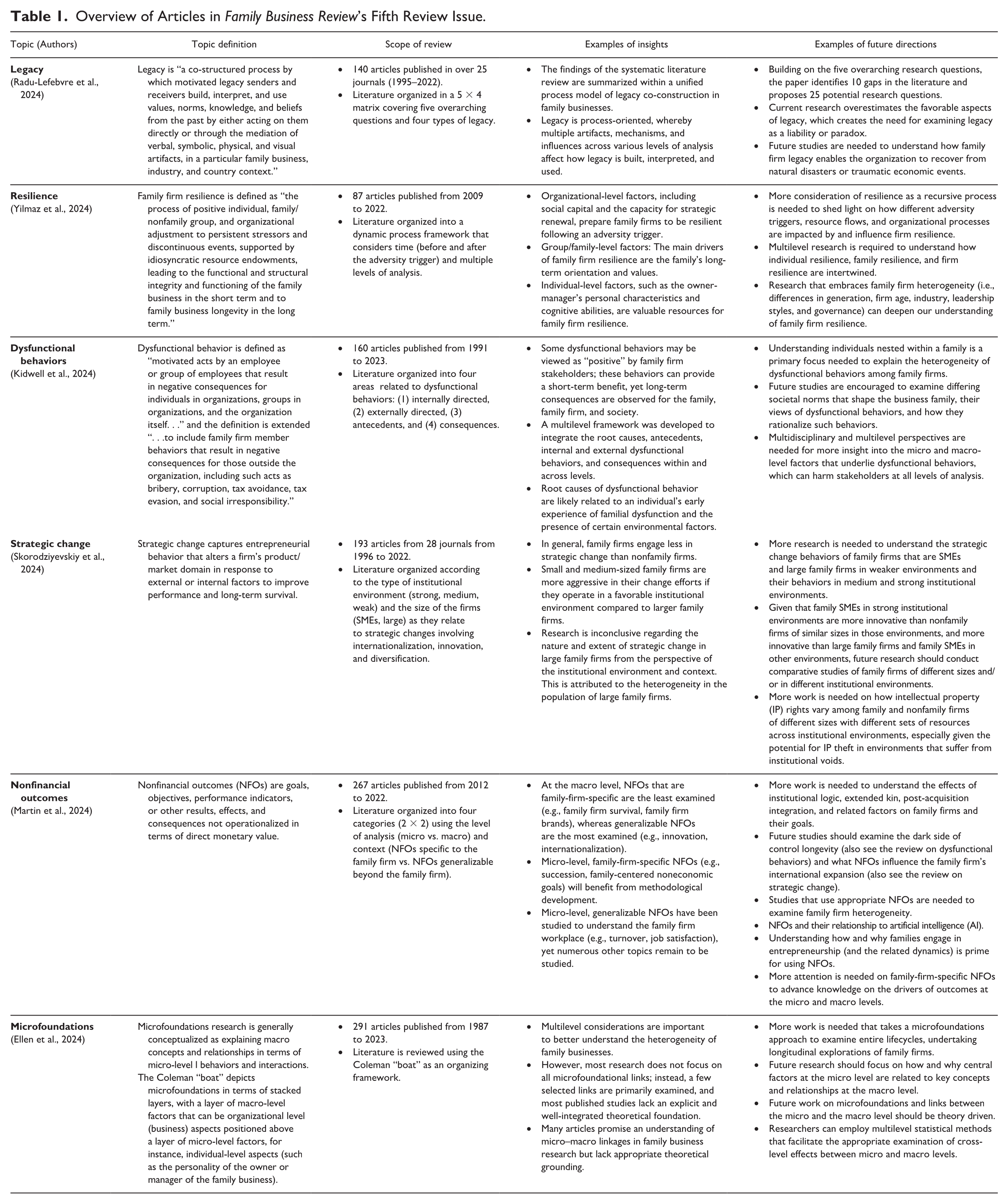
Furthermore, each article independently recognizes a common gap in the reviewed literature. Specifically, the authors of all six review articles observed the need for more multilevel research in the field. We fully agree that multilevel considerations are essential to advancing family firm scholarship (Evert et al., 2016; McKenny et al., 2014). Therefore, we underscore the multilevel aspects of each article in the following summaries, and we then offer future research suggestions for supporting the field’s development through multilevel considerations.
Legacy
With the advancement of the family business field, we have developed an encompassing understanding of the differences between family and nonfamily firms. A primary aspect of differentiation between these two organizational forms relates to the desire of the controlling family to accumulate socioemotional wealth (SEW), which includes pursuing noneconomic goals like continuing the family’s legacy (Berrone et al., 2012; Chrisman et al., 2012; Gómez-Mejía et al., 2007). A notable body of work has examined legacy as it relates to family firms, yet the literature remains divided into streams focused on different types of legacy, leaving essential questions unanswered.
In their article, “Legacy in Family Business: A Systematic Literature Review and Future Research Agenda,” Radu-Lefebvre et al. (2024) systematically review 140 articles published in over 25 journals from various disciplines. The findings of their review are organized to answer five overarching questions related to (1) what legacy is, (2) who sends and receives legacy, (3) why legacy is sent and accepted/rejected, (4) how legacy is sent and received, and (5) in which context legacy occurs. Furthermore, these five questions are answered by reflecting on four types of legacy (i.e., founder legacy, family legacy, family firm legacy, and entrepreneurial legacy). With a meaningful and pragmatic approach, the authors combine their five research questions and the four different types of legacy into a 5 × 4 matrix. Structuring the systematic literature review this way leads to in-depth insights and an integrated understanding of the multiple aspects of legacy.
The authors then use insights from the review to develop a unified process model and offer a definition of legacy in the family business. Both the model and definition emphasize the process-oriented nature of legacy and the multiple artifacts, mechanisms, and influences that span multiple levels of analysis to build, interpret, and use legacy. Overall, the review provides a synthesized understanding that highlights the individuals (senders and receivers), motivations, mechanisms (at the family and business levels), and contexts (business, industry, and country) involved in co-creating legacy. Thus, because influences at multiple levels impact legacy, considering these effects in isolation from one another is not ideal. As the authors note, “legacy fuels individuals, families, and organizations” (Radu-Lefebvre et al., 2024, p. 19). The perspective of legacy offered (focused on co-creation), along with the definition and the process-oriented model, will astutely inspire future studies examining legacy across levels and time.
Resilience
In the family firm context, the presence of legacy—given its values, traditions, and principles—is consequential to the firm’s resilience (e.g., Cucculelli et al., 2016; Zellweger et al., 2013). Furthermore, resilience, or the ability to successfully navigate adversity, is critical to the family firm’s transgenerational longevity (Azouz et al., 2022). Given its importance to the family business, a growing body of research has focused on resilience. While research indicates that family firms can be more resilient than nonfamily firms (Amann & Jaussaud, 2012; Eckey & Memmel, 2023), we need a better understanding of what contributes to this level of resilience in family firms.
Yilmaz et al. (2024), in their review titled “Resilience in Family Businesses: A Systematic Literature Review,” seek to understand the family business idiosyncrasies that unfold in the context of organizational resilience. Based on their review of 87 articles published between 2009 and 2022, the authors first develop a definition of family firm resilience that emphasizes its process orientation and recognizes the multilevel nature through which resilience occurs in the family business. The remainder of their review is organized by the family business-specific factors (e.g., the family’s values and long-term orientation, the firm’s resource and capability endowments, and the demonstration of resilience and learning) that showcase how resilience unfolds in unique and dynamic ways within family firms.
Of particular note, Yilmaz et al. (2024) provide synthesized and comprehensive insights into what makes family firms so resilient, with answers found at each level of analysis. At the individual level, findings indicate that the owner–manager’s cognitive capabilities, knowledge resources, sensemaking abilities, and gender can influence the family firm’s resilience. At the group level, findings show that the owning family’s values (e.g., loyalty, trust, and commitment) and their desire for a transgenerational firm are critical drivers of family firm resilience. At the organizational level, resource and capability endowments (e.g., social capital and capacity for strategic renewal) help make family firms resilient in times of adversity.
A noteworthy implication of these findings is that while factors at each level of analysis shape family firm resilience, consideration of the relationships across levels is necessary for advancing knowledge. Indeed, the authors call for multilevel considerations in future family firm resilience research and identify several promising future research questions. For example, how does the family’s resilience influence the family firm’s resilience and vice versa? How do nonfamily members influence the family firm resilience process? Thus, investigating the interdependencies among different levels of analysis is necessary to provide a deeper understanding of family firms and their resilience.
Dysfunctional Behaviors
Legacy and resilience can be distinctive competencies of the family firm. However, the strong familial bonds and nonfinancial objectives that are foundational to these unique benefits may also be responsible for dysfunctional behaviors. Nonetheless, why dysfunctional behaviors are more likely in some family firms remains to be fully understood.
With this question as their focus, Kidwell et al. (2024) review these negative acts within the family firm in the article titled “Families and their Firms Behaving Badly: A Review of Dysfunctional Behavior in Family Businesses.” Their broad, multidisciplinary search for literature resulted in 160 articles published in 64 journals. From their analysis of these articles, the authors identified the range of dysfunctional behaviors studied in the family firm context—including relevant behaviors focused internal to the family firm and those focused beyond the family firm—and developed a multilevel framework outlining the causes and consequences of these dysfunctional behaviors.
The framework offered by Kidwell et al. (2024) conceptualizes the individual, family, firm, and environmental root causes and antecedents that instigate dysfunctional behaviors in the family firm. The framework also identifies the multilevel consequences that can result from these maladaptive behaviors. In addition to their review, the multilevel model developed by the authors offers insight into why some family firms are more likely to engage in dysfunctional behaviors: the root causes often stem from an individual’s early interactions with a (dysfunctional) family system and from environmental factors. Further, the authors offer explanations about the family interactions that explain these differences and the role of societal and cultural effects on these differences. For example, the root causes of dysfunctional behaviors in the family firm are linked to an individual’s early interactions with their parents and siblings (individual level) and the family system (family level), emphasizing a multilevel scheme of factors that ultimately manifest within the family firm.
Through their review, Kidwell et al. (2024) bring consistency and organization to studying the family firm’s dysfunctional behaviors. Moreover, their multilevel framework underscores the interconnectedness of various levels and highlights the complexity involved in diagnosing, preventing, and addressing dysfunction in the family business. Given that much remains to be known about dysfunctional behaviors in and around the family firm, the insights shared in this review will serve as a valuable resource for future studies on this topic.
Strategic Change
Dysfunctional behaviors may lead to unwanted outcomes for family firms, perhaps resulting in the need for change. Strategic change refers to the alterations a firm makes over time in the form, quality, or state of its products and markets to improve firm performance and/or survival. Family firm research tends to examine either the firm’s external environment or its internal resources in studies of strategic change, resulting in a fragmented understanding.
In the article “Strategic Change in Family Firms: A Review from an Institutional Environment and Firm Size Perspective,” Skorodziyevskiy et al. (2024) examine the family firm’s strategic change by using a framework that concurrently accounts for both the family firm’s institutional environment and its resources. The authors review 193 articles on strategic change—including empirical research on internationalization, innovation, and diversification—published in 28 management, entrepreneurship, finance, and family business journals from 1996 to 2022. They generate findings primarily at the macro level of analysis. However, given the interwoven family and business systems, the review’s pronounced focus on the macro level is naturally linked to the additional levels of analysis associated with the family and the business.
Arranging their review using a framework that integrates the central factors that drive change in strategy, the authors uncover the consensus that exists concerning how family firms internationalize, innovate, and diversify across institutional contexts and the role that the size of the family firm plays herein. Interestingly, Skorodziyevskiy et al. (2024) find that family firms tend to engage less in strategic change than nonfamily firms, yet small- and medium-sized family firms seem to be more aggressive in their change efforts if they operate in a favorable institutional environment. They also find that research is inconclusive regarding the nature and extent of strategic change in large family firms, which is likely attributed to the heterogeneity within this population.
The review provides essential contributions to our understanding of the ways strategic change decisions differ between family and nonfamily firms while clarifying the effects of the institutional environment and firm size on pursuing strategic change. Further, Skorodziyevskiy et al. (2024) offer novel insights to guide future studies that examine the relationships among environmental-level factors (e.g., institutional environment), firm-level factors (e.g., family involvement in management and governance, generation in charge, and ownership distribution within the family), and strategic change. In fact, given that families and their firms are embedded in their institutional context, deconstructing the aspects of the environment (e.g., legal and political environments) is a needed approach that will offer a more granular understanding of the conditions that affect family firms and their strategic decisions. Moreover, extending these studies to account for individual and family-specific differences will better capture the multilevel nature of strategic change decisions and processes.
Nonfinancial Outcomes
As noted, strategic change is pursued to achieve desired outcomes. In family firms, desired outcomes often include those that are nonfinancial. The type (and degree) of nonfinancial outcome pursued is a primary distinction between family and nonfamily firms and a determinant of differences among family firms. Nonfinancial goals have received abundant attention from family business scholars, yet these nonfinancial aspects have been conceptualized broadly, making comparisons of findings across studies remarkably challenging.
Recognizing this limitation, Martin et al. (2024) review nonfinancial outcomes in family firm research. Based on their systematic review of 267 family firm articles that examine 322 nonfinancial outcomes, the authors observed that nonfinancial outcomes are often used in ambiguous and inconsistent ways. Therefore, they first offer a definition of nonfinancial outcomes that is used to develop a four-quadrant (2 × 2) classification scheme, organizing nonfinancial outcomes based on the level of analysis (i.e., macro vs. micro) and context (i.e., specific to family firms vs. generalizable beyond family firms).
Categorizing nonfinancial outcomes into these four quadrants illuminates new insights. For instance, macro-level nonfinancial outcomes specific to the family firm are the least examined, indicating that knowledge in this quadrant remains at a relatively nascent stage of development. Conversely, macro-level nonfinancial outcomes that are generalizable beyond family firms represent a more developed quadrant of research, which is not necessarily surprising given the evolution of the field (evolving from a focus on comparisons between family and nonfamily firms to a greater focus on family firm heterogeneity). The categorization also highlights micro-level nonfinancial outcomes specific to the family firm. While these outcomes are central to family business research, much potential exists for future studies focused on these outcomes, the extent to which the family desires them, and the multilevel factors that lead to their pursuit and achievement. Finally, similar to generalizable nonfinancial outcomes at the macro level, similar outcomes at the micro level have been key to comparisons of family and nonfamily firms. Examining generalizable factors has supported the development of the field to its present stage; however, continuing to focus on generalizable outcomes may hinder future development of the field as the authors note.
In all, researchers have a unique opportunity to gain insights into nonfinancial outcomes by studying family businesses. While nonfinancial outcomes are not unique to the family firm, some goals are certainly more salient in this context. By using family businesses as a platform for future studies, researchers can better understand the nuances of these outcomes, develop generalizable insights, and produce knowledge that contributes to various disciplines. In addition, numerous advances are to be gained from studies that account for temporal dynamics, consider multilevel issues, and employ mixed-method research designs.
Microfoundations
Understanding how nonfinancial (and other firm-level) outcomes emerge requires an examination of the family firm’s microfoundations. The microfoundations perspective—offering “. . . an explanation of how firm-level outcomes emerge from the characteristics, behaviors, and interactions of individuals”—has gained increasing attention in recent years because of its potential to advance our understanding of family firm phenomena (De Massis & Foss, 2018, p. 386). Despite an increasing interest in the microfoundations of the family firm, what is known about relationships that span the primary levels of analysis remains insufficient.
In their review of family firm microfoundations, titled “Microfoundations in Family Firm Research: A Review and Agenda for Theoretically Driven Future Inquiry,” Ellen et al. (2024) examine 291 articles to determine the ways scholars have examined macro-level conditions and micro-level factors to inform macro-level outcomes in family firms. To identify and categorize the distinct microfoundational links, the authors rely on the Coleman “boat” as an organizing framework. This framework depicts microfoundations in terms of stacked layers, which include a layer of macro-level elements positioned above a layer of micro-level elements. The Coleman “boat” is built around four nodes connected by four links. Concentrating on assessing our knowledge of essential links among micro- and macro-level factors in family businesses, Ellen et al. (2024) address the salience of multilevel considerations in the family business literature. In other words, the literature reviewed is organized based on the links outlined by the Coleman “boat” with a core focus on the theories used within each group of studies.
Interestingly, the authors conclude that most research does not incorporate all microfoundational links; instead, a few selected links are often examined. In addition, Ellen and colleagues (2024) report that nearly 25% of the articles reviewed are atheoretical, and of the studies that invoke a theory, the majority integrate the theory’s tenets only superficially. While studies have reported “what” factors are linked at the micro level (e.g., family risk aversion, family tension) and macro level (e.g., family firm innovation, family firm performance), the lack of theoretical development severely restricts our knowledge of the family firm’s multilevel complexities and prevents us from understanding “why” and “how” these relationships exist. As this review suggests, future research must be explicitly theory driven.
Timely and valuable suggestions are offered regarding what theories future scholars can apply in empirical and conceptual studies to investigate the microfoundations of the family business. For example, the authors suggest that one promising route is to conduct more research on the psychological underpinnings of microfoundations, where psychological theories will likely serve as relevant conceptual frameworks (Ellen et al., 2024). Suggestions include self-determination theory, the theory of planned behavior, social cognitive theory, and social cognitive career theory.
Integrated Insights and Next Steps: The Importance of Multilevel Considerations
Multilevel research considers more than one level of conceptualization and analysis (Klein & Kozlowski, 2000) given the underlying assumption that many outcomes result from a combination of influences existing at different levels (Hitt et al., 2007). Today, multilevel research is a well-established approach in management and related fields but remains an under-utilized approach in family firm studies (Evert et al., 2016; McKenny et al., 2014). The central premise of a multilevel lens is that organizations are complex entities existing within a nested system (Hitt et al., 2007; Payne et al., 2011). As family business research evolves, investigations considering a single level of analysis are simply insufficient to capture the complexities inherent to this rich organizational form. Instead, an integrative, multilevel approach is essential to expanding knowledge about the unique aspects of family firms, demonstrating the extent to which these elements differ among family firms, and revealing ways these insights can inform knowledge beyond our field’s boundaries.
The breadth and depth of articles in FBR’s Fifth Review Issue underscore the critical need for multilevel considerations to better understand the nuances of family business dynamics and outcomes. Although the nested system can have numerous levels depending on the context, in broad terms, individuals are nested within work groups, work groups are nested within organizations, and organizations are nested within environments (Hitt et al., 2007; McKenny et al., 2014). We illustrate this nesting arrangement in Figure 1, and we adapt it to the family firm context by adding the family at the group level of analysis. That is, in this context, individuals are nested within work groups, but notably, they may also be nested within families. We suggest that the family is a powerful perspective from which to better understand the multilevel systems inherent to the family firm. Indeed, in the field of family business, a heightened focus on multilevel research will “. . .increase our understanding of how the family influences, and is influenced by, individuals, organizations, environments, and other levels of analysis” (McKenny et al., 2014, p. 595, emphasis added).

Multilevel Nesting Arrangement in Family Firms (and Beyond).
Habbershon and colleagues (2003; Habbershon & Williams, 1999) were among the first family business scholars to strongly and explicitly argue that we need to consider different levels of analysis and the interplay among multiple levels to understand the dynamics of the family business better. Their conceptual work introduced the “familiness” perspective (Habbershon & Williams, 1999). Drawing on the resource-based view and systems theory, they argued that the source of any competitive advantage in the family business arises from the interplay among the levels of the individual, the family/group, and the business/organization (Habbershon et al., 2003). However, as noted from prior examinations of the family business literature, although many family firm phenomena are theorized to exist across levels of analysis, the analyses conducted overwhelmingly continue to focus on a single level (Chrisman et al., 2007; McKenny et al., 2014).
What distinguishes the field of family business research from other fields is the reciprocal effect that exists between the family and the business (Sharma, 2004). The family is a group comprised of individuals who influence the family’s structure, history, culture, and dynamics. That is, individuals are a source from which family-level phenomena emerge (and vice versa). Moreover, because the family is fundamental to the family firm, the family is the ultimate source from which firm-level differences emerge (Daspit et al., 2021, 2023). Additionally, families differ in how they interpret and act upon macro-level phenomena related to their firms (Melin & Nordqvist, 2007). Therefore, due to the inherent multilevel nature of the family firms multilevel considerations must be made when studying this organizational form. By ignoring (or not measuring) phenomena at the micro level, “. . .our theory for macro-level phenomena may be wrong or incomplete” (De Massis & Foss, 2018, p. 386). Conversely, ignoring how phenomena at the macro level are interpreted and made sense of among family firms creates an incomplete theory about the meaning and consequences of micro-level phenomena.
Thus, advocating a multilevel approach to family business research, we agree with Payne (2018, p. 168), who says, “. . .it is time for us to think broader and develop more encompassing research. . .” Therefore, it is in this spirit that we offer suggestions to guide future work. Our recommendations integrate new insights gained from the reviews in this issue and are organized into four topics—each focused on the central role of the family—with research questions offered to inspire future research. The four topics illustrate aspects of the multilevel nature of the family business that emerged from the review articles included in this special issue (although not fully explored). Further, the topics feature promising avenues for multilevel, family-centric research that aims to advance our understanding of the richness that the family infuses into the firm.
Family Topic 1: Involvement and Influence
The family’s involvement in the firm creates dynamics that are not common in other forms of organizations, if present at all. When the family is involved in the business, the family shapes (and is shaped by) each topic examined in this review issue: legacy, resilience, dysfunctional behaviors, strategic change, nonfinancial outcomes, and microfoundations. Common to each of these reviews, a multilevel approach was identified as a necessary pathway forward for future research. Multilevel studies related to the family and its influence will continue developing along numerous pathways; however, particular benefit lies in a more comprehensive understanding of how the aspirations and values of individual family members shape organizational goals and strategies (i.e., furnishing microfoundations), underscoring multilevel relationships involving personal, family, and business objectives. Referring to Figure 1, this represents a “bottom-up” approach to multilevel research, assessing the impact of the individual (Level 1) on the family (Level 2) and the firm (Level 3). Accordingly, we suggest the following research question:
The interplay between the family firm’s institutional environment and strategic change, as addressed by Skorodziyevskiy et al. (2024), calls for multilevel considerations that incorporate external environmental factors with internal family and organizational dynamics. Business families and their members are influenced (directly and indirectly) by their broader institutional contexts, which is the result of historical events, experiences, (in)formal regulations, and other forces that warrant investigation (Aldrich et al., 2023). Future research should explore how family firms navigate and adapt to changing institutional landscapes and how these adaptations are affected by governing family members, family dynamics, and family firm influences, ultimately resulting in the family firm’s response to its environment. Further, the extent to which an appropriate response is successful is likely related to the resilience of the family firm as noted by Yilmaz et al. (2024). This recommended research considers the bidirectional influence of different levels of analysis (e.g., “top-down” and “bottom-up” views) in that it simultaneously explores the effect of the institutional environment (Level 4) on the family (Level 2), and the family’s influence (Level 2) on their firm (Level 3). Along these lines, the following research questions may be investigated:
Family Topic 2: Distinctive Social Capital
Social capital—a topic highly relevant for multilevel considerations (Payne et al., 2011)—is not specific to a particular organizational form. However, family social capital, characterized by the unique ties among kin in the family firm, is specific to the family business (Herrero, 2018). Anchored on elements like trust, norms, values, and familial social networks, family social capital is crucial to the functioning and prosperity of the family enterprise. This distinctive form of social capital influences a family firm’s strategic choices and is shown to affect financial and nonfinancial outcomes (Sanchez-Ruiz et al., 2019).
Family social capital is a double-edged sword. On the one hand, it can enhance unity, expedite decision-making, and reinforce dedication to business objectives. On the other hand, it can instigate favoritism, create internal strife, and raise barriers to resilience when not managed appropriately. Managing family social capital demands a careful balance between family-oriented and business-related priorities, but when managed well, it can facilitate competitive advantage. Poor management of family social capital, though, can lead to challenges such as intergenerational disputes, erosion of legacy transmissions, dysfunctional behaviors, and challenges in making strategic changes. When managed appropriately, these unique bonds can support advantages across numerous aspects of the family firm. The process through which this occurs, beginning with interpersonal relationships, remains to be clearly articulated. We suggest this process can be better understood by considering the interplay of multiple levels of analysis, exploring to what extent and how family social capital (Level 2) is impacted by factors at the individual level (Level 1) and institutional level (Level 4) along with the impacts of family social capital on the firm (Level 3). Formally stated, the following research questions deserve attention:
Family Topic 3: Transgenerational Succession
Succession across family generations is a salient nonfinancial outcome among family firms and one of the most intensively studied topics in the field (see Daspit et al., 2016). While several studies focus on individual-level determinants, such as motivations of potential successors (e.g., Zellweger et al., 2011) or their gender (e.g., Combs et al., 2023; Kubíček & Machek, 2019), many studies have long indicated that factors beyond those related to the individual are consequential. For example, studies have examined family-level factors such as SEW considerations and the relevance of primogeniture (Calabrò et al., 2018; see also Davis & Harveston, 1998), firm-level factors (e.g., in terms of organizational characteristics; see Porfírio et al., 2020), and institutional- or regional-level issues (Baù et al., 2013; Le Breton-Miller et al., 2004; Porfírio et al., 2020).
Moreover, research has pointed to numerous multilevel effects related to succession intentions, the succession process, or related outcomes. For instance, investigations have been made into family-individual interactions in terms of parents’ emotional support and next-generation member’s succession intentions (Lyons et al., 2023) and the relationships among the personal characteristics of successors and organizational characteristics (Porfírio et al., 2020). However, even though Baù et al. (2013) discussed the multilevel nature of succession and called for further corresponding empirical research, and despite Porfírio et al. (2020) reiterating the need for multilevel studies focused on succession in general, we echo these calls given the limited studies that exist.
In their review of microfoundations, Ellen et al. (2024) note that the majority of studies overlook examining the role of individual actions (as the Coleman “boat” and a microfoundations perspective suggest). Doing so will offer a more proximal understanding of the succession outcome. More could be learned from examining individual actions that drive succession success (or failure) while simultaneously accounting for the conditions of individual action and macro-level conditions. In addition, new insights will be gained by investigating the relationships among individual-level motivations, attitudes of potential successors, and firm-level characteristics (e.g., whether high-performing firms attract certain types of successors).
Furthermore, the potential exists to examine how institution-level factors, such as the wealth of a nation or cultural dimensions (Hofstede, 2001; House et al., 2004), affect relevant aspects of succession by considering family-level variables like the preference for primogeniture (Calabrò et al., 2018). This research could also consider how informal and formal institutions impact transgenerational succession intentions in different institutional environments (e.g., Berrone et al., 2022). For instance, in some institutional environments, there might be a strong legal framework associated with inheritance law that drives succession decisions, while in other environments, such decisions are mainly a result of informal norms and expectations. We, therefore, suggest that a more comprehensive understanding of transgenerational succession can be gleaned through examinations that simultaneously consider the multiple levels and directions of such effects. In more formal terms, scholars may consider these research questions (among others):
Family Topic 4: Ownership and Governance
Family ownership is another critical component of the family business system. Researchers have increasingly paid attention to the role of ownership in the long-term development and performance of the family business, for instance, in studies on the importance of the family owner’s mixed motives (Gedajlovic et al., 2012) and the protection of SEW endowments (Gómez-Mejía et al., 2007; Swab et al., 2020). While family ownership is often concentrated and homogeneous, not every family firm is the same. In fact, notable differences exist in ownership concentration and structure. A family business may have multiple owners, and ownership can be divided among several family members, families, nonfamily members, and even other organizations.
Taking a multilevel approach, future research can examine in greater depth to what extent (and how) different types of owners and ownership structures impact family business processes, strategic changes, outcomes, and survival. Haag et al. (2023), for example, used a history-informed longitudinal case study design to understand the micro- and macro-level dynamics that drive family firm longevity, finding that the owner’s change in objectives—and the willingness of the family to sacrifice (some) ownership—contributed to the family firm’s ability to survive environmental changes. Studies that more closely examine family firm ownership and identify the multilevel factors, mechanisms, and outcomes contributing to transgenerational survival are needed to demystify the embedded complexities.
Further, future researchers are encouraged to consider time-related issues (e.g., short-term vs. long-term perspectives of ownership, including entry and exit into ownership of a family business), recognizing that nested factors vary over time. Multilevel assessments that allow for nested and repeated measures are essential to better observe long-surviving family firms (Mathieu & Chen, 2011). In addition to changes within the family firm, the family, and the individuals involved, studies must also consider the institutional conditions that impact changes to ownership and governance (e.g., changes to property rights and ownership protection regimes). Considering factors across multiple levels will offer a more robust understanding of the ways ownership is organized and exercised, that is, the family firm’s governance. Notably, we look forward to future studies that can explain the effects of contextual influences on different owners (and ownership structures) and how their business is impacted. Understanding how family firm owners organize and draw on structures, such as the board of directors and family councils, to navigate factors and pressures that manifest at various levels (e.g., ownership dynamics among kin, firm-level issues, family goals, institutional norms, and industry changes) is necessary. Thus, future studies can consider investigating questions such as:
Conclusion
The articles in this Review Issue provide systematic and comprehensive overviews of the state of research in their respective areas and emphasize the importance of a multilevel approach to advance family business research. In fact, multilevel considerations are crucial to understanding the complexities and diversities of family-owned businesses. A multilevel research approach helps comprehend the interconnectedness and mutual influence of individual, family, organizational, and environmental factors. As family business research evolves, embracing multilevel research designs and theoretical frameworks is essential to generating impactful insights and gaining a deeper understanding of the family enterprise. In addition, the insights gained from multilevel considerations of the family firm, especially those about the family, can advance knowledge beyond the boundary of family business research. That is, given that the institution of the family is a universal commonality, insights from this field can help address broader questions related to the influence of family on many aspects of an individual’s professional life (i.e., the decision to become an entrepreneur, the ability to be a successful successor, the type of career one chooses, leadership and communication skills). More robust knowledge resulting from family firm studies can provide novel insights into workplace behaviors and the higher-level outcomes of such behaviors. Accordingly, we suggest that a focus on the family is a level of analysis commonly absent in many social science fields (beyond our own). We hope that by learning more about the family’s influence through multilevel considerations, we can discover more about the family firm and use that knowledge to create meaningful impact across broader organizational contexts.
Footnotes
Acknowledgements
We thank Peter Jaskiewicz and Evelyn Micelotta for their helpful comments on prior drafts of this introductory article. In addition, Don Neubaum, Editor of FBR, is appreciated for the support and guidance he provided throughout the process of developing this issue and for his feedback on this introductory article. We would also like to thank all the reviewers who devoted considerable time and effort to evaluating the papers included in and considered for this issue. Further, special appreciation is extended to the guest editors and authors of the four previous Review Issues for their contributions to developing a noteworthy collection of insights that have advanced family business scholarship and provided a historical account of the field’s evolution. We are honored and grateful for the opportunity to contribute to this esteemed collection of work.
Correction (March 2024):
Article has been updated online to correct minor style-related and spacing errors.
Author’s Note
Mattias Nordqvist is also affiliated to Jönköping University, Jönköping, Sweden.
Declaration of Conflicting Interests
The author(s) declared no potential conflicts of interest with respect to the research, authorship, and/or publication of this article.
Funding
The author(s) received no financial support for the research, authorship, and/or publication of this article.