




Abstract
Using social cognitive career theory as a theoretical foundation, we examined the relationship between mentor and protégé organizational socialization as well as the mediating role of career, psychosocial, and role-modeling support received by protégés. We also examined the moderating role of mentorship formality in the relationship between mentor socialization and the receipt of career, psychosocial, and role-modeling support. Using survey data collected from 209 ongoing mentoring dyads from five banks in Taiwan, regression results indicated that mentor socialization was positively related to career functions and role modeling that protégés received, as well as protégé socialization. Career support partially mediated the relationship between mentor socialization and protégé socialization. Mentorship formality moderated the relationship between mentor socialization and psychosocial support, suggesting that the positive relationship between mentor socialization and psychosocial functions only bears out in informal mentoring relationships. We offer a discussion of the theoretical and practical implications of these findings.
Keywords
Given the rapidly changing economic environment and increasing trend toward protean careers, organizational socialization is a key issue for both companies and employees. Organizational socialization, or onboarding, is critical to individuals’ adjustment to their work contexts (Bauer, Bodner, Erdogan, Truxillo, & Tucker, 2007; Fisher, 1986; Saks, Uggerslev, & Fassina, 2007; Schein, 1968; Van Maanen & Schein, 1979), and adjustment initiatives have increased (Bauer et al., 2007; Saks et al., 2007). One effective method of socializing employees is through workplace developmental relationships, such as mentoring (Chao, 1997; Chao, Walz, & Gardner, 1992; Feldman & Bolino, 1999; Gibson, 2004; Murphy & Ensher, 2001; Ostroff & Kozlowski, 1993; Saks et al., 2007; Van Maanen & Schein, 1979).
Although some studies have attempted to link mentoring with protégé socialization (Feldman & Bolino, 1999; Thomas & Lankau, 2009), none of the available studies have considered the role of the mentor’s own organizational socialization. Because mentor socialization reflects the knowledge, skills, and attitudes that mentors may pass on to protégés, mentor socialization may impact the effectiveness of the mentoring relationship. Furthermore, mentoring formality may moderate the relationship between mentors’ organizational socialization and mentoring support due to the initiation, attraction, and trust differences in formal and informal mentoring relationships (Allen, Day, & Lentz, 2005; Chao et al., 1992).
In the current study, we adopted the perspective of social cognitive career theory (SCCT; Lent, Brown, & Hackett, 2002) to investigate the mediating role of mentoring functions between mentor socialization and protégé socialization. We examined whether mentorship formality moderates the relationship between mentor socialization and mentoring functions. Employees in the banking industry in Taiwan were surveyed, which allowed us to examine mentoring relationships in non-Western contexts, an area that has been neglected in mentoring scholarship.
Organizational Socialization: An SCCT Perspective
Organizational socialization refers to learning organizational values, norms, knowledge, and skills (Ashforth, Sluss, & Harrison, 2007; Bauer et al., 2007; Chao, O'Leary-Kelly, Wolf, Klein, & Gardner, 1994; Saks & Ashforth, 1997; Schein, 1968; Van Maanen & Schein, 1979), which leads to better adjustment, job attitudes, and job performance (Bauer et al., 2007). Organizational socialization is a lifelong process for both protégés and mentors who are continually adapting their roles within frequently changing, dynamic organizations (Chao et al., 1994; Thomas & Lankau, 2009). A highly socialized employee demonstrates understanding of the organization’s performance proficiency, people, politics, language, goals, values, and organizational history (Chao et al., 1994; Feldman, 1981; Fisher, 1986; Schein, 1968).
Rooted in social learning theory (Bandura, 1986), SCCT (Lent et al., 2002) stresses that learning experiences are critical to an individual’s career development by facilitating vocational interest development, career choices, and career-related performance. One important situational factor of career development is contextual affordances, which refer to environmental resources (Lent et al., 2002). We propose that mentors’ level of socialization represents a critical type of contextual affordance. Because individuals’ learning experiences are shaped by observing and imitating others (Bandura, 1986), mentors’ socialization provides valuable resources (e.g., job-related knowledge) and opportunities for protégés to learn about the organization through processes such as role modeling (Ostroff & Kozlowski, 1993). Consistent with SCCT, employees with mentors are more likely to report higher self-efficacy (Day & Allen, 2004) and may have a clearer understanding about the consequences of their work-related behaviors (i.e., outcome expectancies).
Socialized mentors may be perceived as role models, as these mentors are veterans with higher performance, less stress, and high levels of adjustment (Ashforth et al., 2007; Saks et al., 2007). Protégés may also perceive the degree of their mentors’ organizational socialization as an available resource for their own socialization. In this regard, highly socialized mentors are more likely to act as key organizational agents who can accurately convey performance expectations, organizational goals and values, information about people and politics, and language used in the organization. Because the protégé is more likely to trust and respect a socialized mentor, and because the socialized mentor has a lot of knowledge to transmit, we expect that socialized mentors reinforce protégés’ career interests and choices, which leads to better performance (Lent et al., 2002; Richie et al., 1997). In other words, we propose that socialized mentors are key figures who help to guide the protégés’ perceptions of the work environment which, in turn, is reflected in the protégés’ own organizational socialization. From the SCCT perspective, protégés with socialized mentors will have higher self-efficacy and a higher set of expectations, which relates to interests, choice goals, choice actions, and performance that aligns with the organization. These focused choice behaviors will be reflected in protégé socialization. As such, we propose:
Mentoring Functions as the Mediators
Mentor socialization may also relate to protégé socialization through mentors’ provision of mentoring functions. Kram’s (1983) seminal research specified that career functions support the protégés’ task domains and include mentors’ provision of sponsorship, exposure, and visibility, providing opportunities to develop job-related knowledge and skills, coaching and protection of protégés. Psychosocial functions support the social–psychological domain and include mentors’ provision of role modeling, counseling, friendship, and acceptance and confirmation. Recent mentoring literature recognizes role modeling as a third type of function, in which protégés take on an active role in mentorships (Castro & Scandura, 2004; Hu, Pellegrini, & Scandura, 2011). Cross-cultural studies suggest that mentoring is best understood by the three functions. For example, Taiwanese respondents perceive that there are three distinct mentoring functions and respond to the answering anchors in a similar way to U.S. samples (Hu et al., 2011).
We argue that, from the SCCT perspective, both the mentor’s provision of career and psychosocial functions and the protégé’s active role in seeing the mentor as a role model mediate the relationship between mentor socialization and protégé socialization, as the mentoring functions represent an important learning experience for the protégé. First, highly socialized mentors have more information to share with their protégés via mentoring functions. Second, highly socialized mentors will have more psychosocial resources, such as high job satisfaction, internal work motivation, and job involvement (Bauer et al., 2007; Feldman, 1981; Saks et al., 2007), meaning that highly socialized mentors feel less stressed and more satisfied (Ashforth et al., 2007; Saks & Ashforth, 1997) and therefore have more interpersonal resources to provide meaningful learning experiences for their protégés. Finally, mentors with high organizational socialization are influential in the organization, which leads them to have more political savvy, power and strong professional networks to provide to their protégés. As such, we propose the following hypothesis:
Mentorship Formality as the Moderator
Formal mentoring relationships involve some organizational assistance such as assigning mentors, whereas informal relationships develop spontaneously (Ragins & Cotton, 1999). We argue that the degree of formality of a mentoring relationship may moderate the relationship between mentor socialization and mentoring functions for several reasons. First, mentors and protégés experience higher levels of interpersonal comfort and attraction in informal mentoring relationships (Kram, 1983; Ragins & Cotton, 1999). Second, protégés may feel more comfortable proactively requesting assistance from their informal mentors, which may be interpreted as initiative. Mentors often perceive such behaviors as being favorable and thus are more willing to provide mentoring functions in the future (Hu, Thomas, & Lance, 2008). Furthermore, because informal mentoring relationships tend to emerge when both parties are interested, protégés’ role modeling, admiration, and recognition can enhance their mentors’ self-esteem, thereby facilitating more frequent interactions (Chao et al., 1992; Kram, 1983).
We also explore the importance of mentoring relationships in Chinese societies. Guanxi refers to close relationships that are characterized by high exchange rates and are critical to career success in Chinese organizations (Tsui, Farh, & Xin, 2000). In this regard, especially in Chinese organizations, it is possible that the exchange quality between the mentor and the protégé may be quite different between formal and informal mentorships. Formal mentors may feel reluctant to provide mentoring support since the formal mentorships are less likely to become close relationships and may reserve valuable resources for their informal protégés. In other words, highly socialized formal mentors may not necessarily provide a great deal of mentoring functions to protégés, even though they are capable of doing so. Therefore, we expect that the positive relationship between mentor socialization and mentoring functions will be weaker in formal mentorships than in informal mentorships. As such, we propose:
Method
Participants and Procedure
Executive MBA and continuing education students of the business administration department in a private university located in Northern Taiwan were contacted to provide lists of three to five potential participants who worked in the banking industry. We contacted potential protégé participants, briefed them on the purpose of our study, and invited them to participate in our research. Paired questionnaires containing protégé and mentor surveys were distributed to protégés who agreed to join our research and would distribute the survey to their mentors. For protégés who were involved in more than one mentoring relationship, we asked them to answer the question based on the most recent mentoring relationship and to distribute the survey to their most recent mentor. To prevent potential response biases, in the cover letter, we emphasized that each participant should complete the surveys separately and mail their completed surveys directly to the researchers. All the questionnaires were completed anonymously and matching codes were used to pair returned questionnaires.
Of the 379 questionnaire packages distributed, 251 protégés and 240 mentors returned the completed forms, resulting in a final sample of 209. A total of 143 mentorships (68%) were formal and the average length of the mentoring relationship was 1.43 years (SD = 1.32). Sixty-six percent of the mentors and 65% of the protégés were female. The average age of the mentors was 36.21 (SD = 6.79), and 30.84 (SD = 6.12) for the protégés. The average tenure for the mentors and the protégés was 7.36 (SD = 5.24) and 1.42 (SD = .57) years, respectively.
Measures
Because traditional Chinese was the native language for all respondents, all items were translated from English into traditional Chinese from established scales using Brislin’s (1980) back-translation approach. All items were measured on a 5-point Likert-type scale ranging from 1 (strongly disagree) to 5 (strongly agree), except for demographic variables and mentorship formality. Cronbach’s α values for all scales used in the present study are listed in Table 1.
Coefficients α, Means, Standard Deviations, and Correlations of the Study Variables (N = 209).

aSex: 1 = male, 2 = female. Mentorship formality: 1 = formal, 2 = informal. Length of the mentorship is calculated in months. Mentor tenure in the current organization (in years): 1: less than 2 months, 2: 2 to less than 4, 3: 4 to less than 6, 4: 6 to less than 10, 5: 10 to less than 15, 6: equal or more than 15. Protégé tenure in the current organization (in months): 1: less than 1 month, 2: 1 to less than 6, 3: 6 to less than 12, 4: 12 to less than 24, 5: equal or more than 24. Numbers in parentheses present the coefficient α values of the variables.
*p < .05. **p < .01.
Mentoring functions
Protégé participants answered the 9-item Mentoring Functions Questionnaire (MFQ9; Castro & Scandura, 2004). In past research, the coefficients α for the overall scale, career support, psychosocial, and role modeling were .89, .83, .83, and .81 in the United States and .91, .87, .87, and .84 in Taiwan (Hu et al., 2011). The MFQ9 has been shown to be conceptually equivalent across the United States and Taiwan (Hu et al., 2011). For instance, confirmatory factor analyses supported full configural and metric invariance as well as partial scalar invariance across the two groups.
Organizational socialization
Both mentor and protégé participants responded to the organizational socialization scale (Chao et al., 1994). This scale has 34 items and measures six subdimensions of organizational socialization. Following previous studies in organizational socialization (e.g., Thomas & Lankau, 2009), overall organizational socialization was used to present the level of organizational socialization. The coefficients α in our study (Table 1) were similar to the values (.88) reported by Thomas and Lankau (2009). We identified one study that used the 34-item organizational socialization scale on a sample from Taiwan. Lin and Lee (2010) reported a value of .96 for the reliability coefficient of their sample.
Formality of the mentorship
The formality of the mentoring relationship was measured by one item “Is the mentorship assigned or paired by the organization?” This operationalization is similar to previous studies (e.g., Ragins & Cotton, 1999).
Demographic and control variables
Previous research suggests that employees’ organizational tenure positively correlates with socialization; the longer an individual worked for an organization, the more likely the individual is socialized into the organization (Chao et al., 1994; Thomas & Lankau, 2009). Furthermore, gender and the length of the working relationship between mentor and the protégé also have significant relationships with protégé socialization (Thomas & Lankau, 2009). Thus, we controlled for the following variables in our analyses: the length of the mentorship, the mentor’s organizational tenure and sex, and the protégé’s organizational tenure and sex.
Results
Before testing the hypotheses, we examined construct validity using Anderson and Gerbing’s (1988) confirmatory factor analysis approach on a five-factor model (mentor socialization, the three mentoring functions, and protégé socialization). Organizational socialization was modeled with 6-item parcels, which were average scores of the six subdimensions. The model had a significant chi-square value (χ2 (179) = 371.01, p < .01) and practical fit indices were acceptable (NNFI = .92, comparative fit index [CFI] = .93, PNFI = .75, SRMR = .08, root mean square error of approximation [RMSEA] = .07). The scales used were representative of the corresponding latent constructs since all the factor loadings were significant and constructs were distinguished from each other since none of the confidence intervals included an absolute value of 1. We also compared the five-factor model with a one-factor model (χ2 (198) = 1,500.54, p < .01; NNFI = .62, CFI = .66, PNFI = .56, SRMR = .15, RMSEA = .19) and found that the one-factor model fit substantially worse than the five-factor model (χ2 (19) = 1,129.53, p < .01).
Table 1 shows the descriptive statistics and zero-order correlations for the study variables. Hierarchical regression analyses were used for hypothesis testing. Hypothesis 1, which stated that mentor socialization is positively related to protégé socialization, was supported (Table 2; β = .30, p < .01; ΔR 2 = .09, p < .01). We used Baron and Kenny’s (1986) three-step procedure to test Hypothesis 2, which stated that career, psychosocial, and role modeling mediate the relationship between mentor socialization and protégé socialization. Step 1 was supported in our test of Hypothesis 1. Step 2 examines whether the antecedent related significantly to mediators and was partially supported (career: β = .25, p < .01, ΔR 2 = .07, p < .01; psychosocial: β = .07, p = .52, ΔR 2 = .00, p > .05; role modeling: β = .15, p < .05, ΔR 2 = .02, p < .05). Step 3 examined whether the relationship between mentor socialization and protégé socialization dropped when controlling for significant relationships between the mediators and protégé socialization. We entered the set of predictors (ΔR 2 = .20, p < .01) including mentor socialization (β = .25, p < .01), career functions (β = .19, p < .05), psychosocial functions (β = .18, p < .05) and role modeling (β = .05, p = .50). Only career functions partially mediated the relationship between mentor socialization and protégé socialization (Sobel test = 1.99, p < .05), showing that Hypothesis 2 was partially supported.
Results of Regressing Career, Psychosocial, and Role Modeling on Mentor Socialization and Protégé Socialization on Career, Psychosocial, and Role Modeling (N = 209).

a Sex: 1 = male, 2 = female. Mentorship formality: 1 = formal, 2 = informal. Length of the mentorship is calculated in months. Standardized regression coefficients are reported.
*p < .05. **p < .01.
We tested Hypothesis 3 with three sets of regression analyses, to examine whether mentoring formality moderated the relationship between mentor socialization and mentor function. To test Hypothesis 3, the three types of mentoring relationships were used as outcome variables. We entered the product term of mentorship formality and mentor socialization in the regression after the set of control variables, mentorship formality, and mentor socialization were included in the regression equation. Hypothesis 3 received partial support since mentorship formality moderated the relationship between mentor socialization to psychosocial functions (β = .15, p < .05; ΔR 2 = .02, p < .05), not career functions (β = .06, p = .30; ΔR = 00, p > .05) or role modeling (β = .02, p = .85; ΔR2 = .00, p > .00). Under formal mentorship, mentor socialization negatively related to psychosocial mentoring functions, whereas the relationship was positive in informal mentorship relationships (Figure 1).
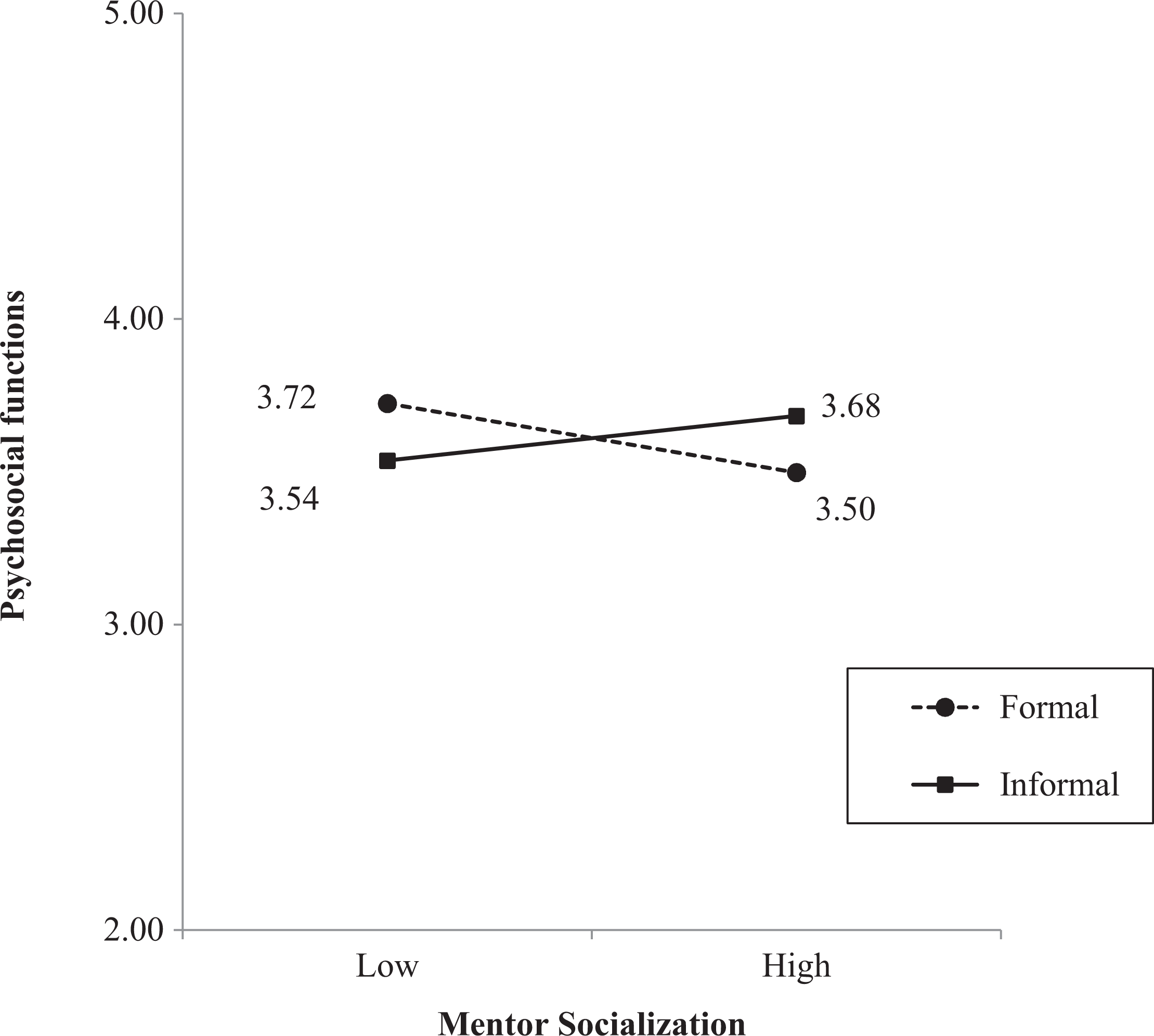
The moderating effect of mentorship formality on the relationship between mentor socialization and psychosocial mentoring functions.
Discussion
Using SCCT (Lent et al., 2002) as a theoretical foundation, we found that mentor socialization positively relates to protégé socialization. Furthermore, mentor socialization relates to career functions and role modeling but not psychosocial functions. Although both career and psychosocial mentoring functions (not role modeling), positively relate to protégé socialization, only career functions partially mediate the relationship between mentor and protégé socialization. Finally, mentor socialization positively relates to psychosocial mentoring functions in informal mentorships, whereas a negative relationship exists in formal mentorships.
Theoretical Implications
Our findings highlight the critical role of mentors in protégé socialization, as mentor socialization not only directly relates to protégé socialization but is also passed to protégés through the provision of career mentoring functions. Although previous research has shown that mentoring can facilitate protégé socialization (Allen, McManus, & Russell, 1999; Chao, 1997; Chao et al., 1992; Feldman & Bolino, 1999; Mullen, 2009; Ostroff & Kozlowski, 1993; Thomas & Lankau, 2009), this is the first study to show that the resources that mentors accumulate as they become more socialized allow them to provide more, high-quality career functions, which in turn facilitates protégé socialization. This study supports SCCT by showing that mentors’ levels of socialization represent a form of contextual affordances that relate to protégés’ organizational socialization through learning experiences, such as career functions provided by the mentor.
Second, the findings of this study demonstrate that mentor socialization and the provision of psychosocial mentoring have a positive relationship when the mentoring relationship is informal, whereas a negative relationship occurs when the relationship is formal. As expected, informal mentors who have more resources as a result of being socialized are able to provide more, high-quality psychosocial functions to their protégés. The negative relationship between mentor socialization and provision of psychosocial functions when the relationship is formal was unexpected. One possible explanation for the negative relationship is that mentors may reserve valuable resources for their informal protégés. Alternatively, mentors in formal relationships may have felt pressured by the organization to participate and may view the mentoring relationship as a burden. One last explanation is that highly socialized mentors may have acclimated to the mentality shared in the organization and, as a result, may have trouble relating to their protégés’ perspectives and challenges. Formal mentorships lack the high degree of mutual attraction, interpersonal comfort, and identification that informal relationships have (Allen et al., 2005; Chao et al., 1992; Wanberg, Welsh, & Kammeyer-Mueller, 2007) and so it may be more difficult for socialized, formal mentors to provide psychosocial functions because their socialization makes it harder for them to identify with their protégés.
Finally, and unexpectedly, although mentor socialization positively relates to role modeling, no relationship was found between role modeling and protégé socialization. This finding was inconsistent with studies highlighting observation of role models as an important means for socialization (e.g., Gibson, 2004; Murphy & Ensher, 2001; Ostroff & Kozlowski, 1993). We argue that two of the three role modeling items used in this study (“I admire my mentor’s ability to motivate others” and “I respect my mentor’s ability to teach others”) may reflect a passive type of mentoring that focuses on the extent to which the protégé admires and respects the mentor’s professional status (Hu et al., 2011). As such, it is possible that the measure fails to capture the active or behavioral part of protégés’ role-modeling behavior.
Given that our study was conducted outside of the United States, our findings provide insight on the role of cultural contexts in career development and protégé socialization. Consistent with the perspective of SCCT, mentors are key contextual affordances and provide important learning experiences for protégés. However, the finding that formal mentors may not help protégés’ socialization, and may in fact hurt socialization, potentially highlights the unique nature of interpersonal relationships in a Chinese context. Given that guanxi emphasizes the importance of having the right connections and valuable information in a professional relationship, formal mentors may feel that sharing key information with formal protégés may put their informal protégés at a disadvantage. Unlike in the United States, where researchers find that career functions relate stronger than psychosocial functions to protégé socialization (Allen et al., 1999), we found that to Taiwanese respondents, the career and psychosocial functions have a similar relationship to protégé socialization. These findings support the concept of guanxi, as the personal component of mentoring appears to be just as influential as the career component.
Practical Implications
Vocational counselors and coaches should know that mentors are important agents who can facilitate the socialization of junior employees. Selecting the right mentor can result in career benefits, and counselors and coaches should encourage their clients to seek out mentors by participating in work-related opportunities to socialize. We suggest that counselors encourage their clients to seek out informal mentors who are highly socialized, as these relationships will yield the maximum number of benefits to their protégés. Individuals who are participating in formal mentoring programs should know that formal mentoring programs can provide many benefits, but that there may be barriers to connecting to mentors due to limits on the mentors’ resources. There is a lot of variability in the effectiveness in formal mentoring relationships. Protégés should seek to work with mentors who they trust and feel comfortable with and recognize that not all mentoring relationships will be equally successful.
Formal mentors should be trained on the importance of organizational socialization and effective ways to develop their protégés. Organizations should also select mentors with an adequate level of socialization, who can provide protégés with correct and desired knowledge concerning the organization, and mentors who also have the potential to identify with their protégés (Eby et al., in press). Organizations with formal mentoring programs can also promote a climate of networking so that protégés can have opportunities to develop informal mentorships. For example, organizations can assign projects that include both senior and junior employees.
Limitations and Future Research Directions
The cross-sectional design of this study leads to the limitation of casual inferences. Although the proposed relationships are derived theoretically, the possibility that protégés with high socialization may hold a positive bias toward their mentors and perceive that they receive more mentoring functions cannot be ruled out. However, this relationship is inconsistent with the rationale in the available mentoring research (Chao et al., 1992; Feldman, Folks, & Turnley, 1998; Mullen, 2009; Ostroff & Kozlowski, 1993; Thomas & Lankau, 2009) and the arguments derived from SCCT (Lent et al., 2002). Second, although multisource, paired data were used, a second possible limitation is that protégés reported both the mediator and outcomes variables. Although results of confirmatory factor analyses suggested that the studied constructs were distinct from each other, the influence of common method variance cannot completely be ruled out. We argue that both the theoretical perspectives and previous empirical studies indicate that mentoring functions provided by mentors as the antecedents of protégé socialization rather than the other opposite direction (Thomas & Lankau, 2009). A third limitation is the possibility that only the protégés who were willing to distribute the survey to their mentors were included in our study, which may cause a potential bias, given the possibility that only satisfying mentoring relationships were included. We argue that this potential bias would have led to the range restriction, which would have our coefficients been attenuated estimates of the actual relationships. Finally, it is important to point out that there are different approaches to testing mediation. We used the Baron and Kenny (1986) method, which can be insensitive to complete mediation and conservative. Because we demonstrated a direct relationship between our predictor and criterion, we identified the Baron and Kenny method as the most appropriate for our data.
The findings of this study also indicate several important directions for future research. First, given the developmental nature of mentorships, the amount of mentoring functions received varies across mentoring phases (Chao, 1997) and relates differently to socialization contexts. Future studies should examine whether the relationship between mentoring functions and socialization varies across mentoring phases. Second, future research should examine how specific mentoring functions (e.g., coaching) relate to protégé socialization since research shows that specific mentoring functions can be differentially related to outcomes (Baranik, Roling, & Eby, 2010). A third research direction is to examine the role of individual characteristics of the mentoring pairs, or person inputs in SCCT. Previous studies have shown that proactive newcomers are more likely to engage in socialization activities, such as information seeking and relationship building (Wanberg & Kammeyer-Mueller, 2000). Therefore, it is possible that mentoring may be more beneficial to the socialization of less proactive protégés.
Footnotes
Declaration of Conflicting Interests
The author(s) declared no potential conflicts of interest with respect to the research, authorship, and/or publication of this article.
Funding
The author(s) received no financial support for the research, authorship, and/or publication of this article.