




Abstract
Contextual factors can play an important and influential role in the career development of Asian American students. The purpose of this study was to examine how specific cultural factors, such as ethnic identity, internalization of Asian American stereotypes, Asian values, parental influences, and perceived barriers, predicted Asian American college students’ self-efficacy, outcome expectations, and interests in occupations and academic areas in which Asian Americans are highly represented. Two social cognitive career theory models were tested in this study: the first model examined how distal and proximal contextual influences predicted self-efficacy and interests in occupations with high Asian American representation and the second model examined how distal and proximal contextual variables predicted math and science self-efficacy, outcome expectations, goals, and intentions. Three hundred and eighty-one Asian American college students participated in this study. The findings from path analyses found a strong fit for the first model, suggesting that distal and proximal contextual factors predicted self-efficacy and interests in occupations with high Asian American representation. An adequate fit was found for the second model. The findings from this study provide psychologists and counselors with a more nuanced understanding of how career decisions are made for Asian American college students.
Asian Americans are the fastest growing ethnic minority group in the United States (U.S. Census Bureau, 2013) and are expected to represent 6% of the population by 2020 (U.S. Department of Health and Human Services, 2001). Occupational segregation continues to exist for Asian Americans with Census data revealing that Asian Americans are overrepresented in science and technology (science, technology, engineering, and mathematics [STEM]) fields and underrepresented in fields related to humanities and social services (U.S. Census Bureau, 2013). For example, Asian Americans comprise approximately 5.5% of the total U.S. workforce but are employed in close to 15% of the U.S. STEM workforce (U.S. Census Bureau, 2013). These career patterns have led to the stereotype that Asian Americans typically choose careers in math, technology, or the physical sciences (Landivar, 2013). Research (e.g., Leung, Ivey, & Suzuki, 1994; Tang, Fouad, & Smith, 1999) has found Asian Americans are more likely to choose realistic and investigative careers and choose occupations that are perceived as logical or analytical. A combination of factors may contribute to this type of career decision-making for Asian Americans, such as parental expectations, societal pressures, cultural values, perceptions of discrimination, and desire for status (Leong, 1998; Leung et al., 1994; Ma & Yeh, 2005; Mau, 2004). Research related to Asian American career development is limited, and more research is needed that examines their career decision-making patterns. The present study examined how cultural, societal, and familial factors predicted self-efficacy, interests, and goals in traditional Asian American occupations and in math and science for Asian American college students.
Family and Collectivist Values
Research on Asian Americans’ career development has highlighted the important role contextual factors can have on vocational development (Fouad et al., 2008). Asian Americans’ family expectations, values, and pressures are factors that play an important role in their career development (Lowe, 2009). Family involvement has been found to predict traditional career interests and choice for Asian American college students, often in math and science fields (Tang, Fouad, & Smith, 2009). In addition, some Asian Americans have reported that they do not engage in career exploration because their family and cultural values impose an expectation to pursue a specific type of career, often in science or technical fields (Fouad et al., 2008). Previous research examining Asian American college students’ career choices in stereotypical occupations found that parental expectations partially mediated the relationship between parental pressures and occupational outcomes (e.g., self-efficacy, outcome expectations, and interests in stereotypical occupations for Asian Americans) and fully mediated the relationship between parental support and these vocational outcomes (Shen, Liao, Abraham, & Weng, 2014). These findings provide support that parental expectations to enter math and science fields are significantly related to increased self-efficacy, higher expectations, and increased interests in stereotypical career paths (e.g., math and science oriented). Asian Americans are also more likely to consider prestige as a factor in their career decision-making than White students, perhaps due to parental expectations (Leung et al., 1994). However, Asian American college students may also feel shame, disappointment, and anxiety if they are not able to or are not inclined to fulfill their parental expectations for their career path (Lowe, 2009). For example, Chinese American youth exhibited higher career indecision when they experienced greater intergenerational family conflict, which results from an incongruence of values or goals between children and parents (Ma & Yeh, 2005).
Collectivism, the idea that an individual is interdependent with family and community, is an important value in Asian American culture and likely is connected to the influential role that parental expectations can have on career choices (Lowe, 2009). Asian Americans’ collectivist values and commitment to family and community may influence them to pursue a career path that ensures financial security, prestige for family, and service to others, rather than fulfillment of intrinsic or personal needs (Leong & Gupta, 2007). Specifically, Asian Americans report a desire to avoid shaming their culture and family and to live up to the stereotype that Asian Americans pursue prestigious, successful careers (Fouad et al., 2008). Moreover, Asian Americans may prioritize family harmony and family tradition rather than individual goals or interests (Leong, Kao, & Lee, 2004). Because of many of these cultural values, Asian Americans are typically viewed as less autonomous as well as more dependent and obedient. These characteristics may affect their self-efficacy and outcome expectations in career-related activities (Leung et al., 1994; Leong & Gupta, 2007).
Ethnic Identity and Acculturation
Asian Americans’ ethnic identity and acculturation levels and styles may also contribute to their career development. For example, Duffy and Klingaman (2009) found that possessing a strong sense of ethnic identity was related to a higher degree of career decidedness for students of color, including Asian Americans. Carter and Constantine (2000) found that a stronger sense ethnic identity was also related to higher career maturity. These findings suggest that Asian American college students with higher levels of ethnic identity may have greater sense of self and an overall lack of confusion, which allows for a greater understanding of career decidedness and firm decision-making about their career futures (Carter & Constantine, 2000; Duffy & Klingaman, 2009). In regard to acculturation, research has found that college students who are more assimilated to American society reported greater interests in careers that were less typical and representative for Asian Americans (Park & Harrison, 1995; Tang et al., 1999). These findings suggest that when Asian American college students become more assimilated to U.S. culture, they are likely to deviate from traditional career choices (Park & Harrison, 1995).
Asian American Stereotypes and Perceived Barriers
Asian Americans often experience stereotypes related to their occupational and educational choices (Oyserman & Sakamoto, 1997; Yoo, Burrola, & Steger, 2010). For example, Asian Americans may be stereotyped as only choosing majors within STEM fields (Leung et al., 1994), and as a result may internalize belief systems that they should be successful in these areas. Internalization of Asian American stereotypes has been found to partially mediate the relationship between parental pressure and occupational outcomes for stereotypical occupations (Shen et al., 2014). These results suggest Asian Americans who internalize stereotypes that they should pursue prestigious math and science careers and believe they will be successful in these fields may exhibit higher outcome expectations, self-efficacy, and interests related to these career choices.
Along with stereotypes that purport Asian Americans are skilled in science and technology fields (Shen et al., 2014), Asian American students may experience negative stereotypes related to their verbal, social, and leadership skills. These stereotypes could result in the development of perceived barriers in obtaining positions that require verbal and social skills. Regardless of whether an individual believes he or she has the necessary skills to pursue a certain career, perceiving obstacles to success, such as discrimination, may prevent that individual from choosing a particular career path (Brown & Lent, 1996). Consequently, Asian American students may pursue careers in which they perceive fewer barriers to their success. Asian Americans perceive greater racial barriers when pursuing careers that are less educationally dependent, such as running for political office (Chen & Fouad, 2013). Asian Americans may particularly perceive discrimination in fields that require high amounts of verbal communication because they are often perceived to lack competent communication skills (Leong & Gupta, 2007). For example, previous research found that Asian American men were not selected for managerial positions due to perceptions that they were not aggressive or assertive enough to be a successful leader (Cheng, 1996). More generally, Asian Americans may be aware of discrimination that occurs in the workplace and therefore guide their children into careers that may not require as much interaction with others or may not provide opportunity for as much upward mobility (Leong & Gupta, 2007). All together this line of research suggests that Asian American college students may contemplate stereotypes about Asian Americans, potential future barriers, and discrimination when making long-term career decisions.
Social Cognitive Career Theory (SCCT)
SCCT can be a useful framework in exploring career decision-making due to its focus on examining relationships between cultural/environmental factors and vocational outcomes (Flores & O’Brien, 2002). SCCT focuses on the interplay between three cognitive variables: self-efficacy, outcome expectations, and personal goals, which facilitate individuals in exercising agency regarding their career decisions (Lent, 2013). SCCT proposes that background contextual factors and learning experiences influence self-efficacy and outcome expectations, which in turn influence career interests, goals, and actions. SCCT also theorizes that proximal contextual factors, such as race, gender, ability, socioeconomic status, and family background, affect one’s ability to access and participate in career development activities (Lent, Brown, & Hackett, 1994). Considering the important role that environmental and cultural factors can have on career development, it is unrealistic to assume that individuals’ interests can always be translated into a feasible career choice regardless of their unique circumstances (Lent et al., 1994). Due to its emphasis on environmental and cultural influences, SCCT lends itself well to examining the career development process of diverse groups (Fouad & Kantamneni, 2013). Since its development in 1994, research using an SCCT framework has advanced our knowledge of how Latino(a), African American, and Asian American student populations make career decisions (Fouad & Kantamneni, 2013) as well as how well social cognitive variables predict math- and science-related outcomes (Lent, 2013).
Current Study
Based on Lent, Brown, and Hackett’s (1994) SCCT model, this study investigated how distal and proximal contextual variables predicted Asian American college students’ vocational outcomes. We examined two SCCT interest models in this study. Considering that Census data suggest that occupational segregation exists for Asian Americans, in which they are employed disproportionately higher in STEM fields and lower in fields related to humanities and social sciences (U.S. Census Bureau, 2013), the first research model examined how distal and proximal contextual influences predicted self-efficacy and interests in occupations which Asian Americans possess high representation. We hypothesized that distal contextual influences, such as ethnic identity, Asian values, and internalized Asian American stereotypes, would predict self-efficacy in occupations with high Asian American representation. We also hypothesized that proximal contextual influences, such as congruence between adolescents and parents in their career choices and perceived barriers, would predict both self-efficacy and interests in occupations with high Asian American representation. Self-efficacy was hypothesized to directly predict interests.
Since Asian Americans are highly represented in STEM fields, are often stereotyped to excel in math and science, and may internalize stereotypes that they should pursue math- and science-related careers (Landivar, 2013; Leung et al., 1994; Shen et al., 2014), we were also interested in gaining a more nuanced understanding of the unique contextual factors that may facilitate the development of math and science goals. The second SCCT model examined in this study investigated how distal and proximal influences predicted math and science self-efficacy, outcome expectations, and goals and intentions. In this model, we hypothesized that distal contextual influences, such as ethnic identity, Asian values, and internalized Asian American stereotypes, would predict both math and science self-efficacy, which in turn would predict math and science goals and intentions. Additionally, we hypothesized that proximal contextual influences, such as congruence between adolescents and parents and perceived barriers, would predict math and science self-efficacy, outcome expectations, and goals/intentions. Finally, as theorized by SCCT, we hypothesized that math and science self-efficacy and outcome expectations would be significantly related to one another and would predict math and science goals and intentions. Much of the prior research regarding Asian Americans’ involvement in math and science has focused on academic outcomes. This study bridges knowledge of Asian American career development with Asian Americans’ involvement in mathematics and sciences.
Method
Participants
Participants included 381 undergraduate students who self-identified as Asian American and were enrolled in a postsecondary institution. Thirty-nine percent of the participants identified as female (n = 149) and 61% identified as male (n = 232). Participants ranged in age from 19 to 42 (M = 23.5, SD = 5.18). Participants identified their ethnic background in an open-ended response as follows: 60.8% Asian or Asian American, 25.1% Eastern Asian American, 9.5% Southeast Asian American, and 2.6% South Asian. Participants reported their majors as follows: art (2.7%), business and economics (23.9%), computer and actuarial science (10.2%), education (1.2%), engineering (18.7%), health science (18.2%), liberal arts (7.2%), social science (5.5%), physical and environmental science (6.7%), unknown (1.2%), and other or no response (3.9%). Participants were recruited from Asian American student organizations at 14 universities across the United States over the course of 1 year as well as through snowball sampling. Participants were recruited from mid-sized to large public and private universities from all geographic regions of the United States. Participants were compensated with a US$10 Amazon gift card for their participation.
Measures
Ethnic identity
Participants completed the Multigroup Ethnic Identity Measure–Revised (MEIM-R; Phinney & Ong, 2007), which consists of 6 items intended to measure individuals’ exploration of and commitment to their ethnic identity. Individuals responded to the items using a Likert-type scale ranging from 1 (strongly disagree) to 5 (strongly agree). The MEIM’s two subscales include the Exploration subscale that evaluates individuals’ active pursuit to learn about their ethnic identity (e.g., “I have often done things that will help me understand my ethnic background better.”) and the Commitment subscale that evaluates individuals’ sense of identification with their ethnic group (e.g., “I have a strong sense of belonging to my own ethnic group.”). Internal reliability coefficients were .81 in the original sample and .83 for the current sample. Previous research has found a two-factor loading across racial/ethnic groups in a large sample of women, providing strong psychometric support the use of the MEIM-R across multiple racial/ethnic groups (Brown et al., 2014).
Asian values
Participants completed the Asian Values Scale–Revised (Kim & Hong, 2004), which consists of 25 items that measure individuals’ identification with Asian values such as modesty, reservation, filial piety, collectivism, and importance of achievement. Items were responded to on a Likert-type scale ranging from 1 (strongly disagree) to 4 (strongly agree). Sample items from the measure include, “One should not deviate from familial and social norms” and “Modesty is an important quality for a person.” The internal reliability coefficient reported for the original sample was .86. The internal reliability coefficient measured for the current sample was .85. Evidence of convergent validity was established when examining high correlations between Asian values and collectivism (Kim & Hong, 2004).
Asian American stereotypes
Participants completed the Internalization of Asian American Stereotypes Scale (IAAS; Shen, Wang, & Swanson, 2011), a 23-item measure that assesses the extent to which individuals’ self-concept and behavior results from espousing stereotyped beliefs about Asian Americans. Items were responded to on a Likert-type scale ranging from 1 (strongly disagree) to 6 (strongly agree). This scale consists of four subscales. Difficulties with English Language Communication examines challenges related to language usage (e.g., “As an Asian American, I would choose a major that requires minimal reading, writing, and verbal communication in English.”). Pursuit of Prestigious Careers explores an individual’s pursuit of prestigious or high-paying careers (e.g., “Prestige is one of the most important determining factors when choosing a career.”). Emotional Reservation examines discomfort with openly expressing emotions and Expected Academic Success assesses academic conscientiousness and pursuit of excellence (e.g., “I am expected to perform well in math and science because I’m Asian American.”). The total scale reliability coefficient was .85 for the original sample and .91 for the current sample. Concurrent validity was established with moderate correlations between the IAAS and measures of well-being; evidence of discriminant validity was found by nonsignificant relationships between IAAS and social desirability (Shen et al., 2011).
Adolescent/parent congruence
Participants completed the Adolescent Parent Congruence Scale (APCS), which consists of 12 items within two subscales intended to measure congruence between adolescents and parents in career exploration, planning, and beliefs using a 6-point Likert-type scale (Sawitri, Creed, & Zimmer-Gembeck, 2012). The Complementary subscale explores whether adolescents believe that their parents meet their career planning needs (e.g., “My parents encourage me to explore the career areas I am interested in”) and are satisfied with their career progress. The Supplementary subscale explores whether adolescents match their parents in career interests, values, and goals (e.g., “My parents want the same career for me as I want for myself”). The internal reliability coefficient reported for the original sample was .87 for the full scale. In the current sample, the full-scale internal reliability coefficient was .88. Evidence for construct validity was found in significant relationships between APCS and measures of parental expectations and support (Sawitri et al., 2012).
Perceptions of barriers
Participants completed the Perceptions of Barriers Scale, which is comprised of 32 items intended to measure participants’ perceptions of career and educational barriers (Luzzo & McWhirter, 2001). The first 11 items assess for perceptions of future job discrimination, and 21 subsequent items assess for educational barriers that may occur when attending college. Items are responded to on a 5-point Likert-type scale ranging from strongly disagree to strongly agree. An example of an item reads, “In my future job, I will probably be treated differently because of my ethnic/racial background.” Higher scores reflect increased perceptions of barriers. The scale was normed with a group of first-year college students, and results exhibited an internal reliability coefficient of .90. For the current sample, the internal reliability coefficient was .97. Luzzo and McWhirter (2001) investigated an earlier version of the scale and revised, eliminated, and added items to increase construct validity.
Self-efficacy in Asian American occupations
Self-efficacy expectations in occupations with high representation of Asian American employment were measured using a method employed by Church, Teresa, Rosebrook, and Szendre (1992). Church and colleagues (1992) originally developed a 31-item questionnaire on which participants rated confidence in their ability to successfully learn to perform an occupation. The self-efficacy measure used for this study was modified to include 20 occupations with the highest and lowest representation of Asian American employment according to the Bureau of Labor Statistics (2014), along with 20 occupations that were neither high nor low in Asian American representation, resulting in 40 occupations that participants responded to in total. Participants responded to each item using a Likert-type scale ranging from very unsure (1) to very sure (6). Sample occupations with high Asian American representation included “computer engineer” and “medical doctor,” whereas sample occupations with low Asian American representation included “steel worker” and “roofer.” Scale scores were calculated by averaging responses for the items assessing for self-efficacy in occupations that possess high employment by Asian Americans. Church et al. (1992) reported an internal consistency reliability of .95 for their sample of Hispanic high school students, and Flores and O’Brien (2002) reported an internal consistency estimate of .81 for their sample of Mexican American adolescents using a similar method of measuring self-efficacy. The internal consistency estimate for the present sample was .98. Flores and O’Brien (2002) provided evidence for convergent validity for this method of measuring occupational self-efficacy. In the present study, self-efficacy in Asian American occupations was positively related to interests in Asian American occupations providing convergent validity for this scale (see Table 1).
Descriptive Statistics and Correlations Among Variables.

Note. SD = standard deviation; EI = ethnic identity; AV = Asian values; AAS = Internalization of Asian American Stereotypes; APC = Adolescent/Parent Congruence; POB = Perceptions of Barriers; SEAA = Self-Efficacy in Asian American Occupations; IAAO = Interest in Asian American Occupations; MSSE = Math and Science Self-Efficacy; MSOE = Math and Science Outcome Expectations; MSGI = Math and Science Goals and Intentions.
**Significant at .05.
Interest in Asian American occupations
Participants’ interests in occupations with high Asian American representation were assessed using the same occupations with high, low, and neutral Asian American employment described on the aforementioned occupational self-efficacy scale. Participants were asked to indicate their interest in 40 occupations listed on a scale ranging from dislike (1) to like (3). Scale scores were calculated by averaging responses for items assessing for interests in occupations that possess high employment by Asian Americans. High scores reflected strong interest in occupations where Asian Americans are highly represented. Church et al. (1992) reported an internal consistency reliability of .86 for their sample of Hispanic high school students and Flores and O’Brien (2002) reported an internal consistency estimate of .74 in their sample of Mexican American women. The internal consistency estimate for the present sample was .95. Further, interest in occupations with high Asian American representation was positively related to self-efficacy in those occupations (see Table 1).
Math and science self-efficacy
Participants responded to the Math and Science Self-Efficacy Scale (MSSES; Smith & Fouad, 1999), which is a 7-item scale designed to assess college students’ confidence to successfully perform math- and science-related tasks using a 6-point Likert-type scale. Sample items included “Earn an A in a science course.” Math and science self-efficacy scores were calculated by averaging the 7 items; higher scale scores indicated higher levels of math/science self-efficacy. Smith and Fouad (1999) demonstrated strong reliability and content and discriminant validity for the MSSES. An internal consistency estimate of .89 was found in the present sample.
Math and science outcome expectations
Participants responded to the Math and Science Outcome Expectations Scale (MSOES; Smith & Fouad, 1999), a 9-item scale intended to assess outcomes that individuals anticipate from participating in math and science activities using a 6-point Likert-type scale. A sample item included, “If I do well in science courses, then I will be better prepared for the work world.” Scale scores were calculated by averaging the 9 items; higher scale scores indicated higher levels of math/science outcome expectations. The internal reliability coefficient was reported to be .81 in the original sample. The internal reliability coefficient for the current sample was .86. Criterion-related and discriminant validity was established by Smith and Fouad (1999) who found that math/science outcome expectations were related to other math and science outcomes (e.g., self-efficacy and goals/intentions), as theorized by SCCT, and were distinct from other academic domains.
Math and science goals and intentions
Participants responded to the Math and Science Goals and Intentions (MSGI) Scales (Smith & Fouad, 1999), a 6-item scale assessing students’ intent to pursue and persist in math- and science-related courses in college and in future careers using a 6-point Likert-type scale. Sample items include, “I intend to enter a career that will use math.” Scale scores were calculated by averaging the 6 items with higher scores reflecting higher levels of math/science goals and intentions. In the current sample, an α coefficient of .80 was found indicating strong reliability for the MSGI. Similar to the MSSES and MSOES, discriminant and criterion-related validity was established in a previous study (Smith & Fouad, 1999). In the current study, math and science goals and intentions were predicted by self-efficacy and outcome expectations providing concurrent validity.
Data Analysis
Two separate, a priori path models were developed based on extant research and literature on Asian American career development and SCCT. These path analyses were performed with Mplus v7.11. Manifest variable models were used due to the number of parameters that would have been estimated relative to the sample size. It is recommended that the sample size be 10 times the number of free parameters in the model (Bentler, 1995). Missing data were addressed by using maximum likelihood estimation during the analysis, as it produces unbiased parameter estimates while maximizing statistical power when data are missing at random or missing completely at random (Enders, 2010). Model fit was assessed using four fit statistics in addition to the chi-square test (χ2): the root mean square error of approximation (RMSEA), the standardized root mean square error of approximation (SRMR), the comparative fit index (CFI), and the Tucker–Lewis index (TLI), which is also referred to as the nonnormed fit index. It is considered good practice to use and report multiple fit indices when evaluating models (Schreiber, Nora, Stage, Barlow, & King, 2006). χ2 tests are the most commonly used method to assess model fit. A low χ2 value, which results in nonsignificant p values (i.e., greater than .05), indicates good model fit. However, the χ2 test is known to be sensitive to large sample sizes, rejecting models with slight inconsistencies with the data. To combat this problem, Raykov and Marcoulides (2006) suggest substantiating the χ2 results by performing additional fit tests. The RMSEA statistic measures the degree of misfit in the hypothesized models; values below .06 indicate a model that fits the data acceptably (Hu & Bentler, 1999), while values greater than .10 designate poor fit (Browne & Cudeck, 1993). Similarly, SRMR values of less than .08 suggest an acceptable model fit, with smaller values indicating better model fit (Hu & Bentler, 1999). CFI and TLI range from 0 to 1; values higher than .95 indicate good model fit (Hu & Bentler, 1999).
Results
Maximum likelihood estimation is robust to multivariate nonnormality (Muthén & Kaplan, 1985), particularly in cases where univariate variables fall within acceptable ranges for normality (skewness values ≤3; kurtosis values ≤10; Weston & Gore, 2006). To ensure that the univariate indices were within acceptable ranges, all of the variables examined were screened for violations of univariate normality. Skewness ranged from −0.50 (perceived barriers) to −0.90 (math and science self-efficacy) and kurtosis ranged from 0.01 (self-efficacy in Asian American occupations) to 1.86 (internalization of Asian American stereotypes), indicating that our variables fell within acceptable ranges of normality. The means, standard deviations, and correlation matrix for each of the measured variables are presented in Table 1.
Traditional Asian American Careers
The manifest variables that appeared in the first model were ethnic identity, Asian values, internalization of Asian American stereotypes, adolescent/parent career congruence, perceptions of barriers, self-efficacy in Asian American occupations, and interest in Asian American occupations. Relationships among the measures are presented in Figure 1. A summary of fit indices is provided in Table 2. The χ2 test indicated that the hypothesized model plausibly fits the data, χ2(3, n = 338) = 3.443, p > .05. In addition, fit indices provided satisfactory evidence that the model fits the data. The CFI was .999. The RMSEA was well within acceptable ranges, with a value of .021 and a 90% confidence interval range of [.000, .096]. The SRMR of the model was .012. In addition, all path coefficients were significant; the coefficients are provided in Table 3. All fit indices and the χ2 test suggest good model fit, indicating that the hypothesized model is a plausible description of the data. Results indicate that ethnic identity (β = .16, p < .05), internalization of Asian American stereotypes (β = .13, p < .05), adolescent/parent congruence (β = .18, p < .05), and perceived barriers (β = .24, p < .05) were positively associated with self-efficacy in Asian American occupations. Asian values were negatively associated (β = −.16, p < .05) with self-efficacy in Asian American occupations. Self-efficacy in Asian American occupations (β = .60, p < .05), adolescent parent congruence (β = .08, p < .05), and perceived barriers (β = .17, p < .05) were positively associated with interests in Asian American occupations.

Social cognitive career model representing relationships between distal contextual variables (i.e., ethnic identity, Asian values, and internalization of Asian American stereotypes), proximal contextual variables (i.e., adolescent/parent congruence, and perceived barriers), and self-efficacy and interests in occupations with high Asian American representation according to the Bureau of Labor Statistics (2014). Asterisk symbol indicates significant at .05.
Summary of Fit Indices.

Note. CFI = comparative fit index; TLI = Tucker–Lewis index; SRMR = standardized root mean square error of approximation; RMSEA = root mean square error of approximation.
Parameter Estimates, Standard Errors, and Significance Levels.

Note. MSSE = Math and Science Self-Efficacy Scale; MSGI = Math and Science Goals and Intentions; AV = Asian value; AAS = Internalization of Asian American Stereotypes; POB = Perceptions of Barriers; EI = ethnic identity; SEAA = Self-Efficacy in Asian American Occupations; APC = Adolescent/Parent Congruence; MSOE = Math and Science Outcome Expectations; MSSE = Math and Science Self-Efficacy; MEIM = Multigroup Ethnic Identity Measure; IAAO = Interest in Asian American Occupations.
Math and Science Careers
The manifest variables that appeared in the second model were ethnic identity, Asian values, internalization of Asian American stereotypes, perceived barriers, adolescent/parent career congruence, math and science outcome expectations, math and science self-efficacy, and math and science goals and intentions. Relationships among the measures are presented in Figure 2. The hypothesized model exhibited a significant χ2; χ2(3, n = 338) = 10.76, p > .05. The fit indices were determined to be acceptable. The CFI exhibited was .986. The TLI was determined to be .918. The RMSEA was .087, with a 90% confidence interval range of [.035, .147]. The SRMR was .016. Not all parameters estimated were significant in the model (see Table 3; Figure 2). Although the χ2 test of the model was significant and there were some nonsignificant paths in the model, the CFI and SRMR fit indices met criteria, providing evidence of adequate model fit. Internalization of Asian American stereotypes (β = .38, p < .05), perceived barriers (β = .13, p < .05), and adolescent parent congruence (β = .21, p < .05) were positively associated with outcome expectations in math and science. Ethnic identity (β = .36, p < .05) and adolescent parent congruence (β = .33, p < .05) were positively associated with self-efficacy in math and science. Perceived barriers (β = −.34, p < .05) were negatively associated with self-efficacy in math and science. Outcome expectations in math and science (β = .56, p < .05), perceived barriers (β = −.08, p < .05), and adolescent parent congruence (β = .21, p < .05) were positively associated with math and science goals and intentions. Outcome expectations and self-efficacy in math and science were positively associated in the model.
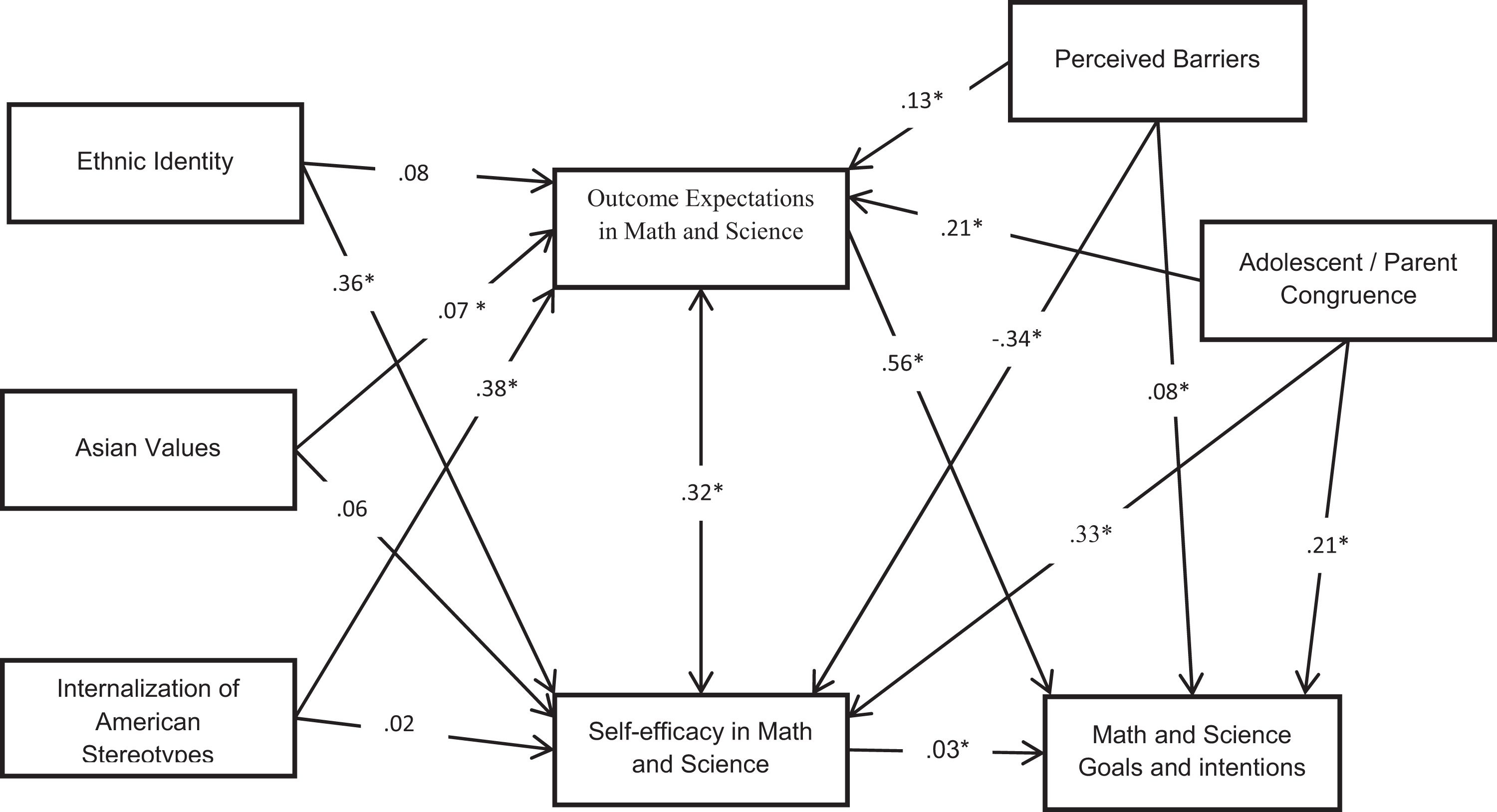
Social cognitive career model representing relationships between distal contextual variables (i.e., ethnic identity, Asian values, and internalization of Asian American stereotypes), proximal contextual variables (i.e., adolescent/parent congruence, and perceived barriers), and math and science self-efficacy, outcome expectations, and goals and intentions. Asterisk symbol indicates significant at .05.
Discussion
The purpose of this study was to examine how distal and proximal contextual variables predicted self-efficacy, goals, and intentions in occupations with high Asian American representation as well as in math and science fields of study. We examined two SCCT models in this study. The first model examined how distal (i.e., ethnic identity, internalization of stereotypes, and Asian values) and proximal (i.e., congruence between parents’ and adolescents’ career expectations and perceptions of barriers) contextual influences predicted self-efficacy and interests in occupations with high Asian American representation. The results from path analyses found a strong fit for the SCCT model, suggesting that both distal and proximal factors predicted self-efficacy and interests in Asian American occupations. Specifically, we found that ethnic identity and internalization of Asian American stereotypes predicted self-efficacy, which in turn predicted interests in representative Asian American occupations. This finding aligns with research that has supported the important role that ethnic identity can play in vocational development (e.g., Gainor & Lent, 1998; Byars-Winston, Estrada, Howard, Davis, & Zalapa, 2010; Duffy & Klingaman, 2009). Additionally, our finding that internalization of Asian American stereotypes predicts self-efficacy and interests in Asian American occupations is not surprising since Asian American students may be more likely to develop self-efficacy, interests, and pursue Asian American stereotypical occupations due to perceived cultural and familial expectations. Our results confirm previous research which has also found that internalization of stereotypes predicts career outcomes for Asian Americans (Shen et al., 2014). Developing high self-efficacy and interests in certain occupations may be helpful in the career decision-making process of Asian American students. However, there is a possibility that Asian American students also experience intrinsic pressure to enter certain prestigious careers, due to the internalization of these stereotypes, which may negatively restrict their career exploration. Further research in this area could directly explore both the positive and negative effects that internalizing stereotypes may have on Asian American college students’ career choices, future career satisfaction, and overall well-being.
Our results also found that congruence between parents and adolescents in career choices and perceived career barriers directly and indirectly predicted self-efficacy and interests in occupations with high Asian American representation. This finding suggests that congruence between parents and adolescents predicts higher self-efficacy and interests in Asian American occupations and strongly aligns with the plethora of research that has supported the important role families and, in particular, parents, have in the career decision-making process of Asian American students (e.g., Fouad et al., 2008; Shen et al., 2014; Tang et al., 1999). Asian Americans may prioritize family harmony and tradition rather than individual interests (Leong et al., 2004) and may experience strong parental expectations in their work choices (Leong & Gupta, 2007). However, our findings did not support the notion that adherence to traditional Asian values predicted vocational outcomes. This result was unexpected since previous research has found that cultural values predicted vocational decision-making (e.g., Fouad et al., 2008). Our findings may be explained by the possibility that Asian American college students more strongly identify with familial influences than cultural influences. Fouad and colleagues (2008) noted that families are often a conduit through which cultural messages are passed. Additionally, we found that Asian American college students who perceive greater barriers to their education and career development may be more inclined to develop self-efficacy and interest in traditional occupations. Perhaps they believe they will experience less barriers in occupations with high representation of Asian Americans. Further research could explore this finding more fully and also explore how Asian Americans cope with educational/career barriers.
Considering that Asian Americans have high representation in math and science occupations and majors (Landivar, 2013), our second model examined how distal and proximal influences predicted self-efficacy, outcome expectations, and goals related to math and science. We found an adequate fit with an SCCT model in which ethnic identity, Asian values, and internalization of Asian American stereotypes acted as distal contextual influences and perceived barriers and adolescent/parent congruence acted as proximal influences in the development of math and science outcome expectations, self-efficacy, and goals and intentions. Specifically, we found that greater internalization of Asian American stereotypes predicted higher outcome expectations in math and science but did not predict self-efficacy. This finding suggests that students who internalize stereotypes may anticipate that math and science will be important in their future career, but simply internalizing stereotypes may not facilitate the development of self-efficacy in math and science. Additionally, we found that ethnic identity predicted math and science self-efficacy; Asian American students who identified more closely with their Asian American background also had higher math and science self-efficacy. This finding is supported by previous research, which reported Asian Americans who more strongly identify with their ethnic background also perform better in math (Armenta, 2010). Combined, these findings suggest that students who strongly identify with their Asian American identity and internalize stereotypes may be more likely to develop greater math and science self-efficacy and outcome expectations, which could result in higher representation of Asian Americans in STEM majors and careers (Landivar, 2013). However, internalization of stereotypes may be more closely related to the development of positive outcome expectations whereas identification with ethnic identity may be more closely related to the development of self-efficacy. Future research could explore the mechanisms in which internalized stereotypes influence outcome expectations.
In regard to proximal contextual influences, both perceived barriers and congruence between adolescents and parents in career decisions predicted math and science outcomes. Specifically, congruence between adolescents and parents predicted greater math and science self-efficacy, outcome expectations, and goals/intentions. Considering that previous research has found that Asian American parents have higher expectations for their children in areas of math and science (Campbell & Mandel, 1990), Asian American students may internalize these expectations, which, in turn, influence their academic and career decision-making. These findings are similar to previous research that has found that parental expectations predicted vocational outcomes for math- and science-related career paths (Shen et al., 2014). Additionally, perceived barriers were negatively related to math and science self-efficacy and positively related to outcome expectations. This finding suggests that Asian American students who perceive higher barriers are more likely to possess lower self-efficacy in math and science yet still possess high outcome expectations, which may indicate that Asian American students still anticipate positive outcomes related to math and science in their future careers despite perceiving barriers.
Overall, both models found support for examining Asian American career development using SCCT; however, the first model demonstrated stronger fit than the second. This study corresponds with meta-analytic reviews (e.g., Rottinghaus, Larson, & Borgen, 2003; Lent et al., 1994) which have found self-efficacy, outcome expectations, and interests to be related to one another in a theoretically hypothesized manner. Additionally, research examining the utility of SCCT in exploring career development in multicultural populations has found similar results (e.g., Gainor & Lent, 1998; Shen et al., 2014; Fouad & Kantamneni, 2013). This study extends the aforementioned research by examining specific contextual factors which could be particularly important for Asian American students, such as adolescent–parent congruence and internalization of stereotypes. Additionally, our study found that outcome expectations predicted math and science goals and intentions, whereas self-efficacy did not. Considering that outcome expectations have not been explored as extensively as other SCCT constructs (Fouad & Guillen, 2006), this study suggests that outcome expectations may be particularly salient when examining Asian American career development. Future research could explore this more fully.
Implications
The results of this study suggest that culturally sensitive career counseling with Asian American college students needs to explore cultural factors such as ethnic identity development, internalization of Asian American stereotypes, and congruence with parents’ and family values. For instance, Asian American college students who have internalized Asian stereotypes in U.S. society appear to have developed self-efficacy in traditionally Asian occupations, but not in math and science subject areas. The incongruence in their expectations to perform well in traditional Asian occupations, but not in the related academic subjects, should be explored further by counselors and psychologists. Perhaps Asian American college students’ self-efficacy in traditional Asian occupations is fueled by cultural and familial expectations, rather than their own past performance. Additionally, the results of this study highlight the central role parents play in the career decision-making process of Asian American college students. This concept may deviate from traditional career development theories which typically place a greater emphasis on the individualistic nature of career decision-making (Gysbers, Heppner, & Johnston, 2014). Psychologists and counselors may need to expand their use of culturally sensitive frameworks so that career development and decision-making are not conceptualized solely from an individualistic perspective. Innovative interventions should also be designed to increase Asian American college students’ awareness in regard to the role of their family in career development and provide students with tools to examine implications of their family’s involvement.
Limitations
Several limitations should be considered when interpreting the results of this study. First, this study examined the career development of Asian American college students as a whole and did not delineate differences between various Asian American identities (e.g., Chinese American, South Asian American), which often differ greatly from one another. Therefore, results from this study are a significant contribution in informing better practice when working with Asian American students but should not be generalized as true for all Asian Americans. Future research could involve replicating this study with smaller subgroups of the Asian American population. Additionally, the recruitment process utilized in this study could have influenced the characteristics of the students who chose to participate in this study, since all participants were recruited from Asian American student groups. There may have been a sampling bias because there could be an inherent similarity in students who choose to join groups related to their ethnic identity. Future research should aim to recruit participants from a wider network. Similarly, our study focused solely on examining the career development of Asian American college students and did not examine Asian Americans employed in the workforce or those in secondary education. Future research could extend the current study by examining satisfaction in career selection for Asian Americans employed in traditional versus nontraditional careers as well as examining high school students who are earlier in their career development.
In conclusion, this study examined how cultural and environmental factors predicted Asian American college students’ academic and career development using SCCT. Our findings highlight the important role that ethnic identity, parental influences, internalized stereotypes, and perceived barriers play in the career development of Asian American students. These findings will hopefully provide psychologists and counselors with a more nuanced understanding of how career decisions are made for Asian American students and inform future research and practice.
Footnotes
Declaration of Conflicting Interests
The author(s) declared no potential conflicts of interest with respect to the research, authorship, and/or publication of this article.
Funding
The author(s) received the following financial support for the research, authorship, and/or publication of this article: This research received funding from the Office of Research and Economic Development at the University of Nebraska-Lincoln.