



Abstract
This study explores the relationship between parental motivational practices, Children’s mathematics achievement trajectories, and persistence in science, technology, engineering, and mathematics (STEM) careers. Nationally representative longitudinal survey data were analyzed using latent growth curve analysis. Findings indicate that parents’ motivational practices influence their children’s mathematics achievement in terms of where the Children start in the 7th grade and how much mathematics achievement grows or changes through the 12th grade. Findings also indicate a positive relationship between mathematics-specific, intrinsically focused parental motivational practices and growth in mathematics achievement and persistence in STEM careers. These findings provide specific information about how different types of parental motivational practices influence long-term mathematics achievement and persistence in STEM careers.
Keywords
Individuals with knowledge in the areas of science, technology, engineering, and mathematics (STEM) are greatly needed to develop and support a competitive workforce in the global marketplace (see e.g., Bureau of Labor Statistics, 2011; National Science Board, 2010a). The National Science Board (2007) highlighted this need by stating that: In the 21st century, scientific and technological innovations have become increasingly important as we face the benefits and challenges of both globalization and a knowledge-based economy. To succeed in this new information-based and highly technological society, all students need to develop their capabilities in science, technology, engineering, and mathematics (STEM) to levels much beyond what was considered acceptable in the past. (p. 2)
Research to support these efforts focuses on a range of factors that contribute to increasing students’ interest and persistence in these fields. Benbow (2012), for example, suggests identifying and supporting students with high early academic achievement, who are likely to play a role in STEM innovations. Other research emphasizes the importance of developing student interest by paying attention to culture (see e.g., Calabrese Barton & Kang, 2000) and formal and informal science opportunities (see e.g., Tal & Morag, 2007; for review see Aschbacher, Li, & Roth, 2010). Building on this literature, this study examines factors that may contribute to achievement test scores and persistence in STEM careers. More specifically, this study examines whether parents’ motivational practices relate to mathematics achievement and persistence in STEM careers.
Parents Influence Mathematics Achievement
Research suggests that children whose parents are supportive and involved in their education have higher academic achievement (see e.g., Brough & Irvin, 2001). These findings are consistent from early childhood through high school (Gonzalez, Doan Holbein, & Quilter, 2002) and for a range of achievement outcomes such as standardized achievement measures, participation in advanced mathematics coursework, and success in higher education (Ma, 2001). Mathematics achievement is viewed as an essential component toward students pursuing STEM careers (seee.g., National Science Board, 2010a). Students with low mathematics achievement are less likely to have the requisite knowledge to persist in these careers. Consider this problematic scenario in which parents simply tell their child that they should become an engineer or a computer scientist but do little else to encourage their child to develop the mathematical knowledge and skills needed to pursue such careers. The child will enter college with an interest in pursuing a STEM career but unprepared to undertake the requisite mathematics coursework. Thus, it is important to explore what parents can do to influence mathematics achievement.
Parents Influence Career Choices
Parents can also influence what careers their children select (Middleton & Loughead, 1993; Otto & Call, 1985; Splete & Freeman-George, 1985). Evidence suggests that parents have a stronger influence on career choices than counselors, teachers, friends, other family members, or people working in the desired career (see e.g., Trusty, 1996). Theories of career development have posed numerous hypotheses for the indirect and direct ways in which parents influence their children and why this might account for the differential influence of parents on their children’s career decisions (see e.g., Young et al., 1997). Parents can influence self-concept, beliefs, and goals by telling their children that they are smart and that they should go to college, which indirectly affects their child’s career decisions (see e.g., Cinamon & Dan, 2010). Parents might also directly support the pursuit of a STEM career by setting high expectations for doing well in mathematics courses and stressing the importance and necessity of mathematics achievement. While some research suggests that the direct behaviors and actions of parents might be more influential than indirect approaches, there is general consensus that parents have at least some influence over their children’s career choices. Effort to further understand this relationship is part of a comprehensive approach to increase the number of students pursuing STEM careers.
Parental Motivational Practices
One lens to examine the relationship between the influence of parents on their children’s mathematics achievement and career choices focuses on different types of parental motivational practices. Parents can motivate their children by engaging in a wide range of methods from providing children with rewards for good grades to praising their children’s effort instead of ability (see e.g., Harackiewicz, Rozek, Hulleman, & Hyde, 2012). Ryan and Deci (2000) define motivation as “being moved to do something” (p. 54); people vary in terms of both the level (how much) and the orientation (what type) of their motivation toward particular tasks. At least two interdependent constructs of motivation are relevant here, extrinsic and intrinsic (Cameron & Pierce, 1994). Extrinsic motivation “refers to doing something because it leads to a separable outcome,” and intrinsic motivation involves “doing something because it is inherently interesting or enjoyable” (Ryan & Deci, 2000, p. 55). Extrinsic motivation includes factors external to the individual, such as punishments or rewards, which are used to control student motivation. Extrinsic rewards include any external factor that does not come from within the task itself, such as receiving money for getting good grades or removing television privileges for getting poor grades. The concern often raised is that external rewards do not promote sustainable behaviors (Lepper, Greene, & Nisbett, 1973). In other words, if the reward or punishment is taken away, the behavior will not continue and the motivation to complete the task decreases. In addition, extrinsic rewards may need to increase in value or magnitude to sustain the behavior. For example, elementary students might be motivated to get a sticker for getting good grades, but high school students need something more than stickers to motivate them to earn high grades.
Intrinsic motivation is the internal desire to engage in a particular task (Deci, 1975; Deci & Ryan, 1985; Harackiewicz, 1979; Harackiewicz & Manderlink, 1984). The factors that influence this engagement come from within the student and are inherent in performing the task itself. Students with intrinsic motivation to learn a particular subject matter might enjoy learning for the sake of learning. Students find rewards in the very process of learning and are less motivated by outside influences, such as teacher praise.
Both extrinsic and intrinsic motivation can be manipulated to optimize student attitudes, performance, and growth (see e.g., Skinner & Belmont, 1993), but not all parental motivational factors equally influence student motivation (see e.g., Ginsburg & Bronstein, 1993; Lepper, Green, & Nisbett, 1973; Sheldon & Epstein, 2005). Research by Gottfried (1990) supports the notion that “development of academic intrinsic motivation in young children is an important goal for educators because of its inherent importance for future motivation, as well as for children’s effective school functioning,” and that “provision of variety of stimulation, parental expectations for achievement, and parental encouragement of curiosity and challenge are positively and significantly related to academic intrinsic motivation” (p. 537). Additional research by Gottfried, Fleming, and Gottfried (1994) and Gottfried, Marcoulides, Gottfried, and Oliver (2009) using longitudinal data from 130 predominantly White respondents suggests differences between particular types of parental motivational strategies. Student intrinsic motivation indirectly influenced academic achievement and related to intrinsic parental motivational strategies. Extrinsic parental motivational strategies did not relate to student intrinsic motivation or achievement. There is general support for the notion that early parental motivational strategies play a role in the development of a child’s current and subsequent motivation orientation and achievement but less agreement on the mechanisms or processes involved.
The present investigation contributes to existing literature on the influence of extrinsic and intrinsic parental motivational practices in three ways. First, this study uses longitudinal data from a nationally representative sample of children to describe the relationship between parental motivational practices and persistence in STEM careers. Second, this study connects multiple outcomes (mathematics achievement and persistence in STEM careers) and focuses on whether two malleable factors (parental motivational practices) influence these outcomes. Finally, this study controls for three factors that influence persistence in STEM careers (gender, ethnicity, and parents’ level of education). These three factors are not malleable and therefore not useful in informing policies focused on increasing mathematics achievement and persistence in STEM careers. However, it is necessary to control for the influence of these factors to see the extent to which the two malleable factors influence achievement and persistence in STEM careers. This research study will address the following questions: Does mathematics achievement in 7th grade and change rates of mathematics achievement from 7th through 12th grade influence persistence in STEM careers? Do general, extrinsically focused and specific, intrinsically focused parental motivational strategies influence starting mathematics achievement in seventh grade and developmental trajectories of mathematics achievement? Do general, extrinsically focused and specific, intrinsically focused parental motivational strategies exhibit differential influences on mathematics achievement and persistence in STEM careers?
This study expands on previous research using the same longitudinal data that analyzed the influence of parents on student mathematics achievement (see e.g., Hong, 2010; Ma, 1999; McDonald, Ing, & Marcoulides, 2010; Wang & Wildman, 1996) by including the most recently released wave of this longitudinal data. The recent data allow for the examination of the influence of parents on middle and high school mathematics achievement and STEM career occupation. As described in the literature above, parents can influence both mathematics achievement and career choice and that mathematics achievement is linked to STEM career interest and persistence. Thus, in examining these multiple outcomes (mathematics achievement and persistence in STEM careers), this study connects research on the influence of parents on mathematics achievement and career choice using a nationally representative, longitudinal database.
Method
Sample
This sample includes participants from the Longitudinal Study of American Youth (LSAY). The LSAY was funded by the National Science Foundation in 1986 to examine the development of student achievement in middle and high school and the relationship of those patterns to career choices. Data collection included attitudinal survey responses from students; telephone interviews with their parents; and survey responses from their mathematics and science teachers and principals. There were two cohorts of students, a 7th-grade cohort and a 10th-grade cohort. Annual data collection continued 1 year beyond high school for the 7th-grade cohort and 4 years beyond high school for the 10th-grade cohort. Follow-up data collection efforts for both cohorts started in 2005 (when participants were in their mid-30s).
The students included in this particular study were from the seventh-grade cohort. The cohort consists of students from 52 middle schools across the United States in 1987 (N = 3,116). Approximately 60 students were randomly selected from each school. The sample is predominantly White (70%) with approximately equal numbers of females (48%) and males (52%). The sample included 9% Hispanic, 11% African American, 4% Asian, and 2% Native American (5% of students did not indicate any race/ethnicity). Thirty-one percent of the students in the sample had at least one parent who completed college, while the other 69% did not. This study included data from students who completed an attitudinal questionnaire in seventh grade and math achievement tests every fall through the end of their high school years. In 2007, more than 95% of the original sample completed a questionnaire about their educational and occupational outcomes (Miller, 2010). The LSAY provides a series of sampling weights to account for unequal attrition from the original sample over the period of the longitudinal study. The data in this study are reweighted from the perspective of the final, overall sample by using the weight created specifically for studies that contain participants who completed the 2007 questionnaire. Attrition is based on observable characteristics by reweighting the respondents who are followed over time and adjusting the estimates for attrition. It is possible that attrition might depend on characteristics that are unobservable, which would render the reweighted estimates used in this study biased.
Measures
Mathematics Achievement
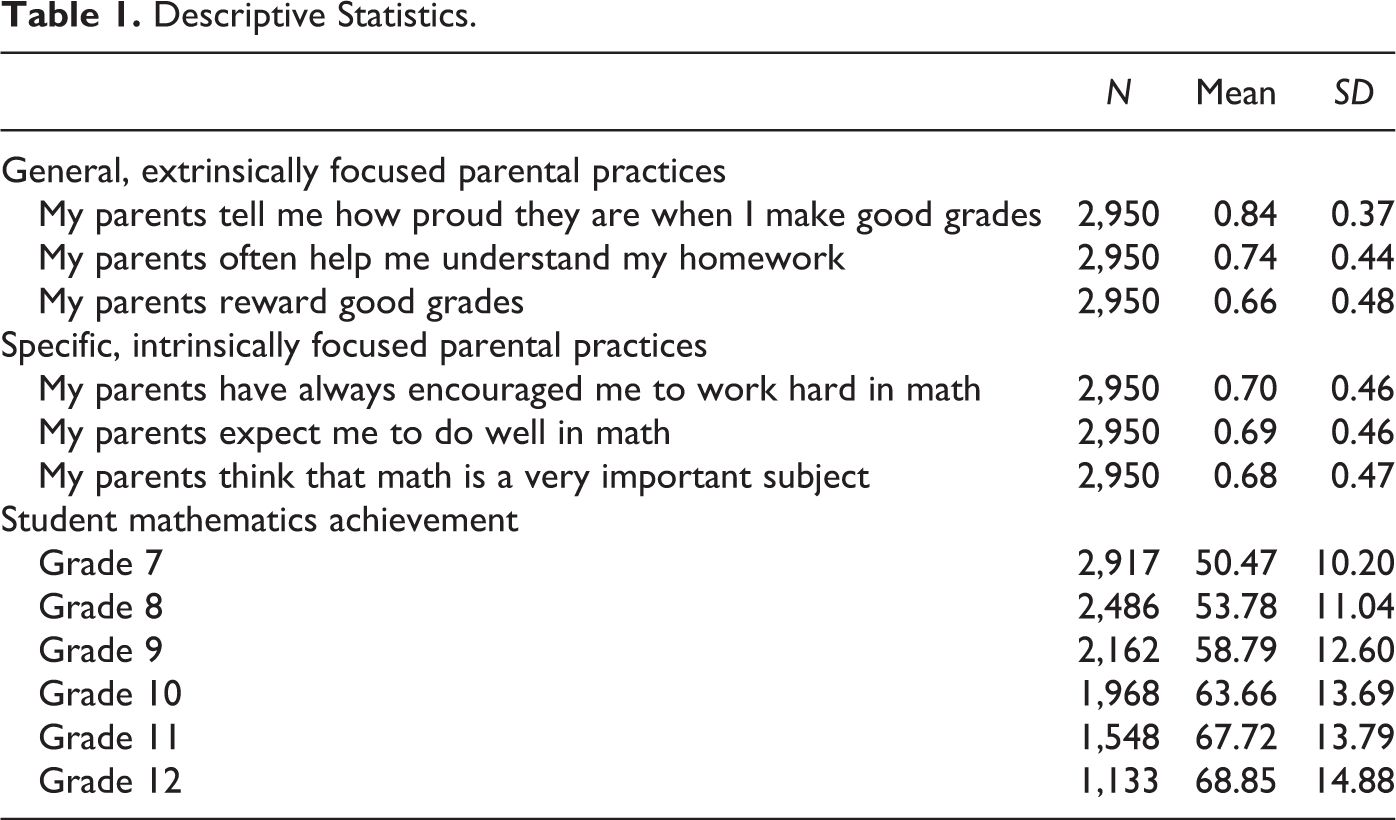
Mathematics achievement was annually assessed in the fall of 7th through 12th grade (Table 1). The scores were calculated using an Item Response Theory model (Lord, 1980), with a scale ranging from 0 to 100. There is a mean score of 50 and a standard deviation of 10 for the seventh-grade students; scores for subsequent years were computed using the same metric (see Miller, 2010 for details). Each test consisted of items from the National Assessment of Educational Progress and was designed to measure basic skills, algebra, geometry, and quantitative literacy. The reliability coefficients of the student responses for these different achievement measures ranged from 0.86 to 0.95.
Descriptive Statistics.
Parental Motivational Practices
Children’s perceptions of their parents’ motivational practices were assessed in the fall of seventh grade using 6 dichotomous items included in the student questionnaire (Table 1). These items were selected based on prior literature on parental motivational practices (see, Gottfried, Fleming, & Gottfried, 1994; Gottfried, Marcoulides, Gottfried, & Oliver, 2009). This prior literature highlights the importance of parents’ encouragement of their children’s intrinsic motivation as a way to increase their children’s motivation and achievement. Prior literature also indicates differences in the influence of parental intrinsic and extrinsic motivational practices.
From these 6 items, two variables were created for this particular study: general, extrinsically focused (My parents tell me how proud they are when I make good grades, My parents often help me understand my homework, My parents reward good grades) and mathematic-specific, intrinsically focused (My parents have always encouraged me to work hard in math, My parents expect me to do well in math, My parents think math is a very important subject). The tetrachoric correlations among the mathematic-specific, intrinsically focused variable ranged from .61 to .70, and among the general, extrinsically focused variable ranged from .42 to .55. The correlations among the items within the same variable are higher than the correlations among the items with the other variable. To examine the structure of these two variables, a confirmatory factor analysis was conducted in which a priori two-factor model was specified. Results indicated that the factor structures exhibited good fit to the data, χ2(7, N = 2,794) = 31.12, p < .001. Following Bentler’s (2007) recommendation that “each major structural equation model be accompanied by at most two other indices of fit” (p. 826), the comparative fit index (CFI) is 0.99 (which is higher than the recommended 0.95 cutoff) and the root mean square error (RMSEA) is 0.04 (which is close to the recommended 0.05 cutoff). Both indices indicate relatively good fit (Bentler, 1990; Hu & Bentler, 1999) between the hypothesized model of children’s perceptions of their parents general, extrinsically focused motivational practices and mathematic-specific, intrinsically focused motivational practices and the observed data.
STEM Career
In the 2007 questionnaire, respondents were asked about the industry of their current occupation. LSAY includes a dichotomous variable to indicate whether or not the respondent was currently employed in a STEM occupation (such engineering). Fifteen percent of the sample was employed in a STEM or STEM support occupation. Being employed in a STEM career varies in terms of educational requirements (Cover, Jones, & Watson, 2011) but does not vary in terms of the high level of technical knowledge and skills required for the occupation. For example, many STEM support occupations are associated with manufacturing and repairing technologically advanced equipment, such as semiconductor processors. These technicians oversee the manufacturing process of semiconductors and need to troubleshoot production problems and ensure that the equipment is functioning properly. This occupation requires strong problem-solving skills and at least an associate degree or 1-year certificate program in semiconductor technology or high-technology manufacturing. The particular measure of a STEM career used as an outcome variable in this study includes the full range of STEM professionals in science, technology, engineering, mathematics, and medicine but excludes social science occupations. Some examples of a STEM career are agricultural and food scientists who study the production and distribution of food; biological scientists who study animals, plants, and bacteria; and materials science engineers who synthesize new nanoscale materials to address challenges in the area of solar power generation. Some examples of STEM support careers are “laboratory technicians, programmers, information network technicians, draftsmen, glass blowers and specialized repair staff” (Miller & Solberg, 2012, p. 8).
In addition to the measures just described, three additional variables were included as controls: student gender, student ethnicity, and parents’ level of education. These variables relate to math achievement and persistence in STEM careers but are not variables that are amenable to manipulation. Student gender is a self-reported variable that is included because males are overrepresented in most STEM careers compared to females (Miller & Kimmel, 2012; National Science Board, 2010b). In addition, gender is sometimes related to perceptions of parental support (see e.g., Adelman, 1998). Student ethnicity is also a variable based on student self-reports of their race/ethnicity. A dichotomous variable created two groups of students: White and Asian (not underrepresented minority) and African American, Hispanic/Latino, and Native American (underrepresented minorities). This grouping is included because underrepresented minority students have lower representation in STEM careers compared to other students (see e.g., Huang, Taddese, & Walter, 2000). In 2004, for example, African Americans made up 12.8% of the population, but only 3.1% of the engineers identified as African American in that year. Additionally, Hispanics made up 14.1% of the population in 2004, but only 4.9% of engineers identified as Hispanic in 2004 (National Science Foundation, 2005). Parents’ level of education is a variable that indicates whether the mother or the father of the student earned an undergraduate degree. The inclusion of this variable is based on research that suggests a relationship between parents’ level of education, academic achievement, and choice of careers (see e.g., Haveman & Wolfe, 1995).
Analysis
A latent growth curve modeling approach (see e.g., Bollen & Curran, 2006) was used to explore the relationship between parental motivational practices, math achievement, and STEM career choice (Figure 1). The independent variables are the parental motivational practices. The dependent variables are student mathematics achievement and STEM career occupation. The first step to building the model is to understand math achievement from 7th through 12th grade. To do this, an unconditional model with no independent variables was estimated:
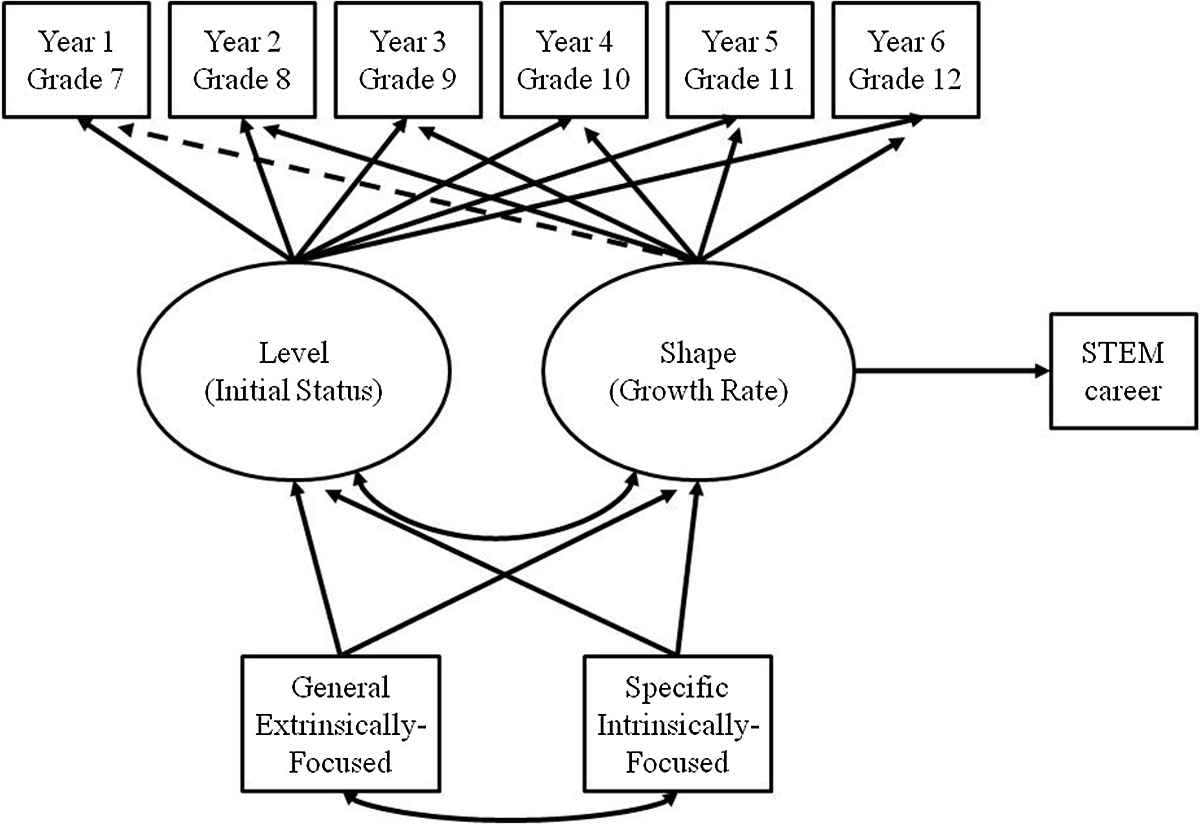
Conditional model for mathematics achievement and science, technology, engineering, and mathematics (STEM) career employment.

where Yit
is the math achievement for student i at time t; α
yi
is the initial status or intercept or level, β
yi
is the change or slope in Yi
between time points; λ
t refers to the different time points; and ∊
it
is the residual for student i at time t. This model estimates two latent factors, the initial starting points (level) and rates of change (shape) to describe the observed changes in math achievement across the 6 years.

These coefficients were estimated and interpreted in the same way as ordinary least squares regression, where a one-unit change in the predictor variable represents the expected change in the outcome variable holding constant the other variables in the model. Positive change in the individual intercepts indicates positive growth in math achievement over time and provides an indication of the magnitude of growth. After estimating the unconditional model, the distal outcome (STEM career) and three control variables (gender, ethnicity, parents’ level of education) were added. This provides information that addresses the first research question (whether math achievement in 7th grade and change rates of math achievement from 7th through 12th grade influences persistence in STEM careers). Finally, the two independent variables (general, extrinsically focused, x
1 and mathematics-specific, intrinsically focused parental motivational practices, x
2) were added to the model. This final model predicted whether student achievement relates to two parental motivational practices after controlling for gender, ethnicity, and parents’ level of education. Equations 4 and 5 illustrate how these two independent variables (x
1 and x
2) and the vector of control variables (x
3) explain the initial status and rate of change.

This approach does not assume a linear growth and models the change process regardless of the actual shape of the trajectory (i.e., linear, quadratic, cubic). Specifically, the specification of the model in this article fixes the loadings on the shape factor of the first assessment occasion (7th grade) at 0 and final assessment occasion (12th grade) to a value of 1 and freely estimates the intermediate loadings (for more on this, see Bollen & Curran, 2006).
Mplus Version 5.2 with maximum likelihood estimation with robust standard errors was used to estimate these models (Muthén & Muthén, 1998–2010). Several fit indices were considered to evaluate model fit: the overall χ2 goodness-of-fit test, CFI, and RMSEA. Similar to fit for the confirmatory factor models discussed earlier, support for good fit of the model includes nonsignificant χ2 goodness-of-fit value, a CFI > 0.90, an RMSEA below 0.05 (Bentler, 1990; Hu & Bentler, 1999). To compare different models, the chi-square test (Δχ2) for nested models with an MLR estimator was computed as outlined in Sattora and Bentler (2001).
Results
To examine whether mathematics achievement in 7th grade and change rates of mathematics achievement from 7th through 12th grade influence persistence in STEM careers, the unconditional model did not consider any independent variables. Instead, this model only included the outcome variables, achievement scores from 7th through 12th grade. The fit criteria indicated good model fit, χ2(15, N = 2,794) = 4,133.61, p < .001, RMSEA = 0.05, CFI = 0.98, with positive growth in achievement over time. Next, a dichotomous, distal outcome and the three control variables were included, Δχ2(5, N = 2,794) = 139.89, p < .001. The level and shape factors were positively and significantly related to persistence in STEM careers, holding constant gender, ethnicity, and parents’ level of education. There was significant variation in both the level (s 2 = 77.50, p < .001) and shape (s 2 = 60.99, p < .001) factors that suggest meaningful individual variability in the average initial starting points and rates of changes in math achievement from 7th through 12th grade. The estimated mean for the level factor indicated that the average mathematics achievement in seventh grade is 46.57 (p < .001). There was also a positively and statistically significant difference for the shape factor (μβy = 13.84, p < .001), which indicated that on average there is a positive increase in math achievement from 7th through 12th grade. In other words, on average, there is an increase in mathematics achievement of approximately 14 units each year.
The final model included the two independent variables, general extrinsically focused parental motivational practices and mathematics-specific, intrinsically focused parental motivational practices, resulting in a significant improvement in model fit, Δχ2(4, N = 2,794) = 56.91, p < .001. There was significant variation in both the level (s 2 = 75.43, p < .001) and shape (s 2 = 58.60, p < .001) factors. Based on the factor loading parameters, this change was greatest in the first 3 years and less in Grades 11 and 12 (Table 2). The significant variation indicated individual variation in terms of Grade 7 math achievement as well as change in math achievement from Grade 7 through Grade 12.
Factor Loading Parameter Estimates, Standard Errors, and Critical T ratios for the Final Model.
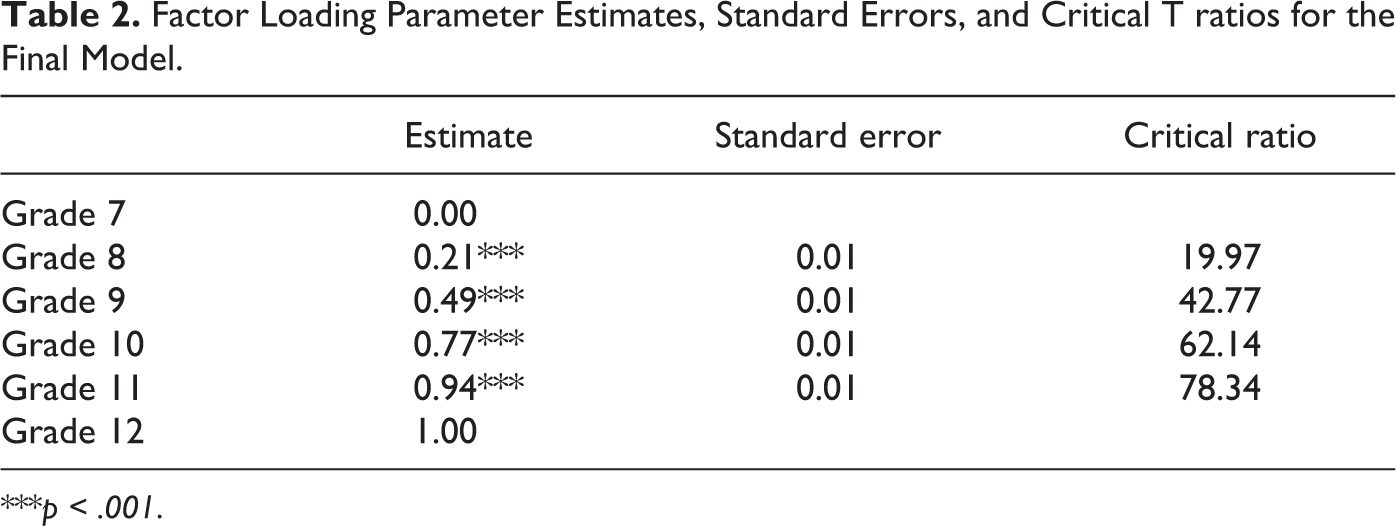
***p < .001.
Only mathematics-specific, intrinsically focused parental motivational practices significantly influenced the level and shape factors of math achievement and persistence in STEM careers (Table 3). Specifically, children with parents who focused on specific intrinsically focused practices had significant increases in their mathematics achievement. A one-unit increase in this type of practice was associated with a 1.45 (p < .001) increase in achievement. Higher levels of specific, intrinsically focused parental practices are also associated with greater rates of change across individuals over time. In contrast, general, extrinsically focused motivational practices were significantly but negatively related to achievement. In other words, children who reported that their parents have greater general extrinsically focused practices had lower Grade 7 achievement test scores. The rate of change over time was not significantly related to this particular practice. Mathematics achievement at Grade 7 and rates of change in mathematics achievement from Grades 7 through 12 were both positively and significantly related to pursuing a STEM career.
Conditional Coefficients for the Level and Shape Factors and STEM Outcome Regressed on General, Extrinsically Focused Parental Practices and Specific, Intrinsically Focused Parental Practices.
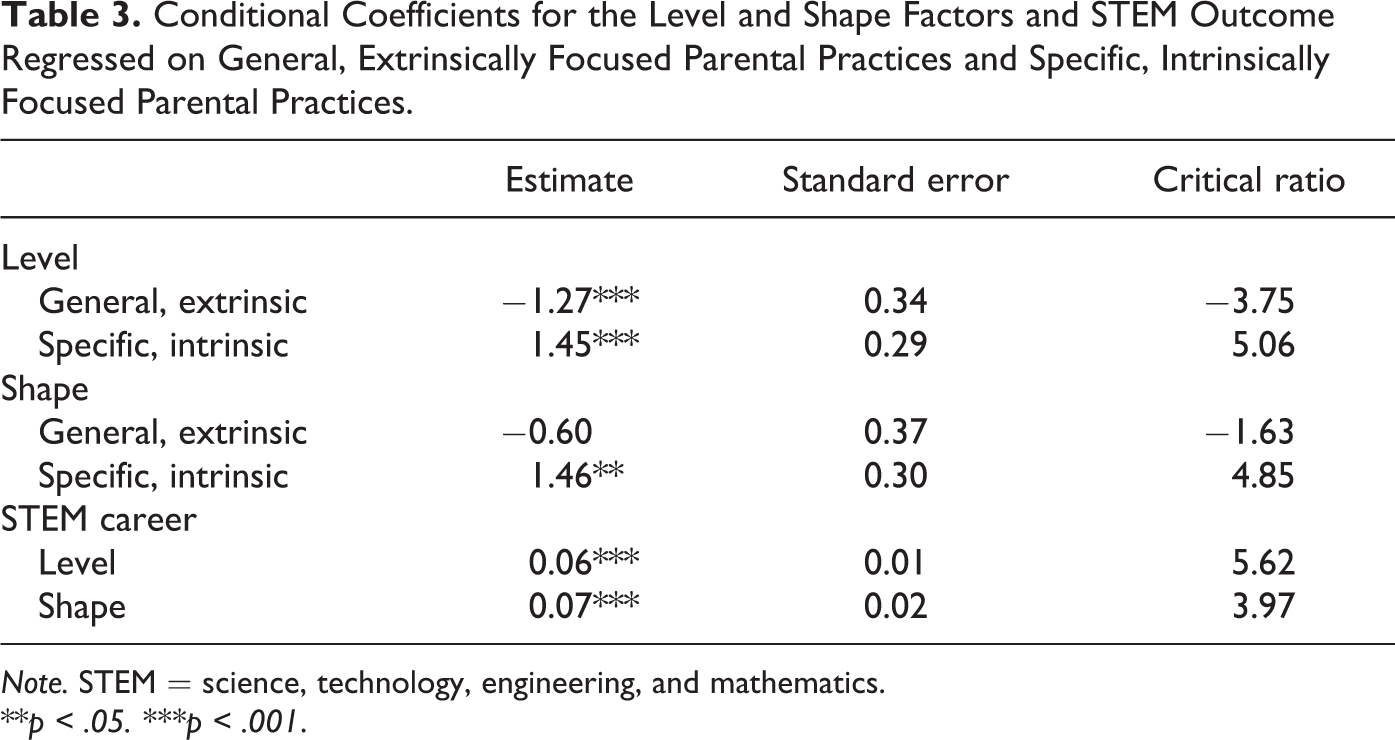
Note. STEM = science, technology, engineering, and mathematics.
**p < .05. ***p < .001.
Discussion and Conclusion
Efforts to increase the number of students in the STEM education pipeline require attention to the multiple factors that influence student persistence (Miller & Kimmel, 2012). This study contributes to the existing literature on the influence parents have on their children’s academic achievement and STEM career persistence by identifying more specific parental motivational practices that help increase persistence and preparation in STEM fields. Not surprisingly, mathematics achievement in 7th grade and change rates in mathematics achievement from 7th through 12th grade influence persistence in STEM careers. In addition, general, extrinsically focused and mathematics-specific, intrinsically focused parental motivational practices influence starting mathematics achievement but only mathematics-specific, intrinsically focused motivational practices influenced developmental trajectories of mathematics achievement. The relationship with seventh-grade mathematics achievement is different, with general, extrinsically focused parental practices negatively related to achievement and mathematics-specific, intrinsically focused practices positively related to achievement.
These findings are consistent with literature on the influence of parents in several ways. First, parents can positively influence their children’s mathematics achievement in terms of where students start in 7th grade and how much students’ achievement grows or changes through 12th grade. Second, parents can influence their children’s persistence in STEM careers. Finally, not all parental motivational practices will influence math achievement or persistence in STEM careers. Mathematics-specific, intrinsically focused motivational practices are positively and significantly associated with mathematics achievement and persistence in STEM careers but general, extrinsically focused practices are related to 7th-grade achievement level but not to changes in math achievement throughout 12th grade.
The findings are also consistent with research that suggests that extrinsically focused motivational practices might provide short-term gains or increased interest but that long-term and more sustained growth and interest requires different types of motivational practices (see e.g., Deci, 1971; Deci, Koestner, & Ryan, 1999, 2001; Lepper, Greene, & Nisbett, 1973). There is also literature in support of more specific notions of intrinsic motivation related to particular subject areas rather than more general motivational practices. However, given the potential interrelatedness of extrinsic and intrinsic motivational practices, causal claims with these findings are not warranted. It is not clear, for example, whether some level of extrinsic motivational practices are needed before intrinsic motivational practices will be effective. Some students might require some initial extrinsic motivation before they develop intrinsic motivation. Moreover, perceptions of extrinsic and intrinsic motivational practices might vary from student to student and might change over time. Since it is not clear whether these motivational practices can be distinctly and separately defined, it is not warranted to say that particular types of practices cause higher student achievement or selection of particular careers.
Despite these limitations, there are practical implications for these findings. One implication is that programs interested in increasing STEM career persistence can take advantage of parents’ ability to guide and influence their children’s career development. These programs can be mindful that parental motivational practices are not always positively related to achievement or STEM career persistence but that there are particular types of practices that are more likely to relate to these outcomes of interest. In particular, programs that seek to increase parental involvement can focus on the importance of mathematics-specific motivational practices rather than more general practices. In other words, providing parents with feedback about how their children are doing in mathematics or encouraging parents to tell their children that mathematics is important is not sufficient to increase student mathematics achievement or persistence in STEM careers (see e.g., Hill & Tyson, 2009). Here is a concrete example of the implications of this research. Suppose you are a middle school science teacher in charge of an afterschool engineering design club. You know the importance of involving parents in this effort but are thinking about specific ways to involve parents that will increase student achievement and persistence in STEM careers. Findings from this research suggest that encouraging parents to reward their children for participating in the engineering design club will not increase achievement and persistence in STEM careers. Instead, encouraging parents to actively participate in the engineering design club might help communicate high expectations about mathematics. As a teacher, you could create opportunities for students to teach their parents about the mathematics included in the engineering design club projects. You could guide discussions about how different students applied unique mathematical solutions to the complex engineering projects. You could also guide students and parents to identify the ways in which the mathematics included in the engineering design process relate to statewide mathematics content standards. Students and parents could then work together to find innovative ways to share this information with other family members and friends. Parents taking an active role in the specifics of the mathematics involved in engineering design projects might help communicate to their children that mathematics is an important subject. Attention to the range of specific and intrinsically focused parental motivational practices can help increase long-term mathematics achievement and persistence in STEM careers.
Footnotes
Declaration of Conflicting Interests
The author declared no potential conflicts of interest with respect to the research, authorship, and/or publication of this article.
Funding
The author received no financial support for the research, authorship, and/or publication of this article.