



Abstract
This study explains the development of science, technology, engineering, mathematics (STEM) interest among elementary and middle schoolchildren. The cohort longitudinal design was applied, starting with three cohorts of students—fourth (10 years), fifth (11 years), and sixth (12 years) grade—followed for three consecutive years. A total of 947 pupils responded to general and specific STEM interest measures. The results show that the level of STEM interest of children is generally low. Gender differences in STEM interest in favor of boys are apparent in all STEM areas, except science. The observed gender gaps in interest over time are constant, except for a small increase in gender difference of engineering interest. The average rate of change of STEM interest over time is mostly insignificant. Large interindividual variability of interests’ scores and slopes indicates that the level of STEM interest and its change over time are highly individualized phenomena.
Keywords
This study aimed to examine the trends of change in science, technology, engineering, mathematics (STEM) interest during late childhood and early adolescence and to determine the role of students’ gender and age in the development of their interest. We think that exploring the development and determinants of children’s STEM vocational interests in elementary and middle school has considerable theoretical and practical importance. The societal and practical importance relates to the notion that the majority of European countries recently experienced difficulties in recruitment of a skilled labor force in STEM areas (Caprile et al., 2015) and have noticed declining numbers of students choosing STEM programs at the university level (Gago et al., 2005; Osborne & Dillon, 2008). Moreover, within the past decade, the proportion of females enrolled in STEM educational areas remains low (Eurostat, 2018). In our opinion, the key period in STEM interest formation is early adolescence, where first career decisions are made and further career paths are set. In many Central and Eastern European countries, as well as in Croatia, the end of middle school (age 14 or 15) represents the first milestone for setting a future career. At this stage, students must choose between grammar schools and vocational programs with different proportions of STEM content. The grammar schools last for 4 years and provide general education and best opportunities for university education. However, grammar schools also have four specialized tracks: general high schools (provide general education); schools that focus on informatics, science, and mathematics; language high school (focus on foreign languages), and classics high school (emphasize on Latin and Ancient Greek languages). Vocational schools provide education in a specific fields—education, administration, management, sociolegal profession, technology, arts, healthcare, and economics. Their programs last from 2 to 5 years and accordingly provide students just basic vocational qualifications, prepare them for specific occupation, or give them opportunity to further enroll in tertiary education (mostly in polytechnic schools).Thus, for many students, middle school is a critical developmental stage regarding their future STEM-related career choices. During the middle school years, girls begin to lose interest in STEM, and this age is considered to be crucial for keeping girls in the STEM field (Hughes et al., 2013).
The theoretical importance of this study is its focus on STEM interest development of younger adolescents, which is a mostly under-researched area. The major body of studies on the formation of STEM interest have included high school and postsecondary students (Usher, 2009; van Tuijl & van der Molen, 2015), but there are some indications that interest in STEM begins to develop earlier, mostly during middle school (Bandura et al., 2001; Fluori et al., 2017). The importance of shifting the focus from high school students to younger children was also emphasized in research on the development of general vocational interests (Hartung et al., 2005; Watson & McMahon, 2005; Watson et al., 2015). Additional support for this shift is the finding that the expected structural relation between STEM and general vocational interests can already be found at the age of 13 (Babarović et al., 2019).
The Early Development of STEM Vocational Interest
Interest in male and female activities starts to develop in early childhood (Gottfredson, 1996; Tracey, 2001; Tracey & Ward, 1998), followed by the formation of interest in school and out-of-school activities during elementary school (Tracey & Ward, 1998). In early adolescence, around the age of 14, interests typical for adults begin to form (I. Šverko, 2008; Tracey & Ward, 1998; Tracey, 2001). However, there are some findings that stability of interests can be expected earlier, even at the age of 12 (Low et al., 2005; Tracey & Sodano, 2008; Xu & Tracey, 2016).
From a theoretical standpoint, support for early formation of STEM vocational interest can be most closely linked to Linda Gottfredson’s (1996, 2002) theory of circumscription and compromises and social cognitive career theory (SCCT; Lent et al., 1994, 2002). According to Gottfredson, in the second stage (6–8 years) of the development of children’s aspirations, children become aware of gender differences and begin to eliminate occupations for further examination if they are not typical for their gender. Considering that STEM occupations are perceived as highly masculine, the early influences on formation of STEM interest can be expected. The central elements of the SCCT model propose that learning experiences affect self-efficacy and outcome expectations, which promote career goals directly and also indirectly via interests. Considering the school context, children from the first grade (age 6 or 7) start to shape their self-efficacy and form outcome expectations in mathematics and science which further affect their interests and educational or career goals. As achievement in mathematics and science is essentially linked to persistence in a STEM field (e.g., Sadler et al., 2012; Tyson et al., 2007), the early formation of students’ interest in STEM disciplines is expected. Thus, we assume that formation of general STEM interest comes earlier than the introduction of science-specific subjects (physics, chemistry, biology) in a school curriculum and that STEM interests are structured much earlier than general vocational interests.
Researchers in STEM areas often use the metaphor of the “leaky pipeline” to describe the finding that children initially have a high level of interest in STEM but lose their interest as they progress through the educational system. The open question is “when does the pipe begin to leak?” DeWitt et al. (2014) found, on the samples of students in England, that interest in a science career often diminished during middle school. Mau (2003) found that in the United States less than one quarter of eighth graders retained an interest in pursuing a science or engineering career 6 years later. Osborne and colleagues (2003) conducted a review of the major literature on attitudes toward science and found a trend of decline in attitudes toward school science in numerous studies, which begins from age 11 onward. Moreover, Osborne et al. (2003) found some evidence from UK surveys (i.e., Murphy & Beggs, 2003; Pell & Jarvis, 2001) revealing that the decline in students’ attitudes toward science begins in the primary grades and is most marked upon entry to secondary school. This is supported by Morrell and Lederman’s (1998) findings that fifth-grade students in Northwest United States had significantly higher positive perceptions of science than upper grade students. We hope that this longitudinal research will provide additional information on the early development of STEM interest.
Gender Difference in STEM Interest in Early Adolescence
Concerning previous research, the major divergence in STEM interest can be expected along with the people–things dimension underlying Holland’s (1997) RIASEC (Realistic, Investigative, Artistic, Social, Enterprising, and Conventional) circumplex. Lubinski and Benbow (2006) argued that gender differences in the people–things interest dimension contribute to the poor representation of women in STEM occupations. Su et al. (2009), in their comprehensive meta-analysis, demonstrated that sex differences in STEM interest are largest along with the people–things dimension. In their further work, Su and Rounds (2015) demonstrated that gender differences in interest vary largely by the specific STEM field. The largest gender differences in interest were found in engineering disciplines, favoring men, while in contrast, gender differences in interest favoring women were found in the social sciences and medical services.
Other major findings have shown that during high school girls overall have less interest in STEM and that there is lower retention of interest in STEM careers among girls (Sadler et al., 2012; Tracey, 2002; Tracey & Robbins, 2005). This is supported by a literature review of girls’ engagement in science (Brotman & Moore, 2008), where girls had lesser positive attitudes toward science and/or a sharper decline in positive attitudes over time. Tracey (2002) reported that gender differences in STEM interest became more pronounced with the shift from elementary school into middle school and that these gender differences in interest persist through entry into college (Tracey & Robbins, 2005). It seems that the metaphor of the leaky pipeline could be especially applicable for girls, who are losing their interest along their educational or career pathway (e.g., Blickenstaff, 2005; Riegle-Crumb et al., 2011). Although gender differences in STEM interest are well-documented at the secondary and postsecondary level, comprehensive longitudinal research on elementary and middle schoolchildren is nonexistent. We hope that this research will provide a new perspective on the developmental gender difference in children’s STEM interest and in particular on the difference in diverse STEM areas.
Measuring STEM Interest and the Role of the General Factor of Interests
Most of the research in the STEM area has been focused not on vocational interests but other related measures, both subjective (e.g., interest in school science or mathematics, perceived self-efficacy in STEM) and objective (e.g., choosing a STEM major, enrollment/attainment of STEM education, employment in a STEM field). However, as suggested by Su et al. (2009), interests are central predictors of educational choices, degree completion, occupational choices, and job satisfaction—and we are interested in exploring the development of early-age STEM interest. Considering the lack of relevant measures and tests specifically focused on STEM career interests, we developed an overall STEM career interest measure similar to the STEM Career Interest Test (Milner et al., 2014). We also applied the adapted and shortened version of the STEM Career Interest Survey (STEM-CIS; Kier et al., 2014), trying to capture interests in different STEM areas.
Furthermore, in this research, we considered the existence of a general factor of interests (GFI) score (Darcy & Tracey, 2003; Prediger, 1982; Rounds & Tracey, 1993). The GFI is the first component, preceding the substantial interest dimensions (e.g., people–things, data–ideas, depending on the model), systematically extracted by factor analysis of the different interests measures. Despite its clear presence in interest data, the meaning of the general factor is not clear. In the literature, it can be viewed as a nuisance, as bias, or as substance (Tracey, 2012). As a nuisance, or unimportant elevation of interest profile, GFI plays no role in P–E fit and career counseling (Prediger, 1982; Prediger & Vansickle, 1992). It has to be ignored and only the rank order of individual’s interest profile has to be considered. Seen as a bias, or systematic, context-related variance, it distorts the interpretation of the assessment (Tracey, 2012). In order to obtain clear and exact information on interests, GFI needs to be removed from the interest variance in favor of ipsatized interest scores (Holtrop et al., 2015, Tracey, 2012). Viewed as a substance, GFI reflects important information on particular psychological traits that are related to career decision-making process but not directly to interests. It is argued that GFI refers to interest flexibility, which moderates the congruence–outcome relations (Darcy & Tracey, 2003; Tracey et al., 2012; Tracey & Robbins, 2006). Individuals with higher GFI have highly flexible interests and easily adapt to many working environments, while individuals with low interest profiles are less flexible and thus they need to find a highly congruent environment to be satisfied and successful.
However, as demonstrated by Tracey (2012), all interest scales have content-specific information (here STEM) and general responding content (general factor). The general factor variance should be removed to get a more accurate representation of STEM-specific interest (Milner et al., 2014). In this study, we applied an independent measure of RIASEC interests, extracted the GFI, and used it as a time-varying covariate in the STEM interest development model. The inclusion of GFI in longitudinal research on STEM interest was also motivated by several studies related to the stability of vocational interest during adolescence (e.g., Tracey, 2002; Tracey & Robbins, 2005; Tracey & Ward, 1998). Based on these results, Tracey and Sodano (2008) concluded that interest scores are relatively high in elementary school, then they swiftly drop with the move into middle school, and they continue dropping until high school, where they start to increase. We assume that these findings could also be applicable for change of GFI across late childhood and early adolescence in our sample. This is also in line with Tracey and Sodano’s (2017) conclusion that the general factor is higher in children and tends to go down in magnitude with older samples. Therefore, we expect some drop in GFI during the observed period (age 10–15), and we want to examine the longitudinal model parameters when controlling for the variance related to GFI in STEM interest scores. We expect that, by including GFI in the model, the expected drop in STEM interest over time will be milder.
Research Questions and Hypotheses
Concerning the research design and previous research findings, we proposed several hypotheses related to three more general research questions: (a) Is there an expected gender and age cohort difference in STEM interest? (b) Does STEM interest change over time, and does the change depend on gender, age cohort, or initial level of students’ STEM interest? (c) In controlling for the GFI, does this change the results for the questions above? The following hypotheses are proposed:
Method
Participants and Procedure
The data for this study were collected within the larger project in which three cohorts of elementary school students were followed for three consecutive years. The students were selected from 16 schools in Zagreb and its surroundings. In each participating school, two classes within one age cohort were randomly sampled. The first-wave cohorts included students from Grades 4, 5, and 6 (age 10–13). In the present study, respondents were 947 students (52% girls) who participated in all three waves (T1–T3). The youngest cohort (C4—fourth grade in the T1) had 320 students (Mage = 10.82 years, SDage = 0.48 years; 54% girls), the fifth-grade cohort (C5—5th grade in the T1) had 305 students (Mage = 11.82 years, SDage = 0.33 years; 52% girls), and the oldest cohort (C6—6th grade in the T1) had 322 students (Mage = 12.79 years, SDage = 0.33 years; 49% girls). The students by their social background, race, and ethnicity represent urban Croatian population (99% Caucasians, 90% Croats; Croatian Bureau of Statistics—Census, 2011).
The data were collected during regular school classes using a paper-and-pencil method. The group data collection was organized by two researchers in each class. For the fourth-grade students, the group assessment was guided, and if needed, individual assistance was provided. The data collection was scheduled at the same time every year (during April and May). The data collection procedure was approved by the ethical committee and Ministry of Education. For all participants in the study, parental consent was given.
Instruments and Measures
Overall STEM interest
For measuring students’ STEM vocational interest, we applied the STEM Interests Inventory for Children (STEM-IIC; Author, 2018). The STEM-IIC was designed as a short measure of STEM vocational interest for middle school students. It consists of two subscales: Interest in STEM Occupations and Interest in STEM Activities. The scale of interest in STEM occupations includes 13 occupations chosen from the list of STEM occupations in the O*NET database (Shatkin, 2011), all familiar to children. Examples of STEM occupations in the STEM-ICC include mathematician, computer programmer, biologist, chemist, construction engineer, and astronomer. The scale of interest in STEM activities is derived from the description of activities in STEM occupations within the O*Net, the Croatian Occupational Outlook Handbook (B. Šverko, 1998), and the latest job descriptions provided by the Croatian Employment Service. The activities descriptors are brief and concise, refer to the most important tasks within a given STEM occupation, and use age-appropriate expressions and wording suitable for children. Examples of STEM activities include study the celestial bodies, planets, stars, and galaxies; maintain aircraft engines, instruments, and control systems; study and explore earthquakes and volcanoes; monitor and organize the technological process in food production; and explore the structure of living organisms with a microscope. The activities scale also comprises 13 items. The task of respondents is to estimate how much they like each occupation and activity on a 5-point scale. Previous research with STEM-IIC on students aged 13 showed a one-factor structure with high internal reliability, α = .93 (Author, 2018). In this research, the one-factor structure is confirmed by PCA (Principal Component Analysis) in all time points and age cohorts, using the Scree test criterion. The general factor eigenvalues were high, and VAF ranges from 37.11% (T1, C5) to 46.73% (T2, C4), while the loadings exceeded .35 in all analyses. To additionally test longitudinal measurement invariance, we applied CFA and tested a sequence of nested models posed by Widaman and Reise (1997). Therefore, we tested for configural invariance, weak factorial invariance, strong factorial invariance, and strict factorial invariance. If two nested models showed a decrease of the comparative fit index (CFI) or the normed fit index (NFI) greater than or equal to .01 or an increase of the root mean square error of approximation (RMSEA) greater than or equal to .01, the more restrictive model should be rejected (Chen, 2007; Cheung & Rensvold, 2002). Because we expected unidimensional structure, we applied item parceling to reduce the number of parameters to estimate and to provide more stable parameter estimates and proper model fit (Bandalos & Finney, 2001; Little et al., 2002). We made four parcels of occupational interest items and four parcels of activities interest items, consistently for all time measurement. The configural invariance model showed mediocre fit to unidimensional structure, χ2/df = 7.06, CFI = .938, NFI = .929, RMSEA = .082, but the standardized saturations for all parcels in all time points exceeded .67, and therefore, we considered the configural invariance achieved. The weak factorial invariance (CFI = .938, NFI = .928, RMSEA = .080, ΔCFI = .000, ΔNFI = .001, ΔRMSEA = .002), strong factorial invariance (CFI = .936, NFI = .925, RMSEA = .078, ΔCFI = .002, ΔNFI = .002, ΔRMSEA = .002), and strict factorial invariance (CFI = .933, NFI = .921, RMSEA = .078, ΔCFI = .003, ΔNFI = .004, ΔRMSEA = .000) showed very similar fit, which confirmed the longitudinal measurement invariance of the STEM interest measure. The internal reliability of the composite scale score was also high and ranged from .93 to .95, indicating excellent reliability of the STEM interest scale.
Interest in Specific STEM Areas (Science, Technology, Engineering, and Mathematics)
The applied STEM careers interest survey—short is an adaptation of the STEM Career Interest Survey (STEM-CIS; Kier et al., 2014). The adapted version retains the 16 items of STEM-CIS, four for each of the STEM areas (Babarović et al., 2019). It examines the extent to which students wish to engage in STEM areas in their career, whether they are interested in these occupations and activities, and whether they have the support of parents in such a choice. The questionnaire was created as a list of statements, and respondents have to estimate how much they agree with each statement on a 5-point scale. The previous study on middle school students in Croatia proved the four-factor structure of the scale with high reliability for all four STEM subscales (Babarović et al., 2019). The expected four-factor structure of the scale was also confirmed in this study. We applied PCA with Oblimin rotation in all time and cohort samples and retained four factors based on the KG (Kaiser-Guttman) and Scree test criterion. After the rotation, simple factor structure was obtained. The median correlation between STEM scales across all time points and cohorts was .41, with the single highest correlation of .60 (between technology and engineering in T2, C4), indicating the relative independence of STEM scales. To additionally test longitudinal measurement invariance, we tested a sequence of nested longitudinal structural models, proposing an invariant four-factor structure over time. The configural invariance model showed very good fit to the four-factor structure in all times of measurements (χ2/df = 2.88, CFI = .942, NFI = .914, RMSEA = .052). The weak factorial invariance (CFI = .941, NFI = .913, RMSEA = .051, ΔCFI = .001, ΔNFI = .001, ΔRMSEA = –.001), strong factorial invariance (CFI = .935, NFI = .906, RMSEA = .053, ΔCFI = .006, ΔNFI = .007, ΔRMSEA = .002), and strict factorial invariance (CFI = .935, NFI = .906, RMSEA = .052, ΔCFI = .000, ΔNFI = .000, ΔRMSEA = –.001) tests resulted in very similar fit estimates, which confirmed the longitudinal measurement invariance of the STEM-CIS short version. The reliabilities of STEM scales were high, ranging from α = .85 (science in T1, C4) to α = .96 (engineering in T3, C6).
The general factor of interests
As a measure of the GFI, we applied the Children’s Vocational Interests Inventory (CVII; Author, 2018). The CVII was developed as a simple interest measure for younger children aged 10–14. It consists of 48 occupations, well-known to children and frequent in the world of work, divided into six RIASEC types with eight occupations representing each type (e.g., truck driver—R, veterinarian—I, sculptor—A, kindergarten teacher—S, lawyer—E, cashier—C). Children need to assess how much they like each occupation on a 5-point Likert-type scale. The reliability of RIASEC scales applied to 13-year-old pupils was high (ranging from αI = .74 to αS = .85). The expected three dimensions underlying the RIASEC types were obtained by PCA, where the first component resembled the GFI, and two subsequent components reflected Prediger’s (1982) people–things and data–ideas dimensions (Author, 2018). In this study, we were interested only in the GFI, and we used it as a factor score at T1, T2, and T3, calculated separately for each age cohort. The existence of the general factor in our data was evident at all time points and in all subsamples. The general factor variance varied from 51.67% (T3, C6) to 66.80% (T1, C4), with high loadings of all RIASEC subscales on the GFI. The GFI factor scores were used in this research.
Two additional variables used in this study were students’ gender (coded 1 for males and 2 for females) and age cohort (coded 4 for the age cohort starting the survey in the fourth grade, 5 for the age cohort starting in the fifth grade, and 6 for students starting the survey in the sixth grade).
Data Analysis Method
We applied latent growth curve modelling (LGCM) to analyze the change in STEM interest over time (Figure 1). Besides this baseline model, we added two time-invariant exploratory variables—students’ gender and their age cohort. These variables are used as predictors of intercept and slope (Figure 2). The five separate LGC models are applied for different repeated dependent variables—overall STEM interest and interest in science, technology, mathematics, and engineering. First, we tested the baseline models (Figure 1) and then the models with time-invariant covariates (age cohort and gender). We also tested the additional model introducing the time-varying variable—GFI—as a covariate in the overall STEM interest model (Figure 3). The tested model is similar to those proposed by Kaplan (2009) and Curran et al. (2013). The model includes three time-variant measures of GFI that predict corresponding time measures of general STEM interest. Furthermore, the correlations are set between time-varying GFI measures.
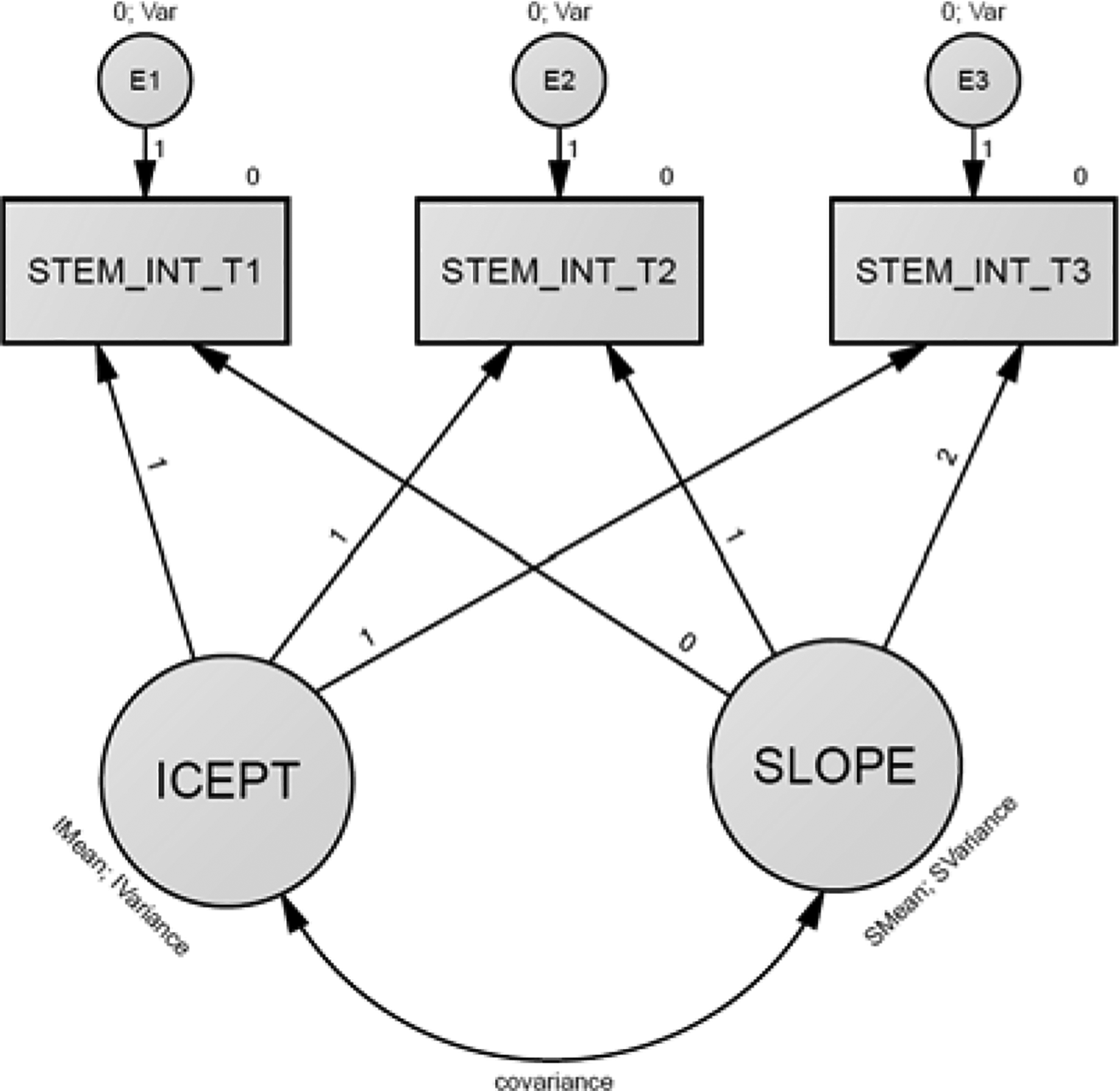
Baseline latent growth curve model for testing the science, technology, engineering, mathematics interest change over time.
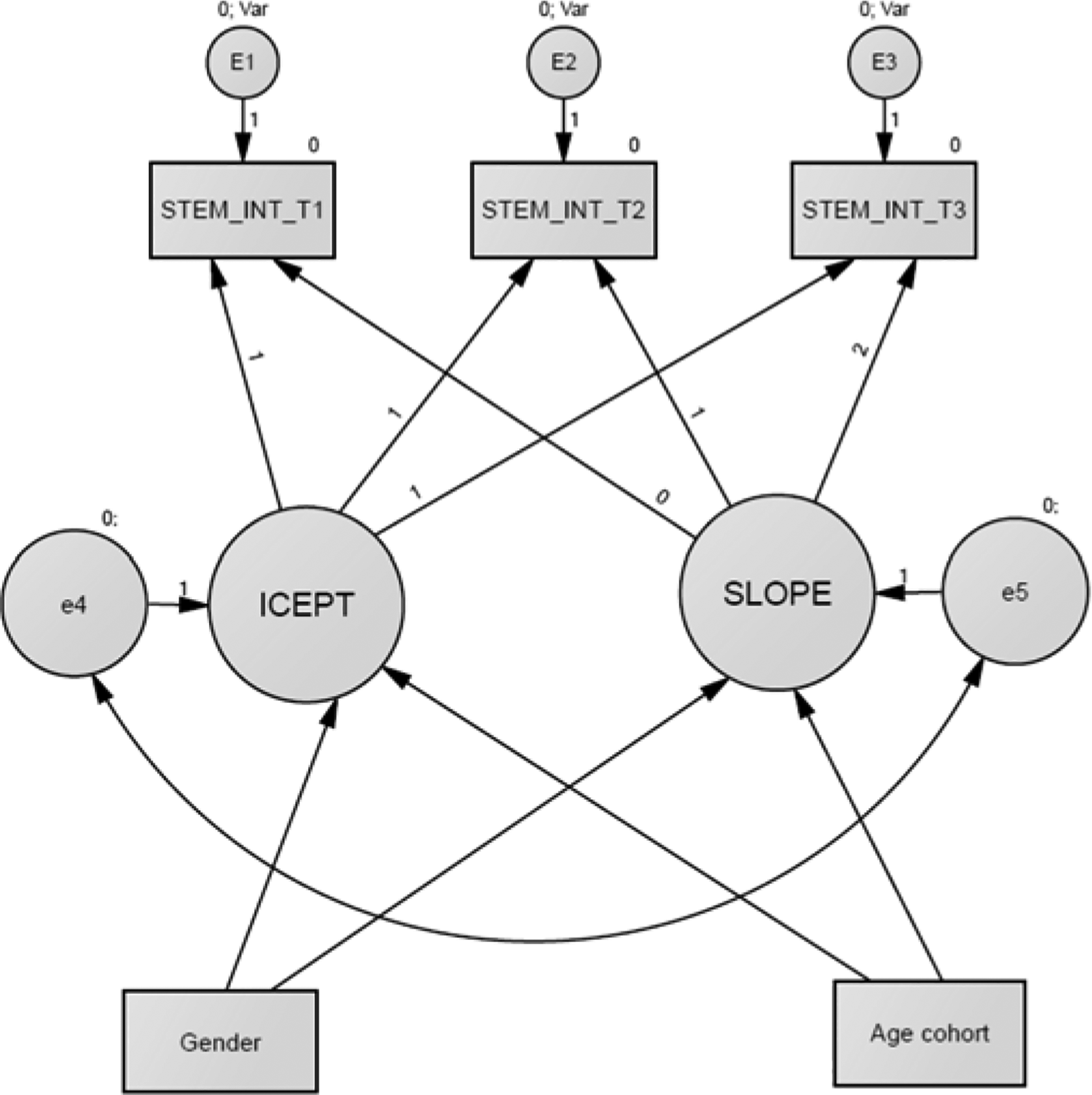
Latent growth curve model for testing the science, technology, engineering, mathematics interest change over time with gender and age cohort covariates.
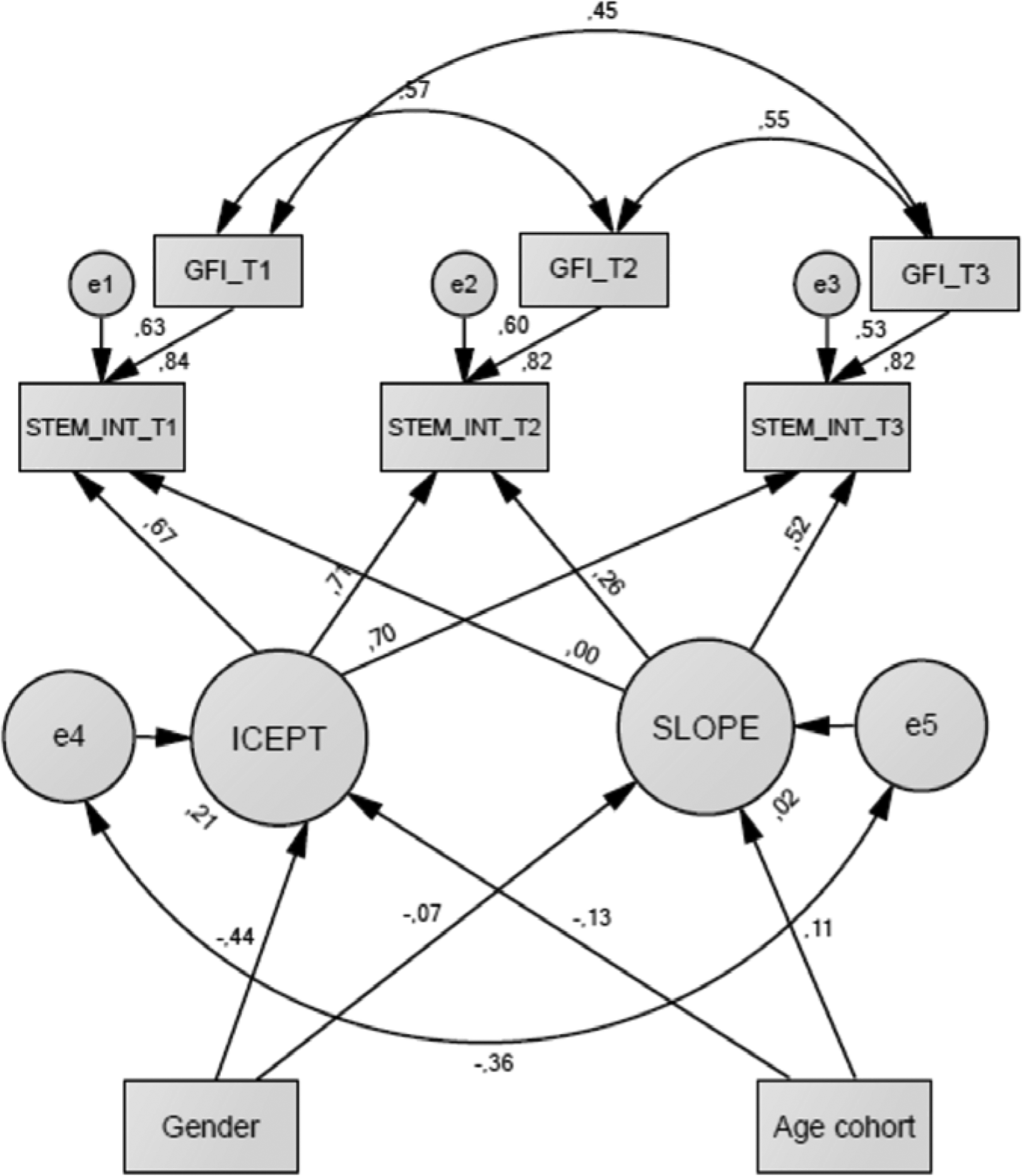
Latent growth curve model for testing the science, technology, engineering, mathematics interest change over time with time-varying covariate of the general factor of interests (standardized coefficients are presented).
The overall fit for the given models is evaluated using the χ2/df ratio, the CFI, the Tucker–Lewis index (TLI), and the root mean square error of approximation (RMSEA). A model is considered acceptable if the χ2/df ratio is below 5 (Jöreskog, 1969), CFI and TLI > .90, and RMSEA < .08 (McDonald & Ho, 2002). Model testing was carried out using IBM SPSS Amos 20.0.
Results
The results show that students’ average career interest in the STEM area was generally low (Table 1). Most of the means were slightly lower than central point of the rating scale. Overall STEM interest was the highest for boys at the first (T1) measurement point (M = 2.82), while it was the lowest for girls at the third (T3) measurement point (M = 2.28). Average values for the individual STEM areas were highest for the technology area, where M = 3.61 for boys at the third (T3) measuring point. The lowest estimates were obtained for girls engineering area, where it did not exceed M = 2.19 through all measurement points.
Descriptive Statistics of Different Students’ Science, Technology, Engineering, Mathematics (STEM) Interests by Time, Age Cohort, and Gender.
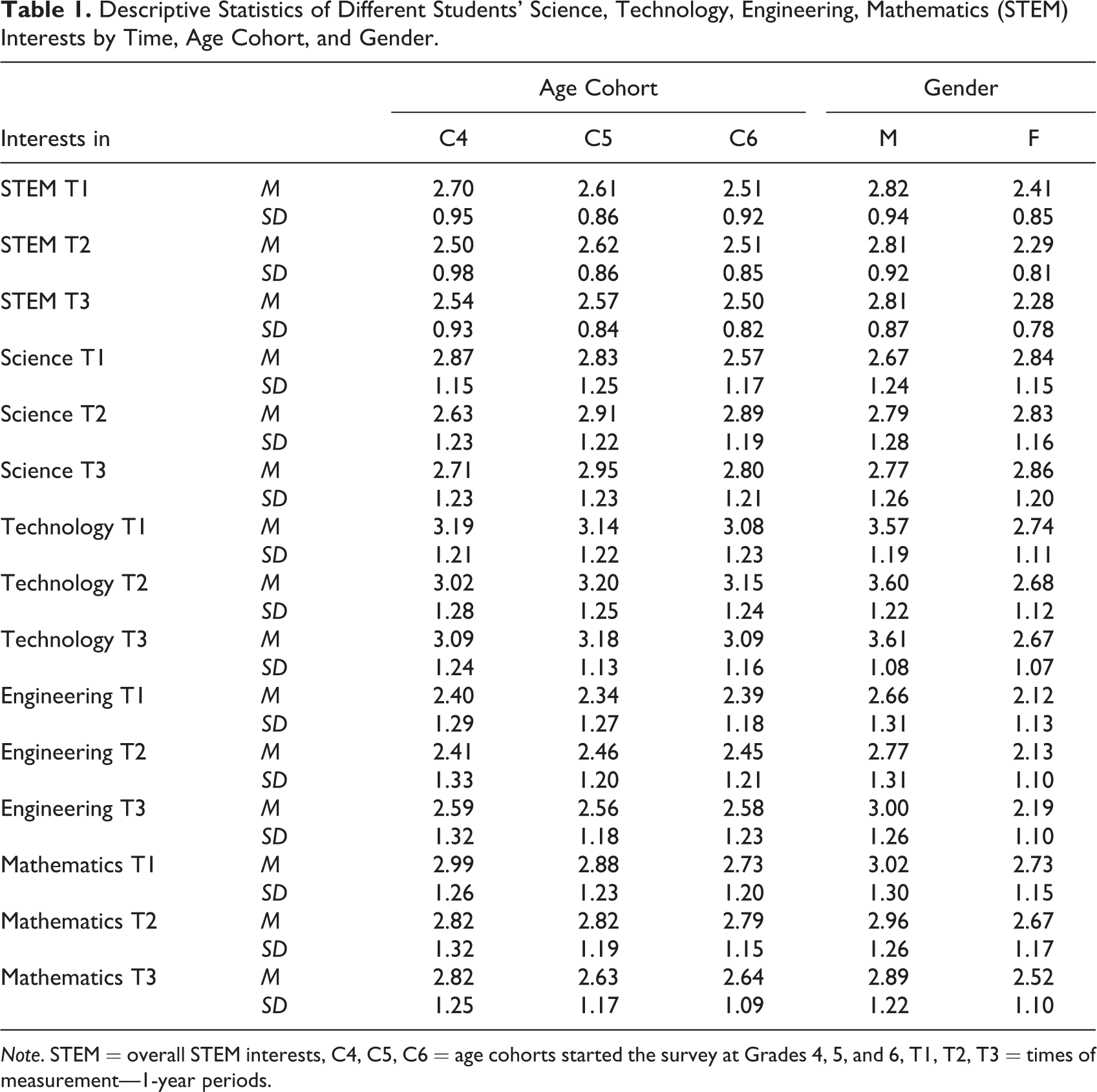
Note. STEM = overall STEM interests, C4, C5, C6 = age cohorts started the survey at Grades 4, 5, and 6, T1, T2, T3 = times of measurement—1-year periods.
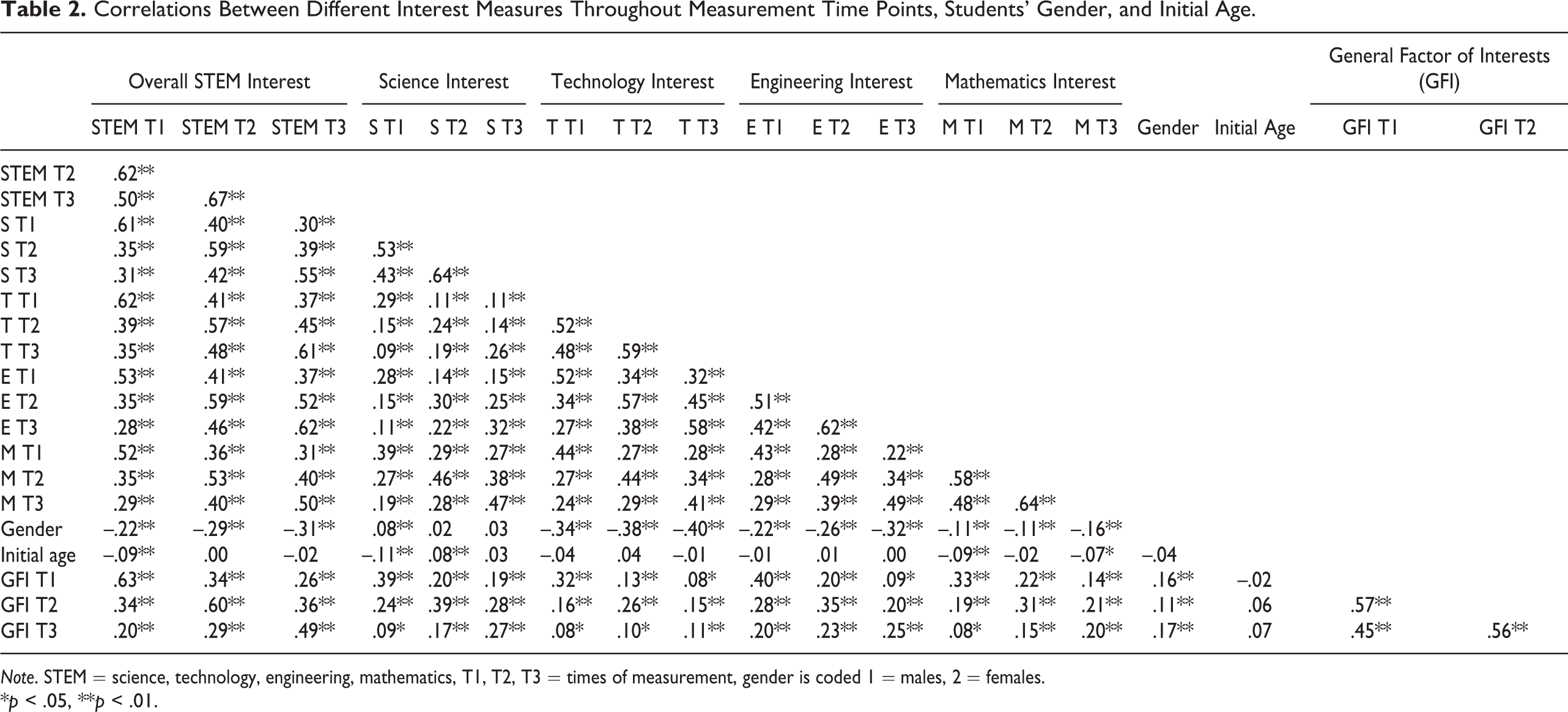
Neither clear trends of decline in STEM interest over time were visible, nor did we see any orderly differences in interest depending on the age of the student. The only systematic differences observed were related to gender differences in interest, where boys showed more interest than girls in all fields except in the field of science, and these differences persisted over time (the gender differences were tested by correlations in Table 2).
Correlations Between Different Interest Measures Throughout Measurement Time Points, Students’ Gender, and Initial Age.
Note. STEM = science, technology, engineering, mathematics, T1, T2, T3 = times of measurement, gender is coded 1 = males, 2 = females.
*p < .05, **p < .01.
The correlations in Table 2 show that all STEM interest measures correlated positively and moderately. As expected, the scores on the same STEM scale measured at the closer time points (e.g., T1 and T2) correlated higher than the scale scores measured at more distant time points (e.g., T1 and T3). The relations between STEM interest and initial age of students (age cohort) were sporadic, unsystematic, and generally negligible in size. The correlations between GFI and STEM interest scores were, as expected, the highest for the measures collected at the same time points and higher for general STEM interest and GFI than the interest in particular STEM areas and GFI. Also, small but significant correlations were found between GFI and gender, indicating that girls have somewhat higher results on GFI at all time points.
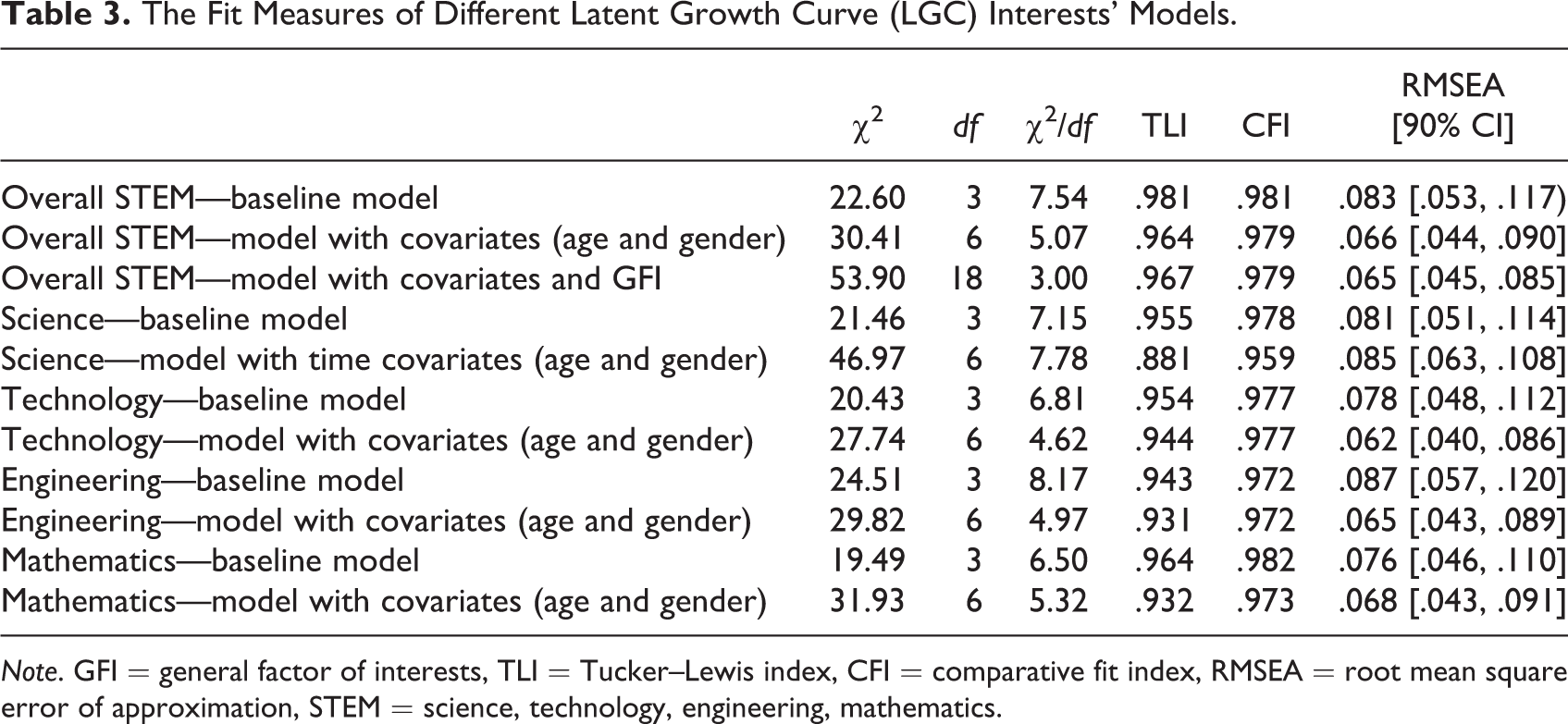
Relations among constructs were systematically tested using the SEM (structural equation modeling) and LGC models. The models’ fit indices (Table 3) indicate that the most of the models had a mediocre fit. The χ2/df ratios were around 5, and CFI and TLI were higher than .90, but the RMSEA confidence interval upper bounds were over .08. The differences in fit between baseline models and comparable models with time-invariant covariates (age cohort and gender) were small, indicating the existence of low correlations between time-invariant covariates and growth parameters (Table 4). The only noticeable drop in the fit of a more complex model in comparison to the baseline model was observed for science interest (TLI = .881, TLI = .955, respectively). This could be attributed to an insignificant path between gender and intercept in the more complex model (β = .08, p > .05). The best fit of data to the model was observed for the model with the time-varying covariate of GFI, which can be attributed to substantial relations between the STEM interest measure and GFI at observed time points (βs varying from .53 to .63).
The Fit Measures of Different Latent Growth Curve (LGC) Interests’ Models.
Note. GFI = general factor of interests, TLI = Tucker–Lewis index, CFI = comparative fit index, RMSEA = root mean square error of approximation, STEM = science, technology, engineering, mathematics.
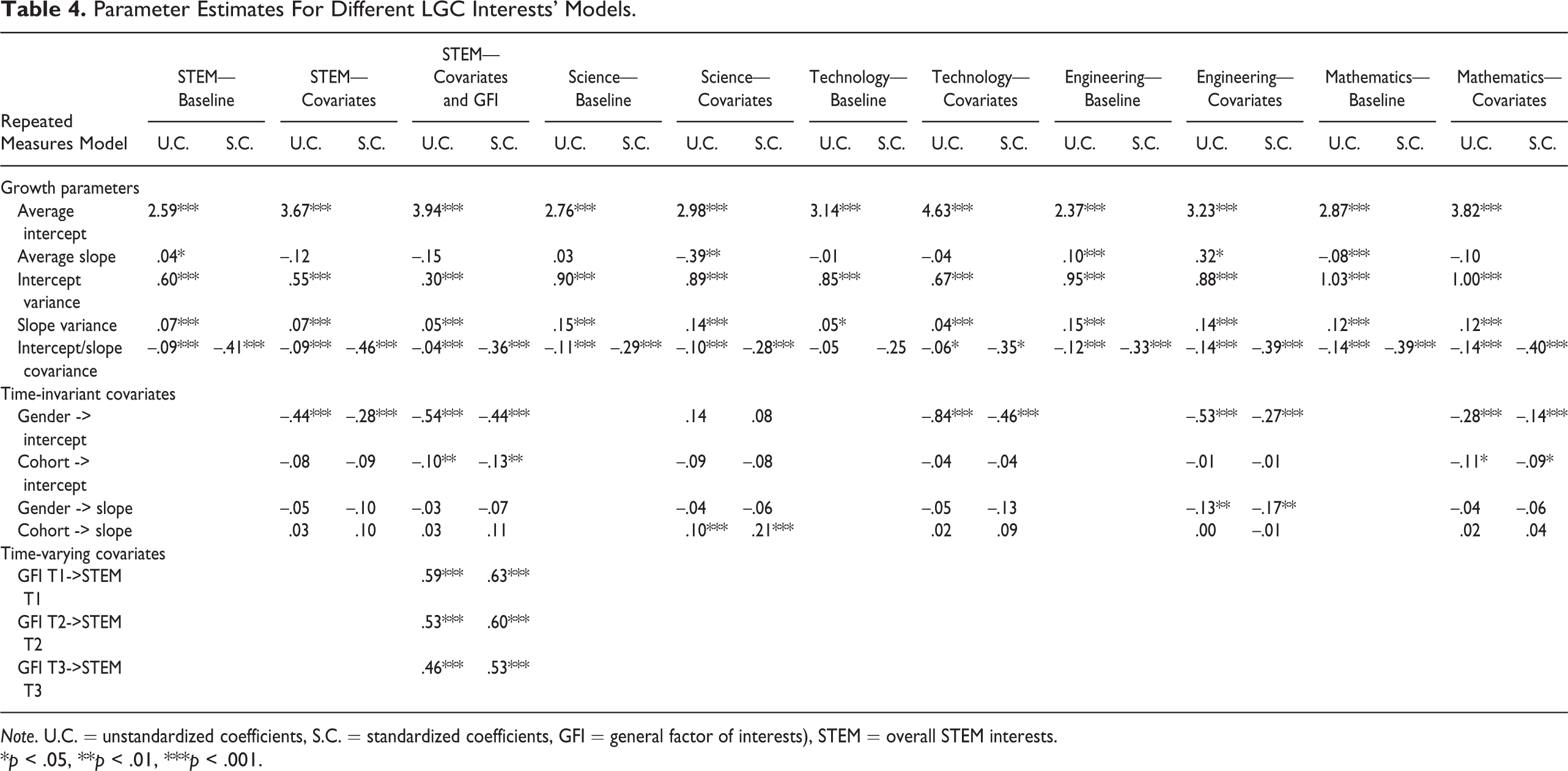
Parameter Estimates For Different LGC Interests’ Models.
Note. U.C. = unstandardized coefficients, S.C. = standardized coefficients, GFI = general factor of interests), STEM = overall STEM interests.
*p < .05, **p < .01, ***p < .001.
An examination of the LGC models’ parameter estimates (factor means, variances, and covariance) in each of the models (Table 4) was used to develop an understanding of the structure of the growth trajectory within our sample. First, we can observe that the intercept factor variances for all interest measures were statistically significant, revealing that sizable individual differences in STEM interest existed at the initial status. The slope variances were also significant in all models, indicating that the rate of change in interest over time varied considerably among individuals.
In support of Hypothesis A1, the path coefficients between gender and intercept were statistically significant and negative for all models except for the science interest model, where it was insignificant. Those relations indicate that boys had a higher initial level of interest in careers in technology (β = –.46), engineering (β = –.27), and mathematics (β = –.14), as well as overall STEM interest—before and after controlling for GFI (β = –.28 and β = –.44, respectively).
Hypothesis A2 was partly confirmed only for interest in mathematics and overall STEM interest after controlling for GFI, where path coefficients between age cohort and intercept were small but significant (β = –.09 and β = –.13, respectively). This means that older cohorts had a lower initial level of interest in mathematics and to some extent in overall STEM interest. However, these differences were small, and there was no evidence of age cohort differences in the initial status for interest in science, technology, and engineering.
To reach an answer for Hypothesis B1, which is related to the significance of the average slope factor and can be interpreted as an average fall or rise of interest over the observed period, we first observed the baseline models’ parameters. A substantial change in STEM interest over time was seen for interest in engineering (Mb = .10, p < .001) and mathematics (Mb = –.08, p < .001), indicating a small average increase of interest in engineering and a small decrease of interest in mathematics over this period. The slope means for interest in technology and science were insignificant. The slope mean for overall STEM interest was very small and of marginal significance (p < .05), indicating that this overall STEM interest did not change substantially over time. So, the interest remained stable within the 3 years of the study (had a flat trajectory). After controlling for time-invariant covariates (age cohort and gender, model 2), the slope factor mean became negative and statistically significant for interest in science (Mb = –.39, p < .01). The significance of this slope mean, which was insignificant in the baseline model, can be attributed to controlling for cohort age as a significant predictor of science slope (β = .21, p < .001). It can be concluded that after controlling for the initial age of students, some average decrease in interest in science can be expected. Controlling for covariates did not change the positive and significant slope mean for interest in engineering (Mb = .32), indicating the stability of a small average increase of interest in engineering over time, even after controlling for covariates. The small negative slope average for mathematics in the baseline model became insignificant after controlling for cohort age and gender, indicating that the initially observed small decrease in mathematics was mostly an artifact of the initial age of respondents and their gender. Concerning all these results, Hypothesis B1 that STEM interest generally declines over time cannot be confirmed, but we can claim that most of the interest remained stable within the 3-year period, that interest in science may have declined a bit, and that interest in engineering even increased to some extent.
Comparing the slope variances and slope means, it should be noted that variances of the slopes were quite large. For example, in the case of overall STEM interest—after controlling for covariates—the mean slope was Mb = –0.12, the variance was vb = 0.07 (sdb = 0.26), and 95% of respondents had slopes that varied from –0.64 to +0.40, with approximately 65% of participants having negative slopes (and 35% with positive slopes). For the science interest, the one with the biggest negative slope mean (Mb = –0.39, vb = 0.14, sd = 0.37), about 85% of respondents had negative slopes, but 15% had positive slopes. Given these calculations, it can be concluded that individual variance in the slopes is an important aspect of STEM interest development and that an increase or decrease in STEM interest at that young age is not a uniform characteristic.
The path coefficients between gender and slopes were mostly insignificant, except for the interest in engineering. This only significant regression coefficient suggests that an increase in the interest in engineering was a bit more pronounced for boys. Thus, the general Hypothesis B2, positing a greater decline of STEM interest over the study period for girls, can be rejected.
Hypothesis B3 also cannot be confirmed based on the given results. The regression coefficients between age cohort and slope were almost all insignificant, indicating that individual rates of change in interest were unrelated to the age of respondents at T1. The only significant and positive path coefficient was found for science interest, indicating that the rate of change has a greater chance to decrease as the respondent belongs to a younger group.
The factor covariance between intercept and slope, for all models except for the technology–baseline model, were negative and statistically significant. This indicates that respondents who had a high mean level of interest at T1 (initial status) decreased in their interest at faster rates over time (had steeper declining slopes) than those who started with a lower mean level of STEM interest. However, this can be interpreted oppositely in the case of engineering interest: Those who had a lower level of initial interest had steeper upper slopes and increased their interest at a faster rate. These findings generally support Hypothesis B4 (that the individual rate of change of interest over time depends on the initial level of interest).
Finally, we tested Hypotheses C1 and C2, related to the role of GFI in the model. GFI correlated substantially with overall STEM interest measured at the same time point. This finding indicates that the measure of overall STEM interest contained, to some extent, the confounding bias of the general factor. However, after controlling for GFI, in the last LGC model as a time-varying covariate (Figure 3), the basic estimates did not change considerably compared to the baseline model. The intercept variance as well as the intercept–slope covariance was expectedly smaller, but the slope mean did not change substantially. So, our hypothesis that controlling for GFI will reduce the decline in STEM interest was not confirmed, but it is also a consequence of the initial stability of STEM interest over time in our results (baseline model). The only noticeable change, as a result of including GFI in the model, was related to a significant negative regression coefficient between cohort age and intercept (β = –.13, p <. 01) and a higher coefficient between gender and intercept (β = –.28, p < .01—without GFI; β = –.44, p < .01—with GFI). The interpretation could go in the direction that controlling for the GFI in STEM-IIC scores can lead to more accurate results and therefore to a more pronounced initial age and gender difference in STEM interest.
Discussion
The study results confirmed previous findings related to gender differences in STEM interest in favor of boys. Boys had higher overall STEM interest as well as higher interest in the areas of technology, engineering, and mathematics, but no gender difference was found in interest in science careers. The biggest difference was found in the technology area, then in overall STEM interest, and then in the field of engineering. These results are consistent with findings from Su and Rounds (2015) that gender difference in interests varies largely by the specific STEM field, and with the expectation that a gender difference will be most pronounced along the people–things dimension (Lubinski & Benbow, 2006; Su et al., 2009). Previous analyses related to the measures of STEM interest applied here (Author, 2018) indicate that overall STEM interest and interest for careers in technology most closely fit along with the people–things dimension underlying the RIASEC circumplex model. The finding that boys and girls do not differ in their interest in science can be explained by diversity and the coverage of the science field in STEM. This includes different science areas, from hard science to biomedicine and biology, where the latter are those corresponding to the areas of girls’ interest (Su & Rounds, 2015).
Further, from our results, it can be concluded that the observed gender gap in STEM interest does not change or enlarge over time for most of the STEM areas. The only gender difference that changes over time is related to a bit faster rate of increase in engineering interest for boys over the observed period. This can then result in a somewhat bigger gender difference at the end of middle school (age 14) in engineering interest, which is consonant with Tracey’s (2002) findings.
A systematic change of STEM interest over time is not confirmed by our results. The expected decline in STEM interest during the elementary and middle school period (e.g., DeWitt et al., 2014; Mau, 2003; Osborne et al., 2003) is partly confirmed only for interest in science but not for overall STEM interest or interest in other technology, engineering, and mathematics areas. To the contrary, some increase in the engineering interest is observed over time, mostly due to the increase of this interest for boys. The lack of support for the hypothesis of a systematic decrease of STEM interest over time can be found in the big intraindividual variation of the slopes, which overpower the small-size group means changes during the observed period. Thus, it seems that change in STEM interest over time is more related to some individual characteristic of the child than to maturation, school grade attainment, or some systematic school-related experience.
The considerable and negative covariations between intercepts and slopes were found in all STEM areas. This means that those individuals with a higher initial level of interest experience a steeper decline of interest over time, or that those with an initially lower interest had flatter slopes, or that even experience increase of their interest over time (applicable for engineering interests). This can lead to less interindividual variability of interest over time. It can be best seen for overall STEM interest (the biggest correlations between intercept and slope; r = –.41 and r = –.46, before and after controlling for covariates, respectively) where its variability decreases over time (the average standard deviations in T1, T2, and T3 decrease; Table 1). This regression to the group average can be easily explained by a need for group conformity in adolescence and to exposure to the same educational environment over time (the groups of students are nested in the same classes and share the same teachers and class and school climate). Moreover, the STEM-related curriculum is prescribed at the national level and is the same for all, without considerable school- or teacher-related variability. However, this effect could also be attributed to RTM (regression to the mean) in longitudinal designs (e.g., Nesselroade et al., 1980; Rocconi & Ethington, 2009). This is the tendency to score closer to the mean in the second and any further administration of the test. It happens because all values are observed with random error, and when observing the same subject repeatedly, high (or low) observations are likely to be followed by less extreme ones closer to the subject’s true mean. To reduce this possible error, in future research, some adjustments in data analysis could be made (e.g., Krause & Pinheiro, 2007).
Regarding our results, older students do not experience a sharper decrease in interest over time. Most of the STEM interest slopes were unrelated to the initial age of students except in the case of science interest. In the science area, a steeper decrease in interest over time was found in younger age cohorts, meaning that younger children lose their interest in science at a faster rate. This can be seen in the sharp decline in interest between T1 and T2 in the youngest cohort (C4; Table 1), and this particular decline mainly contributed to the overall negative slope of scientific interest over time, after controlling for covariates. The decline in scientific interest from fourth to fifth grade may be specific to the Croatian educational system and related changes in curriculum. Pupils in first four grades have only mathematics and nature as STEM-related subjects, and one teacher teaches all subjects. In the fifth grade, specific science-related school subjects are introduced, and each school subject is taught by a different teacher. Thus, in our opinion, this single cohort effect, and the existence of a general negative slope over time in the case of science (model with covariates), is more likely to be a situation-specific effect than evidence of a systematic decline in science interest over the observed educational period.
Finally, controlling for the GFI in the overall STEM interest score did not change the direction or the angle of the slope of STEM interest over time. The STEM interest remained stable at the average during the observed period, even after controlling for GFI. However, controlling for GFI in overall STEM scores can provide a less biased and more accurate measure of STEM interest, which can be seen in a more pronounced gender and age difference at the initial level of STEM interest. Thus, the suggestion by Milner et al. (2014), of the simple inclusion of another interest scale in the research (e.g., the social interest scale) and correcting for this bias by calculating and extracting the GFI from the STEM interest scores, is promising, especially if the STEM interest scale is used for individual career guidance and counselling.
To conclude, the observed level of STEM interest of children aged 10–15 is generally low. The gender difference in STEM interest in favor of boys is demonstrated (except for interest in science), and the gender gap in interest over time is essentially constant. The exception is a small increase in gender difference over time for engineering interest. The rate of change of STEM interest over time is mostly insignificant, and if it occurs it is mostly gender- or age-specific. Hence, the observed decrease in science interest over time is mainly related to the transition of the youngest age cohort from class to subject teaching, and the small significant increase in interest in engineering is specific to boys. Finally, the observed large interindividual variability in STEM interest scores and slopes indicates that STEM interest and its change over the observed period are highly individualized. It seems that individual students’ characteristics related to family background, learning experiences, perceived self-efficacy, or objective competencies and abilities play much more important roles in the development of STEM interest during middle school than some group characteristics such as those related to school characteristics, school curriculum, or students’ initial age or even gender.
The limitations of the study are mostly related to the sample characteristics. The schools in this study were selected from mostly urban areas. Accordingly, it is expected that these students are exposed to STEM-related facilities (e.g., science or nature museums), are included in different in- or out-of-school STEM programs and activities, and have more educated and more school-oriented parents who can provide STEM-related materials. All of this can reduce, to some extent, the decline in STEM interest during the observed period. Furthermore, this study was conducted within a specific educational system, with unique STEM curricula and a specific set of STEM subjects taught in each grade. For example, Croatian elementary schools have separate STEM subjects (i.e., physics, chemistry, and biology) introduced in seventh grade, and all are compulsory, which largely differs from the educational system in the United States, where most of the studies have been conducted. Thus, our findings, to some extent, have limited external validity. However, the vocational interests, which were the focus of this study, are more general, less culture-specific, and not so related to an educational context. They are stable predictors of educational choices (e.g., Hansen & Sackett, 1993; Lapan et al., 1996; Patrick et al., 2011), and they direct students toward their future careers. Therefore, we believe that this research, with a cohort-sequential longitudinal design applied to elementary and middle schoolchildren in Croatia, can provide new findings on the early development of STEM interest in cross-cultural context.
From a practical point of view, these findings shed new light on the change and development of STEM interest during late childhood and early adolescence. Contrary to widespread belief, students aged 10–15 do not lose their interest in STEM. On average, their STEM interest is quite stable, but there is a considerable and substantial intraindividual variation in the change in STEM interest over time. Thus, we stand for and propose a highly individualized approach to STEM-related learning, motivating, or information-providing interventions. In our opinion, specifically tailored interventions are needed for those who had an average level of STEM interest and started to develop it, those who had an initially high STEM interest and started to lose it, or those who did not ever have an actual interest in this area. In this context, educational policy in middle school should consider implementing more additional classes and after school activities for those interested in STEM subjects or better organized remedial or supplementary teaching for those with low STEM interests. Furthermore, if some instruments for measuring STEM interest tend to be used in career guidance in schools, they should be complemented by another interest measure to control for the general factor of interest and get more accurate STEM interest scores. Finally, knowing that the gender gap in STEM interest is existent and constant over this developmental period, school-based STEM interventions, focused on the reduction of gender-related stereotypes, should be introduced in schools as early as possible.
Footnotes
Declaration of Conflicting Interests
The author declared no potential conflicts of interest with respect to the research, authorship, and/or publication of this article.
Funding
The author disclosed receipt of the following financial support for the research, authorship, and/or publication of this article: This research was supported by Croatian Science Foundation (HRZZ) Grant IP-09-2014-9250—STEM career aspirations during primary schooling: A cohort-sequential longitudinal study of relations between achievement, self-competence beliefs, and career interests (JOBSTEM). This article is related to one of the main project’s goals.
