



Abstract
This study examines whether and how job search strategies mediate the relationship between core self-evaluations (CSE) and career growth for mid-career professionals. Using a path analysis approach to analyze a national sample of mid-career professionals (N = 269), results revealed that CSE was positively related to the direct job search strategy (i.e., contacting employers directly) and negatively to the networking job search strategy (i.e., contacting friends/relatives). Interestingly, the direct job search strategy was positively related to both a recent promotion and salary increase (i.e., objective career growth), while the networking job search strategy was positively related to increased job satisfaction (i.e., subjective career growth). Findings also indicated that CSE was positively related to salary increase and a recent promotion. These findings suggest that job search strategies are one mechanism through which individual differences, such as CSE, can influence mid-career professionals’ career growth.
Whether individuals identify career success as pay, occupational prestige, job and career satisfaction, or a promotion, developing their career (i.e., career growth) is a critical aspect of one’s career success. Mid-career professionals (considered to be between the ages of 35 and 45) are at a stage of their career when they evaluate their current situation in terms of career growth and development (e.g., Schneer & Reitman, 1994). As a result of this evaluation, they may feel attracted to look for greener pastures to further develop their career and avoid staying stuck in a career plateau (e.g., Kirchmeyer, 1998; Tremblay, Roger, & Toulouse, 1995; Weng & McElroy, 2012). Although multiple studies have examined predictors of career success and growth (see meta-analysis by Ng, Eby, Sorensen, & Feldman, 2005), further research is needed to understand mechanisms through which mid-career professionals develop their career at such a critical stage of their life. Searching for a new job presents an opportunity for individuals to receive a promotion and increase their salary and job satisfaction. However, through which mechanisms do mid-career professionals achieve this career growth?
This study addresses this question by conceptualizing and testing the role that job search strategies have in mediating the relationships between core self-evaluations (CSE) and career growth for mid-career professionals. Specifically, this article draws upon CSE theory (Judge, Locke, & Durham, 1997), which refers to “fundamental appraisals that people make of their own self-worth, competence, and capabilities” (Chang, Ferris, Johnson, Rose, & Tan, 2012, p. 82), to examine whether and how CSE influences career growth, through their influence on mid-career professionals’ choice of a job search strategy (i.e., contacting friends/relatives and contacting employers directly). Career growth is conceptualized through recent promotions (in a new job) and increases in salary and job satisfaction.
Evidence indicates that individuals’ career success and growth are influenced by predictors such as gender (e.g., Lyness & Thompson, 2000), personality (e.g., Judge, Higgins, Thoresen, & Barrick, 1999; Seibert & Kraimer, 2001), self-esteem and locus of control (e.g., Ng et al., 2005; Orth, Robins, & Widaman, 2012), and CSE (Judge & Hurst, 2007, 2008). Interestingly, scholars have also investigated the importance of job alternatives as a mechanism to further develop one’s career (e.g., Boswell, Boudreau, & Dunford, 2004). Despite this research examining the role of job alternatives as “bargaining leverage,” little is known about processes through which individuals increase their career success (i.e., career growth). As such, this study examines whether and how job search strategies serve as a “tool” for mid-career professionals to further develop their career. Figure 1 illustrates the conceptual model of career growth for mid-career professionals, derived from CSE theory.
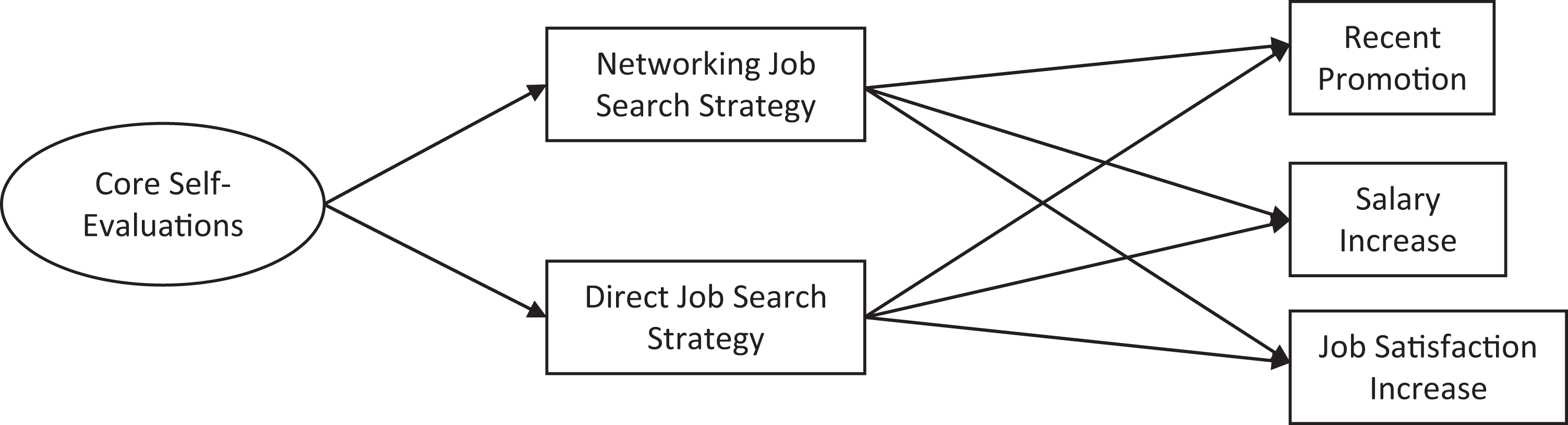
Hypothesized model. General mental ability, race, gender, and tenure served as control variables. However, for the sake of clarity the control variables are omitted from the figures.
CSE, Job Search Strategies, and Career Growth
Career success and growth
Career success is defined as “the positive psychological or work-related outcomes or achievements one accumulates as a result of work experiences” (Seibert, Crant, & Kraimer, 1999, p. 417). An important aspect of career success is the conceptual distinction that scholars have made between objective and subjective facets of career success (e.g., Judge, Cable, Boudreau, & Bretz, 1995; Judge et al., 1999; Ng et al., 2005). For example, facets of objective career success and growth include salary, salary increase, promotions, or occupational prestige (e.g., Weng, 2010). Facets of subjective career success and growth include career satisfaction, job satisfaction, job satisfaction increase, or perceptions of work–life balance (e.g., Boudreau, Boswell, & Judge, 2001; Heslin, 2005; Judge et al., 1995). Interestingly, Ng, Eby, Sorensen, and Feldman (2005) found that objective and subjective measures correlate positively, but that these correlations are only moderate. Findings also suggest that predictors of objective career success may be different from predictors of subjective success (Ng et al., 2005).
Although the most widely used (and accepted) measures of objective career success and growth are salary, salary increase, and promotions (Hall, 2002; Weng, 2010), there has been some debate on the facets of subjective career success. For example, Heslin (2005) suggested that the use of job and career satisfaction as a proxy for intrinsic career success is unsound. Heslin (2005) contended that such measures do not capture important dimensions of individual’s assessments of their success, although career satisfaction is a better measure than job satisfaction. However, because of the nature of this data set (i.e., archival data), only a measure of job satisfaction was available to capture subjective career success. Given that the purpose of this study was to examine career growth, this study actually examines how individuals’ level of job satisfaction increased between jobs. As such, it takes a more dynamic approach to career growth, while tapping into some of the dimensions suggested by Heslin (2005).
Role of CSE theory in career growth
The CSE theory (Chang et al., 2012; Judge et al., 1997) is an integrative theoretical framework, which refers to CSE as fundamental beliefs that people hold about themselves, others, and their environment. CSE is further defined as “fundamental premises that individuals hold about themselves and their functioning in the world” (Judge, Erez, & Bono, 1998, p. 168), and consists of four underlying traits, namely, self-esteem, generalized self-efficacy, emotional stability, and locus of control.
There is evidence indicating that CSE is positively related to career outcomes (Judge & Bono, 2001; Judge & Hurst, 2007, 2008), as well as to changes in career success trajectories over time (Judge & Hurst, 2008). Furthermore, locus of control, one of the four traits, is positively related to salary and job satisfaction (Ng et al., 2005). Self-esteem, another one of the four traits, has also received some attention in the career development literature (e.g., Orth et al., 2012; Salmela-Aro & Nurmi, 2007). Specifically, Salmela-Aro and Nurmi (2007) indicated that self-esteem is positively related to job satisfaction and salary 10 years later. Similarly, a study by Orth, Robins, and Widaman (2012), which used cross-lagged analyses to test the direction of the relationships between self-esteem and career success, found that self-esteem was positively related to job satisfaction, occupational prestige, and salary. In another study, Abele and Spurk (2009) found that self-efficacy, another of the four traits that form CSE, measured at the beginning of one’s career was positively related to salary change and career satisfaction 7 years later. Finally, in a meta-analysis, Ng et al. (2005) found that emotional stability and locus of control were positively related to salary and (job and career) satisfaction. They also found that emotional stability was positively related to promotions.
Judge, Locke, and Durham (1997) suggested four theoretical processes through which CSE might influence outcomes, that is, a direct effect, an indirect effect through cognitions and appraisals, an indirect effect through actions individuals engage in, and as a moderator. In this study, I am interested in examining the indirect effect between CSE and career growth, through actions mid-career professionals engage in. Specifically, this study examines whether and how using different job search strategies as a tool to find a new job allows mid-career professionals to develop their career further.
Mediating role of job search strategies
Job search strategies, also referred to as job search methods, are defined as sources used to find jobs (Barber, Daly, Giannantonio, & Phillips, 1994). Although Barber et al. (1994) categorized these sources as formal (i.e., public employment agencies) and informal sources (i.e., friends or relatives), the most commonly studied job search strategies include contacting friends/relatives, responding to newspaper (or online) advertisements, contacting public employment agencies, and applying directly (e.g., Barber et al., 1994; Holzer, 1987, 1988). Contacting friends/relatives and applying directly are the most frequently used strategies (less costly) and are also the most productive ones in generating offers and acceptances (e.g., Holzer, 1988). This study examines both strategies, referring to them as direct job search strategy (i.e., contacting employers directly) and networking job search strategy (i.e., contacting friends/relatives).
Some evidence indicates that the choice of job search strategies is influenced by predictors such as job search objectives (Van Hoye & Saks, 2008), race and gender (Holzer, 1987; Mau & Kopischke, 2001), and personality traits (Van Hoye, Van Hooft, & Lievens, 2009). Specifically, Van Hoye, Van Hooft, and Lievens (2009) found that extroversion was positively related to the use of networking strategies. Although not examining specific job search strategies, Kanfer, Wanberg, and Kantrowitz (2001) also found that the four trait composing CSE, namely, self-evaluations (i.e., self-efficacy and self-esteem), emotional stability, and locus of control, were positively related to job search behaviors in general.
Although there is little research that has examined the relationship between CSE and the choice and success of a specific job search strategy when changing jobs (see, for exception, Van Hoye et al., 2009), social cognitive theory (Bandura, 1986, 1991) suggests that individuals’ beliefs in their ability (i.e., CSE) positively influences motivation and goals. Specifically, individuals with higher self-beliefs tend to set higher goals and persist following failures, compared to individuals with lower ones. Furthermore, Bandura (1991) suggested that when faced with difficulties, individuals who experience self-doubt about their capabilities decrease their efforts or even give up, whereas those who have a strong belief in their capabilities exert greater effort to master the challenge. As such, I expect that mid-career professionals who are higher (vs. lower) on CSE are more confident in their ability to find a job on their own, believe that they are in control of their environment, and will thus prefer contacting employers directly when looking to switch jobs, rather than asking friends and relatives for help.
Evidence also indicates that the choice of a specific job search strategy influences outcomes such as job performance and turnover (Wanous & Colella, 1989), job–organization fit (Van Hoye et al., 2009), promotions (Forret & Dougherty, 2004), salary (Addison & Portugal, 2002; Forret & Dougherty, 2004), and job satisfaction (Crossley & Highhouse, 2005; Forret & Dougherty, 2004). For example, Addison and Portugal (2002) found that formal job search strategies (e.g., public employment agency) were negatively related to salary. In another study, Crossley and Highhouse (2005) found that individuals who engaged in a deliberate job search strategy had higher job satisfaction, compared to individuals who used a more intuitive approach. Interestingly, Forret and Dougherty (2004) also found that networking job search strategies were related to both subjective and objective career success. Thus, mid-career professionals who are higher (vs. lower) on CSE will use different job search strategies to further develop their career (i.e., career growth). As such, I expect that the use of either the direct job search strategy or the networking job search strategy to find a new job should be beneficial in terms of career growth and development.
Alternative model
As mentioned earlier, evidence indicates that CSE is positively related to subjective and objective career growth (e.g., Judge & Hurst, 2008; Ng et al., 2005; Orth et al., 2012). Given that these studies did not examine mediating mechanisms involved in career growth and development, this study also investigates whether a model including both the mediated paths presented earlier and the direct paths from CSE to career growth is a better conceptual and empirical model than a model without direct paths. This is a critical theoretical and empirical comparison, as support for such a combined model would support a theoretical integration between a mediated framework and previously examined theories in the context of career growth (e.g., self-verification theory).
Control variables
To ensure that the hypotheses tests are as valid as possible, this study controls for several variables that have the potential to impact the results. In the hypothesized and in the alternative models, the following control variables were used: race, gender, tenure at the time of job search, and general mental ability (GMA). For example, Ng et al. (2005) found that gender, race, occupation, and job tenure are related to salary and promotions. Furthermore, Judge, Klinger, and Simon (2010) found that GMA is related to objective career success. As such, including these control variables is consistent with prior research (Judge, Klinger, & Simon, 2010; Ng et al., 2005).
Method
Sample and Procedure
Data from the National Longitudinal Survey of Youth (NLSY79) was used in this study. NLSY79 is a nationally representative sample of 12,686 men and women who were 14 to 22 years old when they were first interviewed in 1979. The NLSY79 was started and is managed by the Bureau of Labor Statistics (a branch of the U.S. Department of Labor). Participants in the NLSY79 were first interviewed in 1979, then on annual basis until 1994, and then every other year. For the purpose of this study, only those participants who had looked for (and found) a new job in 2000 were included. Thus, the sample for this study is 269 respondents. Participants in this specific sample were 59% Caucasian and 50% were female. The participants had an average tenure of 277 weeks at the time of job search and an average yearly salary of US$25,577. The year 2000 was chosen for this study, as the participants were between 35 and 44 years old at that time, with an average of 39 years old, which is consistent with the age range defined for mid-career professionals (Schneer & Reitman, 1994).
Measures
CSE
Although CSE was not directly measured in any of the surveys, its four dimensions (i.e., locus of control, self-esteem, emotional stability, and generalized self-efficacy) were collected in different NLSY79 surveys. Consistent with Judge and Hurst (2008), items from each scale were combined to form a 12-item CSE measure (Judge & Hurst, 2008, p. 863). Furthermore, Judge and Hurst (2008) assessed construct and content validity for this NLSY79 12-item CSE measure and found it to be consistent with the CSE scale developed by Judge, Erez, Bono, and Thoresen (2003). Specifically, they asked seven experts (i.e., personality researchers) to evaluate the 12 items of the NLSY79 CSE measure to confirm “whether each item was a good indicator of core self-evaluations” (Judge & Hurst, 2008). Results from the experts’ assessment indicated the 12 items were strong indicators of CSE. They also administered the NLSY79 CSE measure, along with the established CSE scale (Judge, Erez, Bono, & Thoresen, 2003) and measures of conscientiousness, extroversion, agreeableness, and openness to experience, to four samples of undergraduate students (Judge & Hurst, 2008). They found high levels of convergent validity between the NLSY79 CSE measure and the established CSE scale. As such, the same 12 items from the NLSY79 were used in this study. The internal reliability (coefficient α) of this measure was .73.
Job search strategies
The 269 respondents, who changed jobs in 2000, reported the strategy they used to find (and accept) their new job (e.g., public employment agency and friends/relatives). Specifically, this measure assessed through which strategy mid-career professionals had successfully switched jobs. Participants chose among different options when responding to this question in the survey: contacted employers directly/sending out resumes, contacted public employment agency, contacted private employment agency, contacted friends/relatives, contacted school/university placement center, placed or answered ads for job search, and checked union/professional registries for job search. This study focuses on the two most commonly reported job search strategies, that is, “contacting friends/relatives” and “contacting employers directly.” These two job strategies represent over 75% of the participants’ responses.
Career growth
First, participants reported in the NLSY79 surveys whether they had received a promotion since the last interview. To capture that information as a measure of objective career success and growth, the promotion measure was collected in 2002 (the survey following the job change). Although the measure originally asked whether they had received a promotion, a demotion, or a lateral change, these last two options were coded as no promotion (0) as opposed to a promotion (1). Second, participants reported their salary during every interview. The salary increase variable was computed through the difference in salary between the 2002 survey (2 years after their job change) and 1998 (2 years before their job change). Finally, a similar methodology was used to assess job satisfaction increase. The job satisfaction measure was assessed at every survey, by asking participants to report on a 1- to 4-point Likert-type scale their satisfaction with their current job from 1 = dislike very much to 4 = like very much. The difference in job satisfaction between the 2002 survey (2 years after their job change) and 1998 (2 years before their job change) was computed.
Control variables
Respondents’ GMA was obtained through the Armed Forces Qualification Test (AFQT) scores which individuals reported in the 1980 survey. Participants’ race was coded by the interviewer in the 1980 survey as 1 = White, 2 = Black, 3 = other, which was recoded for this study into 1 = White, 0 = other. Participants’ gender was coded by the interviewer in the 1982 survey and was coded 1 = male and 2 = female, which was recoded for this study into 0 = female, 1 = male. Finally, tenure was assessed at the time of the job search.
Results
Table 1 presents the descriptive statistics and correlations among the variables. Examination of these results indicates that CSE is positively correlated with the use of the direct job search strategy and negatively correlated with the use of the networking strategy. In addition, the use of the direct job search strategy was positively related to a recent promotion, while the use of a networking strategy was positively related to job satisfaction increase. Furthermore, CSE was positively related to objective, but not subjective, career growth.
Correlations and Descriptive Statistics.
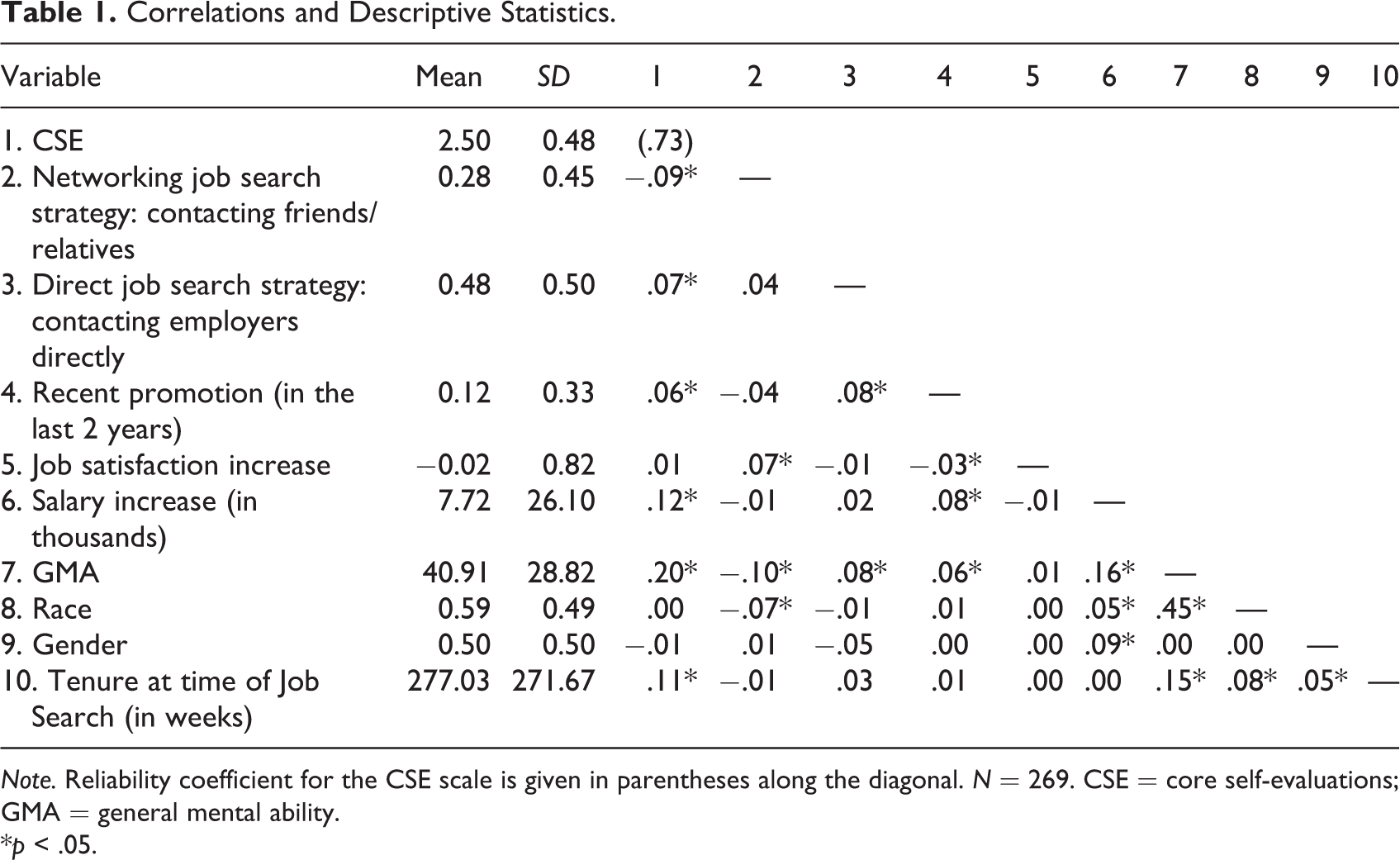
Note. Reliability coefficient for the CSE scale is given in parentheses along the diagonal. N = 269. CSE = core self-evaluations; GMA = general mental ability.
*p < .05.
Measurement Model and Hypothesized Structural Model
The hypothesized and the alternative models were tested through structural equation modeling using AMOS (Arbuckle, 2010). The following four indices were used to assess model fit: the χ2 goodness-of-fit test, the comparative fit index (CFI; Bentler, 1990), Bollen’s (1989) incremental fit index (IFI), and the root mean square error of approximation (RMSEA; Steiger, 1990). For both the CFI and the IFI, indices above .95 represent excellent fit, between .90 and .95 good fit, and below .90 poor fit. For the RMSEA, indices between .01 and .05 represent excellent fit, between .05 and .08 good fit, and above .08 poor fit (Hu & Bentler, 1999).
Before examining the hypothesized model, a measurement model was tested. This model included four indicators, one for each trait of the latent variable CSE and the other observed variables (i.e., job search strategies and career growth variables). As shown in Table 2, the measurement model provided a good fit to the data, χ2(35, N = 269) = 564.4, CFI = .94, IFI = .94, RMSEA = .035. Furthermore, Table 2 also indicates that the hypothesized model provided a good fit to the data, χ2(50, N = 269) = 637.5, CFI = .94, IFI = .94, RMSEA = .030.
Structural Model Comparisons.
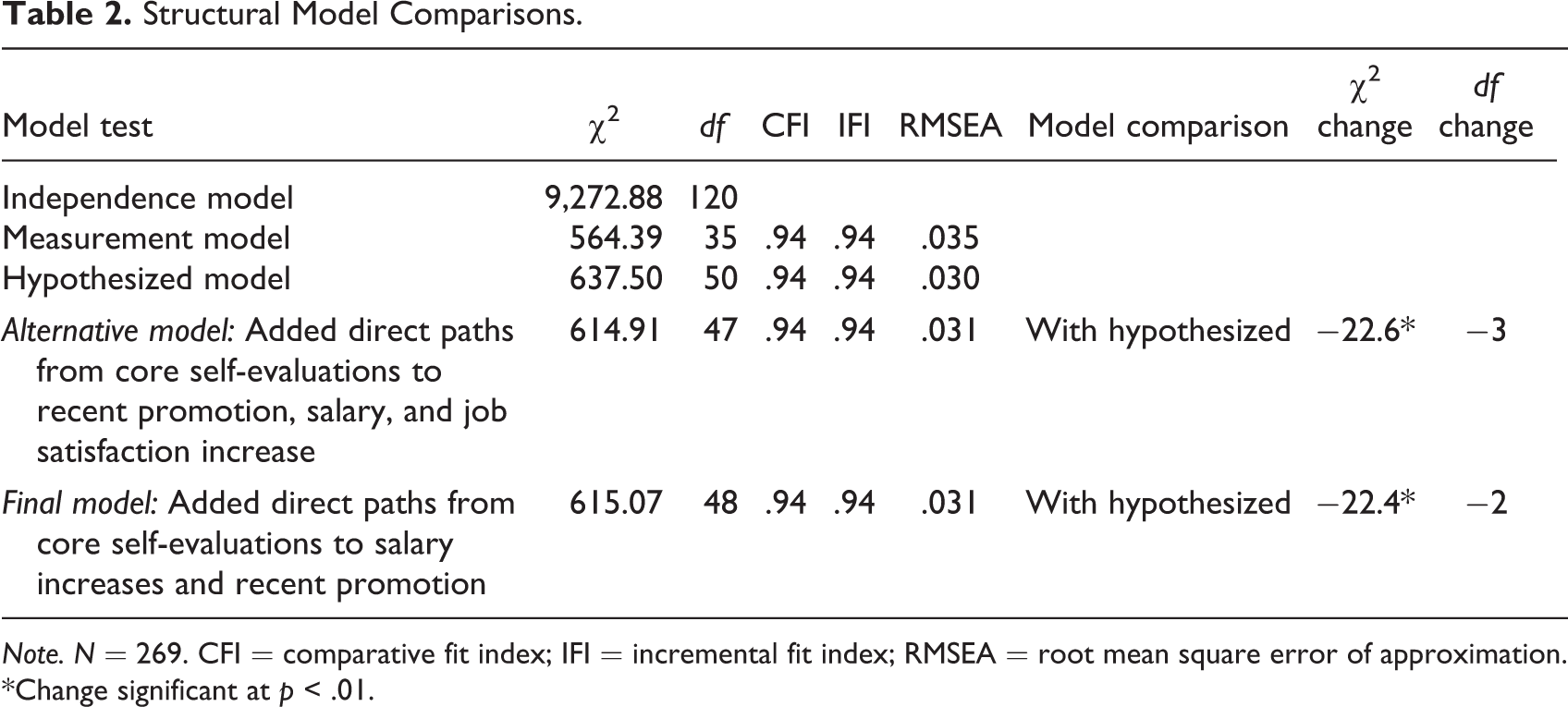
Note. N = 269. CFI = comparative fit index; IFI = incremental fit index; RMSEA = root mean square error of approximation.
*Change significant at p < .01.
In support of the hypothesized model, as illustrated in Figure 2, CSE was positively related to the use of the direct job search strategy, and negatively to the use of the networking strategy, in support of Hypothesis 1. Interestingly, the use of the networking job search strategy was only related to job satisfaction increase, supporting Hypothesis 2c, suggesting that using the networking job search strategy is more beneficial in terms of subjective, rather than objective, career success and growth. Interestingly, the use of the direct job search strategy was positively related to both objective career success and growth outcomes (i.e., recent promotion and salary increase) supporting Hypotheses 3b and 3c. Nevertheless, Hypothesis 3a was not supported, as the direct job search strategy was not related to job satisfaction increase.
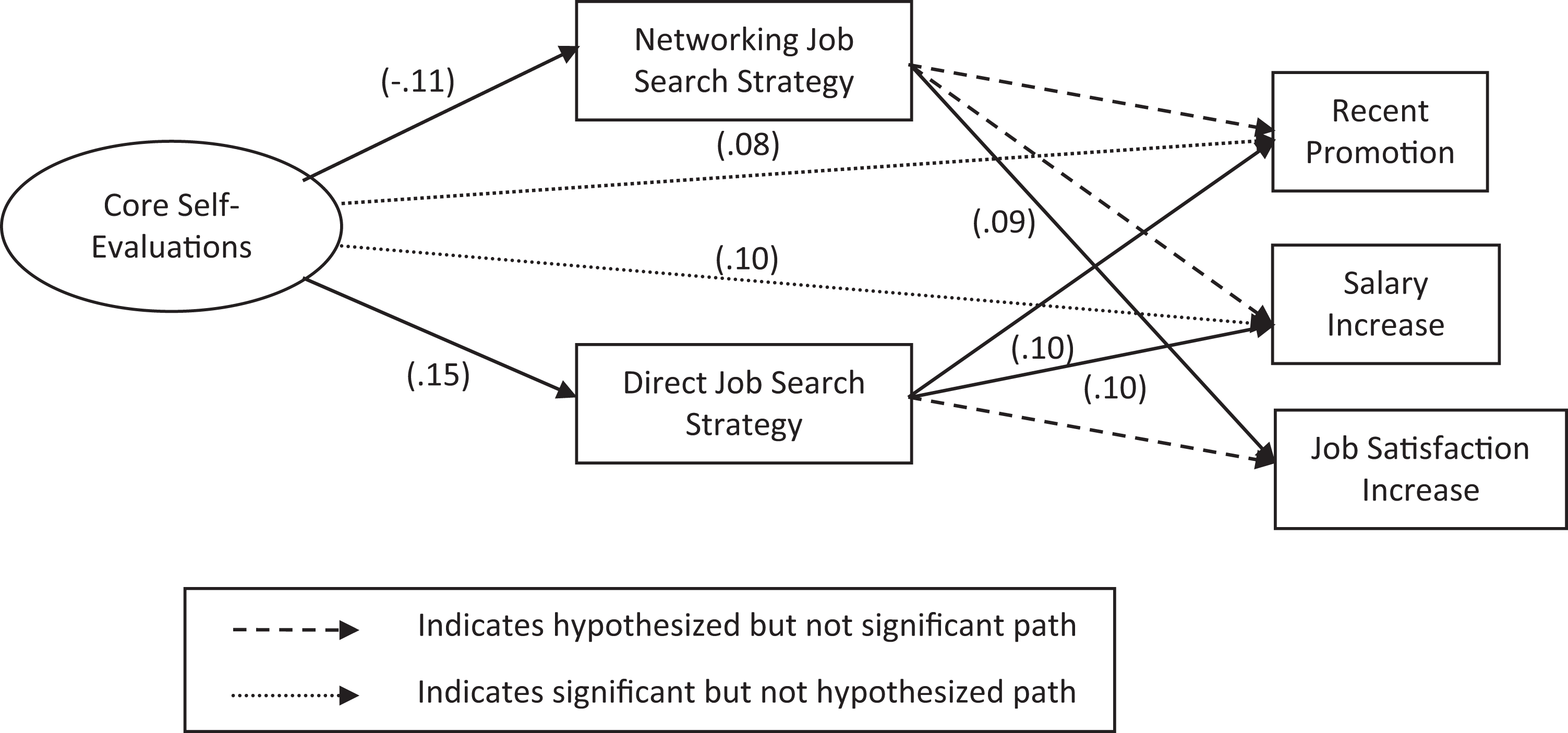
Final model. Only significant (two-tailed) coefficients shown. General mental ability, race, gender, and tenure served as control variables. However, for the sake of clarity, the control variables are omitted from the figures.
Such results indicate that different job search strategies involve different tools or mechanisms in terms of both subjective and objective career success and growth. Although the hypotheses involving CSE was supported, it is interesting to notice that the use of the networking job search strategy influenced positively subjective career growth, while the use of the direct job search strategy influenced positively objective career growth. Although the hypothesized model had a very good fit to the data, a theoretically relevant alternative model was also investigated (see Table 2).
Alternative model
This alternative model examined whether both the mediated and the direct paths between CSE and career success were significant. Thus, the second alternative model added the following three new paths: from CSE to a recent promotion, salary increase, and job satisfaction increase. The addition of these paths did result in a significantly better fitting model (χ2 change = 49.0 with 3 df, p < .01). Furthermore, results indicated that the paths from CSE to salary increase and recent promotion were significant, but not the path from CSE to job satisfaction increase.
Final model
A final model was tested by adding the two significant paths from CSE to salary increase and a recent promotion (see Table 2 and Figure 2). This final model resulted in a better fitting model (χ2 change = 22.4 with 2 df, p < .01) and was retained over the alternative model because it is a more parsimonious model. In general, results supported the hypothesized model, except for the added paths from CSE to objective career growth, which are consistent with prior findings that CSE influence career growth (e.g., Judge & Hurst, 2008; Ng et al., 2005).
The variance explained in the outcome variables (i.e., career growth variables) was obtained by calculating squared multiple correlations in AMOS. Variance explained in the career growth variables ranged from small for job satisfaction increase (r 2 = .04 for job satisfaction increase) to medium for salary increase (r 2 = .10) and recent promotion (r 2 = .08).
Discussion
This study conceptualized and tested a model examining the role job search strategies have in mediating the relationship between CSE and career growth for mid-career professionals. This study makes two contributions to the literature. First, findings suggest the importance of considering processes through which individuals develop their career. Second, results from job search strategies to career growth suggest that using different strategies to change job (or career) can have different effects on both subjective and objective career success and growth, in the context of mid-career professionals.
Contributions
Although small in magnitude, these findings suggest that the choice of specific job search strategies is one tool or mechanism through which mid-career professionals can further develop their career. Specifically, results indicated that CSE was directly related to salary growth and a recent promotion. However, the pattern of relationships of the final model occurred through mediated mechanisms, in this case the use of specific job search strategies. Consistent with social cognitive theory and CSE theory, mid-career professionals higher (vs. lower) in CSE were more likely to use the direct job search strategy. Interestingly, using a direct job search strategy was more likely to result in objective career growth, but not subjective career growth. Examining the role of mediated mechanisms in career growth is a critical aspect of the career development literature. Future research could thus examine the role of other tools or mechanisms in mediating the relationships between individual differences and career growth (family situation, industry context, and economy). For example, international assignments could also mediate the relationships between individual differences (e.g., CSE, extroversion) and how mid-career professionals further develop their career (e.g., Yan, Zhu, & Hall, 2002).
These results also shed light on the influence of job search strategies on various outcomes, in this case subjective and objective career growth. Specifically, although both job search strategies were predicted to be positively related to subjective and objective career growth, findings suggest that each job search strategy related to a different career growth outcome. It appears that mid-career professionals who used their networks of friends and relatives were more likely to experience an increase in their job satisfaction, whereas mid-career professionals who contacted employers directly were more likely to receive an increase in their salary and a promotion. This study thus also contributes to the job search literature, which has surprisingly paid little attention to job search strategies, their predictors and outcomes. Future research could examine the role of job search strategies in predicting career growth, but also as an outcome of mid-career professionals’ career growth, future research could also examine whether there are differences between early career, mid-career, and late career professionals and managers in terms of mediated mechanisms of career growth.
Practical Implications
This article also has practical implications for employees and organizations alike. The findings suggest that job search strategies are not to be neglected in career development. Rather than focusing on specific individual or organizational characteristics to influence career growth, organizations may try to better understand reasons why employees feel that they are not getting what they want or deserve. Specifically, instead of “letting” employees search for alternative jobs outside of their organization, human resource departments could emphasize the importance of job crafting, internal mobility, and/or international (expatriate) assignments as opportunities for employees to further develop their career within the organization.
Furthermore, although individual differences are important predictors of career growth, tools or mechanisms such as job search strategies can influence one’s career development. Employees could choose to use job search strategies that are not only consistent with their personality but also help them achieve their desired career growth. For example, if employees, such as mid-career professionals, put more emphasis on improving their overall job and career satisfaction, they may want to reach out to their friends and relatives when looking for a new job. Relatedly, if they are more interested in increasing their salary or receiving a promotion, they may want to contact organizations directly. These are avenues for future research, along with investigating other less commonly used job search strategies (e.g., responding to online ads) and/or other facets of career success and growth (e.g., work–life balance).
Limitations
Although this study has conceptual, methodological, and empirical strengths, it also carries some limitations. For example, this study examined three dimensions of career success and growth, which have received a lot of attention across various fields. Nevertheless, it does not address Heslin’s (2005) call for research to examine new dimensions of career success and growth, such as work–life balance. Although this archival data set did not have such variables, it would be very interesting for future research to examine whether different job search strategies are used depending on whether someone is looking for a job with a better pay, good promotion opportunities, a good work–life balance, or a calling (Hall & Chandler, 2005).
Other limitations are also related to the use of an archival data set. For example, the measure of job search strategies only asked the participants to report which strategies they had used to find a job. However, future studies could expand such measure to include multiple items asking participants to report why they used some strategies more than others, and also when and why they used those strategies. Furthermore, the sample was drawn from the 2000 survey of the NLSY79, which might not reflect the current employment picture. In sum, although the measures are adequate for such a study, scholars could further examine such a mediated model of career growth using fieldwork and previously defined variables, rather than “constrained” ones, using a sample of currently (or recently) employed individuals.
Finally, a major limitation of this study is that the path coefficients in this study, although significant, were relatively small. This study used a mixed model, combining path analysis and latent variable models, which could explain the relatively low coefficients. Furthermore, Coffman and MacCallum (2005) indicated that path analysis models, such as the proposed mediated model of career growth tend to lead to lower path coefficients. Future research could thus examine various dimensions of the examined variables (e.g., career growth), which would then allow scholars to use parcels to convert path analysis models into latent variable models.
Conclusion
Career growth is critical for mid-career professionals who are trying to stay out of a dreadful career plateau. Results from this study indicated that an important individual difference (i.e., CSE) predicts two commonly employed job search strategies, which in turn have different effects on both subjective and objective career growth. Such findings open the door to various directions for future research involving individual and contextual variables linking individual differences, job search, and career growth.
Footnotes
Declaration of Conflicting Interests
The author(s) declared no potential conflicts of interest with respect to the research, authorship, and/or publication of this article.
Funding
The author(s) received no financial support for the research, authorship, and/or publication of this article.