




Abstract
Work volition refers to the perceived ability of an individual to choose work under constraints. As they age, older workers often face declines in cognitive functioning and adaptability, as well as age discrimination in organizations. Our goal was to examine the relation between the mentioned constraints and work volition for aging workers, and whether general self-efficacy moderated the associations between constraints and work volition. A total of 350 working Chinese (aged over 45 years) in Hong Kong were recruited. Structural equation modeling (SEM) result showed that perceived age discrimination and cognitive constraint (planning and organization) were salient correlations of work volition. Multi-sample SEM analysis verified that general self-efficacy moderated the association between the cognitive constraints as well as perceived age discrimination in the workplace and work volition. Limitations and recommendations, including assessment of work volition, strengthening of general self-efficacy, and elimination of age discrimination, were discussed.
Keywords
Making career decisions is one of the most important issues for adults. In vocational psychology, studies have focused on understanding the factors that relate to career decision making. These factors include personality, job searching efficacy (Saks & Ashforth, 1999), and family expectations (Duffy & Dik, 2009), among others. A key assumption in previous research is that employees and job seekers can choose their career without constraints. Some theories, such as the psychology of working framework, challenge this assumption by stating that individuals have often compromised their career choices because of constraining factors (Blustein et al., 2002; Blustein, McWhirter, & Perry, 2005; Creed, Patton, & Bartrum, 2004). Duffy and colleagues examined work volition, which is defined as an individual’s power or capacity to choose careers despite the presence of constraints (Duffy, Diemer, & Jadidian, 2011; Duffy, Diemer, Perry, Laurenzi, & Torrey, 2012; Jadidian & Duffy, 2012). According to Blustein (2008) and Duffy et al. (2012), individuals with high work volition perceive a wide array of potential job opportunities and few barriers to pursue these opportunities. Conversely, individuals with low work volition perceive limited job options and end up taking jobs antithetical to their true preference.
Aging workers often encounter challenges in the workplace. These challenges can be derived from an individual’s personal development (e.g., cognitive decline and lower adaptability) and/or organizational factors (e.g., age discrimination in the workplace). A paucity of study examines how these unique constraints relate to work volition among aging workers. To address this knowledge gap, our study evaluates the association between personal/organizational constraints and work volition among aging workers. We also investigate whether general self-efficacy moderates the constraints–volition association. Our results will provide useful information to the work volition literature by understanding the common developmental and societal challenges that relate to work volition among the aging workforce, a unique and fast growing work population in modern society.
Work Volition
As discussed earlier, work volition assesses an individual’s perceived capacity to make occupational choices despite constraints. The idea of people feeling restricted in their ability to make career decisions has been explored in earlier studies (Creed et al., 2004; Gushue, Clarke, Pantzer, & Scalan, 2006). For example, De Cuyper and De Witte (2008) investigated how volition affects the decision of taking up jobs in temporary employment. However, the systematic measurement of work volition to capture this psychological construct has only been developed recently. The Work Volition Scale (WVS) developed by Duffy et al. (2012) consists of three subscales, which include volition, structural constraints, and financial constraints. Volition measures the individuals’ perceived capacity to make career choices, such as whether they perceive they are able to change jobs if they want to. Financial constraints measure the individuals’ perceived financial constraints or barriers that may affect their career choices. For instance, because of financial hardship, an individual may opt to take up a job even though he or she does not want to. Finally, structural constraints assess the perception of labor market/societal factor that influences career decisions. For example, during economic downturn, job opening is rare, and individuals might have to engage in jobs they do not truly desire.
Recent studies support the association between perceived constraints and level of work volition. Duffy et al. (2012) reported that work volition is negatively related to sex discrimination, disapproval from significant others, and general perceived barriers among working adults in the United States. By contrast, work volition is positively related to various individual factors, such as work self-efficacy, positive affect, and self-evaluation (Duffy, Bott, Torrey, & Webster, 2013).
Work Volition Among Aging Workers
Super’s career development theory (1953) states that aging workers (40s to early 60s) should be in the maintenance stage, where their major task is to preserve their roles in established careers and follow the established work patterns. Although the majority of workers at this stage opt to stay in their organization and career, involuntary work or career change is not uncommon. According to Rowe and Nguyen (2002), for workers aged between 50 and 65, job separation is primarily caused by involuntary turnover, such as layoff and illness/disability. Most of those who have been laid off would be actively seeking new jobs within 12 months. Therefore, work volition is an important and practical issue in understanding the career selection of aging workers. In the following, we briefly outlined the definition of “aging workers” and discussed potential factors that may be related to aging workers’ sense of work volition.
Although the research on aging workers continues to grow, the studies have not agreed on a consensual age for aging worker. Most often, researchers adopt the Age Discrimination in Employment Act (ADEA) and define aging workers as anyone in the U.S. workforce at or above the age of 40 (Maurer, Barbeite, Weiss, & Lippstreu, 2008). Other researchers (Van Dalen, Henkens, & Schippers, 2010) adopt the U.S. Department of Labor guidelines and define aging workers as working adults aged 55 and above. In this study, we have adopted the age of 45 and above as the cutoff criterion. The age of 45 is the cutoff age proposed by the World Health Organization (1993), and this criterion is in line with the widely adopted baseline proposed by the ADEA. Earlier studies suggested that employees’ functional capacities, such as physical fitness and ability to work, begin to decline at around 45 (Ilmarinen, 2001; Kiss, De Meester, & Braeckman, 2008). Therefore, the age of 45 years is a potential turning point that affects employees’ performance and their subjective evaluation.
With their unique needs, expectations, and challenges (Kanfer & Ackerman, 2004), aging workers are now facing barriers and constraints. These constraints include individual developmental factors (e.g., cognitive constraint and adaptability) and organizational factors (e.g., perceived age discrimination). In the present study, we explore whether these variables relate to work volition. Furthermore, we examined general self-efficacy as a form of resource buffer for the impacts of perceived constraints among aging workers.
Cognitive Constraint and Work Volition
Much research has now accumulated and documented the changes of the cognitive functioning of individuals across their life span. For example, the classic Seattle Longitudinal Study has collected six waves of data and illustrated the pattern of intellectual change from young adulthood to late adulthood (Schaie, 1994). Longitudinal data show that from young adulthood to early middle age, a modest gain of cognitive abilities is observed, such as inductive reasoning, word fluency, and spatial orientation. Several factors are identified to contribute to the individual differences in age-related change, such as a lack of cardiovascular disease and other chronic diseases, the continuous engagement in complex and intellectually stimulating environment, maintenance of high levels of perceptual processing speed into old age, and so on. However, after the age of 50 years, most ability markers start to decline.
Cognitive aging and decline is a barrier that prevents older workers from solving novel problems (McArdle, Ferrer-Caja, Hamagami, & Woodcock, 2002; Schaie, 1994). In this study, we investigated the two dimensions of cognitive constraints, namely, attention and concentration, as well as planning and organization, and their potential association with work volition. The selection of these two cognitive functioning corresponds with the studies on the aging mind, namely, cognitive mechanics and cognitive pragmatics (Baltes, Linderberger, & Staudinger, 1999). Attention and concentration are proxies of cognitive mechanics, in which the neurophysiological architecture of the brain is captured through evolution. These proxies refer to an individual’s perception of whether he or she can concentrate and provide sustained attention over the primary task he or she is performing (e.g., focusing on what people are saying during a conversation).
Older people usually experience lower concentration than their younger counterparts (Ridderinkhof, Span, & van der Molen, 2002). For instance, Hasher and Zacks (1988) found that with age, people have more trouble inhibiting their attention to irrelevant information and concentrating on relevant information. This weakened inhibition function drives aging individuals to hold more information that is disconfirmed in their memories, which might affect their performance, than younger adults.
Planning and organization represent the type of knowledge or competence that helps an individual cope with life, referring to the experience-based and culturally transmitted bodies of factual and procedural knowledge (Baltes et al., 1999). The primary concern is the ability of older individuals to organize their task efficiently and to make decisions. Older individuals often find it difficult to make decisions and plan. For example, Finucane et al. (2002) reported that compared with younger adults, older adults have more comprehension errors and inconsistent preference, even when covariates (e.g., education, income, and decision styles) are controlled. The deteriorating ability to make decisions and plan poses significant challenges for aging workers in the workplace.
The connection between cognitive constraints and work volition builds on the assumption that older workers are able to assess their own cognitive functioning critically. Earlier studies provided some support on this contention. For example, based on an objective test, Levy-Cushman and Abeles (1998) and Pearman and Storandt (2004) found that a modest correlation exists between self-perceived memory competence and memory performance. Overall, we hypothesize that the perceived decline of these cognitive abilities is negatively related to aging workers’ work volition. In particular, when aging employees believe that they do not experience cognitive decline, they tend to perceive more job options are available as they have sufficient cognitive ability to handle work tasks. However, when they perceive that they have lower level of attention and concentration or when they believe that planning and organization is getting more difficult, they perceive they have fewer job options (e.g., as they believe more cognitively demanding jobs do not fit them), and consequently, they perceive lower work volition.
Adaptability and Work Volition
We hypothesize that adaptability is another factor that relates to aging workers’ work volition. Adaptability refers to the individuals’ capacity to continuously adapt and cope with new work environment (Atchley, 1987). Adapting to a social environment with the goal of person–environment integration is important for employees (Savickas, 2005). As suggested by Yeatts, Folts, and Knapp (2000), workplace adaptation is affected by both individual factors (e.g., job skills and attitudes toward change) and organizational factors (e.g., provision of training and age discrimination in the workplace). For example, Warr (1994) suggested that in a stable and routine work environment, low ability to adapt to the work environment may be less detrimental to aging workers job performance because employees can draw on their expertise and skills to compensate for the potential loss (e.g., slower cognitive processing). However, the modern workplace is constantly changing because of technological advancement (Economist, 2014; Gephart, 2002). Work tasks may also change because of organizational restructuring. Thus, aging workers need to adapt to these changes actively to ensure that their knowledge, skills, and abilities satisfy the requirements of their jobs (Yeatts, Folts, & Knapp, 2000). Compared with younger workers, aging workers may need more time to adapt to their new environment and technological advancement (Fozard, Rietsema, Bouma, & Graafmans, 2000; Gist, Rosen, & Schwoerer, 1988). When aging workers fail or refuse to adapt to their new roles, their personal well-being are affected and they have stronger intentions to leave the organization (e.g., Yeatts et al., 2000).
In this study, we argue that adaptability to changes also affect their perceived work volition. For instance, if aging workers perceive that they are generally adaptable to the new workplace and tasks, then they may perceive they have more job opportunities and alternatives in this changing job market. Conversely, if they perceive that they have low adaptability, then they may believe that fewer job options are available because they may not be able to adjust to new roles and organizations.
Perceived Age Discrimination and Work Volition
Apart from personal factors, organizational factors also hinder the work volition of aging workers. One of the factors we have examined is age discrimination in the workplace. Age prejudice and discrimination in the workplace are common in Western societies (Billett, Dymock, Johnson, & Martin, 2011; Chiu, Chan, Snape, & Redman, 2001; Posthuma & Campion, 2009). Posthuma and Campion (2009) noted that common negative age stereotypes on aging workers include low productivity, resistance to change, low ability to learn, and being more costly. Despite the emphasis on respect for older people in collectivistic Chinese society with traditional Confucian values, aging workers in Hong Kong also suffer from age discrimination and stereotyping in the workplace (Cheung & Wu, 2012; Chiu et al., 2001). For instance, in a study on workplace age discrimination, higher discrimination in the workplace is found in Hong Kong than in the United Kingdom. Chiu, Chan, Snape, and Redman (2001) suggested that the rapid shift from manufacturing toward the service industry and a lack of equal opportunity ordinance to protect older workers contribute to the occurrence of age discrimination toward older workers in Hong Kong. Age discrimination in the workplace is also negatively related to successful aging at work among aging workers in Hong Kong (Cheung & Wu, 2012).
Previous studies indicated that age discrimination vary across organizational contexts (McCann & Giles, 2002; Remery, Henkens, Schippers, & Ekamper, 2003). Lawrence (1988) suggested that the organizational norm that emphasizes speed and change may have expectations that younger people will fit better in the job and find the aging workers incompatible with the organizational norm. Hassell and Perrewe (1995) also found an age bias exists against aging workers trying to obtain new jobs. When aging workers perceive that they are being evaluated and treated unfavorably, they may feel distressed and the negative bias may lower their motivation to perform well in the workplace. They will less likely choose these jobs or organizations. Thus, we hypothesize a negative relationship between perceived age discrimination and work volition.
General Self-Efficacy as a Resource
General self-efficacy refers to subjective beliefs necessary to cope with a variety of difficult demands in life (Schwarzer & Jerusalem, 1995). Individuals with higher general self-efficacy tend to be more optimistic and believe they can cope with the difficulties and challenges they encounter. General self-efficacy as buffer of stressors in the workplace is often reported (Jex & Bliese, 1999; Mikkelsen & Einarsen, 2002; Nauta, Liu, & Li, 2008; Siu, Lu, & Spector, 2007). For example, Mikkelsen and Einarsen (2002) reported that when employees encounter bullying behaviors in the workplace, those who reported higher generalized self-efficacy have lower psychological health complaints than those who had low generalized self-efficacy. Similar buffering effect was also found in the Chinese work sample. Siu, Lu, and Spector (2007) reported that general self-efficacy moderated the association between work stressors and mental well-being among Chinese employees in Mainland China: Employees with higher general self-efficacy reported better mental well-being than their counterparts with lower general self-efficacy under high work stress.
According to Grau, Salanova, and Peiro (2001), the influence of work stressors on the outcome depends heavily on the level of perceived efficacy. Together with the abovementioned studies, we hypothesize that general self-efficacy moderates the association between constraints and work volition. In particular, individuals with high general self-efficacy tend to cope better when encountering setbacks and report more positive outcomes than their counterparts with low general self-efficacy. In our study, we hypothesize that when aging workers perceive different barriers (e.g., cognitive decline and discrimination in the workplace), they generally perceive lower work volition. However, this association depends on the level of general self-efficacy of the individual: Those with higher general self-efficacy report a higher level of confidence to overcome these constraints, which in turn heighten their sense of work volition. Conversely, for individuals with lower general self-efficacy, when they experience these constraints they may have lower work volition because they believe they do not have the capacity to deal with the problems ahead.
Method
Participants
We recruited participants from several organizations in Hong Kong, including public companies, governmental divisions, public hospitals, and a nongovernmental organization. Research assistants were sent to approach and coordinate with the liaison person in these organizations. Then, these liaison people informed and recruited their colleagues for this project. Participation in the research was voluntary and was not requested by their employer. Informed consent was obtained from each participant. A questionnaire package that included the study objectives, the intended use for the information, and the measures was distributed to every participant. Confidentiality was ensured and the questionnaire cover clearly stated that all data gathered would be purely for research purposes. These data were not disclosed to the organizations they belong to. A supermarket coupon (US$6.40) was given to participants as an incentive to enhance the response rate.
All participants were full-time employed Hong Kong Chinese, who were at the age of 45 years or above during the study period. A total of 380 questionnaires were distributed, and 350 valid questionnaires were gathered with a response rate of 92.1%. Among the 350 participants, 129 (36.9%) were men and 220 (62.9%) were women, and 1 participant did not report a gender identity. The mean age of the sample was 51.9 years (SD = 5.2, ranging from 45 to 67 years). t-Test showed that the men in the present study were older (M = 52.6 and 51.4, t = 2.09, p = .04) than the women. Ninety-four (26.9%) participants were managers or professionals, whereas 256 (73.1%) were frontline workers, clerks, and nonskilled workers.
Materials and Procedure
Except for the generalized self-efficacy and adaptability, the questionnaire items were originally written in English. A professional translator was employed to translate the questionnaire items from English to Chinese. Back translation was then performed by an individual who had no prior knowledge of the scales. Investigators in this study compared the original scale and the translated English scale. In case of a disagreement between the two versions, the investigators decided which terms could best represent the nature of the study.
Measures
Cognitive constraints
Cognitive constraints were measured using the perceived deficits questionnaire (PDQ) developed by Sullivan, Edgley, and Dehoux (1991). Two subscales were adopted in this study, namely, The Attention/Concentration and Planning/Organization subscales. Each subscale consists of 5 items. Sample items were “I lose my train of thought when I am speaking” (attention/concentration) and “I have trouble getting things organized” (planning/organization). PDQ has been found to correlate significantly with depressive symptoms and fatigue as well as the quality of life of the individuals. A previous study also showed that the two subscales show satisfactory internal consistency, the α coefficients were .78 for attention/concentration and .84 for planning/organization (Sullivan, Edgley, & Dehoux, 1991). Participants were asked to respond on a 5-point Likert-type scale, ranging from 0 = never to 4 = almost always. In the present study, the α coefficients for attention and concentration, as well as planning and organization were .82 and .88, respectively.
Adaptability
Adaptability was measured using the scale developed by Robson, Hansson, Abalos, and Booth (2006). The scale measured an individual’s perception in adjusting to organizational and role demands. Sample items included “I do not resist potential changes in my job” and “I adapt to changes in my job.” The original scale demonstrated excellent internal consistency (α coefficient = .94) and it correlated with the sense of job control (Robson, Hansson, Abalos, & Booth, 2006). A Chinese version was available and was used in a previous study (Cheung & Wu, 2012). The scale also demonstrated good internal consistency (α coefficient = .88) and was found to correlate with perceived organizational support. Participants were asked to rate on a 7-point Likert-type scale, with 1 as strongly disagree to 7 as strongly agree. The α coefficient of this scale was .86.
Perceived age discrimination
We used the perceived age discrimination scale by Redman and Snape (2006) to measure whether aging employees perceived they were being treated unfairly because of their age. The scale consisted of 4 items with sample items including “my age prevents me from getting jobs for which I think I am qualified” and “the people I work with treat me less favorably because of my age.” Past research showed that the scale shows internal consistency (α coefficient = .77) and was found to correlate with successful aging in the workplace among aging workers (Redman & Snape, 2006). Participants responded on a 7-point Likert-type scale, ranging from 1 = strongly disagree to 7 = strongly agree. High scores represented higher perceived age discrimination. This 4-item scale had a Cronbach’s α value of .76 in the present study.
General self-efficacy
Participants were asked to evaluate their general sense of efficacy from the generalized self-efficacy scale (Schwarzer & Jerusalem, 1995). This scale assesses an individual’s perceived ability to handle difficult situations. Sample items included “I can always manage to solve difficult problems if I try hard enough” and “If someone opposes me, I can find the means and ways to get what I want.” The scale showed excellent internal consistency, the α coefficient was .81 and was found to correlate with job satisfaction and emotional exhaustion (Grau, Salanova, & Peiro, 2001). A Chinese version of the general self-efficacy was available and has been tested in the Chinese working population. The scale demonstrated good internal consistency (α coefficient = .92 and .87 for Hong Kong and Mainland China sample, respectively) and was found to relate to job satisfaction and behavioral symptoms. Participants rated each item with a 5-point scale (strongly disagree = 1 and strongly agree = 5). A higher score represented a good sense of general self-efficacy. The internal consistency of the scale in the present study was .88.
Work volition
We used the WVS developed by Duffy et al. (2012) to assess a participant’s work volition. The scale contains 13 items with three subscales, including volition (4 items), structural constraints (4 items), and financial constraints (5 items). Sample items were “I have been able to choose the jobs I have wanted” (volition), “in order to provide for my family, I often have to take jobs I do not enjoy” (financial constraints), and “the current state of the economy prevents me from working in the job I want” (structural constraint). The overall WVS was computed by averaging the three subscale scores. In an earlier study by Duffy et al. (2012), the overall scale shows acceptable internal consistency (α coefficient = .84), and it is correlated with job satisfaction. Participants rated each item with a 7-point scale (strongly disagree = 1 and strongly agree = 7). A higher score represented a high work volition. The α coefficients of the scales in the present study were .78, .70, .77, and .72 for volition, financial constraints, structural constraints, and the overall work volition, respectively.
Demographics
Participants were asked to indicate their gender, age, and job level.
Assessment of Common Method Variance and Power Analysis
All data in the present study were collected via self-administrated questionnaires. Therefore, common method variance may inflate the strength of observed relationships (Podsakoff, MacKenzie, Lee, & Podsakoff, 2003). Harman’s one-factor test was conducted via confirmatory factor analysis (CFA) to address the issue of common method variance. Following the procedure proposed by Podsakoff, MacKenzie, Lee, and Podsakoff (2003), all of the items were loaded into a one-factor solution. If method variance is largely responsible for the covariation among the measures, then explanatory factor analysis should indicate that a single (method) factor fits the data. Results showed that two factors with an Eigenvalue over 1 and a 57.07% variance were explained. The first factor accounted for 37.98% of the total variance.
Two sets of CFAs were conducted to evaluate the common method variance issue further. In the first CFA model, all items were forced to load on one latent factor (i.e., one-factor model), and the second model forced the items to load on their respective factors (i.e., measurement model). The assumption was that one-factor model should fit the data better if there is a significant common method variance. Considering the total number of items and model complexity, item parceling was adopted to reduce the number of observed variables (i.e., individual questionnaire items) and potential estimation problem. To compute the data parcels, we averaged individual items by random assignments (Little, Cunningham, Shahar, & Widaman, 2002) and established composite scores. These scores were adopted as the observed indicators of the CFA model. Results showed that the measurement model (χ2 = 68.46, df = 34, Akaike information criterion [AIC] = 0.05) fitted the data better than the one-factor model (χ2 = 876.12, df = 44, AIC = 788.12). Thus, the Harman’s one-factor test and CFA analysis both suggested that the result in this study should not solely be attributed to common method variance.
Power analysis by G*Power was conducted to examine the total sample size required in this study. With an expected medium effect size, 0.05 error probability, a power of 0.95, and five independent variables, a minimum sample size of 138 participants was needed. Thus, the current sample size (n = 350) should provide sufficient statistical power to correctly reject the null hypothesis when it is false.
Results
Correlation Analysis
Table 1 reported the bivariate correlation and descriptive statistics of major variables. The overall work volition was negatively related to the attention and concentration of cognitive constraints (r = −.33, p < .01), planning and organization (r = −.31, p < .01), perceived age discrimination (r = −.39, p < .01), but positively associated with adaptability (r = .23, p < .01) and general self-efficacy (r = .25, p < .01).
Correlation Table of Major Variables.

Note. N = 350.
**p < .01. *p < .05.
Structural Equation Modeling (SEM)
To examine the association between various constraints and work volition further, SEM was performed to evaluate the hypothesized model. In line with earlier studies (Duffy et al., 2012), volition, structural constraint, and financial constraints were used as observed variables of the latent factor “work volition.” The two cognitive constraint factors (i.e., attention and concentration, as well as planning and organization), adaptability in the workplace, perceived age discrimination, and general self-efficacy were used to predict work volition. Raw scores were used as data input, and the maximum likelihood estimation was adopted. Several fit indexes, including χ2, normed fit index (NFI), comparative fit index (CFI), goodness-of-fit index (GFI), and root mean square error of approximation (RMSEA), were used to evaluate the model’s overall goodness of fit.
Compared to the null model (χ2 = 902.66, df = 28), the hypothesized model showed a significant improvement of model fit with the empirical data (χ2 = 75.34; Δχ2 = 827.32, Δdf = 18, p < .01). Except for the RMSEA, which was higher than the 0.08 criterion (RMSEA = 0.14), CFI (.93), GFI (.95), and NFI (.92) all suggested that the model fit was satisfactory. Figure 1 reports the coefficients of the SEM results.

Structural equation modeling.
Moderation Analysis by Multi-Sample SEM Modeling
We constructed a multi-sample model to assess whether general self-efficacy affects the constraints and work volition associations. Based on the general self-efficacy score, we used median split to divide the overall sample into two subsamples (low and high general self-efficacy groups). A similar statistical procedure was adopted in earlier studies to investigate the moderating effect in SEM analysis (Pappas, Pateli, Giannakos, & Chrissikopoulos, 2014; Whaley, 2012). The four paths (attention and concentration, planning and organization, adaptability, and perceived age discrimination in the workplace) to work volition were constrained in the two groups. This constraining procedure allowed us to test whether the path coefficients were invariant between the low/high general self-efficacy groups. Results showed that the multi-sample SEM model fitted well with the empirical data. In particular, compared to the null model (χ2 = 668.68, df = 56), there was a significant improvement in the overall model fit (χ2 = 59.54; Δχ2 = 609.15, Δdf = 32, p < .01). All fit indices suggested that the model fit was satisfactory (CFI = .94, GFI = .96, RMSEA = .09, 90% confidence interval [0.06, 0.12]). Lagrange multiplier (LM) test suggested that three constrained paths should be released from the multi-sample analysis, including the two cognitive constraint paths and the perceived age discrimination in the workplace to work volition. In other words, general self-efficacy may affect the strength of the constraints and work volition association. Based on the LM test results, we conducted three independent regression analyses and examined the moderation effects. Based on the recommendation by Frazier, Tix, and Barron (2004), the scores on constraints and general self-efficacy were standardized before creating the interaction term to avoid multicollinearity. Figure 2a–c graphically presents the results of these moderation analyses. Across these three analyses, we found that when employees report high levels of constraint (cognitive constraints and perceived age discrimination in the workplace), aging employees with higher general self-efficacy tend to report higher level of work volition than those who reported low level of general self-efficacy.
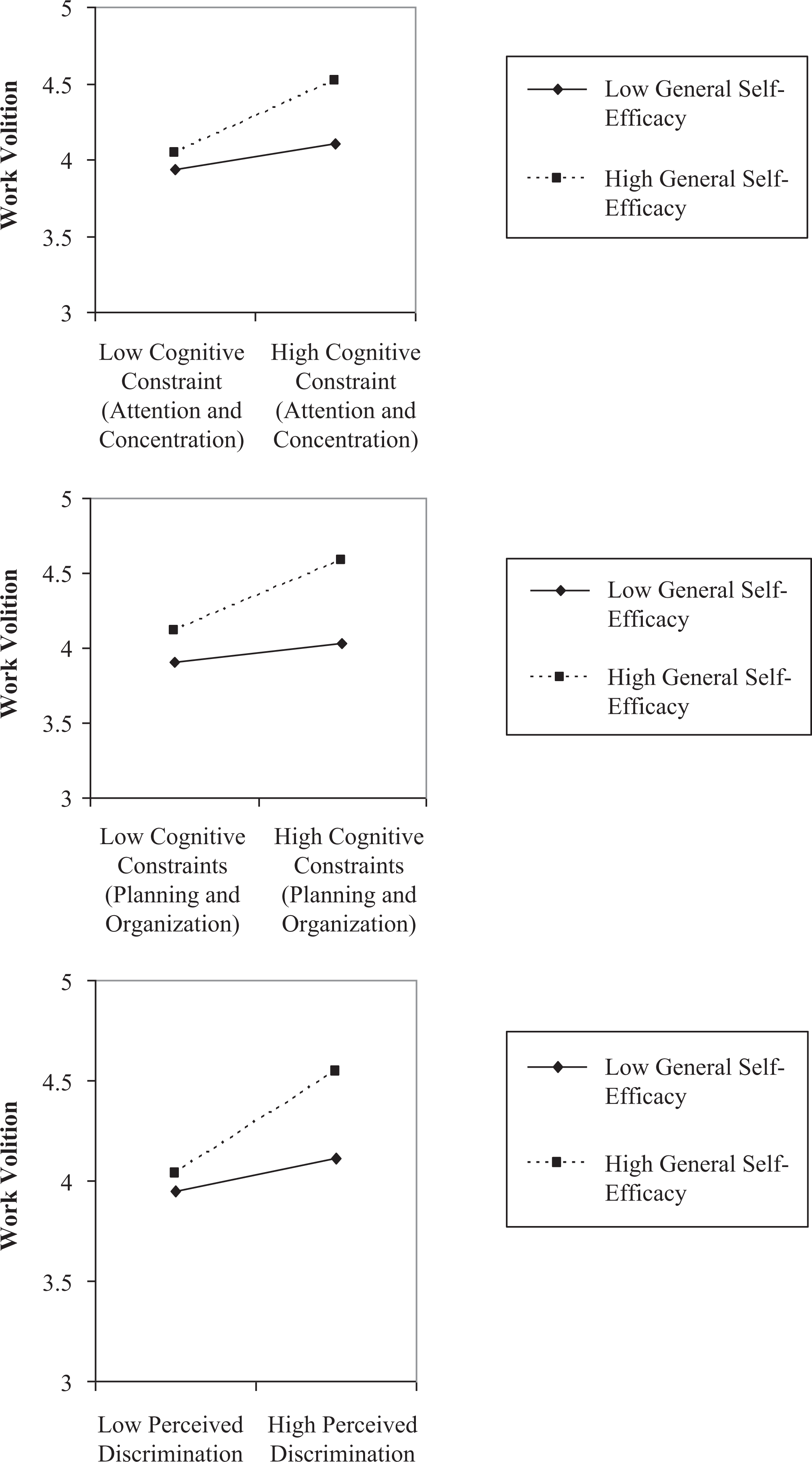
Interaction effect of general self-efficacy and constraints in predicting work volition.
Discussion
In this study, we explored various constraints (i.e., individual and organizational levels) and their relation to work volition. The selection of these constraints represented some developmentally related challenges that aging workers often encounter in the workplace, ranging from cognitive functioning to discrimination against aging workers. The relation of these variables with work volition was not presented in earlier studies. Thus, our study provides additional input to the work volition literature by considering age-related constraints and their impact on work volition to the unique and fast growing workforce.
To the best of our knowledge, our study is the first to examine the association between cognitive constraints and career choice among older workers. Bivariate correlation showed that volition was negatively related with cognitive constraints (attention and concentration) but not to the planning and organization (although it is also in the predicted direction). However, the overall work volition construct was significantly related to both cognitive constraint variables. SEM result further revealed that planning and organization are particularly important in predicting work volition when other factors are considered together. When aging workers believe that their ability to make plans and organize their work is deteriorating, they will believe that some jobs which may be cognitively demanding (i.e., jobs that require frequent planning and organization) may not fit them. This constraint eventually affects their work volition and consequently their actual job selection. Our finding clearly suggests the importance of cognitive constraints in work volition among older workers. However, an interesting finding on the conceptualization of the volition construct is found: Although past studies tend to use the overall “work volition” construct in analysis and prediction (e.g., Duffy et al., 2013; Jadidian & Duffy, 2012), our study suggests that the analysis using subdimension (i.e., volition) may generate a different conclusion.
Apart from the cognitive factor, perceived age discrimination in the workplace was also a significant correlate in predicting work volition. Aging employees who perceive that they are being treated unfavorably or being actively discriminated generally reported lower work volition. The close association between work volition and age discrimination in the workplace is in line with an earlier study by Duffy et al. (2012), which showed that sex discrimination and racial discrimination are significant correlates of work volition. Overall, converging evidence shows that different forms of discrimination in the workplace are negatively related to work volition.
Moreover, general self-efficacy was positively correlated with work volition. When an aging employee has more optimistic self-belief to cope with difficult demands in life, they tend to believe that they have higher control of their job selection. Multi-sample SEM results further supported the notion that general self-efficacy is a salient moderator, which buffers the negative impact of various constraints on work volition. In general, we found that general self-efficacy is particularly important when employees are facing high levels of constraints (e.g., cognitive constraints and age discrimination in the workplace) because employees with higher general self-efficacy report higher level of work volition than others with lower general self-efficacy.
Implications
Our findings provide useful insights on enhancing work volition among aging workers. In terms of career counseling, counselors should first understand the level of work volition and key constraints that the aging workers are facing when they are making career choices (Duffy et al., 2013). These data provide useful information for later counseling and job matching for these individuals. Furthermore, general self-efficacy emerges as an important factor that determines work volition when aging workers are facing constraints. Thus, counselors should enhance the sense of efficacy of aging workers to mitigate the impact of constraints. Raising the efficacy of older workers is particularly challenging because self-confidence at work tends to drop when people are getting older, especially when it is related to career-relevant learning and development (Maurer, 2001). As Bandura (1997) suggested, various factors are closely related to the formation of strong self-efficacy, including experience of mastery, modeling of others, and social persuasion. In counseling sessions, for example, the counselor can remind the aging workers of their successful experiences at work. Direct encouragement from counselors and their significant others can also help establish a stronger sense of self-efficacy. As such, when aging workers experience constraints (e.g., cognitive decline and age discrimination), they can still achieve higher work volition. Another possible strategy is the use of coping skills training to enhance general self-efficacy. Smith (1989), for example, empirically demonstrated that via the use of a short coping strategy program (e.g., goal settings), the general self-efficacy of trainees can be significantly enhanced. Thus, organizations can provide relevant training programs to enhance the coping skills of their older workers to boost their sense of general efficacy.
From a broader perspective, organization and society should aim to eliminate age discrimination in the workplace. During an economic downturn, the total number of recruitment shrinks, which affects aging workers more because organizations are more inclined to hire younger workers for new job openings. Legislation and enforcement against age discrimination are important to ensure fairness of recruitment for aging workers, which is especially true in Hong Kong given that the equal opportunity ordinance only covers discrimination on sex, disability, family status, and race. Improved education for the public and legislation on age discrimination is vital. Work volition should be enhanced when aging workers perceive that their organization and society are fair and they are not being systematically biased.
Limitations
This study has several limitations and its results should be interpreted with caution. First, it used a self-reported cross-sectional design in which participants were recruited during a single time point. Thus, common method variance might have inflated the observed associations (Podsakoff et al., 2003). Although Harman’s one-factor test and the CFA results provided evidence that the common method variance did not significantly inflate the observed relations, future studies should obtain data from other sources (e.g., managers and clients) for external validation. For example, instead of using subjective measures to access cognitive constraints, future studies can adopt an objective measure to assess the cognitive functioning and use the objective score to correlate with work volition.
Second, we limited the scope of the study by examining factors that relate to work volition. The effect of work volition on the actual career behaviors of older workers, such as job changes and actual job selection, was not addressed. Thus, future studies can extend the present line of research to consider the relationships between work volition and career behaviors among aging workers. Although we have explored several developmentally related factors that affect work volition, other individual factors such as personality were not included in this study. Duffy et al. (2012) illustrated that except for openness to experience, five other big personality dimensions are significantly related to work volition. Whether these personality variables interact with other factors in affecting work volition and other vocational development was not explored. For instance, given that extroversion, agreeableness, and conscientiousness were positively correlated with work volition, could these relations be moderated by cognitive constraints or other organizational factors (e.g., age discrimination)? More research is needed to examine how these factors relate to work volition and organizational career growth.
Third, our study only recruited Chinese participants in Hong Kong. Although Hong Kong is strongly influenced by Western cultures, particularly by British traditions, Confucian philosophy is the dominant philosophy of the society. As people age, family roles may become more important (Super, 1953), which is particularly true in the Hong Kong context because family is still considered the fundamental unit of Chinese society. Based on the Confucian philosophy, family takes precedence over its individual members and the most important function of family members is the maintenance and preservation of the household. Therefore, when contradictions exist between work and family roles, individual family members are expected to place the family’s interests above those of the individual. Consequently, the expectation from the family and the urge to balance work and family demands may severely limit the career choices of older workers. In this study, however, we did not directly measure how work–family balance/conflict relates to work volition. Therefore, an inclusion of work–family balance measure in the future study will be important to address the issue of how work–family balance relates to work volition. Furthermore, conducting a similar research in different cultural context (e.g., Western cultures) and testing the generalizability of the findings are important.
Finally, our sample comprised predominately of frontline and nonskilled workers, whereas the proportion of skilled and managerial workers was small. To evaluate the potential difference of the effect of job nature or job rank on work volition is critical, and a more balanced sample should be recruited in future studies. By doing so, researchers can test the model for these two groups separately and evaluate whether the model fits/differs across these nonskilled/professional groups.
Footnotes
Declaration of Conflicting Interests
The author(s) declared no potential conflicts of interest with respect to the research, authorship, and/or publication of this article.
Funding
The author(s) received no financial support for the research, authorship, and/or publication of this article.