



Abstract
Career paths are no longer linear or predictable due to the instability and dynamic changes occurring in the work environment. Career researchers have acknowledged this trend and emphasized the significance of individuals’ actual behaviors in career development. Occupational engagement is an essential behavior that leads to successful and satisfactory career development in college students. The current study examined the mediating and moderating roles of work volition in the relationship between social support and occupational engagement. A total of 233 (80 males, 153 females) Korean undergraduates participated in the survey. The results were as follows: Work volition partially mediated the positive relationship between social support and occupational engagement. That is, people who felt they had higher social support reported more work volition, which in turn resulted in more active participation in occupational engagement. Also, the moderation effect of work volition was found between social support and occupational engagement. Thus, the influence of social support on occupational engagement was greater for those with an average or above level of work volition. The results showed that environmental social support and individual work volition are vital factors in improving occupational engagement. The implications and suggestions for practical uses and future research were suggested.
Following the recent recession, unemployment still persists despite the recovery in job growth. One-third of the unemployed have been out of work for 12 months or longer (Organization for Economic Cooperation and Development [OECD], 2014). From 2011 to 2015, 18% of 15- to 29-year-olds were neither employed nor undergoing education or training (not in education, employment, or training [NEET]; youth NEET, OECD, 2016b). Influenced by the global trends, the Korean labor market has been facing a dire situation for several years. National Statistics Korea (2015) reported that the unemployment rate for young adults (aged 15–29 years) was 9.2%, and 20.3% of those employed had contracts of less than 12 months. Because of this instability and dynamic changes occurring in the work environment, career paths are no longer linear or predictable (Krumboltz, 2009; Savickas, 2000). These changes have led undergraduates, who need to prepare for future careers, to extend their preparation period (Arnett, 2000). On an average, students often take longer to complete their bachelor’s degrees, with only 41% of students graduating within the program’s theoretical duration and 69% graduating up to 3 years after the theoretical duration (OECD, 2016a).
Career researchers have acknowledged this trend and adjusted their theories (e.g., Krumboltz, 2009; Savickas, 2000). Studies on school-to-work transition have placed a significant emphasis on actual behaviors related to careers in addition to attitudes and cognitive aspects (Blustein, 1997; Krieshok, Black, & Mckay, 2009). One of the behavioral constructs that reflects this global trend is occupational engagement, which is defined as behaviors that broaden work-related options and increase self-understanding in relation to the working environment (Cox, 2008; Cox, Krieshok, Bjornsen, & Zumbo, 2014). Compared to other behavioral factors such as career preparation (Kim & Kim, 1997) or career exploration (Stumpf, Colarelli, & Hartman, 1983), which are focused on behaviors specifically directed toward career decisions, occupational engagement is focused more on broad, habitual behaviors. Thus, we hypothesized that behavior that could benefit Korean undergraduates in the constantly changing work environment would involve occupational engagement. Moreover, empirical studies on occupational engagement have indicated positive outcomes. For undergraduates, occupational engagement positively correlated with vocational identity, academic satisfaction (Cox et al., 2014), and life satisfaction (Cox, 2008). Because previous research has demonstrated the benefits of occupational engagement to emerging adults’ career and well-being, a close examination of the precursors of occupational engagement in Korean undergraduates is necessary.
Social Support
Major theories on careers have asserted that career-related behaviors are often determined by both personal and environmental factors (Mitchell & Krumboltz, 1996; Walsh & Savickas, 2005). Social support is one of the contextual and environmental factors known to influence career-related behavior. The term “social support” refers to the positive resources people acquire from their social relationships (Betz, 1989) and includes subfactors such as emotional support (respect, affection, trust, and consideration), evaluative support (feedback, evaluation, and comparison), informational support (advice, suggestion, and information), and instrumental support (economic support, time, and environmental improvement; House, 1981). Studies have found that these factors positively correlate with career behaviors (Caplan & Killilea, 1976; Hirschi, Niles, & Akos, 2011; Metheny & McWirter, 2013) and work-related performance (Blustein, 1997).
Studies on support and career-related behavior have shown that students supported by friends and family are more actively engaged in career exploration and career preparation behavior (Blustein, 1997; Hirschi et al., 2011). Further, Korean studies have revealed the importance of social support for career-related behaviors. Studies showed that social support is positively related to career preparation behavior (Song & Hong, 2010) and career exploration behavior (Lee & Song, 2004). Briefly, previous research has found that social support is positively linked to increased career-related behavior. Therefore, we hypothesized that social support will significantly correlate with occupational engagement.
Social support is a particularly important factor in Korea; this is largely because of Korea’s collectivist culture. In Western cultures, where values such as independence, autonomy, and liberty are emphasized, people will probably consider a first-person perspective of their abilities and goals. However, in collectivist societies such as Korea, the most important values are interdependence and harmony. Accordingly, Koreans usually perceive themselves from an outsider’s perspective, and the self is viewed as a product of society (Fiske, Kitayama, Markus, & Nisbett, 1998; Kim & Cohen, 2010; Markus & Kitayama, 1991). Therefore, it is logical to assume that external evaluation and support significantly influence career choices and motivation. For these two reasons, social support was selected as an important precursor of occupational engagement in Korean undergraduates.
Work Volition
Until recently, many researchers have assumed that all the people have the power and capability to choose their own career paths (Blustein, 2006; Duffy, Diemer, & Jadidian, 2012; Duffy, Diemer, Perry, Laurenzi, & Torrey, 2012). However, in reality, not all individuals who have identified the perfect job based on thorough self-understanding can actually pursue their choices. This may be because they lack the power and agency to overcome potential obstacles such as social status, race, physical disability, sexual orientation, immigration, sex, poverty, resources, or lack of access (Blustein, Kenna, Gill, & Devoy, 2008) to pursue their future occupation (Duffy, Diemer, Perry, et al., 2012). Such powerlessness over one’s career choice can seriously hinder one’s career decision-making processes (Blustein, 2006). A concept closely related to this powerlessness is volition, which is the power to make one’s own choices or decisions. Duffy, Diemer, Perry, et al. (2012) applied this concept specifically to vocational psychology and defined volition in work as “the perceived capacity to make occupational choices despite constraints (p. 400).” In other words, it is one’s perceived level of freedom over his or her occupational choice (Duffy, Diemer, Perry, et al., 2012; Duffy, Diemer, & Jadidian, 2012). People with high work volition have fewer limitations when making career decisions; thus, they have the ability to choose careers that suit their needs, interests, and values. Previous studies on working adults have shown that people with high work volition perceive their work to be meaningful (Allan, Autin, & Duffy, 2013) and as a calling (Duffy & Autin, 2013), which is “an approach to work that involves summons to a job that is personally meaningful and prosocial in nature” (Dik & Duffy, 2009 as cited in Duffy & Autin, 2013, p. 220). They also have higher job satisfaction (Duffy, Bott, Torrey, & Webster, 2013) and higher life satisfaction (Duffy, Bott, Allan, & Torrey, 2013).
Undergraduates’ work volition was positively related to career decision self-efficacy (Jadidian & Duffy, 2011), self-efficacy, expectations, interests, and goals (Duffy et al., 2014). Thus, students with higher work volition tended to perceive their career and academic dimensions more positively. For this reason, this study tested the work volition construct as a predictive variable in understanding undergraduates’ career outcomes. Studies have also suggested that work volition is a key factor not only for employees but also for students exploring their career options (Duffy, Diemer, et al., 2012; Duffy & Dik, 2009). Although university students may have more freedom in their career choices than working adults, researchers have contended that they still have limits in making career-related decisions (Duffy, Bott, Allan, & Autin, 2014; Jadidian & Duffy, 2011). While constraints are important to some extent, subjectively perceived barriers or limits may influence the volition of undergraduates. Also, the concept is particularly relevant in Korea, where tertiary education is more broadly shared among young adults with over 70% of high school graduates entering colleges or universities (Korean National Statistics, 2015).
Even though the relevance and importance of work volition have been widely acknowledged by researchers in non-Western cultures (i.e., Kim & Lee, 2014), most previous studies were based on U.S. samples, and therefore, the role of work volition in other cultural samples is relatively underexamined. More research is needed with non-U.S. and non-Western samples to extend the knowledge of this concept and understand the different cultural, social, and familial influences. Therefore, research in a collectivist Asian culture, such as Korea, could significantly broaden the understanding of the role of volition. Traditional Korean culture originates from Buddhist and Confucian beliefs and is defined as a vertically collective and face-emphasizing culture by social psychologists (Triandis & Suh, 2002). However, modern Korean society is often in conflict with these traditional values as many younger people tend to express themselves in terms of their individual abilities and values, a behavior that had previously been suppressed in traditional Korean culture, while also showing signs of ostentation, a face-saving gesture (Lee, 1999). In other words, through cultural modernization, Koreans have learned to express their thoughts and feelings instead of following the traditional belief that forbearance is a virtue. At the same time, however, they are unable to completely discard all conventional practices. Under these circumstances, it seems even more important to examine the concept of work volition to determine the degree to which volition influences the career outcomes of young modern Koreans.
Work Volition as a Mediator and Moderator
This study explored the role of work volition as either the moderator or mediator variable in the relationship between social support and occupational engagement. First, we assumed that work volition enhances the relation between social support and occupational engagement. Several vocational psychologists have posited that the strength of the predictor to the outcome link in career studies will vary depending on the individuals’ level of work volition (Blustein, 2006; Duffy & Dik, 2009). As a predictor, social support is an external resource that satisfies one’s external needs, such as affection, approval, belonging, and safety (Demerouti, Bakker, Nachreiner, & Schaufeli, 2001; Helgeson, 2003; Thoits, 1986); work volition is an internal, voluntary power that one requires for survival, relatedness, and self-determination needs (Blustein, 2006). It is logical to assume that the effect of outside support on behavior will differ according to the strength of individuals’ internal power. Thus, in the current study, we posited that high perceived work volition enhances the positive impact of social support on occupational engagement.
Second, we also hypothesized that work volition serves a mediating role. Several quantitative studies have demonstrated that a positive relation exists between social support and work volition. It was found that while exploring career options, job seekers who were supported by families, friends, and colleagues were more likely to have higher work volition (Duffy, Bott, Allan, et al., 2013). Perceived support from affiliated organizations has also been found to correlate with work volition positively (Duffy & Autin, 2013). Furthermore, job search support had a significant indirect effect on job search behavior through work volition (Duffy, Bott, Allan, et al., 2013). Hence, we hypothesized that undergraduates who receive support through a range of resources would more likely perceive it to be their free will to make career-related decisions and begin taking action. Also, Duffy, Bott, Allan, et al. (2013) proposed that work volition could act as an outcome expectation variable in the social cognitive career theory (SCCT; Lent, Brown, & Hacket, 1994). Outcome expectation was originally defined as a person’s belief about the most likely consequences following particular behaviors (Bandura, 1986). Bandura (1986) believed that outcome expectations were dependent on perceived performance levels in given situations, with positive expectations serving as incentives to perform and negative expectations as disincentives. Lent, Brown, and Hacket (1994) applied this in the career domain, developing the SCCT, which posits that people with positive outcome expectations set specific goals and have goal-oriented behavior (Lent et al., 1994) because they expect their goals to yield positive outcomes. Work volition could work as an outcome expectation variable since it reflects a person’s belief about the outcomes of occupational choice. Thus, in SCCT, work volition is placed between environmental support and goal-oriented behavior, working as a mediator.
Previous studies assumed work volition to be a mediator or a moderator between career-related predictors and outcomes. However, these studies have investigated the role of work volition on outcome variables only in either mediating or moderating roles. Therefore, it would be meaningful to clarify the role of work volition in a single study setting. In a similar context, researchers have examined the role of a variable using both models. Cole and Turner (1993) examined the mediating and moderating role of children’s negative self-cognitions in the relation between positive and negative events and depression. They noted that in general, almost any diathesis–stress model of depression constitutes a moderator model. Their data supported the mediational model, and weak support emerged for a moderation model. Çivitci and Çivitci (2009) examined the mediator and moderator effects of self-esteem on the relation between loneliness and life satisfaction and concluded that mediation effect was supported. Sawang (2010) examined the role of managerial support in the relationship between role stressors and job satisfaction, and a mediation effect was also observed. Wilks and Croom (2008) investigated the role of social support in the perceived stress-to-resilience relationship and found a moderation effect. With this in mind, we examined both the mediating and moderating effects of work volition within a single study. Baron and Kenny (1986) attempted to differentiate the properties of moderator and mediator variables. Therefore, the hypotheses of this study are not competing, and support for one does not suggest that the other is wrong.
Study Objectives
Based on previous research and relevant theories, this study examined the role of work volition on the relationship between social support and occupational engagement. We explored two perspectives, a mediation model and moderation model. We needed two perspectives to fully understand the role of work volition as a newly conceptualized variable in this study: For instance, why are some people more occupationally engaged than others, and how do differences in work volition influence occupational engagement? To fully examine these research questions, the following hypotheses were proposed:
Method
Procedure and Participants
Participants with missing data on any variable were excluded because the data were missing completely at random (Allison, 2003). The final participant sample comprised 233 undergraduate students enrolled in psychology courses in a university in Seoul, South Korea. Of this group, 34.3% (n = 80) were male and 65.7% (n = 153) were female, with 54.1% (n = 126) freshmen, 18.0% (n = 42) sophomores, 10.3% (n = 24) juniors, and 17.6% (n = 41) seniors. The mean age of the sample was 21.53 (SD = 2.12). For majors, 21.9% (n = 51) identified themselves as majoring in liberal arts, 11.2% (n = 26) in business, 9.4% (n = 22) in music, 8.2% (n = 19) in commerce and economics, 6.4% (n = 15) in engineering, 6.0% (n = 14) in biotechnology, 5.6% (n = 13) in education, and 31.3% (n = 73) in other majors. The survey took approximately 30 min to complete online, and all participants were given research credits. The research was conducted according to the ethical rules of the Departmental Research Committee.
Measures
Social support
To measure social support, the 25-item Social Support Scale (SSS; Park, 1985) was used. This scale was originally developed in Korea by Park (1985) and was constructed and administered in Korean. The SSS comprises the following four subscales: Emotional Support (7 items), Informational Support (6 items), Valuation Support (6 items), and Material Support (6 items), which measures the perceived support provided from others (family, friend, teacher, and others). The response format is a 5-point Likert-type scale that ranges from 1 = strongly disagree to 5 = strongly agree. Sample items include “They pay attention to my personal concerns” and “They readily support me financially, if I need it.” Park (1985) reported an internal consistency (Cronbach’s α) of .93 and, in support of scale validity, reported positive correlations with the scale and the internal locus of control and family strength, and a negative correlation with depression. In this study, the estimated internal consistency reliability was found to be α = .95.
Work volition
Work volition was assessed using the translated and validated Korean version (Kim & Lee, 2014) of the Work Volition Scale–Student Version (WVS-SV; Duffy, Diemer, & Jadidian, 2012). The translated WVS-SV includes 15 items with the following two subscales: Volition (7 items) and Constraints (8 items), which assess the perceived capacity to make occupational choices despite constraints. Participants answered items on a 7-point Likert-type scale that ranged from 1 = strongly disagree to 7 = strongly agree. All items on the constraints were reverse coded. Example items include “I will be able to choose jobs that I want” and “Due to my financial situation, I need to take any job I can find.” In terms of validity, this scale has exhibited positive associations with career maturity and negative associations with career barriers (Duffy, Diemer, & Jadidian, 2012). Duffy, Diemer, and Jadidian (2012) found an internal consistency of .92, and Kim and Lee (2014) estimated an internal consistency of .87. In this study, the reliability of estimated internal consistency was .70 for volition, .83 for constraints, and .84 for the total, all of which were considered acceptable internal consistency levels.
Occupational engagement
Occupational engagement behavior was assessed using the translated Korean version (Jung, 2011) of the Occupational Engagement Scale for Students (OES-S; Cox, 2008). The OES-S has 14 items, examples of which include “I am acquiring hands-on experience that I might use in the future” and “I talk about my career choices with family or friends.” The OES-S measures experiential activities to extract knowledge about the self, world, and relations between them. Participants answered items on a 5-point Likert-type scale that ranged from 1 = strongly disagree to 5 = strongly agree. In support of scale validity, this scale showed positive relations with vocational identity, satisfaction with life, vocational competence, and college grade point average (Cox, 2008). Cox (2008) found an internal consistency of .95, and Jung (2011) found internal consistency estimates to be reliable (.87). In this study, the estimated internal consistency for the OES-S was .88.
Results
Descriptive Findings
The data were analyzed using the statistical package for the social sciences (SPSS) 18.0 and AMOS 7.0 (Arbuckle, 2007). Table 1 presents the descriptive statistics and correlations for the study variables. Social support was found to be positively related to work volition (r = .36) and occupational engagement (r = .34). Work volition was also positively related to occupational engagement (r = .38). We assessed each variable for normalcy using kurtosis and skewness. Based on the suggestion by West, Finch, and Curran (1995; kurtosis and skewness for each variable not over ±4 and ±2), all variables in this study appeared to be distributed normally.
Descriptive Statistics and Correlations Among Variables.

Note. N = 233.
**p < .01.
Measurement Model
We tested the measurement model with a confirmatory factor analysis using AMOS. Several fit indices (Tucker–Lewis index [TLI], comparative fit index [CFI], and root mean square error of approximation [RMSEA]) were considered to evaluate the measurement and structural model fit. Hong (2000) argued that CFI and TLI values greater than .90 indicated fair-fitting models, and Hu and Bentler (1999) suggested that value close to or less than .08 for the RMSEA represented a good fit. Following these suggestions, the fit indices for the measurement model in this study were judged to be good, χ2(17) = 33.38, p < .05; CFI = .99, TLI = .98; RMSEA = .06, 90% confidence interval (CI) = [.03, .09], and all item parcels were loaded on their hypothesized factor at values of .50 or above as recommended by Bagozzi and Yi (1991).
Structural Model
We tested the study hypotheses. The goodness-of-fit indices indicated that the partial mediator model was satisfactory, χ2(17) = 33.38, p < .05; CFI = .99, TLI = .98; RMSEA = .06, 90% CI [.03, .09]. The alternative model is the full mediation model that also fits the data well: χ2(18) = 38.258, p < .05; CFI = .98, TLI = .97; RMSEA = .07, 90% CI [.03, .10]. However, the results revealed that the hypothetical model that included a direct path from social support and occupational engagement offered significant improvement over the alternative model, Δχ2(1) > 3.84. The final mediation model with the standardized weights is shown in Figure 1. For the partial mediation model, the standardized direct effect of social support to work volition (β = .36) and the direct effect of work volition to occupational engagement (β = .29) were both significant at the p < .001 level; the relation of social support to occupational engagement was also significant (β = .34, p < .001). The path from social support to occupational engagement decreased from .34 to .23, signifying partial mediation.
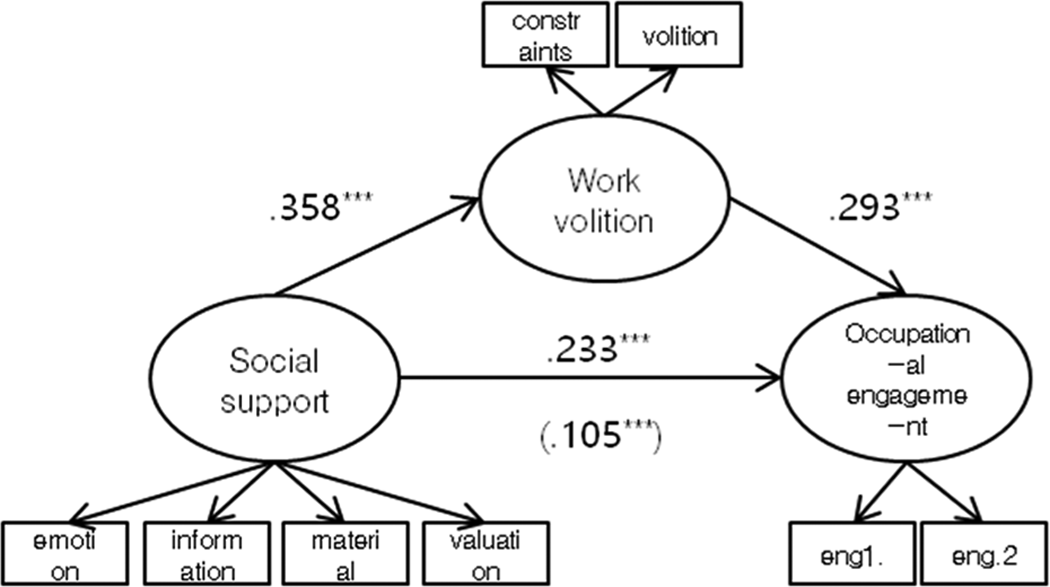
Final structural model with social support predicting occupational engagement via work volition.
Indirect Effects
We used bootstrapping techniques (Shrout & Bolger, 2002) with 1,000 samples to calculate the indirect effects. An advantage this process has over the widely applied Sobel test is that it does not require a normality hypothesis in the significance test for the mediation effect. The intervals for bias-corrected CIs were considered as significant when they did not include zero. The indirect effect of social support to occupational engagement was found to be significantly mediated by work volition (c' = .07, SE = .02, CI [.03, .11]). Briefly, social support appeared to increase work volition; the route that connects the relation to occupational engagement was significant, and the direct effect of social support on occupational engagement was also significant. Therefore, the results supported the hypothesized partial mediation model.
Moderation Analyses
The moderation models were examined using the SPSS Macro developed by Preacher and Hayes (2004). Following the steps proposed by Aiken and West (1991), hierarchical regressions were conducted as follows: In the first step, the standardized scores for social support and work volition were considered. In the second step, the interactions between social support and work volition were considered. As shown in Table 2, work volition moderated social support and occupational engagement. The R 2 variance of .02 changed in the second step, which was statistically significant. From these results, we concluded that the influence of social support on occupational engagement varied according to the level of work volition. Figure 2 demonstrated the interaction of work volition and social support on occupational engagement. Those with high work volition showed a stronger positive link between support and engagement than students with low work volition. Briefly, it can be postulated that work volition enhanced the influence of social support on career-related behavior. To determine the value of the moderation variable in which the moderation effect occurred, a simple slope analysis significance test (Frazier, Tix, & Barron, 2004) was conducted on the basis of the conditional value of work volition. This test revealed that work volition was a significant moderator between social support and occupational engagement for students with levels of work volition 1 SD above the mean (β = .22, p < .001), but the relationship was not significant for students with levels of work volition 1 SD below the mean (β = .06, p = .29).

Work volition as a moderator between social support and occupational engagement.
Moderation Effect.

Note. N = 233.
*p < .05. **p < .01. ***p < .001.
Discussion
This study explored the mediating and moderating roles of work volition on the relation between social support and occupational engagement in a sample of Korean university students. In previous studies, a positive relation between social support and career-related behavior was found. However, the process underlying this influence has not been fully investigated. Blustein (2006) suggested that more research is required on work-related autonomy levels, particularly the differences between high and low work volition groups. Therefore, this study examined the mediating and moderating role of work volition on the relationship between social support and occupational engagement. The theoretical and practical implications of this study are discussed below.
First, a moderating effect of work volition on social support and occupational engagement was supported. This finding support the proposals by Blustein (2006) and Duffy and Dik (2009) that students’ perceptions of work volition may affect the link between predictions and outcomes in their career decision-making. This answers the question about which types of individuals are more involved in occupational engagement, with the key correlate being the level of work volition. These findings showed that the interaction between social support, which is a positive, externally satiated resource, and work volition, which is an internally satiated resource, can result in enhanced engagement activities in the career domain. This is particularly true for those with an average or above level of work volition since the influence of social support on occupational engagement is greater. Thus, when students reported a higher level of work volition, those who also felt they had higher social support tended to engage in more occupational behavior than those with less social support. To improve occupational engagement, it would, therefore, be more effective to enhance work volition rather than targeting social support, which is an external resource. These results were consistent with previous research on working adults, whose job satisfaction was found to be influenced by work volition and the interactive effect of support given by others (Duffy & Autin, 2013; Duffy, Bott, Torrey, et al., 2013).
Second, this study tested the mediation effect of work volition on the relation between environmental support and goal-oriented behavior. In the SCCT, Lent et al. (1994) emphasized a career development process in which personal and environmental variables influenced personal efficacy and outcome expectations and further facilitated goal-oriented behavior. Duffy, Bott, Allan, et al. (2013) set work volition as the outcome expectation variable (an individual’s perceived expectation of their future state) in the SCCT model. These studies demonstrated that work volition acted as a mediator between social support and career-related behavior or occupational engagement. In other words, people who perceived themselves to have greater social support reported greater autonomy when making vocational decisions despite perceiving career barriers that are difficult to overcome, which in turn involved more occupational engagement behavior. Based on these results, interventions in maintaining and enhancing work volition can be assumed necessary for greater occupational engagement. Until now, however, university counseling and education professionals have not addressed the issue of work volition, which has been found to interact with career barriers and internal loci of control. Focus has mainly been on client preferences, such as interests, values, and skills. Therefore, career development counseling interventions should help students overcome their own constraints and help them cultivate the will to handle future obstacles. Career counselors need to assess not only student vocational preferences but also students’ capacity to match their preferences with future jobs (Duffy, Blustein, Diemer, & Autin, 2016). Duffy, Diemer, and Jadidian (2012) recommended that work volition should be the conversation starter from which counselors could explore the factors that may limit it and the degree to which students perceive these factors as controllable. If an undergraduate has low work volition due to high family expectations, low self-understanding, or lack of confidence, cognitive counseling may help him or her develop more rational perspectives.
As previously mentioned, people with greater social support tend to participate more actively in occupational engagement, since they believe that it is possible to choose the direction of their lives. Further, for people with high work volition, social support further strengthens occupational engagement. This study, therefore, supported our hypotheses for the mediating and moderating effects of work volition. The question of why people with higher social support have higher engagement and whether this influence holds at the same level for all university students were answered through the work volition variable. The role of work volition in improving occupational engagement has been less emphasized in Korea, since it is a collectivist society where people’s decisions about their futures are regarded as less voluntary and more harmony seeking than in individualistic cultures, such as the United States. Our findings, however, suggest otherwise and reveal that to improve occupational engagement in counseling interventions, it would be helpful to increase work volition, even among Korean college students. In conclusion, the mediating and moderating effect revealed in this study provides a framework for vocational researchers and counselors that is applicable to a Korean student sample.
There were some limitations to this study. First, the moderating effect of work volition on social support and occupational engagement was modest. Therefore, caution is needed when interpreting the results. Further, since this study’s data were collected from only one university in Korea, the study needs to be replicated with other samples for the findings to be generalizable. Although the relations were not found to be strong, work volition was found to be related to socioeconomic status (SES; Duffy, Douglass, Autin, & Allan, 2015). Therefore, future studies could focus on collecting data on more representative samples by considering SES. Second, this study was using self-report questionnaires. Thus, participants may have tried to present themselves positively or defensively, leading to a gap between perceived occupational engagement and actual behavior. Therefore, other multiple methods may be required to validate the results. This study’s final limitation was that it had a cross-sectional design. To further support the study results, it is recommended that future research use various research designs, such as longitudinal designs.
Additional directions for future research are as follows. First, in this study, several important variables from the SCCT model, such as psychological characteristics, efficacy, and career/academic satisfaction, were not incorporated. These other variables may influence the factors, including work volition, in different ways. Thus, testing the model with additional variables could further expand the use of the SCCT model. Second, work volition could be a variable partly based on the situation itself (e.g., related to SES). Because of this, multiple intervention types not only need to be implemented in career counseling settings but also must be considered in social welfare institutions. In some cases, individual counseling alone cannot effectively address a client’s challenges (i.e., poverty, physical disability, and social class). Thus, social advocacy and case management may provide such clients with a form of scaffolding (Blustein et al., 2008).
Footnotes
Declaration of Conflicting Interests
The author(s) declared no potential conflicts of interest with respect to the research, authorship, and/or publication of this article.
Funding
The author(s) received no financial support for the research, authorship, and/or publication of this article.