



Abstract
This article introduces the reader to the articles contained in this special issue. It outlines how these studies contribute to our understanding of career development in light of the protean and boundaryless career era in which we now live. The articles contained in this special issue also raise questions that serve as a road map for future research. As a result of working on this special issue, we urge researchers to better clarify and differentiate among overlapping career-related concepts and to move career development research from a context-free approach to context-dependent one. Career development research that attempts to examine the connections between development in one’s organization, career, and life and the role played by career transitions would go a long way toward answering these questions raised.
The impetus for this special issue came from the research we have been conducting over the past 5 years on the concept of career growth. It began with the development of a scale for measuring career growth (Weng & Hu, 2009; Weng & Xi, 2011) and quickly turned toward identifying the effects of career growth on organizations, including turnover intentions (Weng & Hu, 2009), organizational commitment (Weng, McElroy, Morrow, & Liu, 2010), occupational commitment (Weng & McElroy, 2012), voice behavior (Wang, Weng, McElroy, Ashkanasy, & Lievens, 2014), and factors that might affect these relationships. These studies have shifted the focus from emphasizing career success over an employee’s total working career to organizational career growth, or the degree to which employees experience career growth within their current organizations. Although research on career success has contributed much to the literature on careers from the individual employee’s perspective, it offers little to organizations seeking to retain and motivate employees in this new era of the protean career. Considering the fact that this new career era is more unpredictable, focusing on organizational career growth, which is more regular and more closely associated with individual attitudes and behavior (Weng & Xi, 2011), is an alternative approach which could result in a more thorough understanding of the employee–employer relationship.
Our research on organizational career growth quickly raised additional questions such as what other effects might career growth have on organizations and organizational behavior, the antecedents or causes of career growth, the role of career mobility on career growth, and the best way to conceptualize and measure career growth, to name a few. It was in light of questions like these that we sought to seek out what others in the field might be doing that would enhance our understanding of the connection between organizational career growth and organizations.
The six articles chosen for inclusion in this special issue address some of the questions raised above, but they, as well as several of the articles that failed to make the cut, raise additional questions. The following is our assessment of the relative contributions of these six articles as well as our identification of additional issues that remain unresolved and that constitute fertile ground for future research.
The New Career Era
Hall argued back in 1996 that the traditional career path model was being replaced by the protean career (Hall, 1996). A protean career is one driven by the person, not the organization. It is characterized by continuous learning and development and psychological success rather than by vertical ascension up the corporate ladder and monetary rewards. Couple this with the boundaryless career (Arthur & Rousseau, 1996), in which an individual’s career is no longer tied to a single organization, and you have a career era in which career changes and job mobility are commonplace. While career success traditionally rested in the hands of organizations, in this new career era individuals own their own careers (Savickas, 2011).
Research on career growth, including our own, has tended to assume that this new career era is the context in which individuals are operating in today’s organizations. Thus, it is assumed that employees need to balance their need for career growth with their attitudes toward their current organizations (Weng & McElroy, 2012). Organizations that cater to employee career growth benefit from a more committed workforce and thus lower turnover in an environment in which individuals are prone to change companies and even careers in order to achieve the psychological career success they seek (Weng & McElroy, 2012; Weng et al., 2010).
The article, “The longitudinal relationship between protean career orientation and job satisfaction, organizational commitment, and intention to quit,” by Supeli and Creed (2015) reminds us that the protean career, while important, is not a given but rather a mind-set. That is, it is not the “new career era” per se but rather an individual difference. Consequently, it is important to some employees but not to others. Supeli and Creed’s research demonstrates that organizations can ignore career growth and development for those employees with a low protean career orientation, but if they do, employees with a high protean career orientation will be less satisfied and more likely to quit as they are inclined to take more personal control over their careers. The fact that career growth is an important consideration for some employees raises the question of how we should conceptualize career growth in order to deal with those employees who do have a high protean career orientation.
Conceptualizing Career Growth and Development
Jans (1989) defined the notion of career growth as one’s perceptions of the chances of development and advancement within an organization. With the advent of the notion of the protean and boundaryless career, attention shifted away from thinking about career development in terms of traditional career paths within an organization (Arthur & Rousseau, 1996) and moved the focus from the organization’s role in career development to the employee’s. With the emphasis on the employee as the driver of career growth, career growth is now seen as referring to career development through one’s experiences in jobs both within an organization and across organizations (Baruch & Rosenstein, 1992).
Weng, McElroy, Morrow, and Liu’s (2010) work attempts to bridge the gap between traditional career paths provided by organizations and the protean career path, whereby one’s career growth is dominated by the individual’s decision making, including job mobility across organizations. They argued that career growth is a by-product of both the individual’s perceptions and the organization’s actions. To reflect the idea that this is an individual-level, organizational-specific concept, Weng designated this form of career growth “organizational career growth” (Weng & McElroy, 2012). According to Weng et al. (2010), organizational career growth consists of four factors: (1) the degree to which one’s current organization creates an environment that allows the person to meet their career goals; (2) acquire new knowledge, skills, and abilities; (3) the degree to which the organization reinforces those accomplishments through promotions; and (4) compensation.
Two of the articles in this special issue add to our understanding of the utility of Weng and his colleagues’ view of career growth. The article, “Cross-cultural validation of the career growth scale for Korean employees,” by Kim et al. (2015) provides evidence that although Korean employees perceive higher levels of career goal progress and promotion speed in their organizations than do Chinese employees, Weng et al.’s (2010) four factors have validity for use in Korea. While work still needs to be done relative to other cultures, this work is a step in that direction. The second article, “The role of career growth in Chinese new employees’ turnover processes,” by Chen et al. (2015), shows the relevance of Weng et al.’s organizational career growth measure as a predictor of turnover among the newest members of the Chinese workforce, that is, those most affected by the recent socioeconomic changes occurring in China. This study demonstrated that organizational career growth has direct effects not only on turnover intentions but also on job satisfaction. Their finding that organizational career growth mediates the relationship between person–organization fit and turnover intentions further supports the notion that organizational career growth not only has direct effects but has mediating effects as well.
Weng et al.’s four-factor model of organizational career growth is not the only way to conceptualize career growth, however. This is borne out in the remaining three articles selected for inclusion in this special issue. In the article, “The relationships between employability, emotional exhaustion, and turnover intention: The moderation of perceived career opportunity,” by Lu, Sun, and Du (2015), career growth is conceptualized as perceived career opportunity or the employee’s perceptions of the degree to which work assignments and job opportunities match one’s career interests and goals (Kraimer, Seibert, Wayne, Liden, & Bravo, 2011). Perceived career opportunity (PCO) is a more narrow interpretation of career growth than is Weng et al.’s organizational career growth, as it places the emphasis on the career goal progress dimension. Nonetheless, Lu et al.’s findings are consistent with Chen et al.’s (2015) study in showing that PCO moderates the relationships between employability, emotional exhaustion (a potential by-product of a poor person–organization fit), and turnover.
The remaining two articles selected for inclusion in this special issue take a much broader view of career growth. The article, “Facilitating a whole-life approach to career development: The role of organizational leadership,” by Litano and Major (2015), recognizes the role of nonwork factors (personal and family life) in defining careers. This article traces the evolution of thinking on careers and concludes that individual career paths are shaped by employee reactions to nonwork as well as work-related issues. Sometimes these reactions take the form of the boundaryless career resulting in interorganizational or even intercareer moves on the part of the employee. But Litano and Major offer the concept of “new organizational career” in which employees are provided the flexibility of a balanced career within a single organization. Building on Greenhaus and Kossek’s (2014) work on the home–career perspective, Litano and Major spell out how the organization’s leaders, at various levels, can support a whole-life view of career development.
The final article, “Professional trajectories, individual characteristics and staying satisfied and healthy,” written by Johnston, Maggiori, and Rossier (2015), takes this a step further using career adaptability to predict overall well-being. This article views career development as being marked by career trajectories of varying degrees of stability and change. Based on Savickas’s (1997) work on career adaptability, Johnston et al. examine how individual career adaptability affects overall well-being for people who experience employment stability, career changes within or between organizations, movement from being unemployed to employed, or who remain unemployed.
Questions Answered, Questions Raised
While a limited number of studies will not answer any questions definitively, the articles contained in this special issue do offer support for a number of questions we had that prompted this special issue. First, the papers by Kim et al. (2015) and Chen et al. (2015) offer support for the use of Weng’s measure of organizational career growth, that is, as a perception of career growth within a single organization. Individuals’ perceptions of their ability to achieve career goals, acquire new skills, and the degree to which their current organization rewards those activities through promotions and compensation have consequences for employee attitudes and behavior. Second, work by Lu et al. (2015) and Johnston et al. (2015) suggest that career growth and development have not only direct effects on employee attitudes and behavior but also indirect effects. Finally, Supeli and Creed (2015) remind us that we should be taking a contingency approach to the potential effects of career growth and development. That is, the effects of career growth are important for those with a high protean career orientation but less important for those without such an orientation.
The findings of these articles, along with others we reviewed for this special issue, raise a number of unanswered questions that remain fruitful avenues for future research. For example, Supeli and Creed’s research suggests the need for more in-depth analysis of the relationship between protean career orientation and subjective versus objective measures of career success. For example, do people with a high protean career orientation place a higher premium on career satisfaction over more objective measures of career success as Hall (1996) suggests? Are there any factors that mediate or moderate this relationship? Supeli and Creed’s (2015) research also leaves open the question of what determines one’s protean career orientation. A cursory look at the literature suggests that there is far more research on the effects rather than on the determinants of a protean career orientation. Some have suggested that a high protean career orientation is a response to one’s business environment (Hall, 2004), while others have turned to gender, age, and education as well as experience (Segers, Inceoglu, Vloeberghs, Bartram, & Henderickx, 2008), and even parents and peer networks (Sargent & Domberger, 2007) as determinants. The finding by Seibert, Kraimer, and Crant (2001) that proactive personality was positively related to career initiative (a possible surrogate for protean career orientation) suggests that future research on the roles of personal versus environmental factors on protean career orientation is warranted.
A second unanswered question concerns how career growth/development should be measured. Should it be conceptualized within a single organization or across one’s total work life? Within the context of a single organization even the four-factor model proposed by Weng et al. (2010) is not universally applicable. A three-factor version, in which promotion speed and compensation were collapsed into one factor, provided a better fit for an exclusively managerial Chinese sample than did the four-factor model (Weng & McElroy, 2012). In addition, Weng’s instrument is not the only way to measure this type of career growth. For example, Bedeian, Kemery, and Pizzolatto (1991) conceptualized career growth in terms of the perceived utility of one’s present job for one’s career.
The issue of having a variety of ways to measure career growth points to a final and important unanswered question raised by the articles reviewed for this special issue. Simply put, there seems to be a proliferation of concepts and measures with overlapping meanings. For example, how is protean career orientation (e.g., Supeli & Creed, 2015) different from career initiative (Seibert, Kraimer, & Crant, 2001), proactive personality (Seibert et al., 2001), self-management (De Vos & Soens, 2008), or career adaptability (Savickas, 1997)? Additionally, how much overlap is there between career success (Judge, Higgins, Thoresen, & Barrick, 1999), PCO (Kraimer et al., 2011), perceived employability (De Vos & Soens, 2008), career growth (Weng et al., 2010), career advancement prospect (Greenhaus & Parasuraman, 1993), career advancement (Tharenou, 1999), and career well-being (Weng & Chen, 2014)? These are but a few of the more striking examples.
The notion of concepts and measures with overlapping meanings or concept redundancy is not unique to career growth and development. In the 1980s, the concept of work commitment reached a similar point. At that time, Morrow (1983) took on the task of looking at 30 different forms of work commitment and their measures, pointing out which concepts varied widely in meaning and which appeared to overlap. This work led to her seminal book, The Theory of Work Commitment (Morrow, 1993), which evaluated the advantages of concepts and measures within and across each form of work commitment. We believe that the field of career growth and development has reached a state of maturity such that it could benefit from work that clearly delineates among the various career-related concepts.
We offer Figure 1 as a start in the effort to untangle and better differentiate some of these career-related terms. In this diagram, we envision career development as the overarching term for research on a variety of career-related topics. This definition is consistent with the title of this journal, The Journal of Career Development, which publishes a wide variety of articles on career-related topics. In doing so, career development encompasses not only what is currently happening in one’s career but what has happened in the past as well as what might happen in the future (career prospects). Career success (whether objectively or subjectively measured) and the more encompassing career well-being, which takes into account health issues (e.g., Johnston, Maggiori, & Rossier, 2015), are accumulated measures of the outcomes associated with one’s total work life at any particular point in time. As such, it may be limited to outcomes of organizational career growth if the person has spent their work life to date with a single employer or it could encompass outcomes achieved across organizations. Organizational career growth, as our diagram shows, is limited to one’s career-related experiences within a single employer. It should be noted that career success is more unpredictable and less related to individual’s organizational attitudes and behaviors than organizational career growth, since one’s work life up to a particular point in time is not only caused by what is happening in the current organization but also the result of one’s past positions in other organizations. Moreover, the positioning of organizational career growth in Figure 1 demonstrates that career growth influences career success/well-being as well as one’s career prospects. Finally, organizational career growth, career success/well-being, and future career prospects are all dependent over time on effective career transitions. For example, one’s career growth associated with their current employer may be a function of the degree to which that person’s decision to transition to that employer was a good one, that is, resulted in a better person–organization fit. The notion of career transitions, in itself, needs to be untangled as there are several overlapping concepts under this umbrella term, such as career adaptability, proactive personality/behaviors, career initiative, and self-management, to name a few.
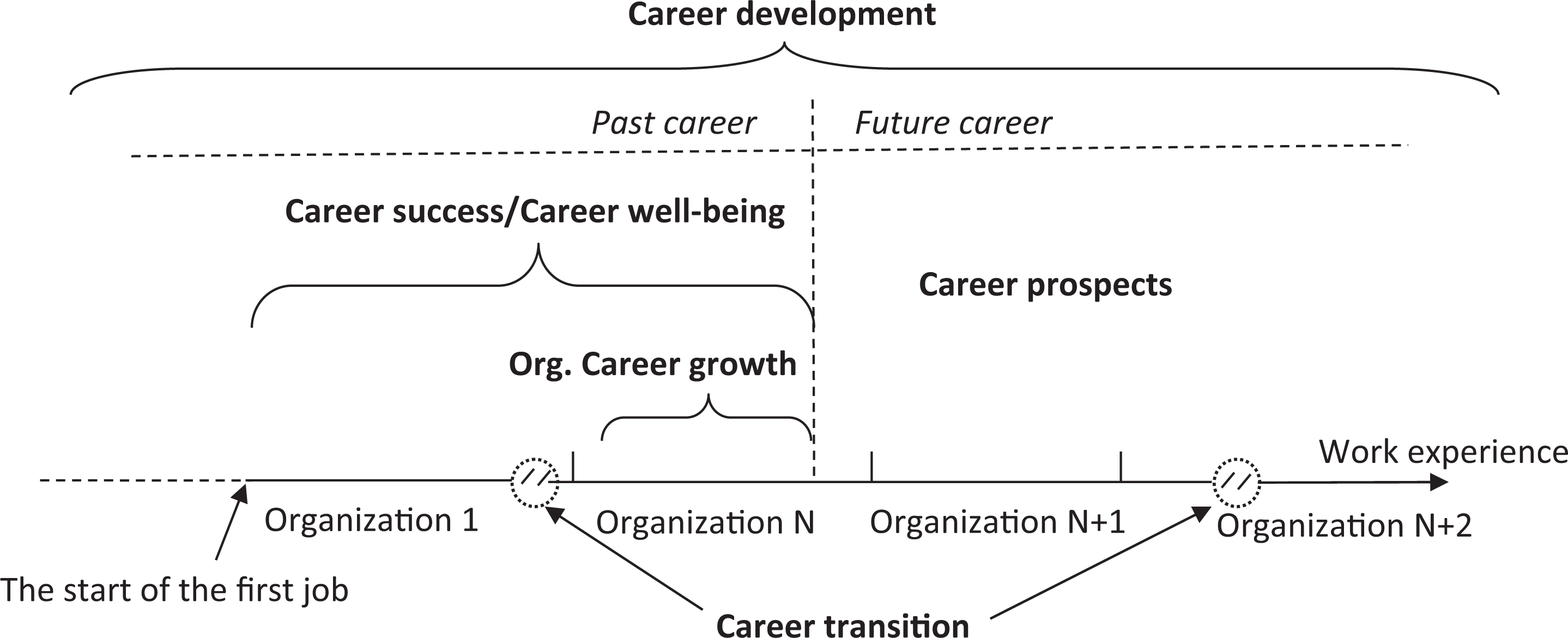
The relation between career growth, career success, and career development.
While these overlapping concepts provide researchers with more choices, this increased choice is not without its costs. Without a clear delineation of how these various concepts are related, researchers and practitioners alike will find it difficult to understand exactly what their results mean. A clearly delineated paradigm of career development and its various components will enable researchers to more precisely identify the concepts most appropriate for their research questions.
In addition to clarifying career development concepts, working on this special issue leads us to recommend that more research is needed in four areas. First, we recommend that researchers choose concepts and research questions appropriate to the level of analysis one is employing, whether it be the organization, career, or one’s whole life. Second, more work is needed on the connections between career development at these various levels of analysis. For example, how is organizational career growth related to career success, life well-being, and even future career prospects? How are career success and life well-being related? Third, we also recommend that career development research take a more context-dependent approach, that is, how are career development relationships affected by the economic context, cultural background, job type, and so on. Finally, more research is needed on the role played by career transitions: what constitute these transitions, what causes them, and what their consequences are.
Conclusion
Considerable research has been conducted on career development in general and organizational career growth and career success in particular. Although still in its infancy, some recently initiated research trends show substantial promise. In the studies we discussed above and in this special issue, we have seen the beginning of an effort to more precisely articulate how employees’ career outcomes are defined and how they are connected to attitudes and actions in and outside of the workplace. But much work remains to be done. Despite the challenges in front of us, we are optimistic that research on the various components that comprise career development will become more precise and more contextual. We hope the studies in this special issue will provide the impetus for more research in response to the questions posed here. More research is needed to determine the relationships among organizational career growth, career success, and career prospects and the role played by career transitions.
Footnotes
Declaration of Conflicting Interests
The author(s) declared no potential conflicts of interest with respect to the research, authorship, and/or publication of this article.
Funding
The author(s) received no financial support for the research, authorship, and/or publication of this article.