



Abstract
Identifying predictors of career success is one of the most considered topics in career research and practice. However, the existing literature suggests a vast array of potential predictors that cannot be economically measured. This significantly limits research and practice. To address this issue, we have integrated theoretical and meta-analytic research to propose an integrative framework of career resources, including human capital, environmental, motivational, and career management behavior resources represented by 13 distinct factors. In a multistep process, we have developed the career resources questionnaire to assess these factors in workers and college students. In two studies encompassing 873 workers and 691 students, we have confirmed reliability and factor structure, convergent validity with existing scales, and criterion validity with indicators of subjective and objective career success. The developed measure can provide researchers and practitioners with a reliable, concise, and comprehensive measure to assess the key predictors of career success.
Vocational and organizational career research has a long-standing interest in identifying factors that allow people to achieve career success (e.g., Schein, 1978). Career success referrers to both objective success that can be externally verified and is usually assessed in terms of salary and promotions (e.g., Ng, Eby, Sorensen, & Feldman, 2005) as well as to subjective success, referring to the subjective evaluation about career progress according to one’s own criteria (Ng & Feldman, 2014b). Apart from research, identifying factors that contribute to success is also of pivotal interest to career counselors and organizations as well as to individual workers and students. All these stakeholders share an interest in such factors in order to promote one’s own career or those of clients and employees.
The large interest in this topic has resulted in a wealth of theoretical models, measures, and empirical studies that aim to identify the predictors of career success. In a recent meta-analysis, Ng and Feldman (2014a) considered as many as 64 potential correlates of objective career success in terms of salary. These authors confirmed a significant correlation with salary for 48 of the assessed factors, ranging from sociodemographic aspects such as gender to work environment factors such as unfavorable job conditions. Similarly, another meta-analysis considered 56 different factors as potential correlates of career satisfaction, finding significant correlations for 40 factors (Ng & Feldman, 2014b).
In addition to the hundreds of single studies that contributed to these meta-analytic findings, several attempts have been made to develop measures that assess specific components deemed critical to master career development tasks and achieve career success. These scales assess a range of factors pertaining to career competencies (e.g., Francis-Smythe, Haase, Thomas, & Steele, 2013), career adaptability (e.g., Rottinghaus, Buelow, Matyja, & Schneider, 2012; Savickas & Porfeli, 2012), employability (e.g., Fugate & Kinicki, 2008; Heijde & Van Der Heijden, 2006), career motivation (e.g., Day & Allen, 2004), or self-directed career management (e.g., Kossek, Roberts, Fisher, & Demarr, 1998a; Sturges, Conway, Guest, & Liefooghe, 2005). The current career literature thus offers vast array of sometimes unique and other times largely redundant concepts and variables as correlates and predictors of career success.
Given this state of affairs, we assert that, at this point, there is little value in adding new constructs and factors to the list. Instead, we see more value in trying to develop models and measures that aim to provide a more concise and integrative view on the key predictors of career success. In an attempt to provide an integrative model of key factors for career success, Hirschi (2012) proposed the career resources framework. Integrating diverse theoretical models and empirical findings, the career resources model distinguishes four general types of career resources: (a) human capital resources which refer to knowledge, skills, abilities, and other characteristics that are important to meet performance expectation for a given occupation, (b) social capital resources, referring to resources external to the individual in terms of developmental networks, mentors, and available social support, (c) psychological resources that include different positive psychological traits and states, and (d) career identity resources which include the conscious awareness of oneself as a worker and the subjective meanings linked with the work role. These resources are in turn connected by behaviors of proactive career management (e.g., networking and positioning) that develop and activate these resources. Building upon this model, we describe the predictors of career success as career resources. In accordance with the general definition of resources by Halbesleben, Neveu, Paustian-Underdahl, and Westman (2014), we define a career resource as anything that helps an individual attain his or her career goals. If the most theoretically and empirically established career resources could be identified and reliably measured, this would provide a valuable source for researchers and practitioners who aim to assess individual differences in key predictors of career success.
To make a contribution in this direction, in this article, we integrate insights from different theoretical models and meta-analyses to identify a concise yet diverse and representative list of factors that are theoretically and empirically well established as the predictors of career success. Across four samples and two studies, including workers and students, we developed and validated a new career resources questionnaire (CRQ) to assess these predictors. Study 1 reports the development, item selection, and validation of the factor structure of the new measure. Study 2 then confirms the factor structure with different samples and provides evidence for convergent and criterion-related validity.
Theory and Research Findings on Predictors of Career Success
Meta-Analytic Findings and General Theories
In the most recent meta-analysis on correlates of salary attainment, Ng and Feldman (2014a) theoretically categorized the correlates of career success into sociodemographic (e.g., gender and having children), trait-related (e.g., cognitive ability and extraversion), motivational (e.g., ambition and job involvement), skill-related (e.g., education level and geographic relocations in the career), social environment (e.g., leader–member exchange quality and networking behavior), and work environment factors (e.g., career-related organizational support and job control). Their analyses confirmed that variables from all six categories significantly correlated with salary.
Similarly, in another meta-analysis, Ng and Feldman (2014b) examined the correlates of subjective career success and theoretically categorized them into background-related (e.g., gender), trait-related, motivational, skill-related, social network, and organizational and job factors. The results showed that background-related and skill-related factors were generally not significantly related while aspects belonging to the trait-related, motivational, social network, and organizational and job categories showed significant correlations with career satisfaction.
While there are, thus, a large range of factors related to objective and subjective career success, past research frequently theoretically explained the attainment of career success by one or a combination of three theoretical perspectives: human capital, social capital, and motivational factors. Human capital theory (Sweetland, 1996) implies that career success depends on the level of education, knowledge, skills, and competencies of a person that allows him or her to obtain jobs and perform adequately in them. In contrast, social capital theory (Adler & Kwon, 2002; Kwon & Adler, 2014; Seibert, Kraimer, & Liden, 2001) posits that the goodwill available in social ties allows people to obtain jobs and competitive career outcomes, such as a high salary or a promotion. Finally, motivational theories of career success see the source of success in individual’s own efforts to advance their career (London, 1983). In addition to these three perspectives, the recent career literature has placed a strong emphasis on career self-management and the proactive role that individuals must take in order to develop their careers (Hall, 2002). In contrast to the related notion of motivational factors, self-directed career management focuses not on attitudes but on the proactive behaviors that individuals show in order to achieve their career goals and optimize their person–environment fit (Thomas, Whitman, & Viswesvaran, 2010).
Human Capital, Environment, Motivation, and Career Management Behaviors as Key Career Resources
In order to develop a comprehensive and concise measure of key factors for career success, we have based our conceptualization on the career resources framework (Hirschi, 2012). A focus on resources fits well with contemporary theorizing in the vocational literature regarding the promoters of meaningful careers (Savickas & Porfeli, 2012), the organizational literature on the importance of resources for job performance and well-being (Halbesleben, Neveu, Paustian-Underdahl, & Westman, 2014), as well as with current conceptualizations on the predictors of career success specifically (Ng & Feldman, 2014a, 2014b).
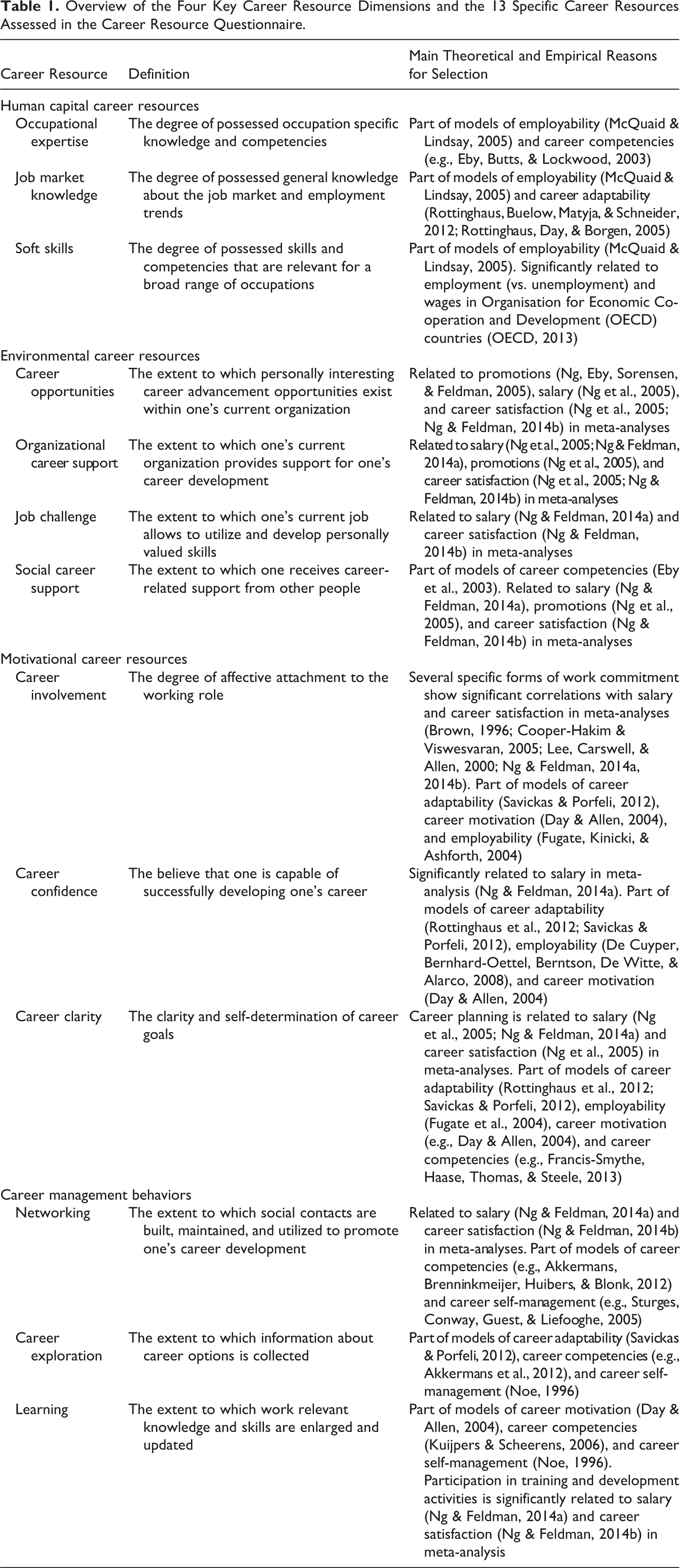
For our purposes, we specifically wanted to focus on career resources that are malleable in principle and not on relatively fixed traits (e.g., cognitive ability, extraversion, and proactive personality) or sociodemographics (e.g., gender and marital status). Even though such factors can also represent career resources according to the herein proposed definition, their assessment promises less actionable insights for test takers (e.g., employees and career counselors) and would thus limit the practical usefulness of the new questionnaire. We thus slightly adapted the model by Hirschi (2012) by combining the psychological resources domain with the career identity resources domain to represent motivational career resources. This was done because we were interested in developing a measure that assesses more specifically career-related psychological factors (e.g., career confidence) instead of more general personality states and traits (e.g., generalized self-efficacy, neuroticism, and hope) as was the idea behind the psychological career resources dimension by Hirschi (2012). Moreover, combining these two types of career resources under a common frame can be justified by meta-analytic research that established a close connection between psychological resources, such as emotional stability, and identity resources, such as career decidedness (Brown & Rector, 2008). In addition, we conceptualized social resources more broadly than in the model by Hirschi (2012) as environmental resources, which encompass, but are not limited to, social resources. For example, we wanted to account for the fact that organizations and other institutions can also represent career resources. Thus, by integrating insights from diverse existing models and adapting the career resources model by Hirschi (2012), we have identified four key areas of predictors of career success to be assessed in our measure: (1) human capital resources, (2) environmental resources, (3) motivational resources, and (4) career management behaviors. Table 1 gives an overview of the general areas and specific factors included in our model as well as their empirical and theoretical foundation.
Overview of the Four Key Career Resource Dimensions and the 13 Specific Career Resources Assessed in the Career Resource Questionnaire.
Study 1: Scale Development
Phase 1: Item Development
After having identified the four broad areas (i.e., human capital career resources, environmental career resources, motivational career resources, and career management behaviors) that should be assessed in our new measure, we aimed to define specific constructs that would represent some of the most important factors of each domain. Several considerations guided the selection of these constructs. Each construct should (a) have a solid theoretical foundation in the career literature, (b) show strong content validity as a defining component of one of the four identified broad domains, (c) correspond to the herein used definition of a career resource and hence represent a means to attain career goals, meaning that it should have a strong theoretical foundation as an antecedent for career success—not be a mere correlate (e.g., job satisfaction, work engagement, organizational commitment, and general job conditions), (d) be possible to develop and not represent a relatively fixed trait (e.g., self-esteem) or sociodemographic (e.g., marital status), (e) show significant and high correlations with objective and/or subjective career success outcomes according meta-analytic research whenever such data are available, and (f) avoid redundancies with other considered constructs in the final model.
In a first step, we reviewed existing meta-analyses on objective and subjective career success (Ng et al., 2005; Ng & Feldman, 2014a, 2014b) to identify factors that corresponded to the criteria listed above. In a next step, we reviewed theoretical models and measures for additional factors that were not considered in the meta-analyses but still fulfilled all of the remaining criteria. In cases where several closely related constructs were identified, we aimed to specify a construct that would best represent the common core of different constructs. For example, constructs, such as job involvement, work centrality, or career motivation, were subsumed under the construct of career involvement. A first list of constructs was derived according to these steps by the first author and subsequently discussed with the coauthors. Adaptations to this list were based on mutual consent, resulting in a final list of 13 constructs that corresponded to the criteria outlined above (Table 1).
For item development, we followed a recommended multistep procedure to ensure high item content validity (Hinkin, 1998). First, we identified 46 existing scales, for example, assessing employability (Fugate & Kinicki, 2008), job-related skills (Eby, Butts, & Lockwood, 2003), self-efficacy and agency (Rigotti, Schyns, & Mohr, 2008; Rottinghaus et al., 2012), career sponsorship (Ng et al., 2005), or networking (Ng, Feldman, & Lam, 2010), that assess the same or very closely related constructs as the 13 identified factors in the previous step (the complete list is available from the authors upon request). We then used a deductive item generation strategy (Hinkin, 1998) by either creating new items or adapting items from existing scales. Four of the authors developed 4 items per person for each of the 13 constructs/factors. Next, all generated items underwent an internal content validity review where each of the four authors evaluated each item on a scale from 1 (does not fit at all to this factor) to 5 (excellent fit to this factor) and provided comments for each item if necessary. We then evaluated the comments, mean scores, standard deviations, and minimum and maximum value from the ratings for each item. Items with the highest ratings per factor were chosen, resulting in 9–13 items per factor to be evaluated in the next step. Some of these items were also rephrased based on the comments. In a third step, to further assess content and discriminant validity for each item, five postgraduate student assistants received random sets of four to five factors with their respective items. For each factor (e.g., career confidence), the respective definition was presented. In addition, all items of all the presented factors were shown in random order, and the raters had to indicate for each item to which factor it belongs or assign it to a “none of the above” category. We then analyzed these responses and deleted 4 items from further consideration that were not assigned to the correct factor by at least four of the five raters. In addition, 9 items were rephrased in order to make their fit with their respective factor clearer. This process resulted in a set of 133 items, between 7 and 12 per factor, to be evaluated in the next step.
Apart from a questionnaire to be used by working adults, we also wanted to create a questionnaire that can assess the same career resources among university students. We hence created a student version of each item. Most items needed no changes (e.g., “I have a good knowledge of the job market” and “I am capable of successfully managing my career”). For other items, we changed item components to fit for students. For example, “my organization” was changed to “my university/college” (e.g., “My university/college actively supports my career development”) and “work” was changed to “my studies” (e.g., “My studies are the most important part of my life”).
Phase 2: Item Selection
In order to empirically evaluate which items best describe each factor and select a parsimonious and efficient number of final items for each factor, we collected data from a worker as well as a university student sample.
Method: Sample and procedure
Participants were recruited through a U.S.-American online-access research panel company with over 1,200,000 registered respondents. The respondents received an incentive for a successfully completed questionnaire. To ensure data quality, participants complete on average one questionnaire per month.
In the worker sample, recruited participants had to be aged between 18 and 65 years and employed in at least 50% of a fulltime position. We conducted extensive data quality checks concerning streamlining, carelessness, and speeding. Based on these checks, 13.5% of the participants were excluded, resulting in a final sample of N = 436, 37.2% men. Respondents were aged between 19 and 65 years (M = 40.73, SD = 11.56), came from a large variety of industry sectors, and worked on average 40.23 (SD = 6.06) hr per week. Respondents’ educational level was representative of the working population in the United States and ranged from vocational training (12.5%) to doctoral graduates (4.0%). The majority of participants had completed an undergraduate program as their highest education (43.1%), whereas 20.2% of the participants held a master’s degree. The majority of participants were Caucasian (76.1%), 9.4% Hispanic, 6.7% African American, 5.9% Asian, and 1.9% indicated another race.
The student sample had to be enrolled at a university or a 4-year college. Based on the data quality checks, 13.3% of the participants were excluded, resulting in a final sample of N = 288, 16.7% men. Respondents were aged between 16 and 30 years (M = 22.30, SD = 3.58), from a broad variety of study fields. The majority of participants were completing their undergraduate degree (76%), and 52.3% were Caucasian, 17.9% African American, 11.6% Asian, 11.4% Hispanic, and 6.8% indicated another race.
Measures
The worker sample participants completed all 133 items. The student sample did not receive the eight organizational career opportunities items (125 items total) because we deemed this as not relevant for this population. All items were answered on a 5-point Likert-type scale ranging from 1 (not true at all) to 5 (completely true).
Results
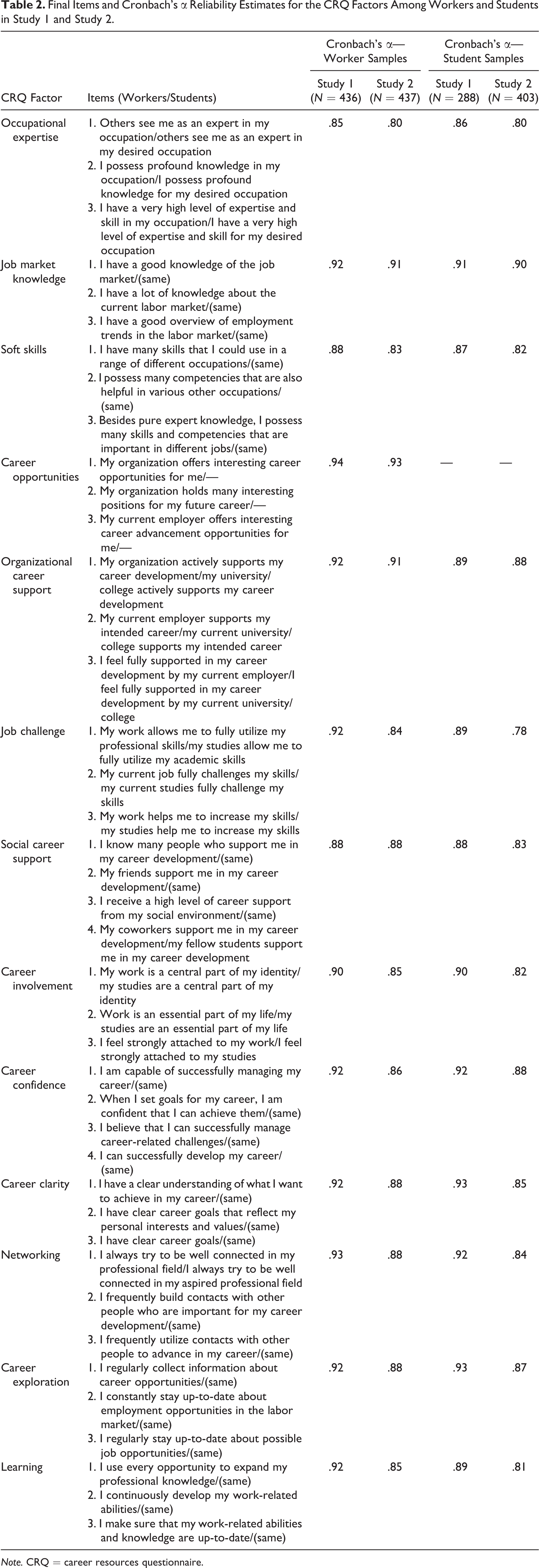
Based on best-practice recommendations in scale development (Hinkin, 1998), we set an aim of 4 to 6 items per scale but were willing to considering as few as 3 items per scale if they would still sufficiently represent the content domain and show adequate reliability. For each factor, we conducted a single-factor confirmatory factor analyses (CFAs) with the worker and the student sample and identified the 6 items per scale that showed the highest average factor loadings across the two samples. Three of the authors independently reviewed these items for content overlap and indicated which items were to be remained for the final version, considering factor loadings, construct representativeness, and avoiding content overlap among selected items. The three raters had a high interrater consistency across the 133 items with an interclass correlation coefficient (ICC) (2, 3) = .75. Together with a fourth author, the team then jointly decided which items to keep for the final version, resulting in 41 items in total for the worker group and 38 items for the student group, with 3–4 items per scale (see Table 2 for an overview).
Final Items and Cronbach’s α Reliability Estimates for the CRQ Factors Among Workers and Students in Study 1 and Study 2.
Note. CRQ = career resources questionnaire.
Phase 3: Confirming the Factor Structure
To confirm dimensionality and structure of the selected items, we conducted CFAs in the worker and student sample with maximum likelihood estimation with robust standard errors. We compared four structurally different models in each sample. The first model (M1) reflected the hypothesized structure of 13 (worker sample) and 12 (student sample) distinct factors that were allowed to freely correlate with each other. The second model (M2) reflected a hierarchical structure, with each of the 13, respectively 12, factors (e.g., career confidence) indicated by their respective items and each factor loading onto its appropriate higher order dimension (e.g., motivational career resource), with the four higher order dimensions allowed to freely correlate. The third model (M3) tested a four-factor model with all items directly loading onto their respective higher order domain (e.g., human capital resources and motivational career resources). The fourth model (M4) represented a one-factor model where all items loaded onto a single factor. Acceptable model fit is defined by the following criteria: above .90 for the Comparative Fit Index (CFI) and the Tucker-Lewis Index (TLI) (Kline, 2015) and an Root Mean Square Error of Approximation (RMSEA) value of .05 or less, with values less than .08 also considered as acceptable (Cheung & Rensvold, 2002; Vandenberg & Lance, 2000). For model comparisons, the scaled χ2 difference test was used.
In both samples, Model 1 was the best fitting model; workers χ2(701) = 112.84, p < .001, RMSEA = .037, CFI = .961, TLI = .955; students χ 2(599) = 891.38, p < .001, RMSEA = .041, CFI = .954, TLI = .946. For workers, the model fit for Model 2, χ2(760) = 1,649.32, p < .001, RMSEA = .052, CFI = .919, TLI = .913, Model 3, χ2(773) = 3,145.00, p < .001, RMSEA = .084, CFI = .784, TLI = .771, and Model 4, χ2(779) = 4,459.89, p < .001, RMSEA = .104, CFI = .665, TLI = .658, was worse than that of Model 1. All model comparisons in the worker sample showed ΔCFI greater than .002 and the Δχ2’s were significant (all p < .001), again favoring Model 1. Similarly, for students, Model 2, χ 2(647) = 1,088.52, p < .001, RMSEA = .049, CFI = .931, TLI = .925, Model 3, χ 2(659) = 1,697.50, p < .001, RMSEA = .074, CFI = .838, TLI = .827, and Model 4, χ2(665)= 2,352.99, p <.001, RMSEA = .094, CFI = .736, TLI = .721 showed poorer model fit than Model 1. All model comparisons showed ΔCFI greater than .002 and all Δχ2’s were significant with p < .001.
These results support our hypothesized structure and favor the 13 factor (and 12-factor model) over other models. However, the hierarchical four-factor Model 2 also showed acceptable fit. This suggests that in addition to 13, or 12 respectively, individual factors, the CRQ can also be used to represent four broader higher order constructs of different career resources. Construct validity of the factors was further supported by high-standardized factor loadings for each scale, ranging between .72 and .92 in the 13-factor model (worker sample) and between .70 and .91 in the 12-factor model (student sample). Reliability estimates for each factor in each sample were also high, ranging from .85 to .94 (Table 2).
Study 2: Confirming Factor Structure, Convergent, and Criterion Validity
The first aim of the second study was to confirm the factor structure and content validity (i.e., factor loadings with theoretically assigned factors) of the selected items in Study 1 with new samples of workers and students. We expected that the results from Study 1 would be replicated and that a model that postulates 13 and 12 different factors among workers and students, respectively, would fit the data well.
The second aim was to assess the convergent validity of the newly developed scale. As it was the goal of the CRQ to comprehensively and economically assess established predictors for career success, the CRQ factors should show high correlations with existing scales that measure closely related constructs. Some factors of the CRQ assess constructs that are very similar to those assessed by existing (and mostly longer) scales (i.e., occupational expertise, job market knowledge, career confidence, organizational support for development, available career opportunities, networking, and career exploration). Other CRQ factors assess constructs that are related to similar constructs assessed by existing scales. Specifically, the CRQ factor soft skills should show a significant correlation with occupational self-efficacy (Rigotti et al., 2008), CRQ-career involvement with job involvement (Kanungo, 1982) and work role commitment (Amatea, Cross, Clark, & Bobby, 1986), CRQ-career clarity with career planning (Gould, 1979), CRQ-job challenges with the job characteristic of skill variety (Morgeson & Humphrey, 2006), CRQ-social support with the job characteristic of social support at work (Morgeson & Humphrey, 2006), and CRQ-learning with job crafting in terms of enhancing structural resources at work (Tims, Bakker, & Derks, 2012). In sum, we expect:
The final goal of Study 2 was to establish criterion-related validity of the CRQ factors. Because the CRQ aims to assess key factors that predict career success, the CRQ factors should show significant correlations with the most commonly established indicators of subjective and objective career success. Specifically, we investigated the relationship of the CRQ factors with career satisfaction, representing the most commonly used indicator of subjective career success (Ng et al., 2005; Ng & Feldman, 2014b). In addition, we examined job satisfaction because subjective evaluation of one’s current job is also frequently used to assess subjective career success (Ng & Feldman, 2014b). In addition, we included salary and promotions as two of the most established factors representing objective career success (Ng et al., 2005; Ng & Feldman, 2014a). Because these career success indicators are only useful to assess among workers, we evaluated criterion validity only among the worker sample. We expected:
Method
Sample and Procedure
We recruited two new samples of participants with the same panel provider and procedure as outlined in Study 1. In the worker sample, we retained a final sample of N = 437, 34.2% men, based on data quality checks concerning streamlining, carelessness, and speeding 11.8% of the participants were excluded. The respondents were aged between 20 and 65 years (M = 41.76, SD = 10.79), came from a large variety of industry sectors, and worked on average 39.92 (SD = 5.26) hr per week. Respondents’ educational level was the representative of the worker population in the United States and ranged from vocational training (8.4%) to doctoral graduates (4.3%). The majority of participants had completed an undergraduate program as their highest education (41.1%), whereas 19.6% of the participants held a master’s degree. The majority of participants were Caucasian (75.8%), 13.5% Hispanic, 3.4% African American, 3.2% Asian, or indicated another race (4.1%).
In the student sample, we had a final sample of N = 403, 27.4% men, from a broad variety of study fields after excluding 15.5% of the participants based on quality checks. Age ranged between 16 and 30 years (M = 22.65, SD = 3.57). The majority of participants were completing their undergraduate degree (74.6%) and were of Caucasian ethnicity (59.4%), 14.0% of Hispanic, 11.2% of African American, 8.5% of Asian ethnicity, and 6.9% indicated another race.
Measures
All measures were completed by the worker and student samples, except of job involvement and organizational career opportunities that were only assessed among the worker sample while only the student sample completed the work role salience measure. The CRQ was administered with the 41 items in the worker sample and the 38 items in the student sample, as selected in Study 1 and indicated in Table 2. Reliability estimates for all factors are presented in Table 2. All other measures are shown in Table 3. Mirroring the procedure used for developing the CRQ items, we adapted the items of existing scales for the student sample where necessary. For example, work was replaced with “studies” and “organization” with “college/university.”
Additional Measures Used in Study 2.
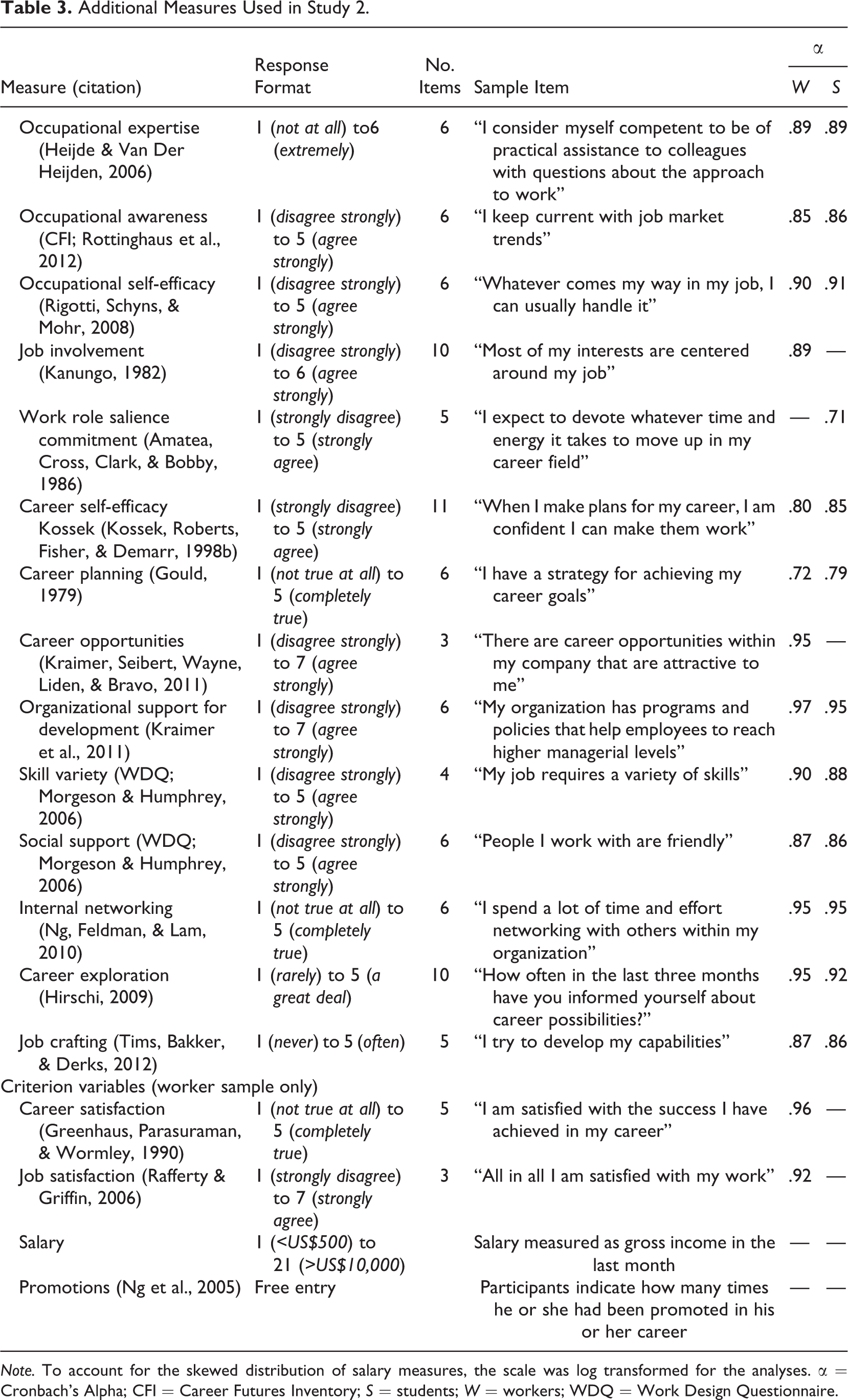
Note. To account for the skewed distribution of salary measures, the scale was log transformed for the analyses. α = Cronbach’s Alpha; CFI = Career Futures Inventory; S = students; W = workers; WDQ = Work Design Questionnaire.
Results and Discussion
CFA
To reconfirm dimensionality and structure of the selected items in the new samples, we repeated the series of CFAs in the worker and student sample as described in Study 1. Replicating the findings from Study 1, in both samples, Model 1, distinguishing 13 and 12 factors, respectively, was the best fitting model. However, as in Study 1, the hierarchical four-factor model also showed acceptable fit (complete results are available from the authors upon request). Confirming the construct validity, standardized factor loadings ranged between .72 and .93 in the worker sample and between .71 and .87 in the student sample. As seen in Table 2, all factors also showed high reliability, ranging from α = .80 to α = .93 in the worker sample and from α = .78 to α = .90 in the student sample. Overall, the results confirm the construct validity and proposed factor structure of the selected CRQ items. The bivariate correlations among the CRQ factors ranged between .42 (organizational career support and career exploration) and .83 (organizational career opportunities and organizational career support) in the worker sample and between .36 (job market knowledge and career involvement) and .77 (job market knowledge and career exploration) in the student sample (full correlation tables are available from the authors upon request).
Convergent Validity
To assess convergent validity, the CRQ factors were correlated with existing scales measuring closely related constructs (Table 4; full correlation table is available from the authors upon request). All correlations were highly significant and moderate to high in size, supporting Hypothesis 2. As expected, some correlations (e.g., for job market knowledge, career opportunities, and networking) were high (r > .70), indicating that some CRQ factors assess constructs that are close to those assessed in existing scales. Other correlations (e.g., skill variety and job crafting) were moderate to high (r = .38–.70), confirming that some CRQ factors assess related constructs to existing scales. Overall, these results confirmed the convergent validity of the newly developed scales.
Correlations of CRQ Factors With Similar Existing Measures (Study 2).

Note. N (workers) = 437; N (students) = 403. All correlations are significant at level p < .001. CRQ = career resources questionnaire.
aJob involvement was measured only in the worker and work role salience only in the students sample.
Criterion Validity
To test criterion validity, we correlated all CRQ factors with the assessed career success variables (Table 5). All CRQ factors correlated significantly and positively with career satisfaction, job satisfaction, salary, and promotions. However, salary generally showed lower correlations with the CRQ factors. Multiple regression analyses showed that the 13 CRQ factors explained 55% variance in career satisfaction (p < .001), 55% (p < .001) in job satisfaction, 4% (p < .001) in salary, and 14% (p < .001) in promotions. These results support the criterion-related validity of the CRQ as stated in Hypothesis 3 and suggest that the factors assessed in the CRQ are useful predictors of career success.
Correlations of Career Success Indicators With CRQ Factors in the Worker Sample (Study 2).

Note. N = 437; n (salary) = 425, n (promotions) = 423 (not all participants provided answers on these measures). Correlations from .10 to .13 are p < .05. Correlations from .14 to .17 are p < .01. All other correlations are p < .001. CRQ = career resources questionnaire.
General Discussion
We set out to develop an integrative framework of key factors that promote career success, the so-called career resources. Based on this framework, we have developed the CRQ to assess the theoretically identified career resources among workers and college students. In two studies encompassing 873 workers and 691 students in four distinct samples, we have established and confirmed the factor structure of the instrument as well as its convergent and criterion-related validity. As such, our article makes several theoretical and empirical contributions to the literature and should provide an important source for future research and practice in career development.
The CRQ as a Comprehensive Framework of Predictors of Career Success
From a theoretical view, based on existing models and theories of career success, we have identified four main areas of key predictors for objective and subjective career success and specified 13 aspects within these four areas that are empirically and theoretically well established in the international career literature as predictors of career success, are not redundant, and do not represent relatively fixed traits or sociodemographics. This developed framework makes a theoretical contribution to the career literature because it synthesizes the vast literature on correlates and predictors of career success into a model that is both comprehensive and manageable.
Following best-practice guidelines in questionnaire development (Hinkin, 1998) and a multistep procedure, we have developed and validated in parallel a version for workers as well as college students. By developing and validating two versions in parallel, we can avoid the pitfall that future studies use a questionnaire among students that was developed and validated only among workers without a proper evaluation process. Instead, future research and practice can rely on two versions of the same questionnaire that have been developed and validated specifically for different populations.
By building upon a theoretically derived model of key predictors of career success, the CRQ represents a comprehensive assessment of key career resources. Existing scales that assess constructs such as career adaptability (Savickas & Porfeli, 2012), employability (Fugate & Kinicki, 2008; Heijde & Van Der Heijden, 2006), or career competencies (Akkermans, Brenninkmeijer, Huibers, & Blonk, 2012; Francis-Smythe et al., 2013; Kuijpers & Scheerens, 2006) mostly focus on a limited range of attitudinal or behavioral constructs. In contrast, the CRQ covers a much broader area, encompassing human capital resources, environmental resources, motivational resources, and career management behaviors. This makes it to our knowledge the most comprehensive single assessment of key predictors of career success available.
An important advantage of the CRQ compared to existing measures is not only the relatively comprehensive coverage of key predictors of career success but also its shortness. By applying a rigorous scale development process, we were able to derive 3–4 items for each factor that reliably measure each construct. Our newly developed measure should thus be welcomed by researchers who are looking for a short survey due to concerns about lower participation rates, increased inattentiveness and fatigue in responding, and higher attrition rates in longitudinal studies due to lengthy questionnaires.
The CRQ in Relation to Existing Measures and Career Success
Our results not only established the factor structure and reliability of the assessed factors but also their convergent validity. Study 2 showed moderate to high correlations between the CRQ factors with existing measures that assess related constructs. Although there were some differences in the magnitude of the correlations between the worker and student sample, in several instances (i.e., job market knowledge, career opportunities, networking, and career exploration) the correlations were above .7 in both groups. This indicates that some CRQ factors measure a highly similar construct when compared to existing scales. Because it was the goal of the CRQ to assess well-established factors for career success, and not some “new” predictors, such overlaps can be expected. It is, however, notable that the herein developed scales are much shorter than most existing scales without suffering in reliability or content validity. Hence, even if some CRQ factors assess a highly similar construct compared to existing scales, the shortness of the CRQ scales and the existence of validated worker and student versions make a useful contribution to the literature beyond existing measures.
The herein developed questionnaire also refined the assessment of key predictors of career success beyond existing scales, as indicted by more moderate correlations to some existing measures. For example, the CRQ factor of career confidence is only moderately related to the existing measure of career self-efficacy by Kossek, Roberts, Fisher, and Demarr (1998a). A closer inspection of the content of the items reveals that the Kossek et al.’s scale contains items referring to learning on the job, advancement in the current company, or career self-reliance. In contrast, the herein developed career confidence scale taps more directly and specifically into the confidence to successfully managing one’s career. In other instances, we have developed scales for constructs, which showed only modest overlap with existing measures of similar constructs, such as for possession of soft skills that can be used in many jobs, job challenges that help to utilize and develop personal valued skills, or executed learning activities of work-related knowledge and skills.
To establish criterion validity, Study 2 showed that all CRQ factors were significantly correlated with indicators of subjective (i.e., career satisfaction and job satisfaction) as well as objective career success (i.e., salary and promotions). These results support the view that the CRQ factors measure career resources that are important to attain career success. Notably, the CRQ factors were generally more strongly correlated with the indictors of subjective career success compared to objective success, particularly in terms of salary. This is in line with meta-analytic findings that motivational, social, and organizational/work environment factors generally show higher correlations with subjective career success than with salary (Ng & Feldman, 2014a, 2014b).
Limitations and Future Research
Although the selected 13 career resources factors are all well established in the literature, no such model can claim to be exhaustive. Other factors not included in this framework might be considered for each category (e.g., ability to adapt quickly to new environments or exhibiting influence behaviors). However, in order for a model to be practically useful, a selection of constructs needs to be made and all the factors included in our framework represent well-established key factors for career success, even if other factors might also be important.
An empirical limitation of the presented studies is that no long-term predictive utility was established. For future evaluation of the measure, it would be important to examine to what extent the assessed CRQ factors predict career success over time. This is especially true for the student population. Here, no criterion validity was established and future longitudinal research needs to investigate to what extent the CRQ factors among students predict career success after graduation. Also, the CRQ assesses human capital and environmental career resources only by self-report. Future studies could aim to establish to what extent such self-assessments are related to more objective indicators of these factors. Future research should also assess the incremental utility beyond existing measures that aim to assess facilitators for career development, for example, employability (Fugate & Kinicki, 2008; Heijde & Van Der Heijden, 2006), career competencies (Akkermans et al., 2012; Francis-Smythe et al., 2013; Kuijpers & Scheerens, 2006), or career adaptability (Rottinghaus, Day, & Borgen, 2005; Savickas & Porfeli, 2012). Future studies could assess the specific strength and weaknesses of all these measures in their ability to predict different career outcomes.
Related to this point is the limitation that we did not assess to what extent the CRQ factors differ across diverse populations (e.g., according to gender, race/ethnicity, age, or education). It is possible that systematic differences in career resources among such groups exist. Moreover, it is possible that different career resources have different effects on career outcomes for different populations. For example, it might be that in smaller organizations, career opportunities and organizational support might not be as important as in larger organizations; or that in highly knowledge intense occupations (e.g., lawyers and engineers), occupational expertise might be a more important factors than in more manual occupations (e.g., construction worker and cleaning staff). Future research could investigate the generalizability of the CRQ across different samples and employment contexts and increase the understanding of differential effects of career resources on career outcomes.
Finally, the results in Study 2 showed that some CRQ factors were highly correlated, specifically career clarity and career confidence, and organizational career opportunities and organizational career support in the worker sample. We argue that it makes sense to measure these constructs with separate scales because they are conceptually not identical. The CFA conducted among the four independent samples also confirmed the good fit of the proposed model to the data. However, future research is needed to empirically establish to what extent different CRQ factors might have different predictors, correlates, and consequences and might imply different approaches in career development practice to further establish the discriminant validity of the CRQ factors.
For future research, the herein developed questionnaire can be useful in several ways. First, it would now be interesting to examine how career resources can predict closely related constructs to career success, such as psychological well-being, work–family balance, or work stress, would provide important insights into how career-related resources can affect a range of work and nonwork outcomes. A second important line of inquiry would be to assess how the career resources develop over time and how they affect each other to form resource gain or loss spirals (Hobfoll, 1989). Related to this point is the question of timing of resources that deserves further attention: Is there a natural or preferable sequence regarding how career resources are developed? Do some career resources become more or less important at specific points in time, for example, among younger employees when compared to older workers or among employees with family obligations when compared to people without childcare or eldercare responsibilities? Moreover, the investigation of resource caravans would be instructive (Halbesleben et al., 2014), that is, the patterns of how career resources typically occur in combination and what type of resource combination leads to which outcomes. Finally, intervention research that assesses by what means and to what extent different career resources can be systematically promoted and to what effect would be important.
Implications for Practice and Conclusions
The herein developed and validated CRQ could be a highly useful tool for career counseling, university career service, and human resources development practice in several ways. First, it can provide practitioners in these areas with an integrative framework of some of the most established key predictors of career success. The CRQ framework can thereby help practitioners making sense of the vast academic literature on career success because the framework shows in a comprehensive yet concise way what career resources are critical for career success based on the best available knowledge to date. Second, the CRQ can be used as an economic way to assess key areas of strength and weaknesses among clients regarding the availability of resources that can help people to achieve their career goals. Based on such an assessment, practitioners could more specifically target their interventions to specific career resources that seem most fruitful to capitalize on or are in need of more development. Third, the CRQ can be used in quality control and assessment of effectiveness of career interventions. If the CRQ is completed before and after an intervention, practitioners could then assess to what extent their intervention has been successful in increasing key career resources among their client(s) and which career resources are more or less affected by the intervention. Such insights could then be used to document the effectiveness of the intervention to important stakeholders (clients, organization, and government agencies) as well as to improve the intervention. Finally, apart from the use by career professionals, the CRQ could also be a useful tool for self-assessment among workers and students. Based on the CRQ results, individuals could get a better understanding of their existing career resources that could be important for career planning and to promote active engagement in self-directed career management.
To conclude, we have developed a framework of critical career resources that integrate existing empirical and theoretical works on which factors help individuals achieve objective and subjective career success. Based on this framework, we have developed and validated a concise measurement that can assess a range of important career resources among workers and students. We believe that the CRQ will be a useful tool for researchers interested in career development generally and predictors of career success more specifically. Moreover, we assume that the CRQ will be a useful instrument among practitioners in career counseling, university career service centers, and human resource managers to help client in their career development as well for as individuals for self-assessment in order to promote successful self-directed career management.
Footnotes
Declaration of Conflicting Interests
The author(s) declared no potential conflicts of interest with respect to the research, authorship, and/or publication of this article.
Funding
The author(s) received no financial support for the research, authorship, and/or publication of this article.