



Abstract
Organizations are increasingly opting to offer alternative career paths to the traditional managerial ladder (particularly, a technical ladder). Although research has mainly focused on differences between the managerial and technical paths with regard to rewards and prestige, our study focuses on gaps between employees’ actual (current) and preferred career paths, that is, being on the technical path while preferring the managerial path and vice versa. We examine how employees experiencing career path gaps compare with employees experiencing career path fit, in terms of self-rated performance and burnout. The results, based on data from 210 professional employees working in four global high-technology companies, suggest that performance levels are lowest among employees who are currently on the technical career path but would prefer the managerial path, whereas burnout levels are lowest among employees experiencing career path fit. Furthermore, among employees experiencing the former, career path gap, performance is lower when supervisor support is high.
Introduction
Most individuals possess a dominant career anchor defined as an element of one’s self-concept “consisting of 1) self-perceived talents and abilities, 2) basic values, and, most important, 3) the evolved sense of motives and needs as they pertain to the career” (Schein, 1996, p. 27). If one assumes that employees seek careers that match their abilities, values, and aspirations—a basic premise of person–career (P-C) fit theory (Parasuraman, Greenhaus, & Linnehan, 2000)—it seems likely that employees whose main career anchor is technical/functional competence will seek to develop their careers by increasing their technical expertise, whereas employees whose main career anchor is general managerial competence will seek to develop their careers by ascending the managerial hierarchy (e.g., Crawshaw, van Dick, & Brodbeck, 2012).
In an attempt to cater to employees with different career anchors, some firms offer the so-called dual-career ladder—comprising a “technical ladder” and a “managerial ladder”—which presumably should provide employees with advancement opportunities that correspond to their individual inclinations. Allen and Katz (1986) examined the extent to which a dual-career ladder succeeds in broadening professional employees’ development opportunities and found that, in many cases, the technical advancement opportunities that firms offer do not constitute viable alternatives to the managerial path: Many firms find it difficult to ensure that the technical ladder provides sustained opportunities for development and offers recognition and rewards that are equivalent to those associated with the managerial ladder. This challenge is further complicated by the fact that society as a whole seems to attribute lower prestige to the technical career ladder compared with managerial advancement (e.g., Hölzle, 2010).
The disparities between managerial and technical career paths may lead professional employees to choose the managerial path, even if their personal interests tend more toward the core, technical aspects of their occupations. These employees may find themselves in managerial positions without being truly motivated or engaged with managerial responsibilities. Conversely, those employees who do choose the technical career path may ultimately feel more drawn toward the managerial path, owing to a desire, for example, to exert more influence over people and decisions or to be accorded a higher degree of prestige (e.g., Cha, Kim, & Kim, 2009; Crawshaw et al., 2012). In effect, such employees may experience career path gaps, defined as gaps between actual and desired career paths.
Herein, focusing on the technical and managerial career paths, we investigate career path gaps and their implications for employee performance and well-being. Our work draws from prior research on P-C fit and extends it in three ways. First, whereas P-C fit research focuses on measuring the compatibility between specific aspects of an individual’s personality (e.g., values, aspirations) and his or her career (e.g., autonomy, opportunities for development; Parasuraman et al., 2000), we focus on the employee’s subjective experience of desiring one career path while being on another, regardless of compatibility. Second, the investigation of career path gap offers a more nuanced approach than P-C fit by considering not only the match or lack thereof between employees’ career paths and their aspirations and aptitudes but also the types of gaps, that is, being on the managerial ladder while preferring a technical position and vice versa. Finally, we take account of the broader context within which a career path gap may occur, suggesting that outcomes associated with career path gaps may differ depending on the degree to which employees perceive their supervisors as supportive.
Alternative Career Paths for Professional Employees
Past research has identified professional growth as a central driver among professional employees (e.g., Horwitz, Heng, & Quazi, 2003; Jayasingam & Yong, 2013; Spender & Strong, 2014; Wang, 2010). As noted above, firms may attempt to provide their employees with growth opportunities by implementing both technical and managerial career ladders, a practice originally referred to in the literature as the dual-career ladder (e.g., Allen & Katz, 1986). The managerial ladder allows employees to grow within the organizational hierarchy, taking positions in which they manage other employees in addition to assuming responsibility for specific strategic initiatives of the organization. In most organizations, the managerial ladder is clear and visible: The promoted employee gains additional responsibilities, which, in most cases, are linked to an increase in benefits and compensation. The technical ladder indicates progression toward higher levels of specialization and technical responsibility within a specific area of competence but no managerial responsibility. Employees on the technical career path can, for example, take on responsibility for leveraging in-depth technical expertise, make recommendations in broad business areas, participate in decisions about scientific activities, and act as mentors to other employees (e.g., Chen, Chang, & Yeh, 2003; Crawshaw et al., 2012).
Much of the scholarly research on the dual-career ladder has examined the differences between managerial and technical career paths in terms of job scope, rewards, and so on. For example, Bailyn (1991) found that employees perceive progression along the technical career path to be less likely to increase one’s visibility or status or to offer additional responsibility or authority, in comparison with progression along the managerial path. Similarly, Hölzle (2010, p. 779) suggested that employees in the technical path (e.g., project managers) “do not feel adequately respected and compensated for their work.” At the same time, research on the dual-career ladder has provided little insight regarding the concept of lack of fit (gap) between actual and preferred career paths—and the implications of such gaps for employees’ performance and well-being.
Career Path Gap, Performance, and Burnout: Main Effects
The provision of congruence or fit between a person and his or her work environment is a central theme in organization research (for meta-analyses, see Assouline & Meir, 1987 and Kristof-Brown, Zimmerman, & Johnson, 2005). One form of fit is P-C fit, discussed briefly above. P-C fit occurs when one’s work environment provides career development opportunities that correspond to one’s values and fulfill one’s needs for career success, or when one has the talent or the ability to seize the career opportunities provided by one’s job (Parasuraman et al., 2000). Empirical findings about the outcomes of P-C fit, or the lack thereof, are rather scant, with the few studies that have tackled this issue indicating that the experience of P-C fit relates positively to job satisfaction, commitment, and willingness to invest more effort at work (Cha et al., 2009; Johnson & Sargeant, 1998).
Importantly, a main limitation in the extant P-C fit literature is its focus on the employee’s career orientation or expectations without considering the career opportunities provided by the organization. A study by Cha, Kim, and Kim (2009) is the only study we know of that has considered the fit between professional employees’ career orientation (what employees want to pursue in their careers) and the career development opportunities provided by their work environments. The authors distinguished between a technical P-C fit (compatibility between technical career orientation and technical development opportunities provided by the organization) and a managerial P-C fit (compatibility between managerial career orientation and managerial development opportunities provided by the organization). We advance Cha et al.’s (2009) findings by considering the compatibility between an employee’s current career path (what career path he or she is following at present) and the career path the employee prefers. Accordingly, we distinguish between a gap in which an employee is on the managerial career ladder but would prefer to be on the technical ladder and a gap in which an employee is on the technical career ladder but would prefer to be on the managerial ladder.
We measure the effects of career path gaps on both performance and burnout to consider implications that capture the employer’s and the employee’s perspectives, respectively. More specifically, we expect performance levels of employees who experience career path fit to be higher than those of employees experiencing a career path gap of either type. This is because being on the career path that best suits their skills and aspirations not only enables employees to best utilize their abilities but also allows them to engage fully in the work at hand (instead of thinking about how to switch jobs). Likewise, employees who experience career path fit may wish to show the organization gratitude and appreciation for addressing their career expectations (e.g., Markman & Baron, 2003; Nachbagauer & Riedl, 2002).
Moreover, we expect performance levels to be lower among employees who are on the technical career ladder but would prefer to be on the managerial ladder, compared with employees who are on the managerial career ladder but would prefer the technical ladder. This expectation draws from the perception that high performance in a technical role is likely to bind an employee to the technical path, whereas, in some cases, firms respond to an employee’s low technical performance by diverting him or her into a managerial role (e.g., Brennan, 2001; Thorne, 1997). Employees who wish to be relocated to the managerial path may thus prefer to opportunistically keep a low profile so as not to be perceived as high performers, for example, by means of putting more emphasis on administrative duties (which they hope would signal their strengths) rather than on excelling in their technical or professional commitments, meeting deadlines, and achieving success. This is likely to be reflected in their overall relatively lower performance level—compared to employees who are on the managerial career ladder but prefer the technical ladder. Employees experiencing the latter career path gap are likely to be driven by the broad responsibility to ensure the success of their business unit, pushing them to high performance. Yet this group is likely to perform worse than employees experiencing career path fit both because employees in this group may lack skills that are required for fulfilling their managerial roles and because of various negative attitudes, such as dissatisfaction and frustration, that may result from their P-C misfit. Indeed, it has been found that a lack of passion for or engagement with managerial roles has a negative influence on individuals’ ability to succeed in these roles (e.g., Johnson & Sargeant, 1998; Nachbagauer & Riedl, 2002). To test the aforementioned arguments, we put forth the following hypothesis:
Employees with career path fit are expected to experience lower levels of burnout compared with employees experiencing gaps of either type because the former experience a good match between their professional aspirations and the opportunities afforded by their career. At the same time, P-C mismatch is likely to be emotionally exhausting—in particular for employees who are on the managerial career ladder but would prefer the technical ladder. The characteristics of managerial positions, including issues related to power and politics, the need to satisfy demands of higher management, the complexity of managing former colleagues, and so on, may be highly stressful for technically oriented employees. These challenges may result in “identity struggles” for such professionals (Joffe & MacKenzie-Davey, 2012, p. 163), threatening their professional identity, and distancing them from the core of their expertise (e.g., Rodrigues, Guest, & Budjanovcanin, 2013; Thorne, 1997; Witman, Smid, Meurs, & Willems, 2011). For these employees, the scope and complexity of issues involved in managerial positions may stretch too much, depleting their resources (e.g., Johnson & Sargeant, 1998). The experience of personal and professional stress among technically-oriented managers has been well documented, often linked to the necessity of uniting various roles and the troublesome task of maintaining balance between, and credibility in two worlds—the management world and the professional world (e.g., Armstrong-Stassen & Stassen, 2013; Jawahar, 2012).
These characterizing feature of managerial positions are often absent from technical positions: Employees who are on the technical career ladder but prefer the managerial ladder are far less exposed to stressful situations, resulting from conflicting priorities and people management issues. Still, owing to the accumulative stress associated with daily routine or boredom, employees in this group are likely to experience more burnout than employees experiencing career path fit. That is, being “forced” into the technical path, employees in this group are required to maintain high standards of professional competence and qualification and to take part in technical work, which they often find to be a poor alternative to broad, strategic assignments, and this may be distressing (e.g., Bailyn, 1991; Cha et al., 2009). We therefore propose:
The Moderating Role of Supervisor Support
Previous research suggests that certain workplace conditions may influence the reactions of employees to a lack of fit with different aspects of their work environment (e.g., Erdogan, Kraimer, & Liden, 2004).We elaborate on these findings by assessing the influence of supervisor support on the association of career path gap with performance and burnout.
Perceived supervisory support reflects the degree to which an employee views his or her supervisor as both caring and able to provide emotional and instrumental assistance toward overcoming challenges (e.g., House, 1981). This variable was found to be positively associated with subordinates’ performance (e.g., Cropanzano, Rupp, & Byrne, 2003) and inversely associated with burnout (e.g., Stephens & Long, 2000). For two main reasons, supervisor support may also have an indirect effect on performance and burnout by moderating the effect of career path gap on these outcomes. First, by its very nature, supervisory support may serve as a buffering mechanism, alleviating the negative outcomes associated with career path gap. For example, to the extent that supervisor support manifests itself in the form of recommendations as to how to minimize experiences of career path gap or actual assistance in doing so (e.g., providing training in relevant topics, assigning employees to tasks that are more consistent with their career interests), employees may be able to perform better and feel less exhausted. Second, the reciprocity norms underlying social exchange (e.g., Biron, 2010; Settoon, Bennett, & Liden, 1996) may make employees feel uncomfortable using underperformance as a means to cope with career path gap. Recognizing the potential adverse effects of poor performance on their supervisor (work lagging behind deadlines, customer complaints, etc.), individuals perceiving their supervisors as being more supportive are likely to be less willing to impose these costs on their supervisors and more willing to perform well even in the face of career path gap.
Accordingly, we propose:
Method
Design and Sample
Data were collected using questionnaires administered to 400 professional employees (engineers, product designers, computer scientists, IT specialists, etc.), working in four global high-technology–software engineering companies. These companies have vast spread across multiple continents. All four companies put much emphasis on the technical career path as a real alternative to the managerial path, with both paths clearly structured in terms of stages of development, responsibilities in each stage, and so on. The 400 employees were identified via professional networks of the researchers, using a snowball sampling method. Participants received an e-mail that included a link to an electronic survey located in a website, which only they could access (from any computer—at work/at home). This e-mail was sent by a research assistant and included an introduction describing the research objectives and inviting participants to voluntarily contribute to the study by completing the survey. The survey was conducted in English only. Participation was anonymous. The survey took approximately 15 min to complete. We received completed questionnaires from 224 employees, of whom 210 were eventually included in our analyses (due to listwise deletion, the discarded data were missing at random, effective response rate of 53%). Seventy-seven percent of the participating employees were Israelis and 23% were U.S. citizen. Sixty-eight percent of the participants were males, and the average age of participants was 39.3 (SD = 7.01).
Measures
Gap between actual and preferred career path
We asked employees to state the current career path on which they are positioned (technical or managerial) and the one they desire (again, technical or managerial). The outcome was a 2 × 2 matrix variable, with 2 cells denoting career path fit (50 employees with managerial career path fit; 109 employees with technical career path fit) and the other two cells denoting the two possible types of career path gap (21 employees on the managerial career path preferred the technical path; 20 employees on the technical career path preferred the managerial path). The sizes of the career path gap groups were relatively small (n = 20/21) but large enough to carry out comparisons of statistical significance (e.g., Ledesma, Macbeth, & Cortada de Kohan, 2009). Accordingly, for the analyses testing Hypotheses 1 through 4, the two groups of employees experiencing career path fit (i.e., on the managerial and technical ladders) were consolidated—serving as the reference group against which we compared the two groups of employees experiencing career path gap.
Performance was measured according to employees’ self-reports, using 3 items adopted from Van Dyne and LePine (1998). Participants indicated on a 5-point scale (1 = strongly disagree; 5 = strongly agree) the degree to which they (1) meet performance expectations, (2) fulfill the responsibilities in their job descriptions, and (3) perform the tasks that their jobs require of them. Prior research had demonstrated the validity of self-rated performance scores. For example, Saks and Ashforth (2000) reported that self-rated performance was positively correlated with self-efficacy, job satisfaction, and organizational identification and negatively correlated with negative affectivity and role ambiguity.
Burnout was measured using the Emotional Exhaustion Scale (Maslach & Leiter, 1997). Participants were asked to indicate the degree to which they agree or disagree with statements such as, “I feel emotionally drained from my work,” “I feel used up at the end of the workday,” and so on, using a 5-point response scale, ranging from 1 = strongly disagree to 5 = strongly agree. Demonstrating the validity of the scale, Bakker and Heuven (2006) found that emotional exhaustion correlated positively with job demands and negatively with performance.
Supervisor support was measured on the basis of an 8-item index adopted from Anderson and Williams (1996). Participants were asked to indicate how often during the past month their direct supervisor had provided them with such support as “talked you through work-related problems, helping you come up with solutions” and “provided you with encouragement (positive feedback) about your work.” Participants responded using a 5-point scale ranging from 1 = never to 5 = several times a day.” The scale was validated in other studies. For example, Biron (2013) reported that supervisor support was positively and negatively correlated with health status and absenteeism, respectively.
Control variables
On the basis of prior evidence linking gender and age with career aspirations (e.g., Bipp, 2010), we controlled for these variables in all analyses. We also controlled for perceptions of (un)met career expectations to capture employees’ general perceptions of their career. This measure, adopted from Buunk and Janssen (1992), assessed the degree to which employees perceive various aspects of their career—such as salary, job security, and so on—as meeting their expectations. As this measure had no significant effect in any of the analyses, it was eventually excluded from the analyses.
Analysis Technique
Hypotheses 1 through 4 were tested with multiple, stepwise regression analyses consisting of the following steps: The first step included the control variables. In the second step, career path gap fit (three groups; “career path fit” as the reference group) was entered. In the third step, the moderating variable (supervisor support) was entered. In the fourth, final step, the interaction terms (products) were entered. We ran two sets of analyses, one in which performance was the dependent variable (Table 1) and one in which burnout was the dependent variable (Table 2).
Linear Regressions Testing the Association Between Career Path Gap and Performance and the Moderating Role of Supervisor Support.
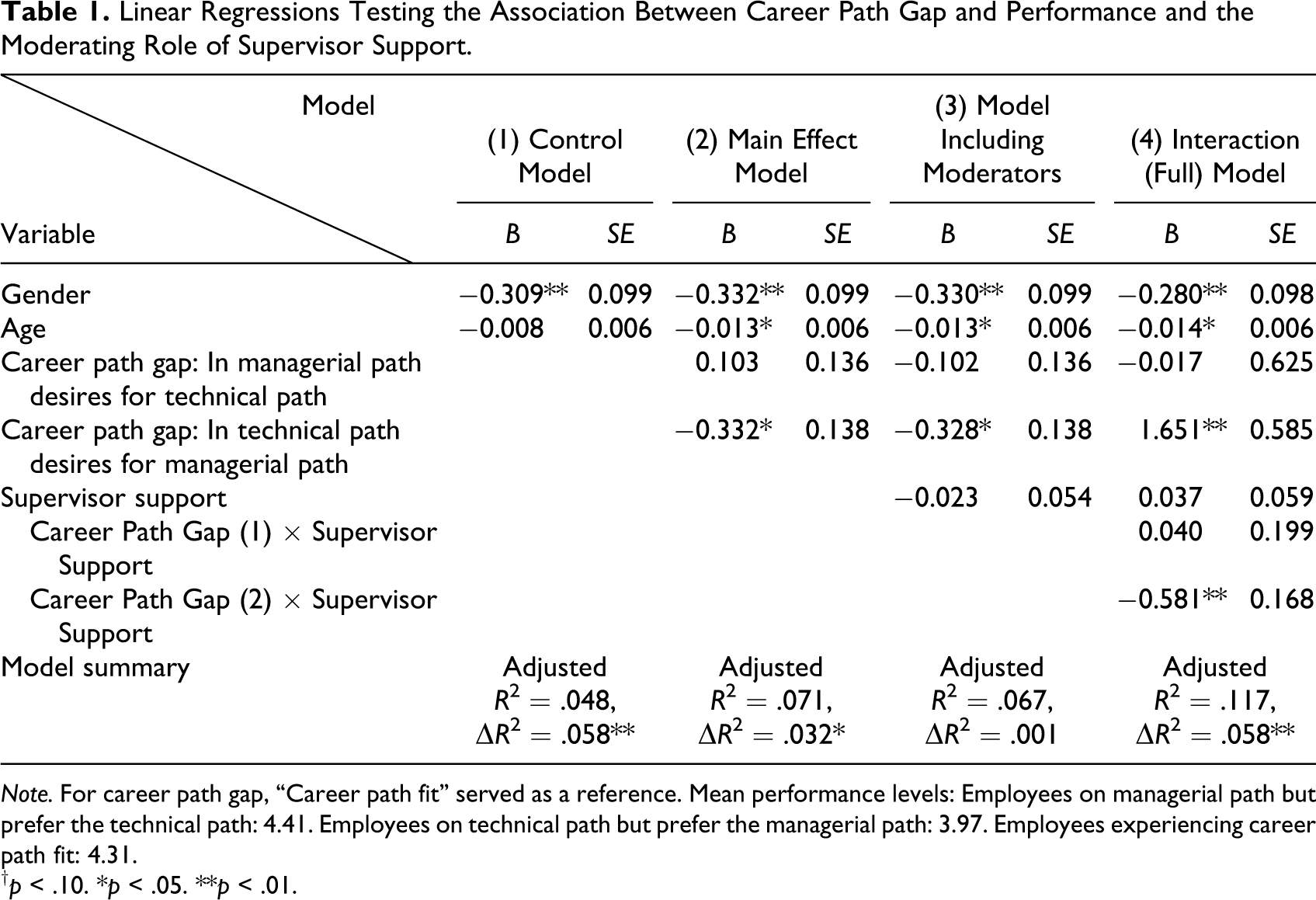
Note. For career path gap, “Career path fit” served as a reference. Mean performance levels: Employees on managerial path but prefer the technical path: 4.41. Employees on technical path but prefer the managerial path: 3.97. Employees experiencing career path fit: 4.31.
† p < .10. *p < .05. **p < .01.
Linear Regressions Testing the Association Between Career Path Gap and Burnout and the Moderating Role of Supervisor Support.
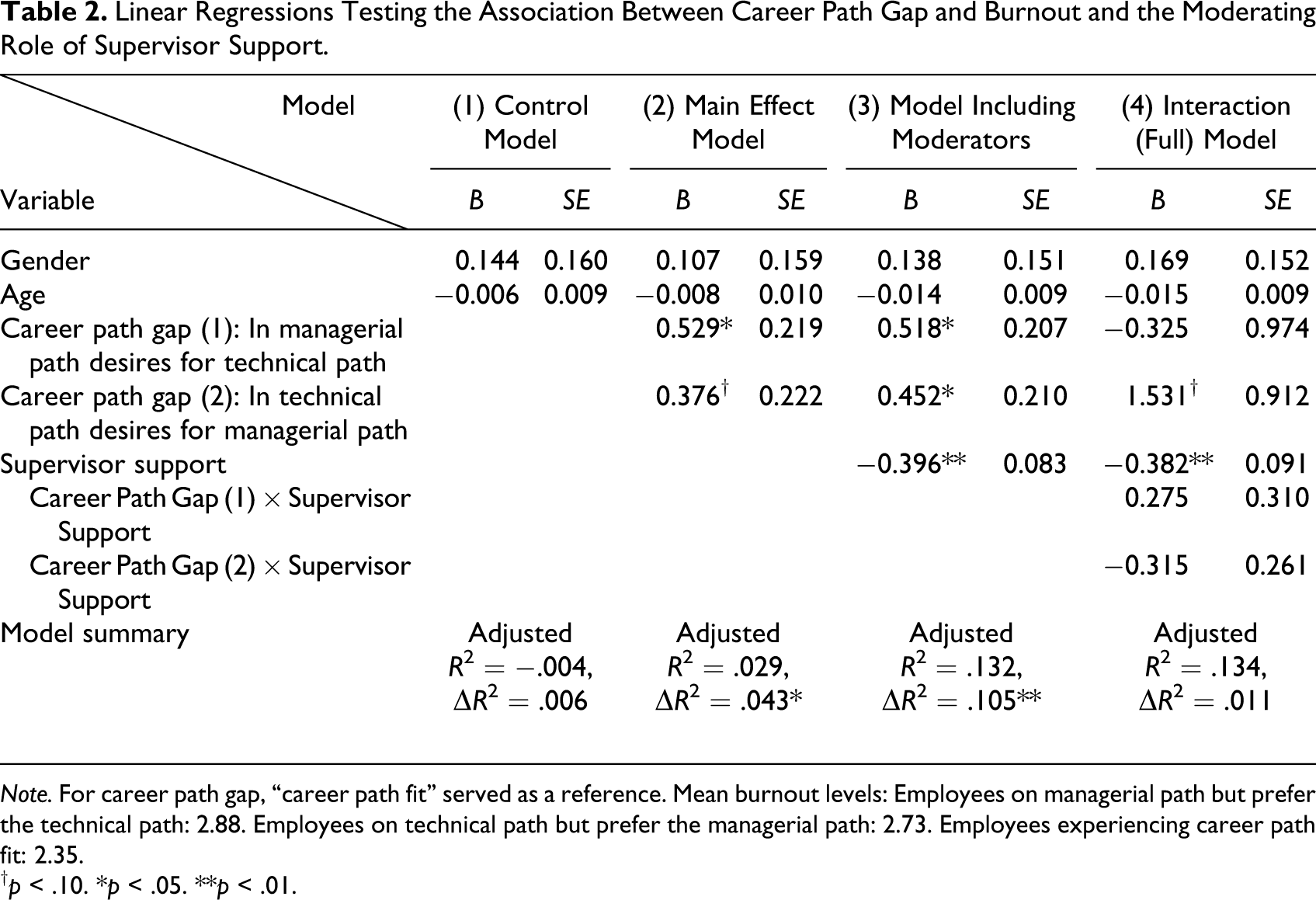
Note. For career path gap, “career path fit” served as a reference. Mean burnout levels: Employees on managerial path but prefer the technical path: 2.88. Employees on technical path but prefer the managerial path: 2.73. Employees experiencing career path fit: 2.35.
† p < .10. *p < .05. **p < .01.
Results
Means, standard deviations, Cronbach’s α, and correlations are displayed in Table 3. Hypothesis 1 was partly supported. Specifically, as Model 1 in Table 1 shows, employees on the technical career path who preferred to be on the managerial path showed significantly lower performance compared with employees with career path fit (β = −.328, p < .05). The performance of employees on the managerial career path who preferred the technical path was not significantly different from that of employees with career path fit (β = .102, p > .05).
Means, Standard Deviation, Cronbach’s α, and Correlation (Pearson) of the Measured Variables.
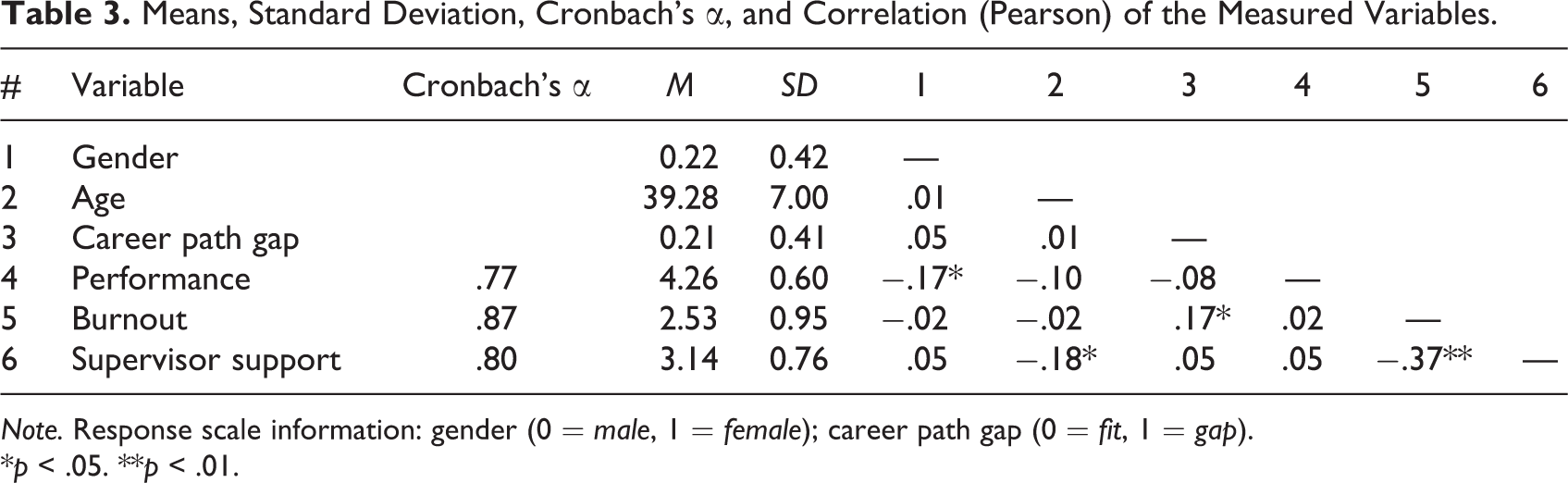
Note. Response scale information: gender (0 = male, 1 = female); career path gap (0 = fit, 1 = gap).
*p < .05. **p < .01.
Hypothesis 2 was supported. Specifically, as Model 2 in Table 2 shows, employees on the managerial career path who preferred the technical path showed significantly higher burnout levels compared with employees with career path fit (β = .529, p < .05). Among employees on the technical career path who preferred the managerial path, burnout was marginally higher than among employees with career path fit (β = .376, p < .10).
Model 4 in Table 1 does not support Hypothesis 3. Specifically, among employees who are currently on the technical career path but prefer the managerial path, performance is lower when supervisor support is high; that is, the negative association between career path gap and performance is amplified as a function of supervisor support (β = −.581, p < .01). Figure 1 graphically illustrates the interaction effect of supervisor support. As Figure 1 shows, among employees who experience career path fit and among those who are in the managerial path but prefer the technical path, performance level is generally similar across high (+1 SD) and low (−1 SD) levels of supervisor support (t = .64, p > .10 and t = .41, p > .10, respectively). Yet among employees who are in the technical path but prefer the managerial path, performance is lower under conditions of high supervisor support than under conditions of low supervisor support (t = −3.45, p < .001).

Interaction effect of career path gap and supervisor support on performance.
Model 4 in Table 2 does not provide support for Hypothesis 4, which posited that the positive association between career path gap and burnout would be attenuated as a function of supervisor support. The interaction effect is not significant for both types of career path gap (in managerial path desires for technical path: β = .275, p > .05; in technical path desires for managerial path: β = −.315, p > .05).
Discussion and Implications
In the past, it was uncommon for an employee to publicly identify technical/functional competence as his or her career anchor. Rather, most employees would publicly express a desire to “get into management and ‘climb the ladder’ because that is where the big rewards are perceived to be” (Schein, 1996, p. 29). However, since technology has become a core competency of enterprises, employees have increasingly begun to view the technical/functional competence anchor as a basis for a career (e.g., Chang, Chen, Klein, & Jiang, 2011; Lee & Wong, 2004; Ramakrishna & Potosky, 2003). Firms are therefore expected to provide employees with diverse channels of growth and development—including both managerial and technical career paths (e.g., Beecham, Baddoo, Hall, Robinson, & Sharp, 2008; Seiler, Lent, Pinkowska, & Pinazza, 2012). The current study aimed to advance our understanding of P-C fit concerns among professional employees, by investigating the association of career path gaps with employees’ behavior (performance) and well-being (burnout). We further sought to examine the extent to which supervisor support influences the career path gap–outcome association.
With respect to the main effects of career path gaps, in line with Hypothesis 1, the results indicate that performance levels were lowest among employees who were on the technical career path but preferred to be on the managerial path. However, contrary to our expectation, employees on the managerial career path who preferred the technical path did not perform at a significantly lower level compared with those experiencing career path fit. This finding may be explained by a self-fulfilling prophecy that drives employees on the managerial ladder to engage in high performance levels; they may feel that they are being held to a standard of high performance (Allen & Katz, 1986; Bailyn, 1991) and therefore strive to meet these expectations. In addition, employees who prefer a technical path may be highly intrinsically motivated, enough so that they may be able to perform at a high level even in the case of a career path gap. Data we have may point in this direction: the level of intrinsic motivation (measured using the Aspiration Index; Kasser & Ryan, 1996) among employees on the managerial career path who preferred the technical path was quite similar to that of employees experiencing career path fit—and different from employees on the technical path who preferred the managerial path.
As expected (Hypothesis 2), burnout levels were lower among employees experiencing career path fit than among employees experiencing career path gaps. Interestingly, however, no significant differences were found between the two career path gap groups. Although employees in managerial positions are exposed to extreme pressures on their daily work routine, with the competitive landscape forcing them to constantly develop their capabilities to successfully address various challenges (e.g., to meet pressing deadlines, to initiate and manage changes), technical positions in firms such as those participating in our study require expertise in specific fields and constant upgrading of skills to cope with rapid technological advancement, more demanding consumers, and intensifying global competition (e.g., Hirakubo, 1999; Martin, Jones, & Callan, 2006). Our results may thus be explained in light of the highly demanding challenges in both managerial and technical positions, which may be particularly exhausting for employees who lack the desire to fill their respective positions.
Although this study focused on comparing between employees experiencing (either type of) career path gap and employees experiencing career path fit, it is also interesting to consider whether the two groups of employees experiencing career path fit (i.e., managerial career path fit and technical career path fit) differ in terms of performance and burnout. One specific finding is worth noting in this respect: The lowest level of burnout was observed among employees experiencing technical career path fit. At the same time, burnout levels among employees experiencing managerial career path fit did not differ significantly from the burnout levels of employees experiencing career path gap (of either type). This finding may suggest that managers who indeed desire to be on the managerial path choose to take on highly demanding challenges, which take their toll on these employees’ well-being.
Turning to the interaction effect found in the study, contrary to Hypothesis 3, support from one’s supervisor was found to amplify the negative association between career path gap and performance. This finding was observed only among employees who are in the technical path but prefer the managerial path. Among employees who are in the managerial path but prefer the technical path and among employees who experience career path fit, the level of performance was largely invariant across high and low level of supervisor support. This finding may be explained on the basis of opportunism on the part of employees who deem their supervisor’s supportive. More specifically, supervisors viewed by their subordinates as being more supportive may also be assumed by these same subordinates to be more understanding and tolerant of career path gap–related underperformance and to be less likely to turn to formal discipline to address such underperformance (e.g., Bacharach, Bamberger, & Biron, 2010). Also, from the approach–avoidance perspective, a decrease in performance may be viewed as a behavior that results from intensified conflict between demotivating forces (career path gap) and motivating forces (support from one’s supervisor; e.g., Elliot & Church, 1997). Alternatively, it may be that supervisors need to provide more feedback and support to lower performing employees—resources that may be more easily applied for technical performance issues. Relatedly, the differences observed between the two types of career path gap may result from the positions individuals currently hold. Technical employees may be more sensitive to and thus influenced by their supervisor behavior compared to employees holding managerial jobs.
Hypothesis 4 was not supported as the association between career path gap (of both types) and burnout did not vary as a function of supervisor support. A possible explanation for the lack of support for this hypothesis may be that a supportive supervisor builds strong relationship with his or her subordinates and, while being supportive and caring (thus generally enhancing their well-being), may also create greater expectations (in terms of performance, effort, etc.), which may lead to burnout—such that the two opposing effects offset each other.
As a final note, we would like to refer to the advantages of hybrid career development paths that address the employees’ desire to engage in challenging and exciting activities rather than to be formally assigned to either a technical or a managerial career path (e.g., Chen et al., 2003; Hölzle, 2010; Tremblay, Wils, & Proulx, 2002). The notion of a hybrid career development path may be highly relevant in light of recent widespread organizational initiatives to eliminate managerial positions in order to reduce costs (e.g., Littler, Wiesner, & Dunford, 2003). Furthermore, this notion may be particularly salient for Generation Y employees who are more likely than employees of previous generations to see themselves progress, during different phases of their career, on both the technical and managerial paths, and thus seek to join firms that are able to address a variety of needs (e.g., Deal, Altman, & Rogelberg, 2010; Hewlett, Sherbin, & Sumberg, 2009; Ng, Schweitzer, & Lyons, 2010). The rapidly growing participation of Generation Y employees in the workforce is also evident in our sample, with 30% of our participants belonging to this cohort. Regression analyses testing whether the effects of career path gap on performance and burnout differed between Generation Y employees and their older counterparts revealed significant differences in performance levels. Among Generation Y employees, the association between career path gap and performance was more strongly negative. This finding is consistent with the arguments presented above in suggesting that Generation Y employees may be more sensitive to career path gaps.
In sum, the results of this study suggest that we may need to move beyond traditional approaches that consider different levels of career fit and toward a more precise evaluation of different types of career gap and how these should be addressed.
Limitations and Suggestions for Future Research
First, the study is based on employees’ self-reports and may therefore suffer from common method variance (CMV). However, for three reasons, we believe that CMV poses little threat to the validity of our findings. First, our independent variable—career path gap—may be viewed as an exogenous variable representing accurate indications of participants’ actual and preferred career paths. Second, whereas CMV concerns may be relevant for main effects, they are less likely to apply to interaction effects (Podsakoff, MacKenzie, & Podsakoff, 2012). Finally, we created temporal and psychological separations in our survey by locating the scales measuring the key concepts nonconsecutively, thereby decreasing the likelihood that participants would recall their responses to prior scales (Podsakoff, MacKenzie, Lee, & Podsakoff, 2003).
Related, self-reported performance can be upwardly biased due to self-inflation. However, and although more objective performance measures (archival data based on performance evaluations) or supervisors’ ratings are desirable indicators of performance, prior research suggests that self-reported performance is a valid measurement technique and correlates well with other performance measures (e.g., Cuyper & Witte, 2006; Kuvaas, 2008; Rasch & Tosi, 1992).
Second, in line with prior fit research, we suggested that lack of fit would affect performance and well-being, although the relationship may be of a reverse form, where poor performers and exhausted employees express a desire to switch career paths. However, at least with respect to performance, our results reveal significant differences between the two types of career path gaps. Thus, while we cannot entirely rule out the possibility of reverse causality, these findings suggest that it is more likely that different types of career path gap lead to different levels of performance than that poor performance leads to career path gaps in a uniform manner across managerial and technical employees. Still, throughout the article, we have been careful to discuss relationships and not effects. Future research, based on longitudinal designs, may further alleviate this concern. Another reason to be cautious and avoid implying any causality is that there could be other, contextual variables, such as performance expectations on the part of managers, which may have influenced both performance and burnout. Future research may incorporate such variables.
Third, for the sake of simplicity and parsimony, we only considered the managerial and technical career paths and did not include other career paths (project-based path, entrepreneurial path, etc.). Future research may extend our model to incorporate additional career paths.
Fourth, respondents were employees working in four large global organizations in the high-technology sector, that is, in firms that were quite similar in terms of size, structure, and culture. This limits the ability to generalize our findings. The dual-career ladder is a useful employee development practice—but not merely for high-technology firms. Future research may test our model in organizations operating in sectors other than high technology (e.g., hospitals and banks) that may well benefit from this practice.
Finally, we do not have data on participants’ tenure, which may be relevant for the study. Yet given that participants were recruited via different personal networks and on different locations, the sample generated is rather heterogeneous in terms of age and likely also in terms of seniority. Future research may still include tenure as a control variable.
Practical Implications
In terms of practice, the model presented in this study may guide the development of more tailored intervention programs, addressing capabilities gaps for both technical employees and managers. These programs can guide career counselors on how to handle career gaps, considering both the employee and the organizational perspective. For example, offering the alternative of a hybrid career, rotating between technical and managerial positions, can help employees navigate and broaden their experience and, just as important, enhance engagement and retention that are crucial in current competitive business environments. Assessment practices could also be developed to better evaluate career motivation to support talent acquisition, internal mobility, and other-related practices. At the same time, it is also important to increase employees’ self-awareness to their preferences, and the impact these preferences may have on various performance and well-being outcomes. Given the potential detrimental implications of career path gaps, it would seem advisable for job applicants to explore very closely their advancement possibilities when considering employment opportunities and to weigh this in decisions about which positions to accept.
Finally, whereas career counselors are likely to recommend employees to seek support from their supervisor when experiencing disappointment about a career path gap, our results suggest that such support may have negative implications for employee performance. Particularly in the case of employees who are currently on the technical career path but prefer the managerial path, supervisor support may be a double-edged sword—with these employees potentially taking advantage of supervisory support to pursue self-interested behaviors, while performing at a lower than desired level. The role of supervisors should therefore be critically examined and discussed in all leadership development programs.
Footnotes
Declaration of Conflicting Interests
The author(s) declared no potential conflicts of interest with respect to the research, authorship, and/or publication of this article.
Funding
The author(s) received no financial support for the research, authorship, and/or publication of this article.