



Abstract
The present study examined the prevalence and role of career-related support in 100 Israeli emerging adults who were followed from ages 22 to 29. At the age of 29, participants were asked to name any significant persons who had impacted their career history. Both parents and nonfamily other adults were most frequently cited to provide career-related support. While both parents provided both emotional and professional career-related support, other adults tended to provide mainly professional support. Availability of career-related support was associated with greater occupational adequacy and higher psychosocial functioning. Parental career-related support was mainly predicted by parental support 7 years earlier. The likelihood of citing a nonparental career-related supportive relationship was predicted by increased personal efficacy and maternal support 7 years earlier. Findings of this study shed light on the role of parental and nonparental career-related support in navigating successfully the transition to adulthood.
Embedded within the broader framework of socialization theory, conceptualization and research in vocational psychology have pointed to the important role of support systems for career development (Blustein, 2001; Lent, Brown, & Hackett, 2002). Greater parental emotional support and encouragement is often associated with better outcomes in career development and maturity among adolescents and college students (Whiston & Keller, 2004). Similarly, teachers, counselors, and senior coworkers are often recognized as influential figures in adolescents’ and college students’ career-related decision-making processes and outcomes (Kidd, Hirsh, & Jackson, 2004; Phillips, Christopher-Sisk, & Gravino, 2001). While the majority of studies exploring the beneficial effects of parental or nonparental career-related support have been conducted on adolescents, college students, or adults who participate in a workplace environment (Allen, Eby, Poteet, Lentz, & Lima, 2004; McDonald, Erickson, Johnson, & Elder, 2007), less is known about the roles of these support systems during the transition to adulthood.
Recent studies, as well as public reports, consistently indicate that a growing number of young adults have difficulties in making the initial steps into the adult world (Arnett, 2004; Cohen, Kasen, Chen, Hartmark, & Gordon, 2003; European Group for Integrated Social Research [ERGIS], 2001; Settersten & Ray, 2010). Developmental tasks such as settling down for an occupation or starting a family have been postponed toward the end of their 20s. Moreover, observations also show that young people may oscillate between transitory and inconsistent states. For example, they may find a job, decide on an occupation, renounce it later, then return to some kind of training, and pursue a different occupation (Arnett, 2004; ERGIS, 2001). Similarly, significant changes occur in existing relationships. The importance of parents may decrease while relationships outside of the family may become more meaningful (Seiffge-Krenke, 2009). Arnett (2004) termed this period as emerging adulthood and argues that the instabilities in relationships and at a workplace are part of an exploration process while making the transition to adulthood. Considering the documented instabilities during emerging adulthood, the current study aims to explore who are the main sources of career-related support (e.g., family and nonfamily) that emerging adults identify during this transitional period and the kinds of support (e.g., professional and emotional) these figures provide (Fruiht & Wray-Lake, 2013). In addition, the study examines the individual and family antecedents that can explain the likelihood of identifying and establishing new nonfamily career-related support systems among emerging adults. Lastly, the current study examines the role of both parental and nonparental career-related support in occupational and psychological functioning.
Parental and Nonparental Career-Related Support During the Transition to Adulthood
Theorizing and research in vocational psychology have quite extensively examined the role of parental support in facilitating vocational exploration and career decision among adolescents (Blustein, Prezioso, & Schultheiss, 1995; Lent et al., 2002). Conceptualized within the tenets of attachment theory (Sroufe, 2005), parents are described as a major source of support for their offspring during adolescence and college years by providing emotional support, enhancing offspring sense of security and self-efficacy, and helping them to master educational and vocational challenges (Raque-Bogdan, Klingaman, Martin, & Lucas, 2013; Whiston & Keller, 2004). Studies on the career-related support of nonfamily other adults also point to the importance of mentors and managers in fostering advantageous socialization in organizational contexts (Murphy & Ensher, 2001).
Conceptually, these studies suggest that career-related support can take two forms: The first refers to psychosocial support and includes counseling about anxieties and uncertainty, providing friendship and acceptance, and role modeling (Allen et al., 2004). The second includes actions such as advice, information, opening opportunities, and the establishment of social connections to powerful individuals in the organization. The availability of both forms of support are relevant for making the transition into the world of work. Both forms enhance an individual’s sense of confidence, identity, and effectiveness while starting a new job or position (Lent et al., 2002) and can facilitate personal and professional growth within the work environment through guidance and direction (Murphy & Ensher, 2001).
As outlined above, emerging adults undergo significant changes in their relationships and in their work (Arnett, 2004; ERGIS, 2001). Relationship with parents are likely to become less prominent while relationships with a romantic partner and peers become more important over time (Laursen & Williams, 1997; Seiffge-Krekne, 2009). Occupational instabilities, like moving from one job to another (Furlong & Cartmel, 2007), are likely to interfere with the process of identification, obtaining, and building up sources of support in a workplace. Considering together these circumstances, it is unclear to what extent parents remain a source of support and to what extent nonfamily other adults become a source of support for emerging adults. It is also not clear to what extent either offer professional or psychological support.
What Can Predict the Establishment of Nonparental Career-Related Support During Young Adulthood?
Considering the changes in relationships among emerging adults, it is important to learn about the factors that can explain the identification and establishment of support networks. A meta-analysis on the antecedents of mentoring suggests that capable and promising individuals are more likely to receive mentoring than others (Allen et al., 2004). Research on resilience has also shown that proactive individuals naturally seek out developmental opportunities through relationships (Werner & Smith, 1982). They cultivate their skills for managing interactions and building trusting relationships (Dougherty, Cheung, & Florea, 2008). They know how to apply their efforts toward forming mutually beneficial relationships, and they engage in appropriate levels of follow-up to keep their mentors informed of how helpful their assistance has been (Chandler, Hall, & Kram, 2010). Adaptive personality characteristics may thus facilitate the establishment of a mentoring relationship.
The ability to seek out help, and the willingness to accept help, can be related to one’s personality and one’s history of relationships with parents (Blatt, 2008). According to Blatt, optimally developing individuals are able to become involved in relationships without losing their sense of self. In short, they strive for achievement and self-definition without neglecting interpersonal relationships. In contrast, individuals who overemphasize self-definition (i.e., achievement of self-esteem and sense of control) may develop a self-critical personality style that interferes with their ability to remain true to themselves and thereby jeopardize their implementation of future plans.
Research has shown that self-criticism impairs interpersonal relationships and predicts difficulties in handling a relationship (Vettese & Mongrain, 2000), difficulties responding to interpersonal clues, and lower social support. Due to their exaggerated sense of self-criticism, a person may not feel comfortable enough to turn to others for help because doing so undermines their elevated self-esteem (Blatt, 2008). It is only those who are able to balance between self and others who will feel comfortable to turn to others (Dobrow, Chandler, Murphy, & Kram, 2012).
The ability to turn to others to seek support is learned within the family. Research within the tenets of the attachment theory shows that patterns of interactions learned within one’s family are carried forward and implemented in future relationships with significant others (Shulman & Collins, 1995). Similarly, Higgins and Kram (2001) suggested that individuals with strong family relationships will be more open and willing to learn from others. It makes it easier for them to accept help, to get confirmation from others, and to see others as role models (Erickson, McDonald, & Elder, 2009).
Taken together, being open to others for support increases the possibility of attracting and establishing new support systems outside the family. In addition, we expect parents to continue to provide career-related support to young adults. However, considering the changes in close relationships during these years (Laursen & Williams, 1997), we may ask whether or not an individual with a difficult personality (like being highly self-critical) deters parents from providing support.
Career-Related Support and Occupational and Psychological Functioning During the Transition to Adulthood
As outlined above, parental career-related support has been found to facilitate vocational exploration and career decision among adolescents and college students (Blustein et al., 1995; Hargrove, Creagh, & Burgess, 2002). Greater support provided by more senior colleagues at a workplace promotes greater job success and stronger attachment to the organization among employees (Allen et al., 2004).
Assessing occupational success among young adults might be more difficult, given the economic and occupational uncertainties young adults currently face (Arnett, 2004; Cohen et al., 2003; Furlong & Cartmel, 2007).
Thus, we need a more subtle understanding of occupational adequacy during the instable period of the transition to adulthood. Dietrich, Parker, and Salmela-Aro (2012) conceptualized that adequacy refers to maximization of transition benefits and minimization of costs associated with this transition. Thus, regardless of how a person navigates this transition and what employment they obtain, it is important to determine the degree to which he or she has met their own career-related goals (Heckhausen, Wrosch, & Schulz, 2010). This sense of progress in the pursuit of goals is likely tied to how well a person is satisfied with the goals he or she had set and attained (Nurmi, 2004) and may relate to whether a person finds meaning in what he or she does (Blustein, 2011).
Appropriate pursuit of a goal can be understood within the tenets of the self-determination theory (SDT). According to Ryan and Deci (2000), intrinsic motivation promotes a focus on the goal itself and yields energizing emotions, such as interest and excitement. Through intrinsic motivation, one’s ability to influence outcomes is enhanced and therefore should also be considered markers of occupational adequacy (Heckhausen et al., 2010; Nurmi, 2004). To summarize, considering educational and occupational fluctuations during emerging adulthood, occupational and psychological adequacy might best assessed while focusing on adaptive goal pursuit and intrinsic motivation that accompany the transition to work. The current study examines these study questions in an Israeli sample. Israel has a Western culture and a developed economy, and as in similar countries, the level of youth unemployment is higher than that of adults (Arlozorov, 2012). The increased rate of unemployment among young people, combined with ongoing changes in the economy, presents young Israelis with similar dilemmas and uncertainties to those in other countries when making the transition to an adult career (Mayseless & Scharf, 2003).
The Study Questions
The first aim of the study is to identify the figures whom emerging adults name as having provided guidance or help in their efforts to establish careers and the type of support they offered. While we assume that those identified will include both family and nonfamily figures, considering the changes in relationship during emerging adulthood, we do not yet know the extent to which parents and nonparental figures provide professional or emotional support.
In addition, we hypothesize that personality attributes (high efficacy and low self-criticism) and parental support assessed 7 years earlier will contribute to the likelihood of citing nonparental career-related support later in life. In contrast, individuals with a more difficult personality makeup (low efficacy and high self-criticism) combined with lower parental support will be less likely to establish later supportive relationships with parents or outside of the family.
Third, we hypothesize that receiving career-related support will be associated with a more successful transition. We rather propose that receiving career-related support will be associated with greater occupational adequacy as defined by assigning greater importance to one’s goals, making greater goal progress, being more intrinsically motivated in one’s occupation. Based on the existing literature, we do not know whether support provided by different figures will be differentially associated with the above indices of an adequate transition. This will also be explored in the current study. Finally, we assume that the presence of career-related support will also be associated with higher levels of concurrent psychosocial functioning (i.e., fewer psychological symptoms).
Method
Participants and Procedure
Participants in the first assessment were 285 Israeli emerging adults (154 men and 131 women; mean age = 23.01, SD = 1.71) enrolled in either one of the two preparatory academic programs at colleges in central Israel and southern Israel. Both government-sponsored programs aim to promote academic studies among young people who aspire to higher education but have not successfully completed their high school education or not attained a high school diploma. On average, participants’ fathers completed 11.92 (SD = 2.55) years of schooling and mothers completed 11.52 (SD = 2.50) years of schooling. The Israeli educational system requires 12 years of schooling to graduate. The average parent in the current sample had only a high school diploma indicating that the sample represents mainly a low middle-class background. The vast majority of the sample was unmarried (96%). After obtaining the approval of the academic programs, consent of the participants was requested. We were able to secure voluntary participation of 96% of students at this stage.
This sample was first assessed in 2003 and reassessed at three later times over a period of 7 years. These assessments were aimed to determine the factors associated with success or failure among young people during the transition to adulthood. In this study, we report on data collected at the first and fourth (7 years later) assessments. In the current study, we refer to personality indices and parental support assessed at T1. The fourth assessment included a random subsample of 100 participants (mean age = 29.38, SD = 1.19) due to budgetary reasons. At the fourth assessment, an in-depth interview was then conducted with participants in which they were asked to talk about their work and career history in recent years. In addition, information about importance and attainment of goals, number of depressive and anxiety symptoms, and level of intrinsic motivation collected at the fourth assessment was also considered in the current study. All inventories as well as the interview were conducted in Hebrew, the native language of the participants. The majority of the inventories were administered many times into different samples in Israel, and their validity has been well established. For the rest of the instruments, reliabilities are provided.
Measures
T1 assessment
Personality
Participants’ personality characteristics were assessed by two scales from the Depressive Experience Questionnaire (Blatt, D’Afflitti, & Quinlan, 1976): Self-Criticism (25 items), which taps preoccupation with achievement, inferiority, and guilt in the face of perceived failure to meet standards (e.g., “It is not who you are but what you have accomplished that counts”), and Efficacy (8 items) which represents personal resilience and inner strength (e.g., “I have many inner resources” and “I feel I am doing well with my abilities and skills”). Items were rated on a 7-point scale (1 = strongly disagree, 7 = strongly agree). Cronbach’s αs for immature self-criticism and efficacy in the current study were .82 and .79, respectively. Self-criticism has been previously linked to perfectionism and efficacy has been previously associated with self-esteem (Blatt, 2008).
Parental support
The Network of Relationship Inventory (Furman & Buhrmester, 1985) assessed perceptions of parental support. For both mothers and fathers, participants rated the quality of support across 8 items (e.g., “I can rely on my mother/father”). Items were rated on a 5-point scale (1 = low support, 5 = high support). Cronbach’s αs for perceived support from mother and father in the current study were .91 and .89, respectively. Adolescents’ and mothers’ perceptions of supportive interactions in their relationship have been found to be significantly related to each other (Furman & Buhrmester, 1985).
T4 assessment
Psychological functioning
Using the Brief Symptom Inventory (BSI; Derogatis & Melisaratos, 1983), participants rated the frequency of psychological symptoms. This inventory is comprised of three 6-item subscales assessing depressive, anxious, and hostile behaviors. Scores ranged from 0 (not at all) to 4 (extremely often). Depression and anxiety were selected, as they are the most commonly researched internalizing symptoms. Hostility is the most defined symptom among the externalizing symptoms and was therefore included to represent the externalizing spectrum. Cronbach’s αs for the three subscales in the current study were .92, .89, and .87, respectively. Derogatis and Melisaratos (1983) reported high correlations between BSI scales and corresponding MMPI measures, thereby establishing sufficient validity of this measure.
Goal pursuit
A modified version of B. R. Little’s (1983) Personal Project Analysis assessed participants’ goal importance and goal progress. Participants were asked to list three personal projects and appraise each project along 6 items to assess their sense of importance and progress in the pursuit of personal goals (e.g., “to what extent is the project important to you” and “to what extent have you made progress realizing this project”). Items were rated on a 7-point scale (1 = strongly disagree, 7 = strongly agree). For the current study, the comprised score of Goal Importance (2 items) and Goal Progress (4 items) across different domains of listed goals was computed. Cronbach’s αs were .93 and .89, respectively. To examine the validity of the Goal Pursuit Inventory, it was administered to emerging adults who have, and have not, been in psychological treatments. A comparison between the two groups on the ability to set up appropriate goals and pursue them revealed that the former group demonstrated significantly lower levels of goal pursuit when compared to the latter group (Shulman et al., 2009).
Motivation
Intrinsic motivation was assessed using a modified version of the Client Motivation for Therapy Scale (Pelletier, Tuson, & Haddad, 1985) that is based on the SDT (Deci & Ryan, 1985). Eight items were adapted in order to represent motivational issues associated with goals or aspirations of young people. Intrinsic motivation was tapped by 7 items (e.g., “because I enjoy pursuing my goals”). For both measures, items were rated on a 5-point scale (1 = strongly disagree, 5 = strongly agree). Cronbach’s α was .87. Intrinsic motivation measured through this instrument was found to predict greater goal invest over a period of 6 years (Dietrich, Shulman, & Nurmi, 2013), substantiating the validity of the adapted instrument.
Career pursuit interview
The interview was comprised of two stages: In the first stage, participants were asked to tell a spontaneous story about their career development. Participants were encouraged to recount their career pursuit and development over the last 5 years in their own words and from their own point of view (Rosenthal, 1993). In the second stage, participants answered follow-up questions regarding specific topics they previously raised. In the current study, we refer to questions assessing the extent to which participants received career-related support. Participants were asked to identify any significant person in their life since they graduated from the preparatory program 5 years prior. Significant persons included individuals (i.e., figures) who provided career- or work-related help or advice. Lastly, participants were probed to indicate the kind of advice and support each figure provided in the course of their pursuits.
Participants could name a variety of figures that had a noticeable impact in their career- or work-related pursuits. In line with the categorization presented in the DuBois and Silversthorn’s (2005) study, mentor relationships were grouped into the following categories: mothers, fathers, siblings, extended family members (e.g., cousins, aunts, or uncles), close friends, romantic partners, and other adults present in participants’ workplace or study settings (e.g., director, teacher, or senior coworkers). In dealing with challenges found in work and study environments, young adults frequently point to the contribution of both professional support (i.e., advice) and emotional support (Turner, Alliman-Brissett, Lapan, Udipi, & Ergun, 2003). Thus, for each figure, we coded whether they provided professional advice, emotional support, or both.
Two coders categorized figures and coded the provision of professional advice and emotional support independently across the entire sample. Across all categories, interrater reliabilities (κ) ranged from .89 to .93.
Plan of Analysis
Main analyses consisted of three sets of path analyses conducted within a structural equation modeling framework using Mplus Version 7.2 with MLR estimation (Muthen & Muthen, 1998–2014). First, in order to examine over time influence of general parental support and personality attributes at T1 on the likelihood of participants’ citations of supportive relationships at T4, a series of binomial logistic regressions were conducted using Monte Carlo integration. Both unstandardized coefficients and odds ratios (ORs) are presented. For a one-unit increase in a given predictor (e.g., efficacy), the unstandardized coefficient indicates the corresponding change in the logits of the outcome variable (e.g., citation of a relationship), whereas the OR indicates the corresponding change in the likelihood of the outcome’s occurrence (e.g., 1.15 = citation is 15% more likely). ORs above 1.00 indicate an increasing likelihood, whereas ratios below 1.00 indicate a decreasing likelihood. Second, to determine the extent to which supportive mentorships co-occur with a more successful transition into adulthood, two sets of path analyses separately explored (a) concurrent associations between participants’ citations of supportive relationships and indices of occupational adequacy at T4 and (b) concurrent associations between participants’ citations of supportive relationships and indices of psychological functioning at T4. For all models, all possible paths were freely estimated and nonsignificant paths were trimmed. We used standard model fit indices where appropriate. The χ2 index should be as small as possible; the root mean square error of approximation (RMSEA) should be less than .08 and the comparative fit index (CFI) should exceed .95 (Hu & Bentler, 1999). All presented fit indices are referred to models without omitted variables.
Missing data accounted for an average of 1.73% of reports for the variables included in this study (range 0–9.00%). Missing data in path analyses were handled with full information maximum likelihood estimation, which allowed participants with incomplete data to be included in the models. R. J. A. Little’s test (1988) indicated that data were missing completely at random, χ2(54) = 47.76, p = .71.
Results
Characteristics of Mentoring Relationships
In line with our first hypothesis, we found that approximately 60% of the sample reported at least one person who had helped them along the way to deal with issues associated with studies, a career decision, or how to cope at a workplace. In most of the cases, young people mentioned more than one figure that had provided them with professional advice or emotional support. Percentages of support figures and the type of support they provided were as follows: fathers (57 professional, 50 emotional), mothers (51 professional, 59 emotional), extended family including siblings (17 professional, 8 emotional), romantic partners (24 professional, 35 emotional), friends (26 professional, 13 emotional), and other adults (49 professional, 21 emotional).
Precursors of Establishing Career-Related Supports During Young Adulthood
Figure 1 presents longitudinal associations between parental support, self-criticism, and efficacy at T1 and type of support at T4.

Overtime associations between parental support, self-criticism, efficacy, and subsequent types of support. N = 100. Unstandardized estimates are reported. Odds ratios are reported in parentheses. *p < .05 and **p < .01, two-tailed.
Higher initial levels of maternal support were separately associated with a greater likelihood of citing professional support from mothers, fathers, and other adults (OR = 1.57–1.78), and a greater likelihood of citing emotional support from mothers (OR = 1.98), 7 years later. Higher initial levels of paternal support were associated with a greater likelihood of citing emotional support from fathers (OR = 2.89) 7 years later. Higher initial levels of self-efficacy were associated with a greater likelihood of citing professional support from other adults (OR = 1.75), and higher initial levels of self-criticism were associated with a decreased likelihood of citing paternal professional support (OR = .56), 7 years later.
Thus, examining the third hypothesis yielded a complex picture. Only previous maternal general support explained current professional support of both parents and other adults. Self-criticism was associated with a lower likelihood of receiving paternal professional support while higher efficacy was associated with an increased likelihood of receiving professional support provided by a nonfamily adult 7 years later.
Career-Related Support, Occupational Adequacy, and Well-Being
Considering the high frequency that both parents and other adults were mentioned as providers of career-related support, only they were included in the following analyses examining our second hypothesis. The roles of all the other figures for occupational outcomes were nevertheless examined and are presented after the major analyses.
Figure 2 presents concurrent associations between type of support and occupational adequacy at T4, χ2 = 5.95, p = .31, CFI = .992, RMSEA = .044. Participants’ citations of professionally supportive relationships with other adults were positively associated with greater levels of intrinsic motivation (β = .37) and greater levels of goal attainment (β = .16). Participants’ citations of emotionally supportive maternal relationships, and professionally supportive paternal relationships, were each positively associated with goal attainment (β = .24–.26). No significant associations were found between paternal emotional support and occupational adequacy, and between maternal professional support and occupation adequacy, therefore both predictors were trimmed from the model.
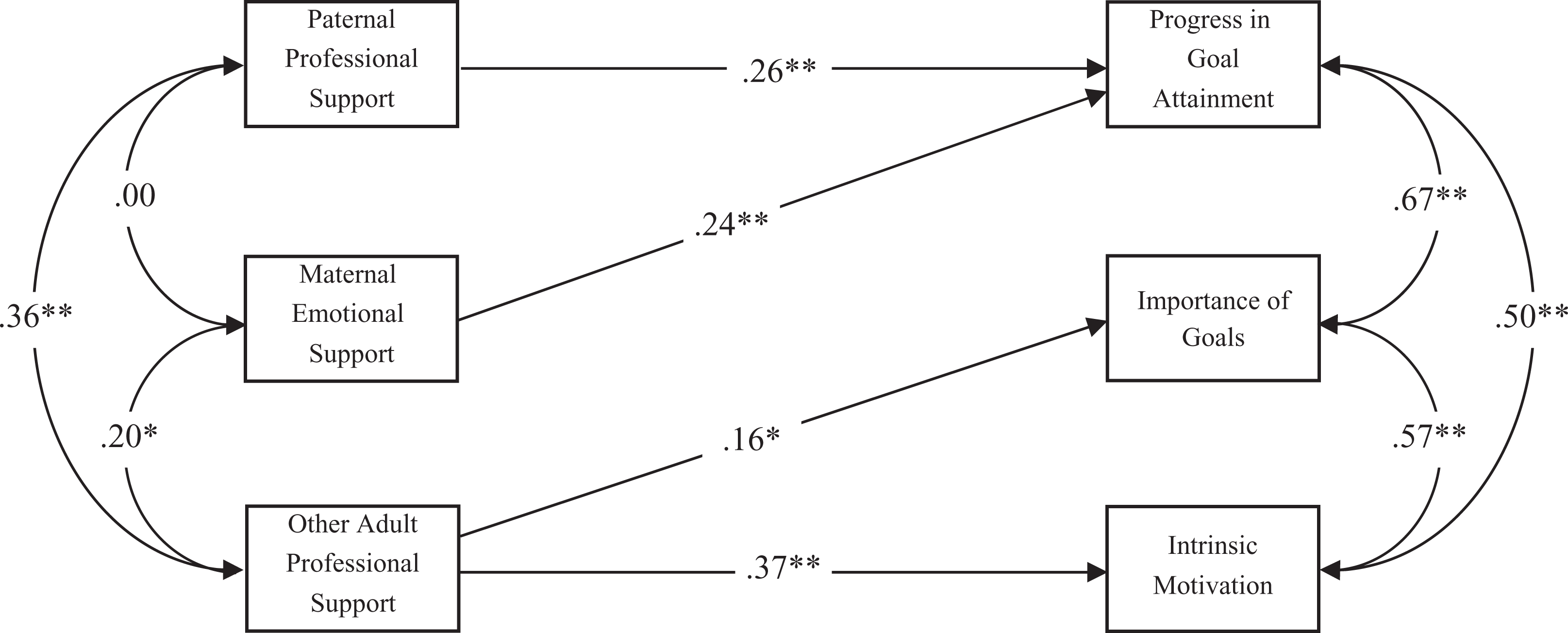
Associations between type of support and indices of occupational adequacy. N = 100. Standardized β weights are reported. *p < .05 and **p < .01, two-tailed.
Figure 3 presents concurrent associations between type of support and measures of well-being at T4, χ2 = 0.00, p = 1.00, CFI = 1.00, RMSEA = .00. Participants’ citations of professionally supportive relationships with other adults were negatively associated with anxiety (β = −.19), with depression (β = −.31), and with hostility (β = −.29). Mentorships with other adults corresponded with better measures of well-being. Professional and emotional support from either parent was not associated with any measures of well-being; therefore, both predictors were omitted from the model.
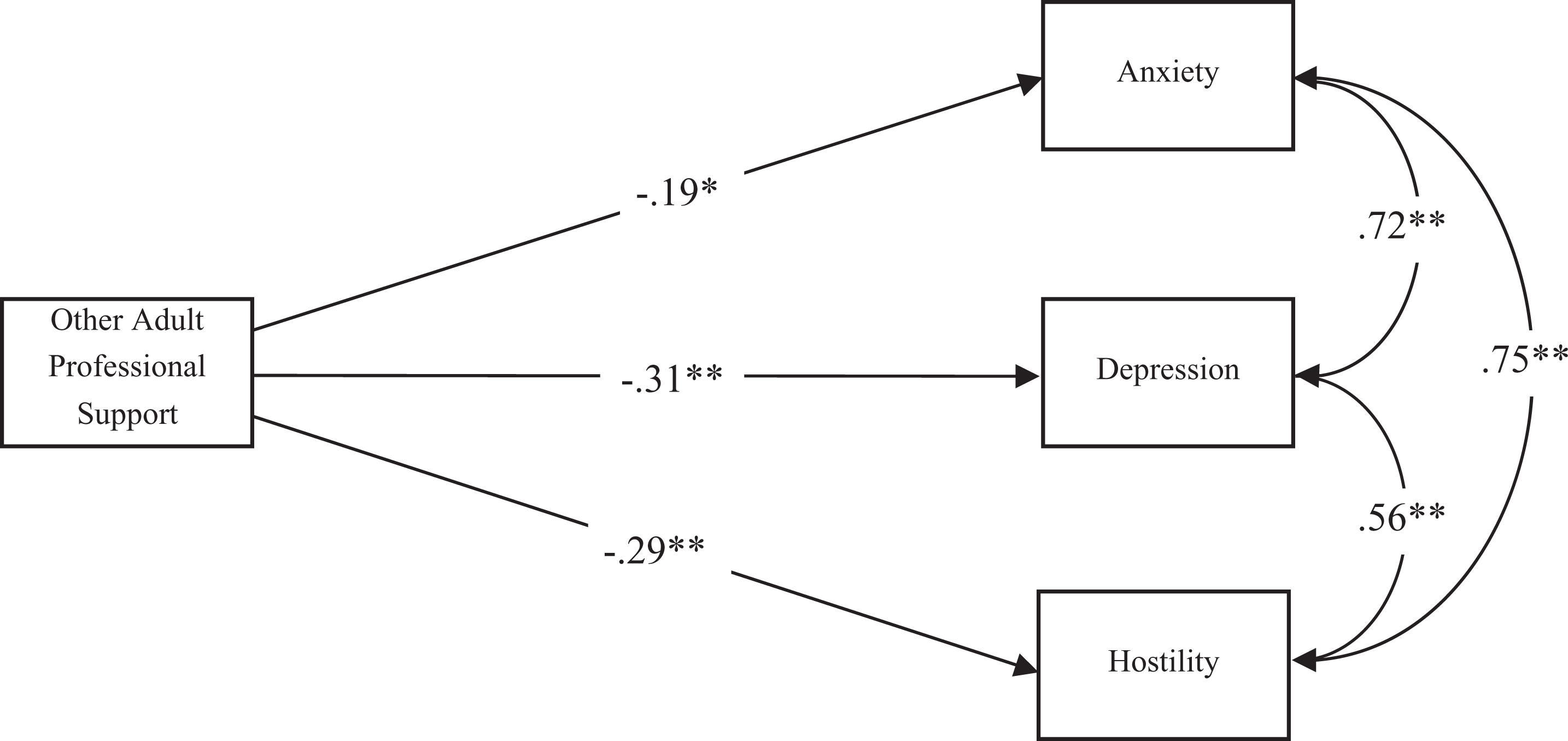
Associations between other adult professional support and well-being. N = 98. Standardized β weights are reported. *p < .05 and **p < .01, two-tailed.
Correlations between provision of career-related support by the different figures and occupational functioning and well-being were computed. Only two significant correlations were found. Romantic partner career-related professional support was associated with a higher likelihood of being employed in the recent 6 months, r = .18, p < .05, and was associated with a lower level of hostility symptoms, r = −.25, p < .05.
Discussion
Several features of the current findings are noteworthy. Allowing our respondents to name all individuals who provided career-related support revealed great diversity among those that contribute to the professional development of emerging adults and the type of support they provided. First, our findings indicate that young adults most frequently identified mothers and fathers as important figures who provided career-related emotional support or advice. In addition, young adults frequently identified nonfamily adults as important figures; however, these individuals mainly provided professional advice. The distinction between types of support provided by parents and nonparents should be noted as both likely serve different functions in young adults’ transition into a work environment. Parental help is not limited to emotional support, they can also pass on advice based on their experiences and expertise. In contrast, nonfamily figures are better able to provide critical institutional information and can facilitate forming connections with colleagues, although they are much less likely to provide emotional support than parents (Chen, Greenberger, Farruggia, Bush, & Dong, 2003; Kidd et al., 2004).
The frequent naming of both parents as emotionally supportive figures can also be attributed to the current status of young people in Western societies. Young people often change jobs or move into different fields of education over a number of years (Cohen et al., 2003). This transience may interfere with the identification of a nonfamily support figure or the establishment of a mentoring relationship in a single given workplace. In contrast, parents are probably among the more stable and available figures to whom a young person can turn to.
In addition to parents and nonfamily adults, respondents named romantic partners, friends, and nonparental family members as sources of support. About a third of our sample indicated that they relied upon romantic partners for help and advice. In contrast to romantic partners, friends and other family members such as siblings were the least mentioned as supportive figures. The diversity of these figures, as well as the relatively lower support attributed to them, probably characterizes normative changes in lives of young people (Phillips et al., 2001). These changes seem to represent young adults’ increased efforts to form workplace relationships and romantic relationships during this age (Caspi, 2002) and help explain why they were less likely to perceive friends and siblings as sources of support. In sum, asking young people to identify figures who previously provided career-related support reveals both a comprehensive picture of support networks and the kinds of support each figure provides.
Our findings tentatively illustrate that early family support paves the way for subsequent identification of supportive nonfamily figures at work and academic settings as proposed by our second hypothesis. Yet, our findings suggested different pathways of influence for maternal and paternal support. Participants’ reports of maternal support predicted maternal emotional and professional career-related support 7 years later. In addition, earlier maternal support predicted professional support of another adult 7 years later. In contrast, reports of paternal support predicted only later paternal career-related emotional support. It did not predict later paternal career-related professional support nor later professional support by a nonfamily adult.
Overall, associations across time were high, suggesting that relational patterns experienced within the family are consistent and carried forward into the domain of career-related support at a later stage of life (Higgins & Kram, 2001; Shulman & Collins, 1995). The fact that only earlier maternal emotional support predicted the provision of later career-related professional support needs further explanation. Past research showed that fathers are more likely than mothers to support age-appropriate development (Snarey, 1993) and occupational pursuits (Shulman & Seiffge-Krenke, 1997). It might be possible that fathers’ support is more conditional; they might be less willing to offer professional support to self-critical offspring. Indeed, self-criticism, a personality characteristic which impairs interpersonal relationships and the ability to handle a relationship (Vettese & Mongrain, 2000), predicted a lower likelihood of receiving career-related professional support from one’s father.
According to these data, identifying and naming a nonfamily adult as a provider of career-related professional support was predicted by both self-efficacy and maternal support measured 7 years earlier. This finding aligns the literature on the role of the protégée’s personality that is linked to development of mentoring relationships (Allen et al., 2004; Dobrow et al., 2012). Young people who are open to new experiences and who welcome new interactions, ideas, and information are more likely to develop support networks (Dougherty et al., 2008). In addition, young people look to mentors for expressions of care and concern they previously experienced in their family life (Liang & Rhodes, 2007). It may be the case that previous positive experiences between mothers and offspring likely facilitate a better understanding of social situations, and naturally encourages young adults to turn to, and appropriately engage with others, and ultimately establish mutually satisfying relationships (Dobrow et al., 2012).
Our third hypothesis that career-related support will be associated with greater occupational adequacy and psychological functioning was supported in general. The potential benefits of parental career-related support and naturally occurring workplace mentorships have been previously established. Strong family support tends to influence young people’s “career journey” by helping them to decide to enter college or pursue a particular occupation (Juntunen et al., 2001) and has been associated with higher levels of career commitment (Whiston & Keller, 2004). As suggested by the social cognitive career theory (Lent et al., 2002), the presence of available supportive figures seems to associate with greater sense of efficacy that facilitates one’s career pursuit.
Emerging from a developmental perspective, our findings build upon previously documented benefits of career-related support. Studies examining the role of career-related support on young adults’ postcollege occupational outcomes have been limited (McDonald et al., 2007; Whiston & Keller, 2004). The corpus of studies examining the role of support of a new worker in workplace settings assessed outcomes like salary, and promotion or satisfaction with the job (Allen et al., 2004), both of which may be irrelevant for young people transitioning between career paths. In the current study, by adopting the concept of phase adequate transition (Dietrich, Parker, & Salmela-Aro, 2012), we found evidence suggesting that career-related support was associated with assigning greater importance to age-related goals and making greater progress in attainment of aspired goals. In addition, career-related support was likely associated with greater intrinsic motivation. As argued above, considering the current economic uncertainties (Furlong & Cartmel, 2007), we posit that it is probably also important to be able to assign importance to what one does (Blustein, 2011).
To the best of our knowledge, no previous study examined the contribution of parental and nonparental career-support simultaneously. Our findings suggest that parental career-related support is associated with different occupational indices as compared to support provided by other adults. To our surprise, parental career-related support was only associated with greater progress in goal attainment. In contrast, career-related support provided by other adults seemed to be associated with assigning greater importance to goals and with reporting higher intrinsic motivation. In addition, greater nonparental support appeared to be associated with reporting fewer psychological symptoms. These findings seem to suggest that changes in the hierarchy of supportive figures occur across age (Laursen & Williams, 1997). As emerging adults grow older, nonfamily figures probably become important sources of support. Furthermore, a supportive relationship with an adult figure at a workplace is more likely to be associated with increased inner motivation indicative of finding meaning in one’s work (Blustein, 2011).
Limitations and Future Directions
Although the results provide a new understanding of the nature and quality of career-related support among emerging adults, the study has some limitations. The sample represents a particular group that aspired to obtain a college education and consisted mainly of young people from lower middle-class families. Although this is not an at-risk sample as found in much of the career-related support literature (McDonald et al., 2007), young adults from privileged backgrounds have access to more resources and may have more advantageous career-related support networks (Schoon, Ross, & Martin, 2009). Naturally, trimmed models are exploratory and this is one limitation of the current study. However, on the positive side, the significant models that emerged can be theoretically justified. Paternal and other adult professional support associated with occupational adequacy, while only maternal emotional support associated with occupational adequacy. This is in line with the documented distinction of maternal and paternal support provided during development (Shulman & Seiffge-Krenke, 1997). This study was conducted on young Israeli adults. As outlined previously, because Israel is a Western culture, when transitioning to adulthood, young Israelis face dilemmas and uncertainties not dissimilar from their counterparts in other Western cultures (Mayseless & Scharf, 2003). Yet, in comparison to most other Western cultures, Israelis tend to emphasize communal values and elevate the role of the family (Schwartz, 1994). As such, we do not know whether cultural emphasis on parents’ emotional support and professional advice will be similar in societies where the role of families is less asserted. In addition, young Israelis are subjected to a military service of 2 or 3 years. Army commanders might also be considered nonfamily adult mentors. Positive or negative experiences with commanders may influence young peoples’ attitudes toward nonfamily adults in the workplace. Future studies could indicate whether the pattern of our findings would be replicated in a different culture.
Conclusions and Implications
By examining the contribution of parental and nonparental career-related support simultaneously, the current study enabled a more comprehensive understanding of the diversity of important figures that young people name as providers of help and the interplay between them. In particular, our findings demonstrate that support provided by nonparental other adults plays a major role in occupational adequacy and well-being of emerging adults, thereby emphasizing the increasing importance of nonfamily support in the third decade of life. Over the last decade, societal and economic conditions have been unfavorable and have been characterized by a lack of supportive societal programs (Furlong & Cartmel, 2007). Therefore, it is important for communities to establish programs such as youth–adult partnerships (Camino, 2000) that can enhance interaction and communication between young people and nonfamily support figures in their communities or workplaces. It is also important to inform counselors and potential mentors that while efficacious young adults are capable to attract career-related support from nonfamily adults, there are individuals who tend more to deter others from helping them. These young adults might be at greater risk to navigate successfully during the transition to adulthood. Greater awareness to the needs of such individuals and learning how to approach them could be beneficial both for them and for a working place. In sum, our findings may hold informative value for nonfamily adults who wish to approach young people to establish a mentorship while recognizing and avoiding important difficulties.
Footnotes
Declaration of Conflicting Interests
The author(s) declared no potential conflicts of interest with respect to the research, authorship, and/or publication of this article.
Funding
The author(s) disclosed receipt of the following financial support for the research, authorship, and/or publication of this article: This study was supported by the Israeli Science Foundation (ISF), grant no. 1016/05 and the Ben Dov chair in youth psychology.