



Abstract
Support at work has been linked to a wide range of positive individual and organizational outcomes. However, research to date has overlooked its influence on career-related outcomes. Drawing on attachment theory, we examined the relationship between instrumental support and two aspects of subjective career success—job satisfaction and career satisfaction—and the mediating and moderating roles of relational attachment and personal support, respectively. Results from survey data collected from employees working in Poland provide support for our hypothesized relationships. The findings contribute to a richer understanding of how and when employee subjective career success is influenced by social support and positive relationships in work life. Our findings have theoretical implications for social support, positive workplace relationships, and career success literatures.
Keywords
Introduction
The pandemic of COVID-19 is presenting us with uncertain times, and the influence of this pandemic has already represented a career shock to many people (e.g., Akkermans et al., 2020; Rudolph and Zacher, 2020). Understanding people’s career success, especially during the COVID-19 pandemic, has become a significant area of interest for careers researchers (Gomes et al., 2021; Guan and Frenkel, 2019). Career success refers to subjective and objective indicators of progress and fulfillment in one’s work (Drewery et al., 2020). Objective career success refers to those indicators that are observable and tangible (e.g., salary or promotions), while subjective career success (SCS) refers to one’s own evaluation of his/her career progress and accomplishments such as career satisfaction, perceived employability, and perceived financial success (Bagdadli et al., 2021; Chen et al., 2021).
Recently, careers scholars (e.g., Blokker et al., 2019; Gordon, 2021; Montanari et al., 2021) have started advocating for and focusing more on the subjective indicators of career success rather than the objective indicators. This is mainly due to two reasons. First, objective indicators (e.g., promotions or hierarchical growth) are often not available to everyone in organizations. That is why subjective indicators such as how personally meaningful career are or how people perceive their own career success, have become more salient (Kundi et al., 2021b). Second, objective indicators are becoming less aligned with the landscape of contemporary organizations (i.e., organizations hierarchies have become flatter and the upward mobility within the organization has become less obtainable; Kundi et al., 2021b) and attitudes of contemporary employees (i.e., employees prefer to become more self-directed and flexible in managing their careers; Kundi et al., 2021c). Hence, it is important for the organizations to understand how their employees feel about their SCS and most importantly what affects it.
Social support at work is considered a highly important social job resource for individuals' personal growth and development (Kerksieck et al., 2019). Eisenberger et al. (2002) define social support at work as the degree to which individuals perceive that their wellbeing is valued by workplace sources, such as coworkers, supervisors, and the broader organization in which they work. Social support at work can take various forms, such as emotional support, collegial support, and task support (Harris et al., 2007). This study focuses on two sets of social support, namely, personal and instrumental support, because they are the widely used indicators of social support at work (see Kundi et al., 2021c; Mathieu et al., 2019). Instrumental support refers to tangible assistance (e.g., help or information received to complete a task) received by an individual at work, whereas personal support refers to non-work or personal assistance (e.g., help received to get back on track when one is having a bad day at work) received by an individual (Kahn, 2007). Previous researchers have argued that instrumental and personal support are conceptually independent and provide distinct resources (Mathieu et al., 2019). In contrast, other research indicates that these two variables (i.e., instrumental and personal support) are often strongly correlated (Ehrhardt and Ragins, 2019) and can be interpreted by an employee as providing the same resources (Nabi, 2001).
Though previous research has documented that instrumental support received in the workplace has positive and significant effects on employee career success (e.g., Karatepe and Olugbade2017), this research comprises a small number of studies demonstrating the positive effects of instrumental support on OCS (e.g., salary and promotions). In contrast, studies on the effects of instrumental support on SCS (e.g., career satisfaction and job satisfaction) have attracted very little attention from the scholarly community. Furthermore, little is known about the underlying mechanisms that explain how instrumental support relates to employee career success, which warrants further examination (Ehrhardt and Ragins, 2019). Such research considerations are needed to advance the emerging social support literature. They would provide both scholars and practitioners with an understanding of the importance of social support for employees' careers and career development during uncertain times like the COVID-19 pandemic (Rudolph and Zacher, 2020).
Accordingly, in the present research, we use attachment theory (Bowlby, 1988; Hazan & Shaver, 1987) to conceptualize the mechanism linking instrumental support to employees' SCS in terms of job satisfaction and career satisfaction. People form attachments with others at work which provide them with essential social support functions in times of need or stress (Florian et al., 1995), which, in turn, leads to greater SCS (Kundi et al., 2021c). We argue that instrumental support as an interpersonal process that involves the mutual influence of support seekers and caregivers will foster employees' relational attachment (defined as “the cumulative experience of feeling connected, attached and close to others at work”; Kahn, 2007). In turn, such feelings of belongingness with others at work will contribute to higher SCS.
The present study contributes to social support, workplace relationships, and careers literature in the following ways. First, we extend an understanding of the implications of instrumental support for employees' career outcomes or success (Kundi et al., 2021c; Murphy & Ensher, 2001). In particular, we examine how instrumental support fosters employee subjective career success in terms of career satisfaction and job satisfaction. We do this by examining the mediating role of relational attachment between instrumental support and employee subjective career success. By doing so, we offer more insights into the underlying mechanism through which instrumental influences employee career satisfaction and job satisfaction.
Second, we respond to the recent calls by researchers (e.g., Ehrhardt & Ragins, 2019; Spurk et al., 2019) to study the role of positive relationships at work on employee career-related needs/outcomes. Therefore, this research emphasizes the role of relational attachment in facilitating employees in their SCS in the form of achieving greater job satisfaction and career satisfaction. When employees experience feelings of closeness, attachment, and connection to others at work, the long-term consequences are likely to be greater satisfaction with ones' job or/and career (Kundi et al., 2021c).
Third, this study fills an important gap in the social support literature by investigating the moderating role of personal support on the instrumental support−SCS relationship. Research demonstrates that personal support plays a contingent role in determining employees' attitudes and behaviors toward others (Kahn, 2007; Kellner et al., 2019). Because employees with high personal support are generally close and attached to others at work (Feeney and Collins, 2019), we theorize that compared to employees with low personal support, employees with high personal support will be more attached to others at work, which subsequently increases their level of SCS. We also answer the call to identify more variables that moderate the relation between instrumental support and its outcomes (Kundi et al., 2021c).
Finally, this research may contribute to the development of attachment theory by framing and empirically testing the associations between instrumental support, personal support, relational attachment, and SCS Figure 1.
Theoretical Background and Hypotheses
Workplace relations play a vital role in an organization’s success because positive workplace relations benefit organizations not only in times of difficulty but also at any time when employees experience a threat to their resources, such as diminished job security in times of economic downturn (Toker et al., 2015). It has been recognized by the organizational scientist that “people make the place” (Schneider, 1987). The relationships in an organization provide the foundations for attachment (Chiaburu & Harrison, 2008). According to Bowlby (1988), attachments refer to individuals' close and emotional associations with others that can be either secure or insecure depending upon the quality of association they are having. Attachment theory (Ainsworth et al., 1978; Bowlby, 1988) is a general theory of social and emotional development that describes individuals' relationships, how they experience these relationships, and plausible attitudinal or/and behavioral outcomes of these relationships.
Attachment theory conceptualizes a systematic pattern of relational expectations, emotions, and behavior (Campbell & Stanton, 2019). This pattern arises from individuals' attachment experiences which shape their attitudes or/and interactions with others, ultimately leading to greater psychological well-being (Fraley & Shaver, 2000; Mikulincer & Shaver, 2005). This theory also suggests that individuals form attachments with others, providing them with the social support they need in times of difficulty. Individuals also develop an emotional attachment to their caregiver(s) and use such attachment experiences as references for future relationships (Hazan & Shaver, 1987). The attachment behavior that results from these internal working models is conceptualized as avoidance and anxiety (Brennan et al., 1998). The avoidance represents the degree of comfort with interpersonal closeness, whereas anxiety refers to the fear of interpersonal rejection (Lopez, 2003). These internal working models influence almost all areas of a person’s life, including his career development (Blustein et al., 1995; Hazan & Shaver, 1990).
Although attachment theory appears to be focused on an individual, it explores the process of building and enhancing the relationships in an organization (Mikulincer & Shaver, 2005). In addition to that, attachment theory offers an integrated model that deals with the cognitive, affective, and cognitive aspects of interpersonal relationships. Hence, based on attachment theory, we argue that individuals who receive care or support from others at work are more likely to experience belongingness and closeness to others (i.e., relational attachment), ultimately leading to greater subjective career success in the form of job satisfaction and career satisfaction.
The Indirect Relationship Between Instrumental Support and SCS
Careers have become unpredictable and unstable because they become more boundaryless and self-directed (Kundi et al., 2020). Therefore, SCS is drawing more scholarly attention. However, SCS does not happen in a vacuum (Tlaiss & Dirani, 2015); instead, it is supported by individuals’ environment and social ties (Ng & Feldman, 2014). According to Ocampo et al. (2018), employees need two types of social support to succeed in their careers. First, social support that an individual receives from the workplace environment, including task-related support (i.e., instrumental support), organizational support, and support received from immediate supervisors. Second, social support that an individual receives from a non-work environment, including personal support, family support, and spousal support.
Instrumental support refers to support received by coworkers or supervisors in the job or task-related problems (Kahn, 2007). Recent evidence suggests that the amount of task-related support employees feel they have received from others at the workplace may help them to direct their attitudes and behaviors concerning their careers ( Karatepe and Olugbade, 2017). Several researchers (e.g., Cai et al., 2018; Kundi et al., 2021c) have reported that when employees receive instrumental support from their coworkers and supervisors in addition to their self-regulation strengths or capacities, they can better focus on their career goals and navigate their career success. Similarly, supportive resources received by individuals at work enable them to invest these resources to gain additional resources or preventing future resource loss (Jung & Takeuchi, 2018), which, in turn, foster individuals' SCS (Santos, 2016).
Instrumental support is an important job resource enabling employees to successfully navigate their careers (Di Fabio and Kenny, 2015). For example, Karatepe and Olugbade (2017) found that social support in the form of instrumental support helps individuals in their career development and promotes behaviors that facilitate employees in achieving career-related goals and success. Although there is evidence that instrumental support received at work facilitates individuals in their career goals and success (Mathieu et al., 2019), very little is known about mechanisms by which instrumental support promotes employee SCS, especially job satisfaction and career satisfaction.
Accordingly, drawing on attachment theory, we argue that employees receiving instrumental support at work will be more strongly connected, related, and attached to others at work (i.e., relational attachment), which, in turn, will lead to greater SCS in the form of career satisfaction and job satisfaction. In other words, we suggest that relational attachment will mediate the relationship of instrumental support and SCS (job satisfaction and career satisfaction) because employees who receive task-related help or assistance are more attached, connected, and close to others at work (Kundi et al., 2021c), which, in turn, trigger positive psychological state such as relaxation, happiness, and satisfaction ( Dutton and Ragins, 2007). Hence, we expect the following:
Relational attachment mediates the effects of instrumental support on SCS in terms of (a) career satisfaction and (b) job satisfaction.
The Moderating Role of Personal Support
Kahn (2007) defines personal support as the support from coworkers or supervisors in non-work or personal-related problems. Researchers have argued that personal support at work is crucial for individuals' overall performance and productivity (Nazir et al., 2019). In fact, existing studies have reported the positive outcomes of personal support received at work, including greater employee engagement, job satisfaction, and positive workplace relationships (Harris et al., 2007; Madden et al., 2015). Therefore, it is not surprising that personal support received at work has been studied extensively in the literature. However, a gap in the workplace relationships research is the extent research has predominately focused on the main effects of various predictors on employee relational attachment and neglected potential moderating processes. Although there is only one empirical study on instrumental support-relational attachment relationship (see Kundi et al., 2021c), the extent to which other variables moderate these relationships has not been well understood. Hence, this study seeks to illuminate these relationships by investigating the moderating influence of personal support.
We focus on the instrumental support received at work for two reasons. First, the notions of instrumental support received at work have been widely researched for decades (Mathieu et al., 2019), but their interaction effects with personal support remain largely unexplored. Second, previous studies have consistently shown the beneficial effects of the instrumental support on work outcomes (Karatepe and Olugbade, 2017; Öztemel and Yıldız-Akyol, 2021), whereas research on the impacts of instrumental support and personal support on work outcomes has produced inconsistent findings and weak predictive power (Colbert et al., 2016; Ehrhardt and Ragins, 2019). Thus, in the current research, we attempt to examine whether personal support moderates the effects of instrumental support on employee relational attachment.
Attachment theory provides an ideal framework to understand how personal support influences individual’s workplace relations and subsequent career development. Attachment theory maintains that people feel safe and secure through contact with nurturing caregivers (i.e., the ones who provide support). The theory also maintains that people get attached to others strongly when they receive support in personal matters, especially when distressed, which makes them feel secure and protected (Feeney & Collins, 2019). Researchers (e.g., Caillier, 2017; Jolly et al., 2021) have also highlighted the value that the personal support at work has in fostering individuals’ personal relationships in the workplace. Hence, we anticipate that individuals who receive personal support (e.g., care and comfort, referral, and interpersonal help) will be more likely to attach to others at work. That is because personal support fulfills individuals’ safety needs, reduces feelings of desolation, and strengthens the feeling of social belongingness (Feeney & Collins, 2019). We therefore expect the relationship between instrumental support and relational attachment to be more positive for employees with high levels of personal support.
Personal support will moderate the relation between instrumental support and relational attachment such that the relation between instrumental support and relational attachment will be stronger (weaker) for those who receive high (low) personal support. Thus far, we have explained how instrumental support received at work leads to greater SCS via employee relational attachment and proposed the moderating role of personal support received at work on the instrumental support and relational attachment relationship. Taking these together, we further propose the moderating role of personal support received at work on the indirect crossover relationship of instrumental support received at work and employee SCS via employee relational attachment (i.e., moderated mediation model). In the context of high-personal support, there is a stronger indirect effect of instrumental support on employee SCS. We expect that the personal support received at work as a moderator will impact the indirect crossover of instrumental support on SCS through employee relational attachment. Accordingly, we hypothesize:
The indirect effects of instrumental support on employee SCS in terms of (a) career satisfaction and (b) job satisfaction via relational attachment will be moderated by personal support, such that the mediated relationship will be stronger (weaker) when personal support is high (low).
Method
Sample and Procedure
The data for the current research were collected in three waves over 2 months with a time lag of 3 weeks between the collection of waves. We collected the data from employees working in multiple sectors located in Poland. The sectors included banking, consulting, electronics, and manufacturing. Approval from company managers was taken to recruit/access the participants. The research assistants disseminated the questionnaire among the participants on-site during the working hours for all three waves of data collection. The participants were informed about the purpose and multi-wave nature of the study, confidentiality, and anonymity of their responses. They were also advised that there are no right or wrong answers to the questions so that they answer them as honestly as possible (Kundi and Badar, 2021).
At Time 1, we asked participants to report their demographic information and instrumental and personal support received at work. At Time 2 (3 weeks after Time 1), participants reported their relational attachment with others at work. At Time 3 (3 weeks after the Time 2), the participants reported SCS in terms of career satisfaction. Of 572 employees participated in the study voluntarily, 441 individuals completed the Time 1 survey (77% response rate), 389 individuals completed the Time 2 survey (88% retention rate), and 374 individuals completed the Time 3 survey (96% retention rate). Moreover, 65% of respondents who completed the Time 1 survey completed all three waves. The attrition analysis for the longitudinal sample Time 1–Time 3 revealed that no systematic attrition emerged in relation to age, gender, education, and organizational tenure compared with those who participated in the study only at Time 1 (N = 183).
Of the N = 374 participants, 59.7% were men with an average age of 32.46 years (SD = 7.86), and average organizational tenure of 6.54 years (SD = 4.33). Regarding employees' education, 38.5% had a bachelor’s degree or below, and 61.5% had a master’s degree. Moreover, around 35.3% were working in managerial positions.
Measures
All measures were administered in English. Unless indicated otherwise, all measures were rated on a 5-point Likert scale ranging from 1, “strongly disagree,” to 5, “strongly agree.”
Instrumental Support
To measure instrumental support received at work we adopted Ehrhardt and Ragins’s (2019) four-item scale. A sample item is “To what degree do others at work offer you advice that helps you do your job.” Items were rated on a 5-point scale ranging from 1, “to a small extent,” to 5, “to a greater extent.” The Cronbach’s alpha for this scale was 0.88.
Personal Support
Personal support received at work was measured using a four-item scale (Ehrhardt & Ragins, 2019). A sample item is “to what degree do others at work offer to listen to a problem you may be having.” Items were rated on a 5-point scale ranging from 1, “to a small extent,” to 5, “to a greater extent.” The Cronbach’s alpha for this scale was 0.90.
Relational Attachment
Employees' relational attachment with others at work was measured with Ehrhardt and Ragins’s (2019) six-item scale. Sample items are “When thinking about my relationships with others at work, I feel a close bond with” and “When thinking about my relationships with others at work, I feel attached to them.” The Cronbach’s alpha for this scale was 0.83.
Subjective Career Success
Two different indicators were applied to reflect SCS, namely, job satisfaction and career satisfaction broadly. We assessed job satisfaction using three items from the Michigan Organizational Assessment Questionnaire (Cammann et al., 1983). The sample item is “I am satisfied with my job.” The Cronbach’s alpha for this scale was 0.87. The career satisfaction was assessed with the five-item scale (Greenhaus et al., 1990). A sample item is “I am satisfied with the progress I have made towards meeting my overall career goals.” The Cronbach’s alpha for this scale was 0.91.
Covariates
Prior research has consistently related age, gender, and organizational tenure to SCS (e.g., Kundi et al., 2020, 2021a). Therefore, we controlled these variables to make sure that our findings hold irrespective of these individual attribute variables.
Analytical Strategy
We conducted structural equation modeling (SEM) in Mplus (version 7.3; Muthén & Muthén, 2010) to test our hypothesized relationships. Following prior studies (e.g., De Clercq et al., 2021; Kundi et al., 2020), we first evaluated measurement models prior testing the hypothesized structural model. Measurement models were evaluated via confirmatory factor analysis (CFA) to test whether the hypothesized latent variables (with original items) were separate constructs. Following Hu and Bentler (1999), we evaluated the fits for the CFA and SEM models using three fit indices, namely, comparative fit index (CFI), root mean square error of approximation (RMSEA), and standardized root mean square residual (SRMR). The cutoff values for these fit indices were 0.95, 0.06, and 0.08, respectively.
All statistical analyses were run using maximum likelihood robust estimation in Mplus. Mean-centered values of predictor (i.e., instrumental support and relational attachment) and moderator variables (i.e., personal support) were used. The confidence intervals for the indirect and moderated mediation effects were calculated using the bootstrap re-sampling technique with 1000 iterations. The indirect paths were specified using the MODEL CONSTRAINT function of Mplus. For the moderation and moderation mediation results, we assessed the statistical mean difference in relational attachment levels for low and high instrumental support between high or low personal support (cf. Cui & Zhang, 2021). The conditional indirect effects were tested using the approach recommended by Preacher et al. (2006).
Results
Descriptive Statistics and Intercorrelation Coefficients.
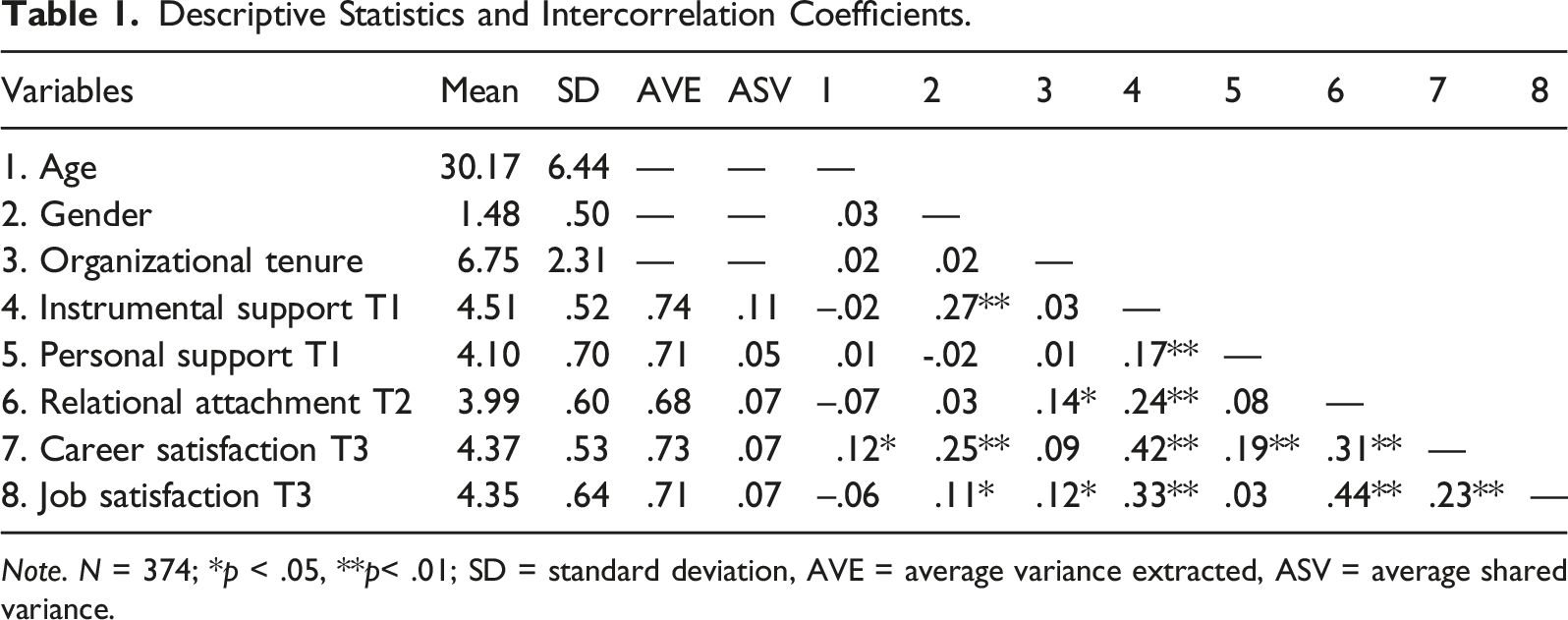
Note. N = 374; *p < .05, **p< .01; SD = standard deviation, AVE = average variance extracted, ASV = average shared variance.
Confirmatory Factor Analysis
Results of Confirmatory Factor Analysis.

Note. *p < .05, **p < .01; IS = instrumental support, PS = personal support, CS = career satisfaction, JS = job satisfaction.
Common Method Variance
Statistically, we employed the marker variable technique as Lindell and Whitney (2001) recommended to test the common method bias problem. We used “sexual frustration” as a marker variable because it was theoretically unrelated to our study variables. Following Kundi et al., 2021a, we compared a model (wherein the items of study variables were loaded onto the latent marker) with another model (wherein the items were not loaded onto the marker variable). The chi-square difference test between the two models was non-significant (Δχ2 Research Model. T = Time.
Hypotheses Testing
Figure 2 demonstrates the results of structural equation model. As seen in Figure 2, instrumental support is positively and significantly related to relational attachment (γ = .399, SE = .068, p = .000), career satisfaction (γ = .244, SE = .078, p = .002), and job satisfaction (γ = .325, SE = .067, p = .000). Hypothesis 1 proposed that relational attachment mediates the relationship between instrumental support and SCS in the form of (a) career satisfaction and (b) job satisfaction. To test the indirect effects, we estimated the overall indirect relationships between instrumental support and SCS (career satisfaction and job satisfaction) via employee relational attachment using 1000 bootstrap replications to obtain the 95% CIs for the indirect effects. Results showed that the indirect effect between instrumental support, relational attachment, and SCS was significant (for career satisfaction: estimate = .097, 95% CI: .044, .119; for job satisfaction: estimate = .122, 95% CI: .108, .211), lending support for Hypothesis 1a and 1b. Results of Structural Model. Standard Errors are Reported in Parentheses. Dotted Lines Represent Non-Hypothesized Relationships. T = time.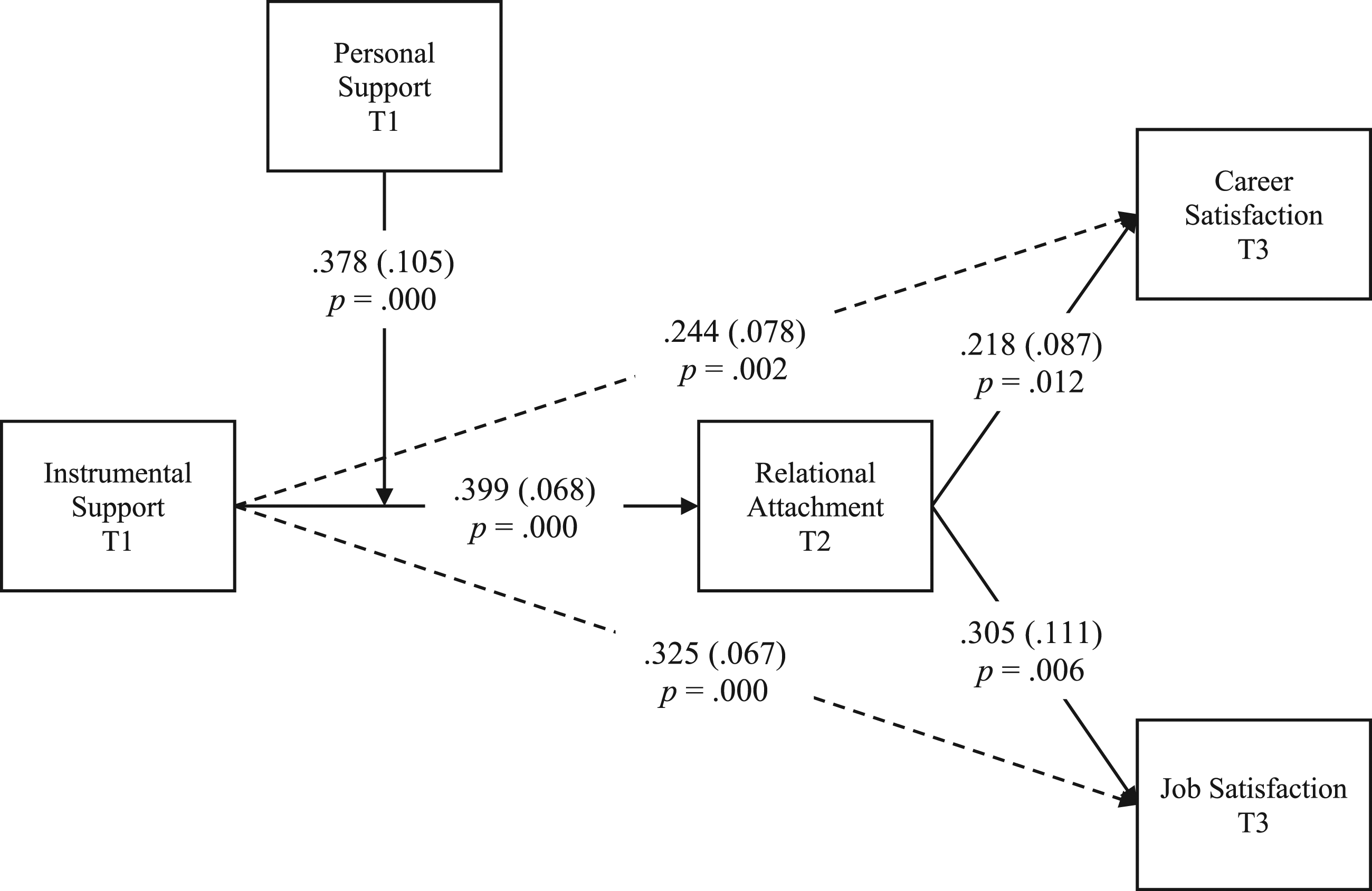
In Hypothesis 2, we proposed a moderating effect of personal support in the relationship between instrumental support and employee relational attachment, such that the relationship is positive and strong when personal support is high than when it is low. As can be seen in Figure 2, the interaction term between instrumental support and personal support was significantly related to employee relational attachment (γ = .378, SE = .105, p = .000), providing initial support for Hypothesis 2. Following the guidelines of Dawson (2014), we plotted this moderation (interaction) at 1 SD above and below the mean of personal support. As shown in Figure 3, instrumental support had a stronger positive relationship with employee relational attachment under higher (γ = .417, SE = .122, p = .000) as compared with lower (γ = .318, SE = .114, p = .000) levels of personal support. Hence, our results fully supported Hypothesis 4. Simple slopes of instrumental support on relational attachment at levels of personal support.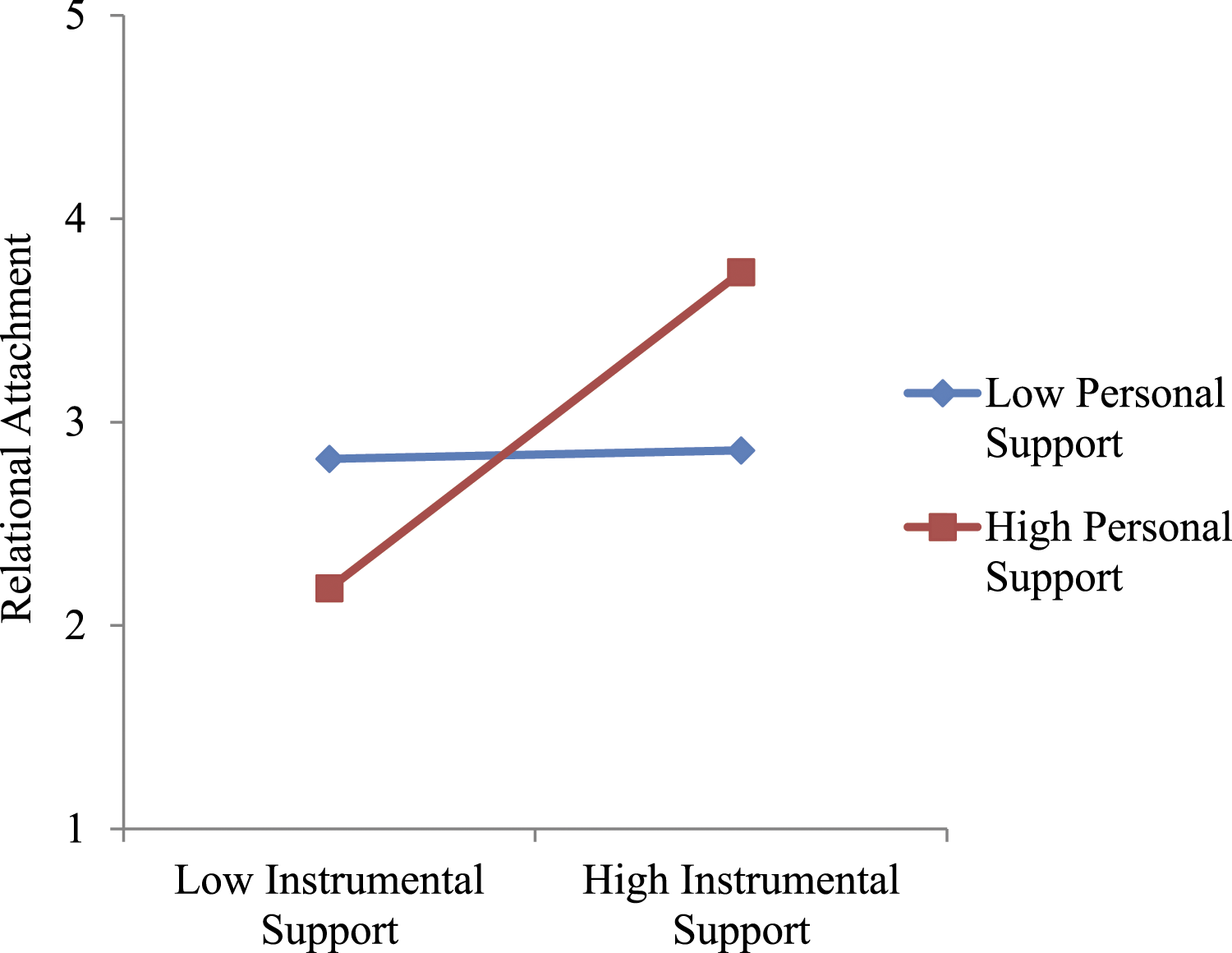
In light of the mediating and moderating results, we proceeded to test the moderated mediation effects (Hypothesis 3). In Hypothesis 3, we predicted that the indirect effect of instrumental support on SCS (career satisfaction and job satisfaction) via relational attachment would be moderated by personal support. Our results demonstrated that when personal support was high, the positive indirect effect of instrumental support on career satisfaction via relational attachment was stronger (estimate = .13, 95% CI: .014, .198) as compared to when it was low (estimate = .06, 95% CI: .012, .159). The difference in the indirect effect was also significant (Δβ = .07, SE = .03, 95% CI = .002, .039); thus, providing support to Hypothesis 3a. Similarly, our results revealed that when personal support was high, the indirect effect of instrumental support on job satisfaction via relational attachment was positive and stronger (estimate = .17, 95% CI: .036, .266) as compared to when it was low (estimate = .11, 95% CI: .020, .143). The difference in the indirect effect was also significant (Δβ = .06, SE = .02, 95% CI = .016, .123), which provided support to Hypothesis 3b.
Supplemental Analysis
Our research model indicates a first-stage moderation model where personal support moderates the first path in the mediation (between instrumental support and relational attachment). To explore the possibility of a second-stage moderated mediation, we run a model where personal support was considered as a moderator in the relationship between relational attachment and SCS (both career and job satisfaction). Results show that the interaction term relational attachment personal support was a non-significant predictor for both career (γ = .007, p = .911) and job satisfaction (γ = .024, p = .772).
Discussion
Through the lens of attachment theory, we developed and tested a moderated mediation model of how instrumental support to SCS in terms of careers satisfaction and job satisfaction through relational-based mediator and moderator. Specifically, we expected personal support to strengthen the instrumental support-relational attachment relationship and the instrumental support- SCS relationship. Across our study sample, our findings supported the hypothesized relationships. We identified the relational processes that help us better understand why instrumental support is beneficial for one’s SCS. In addition, we found that personal support significantly enhanced the relationship between instrumental support and our intervening variable and the indirect effects of instrumental support on SCS via relational attachment.
Theoretical Implications
First, this study examines the mediating role of relational attachment, which offers more insights into the underlying mechanism through which instrumental support influences employee SCS in the form of career satisfaction and job satisfaction. This highlights the important role of positive relations with others at work in understanding how instrumental support promotes employee SCS. In particular, individuals who receive instrumental support at work are more likely to experience feelings of connectedness, attachment, and closeness to others at work, affecting their attitudes and positive psychological states (Ehrhardt & Ragins, 2019), perhaps ultimately leading to greater job and career satisfaction. This finding helps to open up the black box between the “instrumental support-employee SCS” linkage and deepen the understanding of how instrumental support affects employees' SCS.
Second, we respond to the call for additional studies on the consequences of relational attachment on employee career-related outcomes (Ehrhardt and Ragins, 2019; Spurk et al., 2019). We found that when employees are closer, attached, and connected to others at work (i.e., relational attachment), they are more likely to experience higher satisfaction levels with their jobs and careers. This is consistent with prior research that argued that positive relationships at work are central to individual satisfaction and well-being ( Dutton & Ragins, 2007; Roffey, 2016). In addition, employees are likely to experience positive emotions when they are close and attached to others at work (Langley, 2012). According to Kundi et al., 2021c, employees are more likely to be committed and satisfied in their careers when they are emotionally attached and connected with others at work.
Third, our research examines personal support as a boundary condition underlying the effect of instrumental support on employee relational attachment. We found that personal support tends to augment the positive impact of instrumental support on relational attachment. In accordance with our hypotheses, we found that the positive relationship between instrumental support and employee relational attachment was stronger for those high (rather than low) in personal support. As it can be observed in Figure 3, employees with high personal support were more attached to others at work when they were having high levels of instrumental support besides the personal support, we should note that the employees with high personal support were found to be less attached to others at work when they were having low levels of instrumental support. These findings suggest that personal support can have positive consequences on employee relational attachment when combined with the instrumental support. In a recent study by Kundi et al., 2021c, in which they examined the effects of instrumental and personal support on employee relational attachment and found non-significant direct effects of personal support on employee relational attachment. In light of their findings, it can be argued that personal support alone might not foster employee relational attachment; however, when combined with instrumental support, it might yield positive outcomes.
Furthermore, the moderated mediation framework contributes to our understanding of how the effects of instrumental support on SCS via relational attachment are conditional on personal support. Our results suggest that the interaction effect of instrumental support and personal support on relational attachment can be further extended to SCS in terms of greater job and career satisfaction. As per our findings, instrumental support is more likely to increase employees’ levels of satisfaction in their jobs and careers via fostering their relational attachment when they have more personal support at work.
Practical Implications
We have seen that high-instrumental support fosters employees' subjective career success through relational attachment. This suggests that to promote employee satisfaction with his/her job and careers, organizations should not only rely on career development policies and practices inside the workplace but also provide tangible assistance, such as money, information, and assistance with work. Organizations should create a supportive work environment in the workplace to encourage employees to help or assist others in their work-related matters, especially in times of difficulty. This could be done by including norms of constructive and appreciating feedback among employees instead of overly criticizing each other (Montoya-Weiss et al., 2001). In addition, leisure activities that include employees and their coworkers and supervisors are likely to encourage more personal and work-related knowledge sharing that will support learning, coordination, motivation, and employees will be better able to understand and assist others in difficult situations (Guan & Frenkel, 2019; Sarin and McDermott, 2003).
Since relational attachment mediated the relationship between instrumental support and SCS, organizations need to ensure a positive working climate that fosters workplace relationships in which employees can give and get resources from each other. This could be achieved by implementing reward structures that promote collaboration and cohesiveness among employees or by providing a platform where they could share information and positive emotions with each other, benefiting individuals as well as organizations for which they work. Hence, when organizations support workplace relationships, it will not only enhance employees' levels of satisfaction with their jobs and careers but may also benefit organization via lowered turnover and reduced health care costs (Colbert et al., 2016).
Finally, regarding the moderating role of personal support, organizations should facilitate employees by not only providing task-related support (i.e., instrumental) but also personal-related support because it creates the conditions in which instrumental support can foster relational attachment, thereby leading employees to experience greater SCS. Hence, organizations should ensure a strong collegial climate where employees can share and get feedback on personal-related challenges or problems they face in their lives. Such a climate can be achieved through careful selection and placement of people in teams/departments, encouraging employees to form help-based relationships, raising awareness of the importance of turning to colleagues for help during stressful times, and providing training regarding how and when to provide personal assistance to others at work since interfering too much in one’s personal life could yield adverse outcomes (e.g., see Ehrhardt and Ragins, 2019).
Limitations and Future Research
Our study has several limitations that provide opportunities for future research. First, we collected multi-wave data with a time lag of 3 weeks between each interval. However, the relational attachment may be an outcome of SCS. For example, it could be possible that employees who are more satisfied in their jobs or careers are more attached to others at work; the exact relationship can only be established using a longitudinal design. Second, we relied on only employees' scores for assessing instrumental support received at work. In the future, it would be desirable for researchers to collect multi-source data especially collecting supervisory ratings for instrumental support received at work; in effect, triangulating the research results. Third, we measured SCS with job satisfaction and career satisfaction. Hence, future researchers should also consider measuring SCS with other indicators such as perceived financial success, personal growth and development, employability, and work–life balance (Kundi et al., 2021b; Spurk et al., 2019). Fourth, our focus on personal support as a moderator only serves as a starting point to understand the boundary conditions underlying the effects of instrumental support. Many personal and situational factors might come into play to determine this relationship (Kundi et al., 2021c). Therefore, it would be interesting to investigate the moderating roles of personality, organizational climate, and positive/negative leadership traits on the effects of instrumental support. Fifth, we collected data from only Polish employees that limits the generalizability of our findings. Therefore, future researchers should test the proposed relationships in other cultures/countries. Sixth and finally, majority of our sample was highly educated, which may have led to atypical findings. Therefore, the results of our study may only apply to an educated sample and should be tested and replicated across general working population.
Footnotes
Declaration of Conflicting Interests
The author(s) declared no potential conflicts of interest with respect to the research, authorship, and/or publication of this article.
Funding
The author(s) received no financial support for the research, authorship, and/or publication of this article.
