




Abstract
We test two models in which Latina/o students’ school connectedness partially mediates the relationship between barriers (discrimination experiences at school and other educational barriers, respectively) and thoughts of dropping out of high school. Results of a moderated mediator analyses in a sample of 896 Latina/o high school students were consistent with hypotheses. Latina/o students who reported greater frequency of discrimination experiences and those who reported greater frequency of other barriers that affect how they are doing in school were more likely to have thoughts of dropping out, and these relationships were attenuated by school connectedness. A hierarchical regression indicated that discrimination experiences, other educational barriers, and school connectedness each contributed unique variance to thoughts of dropping out. Findings highlight the salience of efforts to reduce discrimination in schools and enhance school connectedness as a potential protective factor for Latina/o youth. Implications for dropout prevention are discussed.
Young adults without a high school diploma or its equivalent have considerably higher unemployment rates and are less likely to be working full time than their counterparts with high school diplomas or college degrees (National Center for Education Statistics [NCES], 2015; U.S. Bureau of Labor Statistics, 2013). In 2013, the median earnings for U.S. young adults without a high school credential were US$23,900, compared to US$30,000 for those with a high school degree, and US$48,500 for those with a bachelor’s degree (NCES, 2015). Earning a high school degree is also positively associated with a variety of overall health indicators (e.g., smoking, exercise) and job satisfaction (Baum, Ma, & Payea, 2013; Oreopoulos & Salvanes, 2011). Thus, reducing high school dropout and raising educational attainment yields significant benefits to individuals, families, and communities.
High school dropout rates declined from 28% in 2000 to 14% in 2011 among U.S. Latina/os aged 16–24; however, Latina/o youth still drop out significantly more often than White (5%) and African American (7%) youth (Fry & Taylor, 2013). The adjusted 4-year cohort graduation rate for Latina/o students in public high schools was 76%, and for White students 87%, in 2013–2014 (U.S. Department of Education, 2015). Efforts to reduce dropout and increase educational attainment among Latina/o youth require continued attention.
Dropping out is a process rather than an event and the result of a dynamic interaction between individual characteristics, risk factors, and contextual factors (Rumberger & Rotermund, 2012). A mixed-method study combining 30 focus group interviews with survey data from nearly 3,000 U.S. youth who had dropped out (America’s Promise Alliance, 2014) yielded four themes: No single factor accounted for leaving school; youth who left school were likely to be experiencing toxic home, school, or community environments; many youth demonstrated resilience, but not enough to lead to long-term positive development; and connectedness to others was a powerful influence, serving as both a risk and protective factor.
In this study, we focus on Latina/o high school students’ school connectedness as a protective factor against dropout. Specifically, we test school connectedness as a potential mediator of risk factors commonly experienced by Latina/o youth. We selected discrimination experiences at school and a set of other barriers that can affect students in school (e.g., financial, teacher support, and sociocultural barriers), as the two proximal contextual risk factors, with thoughts of dropping out serving as the outcome variable. The study is framed within social cognitive career theory (SCCT; Lent, Brown, & Hackett, 1994, 2000). First, we describe findings on discrimination experiences among Latina/o youth.
Discrimination Experiences
Discrimination experiences are reported by many Latina/o adolescents (Araujo & Borrell, 2006; Pascoe & Richman, 2009; Umaña-Taylor & Updegraff, 2007). Experiences of discrimination include being treated as inferior to and different from others on the basis of ethnocultural or other group membership as well as being subjected to racist, sexist, stereotypical, or ignorant comments or actions. For example, Latina/o youth report experiencing discrimination from teachers and peers, including being ridiculed and made to feel as though they were second-class citizens compared to their White peers (Córdova & Cervantes, 2010). A 2007 survey of U.S. Latina/os found that 41% reported they or someone close to them had personal experiences with discrimination due to race or ethnicity within the past 5 years and 64% believed that discrimination is a major problem in schools in the United States (Pew Research Center, 2007). A more recent 2016 Pew Center survey found that 52% of U.S. Latina/os reported experiencing discrimination based on their race or ethnicity (Krogstad & López, 2016).
Experiences of discrimination have several well-documented adverse consequences. One meta-analysis concluded that Latina/os experiencing more discrimination have higher rates of anxiety, depression, psychological distress, and job dissatisfaction and underperformance (Lee & Ahn, 2012). A longitudinal study found that discrimination predicted later depressive symptoms and lower self-esteem among Latina/o adolescents (Greene, Way, & Pahl, 2006).
The experience of overt and subtle forms of discrimination during adolescence may be especially harmful since such negative experiences may impact adolescents’ educational and occupational trajectories (Huynh, 2012). Latina/o youth who report experiencing greater discrimination demonstrate lower levels of academic motivation and achievement (Alfaro, Umaña-Taylor, Gonzales-Backen, Bamáca, & Zeiders, 2009; Romero & Roberts, 2003; Umaña-Taylor & Updegraff, 2007) and lower educational attainment and incomes (Araujo & Borrell, 2006). In a 2-year longitudinal study, Benner and Graham (2011) found that higher levels of discrimination were associated with reports of poorer school climate, which in turn was associated with lower grades and more school absences among Latina/o high school students. Based on these findings, we expected that Latina/o students reporting more experiences of school-based discrimination would be more likely to consider dropping out.
Other Education Barriers
Discrimination is not the only barrier experienced by Latina/o high school students, as they navigate high school and consider their educational and occupational futures (Hill & Torres, 2010; McWhirter, 1997; McWhirter, Torres, Salgado, & Valdez, 2007; Shinnar, 2007). Barriers experienced by Latina/o students include lower teacher expectations, differential treatment from teachers, and underrepresentation in advanced placement classes (Hill & Torres, 2010). In a focus group study, in addition to discrimination from teachers, peers, and family members, Latina high school students described lack of teacher support, limited financial and language resources, lack of access to information, and negative peer influences as barriers to their education (McWhirter, Valdez, & Caban, 2013). Latina/o high school students anticipated more external (e.g., lack of teacher and peer support) and internal (e.g., ability to succeed, feeling prepared, and motivated) barriers to their postsecondary plans and perceived those barriers as more difficult to overcome than their White peers (McWhirter et al., 2007).
The relationship between adolescents’ perceived barriers and career/education-related outcomes has been explored in a number of studies. Kenny, Blustein, Chaves, Grossman, and Gallagher (2003) demonstrated that urban high school students with higher perceived barriers had lower school engagement and more negative vocational attitudes. Among Mexican American high school students, Flores, Navarro, and DeWitz (2008) did not find a significant relationship between perceived barriers and postsecondary education goals; however, two studies reported that Mexican American high school students with higher anticipated barriers had lower educational attainment goals 2 years later (Garriott & Flores, 2013; Ojeda & Flores, 2008). Finally, the perception of fewer barriers among Latina/o high school students has been associated with more clearly defined career identities (Gushue, Clarke, Pantzer, & Scalan, 2006). Based on these findings, we anticipated that Latina/o high school students who reported more frequently experiencing barriers that affected how they were doing in school would be more likely to consider dropping out.
School Connectedness
School connectedness is a significant protective factor against emotional distress, suicidal thoughts and behaviors, violence, use of cigarettes, alcohol, marijuana, and age of sexual debut among adolescents (Resnick et al., 1997). Connectedness refers to involvement, engagement, relatedness, and belonging (Townsend & McWhirter, 2005) across key microsystems (family, neighborhood, and school; Karcher, 2003; Karcher & Sass, 2010). We drew upon Karcher’s (2004) ecological definition of adolescent connectedness as a reflection of, “…volitional involvement in relationships, contexts, and activities which he or she finds positive, worthwhile, and important” (p. 13), such that connectedness is a behavioral and attitudinal response to the experience of belonging and relatedness. School connectedness is a function of students’ experiences of, receptivity to, and security in social support at school (Karcher, 2004, p. 13).
Among Latina/o adolescents, school connectedness has been associated with positive behavioral and academic outcomes (Osterman, 2000; Sass, Castro-Villarreal, McWhirter, McWhirter, & Karcher, 2011), higher academic achievement and engagement (Croninger & Lee, 2001; Hargreaves, Earl, & Ryan, 1996), high school completion and postsecondary attendance (Niehaus, Irvin, & Rogelberg, 2016), and lower rates of delinquency and problem behaviors (Catalano, Haggerty, Oesterle, Fleming, & Hawkins, 2004; Sass et al., 2011; Thomas & Smith, 2004). In a recent study by Orpinas and Raczynski (2015), students who dropped out of high school reported significantly lower school connectedness and less meaningful participation in school compared to students who remained in school.
Reasons that students list for having dropped out of high school, while varied, consistently include indicators of lower school connectedness: missing days of school, finding school uninteresting, not doing well in school, and not liking school (Rotermund, 2007).
Based on these findings, we expected that school connectedness would be inversely related to thoughts of dropping out among Latina/o adolescents. Additionally, we hypothesized that the negative relationship between discrimination, other education barriers, and thoughts of dropout would be attenuated by school connectedness.
Theoretical Framework
We utilize SCCT (Lent et al., 1994, 2000) as the general theoretical frame for this study because of its utility for understanding contextual influences on Latina/o adolescent career development outcomes (Flores, Navarro, & DeWitz, 2008; Flores & O’Brien, 2002) and in particular its attention to the influence of contextual barriers on such outcomes. Proximal barriers (e.g., lack of access to opportunities, discrimination) and supports (e.g., high teacher expectations, family support) reduce or enhance, respectively, career-related self-efficacy expectations and the likelihood that career-related interests translate to goals, and goals to actions (Lent et al., 2000, 2003). An early review of SCCT research concluded that the negative effects of perceived barriers on career-related outcomes were smaller and more inconsistent than expected, prompting suggestions that supports may be more influential and may mediate the influence of barriers on outcomes as well as a recommendation that barriers and supports be studied together (Lent et al., 2000). In the present study, we focus on proximal barriers and supports within the specific context of the school. We test whether school connectedness, conceptualized here as a function of school support, attenuates the negative relationships between experiences of discrimination and other educational barriers, respectively, on Latina/o high school students’ thoughts about dropping out of high school.
We followed Baron and Kenny (1986) and MacKinnon (2008) to test the mediation model with the following specific hypotheses: (1) Experiences of discrimination at school will be positively associated with thoughts of dropping out and (2) inversely associated with school connectedness, (3) school connectedness will be inversely associated with thoughts of dropping out, and (4) the magnitude of the relationship between experiences of discrimination and thoughts of dropping out will be attenuated when school connectedness is included in the model. We also tested a parallel set of hypotheses, in which other educational barriers are (1) positively associated with thoughts of dropping out, (2) negatively associated with school connectedness, and (3) the magnitude of the relationship between other barriers and thoughts of dropping out is attenuated when school connectedness is included in the model.
Method
Participants
Participants consisted of 896 attendees of a 1-day leadership conference for Latina/o high school students who completed a conference evaluation questionnaire in English and who self-identified as Latina/o (n = 819, 91%), Latina/o and Other (multiracial; n = 53, 6%), or did not report their ethnicity (n = 24, 3%). Two participants who identified as “Other” were excluded from the analyses. Participants attended 57 different high schools in which the proportion of Latina/o students ranged from 6% to 96% (M = 27%). At the time of data collection, the state high school dropout rate for Latina/o students was 4.49%, but the 4-year cohort graduation rate for Latina/o students was 57.7% (Oregon Department of Education, 2016). Participants self-reported as male (n = 296), female (n = 591), or did not report gender (n = 9) and ranged in age from 14 to 19 years old (M = 16.6, SD = 1.17). Immediate postsecondary plans included specialized training (n = 57, 6.4%), 2 years/community college (n = 300, 33.5%), and 4 years/bachelor degree (n = 422, 47.1%) programs. Self-reported grades corresponded to “mostly Bs” (M = 2.02, SD = 0.81). Most students responded “not at all true” to having past (62%) or present (87%) thoughts of dropping out.
Procedures
The archival survey data on which this study is based were collected by conference staff from participants at a Latina/o youth leadership conference in the Pacific Northwest. The conference aims to increase Latina/o high school students’ leadership skills, pride and self-confidence, and educational motivation and aspirations. Latina/o students at participating high schools self-nominate and/or are encouraged to participate by teachers and staff. Conference personnel administered and collected an anonymous two-page questionnaire and evaluation at the close of the conference. No identifying information was collected. Questionnaires were compiled and sent to the researcher. The university institutional review board determined that these data do not meet criteria for human subjects research.
Measures
Demographic information
Participants completed items eliciting self-reported age, gender (two options), and ethnicity (five options); postsecondary education and work plans; general grades; and thoughts about dropping out. Education and work plans were indicated in response to the prompt, “What are your PLANS immediately after high school? (Check all that apply).” Response options included work full-time, work part-time, not planning to work, enroll in 2 years/community, enroll in 4 years/bachelor, enroll in specialized training or apprenticeship program (carpentry, beautician), enter military, and other (please describe). General grades were assessed using the prompt, “What are your grades, in general? (Circle one).” Response options were Mostly…As, Bs, Cs, Ds, or Fs and were assigned values of 1–5, respectively.
Thoughts of dropping out were assessed with 2 items, “In the past, I considered dropping out of school” and “I might drop out of school.” Response options ranged from 1 (not at all true) to 5 (very true) and were averaged as the indicator of thoughts of dropping out. A Spearman–Brown internal consistency coefficient of .61 was calculated following best practice recommendations by Eisinga, TeGrotenhuis, and Pelzer (2013).
Perceptions of educational barriers (PEB)
We adapted the 28-item Likelihood subscale of the PEB (McWhirter, Rasheed, & Crothers, 2000) to assess current perceived barriers among Latina/o students. Instead of assessing the likelihood of encountering barriers, we asked participants “How often does each barrier affect how you are doing in high school?” As such, we removed or altered items that focused on future activities (e.g., removed “Not fitting in at new school or program” and changed “Friends don’t support my plans” to “Friends don’t support me”) and added items salient to Latina/o high school students based on a review of literature (e.g., “Cultural differences between home and school”), resulting in a total of 24 items. Sample items include “not confident enough,” “lack of access to opportunities,” and “not enough communication between school and home.” The 4-point Likert-type response options range from 1 (never a barrier) to 4 (very often a barrier). Responses are averaged across items; higher scores indicate a higher frequency of barriers affecting how the respondent does in school. Validity and reliability for the original scale are presented in McWhirter, Rasheed, and Crothers’s (2000) study. In the present study, the PEB was inversely correlated with postsecondary plans (−.23, p < .001) and Cronbach’s α was .91.
Perceived discrimination experiences
Based on a review of literature on Latina/o adolescent experiences in the education system (Araujo & Borrell, 2006; Alfaro et al., 2009; Benner & Graham, 2011; Cordova & Cervantes, 2010; Kenney & Wissoker, 1994; Lee & Ahn, 2012; McWhirter et al., 2013; Sue et al., 2007), 16 items were developed to assess frequency of experiences of discrimination in school settings, introduced by the prompt, “As a Latina/Latino student, how often do you experience the following at your school?” Sample items include, “Teachers or staff think you are less smart” and “Students express stereotypes about Latina/os.” The 5-point Likert-type response options range from 1 (never) to 5 (daily). Items were averaged to derive a score in which higher values reflect more frequent experiences of discrimination in the respondents’ school setting. Total scores were correlated at .41 (p < .001) with the PEB item assessing racial/ethnic discrimination as a current barrier. Cronbach’s α in the present sample was .91.
School connectedness
The 6-item School Connectedness subscale of Karcher’s (2003) Hemingway: Measure of Adolescent Connectedness was utilized to assess participants’ connectedness to school. The prompt is, “How true are the following statements for you?” and the sample items include, “I enjoy being at school” and “Doing well in school is important to me.” The 5-point Likert-type response options range from 1 (not at all true) to 5 (very true), and after reverse scoring one negatively worded item, items are averaged for a total score. Higher scores reflect higher levels of connectedness to school. Evidence of reliability, validity, and measurement invariance is presented by Karcher (2003) and Karcher and Sass (2010). Cronbach’s α in the present sample was .80.
Analytic Strategy
Mediation analysis (MacKinnon, 2008) was carried out in a covariance structure framework using the Mplus 7.4 software (Muthén & Muthén, 1998–2012) to test the mediation models (Figure 1). To establish the presence of mediation, Baron and Kenny’s (1986) four criteria were examined and a bias-corrected bootstrapping test (10,000 samples; Shrout & Bolger, 2002) was used to evaluate the indirect effect. Mediation effect size was estimated as the percentage of the total effect accounted for through the indirect effect. A follow-up hierarchical regression tested individual contributions of the predictor variables to the thoughts of dropping out.
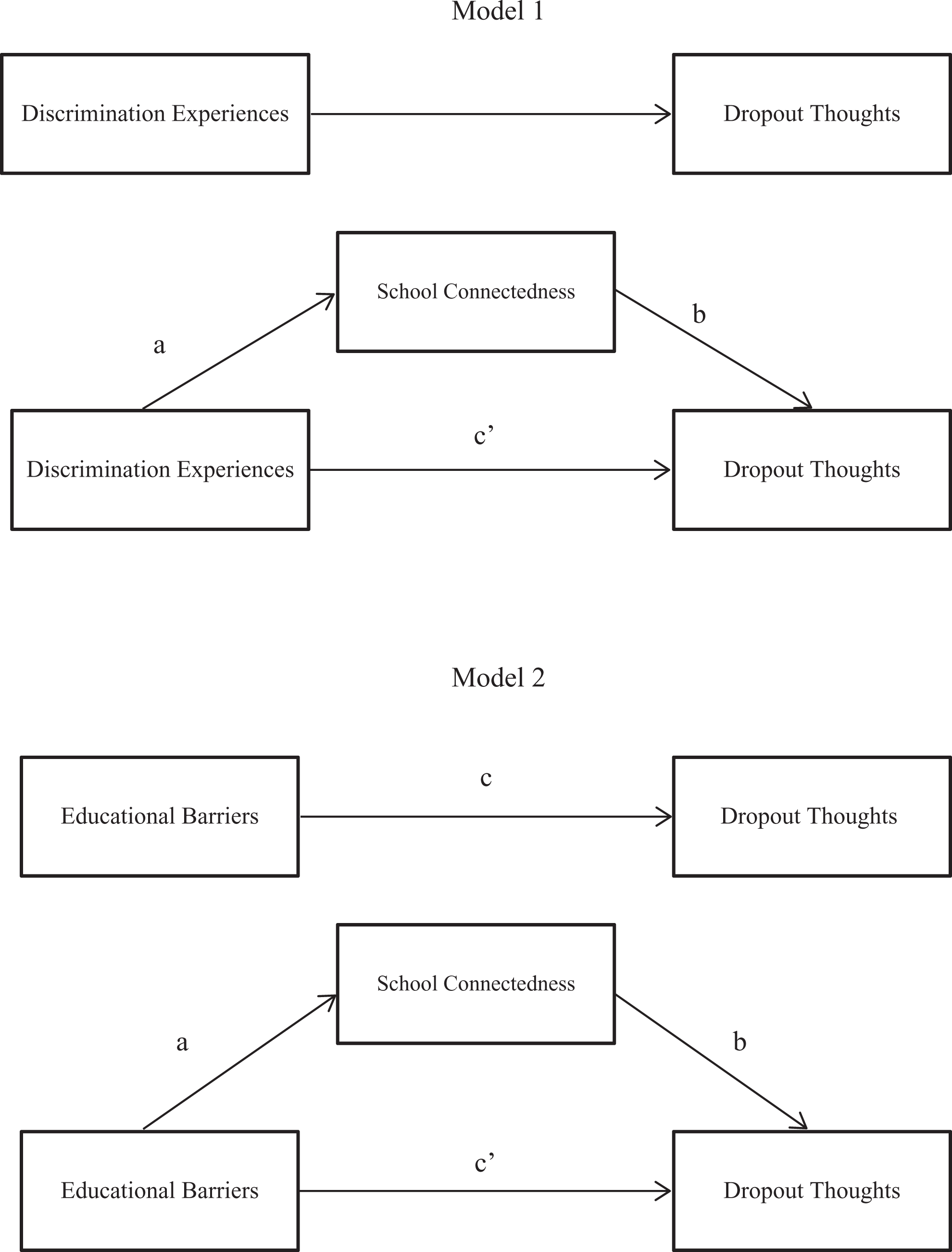
Mediation models.
Results
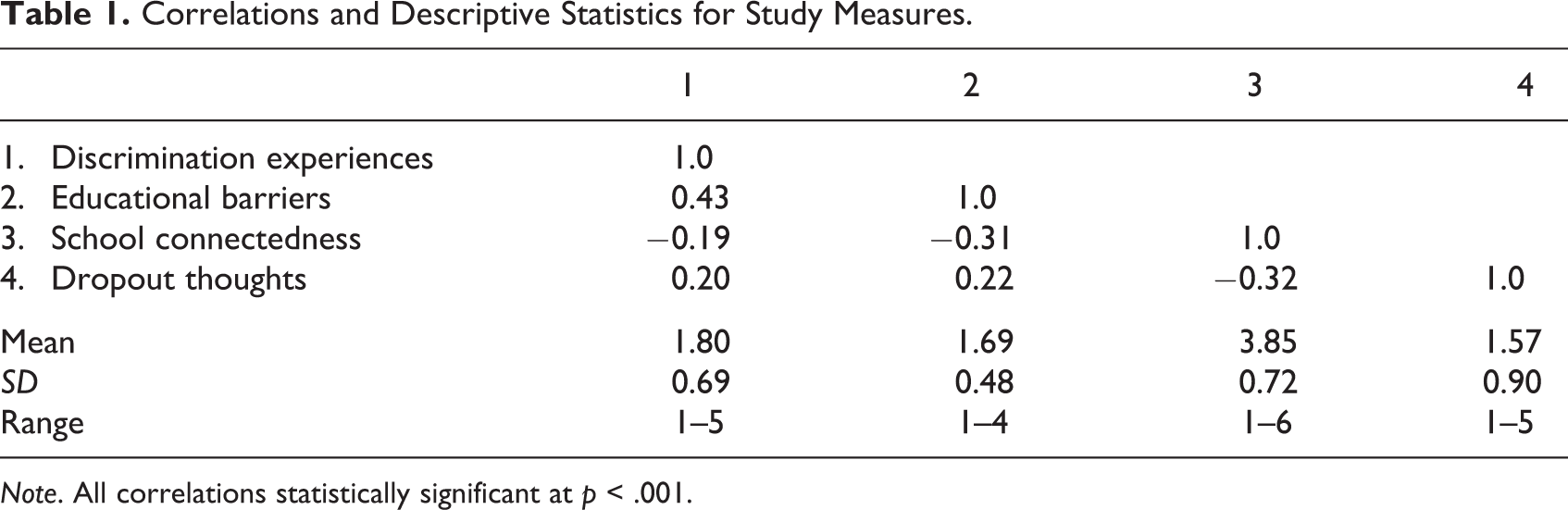
First, we determined that data met the assumptions of the analyses and that less than 4% of data were missing for any given variable. Descriptive statistics and correlations among main study variables are presented in Table 1. Correlation analyses indicate that students with greater levels of perceived discrimination and educational barriers were more likely to have thoughts of dropping out (r = .20 and r = .22, respectively) and had lower levels of school connectedness (r = −.19 and r = −.31, respectively). Those with higher levels of school connectedness were less likely to have thoughts of dropping out (r = −.32).
Correlations and Descriptive Statistics for Study Measures.
Note. All correlations statistically significant at p < .001.
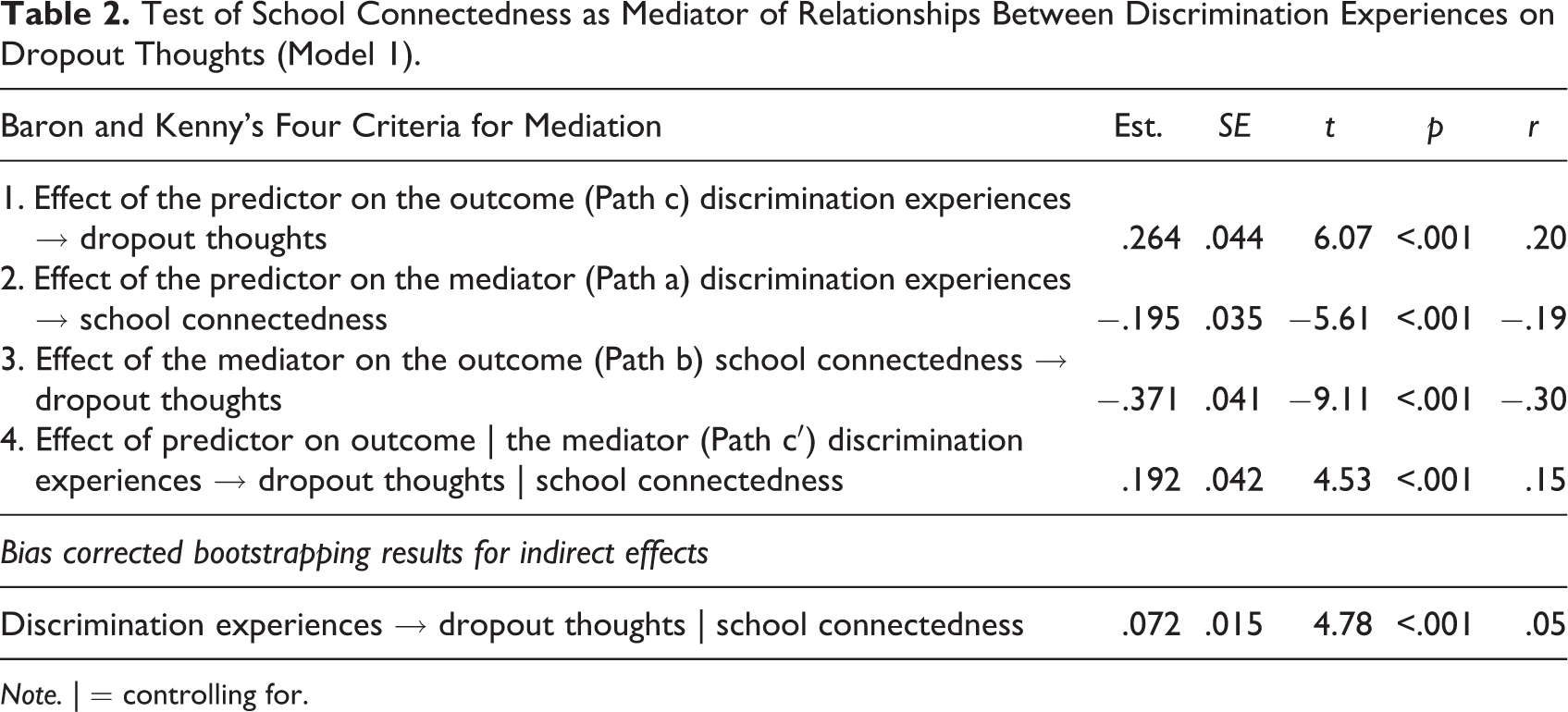
Results of testing mediation Model 1 are summarized in Table 2. For Criterion 1 (Path c), a significant relationship between perceived discrimination and dropout thoughts without school connectedness in the model was established (r = .20, moderately small effect). For Criterion 2 (Path a), a significant relationship between perceived discrimination and school connectedness was established (r = −.19, moderately small effect). For Criterion 3 (Path b), a significant relationship between school connectedness and dropout thoughts was established (r = −.30, moderate effect). For Criterion 4 (Path c′), the direct effect of perceived discrimination on dropout thoughts, controlling for the effects of school connectedness, remained significant, indicating partial mediation. The bootstrapping test of the indirect effect was significant and represented a 25% reduction (r = .05/r = .20) in the total effect established in Criterion 1.
Test of School Connectedness as Mediator of Relationships Between Discrimination Experiences on Dropout Thoughts (Model 1).
Note. | = controlling for.
Results of mediation Model 2 are summarized in Table 3. For Criterion 1 (Path c), a significant relationship between educational barriers and dropout thoughts without school connectedness in the model was established (r = .22, moderately small effect). For Criterion 2 (Path a), a significant relationship between educational barriers and school connectedness was established (r = −.31, moderate effect). For Criterion 3 (Path b), a significant relationship between school connectedness and dropout thoughts was established (r = −.28, moderate effect). For Criterion 4 (Path c′), the direct effect of educational barriers on dropout thoughts controlling for the effects of school connectedness remained significant indicating partial mediation was observed. The bootstrapping test of the indirect effect was significant and represented a 41% reduction (r = .09/r = .22) in the total effect established in Criterion 1.
Test of School Connectedness as Mediator of Relationships Between Educational Barriers on Dropout Thoughts (Model 2).

Note. | = controlling for; CI = confidence interval.
Results of the hierarchical regression (see Table 4) indicated that discrimination experiences, other barriers, and school connectedness each contributed unique variance to thoughts of dropping out (B = .15, .16, and −.35, respectively).
Hierarchical Regression of Discrimination, Other Barriers, and School Connectedness on Thoughts of Dropping Out.

Note. CI = confidence interval.
*p < .05. **p < .01. ***p < .001.
Discussion
The purpose of the current study was to test whether school connectedness partially mediates the relationship between two sets of barriers (discrimination experiences and other educational barriers) and thoughts of dropping out, among Latina/o high school students. Findings were consistent with the hypotheses. Latina/o students who reported greater frequency of discrimination experiences, and those who reported greater frequency of other barriers that affect how they are doing in school, were more likely to have thoughts of dropping out, and these relationships were attenuated by school connectedness. Our small to moderate effect sizes are consistent with prior findings (Lent et al., 2000) and may also be attributed to two other factors. First, the dropout process is multiply determined, including contextual influences outside of the school setting, and our model was not intended to account for the breadth of these factors (Rumberger & Rotermund, 2012). Second, students who attend this conference may have higher engagement in school and have just been exposed to motivational workshops and information designed to foster their educational motivation and aspirations. Only a small proportion of students reported that it was true (2.9%) or very true (2.4%) that they might drop out of school. We suspect that a sample more varied in thoughts of dropping out would yield stronger effect sizes, but this conjecture remains to be tested.
Inclusion of school connectedness as a mediator reduced the association between discrimination experiences and dropout thoughts by 25% and between other educational barriers and dropout thoughts by 41%. These findings highlight school connectedness as a potential support and/or buffer to contextual barriers experienced by Latina/o adolescents. As indicated in the regression analyses, all three variables accounted for unique variance in dropout thoughts, with school connectedness accounting for the greatest share of variance.
Implications for Research and Practice
The results provide additional evidence of negative associations between discrimination experiences at school, other in-school barriers, and thoughts of dropping out. Understanding the sources and frequency of school-based discrimination experiences can contribute to efforts to prevent and limit their deleterious effects. At a practical level, school personnel should be aware of the frequency of Latina/o students’ exposure to discriminatory experiences from peers, teachers, and staff. Learning to recognize and interrupt overt forms of discrimination as they occur may reduce both the frequency with which discrimination occurs and its potential negative impact on students. Covert discrimination is more challenging to address. Tenenbaum and Ruck (2007) found that teachers demonstrated lower expectations, made fewer positive referrals and more negative referrals (e.g., disciplinary issues), and directed less positive speech toward Latino/a students compared to their White peers. Given links between educator bias, behavior toward students, and student achievement, Quintana and Mahgoub (2016) recommend training educators to identify and mitigate explicit and implicit bias as part of comprehensive efforts to reduce the achievement gap for racial and ethnic minority students.
From a prevention perspective, the optimal time to intervene is before students even consider dropping out. Students often do not come to the attention of school staff until they are farther along in the dropping out process, hence “early warning systems” that track attendance, behavior, and performance are recommended (Balfanz et al., 2014; Frazelle & Nagel, 2015). Along with early detection, and reducing discrimination in school, fostering greater school connectedness is recommended, given its associations with positive academic and health outcomes (Catalano et al., 2004; Karcher, 2002; Karcher & Finn, 2005; Thomas & Smith, 2004).
School connectedness, most strongly associated with dropout thoughts, can be promoted at individual, school, and district levels. School-based interventions that promote adolescents’ connectedness to school, family, and future goals can reduce subsequent risk-taking behaviors (Chapman, Buckley, Sheehan, & Shochet, 2013). Interventions aimed at enhancing school bonding were associated with higher Grade point average (GPA) and lower likelihood of grade repetition, school misbehavior, suspension/expulsion, and dropout (Hawkins, Guo, Hill, Battin-Pearson, & Abbott, 2001). School characteristics associated with higher school connectedness include positive classroom management climates and tolerant disciplinary policies (McNeely, Nonnemaker, & Blum, 2002). Efforts to increase Latina/o students’ school connectedness should include school and district-wide strategies aimed at encouraging positive behavior and eliminating bias and disproportionate discipline practices (see McIntosh, Girvan, Horner, Smolkowski, & Sugai, 2014; Quintana & Mahgoub, 2016; Skiba et al., 2011).
Limitations and Implications for Future Research
Study limitations include the use of a cross-sectional design that does not allow for causal or directional conclusions, such as whether discrimination experiences and other barriers at one time are associated with subsequent thoughts of dropping out. All of the measures are self-report. Face validity of the measures is strong and relationships were as expected, but further assessment of the psychometric properties of the study measures is warranted. Participants had just attended a conference intended to foster motivation and raise educational aspirations, and it is possible survey responses may have been influenced by this experience, affecting generalizability of findings. The internal consistency of the measure of dropout thoughts was low. Perhaps this is because past thoughts of dropout is a broad time frame, while current thoughts of dropout is more specific and could have been reduced via the conference. Future research utilizing a multiple time point design could help determine whether the conference is associated with changes in dropout thoughts as well as establish a link between thoughts of dropping out and actual dropping out. Finally, the amount of variance explained was relatively small, and we recommend replication in a sample of Latina/o high school students at higher risk of dropping out.
Additional recommendations for future research include investigating whether particular barriers are more strongly associated with thoughts of dropping out. The current study focused on the frequency of experienced discrimination from teachers, staff, and students. Intragroup discrimination is a significant issue among students of color (McWhirter et al., 2013; Rakosi-Rosenbloom & Way, 2004), and our measure did not distinguish discrimination from Latina/o or non-Latina/o peers. Future research also might explore whether there are differential relationships between sources of discrimination and school-related outcomes.
Summary and Conclusion
Dropping out of school is a process and one that continues to occur disproportionately among Latina/o students in the United States. We found that Latina/o high school students reporting higher frequency of discrimination experiences at school, and those reporting more barriers that affected how they were doing in school were less connected to school and more likely to report thoughts of dropping out. School connectedness partially mediated relationships between discrimination experiences and dropout thoughts and between other education barriers and dropout thoughts. We recommend systemic efforts to improve Latina/o high school retention that include enhancing school connectedness, reducing school-based discrimination, and supporting students’ ability to persist in the face of discrimination and other barriers.
Footnotes
Acknowledgments
The authors wish to thank Dr. David McDonald for his contributions to this project and Jeff Gau for statistical consultation.
Declaration of Conflicting Interests
The author(s) declared no potential conflicts of interest with respect to the research, authorship, and/or publication of this article.
Funding
The author(s) received no financial support for the research, authorship, and/or publication of this article.