



Abstract
This investigation of proactive personality focused on life satisfaction during a 10-year period in which people went from being full-time employees to being fully retired. The study contributes at the intersection of the literatures on proactive personality, careers, retirement, and life satisfaction. In a sample of 118 recent retirees across the U.S. workforce (mean age = 65), personality was correlated with assessments of life satisfaction over the prior 10-year period and a variety of control variables (individual, household, and previous job) were included so that we could examine the incremental and unique effects of proactive personality. Proactive people were more satisfied during this critical period of life. This was true whether differences in life satisfaction included or excluded differences in career satisfaction during that time. We discuss future research implications and potential practical implications for enhancing satisfaction during a life stage in which proactive behavior may be beneficial.
Although notable research has demonstrated that proactivity has beneficial task-related consequences for individuals and organizations (cf. Grant & Ashford, 2008; Seibert, Crant, & Kraimer, 1999), there is relatively less research on the well-being consequences of being proactive. At this point in the evolution of the literature, there could be benefit from research which seeks to broaden the scope of investigation to include a wider variety of dependent variables in ways that span traditional place and time boundaries related to organizational life. For example, there is little research on the relationship of proactivity with employee well-being during times of career and life transitions. Retirement is often viewed as a career and life stage that involves departing from full-time work to enjoy the fruits of one’s labors—and as the population ages, this notion applies to more people each year (Benz, Sedensky, Tompson, & Agiesta, 2013; Chevalier, Fouquereau, Gillet, & Demulier, 2013; Shultz, Morton, & Weckerle, 1998; U.S. Census Bureau, 2012; Wang & Shultz, 2010). Wang and Shi (2014) define retirement as “an individual’s exit from the workforce, which accompanies decreased psychological commitment to and behavioral withdrawal from work” (p. 211). Interestingly, this definition does not indicate that retirement is necessarily synonymous with greater life satisfaction. While studies have shown that people look forward to retirement (Dorfman, 1992) and are happy being retired (Calasanti, 1996), some retirees may find themselves growing bored or feeling less valuable when no longer having to work (Feldman, 1994), and some retirees report depression and lower happiness and activity levels as they move into retirement (J. E. Kim & Moen, 2002; Richardson & Kilty, 1991). Thus, there may be differences among retirees with respect to how satisfied they are with life as they move out of work and into retirement. A very important cause of differences in reactions and affective experiences in life is disposition or personality; however, very little empirical research has examined personality as a predictor of life satisfaction as people transition from work into retirement (Wang, Henkens, & van Solinge, 2011).
Proactive personality has emerged as being prominent as a predictor of success. It has been shown to predict career outcomes, including job and career satisfaction (Maurer & Chapman, 2013; Ng, Eby, Sorensen, & Feldman, 2005; Seibert et al., 1999), and the prediction is sometimes even stronger than any of the Big Five personality traits (Fuller & Marler, 2009). As will be discussed in some detail below, proactive behavior tends to produce positive outcomes and experiences for those who display it, so it has very promising explanatory value for satisfaction differences.
Thus, the goal of the present study was to address the proactive personality–life satisfaction relationship in late career/early retirement in a broad sample of people across the United States. This career and life stage would seem to benefit greatly from proactive behavior compared to those stages where there is more stability and consistency and thus possibly less need for proactive behavior. We now describe the research and theoretical background pointing to the need for research on this dispositional construct in relation to life satisfaction as part of the transition and adaptation process from working to retirement. We then present an empirical study spanning more than a decade which focused on the life satisfaction among recent retirees in relation to proactive personality. While we recognize that some individuals may phase into retirement via part-time work or bridge employment, for clarity, our research focuses on individuals who are fully retired.
Literature Review and Theoretical Background
Life Satisfaction Research and Retirement
In a recent review by Erdogan, Bauer, Truxillo, and Mansfield (2012), the authors showed that life satisfaction has been linked to reduced mortality (Chida & Steptoe, 2008), lower levels of both sleep problems (Brand et al., 2010) and burnout (Haar & Roche, 2010), lower turnover intentions (Rode, Rehg, Near, & Underhill, 2007), and increased performance (Jones, 2006). Erdogen et al. looked at the state of life satisfaction research in relation to research literature relevant to working life and concluded that it is largely ignored in this literature despite its importance as an indicator of subjective well-being. The authors go on to say that this lack of attention to life satisfaction is a “critical research gap” (2012, p. 1039). While there is a case to study life satisfaction among employed workers, it is also interesting to consider life satisfaction among retirees.
In studies regarding life satisfaction/dissatisfaction among retirees, it is seems that there is significant heterogeneity in retirement quality among retirees (cf. Calasanti, 1996; Feldman, 1994; J. E. Kim & Moen, 2002; Richardson & Kilty, 1991), with some retirees even experiencing negative physical and psychological effects due to retirement (J. E. Kim & Moen, 2002; Richardson & Kilty, 1991; Wang, 2007). The varying levels of satisfaction in retirement need to be examined to better understand what leads to better or worse life satisfaction among retirees. This is important as retirees make up a growing percentage of the population each year. There is a very large number of individuals who have retired or will likely retire from the workforce in the near future (Benz et al., 2013; U.S. Census Bureau, 2012), suggesting broad relevance of retirement as a career and life stage across the population. Life satisfaction at the end of one’s career and beginning of retirement seems a key period of life to examine because it requires significant adjustment—with implications for satisfaction with life during this life stage. It is interesting to consider the possibility that variables relevant to one’s work prior to retirement as well as individual differences might affect life satisfaction upon leaving the workforce.
While numerous antecedents can be linked to life satisfaction, dispositional trait or personal resources seem particularly promising from a theoretical point of view but surprisingly have received little research attention. Wang, Henkens, and van Solinge (2011) look at retirement as an adjustment process, and the quality of that adjustment can be influenced by a person’s resources, particularly during the transition and earlier years of retirement as adjustment is being made. The extent to which life during this period is good or bad is influenced by underlying resources available to a person. Drawing on a resource perspective, Wang (2007) asserted that these kinds of resources might exist in multiple domains, such as physical, cognitive, motivational, financial, social, and emotional resources. When people have more resources, they will have better experiences in retiring. Wang et al. (2011) also state that although personality traits have been found to be important individual resources that influence the extent to which positive outcomes occur in other types of life transitions, very little empirical research has examined personality as a predictor of retirement quality of life. The authors go on to state, Given that personality variables and dispositional traits are important for people in conducting emotional appraisals, setting up motivational priorities, and choosing coping strategies (Löckenhoff, Terracciano, & Costa, 2009), more research should focus on explicating how these variables may influence retirement adjustment quality. (p. 211)
In the present study, we respond to this call for more research into these potential influences on life satisfaction when fully retiring by focusing on a personality construct with great theoretical promise in this domain. Proactive personality has not been examined in this context despite its strong potential relevance.
The Role of Proactive Personality
Proactive people are anticipatory individuals who identify opportunities in new or changing contexts. They possess high initiative and persevere to enact change around them, creating new environments (Bateman & Crant, 1993). While the proactive person tends to try to influence his or her environment, the individual low in proactive personality is more passive, allowing circumstances to be more influential (Bateman & Crant, 1993). Further, despite some similarities with prominent constructs such as the Big Five personality traits, proactive personality is a separate construct. Major, Turner, and Fletcher (2006) as well as Crant and Bateman (2000) found that proactive personality is distinct from the Big Five and has unique predictive effects over and above the Big Five.
Proactive personality has been shown to predict career outcomes such as salary, promotions, and job and career satisfaction (cf. Maurer & Chapman, 2013; Seibert et al., 1999). Other studies have also found proactive personality to be a strong predictor of career success (e.g., Ng et al., 2005), even stronger than any individual Big Five personality trait (Fuller & Marler, 2009). The link between proactive personality and career success is largely due to the highly proactive person being able to influence and generate constructive change to enhance results at work (Maurer & Chapman, 2013). With respect to broader indices of well-being outside of work, there has been very limited attention to effects by proactive behavior.
We would expect that even when employees no longer work, the drive of the proactive person will constructively prepare for and change the new context of retirement and lead to greater life satisfaction. The transition to retirement would present new and novel challenges and experiences as opposed to the consistency and stable environment of work, further reinforcing the benefits of proactive personality. Diener (1984) presented a top-down approach to life satisfaction. This theory argues that stable traits naturally lead to some people being more satisfied. This approach “treats life satisfaction as a function of the person” (Erdogan, Bauer, Truxillo, & Mansfield, 2012, p. 1042). Thus, proactive personality could naturally lead to greater life satisfaction during the transition to being retired.
In their review of research on retirement adjustment, Wang et al. (2011) present multiple models and theories related to the quality of adjustment to retirement. We found the discussion of two particular theories to be most relevant to our examination of proactive personality as a predictor of life satisfaction in retirement. The first, continuity theory, stresses the accommodation of changes in life and views those changes positively and not as disruptions (Atchley, 1999). “Rather than focusing on retirement as a disruptive role loss, continuity theorists view it as an opportunity to maintain social relationships and lifestyle patterns” (Wang et al., 2011, p. 205). This theory may suggest that a proactive person will prepare for and alter the “new” context of retirement to be more in line with previous patterns and to be in line with what he or she prefers.
Stage theory (Atchley, 1976) is the second theory presented in the Wang et al.’s (2011) paper that seems particularly relevant to the present study. This theory suggests that disenchantment can occur during retirement characterized by feelings of boredom, dissatisfaction, and low self-worth when being separated from the workforce. However, the disenchantment can be altered or avoided. The general premise is that if an individual has cultivated a flexible style in dealing with previous life transitions, is less socially integrated with their work, and has the attributes that help smooth and accomplish the transition, he or she will be more likely to prepare well for the adjustment and to achieve better outcomes of the adjustment (Wang & Shultz, 2010). (Wang et al., 2011, p. 206)
We argue that individuals high in proactive personality have the “attributes that help smooth and accomplish the transition” into retirement. This is precisely what a highly proactive person would do compared to a person low in proactive personality. That is, the proactive person would anticipate changes and identify opportunities in the new and changing context, take initiative and persevere to enact change, and create a new environment (Bateman & Crant, 1993). Thus, there are at least two theoretical perspectives on the quality of adjustment to retirement which suggest that proactive personality should lead to positive results.
Life Satisfaction in Light of Career Satisfaction
In thinking about life satisfaction from this perspective in the present study, we considered two ways to capture the construct during this phase of life. First, from a big picture point of view, as one anticipates, prepares for, and eventually departs from full-time work and then settles into a life of full-time retirement, overall life satisfaction during this critical period of life could be assessed. From the perspective of adjustment (e.g., Wang et al., 2011), through these changes and transitions, the adaptation and affective reactions are important. Life satisfaction through this phase of career and life is an important and worthwhile focus from a psychological point of view. This phase of life encompasses the end of one’s career and the beginning of one’s retired life.
Another way to capture life satisfaction during this phase of life is to focus only on that part of life outside of career—one’s life away from job and career. This includes retired life and those aspects of living outside of career. Because prior research reviewed above has shown effects of proactive personality on career satisfaction and because career satisfaction could contribute to life satisfaction, it would be worthwhile to examine effects of proactive personality including and excluding career satisfaction effects from life satisfaction. The first approach to framing life satisfaction described above allows a comprehensive and holistic view of life satisfaction that is all encompassing to include career changes and influences during this phase of life, and the second allows a focus on life outside of career, which is also a worthwhile concern as this phase of life turns toward being without work. We therefore tested the effects of proactive personality on life satisfaction both ways—that is, overall life satisfaction during the period of finishing out work and starting a retired life and also life satisfaction controlling for the influence of one’s career satisfaction on life satisfaction during this period.
Given the predictive effects of proactive personality on career success and combining the tenets of the top-down approach to life satisfaction, continuity theory, and stage theory, we hypothesize the following:
Job, Household, Individual, and Career Control Variables
In order to strengthen the design of our study, we included several variables as controls due to their possible influence on life satisfaction in the research setting. In the model by Wang et al. (2011), the authors list several potential antecedents to adjustment in retirement. These include macro-level, organizational-level, job-level, household-level, and individual-level variables. We drew upon the most relevant of these categories for a focus on current life satisfaction in retirement: individual-, household-, and (previous) job-level variables.
At the job level, because we focused on individuals who are fully retired and not moving into retirement, we examined a variable that might reflect the extent to which people were previously involved in their work and, therefore, the extent to which retirement might represent a loss in terms of an engaging, involving activity. We also looked at the relative job level within the company to account for potential effects of status loss upon retiring. Rather than to rely on retrospective measures, we use actual measures of job level and job involvement taken while respondents were still employed a decade earlier. Heller, Watson, and Ilies (2004) suggested that job-related constructs may mediate personality and life satisfaction relationships. Wang et al.’s (2011) paper on retirement adjustment summarized multiple studies in which job-related variables did indeed have positive effects on retirement adjustment quality (cf. Quick & Moen, 1998; van Solinge & Henkens, 2008). Thus, controlling for elements of the job was warranted in our study.
At the household level, we examined marital status as an indicator of whether the person has a personal relationship and possible source of support. Calasanti (1996) found that married individuals have a more positive retirement. Pinquart and Schindler (2007) found a positive link between being married and greater retirement adjustment quality. Heller et al. (2004) suggested that marital status may play a role in the personality–life satisfaction link. Previous studies have indicated that marital status does affect one’s satisfaction and experiences in retirement; therefore, we included this variable as a control.
At the individual level, Wang et al. (2011) referenced health as being a predictor of retirement adjustment quality. Specifically, health is positively linked to retirement adjustment quality (Dorfman, 1992; S. Kim & Feldman, 2000; van Solinge & Henkens, 2008). The present study included a measure of overall health. Perhaps relevant to both the individual and household levels, financial resources in retirement should be reflected in measures of income and job status before retirement—as the income one earned while employed and the status of his or her job should have some bearing on one’s resources at that time and in retirement. Furthermore, financial resources have been shown to influence satisfaction in retirement (Gall, Evans, & Howard, 1997; Pinquart & Schindler, 2007; Wang, 2007). Thus, we measured these variables to control for this possible influence.
We also controlled for the Big Five personality variables as they overlap and correlate with proactive personality, and they have been explored in relation to life satisfaction and retirement. Steel, Schmidt, and Schultz (2008) found that the Big Five accounted for 18% of variance in life satisfaction. Robinson et al. found that the Big Five predicted retirement life satisfaction with agreeableness, conscientiousness, and low neuroticism as significant individual predictors of life satisfaction in retirees (Robinson, Demetre, & Corney, 2010). Similarly, retirees low in neuroticism and high in extroversion report greater retirement satisfaction (Löckenhoff et al., 2009). Controlling for the Big Five is imperative in order to test the unique effects of proactive personality on life satisfaction in retirees.
Finally, we note that this study focused on measuring a 10-year interval of life satisfaction among a group of fully retired people who were in the earlier years of retirement, with most of our sample being retired fewer than 5 years. This allowed a look into this critical phase of life adjustment that also included a portion of working years and the period of transition into retirement. Therefore, we measured and controlled for the number of years retired among participants in the sample.
Method
Participants were surveyed at two separate times, spaced 10 years apart. The sample consisted of participants from various occupations and geographic locations across the U.S. workforce. Participants were recruited via random digit telephone dialing at Time 1 (t1) at a survey center, and they were paid for their participation. In the follow-up survey 10 years later, we relied on well-tested and established methods to increase participation (Dillman, 2009; Lynn, 2009). Upon updating address information, we sent a preinvitation letter outlining the reason for our soon-to-arrive follow-up survey. We then sent an invitation letter shortly after with a US$2 gift incentive along with the survey for completion. This letter informed participants that they would receive an additional US$10 for returning the completed survey, but either way they could keep the US$2 gift.
The original study was aimed at individuals who had been with their current employer for 1 year or more and were working at least 32 hr/week. Of the 926 surveys sent out for the second study, 536 participants responded. At Time 2 (t2), these respondents consisted of 314 full time, 38 part time, 50 part time and partially retired, 127 fully retired, and 13 unemployed workers. Three respondents did not provide employment status data for the second survey. Of the 127 fully retired respondents, nine cases were dropped due to significant missing data from t1 (10 years prior). The focus of this study was on the other 118 fully retired respondents at t2 who provided data taken from both surveys, spaced 10 years apart.
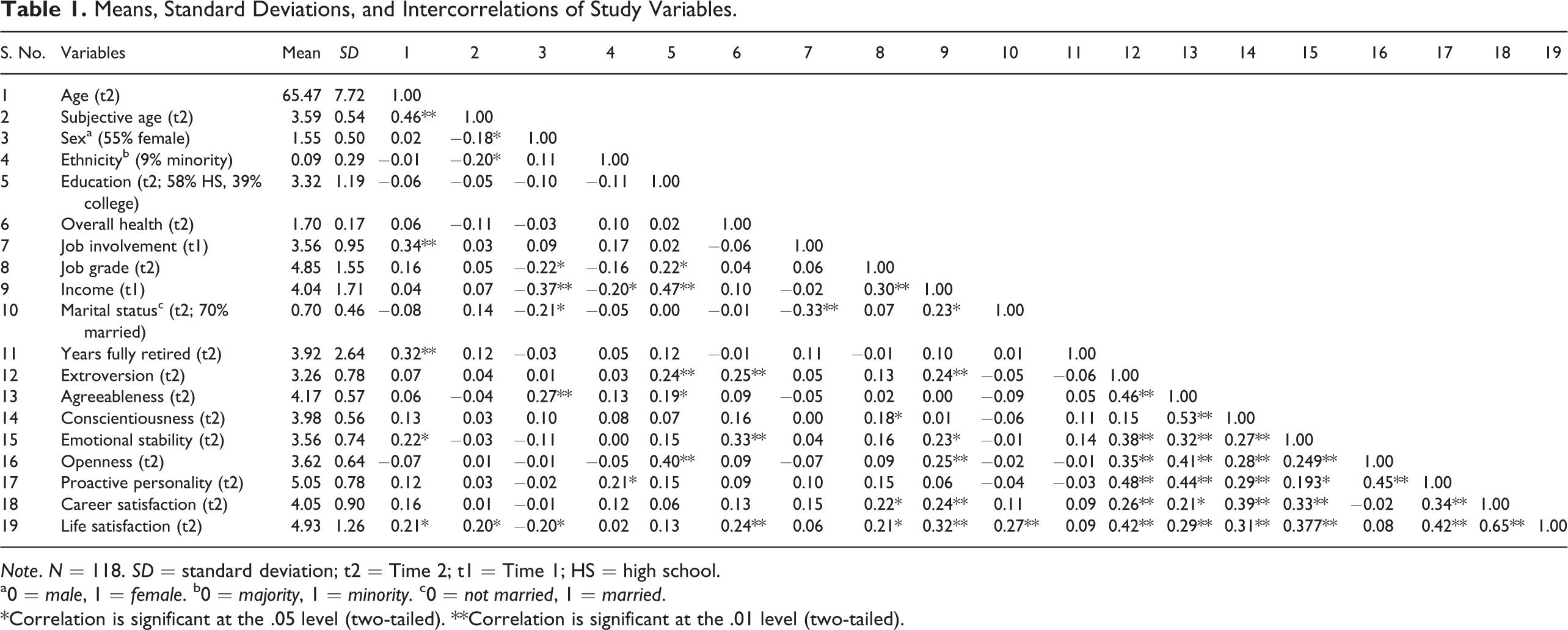
Table 1 provides demographic data on this sample. Although it was not the purpose of the present study to conduct a representative national poll that reflects the population, some general benchmark comparators that provide basic and global indicators of overall sample demographic representativeness are available. With respect to race and sex data in 2012, for those in the United States who were aged 65 and over, 56.4% were female and 86% were nonminority/White (Ortman, Velkoff, & Hogan, 2014); while in the present sample, 55% were female and 91% were nonminority. Thus, we have some basic demographic similarity of this sample compared to the population in terms of race and sex. Seventy percent of our sample was married, and 58% had completed high school while 39% had a college degree. Job information from when our retirees were employed revealed that at t1 (10 years prior), our sample worked in the following job types: professional (37%), managerial (12%), technical (16%), clerical (12%), sales (4%), blue collar (10%), and other (9%). Additionally, regarding job level at t1, 8% worked in the lowest level of their organization, 60% middle level, and 32% highest level.
Means, Standard Deviations, and Intercorrelations of Study Variables.
Note. N = 118. SD = standard deviation; t2 = Time 2; t1 = Time 1; HS = high school.
a0 = male, 1 = female. b0 = majority, 1 = minority. c0 = not married, 1 = married.
*Correlation is significant at the .05 level (two-tailed). **Correlation is significant at the .01 level (two-tailed).
Survey Content
Details on the scales used in the present study, as well as the time of measurement (t1 or t2), are described below. Variables scores were created by computing the mean of the items for each variable. We used measures that have been validated and used in prior studies (e.g., Maurer & Chapman, 2013; Maurer, Weiss, & Barbeite, 2003), and these measures had reliabilities that are satisfactory for research purposes (α = .70 or higher) in those respective studies. Unless otherwise noted, respondents used a 7-point scale ranging from 1 (disagree very strongly) to 7 (agree very strongly).
Control Variables
We controlled for individual, household, and (previous) job level and involvement.
Job involvement
Job involvement (t1, mean of 5 items, α = .75) measured the degree to which individuals consider their work to be a central life concern (Kanungo, 1979; Lodahl & Kejner, 1965). An example item was “I am very much personally involved in my work.”
Marital status
We measured marital status (t2). Respondents were asked if they were currently single, married, divorced/separated, or widowed. A dummy variable was created with not married (0) and married (1).
Individual
We controlled for the effects of overall health, income prior to retirement, job status prior to retirement, and other demographic variables on life satisfaction in retirement. Overall health (t2, 12 items) was measured by listing 12 common medical problems (i.e., diabetes, hypertension, etc.) and asking respondents to select “yes” or “no” if their doctor had said they had issues with any of those ailments during the past 10 years. An overall health score was calculated by summing the responses. Higher scores indicated healthier respondents. Income (t1) was measured by asking respondents to select the range that captured their income. Ranges were (1) under US$15 k, (2) US$15 k to US$29,999 k, (3) US$30 k to US$44,999 k, (4) US$45 k to US$59,999 k, (5) US$60 k to US$74,999 k, (6) US$75 k–US$89,999 k, and (7) US$90 k or over. Job status was measured by assessing relative grade of job (t1), a 1-item measure that asked respondents their relative job level within the company. The response scale was lowest (1) to highest (7). Demographic controls included age (t2), sex, ethnicity, education (t2), and subjective age (t2). Subjective age (mean of 5 items, α = .70), adapted from Cleveland, Shore, and Murphy (1997), reflected the age in which respondents actually felt at the time of the follow-up survey while retired. The scale was 16–25 years (1) to 56–75 years (5), and a sample item was “The way you generally feel.” Also, respondents were asked how many years they had been fully retired. The sample had a mean of 3.9 years since retirement, and 73.7% were retired 5 or fewer years.
Big Five personality
The Big Five were measured using the 50-item International Personality Item Pool (IPIP) Representation of the NEO PI-R (or the Revised NEO Personality Inventory, originally named for measuring Neuroticism-Extraversion-Openness and later revised to include Agreeableness (A) and Conscientiousness (C) as a Big 5 inventory). Using the IPIP scoring guide, we calculated mean scores for each of the five dimensions. A sample agreeableness item is “Am interested in people.” Response scales reflected the extent to which each item described oneself, very inaccurate (1) to very accurate (5). Reliabilities for each of the five dimensions were α = .75 or higher.
Career satisfaction (t2, mean of 5 items, α = .89)
We adapted the 5-item scale by Greenhaus, Parasuraman, and Wormley (1990), and used by Judge, Cable, Boudreau, & Bretz (1995), to measure career satisfaction during the period of interest. A sample item is “I am satisfied with the success I have achieved in my career over the past 10 years.” The response scale ranged from strongly disagree (1) to strongly agree (5).
Proactive personality (t2, mean of 10 items, α = .90)
Bateman and Crant’s (1993) Shortened Version Proactive Personality Scale was used. An example item is “I excel at identifying opportunities.”
Life satisfaction (t2, mean of 5 items, α = .93)
The satisfaction with life scale (Diener, Emmons, Larsen, & Griffin, 1985) was adapted to cover the 10-year interim since the earlier survey, which included the period of adjustment into retirement up to the second survey administration. A sample adapted item is “I have been satisfied with my life over the past 10 years.” The life satisfaction scale has a very long-term and broad focus with items such as “If I could live my life over, I would change almost nothing,” and so by focusing on a 10-year period (e.g., “If I could live the prior 10 years of my life over, I would change almost nothing”), while still appropriately broad in temporal focus, it is relatively more focused on the phase of life that is directly relevant to the present study.
Results
Analyses Overview
We were fortunate to have little missing data from our 118 retiree sample. At most, two responses were missing for any one variable. Missing data were replaced via series mean for the calculated variables, and for the two missing data points on age at t2, we simply added 10 years to the response to age at t1. Relying on the Shapiro–Wilk test, our data met the assumptions of normality, with p > .05 for nearly all variables except ethnicity (skewed nonminority) and marital status (skewed married). To conduct the main research analyses, using hierarchical multiple regression, we conducted two analyses. In both, we controlled for a number of variables in order to assess the individual contribution of proactive personality; but in the second analysis, we added career satisfaction to the first block of controls to allow a focus on life satisfaction controlling for career satisfaction. In both analyses, number of years retired, prior job involvement, household, and other individual and demographic variables were entered into Block 1 (in the second analysis, career satisfaction was included in this block). In Block 2, we then entered the Big Five personality factors to control for the overlapping effects of these factors with proactive personality. We entered our focal variable of interest, proactive personality, last to assess hypothesized unique effects on life satisfaction for retirees, over and above other variables.
Intercorrelations of Variables and Hypothesis Test
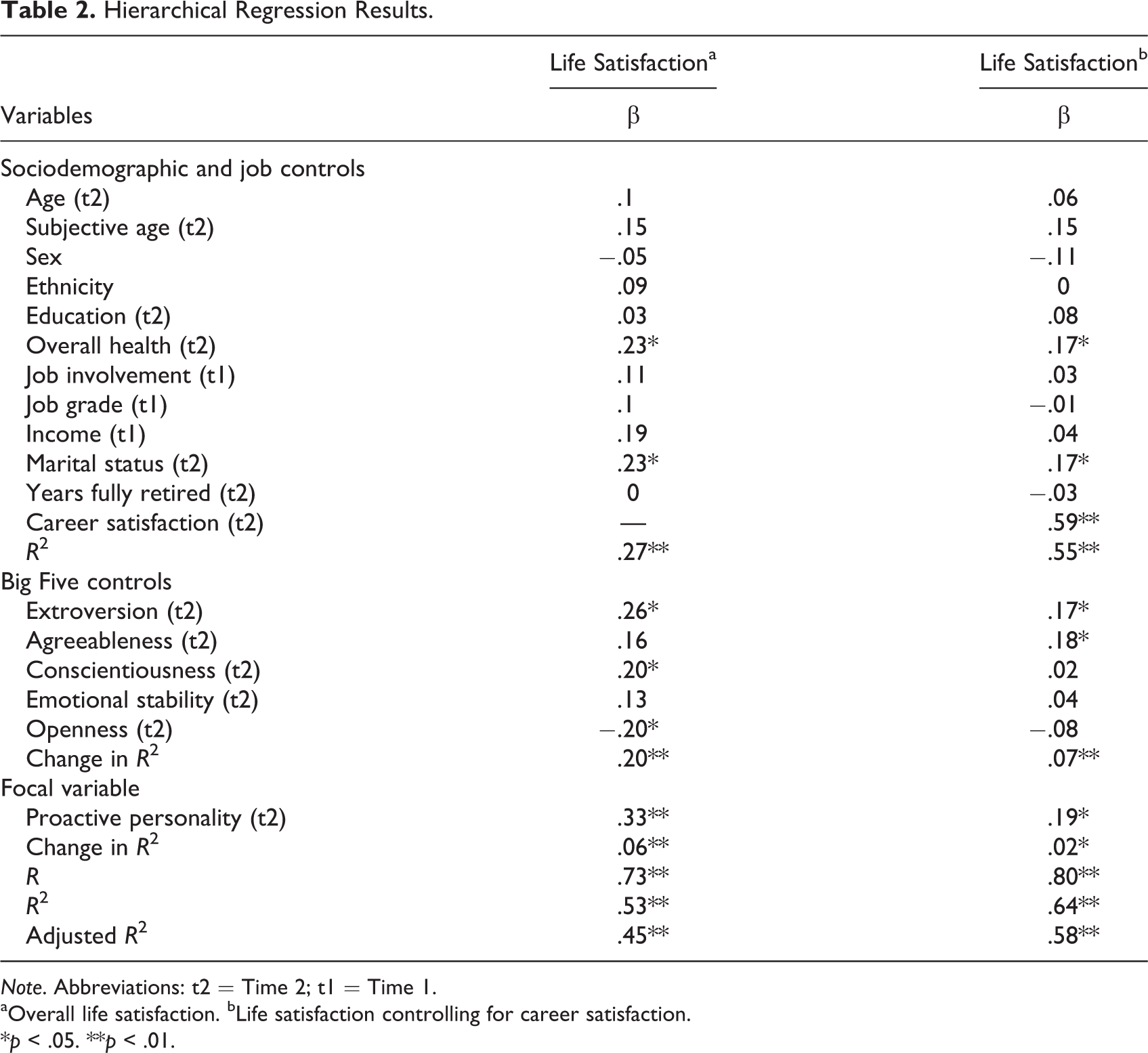
Descriptive statistics and intercorrelations of the control variables and proactive personality for our sample of 118 retirees are shown in Table 1. To test our hypothesis that proactive personality predicts life satisfaction in retirees, we conducted hierarchical linear regression as described earlier using SPSS, Version 21 (IBM Corp., 2012). Table 2 provides the results of the regression. In the first test for overall life satisfaction including career satisfaction, as expected based on prior research, our first block of controls consisting of job, household, and individual variables was significant (R 2 = .27, p < .01), with overall health (β = .23, p < .05) and marital status (β = .23, p < .05) as significant individual predictors.
Hierarchical Regression Results.
Note. Abbreviations: t2 = Time 2; t1 = Time 1.
aOverall life satisfaction. bLife satisfaction controlling for career satisfaction.
*p < .05. **p < .01.
In Block 2 of this analysis, we further controlled for the Big Five personality traits. This block was also significant (ΔR 2 = .20, p < .01). Extroversion (β = .26, p < .05), conscientiousness (β = .20, p < .05), and openness (β = −.20, p < .05) all significantly predicted life satisfaction in retirees. Because openness has a nonsignificant and near zero correlation with satisfaction, it is unclear whether the negative effect in multiple regression may be due to collinearity or suppression effects.
In the third and final block of the regression, we were able to examine the effect of our focal variable, proactive personality. This block was significant (ΔR 2 = .06, p < .01), and proactive personality was significant (β = .33, p < .01) as a predictor of life satisfaction in retirees.
In the second analysis, we repeated the hierarchical linear regression from the first analysis, but we included career satisfaction as a control variable in Block 1. Results of this regression are also presented in Table 2. The first block of controls was significant (R 2 = .55, p < .01), with marital status (β = .17, p < .05) and career satisfaction (β = .59, p < .01) as significant controls predicting life satisfaction.
Block 2 consisted of the Big Five traits and was significant (ΔR 2 = .07, p < .01), with extroversion (β = .17, p < .05) and agreeableness (β = .18, p < .05) as significant predictors. Finally, Block 3 consisted of proactive personality. This block was significant (ΔR 2 = .02, p < .01), with our focal variable, proactive personality, significant (β = .19, p < .05) as a predictor of life satisfaction beyond the effects of career satisfaction.
We also ran a supplementary regression with career satisfaction as the dependent variable using all of the same predictors and steps in the analyses above. This additional analysis yielded significance in all three blocks (R 2 = .17, p < .05; ΔR 2 = .19, p < .01; ΔR 2 = .06, p < .01, respectively). Significant predictors were yearly income (β = .26, p < .05), conscientiousness (β = .38, p < .01), openness (β = −.24, p < .05), and as expected, proactive personality (β = .34, p < .01). This additional analysis confirmed the positive and significant predictive effect of proactive personality on career satisfaction, and it illustrated the value in analyzing life satisfaction both holistically and isolated from career satisfaction effects.
Discussion
As research on proactivity evolves, there should be significant benefit from broadening the scope to include a wider variety of dependent variables in ways that span place and time boundaries related to organizational life. This study examined proactive personality in relation to life satisfaction in a critical stage of life—retirement. As a greater number of people depart from full-time work and enter retirement each year, it becomes increasingly critical to better understand how people fare during that phase of life and career. We focused on proactive personality due to its theoretical relevance among recent retirees and its unique effects over and above the Big Five personality traits. To examine proactive personality’s incremental effects, we controlled for many variables set forth by Wang et al. (2011) as being key in retirement adjustment.
The proactive individual is one who identifies opportunities and does not shy away from unfamiliar situations. The proactive individual generates change constructively to enhance his or her experience and outcomes. Proactive individuals are problem solvers, initiators, and masters of their own fate in a sense (Bateman & Crant, 1993). Our study found that proactive personality positively related to life satisfaction among recent retirees from across the United States, indicating that having a proactive personality is associated with a more positive experience as one moves away from work and becomes fully retired. Perhaps the end of career and the beginning of retirement is not seen as a stressful disruption or unwelcomed event for the proactive person, but instead, retirement represents a new context, a new challenge for the proactive person to alter for his or her benefit. By uncovering the unique and significant relationship of proactive personality with life satisfaction in this phase of life, we can begin to understand one potential reason for the discrepant feelings of satisfaction among retirees. Perhaps those retirees low in proactive personality allow the new circumstances of transitioning to retirement to alter them and affect them in a negative way, whereas those high in proactive personality control those new circumstances. Our results suggested that proactive personality plays a role in life satisfaction whether framed as the overall satisfaction with life including career satisfaction during this period or whether focusing on satisfaction with life excluding or controlling for career satisfaction.
Our results contribute at the intersection of the personality, retirement, careers, and life satisfaction literatures. We have answered the charge by Wang et al. (2011) to further investigate the link between personality and retirement satisfaction, particularly life satisfaction. We have included but controlled the Big Five to further elucidate the unique construct and predictive effects of proactive personality. While much of the proactive personality outcomes in prior research have dealt with work, our study examined how it relates to life as one transitions out of work and begins a life as a full-time retiree. Leaving the workforce is a major life change and phase of career, potentially having negative effects on those who do not welcome the change or become uneasy with the change over time. Having a highly proactive personality, as suggested in our study, may be a key person factor that determines which types of people do adjust positively to retiring.
Potential Practical Implications
Provided the positive outcomes associated with proactive personality, it is worthwhile to explore from a practical standpoint if an individual can make a conscious effort to become more proactive. Kirby, Kirby, and Lewis (2002) argued that proactive thinking was trainable. The training in their study consisted of recognizing critical events and developing and implementing strategies for dealing with those events. Subjects trained in proactive thinking had better performance than those not trained in proactive thinking. Additionally, Strauss and Parker (2015) found that vision-focused intervention increased proactivity in those high in future orientation. Essentially, those who saw a discrepancy between their current state and their future ideal tended to set goals and proactively planned ways to obtain resources to obtain the future ideal. Grant and Ashford (2008) set forth three phases of proactive behavior: anticipation, planning, and action toward future impact. The common theme among these studies is goal setting and future thinking. While the research on interventions to increase proactive behavior has been conducted in organizational settings, the takeaway from these studies can be translated to retirement. Individuals can increase proactive behavior by envisioning their future ideals that should result in satisfaction, setting goals to achieve those future ideals, and acting to obtain the resources that will enable them to achieve those goals. More specifically, an individual can anticipate the events of their retirement, envision their ideal retirement life, and proactively (not reactively) obtain resources toward execution of that future satisfactory life of retirement.
The studies discussed above suggest that training to produce more proactive behavior could be beneficial as part of retirement planning and the transition into retirement. Perhaps proactive personality measures could also be used as diagnostic tools to identify those who may especially benefit from additional preparation for retirement via relevant training or coaching along the lines of proactivity.
Implications for Future Research
It is interesting that research has linked activities such as retirement planning to retirement satisfaction (cf. Elder & Rudolph, 1999) and also some personality variables such as conscientiousness and emotional stability have been linked to financial knowledge and preparedness for retirement (Hershey & Mowen, 2000), but proactive personality has not been addressed in this research nor has proactive personality been included in research on antecedents of retirement planning and decision-making (Topa, Moriano, Depolo, Alcover, & Morales, 2009). The present study suggests that research might explore whether proactive personality is a predictor of retirement planning and preparation, and the preparation contributes to life satisfaction in retirement. Alternatively, or in addition, proactive personality could be a determinant of ongoing proactive behavior during retirement as retirees shape their environment and take action to create a satisfying situation for themselves. Both paths toward satisfaction might be addressed in future research. Relatedly, the results of the present study suggest that both career-related processes and influences outside of career may uniquely contribute to overall life satisfaction. Thus, proactive personality seems a dispositional factor that should receive more attention in research on the transition to retirement. In fact, only one study to date has addressed a link between proactive personality and life satisfaction in any context, but that prior study addressed the link amidst several work-related outcomes in a fully employed sample of predominantly Singaporean workers of Chinese descent (Greguras & Diefendorff, 2010). As suggested by the authors of that study, “…the issue of whether results generalize to, for example, different cultures, organizations, jobs, or participants, is important” (p. 555) and the present research into the relationship between proactivity and life satisfaction as people transition from full-time work into full-time retirement in the United States directly addressed an important gap in the literature. Perhaps these findings can be pursued in other samples that are also directly involved in that important transition. The present study suggests some new directions for research and practice.
While our study had several strengths including that it was a 10-year endeavor conducted on employees from across the workforce using several important control variables, and some constructs were measured during employment and some during retirement, this study does have limitations with implications for future research. First, our sample size was relatively small at 118 retirees; and although there were some very basic indicators that the sample was similar in terms of race and sex to the population over 65 (a relevant comparison group for a focus on retirement), we can make no claims about population representativeness more broadly. Also, despite a small sample, we do note that proactive personality was a significant predictor despite rather conservative tests that involved controlling for numerous other variables, some measured at the same time and some measured 10 years earlier. This speaks to the robustness of proactive personality as a predictor. Further, our sample consisted of relatively recent retirees in which most were retired under 5 years and all were under 10 years into retirement. Although this is a strong point of the study because this is a critical time in life and retirement due to the major adjustments required (Wang et al., 2011), the results do not speak to the effects of proactive personality in later retirement (beyond 10 years retired), which is also an important phase of retirement and life. Perhaps future research can address that time period and target a larger sample. Additionally, now that the present study has determined that the relationship between proactivity and life satisfaction exists in retirement, perhaps future research could address appropriate mediators for this stage of life such as retirement and financial planning behavior which may help to explain the effects of proactive personality on life satisfaction.
Finally, there may be some concerns about method variance, although the design allowed controlling for other dispositional measures as well as a career satisfaction measure all captured at the same time in the same measure. This should help to reduce concerns about method variance because the same types of variables that were measured in the same way were controlled, thus conceivably capturing and controlling method variance associated with measuring those types of variables in that method. Further, although personality was measured in a cross-sectional manner in relation to life satisfaction as in several prior studies on personality in relation to outcomes, previous authors and research (cf. Boudreau, Boswell, & Judge, 2001; Seibert et al., 1999; Staw, Bell, & Clausen, 1986) assert that personality tends to have some degree of stability or consistency and may have some genetic origins, suggesting personality constructs likely influence other outcomes such as satisfaction rather than the reverse. Despite these limitations, the new insights about satisfaction in retirement add to the literature and help demonstrate the robustness of proactive personality as a key construct from prior research on career success and other outcomes. Hopefully, the findings from this study will also stimulate future research. The proactivity that we possess throughout life could be as influential as we move away from work and into retirement as it was in work. Understanding what leads people to enjoy that phase of life is important to any of us who eventually face such a transition in our careers.
Footnotes
Declaration of Conflicting Interests
The author(s) declared no potential conflicts of interest with respect to the research, authorship, and/or publication of this article.
Funding
The author(s) received no financial support for the research, authorship, and/or publication of this article.